
Market Overview:
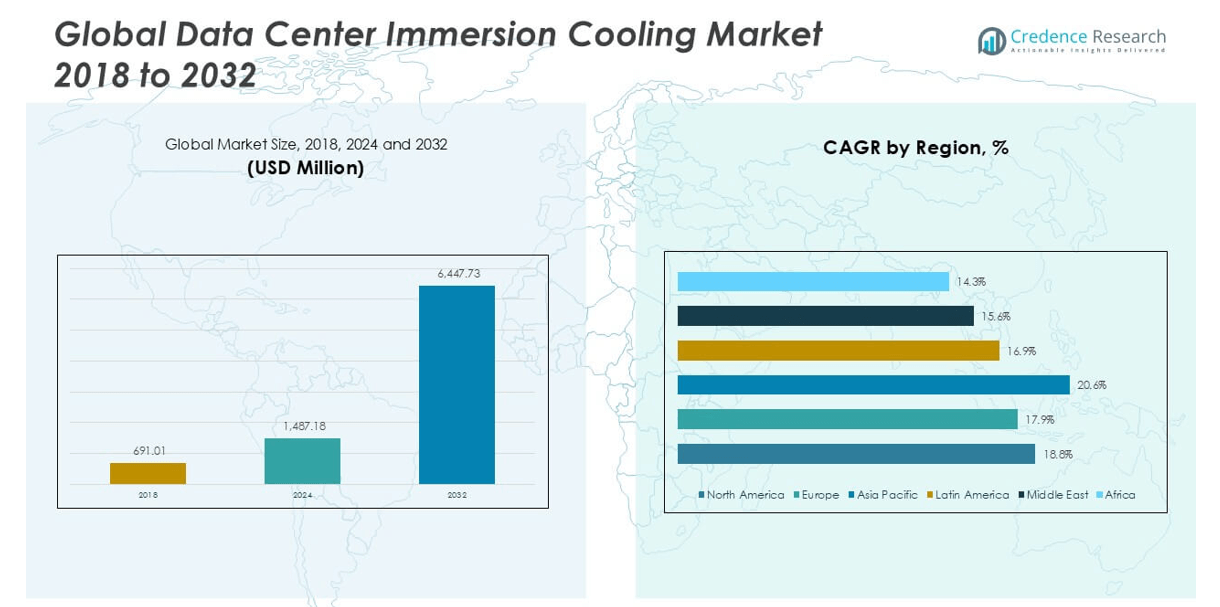
The Data Center Immersion Cooling market size was valued at USD 691.01 million in 2018, increased to USD 1,487.18 million in 2024, and is anticipated to reach USD 6,447.73 million by 2032, at a CAGR of 18.77% during the forecast period.| REPORT ATTRIBUTE | DETAILS |
|---|---|
| Historical Period | 2020-2023 |
| Base Year | 2024 |
| Forecast Period | 2025-2032 |
| Data Center Immersion Cooling Market Size 2024 | USD 1,487.18 million |
| Data Center Immersion Cooling Market, CAGR | 18.77% |
| Data Center Immersion Cooling Market Size 2032 | USD 6,447.73 million |
Market Insights
- The Data Center Immersion Cooling market was valued at USD 1,487.18 million in 2024 and is projected to reach USD 6,447.73 million by 2032, growing at a CAGR of 18.77% during the forecast period.
- Growth is driven by rising demand for high-performance computing, increasing power density in data centers, and the need for energy-efficient cooling solutions, particularly in hyperscale and enterprise-level facilities.
- Market trends include the rapid adoption of single-phase cooling systems, dominating with over 60% share, and growing preference for mineral oil-based fluids due to affordability and performance reliability.
- Competitive players such as Asperitas, Submer, Vertiv, and Fujitsu are advancing through product innovation and strategic partnerships, while new entrants like DCX Liquid Cooling and Midas target niche segments like cryptocurrency mining.
- North America leads with 43.4% market share in 2024, followed by Europe at 27.6% and Asia Pacific at 21.0%, the latter also being the fastest-growing region due to rapid digital expansion.
Market Segmentation Analysis:
By Component In the Data Center Immersion Cooling market, the solution segment holds the dominant market share, accounting for over 65% of the total revenue in 2024. This dominance is driven by the increasing deployment of comprehensive cooling systems that include tanks, power distribution units, and integrated monitoring software. As data centers grow in size and density, operators prefer end-to-end immersion cooling solutions that offer high efficiency, reduced energy consumption, and simplified management. The service segment is also gaining momentum due to the rising demand for maintenance, installation, and system optimization support.- For instance, Submer Technologies has deployed over 1,500 SmartPodX units globally, offering modular immersion cooling systems that integrate real-time monitoring, leak prevention, and smart power distribution in one solution.
- For instance, Green Revolution Cooling has implemented over 200 deployments using single-phase cooling, each achieving an average PUE of 1.03 across enterprise-level data centers.
Market Overview
Rising Demand for High-Performance Computing (HPC):
The increasing adoption of high-performance computing in applications such as AI, machine learning, and big data analytics is significantly driving the need for efficient cooling technologies. Immersion cooling enables superior thermal management of dense computing systems by directly submerging hardware in non-conductive liquids, reducing heat more effectively than traditional air cooling. As HPC workloads demand greater processing power and generate more heat, data center operators are turning to immersion cooling to ensure system reliability and energy efficiency.- For instance, Fujitsu’s HPC systems running PRIMEHPC FX700 have integrated immersion cooling in AI research labs, achieving thermal performance efficiency for systems running over 384 cores per node without traditional air circulation.
Energy Efficiency and Sustainability Goals:
Global focus on reducing carbon footprints and meeting sustainability targets has accelerated the demand for immersion cooling solutions. These systems drastically lower power consumption by eliminating the need for fans and complex air-conditioning infrastructure. The resulting reduction in power usage effectiveness (PUE) supports data centers in meeting environmental regulations and sustainability goals. With rising energy costs and stricter emissions standards, immersion cooling is emerging as a preferred technology to achieve operational efficiency and green certification.- For instance, Asperitas has helped clients reduce energy usage by 50,000 kWh annually per deployment by integrating its AIC24 immersion cooling solution, aligning data center operations with ISO 50001 energy efficiency targets.
Rapid Expansion of Hyperscale and Edge Data Centers:
The proliferation of hyperscale and edge data centers worldwide is fueling the adoption of advanced cooling solutions. Hyperscale facilities, which house thousands of servers, generate substantial heat and require scalable, efficient cooling systems. Immersion cooling provides the thermal reliability and space-saving benefits essential for these deployments. Similarly, edge data centers located in constrained environments benefit from immersion cooling’s silent, compact design. This trend is expected to continue as digital transformation drives demand for low-latency data processing across diverse geographies.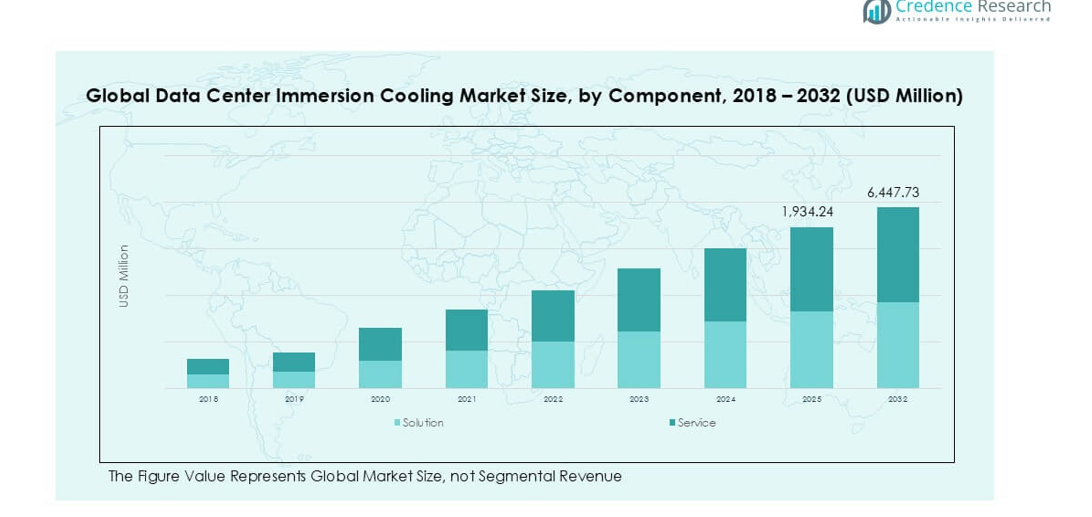
Key Trends & Opportunities
Emergence of Two-Phase Cooling for HPC Applications:
Two-phase immersion cooling is gaining traction in high-density computing environments due to its exceptional thermal efficiency. This technique involves fluids that evaporate and condense within a closed system, offering enhanced heat dissipation capabilities. While more complex and costly, it is increasingly viewed as a viable option for mission-critical applications like supercomputing and AI training. Ongoing advancements in fluid technology and system design are expected to make two-phase cooling more commercially viable, opening up new opportunities in performance-intensive sectors.- For instance, 3M has developed Novec engineered fluids specifically for two-phase immersion cooling, capable of handling thermal loads exceeding 300 watts per chip in AI training clusters used by major tech firms.
Growing Adoption Across Cryptocurrency Mining Facilities:
Cryptocurrency mining operations are rapidly adopting immersion cooling to manage the intense heat generated by ASICs and GPUs. With rising electricity costs and competitive mining margins, operators are turning to this technology for its ability to enhance hardware lifespan, improve energy efficiency, and reduce noise levels. The trend is especially prominent in regions where environmental regulations are pushing mining firms to reduce energy consumption. As digital currencies remain in demand, immersion cooling presents a key opportunity in this niche but expanding segment.- For instance, Bitfury has implemented immersion cooling in its mining farms across Georgia, achieving thermal stability that extended ASIC operational lifetime by over 35%, while also cutting acoustic output by more than 20 decibels.
Key Challenges
High Initial Capital Investment:
One of the major barriers to widespread adoption of immersion cooling is the high upfront cost of system installation. This includes custom tanks, fluid procurement, and retrofitting existing data center infrastructure. For small and medium enterprises with limited budgets, these costs can be prohibitive despite long-term energy savings. Convincing stakeholders to invest in new technologies without immediate ROI remains a key hurdle, slowing adoption across less capital-intensive sectors.Compatibility and Standardization Issues:
Immersion cooling systems often require customized designs to accommodate different server configurations and components. Lack of industry-wide standards poses integration challenges for data center operators. Concerns over material compatibility, fluid degradation, and maintenance practices further complicate deployment. Without standardized equipment and protocols, vendors and operators face increased engineering efforts and operational risk, which can discourage mass-scale implementation.Limited Awareness and Technical Expertise:
Despite its advantages, immersion cooling remains relatively unfamiliar to many data center operators and IT managers. Limited industry knowledge and lack of hands-on expertise can result in hesitance toward adoption. Furthermore, specialized training is needed to manage, monitor, and maintain these systems effectively. The slow diffusion of knowledge and skills across the sector remains a challenge, especially in emerging markets where conventional cooling is still dominant.Regional Analysis
North America: North America held the largest share in the Data Center Immersion Cooling market, accounting for approximately 43.4% of the global revenue in 2024, with a market value of USD 645.16 million, up from USD 302.90 million in 2018. The region is projected to reach USD 2,804.83 million by 2032, growing at a CAGR of 18.8%. This growth is fueled by the rising deployment of hyperscale data centers and early adoption of advanced cooling technologies in the U.S. and Canada. Strong investments in AI, cloud services, and sustainability initiatives continue to drive market expansion across the region. Europe: Europe represented around 27.6% of the global market in 2024, with revenues rising from USD 197.86 million in 2018 to USD 410.63 million in 2024. The market is expected to grow at a CAGR of 17.9%, reaching USD 1,677.14 million by 2032. The region’s growth is supported by strong regulatory pressures to reduce energy consumption in data centers and the push for green IT infrastructure. Countries like Germany, the UK, and the Netherlands are key contributors due to their robust data center ecosystems and investments in sustainable digital transformation. Asia Pacific: Asia Pacific is the fastest-growing region in the Data Center Immersion Cooling market, with a CAGR of 20.6%. The market grew from USD 134.21 million in 2018 to USD 312.85 million in 2024, and is projected to reach USD 1,534.59 million by 2032, capturing a 21.0% share in 2024. Rapid digitization, increased investments in hyperscale infrastructure, and expanding demand for high-performance computing in China, India, and Japan are key drivers. Additionally, rising electricity costs and space constraints are accelerating the adoption of more energy-efficient cooling methods across the region. Latin America: Latin America held a modest 4.6% share of the global Data Center Immersion Cooling market in 2024, with revenue rising from USD 31.95 million in 2018 to USD 67.88 million. The market is expected to reach USD 259.73 million by 2032, growing at a CAGR of 16.9%. Increasing digitalization in countries such as Brazil, Mexico, and Chile, along with rising adoption of cloud-based services, is supporting data center expansion. Though infrastructure challenges remain, the push for modernizing IT ecosystems and improving energy efficiency presents opportunities for immersion cooling adoption in the region. Middle East: In 2024, the Middle East accounted for 2.1% of the global Data Center Immersion Cooling market, with revenue rising from USD 15.98 million in 2018 to USD 30.81 million. The market is projected to grow at a CAGR of 15.6%, reaching USD 107.78 million by 2032. The region’s growth is primarily driven by increasing investments in digital infrastructure, particularly in the UAE and Saudi Arabia. As governments pursue smart city initiatives and cloud service providers expand their footprint, demand for efficient and space-optimized cooling solutions is expected to grow steadily. Africa: Africa represented the smallest share of the market in 2024, accounting for approximately 1.3%, with revenue increasing from USD 8.11 million in 2018 to USD 19.86 million. The market is forecasted to reach USD 63.66 million by 2032, expanding at a CAGR of 14.3%. Growth in the region is largely fueled by digital infrastructure development in countries like South Africa, Nigeria, and Kenya. Although adoption is at a nascent stage due to limited awareness and high capital costs, the rising demand for local data processing and cloud services is gradually opening opportunities for immersion cooling deployment.Market Segmentations:
By Component- Solution
- Service
- Single-phase cooling
- Two-phase cooling
- Mineral oil
- Synthetic fluid
- Fluorocarbons-based fluid
- SME
- Large enterprises
- Hyperscale
- Supercomputing
- Enterprise HPC
- Cryptocurrency
- Others
- North America
- U.S.
- Canada
- Mexico
- Europe
- Germany
- France
- U.K.
- Italy
- Spain
- Rest of Europe
- Asia Pacific
- China
- Japan
- India
- South Korea
- South-east Asia
- Rest of Asia Pacific
- Latin America
- Brazil
- Argentina
- Rest of Latin America
- Middle East & Africa
- GCC Countries
- South Africa
- Rest of the Middle East and Africa
Competitive Landscape
The competitive landscape of the Data Center Immersion Cooling market is characterized by a mix of established technology firms and specialized cooling solution providers striving to gain market share through innovation and strategic partnerships. Key players such as Asperitas, Submer, and Green Revolution Cooling lead the market with proprietary immersion cooling technologies designed to meet the growing demand for energy efficiency and thermal management in high-density data centers. Companies like Fujitsu and Vertiv leverage their global presence and infrastructure expertise to deliver scalable and integrated cooling systems. Emerging players such as DCX Liquid Cooling and Midas Immersion Cooling are gaining traction through cost-effective solutions tailored for cryptocurrency mining and small-scale deployments. Strategic initiatives such as product development, mergers, and R&D investments are central to competitive positioning. As demand intensifies across hyperscale, enterprise, and edge environments, market participants are focused on enhancing fluid efficiency, system compatibility, and deployment flexibility to cater to a broad customer base.Key Player Analysis
- Asperitas
- Bitfury Group
- DCX Liquid Cooling Company
- Fujitsu
- Green Revolution Cooling
- Inspur
- LiquidCool Solutions
- Midas Immersion Cooling
- Submer
- Vertiv
Recent Developments
- In October 2024, Submer received a total of USD 55.5 million to expand immersion cooling technologies that power AI manufacturing and AI data centers. This investment will enable the company to grow and come up with more green cooling technology.
- In October 2024, Zero Two and Submer announced a collaboration, which would fast-track the expansion of AI development in the UAE by use of immersion cooling processes. This partnership improves the effectiveness and viability of Middle East data centers.
- In September 2024, LiquidStack raised a further USD 20 million, a total amount of USD 35 million of Serious B funding through Tiger Global. The money will be utilized to increase production capacity and to offer more product lines in immersion cooling AI data centers worldwide.
- In September 2024, Stellium Datacenters joined forces with Submer and ExxonMobil on an Open Compute Project. The partnership combines the immersion cooling practices at Submer and ExxonMobil DC 3235 Super cooling fluid in a bid to improve the efficiency.
- In August 2024, Baltimore Aircoil Company (BAC) announced a global exclusive licensing agreement with DUG Technology of immersion-cooling technology. The collaboration supports the changing cooling requirements that are prompted by augmented heat loads of AI and machine learning deployments.
Market Concentration & Characteristics
The Data Center Immersion Cooling Market exhibits a moderately concentrated structure, with a mix of global technology leaders and specialized providers competing for market share. Key players such as Asperitas, Submer, Green Revolution Cooling, and Vertiv lead with proprietary technologies and strong project portfolios. It is characterized by high entry barriers due to the capital-intensive nature of infrastructure development and the need for specialized engineering capabilities. The market favors companies with robust R&D, established partnerships with data center operators, and fluid technology expertise. Competitive differentiation centers on cooling efficiency, system compatibility, deployment flexibility, and sustainability performance. Firms offering scalable, modular systems and low-maintenance designs hold a competitive advantage. Demand concentrates in regions with high-density data centers, particularly North America and Asia Pacific, where hyperscale development and digital transformation initiatives drive growth. It responds to energy efficiency mandates and the operational challenges of high-performance computing. Buyers prioritize long-term cost savings, thermal reliability, and environmental compliance when selecting vendors.Report Coverage
The research report offers an in-depth analysis based on Component, Cooling Technique, Cooling Fluid, Organization Size, Application and Geography. It details leading market players, providing an overview of their business, product offerings, investments, revenue streams, and key applications. Additionally, the report includes insights into the competitive environment, SWOT analysis, current market trends, as well as the primary drivers and constraints. Furthermore, it discusses various factors that have driven market expansion in recent years. The report also explores market dynamics, regulatory scenarios, and technological advancements that are shaping the industry. It assesses the impact of external factors and global economic changes on market growth. Lastly, it provides strategic recommendations for new entrants and established companies to navigate the complexities of the market.Future Outlook
- The market will continue to expand rapidly driven by demand for efficient thermal management in high-density data centers.
- Single-phase immersion cooling will maintain its dominance due to lower complexity and operational stability.
- Two-phase cooling will gain momentum in high-performance computing and supercomputing environments.
- Hyperscale and edge data centers will remain key adopters of immersion cooling technologies.
- North America will retain the largest market share, while Asia Pacific will emerge as the fastest-growing region.
- Companies will focus on developing eco-friendly and high-performance cooling fluids to meet regulatory standards.
- Strategic collaborations between cooling technology providers and data center operators will intensify.
- Modular and scalable immersion cooling systems will gain popularity for ease of deployment and cost efficiency.
- Increased emphasis on sustainability and energy efficiency will drive greater adoption across regions.
- The market will see growing investments in R&D to enhance system compatibility and reduce fluid degradation.

Request a Free Sample
Fill in your details and we'll send you a free sample report.
- Sample data tables & charts
- Research methodology
Market Dynamics
High-Performance Computing (HPC) Adoption
The proliferation of AI, machine learning, and big data analytics is increasing the need for efficient cooling in high-density computing environments. Immersion cooling enables superior thermal management for these workloads, supporting system reliability and energy efficiency.
Energy Efficiency and Sustainability Mandates
Global initiatives to reduce carbon footprints and comply with stricter energy regulations are pushing data centers to adopt immersion cooling, which significantly lowers power consumption and improves power usage effectiveness (PUE).
Expansion of Hyperscale and Edge Data Centers
The rapid growth of hyperscale and edge data centers, which require scalable and space-efficient cooling solutions, is driving the adoption of immersion cooling technologies that offer high thermal reliability and compact design.
Advancements in Cooling Fluids and System Design
Ongoing innovation in fluid chemistry and modular system architectures is making immersion cooling more accessible and effective, enabling broader deployment across diverse data center environments.
Cryptocurrency Mining Demand
The intense heat generated by ASICs and GPUs in cryptocurrency mining operations is accelerating the shift to immersion cooling, which extends hardware lifespan, improves energy efficiency, and reduces operational noise.
Need a Custom Version of This Report?
Tailor the scope, geography, or segments to your exact requirements.
- Custom geography or segment scope
- Direct access to our analyst team
Frequently Asked Questions
What is the current market size for Data Center Immersion Cooling, and what is its projected size in 2032?
What are the primary factors fueling the growth of the Data Center Immersion Cooling market?
Who are the leading companies in the Data Center Immersion Cooling market?
Which region commanded the largest share of the Data Center Immersion Cooling market in 2024?
Table of Content
Chapter 1 Market Segmentation
- 1.1 Segmentation Framework
- 1.1.1 Product and Service Classification
- 1.1.2 Application and End-Use Classification
- 1.1.3 Technology and Solution Classification
- 1.1.4 Customer and Distribution Channel Classification
- 1.1.5 Geographic Segmentation
- 1.1.6 Market Segment Definitions and Boundaries
- 1.2 By Component
- 1.2.1 Solution
- 1.2.2 Service
- 1.3 By Application
- 1.3.1 Hyperscale
- 1.3.2 Supercomputing
- 1.3.3 Enterprise HPC
- 1.3.4 Cryptocurrency
- 1.3.5 Others
- 1.4 By Cooling Fluid
- 1.4.1 Mineral oil
- 1.4.2 Synthetic fluid
- 1.4.3 Fluorocarbons-based fluid
- 1.5 By Cooling Technique
- 1.5.1 Single-phase cooling
- 1.5.2 Two-phase cooling
Chapter 2 Introduction
- 2.1 Report Objectives and Scope
- 2.2 Product Definition and Industry Terminology
- 2.3 Market Inclusions and Exclusions
- 2.4 Research Process
- 2.4.1 Primary Research and Expert Interviews
- 2.4.2 Secondary Research and Source Review
- 2.4.3 Top-Down and Bottom-Up Estimation
- 2.4.4 Data Triangulation and Verification
- 2.5 Market Size Measurement Basis
- 2.5.1 2024: USD 1,487.18 million → 2032: USD 6,447.73 million
- 2.6 Historical and Forecast Reference Periods
- 2.6.1 Base Year: 2024
- 2.6.2 Forecast Period: 2024-2032
- 2.7 Research Assumptions and Limitations
Chapter 3 Executive Summary
- 3.1 Market Snapshot and Key Findings
- 3.2 Base-Year Market Size, 2024
- 3.3 Forecast Market Size, 2032
- 3.4 Revenue and Volume Growth Outlook
- 3.5 Key Demand and Supply Indicators
- 3.6 Leading Market Segments
- 3.7 Fastest-Growing Market Opportunities
- 3.8 Regional Performance Highlights
- 3.9 Technology and Industry Transformation
- 3.10 Competitive Landscape Summary
- 3.11 Analyst View and Strategic Implications
Chapter 4 Global Data Center Immersion Cooling Market Trends and Developments
- 4.1 Historical Industry Development
- 4.2 Recent Market Trends and Developments
- 4.3 Demand and Customer Behavior Trends
- 4.4 Technology and Product Innovation
- 4.5 Artificial Intelligence, Automation and Digitalization
- 4.6 Local Manufacturing and Supply Chain Realignment
- 4.7 Industry Partnerships, Mergers and Acquisitions
- 4.8 Sustainability and Circular Economy Developments
- 4.9 Government and Private Sector Investment Trends
- 4.10 Emerging Business Models and Commercialization
- 4.11 Industry Developments and Announcements
Chapter 5 Global Data Center Immersion Cooling Market Production, Supply and Demand Analysis
- 5.1 Demand Trend and Consumption Analysis
- 5.2 Demand Forecast, 2024-2032
- 5.3 Production and Output Trend
- 5.4 Production and Output Forecast, 2024-2032
- 5.5 Installed Capacity and Capacity Utilization
- 5.6 Company-Wise Production Plants and Statistics
- 5.6.1 Installed Production Capacity
- 5.6.2 Actual Production
- 5.6.3 Planned Capacity and Expansion Targets
- 5.7 Supply Chain Structure and Procurement Trends
- 5.8 Supply-Demand Gap and Bottlenecks
- 5.9 Import Dependence and Sourcing Structure
- 5.10 Contract Manufacturing and Outsourcing
- 5.11 Regional Supply and Demand Concentration
Chapter 6 Global Data Center Immersion Cooling Market Pricing Analysis
- 6.1 Pricing Structure and Measurement
- 6.2 Historical Pricing Trends
- 6.3 Pricing Outlook, 2024-2032
- 6.4 Average Selling Price and Unit Economics
- 6.5 Pricing by Product and Market Segment
- 6.6 Geographic Pricing Differences
- 6.7 Key Input, Energy, Labor and Logistics Costs
- 6.8 Contract Pricing and Purchasing Models
- 6.9 Pricing Sensitivity and Competitive Positioning
- 6.10 Price, Margin and Profitability Implications
Chapter 7 Global Data Center Immersion Cooling Market Dynamics
- 7.1 Market Growth Drivers
- 7.1.1 Demand-Side Drivers
- 7.1.2 Technology and Innovation Drivers
- 7.1.3 Infrastructure and Investment Drivers
- 7.1.4 Regulatory and Policy Drivers
- 7.2 Market Restraints
- 7.2.1 Cost and Affordability Constraints
- 7.2.2 Technology and Adoption Barriers
- 7.2.3 Supply Chain and Operational Constraints
- 7.3 Market Challenges
- 7.3.1 Competitive Pressure and Margin Erosion
- 7.3.2 Skills, Infrastructure and Implementation Gaps
- 7.4 Emerging Market Opportunities
- 7.5 Market Dynamics Impact and Time-Horizon Assessment
Chapter 8 Global Data Center Immersion Cooling Value Chain Analysis
- 8.1 Industry Value Chain Overview
- 8.2 Upstream Suppliers and Critical Inputs
- 8.3 Technology and Component Providers
- 8.4 Manufacturing or Service Delivery
- 8.5 Distribution, Channel Partners and Integrators
- 8.6 Downstream Applications and End Users
- 8.7 Value Addition and Profit Pools
- 8.8 Vertical Integration and Outsourcing
- 8.9 Supplier Concentration and Risk
- 8.10 Supply Chain Localization and Resilience
Chapter 9 Global Data Center Immersion Cooling Market Regulations and Policies
- 9.1 Relevant Laws, Standards and Compliance Frameworks
- 9.2 Product, Service, Safety and Quality Requirements
- 9.3 Government Policies, Incentives and Subsidies
- 9.4 Imports, Exports and Trade Barriers
- 9.5 Public Procurement and Local Content Requirements
- 9.6 Environmental and Sustainability Compliance
- 9.7 Data Protection, AI and Cybersecurity Compliance
- 9.8 Upcoming Policy Changes and Market Implications
Chapter 10 Global Data Center Immersion Cooling Market Hotspots and Opportunities
- 10.1 Market Opportunity Mapping and Growth Hotspots
- 10.2 High-Growth Applications and Customer Groups
- 10.3 Underserved Markets and White-Space Opportunities
- 10.4 Emerging Technology and Product Opportunities
- 10.5 New Capacity and Investment Hotspots
- 10.6 Market Entry and Expansion Opportunities
- 10.7 Distribution and Partnership Opportunities
- 10.8 Near-Term and Long-Term Commercial Potential
- 10.9 Opportunity Attractiveness and Execution Risks
Chapter 11 Global Data Center Immersion Cooling Market Outlook, 2024-2032
- 11.1 Market Size and Analysis
- 11.1.1 Revenue (Market Measurement: 2024: USD 1,487.18 million → 2032: USD 6,447.73 million)
- 11.1.2 Market Volume and Quantity Sold
- 11.1.3 Historical Market Size
- 11.1.4 Base-Year Market Size, 2024
- 11.2 Market Forecast, 2024-2032
- 11.2.1 Revenue Forecast to 2032
- 11.2.2 Volume Forecast to 2032
- 11.2.3 CAGR and Year-on-Year Growth
- 11.2.4 Incremental Revenue Opportunity
- 11.3 Forecast Assumptions and Scenario Analysis
- 11.3.1 Base-Case Forecast
- 11.3.2 Optimistic and Conservative Scenarios
- 11.3.3 Technology, Pricing and Policy Sensitivities
- 11.4 Market Attractiveness and Growth Outlook
Chapter 12 Global Data Center Immersion Cooling Market Segmentation and Outlook
- 12.1 Segmentation Summary and Market Shares, 2024
- 12.2 Largest and Fastest-Growing Segments
- 12.3 By Component - Market Size and Forecast, 2024-2032
- 12.3.1 Segment Definition and Scope
- 12.3.2 Historical Market Size
- 12.3.3 Revenue Forecast, 2024-2032
- 12.3.4 Volume Forecast, 2024-2032
- 12.3.5 Base-Year Market Share, 2024
- 12.3.6 Segment CAGR and Growth Drivers
- 12.3.7 Subsegment Market Size and Forecast
- 12.3.7.1 Solution
- 12.3.7.2 Service
- 12.3.8 Subsegment Pricing and Adoption Trends
- 12.3.9 Leading Suppliers and Competition
- 12.3.10 Regional Demand and Opportunities
- 12.4 By Application - Market Size and Forecast, 2024-2032
- 12.4.1 Segment Definition and Scope
- 12.4.2 Historical Market Size
- 12.4.3 Revenue Forecast, 2024-2032
- 12.4.4 Volume Forecast, 2024-2032
- 12.4.5 Base-Year Market Share, 2024
- 12.4.6 Segment CAGR and Growth Drivers
- 12.4.7 Subsegment Market Size and Forecast
- 12.4.7.1 Hyperscale
- 12.4.7.2 Supercomputing
- 12.4.7.3 Enterprise HPC
- 12.4.7.4 Cryptocurrency
- 12.4.7.5 Others
- 12.4.8 Subsegment Pricing and Adoption Trends
- 12.4.9 Leading Suppliers and Competition
- 12.4.10 Regional Demand and Opportunities
- 12.5 By Cooling Fluid - Market Size and Forecast, 2024-2032
- 12.5.1 Segment Definition and Scope
- 12.5.2 Historical Market Size
- 12.5.3 Revenue Forecast, 2024-2032
- 12.5.4 Volume Forecast, 2024-2032
- 12.5.5 Base-Year Market Share, 2024
- 12.5.6 Segment CAGR and Growth Drivers
- 12.5.7 Subsegment Market Size and Forecast
- 12.5.7.1 Mineral oil
- 12.5.7.2 Synthetic fluid
- 12.5.7.3 Fluorocarbons-based fluid
- 12.5.8 Subsegment Pricing and Adoption Trends
- 12.5.9 Leading Suppliers and Competition
- 12.5.10 Regional Demand and Opportunities
- 12.6 By Cooling Technique - Market Size and Forecast, 2024-2032
- 12.6.1 Segment Definition and Scope
- 12.6.2 Historical Market Size
- 12.6.3 Revenue Forecast, 2024-2032
- 12.6.4 Volume Forecast, 2024-2032
- 12.6.5 Base-Year Market Share, 2024
- 12.6.6 Segment CAGR and Growth Drivers
- 12.6.7 Subsegment Market Size and Forecast
- 12.6.7.1 Single-phase cooling
- 12.6.7.2 Two-phase cooling
- 12.6.8 Subsegment Pricing and Adoption Trends
- 12.6.9 Leading Suppliers and Competition
- 12.6.10 Regional Demand and Opportunities
- 12.7 Segment Growth Comparison
- 12.8 Segment Attractiveness and Priority Matrix
Chapter 13 Global Data Center Immersion Cooling End-Use and Application Market Outlook
- 13.1 End-Use Industry and Customer Demand Structure
- 13.2 Leading Applications and Customer Groups
- 13.3 End-Use Market Size, Share and Forecast
- 13.4 Major End-Use Industry Deep Dives
- 13.4.1 Customer Requirements and Use Cases
- 13.4.2 Demand and Replacement Cycles
- 13.4.3 Technical and Regulatory Considerations
- 13.4.4 Purchasing and Procurement Models
- 13.4.5 Leading Vendors and Distribution Channels
- 13.4.6 Forecast and Commercial Opportunities
- 13.5 Emerging Applications and Cross-Segment Demand
- 13.6 End-Use Industry Investment Priorities
Chapter 14 Global Data Center Immersion Cooling Geographic Market Outlook, 2024-2032
- 14.1 Regional Market Size and Share, 2024
- 14.2 Regional Market Forecast, 2024-2032
- 14.3 Regional Pricing, Production and Demand Differences
- 14.4 North America
- 14.4.1 United States
- 14.4.2 Canada
- 14.4.3 Mexico
- 14.5 Europe
- 14.5.1 Germany
- 14.5.2 France
- 14.5.3 Italy
- 14.5.4 United Kingdom
- 14.5.5 Spain
- 14.5.6 Poland
- 14.5.7 Russia
- 14.5.8 Netherlands
- 14.5.9 Belgium
- 14.5.10 Sweden
- 14.5.11 Denmark
- 14.5.12 Norway
- 14.5.13 Rest of Europe
- 14.6 Asia Pacific
- 14.6.1 China
- 14.6.2 India
- 14.6.3 Japan
- 14.6.4 South Korea
- 14.6.5 Thailand
- 14.6.6 Indonesia
- 14.6.7 Vietnam
- 14.6.8 Malaysia
- 14.6.9 Australia
- 14.6.10 Rest of Asia Pacific
- 14.7 Latin America
- 14.7.1 Brazil
- 14.7.2 Argentina
- 14.7.3 Colombia
- 14.7.4 Chile
- 14.7.5 Rest of Latin America
- 14.8 Middle East
- 14.8.1 Saudi Arabia
- 14.8.2 United Arab Emirates
- 14.8.3 Turkey
- 14.8.4 Israel
- 14.8.5 Iran
- 14.8.6 Rest of the Middle East
- 14.9 Africa
- 14.9.1 South Africa
- 14.9.2 Egypt
- 14.9.3 Nigeria
- 14.9.4 Morocco
- 14.9.5 Rest of Africa
- 14.10 Regional Investment, Policy and Supply Chain Differences
- 14.11 Regional Competitive Landscape
- 14.12 Geographic Growth Hotspots
Chapter 15 Global Data Center Immersion Cooling Technology, Innovation and Sustainability Outlook
- 15.1 Technology Landscape and Maturity
- 15.2 Product, Process and Service Innovation
- 15.3 AI, Automation and Digital Tools in the Industry
- 15.4 Technology Adoption and Performance Benchmarking
- 15.5 Innovation Pipeline and R&D Investment
- 15.6 Patent and Intellectual Property Trends
- 15.7 Energy Efficiency and Resource Management
- 15.8 Sustainability, Recycling and Circularity
- 15.9 Technology Roadmap, 2024-2032
- 15.10 Risks of Obsolescence and Technology Substitution
Chapter 16 Global Data Center Immersion Cooling Market Key Strategic Imperatives
- 16.1 Growth and Market Entry Priorities
- 16.2 High-Return Products and Segments
- 16.3 Pricing, Profitability and Cost Optimization
- 16.4 Technology Investment and Product Differentiation
- 16.5 Supply Chain Localization and Resilience
- 16.6 Distribution and Customer Acquisition
- 16.7 Partnership, Acquisition and Capacity Strategy
- 16.8 Regional Expansion Priorities
- 16.9 Short-, Medium- and Long-Term Actions
Chapter 17 Competition Outlook
- 17.1 Industry Competition Characteristics
- 17.2 Market Structure and Concentration
- 17.3 Market Share and Competitive Positioning, 2024
- 17.4 Company-Wise Revenue and Product Benchmarking
- 17.5 Production and Service Capacity Benchmarking
- 17.6 Technology, Pricing and Differentiation
- 17.7 Regional Footprint and Distribution Strength
- 17.8 Mergers, Acquisitions and Strategic Alliances
- 17.9 New Entrants and Competitive Threats
- 17.10 Porter's Five Forces and Industry Attractiveness
- 17.11 Competitive Outlook, 2024-2032
Chapter 18 Company Profiles
- 18.1 Company Coverage and Selection Criteria
- 18.2 Asperitas
- 18.2.1 Business Description
- 18.2.2 Company Ownership and Geographic Presence
- 18.2.3 Product and Service Portfolio
- 18.2.4 Manufacturing and Operating Footprint
- 18.2.5 Production Capacity and Expansion Plans
- 18.2.6 Financial Performance and Investment
- 18.2.7 Market Share and Competitive Position
- 18.2.8 Technology and Innovation Capabilities
- 18.2.9 Strategic Alliances or Partnerships
- 18.2.10 Recent Developments
- 18.2.11 Growth Strategy and Outlook
- 18.3 Bitfury Group
- 18.4 DCX Liquid Cooling Company
- 18.5 Fujitsu
- 18.6 Green Revolution Cooling
- 18.7 Inspur
- 18.8 LiquidCool Solutions
- 18.9 Midas Immersion Cooling
- 18.10 Submer
- 18.11 Vertiv
- 18.12 Other Relevant Market Participants
Note: Every listed company is profiled on the structure shown under the first company. The company list is preliminary and may change based on research findings, market developments, data availability and client requirements.
Chapter 19 Disclaimer
- 19.1 Research and Forecast Disclaimer
- 19.2 Data Source and Estimation Limitations
Note: The depth of individual sections depends on data availability for this market. Volume, capacity, trade and other unit-based metrics are included where applicable.

