
Cell and Gene Therapy Contract Development And Manufacturing Organization Market
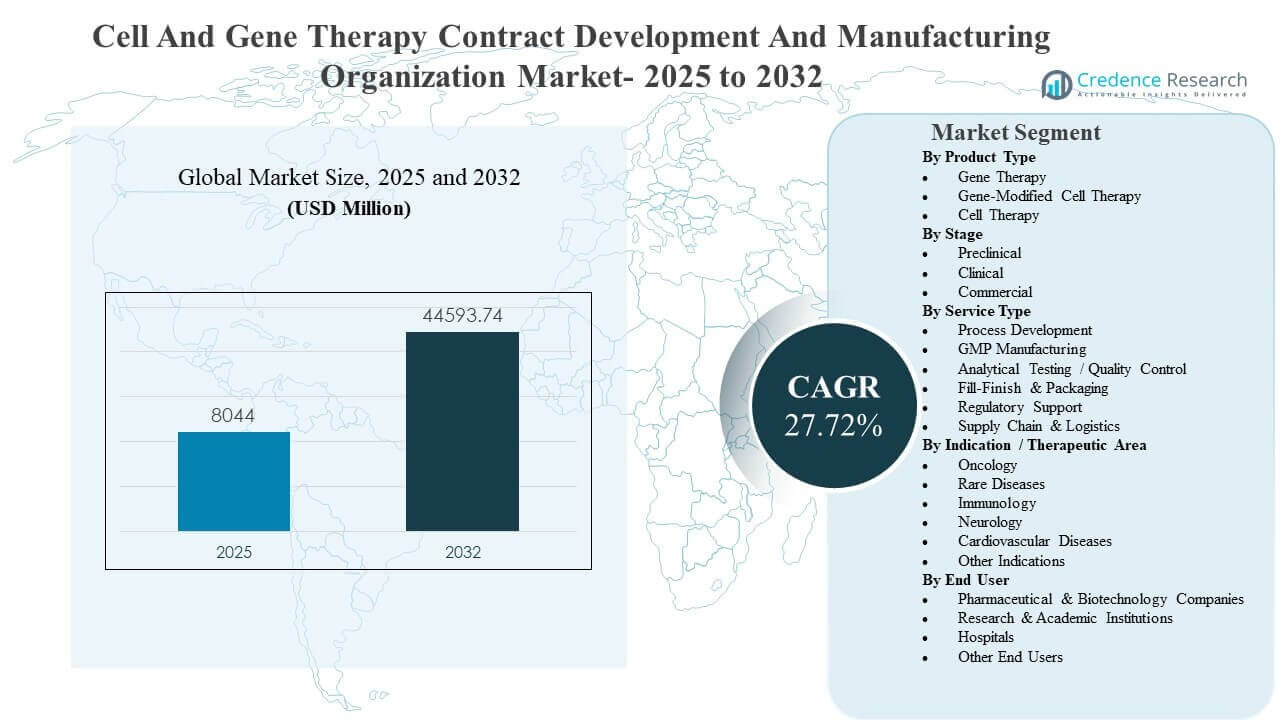
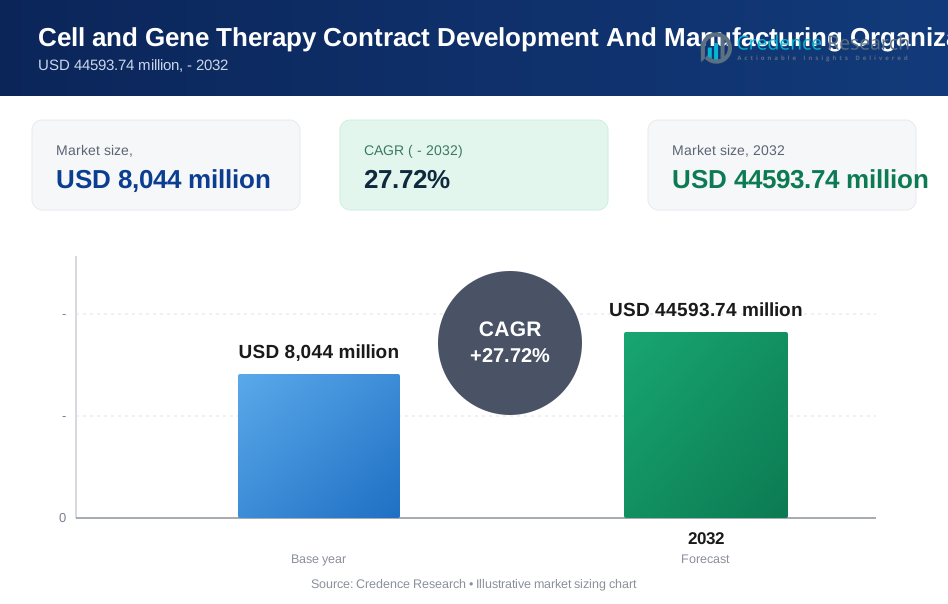
The global Cell And Gene Therapy Contract Development And Manufacturing Organization Market size was estimated at USD 8044 million in 2025 and is expected to reach USD 44593.74 million by 2032, growing at a CAGR of 27.72% from 2025 to 2032. Growth is primarily driven by expanding clinical and commercial pipelines for cell therapies and gene therapies that require specialized GMP infrastructure, validated analytics, and inspection-ready quality systems that many sponsors prefer to access through outsourcing. North America remains the largest regional revenue pool in 2025, supported by high therapy developer density and faster translation of late-stage programs into scalable manufacturing demand.
| REPORT ATTRIBUTE | DETAILS |
|---|---|
| Historical Period | 2020-2024 |
| Base Year | 2025 |
| Forecast Period | 2026-2032 |
| Cell And Gene Therapy Contract Development And Manufacturing Organization Market Size 2025 | USD 8044 million |
| Cell And Gene Therapy Contract Development And Manufacturing Organization Market, CAGR | 27.72% |
| Cell And Gene Therapy Contract Development And Manufacturing Organization Market Size 2032 | USD 44593.74 million |
Key Market Trends & Insights
- The market expands from USD 8044 million in 2025 to USD 44593.74 million by 2032, reflecting a 27.72% CAGR during 2025–2032.
- Cell Therapy accounted for the largest share of 66.8% in 2025, supported by sustained outsourcing demand for complex living-cell workflows.
- Preclinical accounted for the largest share of 67.1% in 2025, reflecting the heavy volume of early-stage programs requiring development and small-lot GMP execution.
- GMP Manufacturing represented 31.6% of the 2025 service mix, underlining buyer preference for qualified suites, documentation control, and batch-release readiness.
- North America contributed 39.6% of 2025 revenue, with Asia Pacific at 31.7% reflecting accelerating capacity build-out and sponsor activity.
Segment Analysis
The Cell And Gene Therapy Contract Development And Manufacturing Organization Market shows strong outsourcing intensity because advanced therapy manufacturing requires specialized facilities, closed-system processing, and tightly controlled QC release timelines. Buyers prioritize vendors that can reduce technology transfer friction across process development, GMP execution, analytics, and fill-finish handoffs. Vendor differentiation is increasingly tied to inspection track record, deviation management, and the ability to provide stable supply in multi-year capacity reservations. Long-term contracting is becoming more common as late-stage programs progress and sponsors aim to reduce supply disruption risk.
Service bundling is a major purchasing driver across the Cell And Gene Therapy Contract Development And Manufacturing Organization Market because integrated execution improves cycle time, documentation continuity, and change-control governance. Analytical testing and quality control are receiving higher attention due to evolving potency assays, product heterogeneity, and the need for comparability across clinical phases. Cold-chain logistics and packaging are also becoming more integrated into CDMO scopes as sponsors seek tighter chain-of-custody controls. Automation and digital batch records are increasingly used to support reproducibility and to strengthen audit readiness.
By Product Type Insights
Cell Therapy accounted for the largest share of 66.8% in 2025. Leadership is supported by the scale of oncology cell therapy pipelines and increasing reliance on external partners for consistent manufacturing outcomes. Sponsors in the Cell And Gene Therapy Contract Development And Manufacturing Organization Market prioritize CDMOs that can provide standardized unit operations, trained personnel, and robust release testing for patient- or donor-derived materials. CDMO platforms that offer end-to-end workflows across cell processing, analytics, and controlled storage strengthen adoption and repeat contracting.
By Stage Insights
Preclinical accounted for the largest share of 67.1% in 2025. The Cell And Gene Therapy Contract Development And Manufacturing Organization Market is heavily influenced by IND-enabling work where sponsors need fast iteration cycles, platform development, and early GMP readiness. Outsourcing demand is sustained by the need for scalable process concepts, method development, and documentation foundations that can carry forward into clinical phases. CDMOs with flexible scheduling and small-batch execution capabilities capture a larger share of early-stage programs.
By Service Type Insights
GMP Manufacturing accounted for the largest share of 31.6% in 2025. The Cell And Gene Therapy Contract Development And Manufacturing Organization Market places high value on qualified suites, validated equipment, and controlled environments that reduce contamination and batch failure risk. Buyers also prioritize CDMOs that can align GMP execution with analytical release, stability planning, and deviation-response systems. Integrated GMP operations linked with fill-finish and packaging reduce operational handoffs and improve lot disposition timelines.
By Indication / Therapeutic Area Insights
Oncology accounted for the largest share of 47.3% in 2025. Demand concentration reflects the volume of engineered immune-cell and gene-modified programs, which require complex manufacturing steps and stringent QC frameworks. The Cell And Gene Therapy Contract Development And Manufacturing Organization Market benefits from oncology-driven sponsor urgency that favors CDMOs with proven experience in controlled supply chains and time-sensitive release testing. CDMOs that support rapid scale-up and comparability strategies are better positioned as oncology programs move toward late-stage evaluation.
By End User Insights
Pharmaceutical & Biotechnology Companies represent the strongest demand base in the Cell And Gene Therapy Contract Development And Manufacturing Organization Market due to higher clinical program volume, complex regulatory expectations, and the need for dependable supply execution. Research & Academic Institutions support early translational activity that often transitions into sponsored development once proof-of-concept milestones are achieved. Hospitals contribute to localized manufacturing and clinical delivery models, especially in settings where therapy logistics and chain-of-custody require close clinical coordination. CDMO selection across end users is shaped by quality systems maturity, technical breadth, and readiness for inspections and audits.
Cell And Gene Therapy Contract Development And Manufacturing Organization Market Drivers
Expanding Advanced Therapy Pipeline And Commercialization Readiness
The Cell And Gene Therapy Contract Development And Manufacturing Organization Market is driven by a growing pipeline of cell therapies and gene therapies progressing through clinical evaluation and into commercial planning. Many sponsors require specialized GMP infrastructure and compliant quality systems to support consistent batch execution and release. Outsourcing accelerates timelines by providing trained personnel, validated suites, and established documentation practices. Demand increases as late-stage programs require more frequent manufacturing runs, stricter lot-to-lot consistency, and stronger supply assurance.
Complexity Of Manufacturing And Quality Control Requirements
The Cell And Gene Therapy Contract Development And Manufacturing Organization Market benefits from high technical complexity across upstream processing, vector handling, aseptic operations, and product characterization. Potency and release assays often require customized development and rigorous validation, raising the value of experienced analytical teams. Quality systems, deviation management, and change-control discipline are critical to reduce batch failure risk and to improve inspection readiness. Sponsors increasingly choose CDMOs that can integrate process development with analytics and GMP execution to reduce risk.
Capacity Constraints And Need For Flexible Scale-Up
The Cell And Gene Therapy Contract Development And Manufacturing Organization Market is supported by ongoing capacity planning needs across clinical and commercial scale. Therapy developers often face internal constraints in facility availability, equipment qualification, and scheduling flexibility. CDMOs provide configurable capacity, multi-suite setups, and adaptable project timelines that can support both early-stage and late-stage manufacturing needs. Scale-up requirements also increase demand for standardized platforms, automation, and process optimization to improve throughput and reproducibility.
- For instance, FUJIFILM Diosynth Biotechnologies expanded its California cell therapy facility by adding two new independent cGMP production suites equipped with automated cell separation, selection, and expansion systems, increasing cleanroom flexibility for both multiple-patient autologous lots and larger-volume allogeneic batches.
Integrated Service Bundling To Reduce Handoffs
The Cell And Gene Therapy Contract Development And Manufacturing Organization Market is increasingly shaped by sponsor preference for integrated service models spanning process development, GMP manufacturing, analytical testing, fill-finish, and regulatory support. Consolidating vendors reduces technology transfer friction and improves continuity of documentation and quality oversight. Integrated execution also improves responsiveness when changes are needed due to comparability, raw material shifts, or regulatory feedback. CDMOs that provide coordinated program management and end-to-end workflows strengthen long-term contracting outcomes.
- For instance, Lonza states that its viral therapy services cover cell and virus banking, bulk drug-substance production, and final drug-product fill-finish, with fill-finish batch sizes ranging from 100 to approximately 8,000 vials per lot and clinical supply distribution experience of over 10 years.
Cell And Gene Therapy Contract Development And Manufacturing Organization Market Challenges
The Cell And Gene Therapy Contract Development And Manufacturing Organization Market faces pressure from variability in starting materials, complex batch records, and high sensitivity to contamination and process deviations. Many therapies require patient-specific or donor-dependent manufacturing steps, making reproducibility and scheduling harder to maintain across programs. Analytical release timelines can be challenging due to assay complexity and limited reference standards. Quality events can cause costly delays, increasing scrutiny on vendor quality maturity and operational discipline.
The Cell And Gene Therapy Contract Development And Manufacturing Organization Market also encounters constraints linked to specialized workforce availability, long equipment lead times, and evolving regulatory expectations around potency, comparability, and validation. Supply chain risks in critical raw materials, single-use components, and cold-chain logistics can disrupt program schedules. Capacity reservations and long-term contracts can limit flexibility for smaller sponsors that require rapid pivots. Vendor selection becomes more complex as sponsors balance cost, capacity certainty, and inspection readiness.
- For instance, Thermo Fisher Scientific said its Plainville, Massachusetts viral vector site would more than double the company’s commercial viral vector capacity, span 290,000 square feet, and add more than 200 jobs, while also incorporating flexible laboratory and production suites, an onsite engineering laboratory, and digital connectivity to improve data visibility and operator training.
Cell And Gene Therapy Contract Development And Manufacturing Organization Market Trends and Opportunities
The Cell And Gene Therapy Contract Development And Manufacturing Organization Market is trending toward closed-system processing, automation, and digital quality infrastructure to improve reproducibility and reduce contamination exposure. Greater adoption of standardized unit operations supports faster tech transfer and more consistent outcomes across sites. Analytical capability expansion is also accelerating, particularly for potency testing, identity characterization, and rapid microbiology. CDMOs that combine automation with robust quality governance can improve throughput and strengthen audit outcomes.
- For instance, Lonza’s Cocoon Platform received FDA Advanced Manufacturing Technologies designation in 2025; the functionally closed, automated system uses a single-use cassette, has been deployed in more than 150 instruments globally, and is associated with roughly 5,000+ batches of annual installed-base capacity, with each unit processing one patient batch in up to 10 days.
The Cell And Gene Therapy Contract Development And Manufacturing Organization Market presents opportunities in integrated fill-finish and packaging offerings that reduce handoffs and strengthen chain-of-custody controls. Sponsors increasingly seek end-to-end partners that can support clinical-to-commercial transitions with validated documentation pathways. Regional expansion in Asia Pacific creates room for capacity localization and multi-site execution strategies. Regulatory support services are also gaining importance as sponsors need faster submission support and stronger inspection preparation.
Regional Insights
North America
North America accounted for 39.6% of 2025 revenue in the Cell And Gene Therapy Contract Development And Manufacturing Organization Market. Regional leadership is supported by a dense sponsor ecosystem, higher concentration of clinical programs, and stronger commercial translation of advanced therapies. CDMO demand in the region is reinforced by inspection readiness requirements and a preference for integrated service delivery spanning process development through GMP execution. Capacity contracting is more common as sponsors seek supply assurance for late-stage pipelines.
Europe
Europe accounted for 22.8% of 2025 revenue in the Cell And Gene Therapy Contract Development And Manufacturing Organization Market. The region is supported by established advanced therapy development activity, expanding GMP capabilities, and growing demand for specialized analytics and regulatory support. Vendor selection emphasizes quality track record, flexible capacity, and multi-country supply coordination. Cross-border distribution and compliance needs also increase reliance on CDMOs that can manage documentation continuity and cold-chain logistics.
Asia Pacific
Asia Pacific accounted for 31.7% of 2025 revenue in the Cell And Gene Therapy Contract Development And Manufacturing Organization Market. Growth is supported by expanding capacity investments, improving quality systems, and rising sponsor activity across major markets. Regional demand favors CDMOs that can provide scalable GMP suites and integrated analytical services to support faster development cycles. Localization strategies are increasing as sponsors seek supply resilience, lower lead times, and broader access to trained manufacturing talent.
Latin America
Latin America accounted for 3.9% of 2025 revenue in the Cell And Gene Therapy Contract Development And Manufacturing Organization Market. Regional activity remains comparatively smaller due to limited high-scale advanced therapy infrastructure and fewer late-stage programs. Demand is concentrated in selective hubs where clinical activity and healthcare infrastructure support advanced therapy adoption. CDMO opportunities are tied to niche manufacturing services, regional trial supply support, and improving cold-chain logistics capabilities.
Middle East & Africa
Middle East & Africa accounted for 2.0% of 2025 revenue in the Cell And Gene Therapy Contract Development And Manufacturing Organization Market. The region is at an earlier stage of ecosystem development, with emerging investments in specialty healthcare infrastructure and advanced manufacturing capabilities. Demand is shaped by pilot programs, partnerships, and selective capacity development in key hubs. CDMO growth depends on continued investment in quality systems, workforce development, and reliable cold-chain networks.
Competitive Landscape
Competition in the Cell And Gene Therapy Contract Development And Manufacturing Organization Market is shaped by capacity expansion, service integration, and differentiation through quality systems, analytics depth, and inspection readiness. Leading CDMOs compete on cycle time reduction through bundled offerings, platform standardization, and program management discipline. Buyers increasingly prioritize vendors that can support clinical-to-commercial transitions with consistent documentation and supply assurance. Strategic collaborations, network expansion, and capability investments in analytics and fill-finish are common competitive levers.
Lonza Group Ltd. is positioned as a leading participant in the Cell And Gene Therapy Contract Development And Manufacturing Organization Market through broad manufacturing infrastructure and integrated development-to-production capabilities. The company’s approach emphasizes scalable GMP execution, strong quality governance, and the ability to support multi-program portfolios. Focus on operational consistency and supply assurance supports long-term contracting with advanced therapy sponsors. Continued investment in infrastructure and technology supports competitiveness in late-stage and commercial manufacturing scopes.
The industry research and growth report includes detailed analyses of the competitive landscape of the market and information about key companies, including:
- Lonza Group Ltd.
- Catalent, Inc.
- Thermo Fisher Scientific Inc.
- Cytiva
- Samsung Biologics
- WuXi AppTec / WuXi Advanced Therapies
- Charles River Laboratories
- AGC Biologics
- Rentschler Biopharma SE
- OmniaBio
- Novartis AG
Qualitative and quantitative analysis of companies has been conducted to help clients understand the wider business environment as well as the strengths and weaknesses of key industry players. Data is qualitatively analyzed to categorize companies as pure play, category-focused, industry-focused, and diversified; it is quantitatively analyzed to categorize companies as dominant, leading, strong, tentative, and weak.
Recent Developments
- In February 2026, OXB announced a new multi-year Commercial Supply Agreement with Bristol Myers Squibb, expanding their strategic partnership for the manufacture and supply of lentiviral vectors for BMS’s CAR-T programs. Under the agreement, OXB is expected to begin commercial manufacturing in 2026, subject to regulatory approvals, from its facilities in Oxford, UK, and Durham, North Carolina.
- In December 2025, Minaris and Cell and Gene Therapy Catapult said they had entered a collaboration to develop delivery technologies intended to make cell and gene therapy manufacturing more robust, improve quality, and lower cost of goods. The partnership was presented as a move to support more efficient CGT manufacturing processes and strengthen innovation in the CDMO ecosystem.
- In December 2025, SCTbio and Fortrea announced a strategic collaboration aimed at streamlining development, accelerating timelines, and helping bring advanced therapies to patients faster. The companies said the partnership combines Fortrea’s clinical reach with SCTbio’s expertise in cell therapy, viral vectors, and apheresis to improve protocol design, supply chains, and execution efficiency.
- In a May 2025 announcement, CellFE and Made Scientific revealed a strategic collaboration to generate pilot data using the CellFE High Volume Cyva system and advance nonviral gene editing for T-cell therapies. The collaboration brings together CellFE’s microfluidics-based cell engineering platform and Made Scientific’s CDMO services to support clinical translation and scalable engineered T-cell manufacturing.
Report Scope
| Report Attribute | Details |
| Market size value in 2025 | USD 8044 million |
| Revenue forecast in 2032 | USD 44593.74 million |
| Growth rate (CAGR) | 27.72% (2025–2032) |
| Base year | 2025 |
| Forecast period | 2026-2032 |
| Quantitative units | USD million |
| Segments covered | By Product Type Outlook: Gene Therapy, Gene-Modified Cell Therapy, Cell Therapy; By Stage Outlook: Preclinical, Clinical, Commercial; By Service Type Outlook: Process Development, GMP Manufacturing, Analytical Testing / Quality Control, Fill-Finish & Packaging, Regulatory Support, Supply Chain & Logistics; By Indication / Therapeutic Area Outlook: Oncology, Rare Diseases, Immunology, Neurology, Cardiovascular Diseases, Other Indications; By End User Outlook: Pharmaceutical & Biotechnology Companies, Research & Academic Institutions, Hospitals, Other End Users |
| Regional scope | North America, Europe, Asia Pacific, Latin America, Middle East & Africa |
| Key companies profiled | Lonza Group Ltd.; Catalent, Inc.; Thermo Fisher Scientific Inc.; Cytiva; Samsung Biologics; WuXi AppTec / WuXi Advanced Therapies; Charles River Laboratories; AGC Biologics; Rentschler Biopharma SE; OmniaBio; Novartis AG |
| No. of Pages | 328 |
Segmentation
By Product Type
- Gene Therapy
- Gene-Modified Cell Therapy
- Cell Therapy
By Stage
- Preclinical
- Clinical
- Commercial
By Service Type
- Process Development
- GMP Manufacturing
- Analytical Testing / Quality Control
- Fill-Finish & Packaging
- Regulatory Support
- Supply Chain & Logistics
By Indication / Therapeutic Area
- Oncology
- Rare Diseases
- Immunology
- Neurology
- Cardiovascular Diseases
- Other Indications
By End User
- Pharmaceutical & Biotechnology Companies
- Research & Academic Institutions
- Hospitals
- Other End Users
By Region
- North America
- U.S.
- Canada
- Mexico
- Europe
- Germany
- France
- U.K.
- Italy
- Spain
- Rest of Europe
- Asia Pacific
- China
- Japan
- India
- South Korea
- South-east Asia
- Rest of Asia Pacific
- Latin America
- Brazil
- Argentina
- Rest of Latin America
- Middle East & Africa
- GCC Countries
- South Africa
- Rest of the Middle East and Africa
Request a Free Sample
Fill in your details and we'll send you a free sample report.
- Sample data tables & charts
- Research methodology
Need a Custom Version of This Report?
Tailor the scope, geography, or segments to your exact requirements.
- Custom geography or segment scope
- Direct access to our analyst team
Frequently Asked Questions
What is the market size of the Cell And Gene Therapy Contract Development And Manufacturing Organization Market in 2025 and 2032?
What is the CAGR for the Cell And Gene Therapy Contract Development And Manufacturing Organization Market during 2025–2032?
Which segment holds the largest share in 2025?
What are the key growth factors shaping this market?
Who are the leading companies in this market?
Which region leads the market in 2025?
Table of Content
Chapter 1. Report Introduction
- 1.1 Report Description & Purpose
- 1.1.1 Report Title & Market Definition
- 1.1.2 Unique Selling Propositions (USP) & Key Differentiators
- 1.1.3 Value Proposition for Stakeholders
- 1.2 Research Objectives
- 1.2.1 Market Sizing Objectives (Volume & Revenue)
- 1.2.2 Segmentation Objectives
- 1.2.3 Competitive Intelligence Objectives
- 1.2.4 Forecast & Scenario Objectives
- 1.3 Report Scope
- 1.3.1 Cell and Gene Therapy Contract Development And Manufacturing Organization Scope – Types & Subtypes Covered
- 1.3.2 Geographic Scope – Regions & Countries Covered
- 1.3.3 Historical Period, Base Year & Forecast Period (the historical period; forecast to 2032)
- 1.3.4 Inclusions & Exclusions
- 1.4 HS Code & Classification Framework
- 1.5 Currency, Units & Pricing Basis
- 1.6 Target Stakeholders
- 1.7 Limitations & Assumptions
Chapter 2. Executive Summary
- 2.1 Global Cell and Gene Therapy Contract Development And Manufacturing Organization Market Snapshot
- 2.1.1 Market Size – Historical (the historical period) & Forecast (2032) (base year: USD 8,044 million → 2032: USD 44593.74 million)
- 2.1.2 Volume & Revenue – Global Totals
- 2.1.3 Key Market Highlights – Top Five Facts
- 2.2 Cell and Gene Therapy Contract Development And Manufacturing Organization Market Segmentation Snapshot
- 2.2.1 Market Split by Region – vs. 2032
- 2.3 Competitive Snapshot
- 2.3.1 Top 10 Players by Revenue Share –
- 2.3.2 Top 10 Players by Volume Share –
- 2.3.3 Recent Strategic Developments (18-Month Summary)
- 2.4 Key Investment Highlights & Strategic Conclusions
Chapter 3. Cell and Gene Therapy Contract Development And Manufacturing Organization Market Dynamics & Industry Analysis
- 3.1 Market Overview & Context
- 3.1.1 Cell and Gene Therapy Contract Development And Manufacturing Organization Market Position in the Broader Automotive Value Chain
- 3.1.2 OEM vs. Replacement Market Dynamics
- 3.1.3 Market Maturity & Development Stage by Region
- 3.2 Cell and Gene Therapy Contract Development And Manufacturing Organization Market Drivers
- 3.3 Cell and Gene Therapy Contract Development And Manufacturing Organization Market Restraints & Challenges
- 3.4 Cell and Gene Therapy Contract Development And Manufacturing Organization Market Opportunities
- 3.5 Porter's Five Forces Analysis
- 3.5.1 Threat of New Entrants
- 3.5.2 Bargaining Power of Suppliers
- 3.5.3 Bargaining Power of Buyers
- 3.5.4 Threat of Substitutes
- 3.5.5 Competitive Rivalry – Intensity Assessment
- 3.6 Cell and Gene Therapy Contract Development And Manufacturing Organization Value Chain Analysis
- 3.6.1 Upstream – Raw Material/Input Suppliers
- 3.6.1.1 Raw Material/Input 1
- 3.6.1.2 Raw Material/Input 2
- 3.6.1.3 Raw Material/Input 3
- 3.6.2 Midstream – Production/Manufacturing/Service Delivery
- 3.6.2.1 Production/Process Overview
- 3.6.2.2 Key Facility Locations & Capacity by Manufacturer
- 3.6.3 Downstream – Distribution & End Consumer
- 3.6.3.1 Primary Channel – B2B/OEM
- 3.6.3.2 Secondary Channels – Dealer, Retail, Online, Direct
- 3.6.4 Value Chain Profitability Analysis
- 3.6.1 Upstream – Raw Material/Input Suppliers
- 3.7 PESTEL Analysis
- 3.7.1 Political Factors
- 3.7.2 Economic Factors
- 3.7.3 Social Factors
- 3.7.4 Technological Factors
- 3.7.5 Environmental Factors
- 3.7.6 Legal Factors
- 3.8 Cell and Gene Therapy Contract Development And Manufacturing Organization Supply Chain Analysis
- 3.8.1 Raw Material/Input Supply Risk Assessment
- 3.8.2 Manufacturing Concentration Risk (Geographic Exposure)
- 3.8.3 Trade Disruption Impact Analysis
- 3.9 Regulatory & Policy Landscape
Note: The regulatory and policy landscape section covers regulations based on their applicability to the market, Cell and Gene Therapy Contract Development And Manufacturing Organization category, geography, and scope of the study. Only regulatory frameworks with a material impact on operations, compliance, trade, sustainability, or market access are analyzed in detail.
Chapter 4. Key Investment Pockets & Opportunity Analysis
- 4.1 Cell and Gene Therapy Contract Development And Manufacturing Organization Market Attractiveness Analysis
- 4.1.1 By Region – Investment Attractiveness Matrix (Volume × CAGR)
- 4.2 Absolute Revenue Growth Opportunity
- 4.2.1 By Region – Absolute USD Growth Through 2032
- 4.3 Incremental Volume Opportunity
- 4.3.1 By Region – Incremental Volume Through 2032
- 4.3.2 Segment – Incremental Volume
- 4.4 Emerging Submarket Opportunity Deep Dive (Subject to Applicability)
- 4.5 Emerging Market Opportunity Scorecards
- 4.5.1 United States
- 4.5.2 Europe
- 4.5.3 Asia
- 4.5.4 Middle East & Africa
Note: Emerging Market Opportunity Scorecards will be included based on relevance and strategic importance. Regions listed are indicative and may vary depending on data availability and market dynamics.
Chapter 5. Cell and Gene Therapy Contract Development And Manufacturing Organization Import-Export Analysis & Trade Flows
- 5.1 Global Trade Overview
- 5.1.1 Global Export Value by Country (the historical period)
- 5.1.2 Global Export Volume by Country (the historical period)
- 5.1.3 Global Import Value by Country (the historical period)
- 5.1.4 Global Import Volume by Country (the historical period)
- 5.1.5 Net Trade Balance by Country (the historical period)
- 5.2 Export Analysis – Segment
- 5.2.1 Type 1 (HS Code)
- 5.2.2 Type 2 (HS Code)
- 5.2.3 Type 3 (HS Code)
- 5.2.4 Type 4 (HS Code)
- 5.2.5 Type 5 (HS Code)
- 5.3 Import Analysis – Segment
- 5.3.1 Type 1 (HS Code)
- 5.3.2 Type 2 (HS Code)
- 5.3.3 Type 3 (HS Code)
- 5.3.4 Type 4 (HS Code)
- 5.3.5 Type 5 (HS Code)
- 5.4 Average Unit Trade Prices
- 5.4.1 Average Export Price – Segment & Country
- 5.4.2 Average Import Price – Segment & Source Country
- 5.4.3 Price Trends (the historical period)
- 5.5 Key Trade Route Analysis
- 5.5.1 Trade Route 1
- 5.5.2 Trade Route 2
- 5.5.3 Trade Route 3
- 5.5.4 Trade Route 4
- 5.5.5 Trade Route 5
- 5.6 Trade Policy Impact Assessment
- 5.6.1 US Anti-Dumping & Section 301 Tariffs
- 5.6.2 EU Customs Union Impact
- 5.6.3 Major Free Trade Agreements
- 5.6.4 USMCA Rules of Origin
Note: Trade policy analysis will be included only where relevant to the Cell and Gene Therapy Contract Development And Manufacturing Organization market.
Chapter 6. Competitive Landscape & Company Benchmarking
- 6.1 Cell and Gene Therapy Contract Development And Manufacturing Organization Market Concentration & Structure
- 6.1.1 Herfindahl-Hirschman Index (HHI) – vs.
- 6.1.2 Tier 1, Tier 2 & Tier 3 Market Structure
- 6.1.3 Global, Regional & Local Player Dynamics
- 6.2 Cell and Gene Therapy Contract Development And Manufacturing Organization Market Share Analysis –
- 6.2.1 Global Revenue Share by Company
- 6.2.2 Global Volume Share by Company
- 6.2.3 Regional Revenue Share
- 6.2.4 Market Share Evolution ( vs. )
- 6.2.5 OEM Segment Share by Company
- 6.2.6 Replacement Segment Share by Company
- 6.3 Production/Delivery Capacity & Facility Analysis
- 6.3.1 Global Installed Capacity
- 6.3.2 Capacity Utilization Rates
- 6.3.3 Production/Output Volume
- 6.3.4 Facility Locations & Capacity Map
- 6.3.5 Planned Capacity Additions
- 6.4 Cell and Gene Therapy Contract Development And Manufacturing Organization Competitive Benchmarking Matrix
- 6.4.1 Revenue, Volume, CAGR & Profitability Comparison
- 6.4.2 Channel Revenue Mix
- 6.4.3 Geographic Revenue Exposure
- 6.4.4 R&D Intensity
- 6.4.5 Sustainability Maturity
- 6.5 Strategic Developments in Cell and Gene Therapy Contract Development And Manufacturing Organization (Last 24 Months)
- 6.5.1 Mergers, Acquisitions & Divestments
- 6.5.2 New Cell and Gene Therapy Contract Development And Manufacturing Organization Launches
- 6.5.3 Facility Expansions
- 6.5.4 Strategic Alliances, Joint Ventures & Partnerships
- 6.5.5 Distribution Expansion & Market Entry
- 6.5.6 Sustainability & ESG Initiatives
- 6.6 Competitive Strategy Mapping
- 6.6.1 Leader, Challenger, Follower & Niche Classification
- 6.6.2 Pricing Strategy Comparison
- 6.6.3 Channel Strategy Matrix
Note: Strategic developments are included based on their materiality and the availability of reliable information.
Chapter 7. Global Cell and Gene Therapy Contract Development And Manufacturing Organization Market – By Distribution Channel
- 7.1 Segment Overview
- 7.1.1 Volume & Revenue Split by Channel ( & 2032)
- 7.1.2 Channel Mix Evolution (2032)
Chapter 8. Regional Market Analysis – Global Overview
- 8.1 Global Regional Overview
- 8.1.1 Regional Volume Share
- 8.1.2 Regional Revenue Share
- 8.1.3 Regional Volume by Region
- 8.1.4 Regional Revenue by Region
- 8.1.5 Regional Forecast Through 2032
- 8.2 Cross-Regional Segment Analysis
- 8.2.1 By Distribution Channel
- 8.2.2 By Brand/Price Tier
Chapter 9. North America Cell and Gene Therapy Contract Development And Manufacturing Organization Market
- 9.1 United States
- 9.2 Canada
- 9.3 Mexico
Chapter 10. Europe Cell and Gene Therapy Contract Development And Manufacturing Organization Market
- 10.1 Germany
- 10.2 France
- 10.3 Italy
- 10.4 United Kingdom
- 10.5 Spain
- 10.6 Poland
- 10.7 Russia
- 10.8 Netherlands
- 10.9 Belgium
- 10.10 Sweden
- 10.11 Denmark
- 10.12 Norway
- 10.13 Rest of Europe
Chapter 11. Asia Pacific Cell and Gene Therapy Contract Development And Manufacturing Organization Market
- 11.1 China
- 11.2 India
- 11.3 Japan
- 11.4 South Korea
- 11.5 Thailand
- 11.6 Indonesia
- 11.7 Vietnam
- 11.8 Malaysia
- 11.9 Australia
- 11.10 Rest of Asia Pacific
Chapter 12. Latin America Cell and Gene Therapy Contract Development And Manufacturing Organization Market
- 12.1 Brazil
- 12.2 Argentina
- 12.3 Colombia
- 12.4 Chile
- 12.5 Rest of Latin America
Chapter 13. Middle East Cell and Gene Therapy Contract Development And Manufacturing Organization Market
- 13.1 Saudi Arabia
- 13.2 United Arab Emirates
- 13.3 Turkey
- 13.4 Israel
- 13.5 Iran
- 13.6 Rest of the Middle East
Chapter 14. Africa Cell and Gene Therapy Contract Development And Manufacturing Organization Market
- 14.1 South Africa
- 14.2 Egypt
- 14.3 Nigeria
- 14.4 Morocco
- 14.5 Rest of Africa
Chapter 15. Cell and Gene Therapy Contract Development And Manufacturing Organization Company Profiles
- 15.1 [Company 01]
- 15.1.1 Company Overview
- 15.1.2 Key Management Personnel
- 15.1.3 Products & Services Portfolio
- 15.1.4 Financial Performance
- 15.1.5 Key Market Focus & Geographic Presence
- 15.1.6 Recent Developments & Strategic Initiatives
Note: The company profile list is preliminary and may change based on research findings, market developments, data availability, and client requirements.
Chapter 16. Appendices
- Appendix A – List of Abbreviations & Acronyms
- Appendix B – Industry Classification Code Reference – Full Series
- Appendix C – Production & Capacity Data Tables
- Appendix D – End-Use & Demand Base Tables
- Appendix E – Consumption & Replacement Rate Assumptions
- Appendix F – ASP Reference Tables
- Appendix G – Manufacturing & Facility Database
- Appendix H – Import-Export Data Tables
- Appendix I – Regulatory Summary Tables
- Appendix J – Primary Research Participant List (Anonymized)
- Appendix K – Primary Research Questionnaire Framework
- Appendix L – Data Sources & Bibliography
- Appendix M – Market Size Divergence & Source Comparison
Chapter 17. Research Methodology
- 17.1 Research Framework & Philosophy
- 17.2 Secondary Research – Sources, Hierarchy & Data Extraction
- 17.3 Data Modeling – Bottom-Up & Top-Down Market Sizing
- 17.4 Primary Research – Stakeholder Framework, LOI & Sample Sizes
- 17.5 Forecast Methodology – Regression, Scenario & Sensitivity Analysis
- 17.6 Quality Control – Four-Layer Validation Framework
- 17.7 Limitations & Standard Assumptions
- 17.8 Disclaimer
