
Banks, Blackstone Commit $63 Billion to Finance Broadcom AI Chips for Anthropic
Bank of America, Blackstone, Citi and Morgan Stanley have committed $63 billion to finance artificial intelligence compute capacity built on Broadcom chips and networking equipment for Anthropic, the companies announced Monday, Oct. 26, 2026. Under the structure, a newly formed special purpose vehicle will buy Broadcom XPU accelerators and networking systems and lease them to the Claude developer, with deliveries expected to begin in calendar 2027. Broadcom, which issued the announcement from New York, Charlotte and Palo Alto, will provide residual value support to the vehicle equal to the first lien amount.
Key developments
- The four Lead Financial Partners committed $63 billion to a new special purpose vehicle that will acquire Broadcom XPU AI accelerators and networking solutions and lease them to Anthropic.
- Bank of America, Citi and Morgan Stanley are arranging the first lien financing, while Blackstone is the sole provider of the committed portion of the second lien.
- Broadcom will provide residual value support to the vehicle in an amount equal to the first lien, a commitment that sits behind the senior lenders.
- The financing supports a compute capacity agreement Broadcom announced earlier, and equipment deliveries are expected to start in calendar 2027.
- Reuters, citing two people familiar with the matter, reported that the senior first lien debt totals about $43.5 billion, or roughly 69% of the package. The release did not break down the tranches.
How the structure works
The transaction separates the ownership of AI hardware from the company that uses it. Rather than buying accelerators outright, Anthropic will lease them from a purpose-built vehicle that holds the equipment and carries the debt. The lenders are repaid from lease payments, and the hardware itself serves as collateral. Broadcom's residual value support is designed to protect the senior lenders if the equipment loses value faster than expected, a central risk for assets whose economic life depends on the pace of chip innovation.
The release did not disclose the gigawatt capacity covered, interest rates, loan tenor or tranche sizes. Kirkland & Ellis advised Blackstone, Latham & Watkins advised the three banks, Sullivan & Cromwell advised Broadcom, and Evercore acted as Broadcom's financial advisor.
The deal builds on a template set earlier this year. In April 2026, Anthropic said it had signed an agreement with Google and Broadcom for multiple gigawatts of next-generation TPU capacity coming online starting in 2027, with most of that compute located in the United States. In June, Apollo and Blackstone completed a reported $35 billion private credit financing for Anthropic chip purchases, in which Broadcom agreed to support the senior tranches, according to trade press accounts at the time.
Industry implications
The size of the package shows how AI infrastructure finance is moving from corporate balance sheets into structured, asset-backed vehicles. Chips and networking gear are now being financed much like aircraft or rail cars, with leases, liens and manufacturer support. That approach lets an AI developer secure capacity years ahead of delivery without paying for it upfront, and it gives banks and private credit firms a way to deploy large sums against identifiable hardware.
The deal also follows a cluster of similar transactions this week. SpaceX agreed to a roughly $40 billion finance lease for NVIDIA GPUs with an Apollo-managed entity, and Meta launched about $35 billion in equity offerings tied to its AI buildout. Taken together, the announcements show frontier AI developers and hyperscalers tapping every major capital channel, from leases to equity, to fund compute.
Moody's said Broadcom remains one of the strongest large technology companies but warned that risk would rise if several such transactions were completed over a short period to meet AI labs' funding needs, Reuters reported.
Competitive and supply chain implications
For Broadcom, the financing helps turn a customer commitment into firm hardware orders. Custom accelerators, which Broadcom calls XPUs, compete directly with merchant GPUs from NVIDIA and AMD. Financing that is tied to Broadcom silicon and networking gives the company a stronger hand in winning large AI clusters, while its residual value support shows a willingness to take on balance sheet exposure to close deals.
The arrangement also deepens Anthropic's multi-vendor strategy. The company has said it trains and runs Claude models on AWS Trainium, Google TPUs and NVIDIA GPUs, and the new capacity adds to that mix. Upstream, deliveries starting in 2027 will draw on advanced foundry capacity, high-bandwidth memory, advanced packaging, optical interconnects and power equipment, all of which have faced tight supply during the AI buildout.
The Wall Street Journal reported, as cited by Benzinga, that some banks considered withdrawing before Broadcom CEO Hock Tan held weekend talks and agreed to higher interest rates and stronger loss protection. The companies did not comment on those reports in the release.
Regional implications
The United States stands to see the largest physical impact. Anthropic said in April that the vast majority of its new TPU capacity would be located in the United States, extending a November 2025 pledge to invest $50 billion in American computing infrastructure. That points to new demand for data center sites, grid connections and construction labor in states already competing for AI campuses.
In Asia, the chips and memory behind these systems will largely come from fabrication and packaging plants in Taiwan and South Korea, so lease-financed orders translate into multi-year production visibility for those suppliers. In Europe and the Gulf, where governments are courting AI infrastructure, the model offers a financing template that local banks and sovereign investors could replicate.
Credence Research analysis
The most notable feature of this deal is not its size but who carries the risk. By providing residual value support equal to the first lien, Broadcom is effectively standing behind the senior lenders, which lowers the cost of capital for Anthropic and makes the hardware easier to finance. That shifts part of the technology obsolescence risk from the AI developer to the chip supplier. If accelerators remain productive through the lease term, the structure works well for every party. If faster product cycles shorten their useful life, Broadcom's support becomes a real cost.
The pattern also highlights how quickly AI compute is becoming a financed asset class. Two Broadcom-linked packages totaling nearly $100 billion within five months suggest that compute capacity agreements are now being negotiated alongside their funding plans. We expect suppliers with strong balance sheets to use similar guarantees as a competitive tool, and lenders to demand more disclosure on lease terms, utilization and counterparty strength as these vehicles multiply.
What comes next
- Closing of the special purpose vehicle financing and any further disclosure of tranche sizes, pricing and tenor.
- Broadcom's next quarterly report, which may detail the accounting treatment of the residual value support.
- Anthropic's public offering process, after Reuters reported that the company publicly filed for a Nasdaq listing on the same day.
- Start of XPU and networking deliveries to the vehicle in calendar 2027.
- Possible follow-on compute financings, which Broadcom's leadership has previously described as part of a series.
Sources
- Broadcom: Bank of America, Blackstone, Citi and Morgan Stanley announce $63 billion financing structure (PR Newswire, Oct. 26, 2026)
- Anthropic: Agreement with Google and Broadcom for TPU capacity (April 6, 2026)
- Reuters via Investing.com: Wall Street banks, Blackstone line up $63 billion to finance Broadcom AI chips for Anthropic
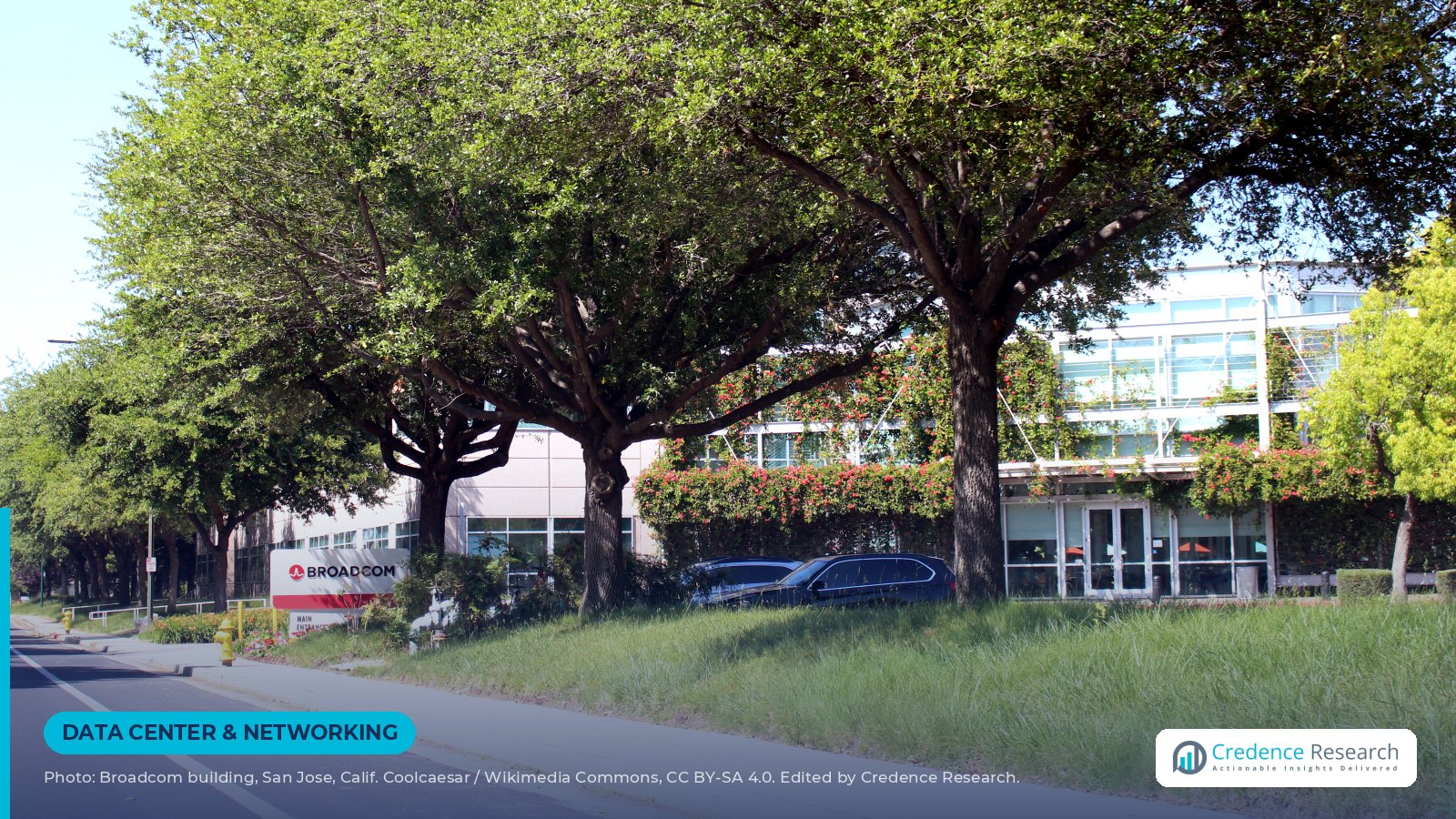
Image: Broadcom building in San Jose, California, by Coolcaesar via Wikimedia Commons, CC BY-SA 4.0. Cropped and edited by Credence Research.

About the Author

Senior News Editor at Credence Research Inc