
Market Overview:
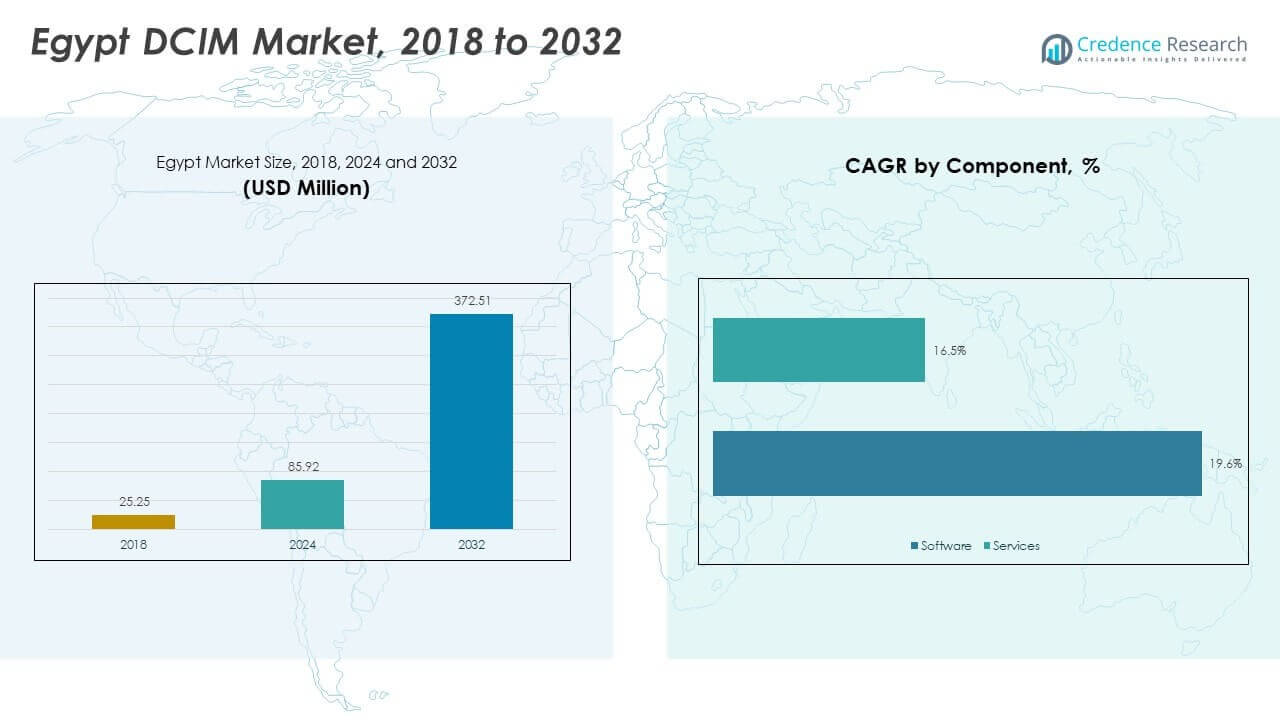
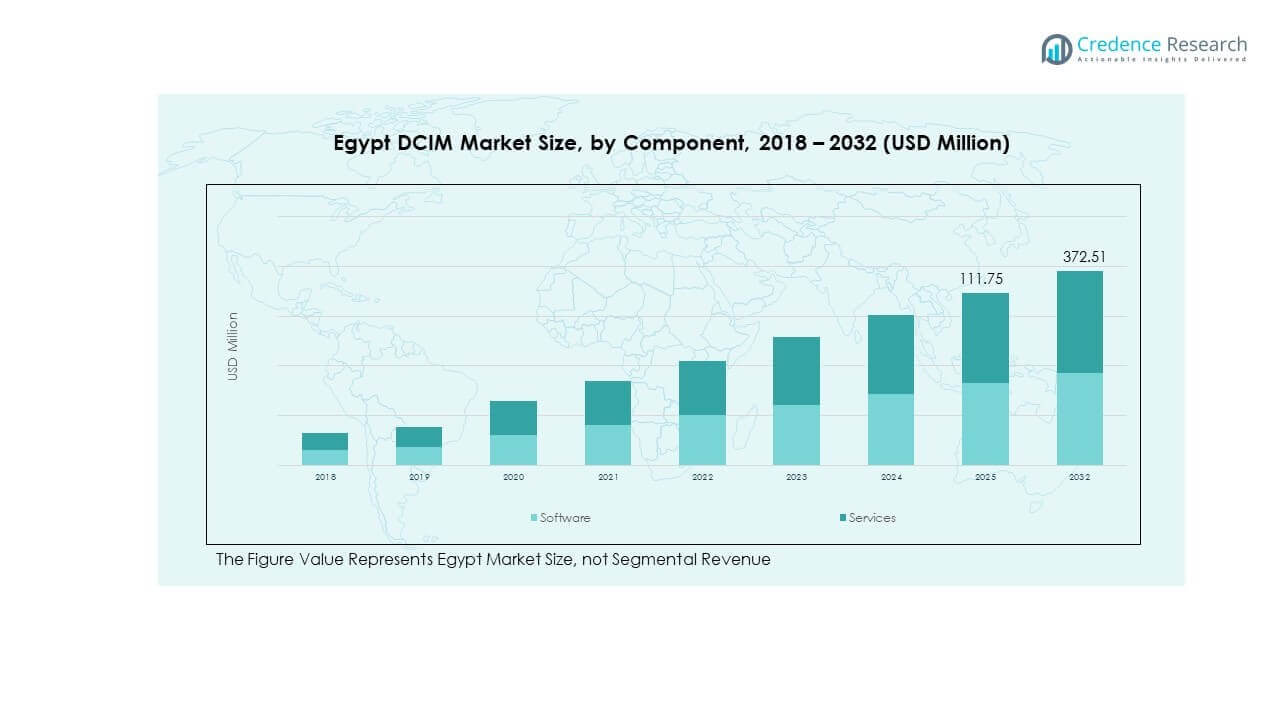
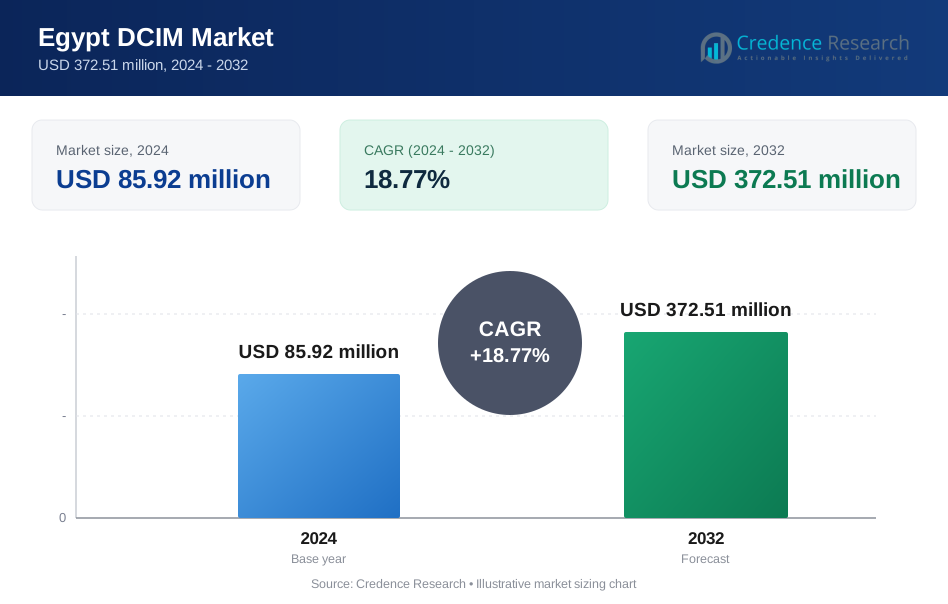
The Egypt DCIM Market size was valued at USD 25.25 million in 2018 to USD 85.92 million in 2024 and is anticipated to reach USD 372.51 million by 2032, at a CAGR of 18.77% during the forecast period.
| REPORT ATTRIBUTE | DETAILS |
|---|---|
| Historical Period | 2020-2023 |
| Base Year | 2024 |
| Forecast Period | 2025-2032 |
| Egypt Data Center Infrastructure Management (DCIM) Market Size 2024 | USD 85.92 million |
| Egypt Data Center Infrastructure Management (DCIM) Market, CAGR | 18.77% |
| Egypt Data Center Infrastructure Management (DCIM) Market Size 2032 | USD 372.51 million |
The market is expanding due to Egypt’s digital transformation agenda, growing cloud adoption, and rising data center investments. Enterprises and public sector operators deploy DCIM platforms to enhance infrastructure visibility, reduce energy costs, and improve operational efficiency. Demand increases for real-time monitoring, capacity planning, and integrated asset management solutions. Vendors benefit from a shift toward hybrid deployments, sustainability goals, and power optimization mandates. National digitalization projects and smart infrastructure initiatives also contribute to adoption across telecom, BFSI, and colocation segments.
Greater Cairo leads the Egypt DCIM Market due to its concentration of data centers, enterprise IT hubs, and government facilities. This subregion accounts for most large-scale deployments and modernization efforts. Alexandria and the northern coastal corridor are gaining traction with increased investments in telecom infrastructure and edge facilities. The Suez Canal Economic Zone and interior regions show rising activity from logistics, industrial parks, and smart city developments. These emerging zones demand scalable DCIM platforms with strong energy and asset control capabilities. Regional dynamics reflect a shift from core urban hubs to distributed, growth-focused digital corridors.
Market Insights
- The Egypt DCIM Market was valued at USD 25.25 million in 2018, rose to USD 85.92 million in 2024, and is projected to reach USD 372.51 million by 2032, growing at a CAGR of 18.77%.
- Greater Cairo and Giza held the largest regional share at 55–58%, driven by dense enterprise, telecom, and government infrastructure; Alexandria followed with 20–22%, supported by coastal connectivity and telecom hubs; the Suez Canal Economic Zone accounted for 20–23%, benefiting from industrial and logistics-backed digital growth.
- The Suez Canal and interior regions represent the fastest-growing zones with a combined share of 20–23%, supported by greenfield data center development and smart city investments.
- Software accounted for approximately 60–62% of the Egypt DCIM Market in 2024, driven by adoption of power monitoring, capacity management, and analytics platforms.
- Services grew faster at a 19.6% CAGR versus software’s 16.5%, with managed services and integration gaining traction among telecom, BFSI, and public-sector clients.
Market Drivers
Government-Led Digital Infrastructure Projects Fuel Widespread Data Center Expansion
Government programs across Egypt are increasing investment in IT infrastructure and cloud computing. These initiatives create demand for scalable data centers equipped with monitoring and energy management platforms. The Egypt DCIM Market benefits from this momentum as new facilities require comprehensive infrastructure visibility. Authorities prioritize uptime, fault tolerance, and power optimization, all of which DCIM platforms provide. Data centers serving ministries and public agencies often mandate local control capabilities. This shift improves resilience against regional service disruptions. Vendors offering modular, cloud-integrated DCIM tools gain early traction in public-sector bids. This segment sets a reference point for broader market growth across sectors.
- For instance, Egypt's Ministry of Communications and Information Technology (MCIT) inaugurated the Government Data and Cloud Computing Center in April 2024 along Ain Sokhna highway, spanning 23,500 sqm with 10,000 sqm of active infrastructure for centralized ministry data and AI applications.
Power Efficiency Goals Drive Adoption of Intelligent Thermal and Energy Management Systems
Enterprises in Egypt face mounting pressure to reduce operational costs linked to energy usage. DCIM systems help facilities cut power bills by analyzing thermal patterns and optimizing load distribution. The Egypt DCIM Market gains strength from rising electricity tariffs and capacity challenges. Large operators deploy intelligent cooling systems supported by real-time data insights. Predictive analytics help prevent thermal spikes that compromise hardware. Energy-saving targets make smart infrastructure monitoring a strategic priority. Several hyperscale and colocation players embed energy dashboards across facilities. These solutions support LEED and ISO standards, creating competitive advantages for green-certified data centers.
- For instance, Raya Data Center is expanding Tier III facilities in Cairo and has emphasized energy efficiency in its operations as part of national digital infrastructure growth.
Private Sector Cloud Migrations Accelerate Need for Integrated IT and Facility Monitoring Tools
Egyptian enterprises across banking, telecom, and retail sectors are expanding cloud-first operations. Cloud adoption increases pressure on data center operators to maintain uptime and visibility. The Egypt DCIM Market sees rising demand from firms migrating legacy systems to managed infrastructure. DCIM tools bridge IT and facility layers, helping providers manage space, power, and compute assets together. Operators require unified dashboards that track environmental conditions alongside server health. These capabilities are vital for SLA compliance in enterprise contracts. Businesses with hybrid deployments also use DCIM for tracking cross-site resource usage. System integrators customize platforms to fit industry-specific workflows and security policies.
Growth of Colocation Services Requires Scalable DCIM Platforms to Support Multitenant Environments
Colocation providers in Egypt are gaining traction among SMEs and regional service firms. Shared infrastructure models need advanced DCIM solutions for tenant-specific monitoring. The Egypt DCIM Market benefits as colocation operators adopt modular, API-driven platforms. Tenants demand visibility into power usage, rack space, and thermal performance. Custom reporting tools improve transparency and service differentiation. Colocation hubs also serve international cloud providers, adding complexity to infrastructure control. Scalable DCIM platforms with granular access control and billing integration are in high demand. Vendors supporting tenant self-service portals gain preference among growing colocation networks.
Market Trends
AI-Integrated DCIM Platforms Enhance Predictive Maintenance and Failure Prevention
Vendors are embedding AI and machine learning into DCIM platforms to improve forecasting. Algorithms analyze historical equipment behavior to predict failures or abnormal loads. The Egypt DCIM Market is aligning with this shift, especially across mission-critical facilities. Predictive maintenance reduces unplanned downtime and service disruptions. These platforms automate alerting, diagnosis, and resolution processes using data insights. Energy consumption, temperature variances, and airflow anomalies are tracked continuously. This improves equipment lifecycle management and cost planning. Operators benefit from reduced manual intervention, streamlined issue triage, and lower operational risk.
- For instance, Schneider Electric's EcoStruxure Asset Advisor connects to critical electrical assets via the cloud for real-time monitoring and sends event notifications to enable early warnings of potential equipment issues.
Edge Data Center Growth Stimulates Demand for Lightweight, Remote-First DCIM Solutions
Edge computing is expanding in regions beyond Cairo, supporting low-latency applications like IoT and mobile banking. These sites are often small and remotely managed, requiring compact, cloud-native DCIM tools. The Egypt DCIM Market is adapting to this trend by offering lightweight deployments with remote control capabilities. Solutions with mobile dashboards and AI-assisted alerts support decentralized operations. Technicians access real-time facility metrics without being on-site. Cloud-native tools reduce infrastructure overhead while preserving visibility. Vendors focus on containerized installations and flexible licensing models. Edge operators value uptime, security, and minimal setup time over complex feature sets.
DCIM Integration with Smart Grids and Renewable Energy Assets Gains Importance
Data centers are integrating renewable sources like solar and battery storage to offset grid instability. Smart DCIM platforms track energy mix, source switching, and battery efficiency in real time. The Egypt DCIM Market reflects this trend as facilities embed smart meters and solar controllers. Platforms monitor power quality, voltage fluctuations, and grid failovers. Load balancing tools shift non-critical operations to off-peak or solar hours. These capabilities help operators comply with government clean-energy mandates. DCIM supports power purchase agreements by validating renewable consumption. Vendors that offer open APIs for smart grid systems gain interest from sustainability-driven clients.
Growing Cybersecurity Threats Promote Interest in Secure DCIM Deployments with Role-Based Controls
Cyberattacks on operational technology systems, including HVAC and UPS controllers, raise security concerns. DCIM vendors now embed multi-layered access controls, encrypted communication, and audit logs. The Egypt DCIM Market benefits from this push as critical facilities seek robust cybersecurity compliance. Secure-by-design platforms help avoid manipulation of power and cooling systems. Role-based access ensures operators manage only permitted assets. Secure integrations with physical access controls and biometric systems are becoming standard. Clients demand centralized logging and breach detection aligned with NIST or ISO 27001. Vendors offering security-hardened DCIM are preferred for government and financial projects.
- For instance, Nlyte's DCIM software provides role-based access controls and centralized logging for multi-site operations compliant with standards like ISO 27001.
Market Challenges Analysis
Fragmented Infrastructure and Legacy Systems Limit DCIM Interoperability Across Older Facilities
Many facilities in Egypt still operate legacy cooling, power, and access control systems. Integrating these with modern DCIM platforms poses significant technical challenges. The Egypt DCIM Market faces friction when operators must retrofit or upgrade hardware interfaces. Proprietary communication protocols often prevent seamless interoperability. Facility managers may resist changes due to limited budgets or downtime concerns. Older buildings also lack the structured cabling needed for unified data collection. These constraints increase deployment complexity and integration timelines. Vendors must offer backward-compatible adapters and extensive customization, which slows adoption and inflates costs.
Shortage of Skilled Personnel Hampers Effective DCIM Implementation and Real-Time Monitoring
There is a limited pool of professionals trained in DCIM software, analytics, and infrastructure operations. This gap reduces the effectiveness of deployments even in modern facilities. The Egypt DCIM Market experiences delayed returns on investment due to skill shortages. Many technicians lack experience with integrated platforms covering IT, HVAC, and power systems. Without skilled operators, organizations cannot leverage advanced features like predictive maintenance or workload balancing. Outsourcing increases cost and lowers response time to critical alerts. Vendors must provide localized training programs to support broader adoption across market tiers.
Market Opportunities
Rise in Hyperscale and Modular Data Centers Offers Strong Demand for Custom DCIM Solutions
The ongoing development of hyperscale and prefabricated modular facilities opens new avenues for DCIM adoption. The Egypt DCIM Market sees opportunity in providing scalable solutions tailored to fast-deploy environments. These setups require flexible monitoring, asset tracking, and energy optimization modules. Vendors offering modular licensing and plug-and-play sensor support gain traction. Local system integrators can expand by bundling DCIM with design and commissioning services. Growth in AI workloads and cloud-native applications supports future upgrades of deployed platforms.
Smart City and National Digitalization Projects Expand Scope for Public-Sector DCIM Adoption
National digital infrastructure initiatives including smart cities, e-governance, and public cloud hosting require resilient data centers. The Egypt DCIM Market can leverage these developments to supply infrastructure monitoring across civic IT hubs. Public-sector clients seek secure, standards-compliant tools with localized support. New digital ID systems, e-health platforms, and financial inclusion apps all rely on managed data environments. Vendors offering government-certified and energy-efficient platforms gain visibility in procurement cycles. These projects support long-term market maturity through stable contracts and local ecosystem development.
Market Segmentation Analysis
By Component
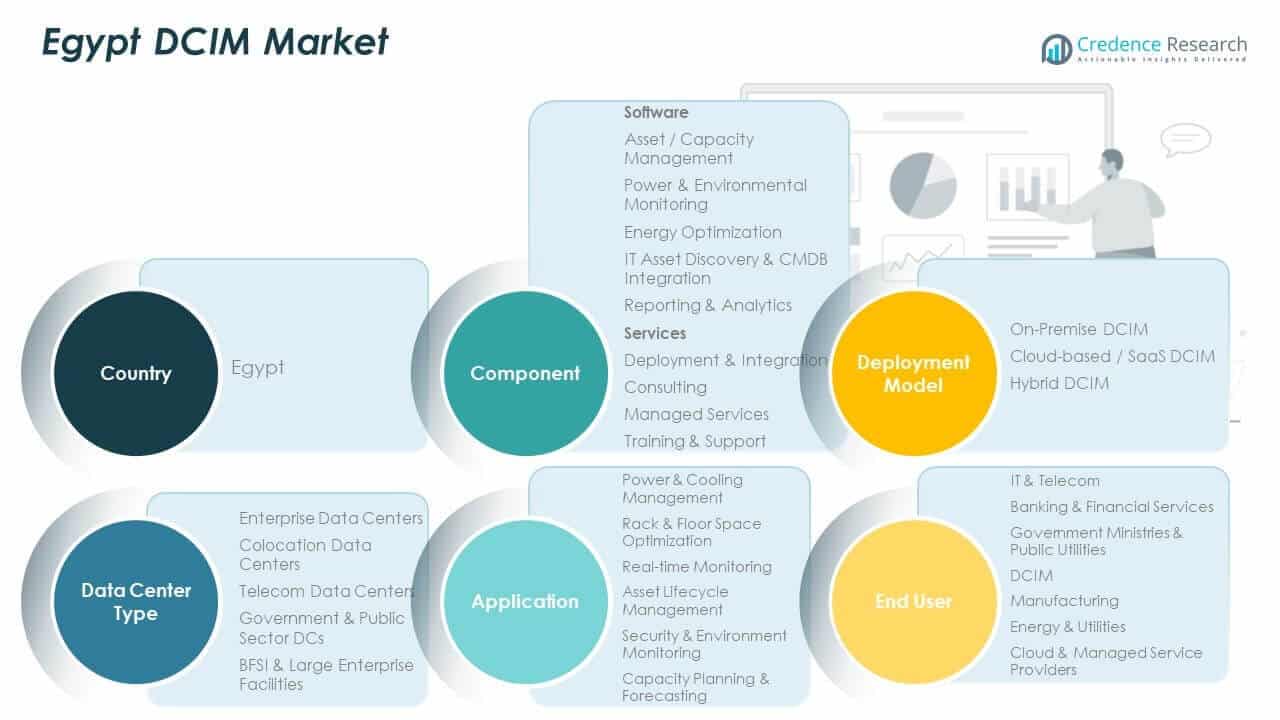
The Egypt DCIM Market shows strong demand for software-led solutions that improve visibility and control. Software tools support asset and capacity management, power and environmental monitoring, and energy optimization. These platforms help operators track IT assets through CMDB integration and analytics dashboards. Reporting features support audit readiness and operational decisions. Services play a critical role during deployment and system alignment. Consulting and integration ensure compatibility with existing infrastructure. Managed services support daily operations where in-house skills remain limited. Training and support improve long-term platform utilization.
- For instance, Schneider Electric’s EcoStruxure IT platform supports real-time monitoring across large telecom data centers in the Middle East, with customer deployments often exceeding 1,000 monitored assets and achieving near-99.999% uptime performance in mission-critical environments.
By Deployment Model
The Egypt DCIM Market reflects diverse deployment preferences across operators. On-premise DCIM remains relevant for sensitive environments that require local data control. Cloud-based and SaaS DCIM platforms gain traction due to faster deployment and lower upfront cost. These models suit operators with distributed or edge facilities. Hybrid DCIM adoption rises where firms balance compliance with scalability needs. Hybrid models allow gradual transition from legacy systems. This flexibility supports phased modernization strategies. Vendors that support all models gain wider acceptance.
By Data Center Type
The Egypt DCIM Market serves varied data center formats with distinct needs. Enterprise data centers focus on internal efficiency and asset tracking. Colocation data centers require tenant-level monitoring and billing visibility. Telecom data centers prioritize uptime and power resilience. Government and public sector DCs emphasize security and compliance controls. BFSI and large enterprise facilities demand high availability and audit-ready reporting. Each data center type drives tailored DCIM configurations. Vendors adjust feature depth based on operational complexity.
By Application
The Egypt DCIM Market benefits from broad application use across facilities. Power and cooling management remains the core use case. Rack and floor space optimization supports capacity efficiency. Real-time monitoring improves response to faults and thermal risks. Asset lifecycle management helps plan upgrades and replacements. Security and environment monitoring protect critical infrastructure. Capacity planning and forecasting guide long-term expansion. These applications support both operational and strategic goals.
- For instance, Panduit’s PanView iQ system enables real-time fault detection and asset monitoring across hundreds of sensors, supporting rapid diagnostics and proactive lifecycle management within enterprise data centers.
By End User
The Egypt DCIM Market supports a wide range of end users. IT and telecom operators lead adoption due to scale and uptime needs. Banking and financial services rely on DCIM for compliance and resilience. Government ministries and public utilities use it to secure national digital systems. Manufacturing firms deploy DCIM to support automation and data workloads. Energy and utilities value power analytics and reliability. Cloud and managed service providers depend on DCIM for service assurance.
Segmentation
By Component
- Software Includes
- Asset / Capacity Management
- Power & Environmental Monitoring
- Energy Optimization
- IT Asset Discovery & CMDB Integration
- Reporting & Analytics
- Services Include
- Deployment & Integration
- Consulting
- Managed Services
- Training & Support
By Deployment Model
- On-Premise DCIM
- Cloud-based / SaaS DCIM
- Hybrid DCIM
By Data Center Type
- Enterprise Data Centers
- Colocation Data Centers
- Telecom Data Centers
- Government & Public Sector DCs
- BFSI & Large Enterprise Facilities
By Application
- Power & Cooling Management
- Rack & Floor Space Optimization
- Real-time Monitoring
- Asset Lifecycle Management
- Security & Environment Monitoring
- Capacity Planning & Forecasting
By End User
- IT & Telecom
- Banking & Financial Services
- Government Ministries & Public Utilities
- DCIM
- Manufacturing
- Energy & Utilities
- Cloud & Managed Service Providers
Regional Analysis
Greater Cairo and Giza Metropolitan Area
The Egypt DCIM Market remains highly concentrated in Greater Cairo and Giza, which account for nearly 55–58% of national demand. This subregion hosts the highest density of enterprise, government, telecom, and colocation data centers. Financial institutions and public-sector IT hubs drive steady adoption of monitoring and energy optimization platforms. Cairo’s role as a connectivity hub with access to major fiber routes strengthens DCIM uptake. Operators prioritize uptime, compliance, and power efficiency in dense facilities. It benefits from early adoption of cloud-enabled and hybrid DCIM platforms. Vendor presence and system integrator activity remain strongest in this zone.
Alexandria and Northern Coastal Corridor
Alexandria and the northern coastal corridor contribute around 20–22% of the market share. This region gains importance due to proximity to submarine cable landing stations and port-led digital infrastructure. Telecom operators and cloud service providers expand regional facilities to support latency-sensitive workloads. Data centers in this area focus on power monitoring and cooling efficiency due to coastal climate conditions. The Egypt DCIM Market sees rising adoption of real-time monitoring tools in this subregion. Operators prefer scalable solutions to support gradual capacity expansion. Growth remains steady but selective across large projects.
Suez Canal Zone and Emerging Interior Regions
The Suez Canal Economic Zone and emerging interior regions represent roughly 20–23% of total demand. These areas attract interest from logistics, industrial, and smart infrastructure projects. Government-backed digital zones support new data center builds that require modern DCIM platforms. Energy and utilities operators drive adoption for power-intensive facilities. It benefits from greenfield developments where DCIM integration starts at design stage. Adoption rates rise steadily but remain lower than urban centers. Long-term growth depends on infrastructure and skilled workforce availability.
Key Player Analysis
- Schneider Electric,
- Huawei,
- Vertiv,
- Siemens,
- Nlyte Software / Sunbird DCIM,
Competitive Analysis
The Egypt DCIM Market features a mix of global software vendors, regional system integrators, and niche service providers. International players lead in advanced analytics, AI-driven monitoring, and scalable platforms. Regional integrators compete through localized deployment, customization, and ongoing support services. Competition centers on software capability, integration flexibility, and cybersecurity readiness. Vendors differentiate through cloud compatibility and hybrid deployment support. Pricing models vary based on project scale and service depth. Large players target hyperscale, government, and telecom projects through long-term contracts. Mid-tier firms focus on enterprise and colocation operators seeking modular solutions. Managed services gain traction where in-house skills remain limited. Partnerships between DCIM vendors and data center builders strengthen market reach. Certification, compliance support, and training programs influence vendor selection. Competitive intensity continues to rise as digital infrastructure investments expand nationwide.
Recent Developments
- In September 2025, Schneider Electric launched new power solutions at its Secure Power Innovation Day event in Egypt, showcasing advanced systems to support digital transformation and sustainable infrastructure
- In April 2025, Schneider Electric signed a strategic partnership with Egypt's Ministry of Electricity and Renewable Energy to digitally transform the Sharm El-Sheikh Control Center and additional distribution centers in Minya and South Delta, enhancing grid efficiency with EcoStruxure technologies.
- In December 2024, the Ministry of Communications and Information Technology of Egypt signed a Memorandum of Understanding (MoU) with the UAE Ministry of Investment to collaborate on data center projects totaling 1 GW capacity. This partnership supports Egypt's digital transformation under Vision 2030, enhancing infrastructure for DCIM-integrated facilities.
- In December 2024, Africa50 invested $15 million for a 42.9% stake in Raya Data Center (RDC), part of a $25 million funding round valuing the company at $35 million. The funds will expand RDC's Tier III data centers in Cairo and develop a new greenfield site starting in early 2025, bolstering Egypt's digital ecosystem where DCIM plays a key role.
Report Coverage
The research report offers an in-depth analysis based on Component, Deployment Model, Data Center Type, Application and End User. It details leading market players, providing an overview of their business, product offerings, investments, revenue streams, and key applications. Additionally, the report includes insights into the competitive environment, SWOT analysis, current market trends, as well as the primary drivers and constraints. Furthermore, it discusses various factors that have driven market expansion in recent years. The report also explores market dynamics, regulatory scenarios, and technological advancements that are shaping the industry. It assesses the impact of external factors and global economic changes on market growth. Lastly, it provides strategic recommendations for new entrants and established companies to navigate the complexities of the market.
Future Outlook
- Smart city initiatives and digital government programs will create sustained demand for integrated DCIM platforms.
- Growing data center investments in Cairo and coastal regions will expand the addressable market across public and private sectors.
- Hybrid deployment models will dominate as operators seek a balance between security, flexibility, and scalability.
- AI-enabled analytics in DCIM systems will gain adoption for predictive maintenance, capacity planning, and power optimization.
- Colocation and edge data centers will drive need for modular DCIM solutions with tenant-level control and monitoring features.
- Telecom, BFSI, and cloud service providers will continue to lead adoption due to mission-critical workload requirements.
- Green data center standards and rising power costs will push demand for energy-efficient DCIM platforms across large campuses.
- Local system integrators and managed service providers will strengthen market presence through consulting and support services.
- Regional DCIM innovation will benefit from vendor partnerships and integration with smart grid and renewable energy systems.
- Security-hardened, role-based access features will become essential in vendor selection due to rising OT cybersecurity threats.
Request a Free Sample
Fill in your details and we'll send you a free sample report.
- Sample data tables & charts
- Research methodology
Need a Custom Version of This Report?
Tailor the scope, geography, or segments to your exact requirements.
- Custom geography or segment scope
- Direct access to our analyst team
Frequently Asked Questions
What is the current market size for Egypt DCIM Market, and what is its projected size in 2032?
At what Compound Annual Growth Rate is the Egypt DCIM Market projected to grow between 2024 and 2032?
Which Egypt DCIM Market segment held the largest share in 2024?
What are the primary factors fueling the growth of the Egypt DCIM Market?
Who are the leading companies in the Egypt DCIM Market?
Which region commanded the largest share of the Egypt DCIM Market in 2024?
Table of Content
Chapter 1. Report Introduction
- 1.1 Report Description & Purpose
- 1.1.1 Report Title & Market Definition
- 1.1.2 Unique Selling Propositions (USP) & Key Differentiators
- 1.1.3 Value Proposition for Stakeholders
- 1.2 Research Objectives
- 1.2.1 Market Sizing Objectives (Volume & Revenue)
- 1.2.2 Segmentation Objectives
- 1.2.3 Competitive Intelligence Objectives
- 1.2.4 Forecast & Scenario Objectives
- 1.3 Report Scope
- 1.3.1 Egypt DCIM Scope – Types & Subtypes Covered
- 1.3.2 Geographic Scope – Regions & Countries Covered
- 1.3.3 Historical Period, Base Year & Forecast Period (2024; forecast to 2032)
- 1.3.4 Inclusions & Exclusions
- 1.4 HS Code & Classification Framework
- 1.5 Currency, Units & Pricing Basis
- 1.6 Target Stakeholders
- 1.7 Limitations & Assumptions
Chapter 2. Executive Summary
- 2.1 Global Egypt DCIM Market Snapshot
- 2.1.1 Market Size – Historical (2024) & Forecast (2024-2032) (2024: USD 85.92 million → 2032: USD 372.51 million)
- 2.1.2 Volume & Revenue – Global Totals
- 2.1.3 Key Market Highlights – Top Five Facts
- 2.2 Egypt DCIM Market Segmentation Snapshot
- 2.2.1 Market Split by Region – 2024 vs. 2032
- 2.3 Competitive Snapshot
- 2.3.1 Top 10 Players by Revenue Share – 2024
- 2.3.2 Top 10 Players by Volume Share – 2024
- 2.3.3 Recent Strategic Developments (18-Month Summary)
- 2.4 Key Investment Highlights & Strategic Conclusions
Chapter 3. Egypt DCIM Market Dynamics & Industry Analysis
- 3.1 Market Overview & Context
- 3.1.1 Egypt DCIM Market Position in the Broader Automotive Value Chain
- 3.1.2 OEM vs. Replacement Market Dynamics
- 3.1.3 Market Maturity & Development Stage by Region
- 3.2 Egypt DCIM Market Drivers
- 3.3 Egypt DCIM Market Restraints & Challenges
- 3.4 Egypt DCIM Market Opportunities
- 3.5 Porter's Five Forces Analysis
- 3.5.1 Threat of New Entrants
- 3.5.2 Bargaining Power of Suppliers
- 3.5.3 Bargaining Power of Buyers
- 3.5.4 Threat of Substitutes
- 3.5.5 Competitive Rivalry – Intensity Assessment
- 3.6 Egypt DCIM Value Chain Analysis
- 3.6.1 Upstream – Raw Material/Input Suppliers
- 3.6.1.1 Raw Material/Input 1
- 3.6.1.2 Raw Material/Input 2
- 3.6.1.3 Raw Material/Input 3
- 3.6.2 Midstream – Production/Manufacturing/Service Delivery
- 3.6.2.1 Production/Process Overview
- 3.6.2.2 Key Facility Locations & Capacity by Manufacturer
- 3.6.3 Downstream – Distribution & End Consumer
- 3.6.3.1 Primary Channel – B2B/OEM
- 3.6.3.2 Secondary Channels – Dealer, Retail, Online, Direct
- 3.6.4 Value Chain Profitability Analysis
- 3.6.1 Upstream – Raw Material/Input Suppliers
- 3.7 PESTEL Analysis
- 3.7.1 Political Factors
- 3.7.2 Economic Factors
- 3.7.3 Social Factors
- 3.7.4 Technological Factors
- 3.7.5 Environmental Factors
- 3.7.6 Legal Factors
- 3.8 Egypt DCIM Supply Chain Analysis
- 3.8.1 Raw Material/Input Supply Risk Assessment
- 3.8.2 Manufacturing Concentration Risk (Geographic Exposure)
- 3.8.3 Trade Disruption Impact Analysis
- 3.9 Regulatory & Policy Landscape
Note: The regulatory and policy landscape section covers regulations based on their applicability to the market, Egypt DCIM category, geography, and scope of the study. Only regulatory frameworks with a material impact on operations, compliance, trade, sustainability, or market access are analyzed in detail.
Chapter 4. Key Investment Pockets & Opportunity Analysis
- 4.1 Egypt DCIM Market Attractiveness Analysis
- 4.1.1 By Region – Investment Attractiveness Matrix (Volume × CAGR)
- 4.2 Absolute Revenue Growth Opportunity
- 4.2.1 By Region – Absolute USD Growth Through 2032
- 4.3 Incremental Volume Opportunity
- 4.3.1 By Region – Incremental Volume Through 2032
- 4.3.2 Segment – Incremental Volume
- 4.4 Emerging Submarket Opportunity Deep Dive (Subject to Applicability)
- 4.5 Emerging Market Opportunity Scorecards
- 4.5.1 United States
- 4.5.2 Europe
- 4.5.3 Asia
- 4.5.4 Middle East & Africa
Note: Emerging Market Opportunity Scorecards will be included based on relevance and strategic importance. Regions listed are indicative and may vary depending on data availability and market dynamics.
Chapter 5. Egypt DCIM Import-Export Analysis & Trade Flows
- 5.1 Global Trade Overview
- 5.1.1 Global Export Value by Country (2024)
- 5.1.2 Global Export Volume by Country (2024)
- 5.1.3 Global Import Value by Country (2024)
- 5.1.4 Global Import Volume by Country (2024)
- 5.1.5 Net Trade Balance by Country (2024)
- 5.2 Export Analysis – Segment
- 5.2.1 Type 1 (HS Code)
- 5.2.2 Type 2 (HS Code)
- 5.2.3 Type 3 (HS Code)
- 5.2.4 Type 4 (HS Code)
- 5.2.5 Type 5 (HS Code)
- 5.3 Import Analysis – Segment
- 5.3.1 Type 1 (HS Code)
- 5.3.2 Type 2 (HS Code)
- 5.3.3 Type 3 (HS Code)
- 5.3.4 Type 4 (HS Code)
- 5.3.5 Type 5 (HS Code)
- 5.4 Average Unit Trade Prices
- 5.4.1 Average Export Price – Segment & Country
- 5.4.2 Average Import Price – Segment & Source Country
- 5.4.3 Price Trends (2024)
- 5.5 Key Trade Route Analysis
- 5.5.1 Trade Route 1
- 5.5.2 Trade Route 2
- 5.5.3 Trade Route 3
- 5.5.4 Trade Route 4
- 5.5.5 Trade Route 5
- 5.6 Trade Policy Impact Assessment
- 5.6.1 US Anti-Dumping & Section 301 Tariffs
- 5.6.2 EU Customs Union Impact
- 5.6.3 Major Free Trade Agreements
- 5.6.4 USMCA Rules of Origin
Note: Trade policy analysis will be included only where relevant to the Egypt DCIM market.
Chapter 6. Competitive Landscape & Company Benchmarking
- 6.1 Egypt DCIM Market Concentration & Structure
- 6.1.1 Herfindahl-Hirschman Index (HHI) – vs. 2024
- 6.1.2 Tier 1, Tier 2 & Tier 3 Market Structure
- 6.1.3 Global, Regional & Local Player Dynamics
- 6.2 Egypt DCIM Market Share Analysis – 2024
- 6.2.1 Global Revenue Share by Company
- 6.2.2 Global Volume Share by Company
- 6.2.3 Regional Revenue Share
- 6.2.4 Market Share Evolution ( vs. 2024)
- 6.2.5 OEM Segment Share by Company
- 6.2.6 Replacement Segment Share by Company
- 6.3 Production/Delivery Capacity & Facility Analysis
- 6.3.1 Global Installed Capacity
- 6.3.2 Capacity Utilization Rates
- 6.3.3 Production/Output Volume
- 6.3.4 Facility Locations & Capacity Map
- 6.3.5 Planned Capacity Additions
- 6.4 Egypt DCIM Competitive Benchmarking Matrix
- 6.4.1 Revenue, Volume, CAGR & Profitability Comparison
- 6.4.2 Channel Revenue Mix
- 6.4.3 Geographic Revenue Exposure
- 6.4.4 R&D Intensity
- 6.4.5 Sustainability Maturity
- 6.5 Strategic Developments in Egypt DCIM (Last 24 Months)
- 6.5.1 Mergers, Acquisitions & Divestments
- 6.5.2 New Egypt DCIM Launches
- 6.5.3 Facility Expansions
- 6.5.4 Strategic Alliances, Joint Ventures & Partnerships
- 6.5.5 Distribution Expansion & Market Entry
- 6.5.6 Sustainability & ESG Initiatives
- 6.6 Competitive Strategy Mapping
- 6.6.1 Leader, Challenger, Follower & Niche Classification
- 6.6.2 Pricing Strategy Comparison
- 6.6.3 Channel Strategy Matrix
Note: Strategic developments are included based on their materiality and the availability of reliable information.
Chapter 7. Global Egypt DCIM Market – By Distribution Channel
- 7.1 Segment Overview
- 7.1.1 Volume & Revenue Split by Channel (2024 & 2032)
- 7.1.2 Channel Mix Evolution (2024-2032)
Chapter 8. Regional Market Analysis – Global Overview
- 8.1 Global Regional Overview
- 8.1.1 Regional Volume Share
- 8.1.2 Regional Revenue Share
- 8.1.3 Regional Volume by Region
- 8.1.4 Regional Revenue by Region
- 8.1.5 Regional Forecast Through 2032
- 8.2 Cross-Regional Segment Analysis
- 8.2.1 By Distribution Channel
- 8.2.2 By Brand/Price Tier
Chapter 9. North America Egypt DCIM Market
- 9.1 United States
- 9.2 Canada
- 9.3 Mexico
Chapter 10. Europe Egypt DCIM Market
- 10.1 Germany
- 10.2 France
- 10.3 Italy
- 10.4 United Kingdom
- 10.5 Spain
- 10.6 Poland
- 10.7 Russia
- 10.8 Netherlands
- 10.9 Belgium
- 10.10 Sweden
- 10.11 Denmark
- 10.12 Norway
- 10.13 Rest of Europe
Chapter 11. Asia Pacific Egypt DCIM Market
- 11.1 China
- 11.2 India
- 11.3 Japan
- 11.4 South Korea
- 11.5 Thailand
- 11.6 Indonesia
- 11.7 Vietnam
- 11.8 Malaysia
- 11.9 Australia
- 11.10 Rest of Asia Pacific
Chapter 12. Latin America Egypt DCIM Market
- 12.1 Brazil
- 12.2 Argentina
- 12.3 Colombia
- 12.4 Chile
- 12.5 Rest of Latin America
Chapter 13. Middle East Egypt DCIM Market
- 13.1 Saudi Arabia
- 13.2 United Arab Emirates
- 13.3 Turkey
- 13.4 Israel
- 13.5 Iran
- 13.6 Rest of the Middle East
Chapter 14. Africa Egypt DCIM Market
- 14.1 South Africa
- 14.2 Egypt
- 14.3 Nigeria
- 14.4 Morocco
- 14.5 Rest of Africa
Chapter 15. Egypt DCIM Company Profiles
- 15.1 [Company 01]
- 15.1.1 Company Overview
- 15.1.2 Key Management Personnel
- 15.1.3 Products & Services Portfolio
- 15.1.4 Financial Performance
- 15.1.5 Key Market Focus & Geographic Presence
- 15.1.6 Recent Developments & Strategic Initiatives
Note: The company profile list is preliminary and may change based on research findings, market developments, data availability, and client requirements.
Chapter 16. Appendices
- Appendix A – List of Abbreviations & Acronyms
- Appendix B – Industry Classification Code Reference – Full Series
- Appendix C – Production & Capacity Data Tables
- Appendix D – End-Use & Demand Base Tables
- Appendix E – Consumption & Replacement Rate Assumptions
- Appendix F – ASP Reference Tables
- Appendix G – Manufacturing & Facility Database
- Appendix H – Import-Export Data Tables
- Appendix I – Regulatory Summary Tables
- Appendix J – Primary Research Participant List (Anonymized)
- Appendix K – Primary Research Questionnaire Framework
- Appendix L – Data Sources & Bibliography
- Appendix M – Market Size Divergence & Source Comparison
Chapter 17. Research Methodology
- 17.1 Research Framework & Philosophy
- 17.2 Secondary Research – Sources, Hierarchy & Data Extraction
- 17.3 Data Modeling – Bottom-Up & Top-Down Market Sizing
- 17.4 Primary Research – Stakeholder Framework, LOI & Sample Sizes
- 17.5 Forecast Methodology – Regression, Scenario & Sensitivity Analysis
- 17.6 Quality Control – Four-Layer Validation Framework
- 17.7 Limitations & Standard Assumptions
- 17.8 Disclaimer
