
Singapore Approves Sembcorp Plan to Import 1.3 GW of Vietnam Wind and Malaysia Solar Power
Singapore's Energy Market Authority on Oct. 26 granted Sembcorp Utilities a conditional approval to import up to 1.3 gigawatts of low-carbon electricity sourced from offshore wind in Vietnam and solar power in Malaysia, with flows targeted to start by 2035. The approval, announced as the 19th Singapore International Energy Week opened, covers a three-country corridor that Sembcorp is developing with PetroVietnam Technical Services Corp. and MY Energy Consortium, a Malaysian group made up of Petronas and Tenaga Nasional Bhd.
Key developments
- EMA granted Sembcorp Utilities, a wholly owned subsidiary of Sembcorp Industries, a conditional approval to import a total of 1.3 GW of electricity into Singapore.
- The project would combine offshore wind generation in Vietnam with solar and battery energy storage in Malaysia, with Malaysia acting as both a recipient and a transit country for power generated in Vietnam.
- Sembcorp aims to begin imports by 2035. The partners still need approvals in the other jurisdictions, signed power purchase agreements with buyers and sufficient financing.
- The approval builds on a joint development agreement that Sembcorp Utilities, MY Energy Consortium and PTSC signed in May 2025 on the sidelines of the 46th ASEAN Summit in Kuala Lumpur.
- On the same day, EMA and Malaysia's Energy Commission renewed a memorandum of understanding covering cross-border electricity trading, interconnection capacity, renewable energy certificates, and solar and storage systems.
Policy background
Singapore generates most of its electricity from imported natural gas and has little room for large domestic renewable projects. EMA has said the power sector accounts for about 40% of the country's carbon emissions, which is why imported low-carbon electricity sits at the center of its decarbonization plan. In September 2024, the regulator raised its ambition to import about 6 GW of low-carbon power by 2035, up from an earlier goal of 4 GW, citing strong interest from credible developers.
EMA uses a staged process. A conditional approval lets a developer move into detailed technical and commercial work. A conditional license follows once a project shows substantive progress, and a full importer license comes only after financial close. By August 2026, EMA had granted conditional approvals or conditional licenses to 13 import projects from Australia, Cambodia, Indonesia, Malaysia and Vietnam. In that round it cleared 900 megawatts of solar-plus-storage imports from Johor, split between a 300 MW Sembcorp project and a 600 MW project from Southern Solar Alliance, both targeting operations around 2029.
Vietnam has been part of Singapore's import plans since 2023, when EMA gave Sembcorp and PTSC a conditional approval for about 1.2 GW of mainly wind-generated power. Sembcorp described that concept at the time as relying on new subsea cables of roughly 1,000 kilometers. The new approval reframes the Vietnam link as a regional corridor that runs through Malaysia and folds in Malaysian solar and storage. EMA's release does not say how the new approval relates to the earlier one.
Industry implications
The structure of the project matters as much as its size. Pairing offshore wind from southern Vietnam with Malaysian solar and batteries is designed to smooth supply, since wind and solar output peak at different times and storage can shift solar energy into the evening. For Singapore, which needs firm and reliable supply for a dense economy and a growing base of data centers and advanced manufacturing, a blended portfolio is easier to integrate than a single intermittent source.
For Petronas and TNB, the project offers a route to export low-carbon power and to put Malaysian grid assets at the center of regional trade. For PTSC, a unit of state-owned Petrovietnam, it offers an anchor buyer for offshore wind at a time when Vietnam is still building the regulatory framework for that sector. The joint statement from the partners framed the approval as part of wider efforts to unlock Southeast Asia's renewable energy potential.
The conditions attached to the approval are substantial. A cross-border offshore wind and transmission project of this scale needs permits in three countries, long-term offtake contracts and a financing package large enough to cover generation, storage and subsea and overland transmission. None of those elements has been announced.
Competitive and supply chain implications
Sembcorp is now a participant in several of Singapore's import routes, including the 300 MW Johor solar project and the Vietnam corridor. That positions the company as a central importer as Singapore works through its pipeline, while competitors such as Singa Renewables, Sun Cable and Southern Solar Alliance pursue projects in Indonesia, Australia and Malaysia.
The supply chain needs are significant. Offshore wind in Vietnam would require turbines, foundations, installation vessels and port capacity, while the corridor would depend on high-voltage subsea and land cables, converter stations and grid upgrades in Malaysia. Battery storage in Malaysia adds demand for cells, inverters and control systems. Cable manufacturing slots and installation vessels are already contested by projects in Europe and Asia, so securing them early will be a key test for the consortium once financing is in sight.
Regional implications
The approval is one of the more concrete steps toward the ASEAN Power Grid, a long-standing plan to link national grids across Southeast Asia. A route that delivers Vietnamese power through Malaysia to Singapore would test the commercial and regulatory rules for multilateral power trading, including how transit fees, grid access and renewable energy certificates are handled.
The renewed EMA and Energy Commission agreement, witnessed by Malaysian Deputy Prime Minister Fadillah Yusof and Singapore minister Tan See Leng, addresses several of those issues directly. For Malaysia, the project could bring new generation and storage investment while strengthening its role as a transit hub. For Vietnam, it would open an export channel for offshore wind resources off its southern coast.
Credence Research analysis
The approval matters less for the electricity it will deliver in the near term than for the model it endorses. By routing Vietnamese wind through Malaysia and blending it with Malaysian solar and storage, Singapore is backing a multi-country design that spreads risk and value across three partners, each with a national energy company at the table. That is a different bet from earlier point-to-point concepts, and it gives Malaysia a stake in the project's success rather than leaving it as a bystander to subsea cables passing its coast.
The 2035 start date and the list of open conditions show how early this project still is. In our view, the milestones to watch are the conversion of this approval into a conditional license, the signing of power purchase agreements and evidence that Vietnam's offshore wind framework can support export projects. Until those arrive, the approval is best read as a strong policy signal from Singapore rather than a commitment of capital.
What comes next
- Sembcorp and its partners will seek approvals from Vietnamese and Malaysian authorities for generation, transmission and transit.
- The consortium must conclude power purchase agreements with buyers and assemble financing before a full importer license can be issued.
- EMA will assess project progress for a possible conditional license, the next step in its licensing process.
- Regulators in Singapore and Malaysia are expected to use the renewed agreement to work through cross-border trading and interconnection rules.
- Sembcorp targets the start of electricity imports from the corridor by 2035.
Sources
- Energy Market Authority: EMA grants conditional approval to Sembcorp Utilities for 1.3GW of electricity imports (Oct. 26, 2026)
- Energy Market Authority: Singapore and Indonesia make substantive progress on electricity imports (Sept. 5, 2024)
- Energy Market Authority: Conditional approval for 900MW of electricity trade between Peninsular Malaysia and Singapore (Aug. 7, 2026)
- Malay Mail: Singapore, Malaysia renew energy partnership covering power, gas and renewables (Oct. 26, 2026)
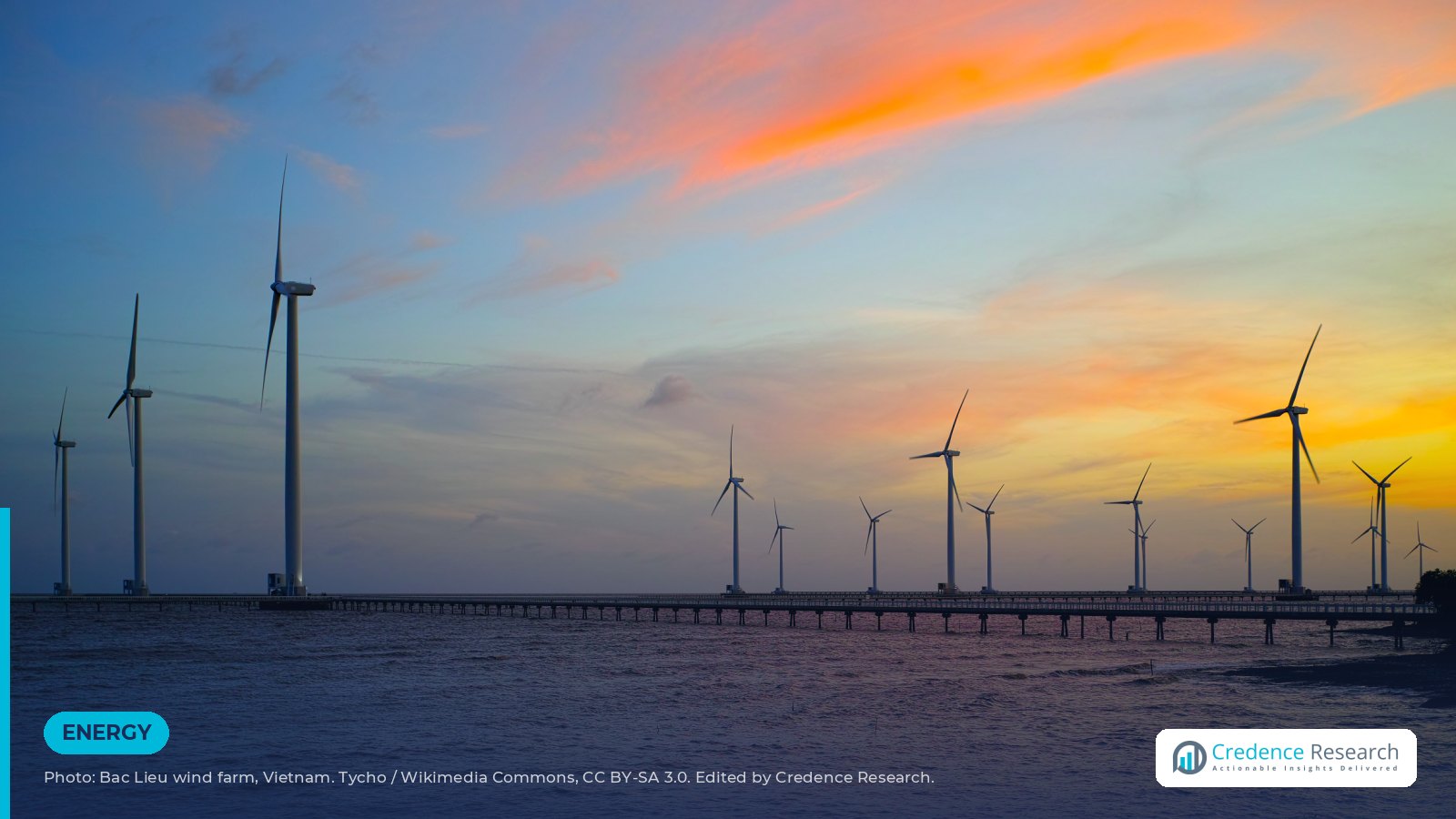
Image: Bac Lieu wind farm in Vietnam, by Tycho via Wikimedia Commons, CC BY-SA 3.0. Cropped and edited by Credence Research.

About the Author

Senior News Editor at Credence Research Inc