
CATL Unveils Dual-Battery System for Electric Heavy Trucks, Expands QIJI Swap Network
Contemporary Amperex Technology Co. Ltd. (CATL) unveiled a two-battery power system for electric heavy-duty trucks in Beijing on Oct. 20, pairing a swappable main pack with a fixed range-extension battery mounted behind the cab. The Chinese battery maker introduced the system together with QIJI Energy, its heavy-truck battery-swapping business, and rolled out larger standardized swap blocks, a net-energy billing model and an expansion plan for its swap network in China. The company said agreements covering 13,000 units were signed at the launch event.
Key developments
- CATL's dual-electric range extension system combines a QIJI chassis-mounted swappable main battery with a 77 kWh range-extension battery that supports 3C charging and provides backup power.
- The company said the backup pack lifts the usable depth of discharge of the main battery from about 70% to more than 95%, so trucks can reach a swap station with less than 5% state of charge. Power transfers to the extender within milliseconds.
- QIJI added two standardized swap blocks, the 260# at 432 kWh and the 300# at 513 kWh, alongside its existing 75# block. CATL said a swap takes five minutes with a 99.99% first-time success rate.
- A new battery-as-a-service model bills customers for net energy, meaning energy charged minus energy recovered through regenerative braking. CATL said this cuts per-kWh rental costs by up to 20% on basic plans.
- CATL targets 900 heavy-truck swap stations by the end of 2026, 2,000 by 2027 and a long-term goal of 10,000 across China with partners.
How the technology works
CATL describes the design as a "1+X" architecture. The "1" is a standardized main battery that can be swapped at QIJI stations. The "X" is a range-extension battery that the truck owner buys and keeps with the vehicle, offered in versions tuned for ultra-high energy density, low-temperature operation or ultra-high power. The company said the two packs can be developed and upgraded independently, which separates the fleet's shared swap infrastructure from the configuration choices of each operator.
The practical problem the extender addresses is reserve capacity. Swap-based trucks today typically return to a station with a sizable share of charge still in the pack because drivers need a buffer against delays, detours and cold weather. A fixed backup battery takes over that role, letting the swappable pack run closer to empty. In CATL's figures, that adds about 25 percentage points of usable capacity from the main pack on each cycle.
The ownership split matters as much as the chemistry. Because the main pack is leased, CATL said operators can scale capacity seasonally, renting more energy during peak freight periods and less in slower months. The extender, owned outright, gives the truck a stable baseline. CATL also introduced rear-mounted ultra-light and ultra-thin packs for weight- and space-sensitive vehicles, plus chassis-mounted packs for short-haul and long-haul routes.
Industry implications
Heavy trucks are among the hardest vehicles to electrify. Payload limits, long daily duty cycles and the cost of downtime make charging time and battery weight central to the economics. Battery swapping attacks downtime directly, while the extender attacks the range penalty of swapping, where trucks must stay close to a station. Together they aim to make electric trucks behave more like diesel units on fixed corridors.
The billing change is a meaningful signal of where CATL is heading. Charging customers for net energy rather than gross discharge rewards regenerative braking, which is especially valuable on hilly routes and in stop-and-go urban freight. It also positions CATL less as a component supplier and more as an energy service provider that earns recurring revenue from battery assets it owns and manages across their life.
For truck manufacturers, standardized blocks reduce engineering effort on each new model, but they also concentrate influence over pack formats with the battery supplier. Automakers that adopt QIJI blocks gain access to a growing station network in exchange for designing around CATL's dimensions and interfaces.
Competitive and supply chain implications
The launch raises the bar for rival battery makers and swap operators in China, where several groups are building competing heavy-truck swap systems. A network of thousands of compatible stations would create strong lock-in for fleets, since a truck built for one block standard cannot easily use another operator's stations. CnEVPost reported that logistics groups including SF Holding and China Postal Express & Logistics were among the partners, and Car News China named SF Express, ZTO Express and YTO Express among those signing agreements.
On the supply side, larger standard blocks and a 10,000-station ambition imply sustained demand for cells, pack enclosures, swap robotics, grid connections and station construction. CATL also said its new generation of station design is intended to optimize land use, payload and grid electricity, which points to tighter coordination with utilities as stations multiply. Fleet financing partners, insurers and aftermarket service providers are built into the model through what QIJI calls Battery Asset Service Partners and Energy Replenishment Service Partners.
Regional implications
The plan is focused on China, where dense freight corridors, state support for new energy vehicles and a single dominant battery supplier make a unified swap standard feasible. CATL's deployment targets are all stated for the domestic network, and the near-term winners are Chinese logistics fleets on high-frequency trunk routes.
Europe presents a different picture. Automotive World noted that the model depends on a dense station network and may not transfer easily to Europe, where truckmakers are prioritizing megawatt charging. European fleets face binding CO2 reduction targets for new heavy-duty vehicles under EU rules, so the question of whether swapping or ultra-fast plug-in charging becomes the default has direct consequences for depot design, highway infrastructure and grid investment. CATL already operates battery manufacturing in Germany, which gives it a foothold should operators there show interest in hybrid approaches such as a fixed extender paired with fast charging.
Credence Research analysis
The most significant element of this launch is not a single battery specification but the business architecture around it. By separating an owner-held extender from a leased, standardized main pack, CATL turns the battery into two products: a vehicle component it sells once and an energy service it bills repeatedly. The 13,000 units signed at the event suggest that large logistics fleets are willing to commit to that model when it is paired with guaranteed station access.
The open question is execution speed. Reaching 900 stations by the end of 2026 and 2,000 in 2027 requires land, grid capacity and partner capital at scale. If the network grows on schedule, QIJI's block formats could become a de facto standard for electric trucks in China, pressuring competing swap systems and shaping how truckmakers design chassis. If station rollout lags, the extender still provides a hedge, since it gives each truck usable reserve range regardless of network density.
What comes next
- Delivery schedules and vehicle models covered by the 13,000-unit agreements signed at the launch.
- Progress toward 900 QIJI heavy-truck swap stations by the end of 2026.
- Truckmaker announcements of models designed around the 260# and 300# blocks and the 77 kWh extender.
- Uptake of the net-energy billing plans and any changes to pricing tiers.
- Any signal from CATL on piloting the dual-battery concept outside China, including Europe.
Sources
- CATL: CATL Unveils Dual-Electric Range Extension Battery to Accelerate Electric Heavy-Duty Truck Adoption (Oct. 20, 2026)
- CnEVPost: CATL unveils dual-battery system to accelerate heavy-duty truck electrification
- Car News China: CATL launches Dual-Electric Range Extender
- Automotive World: CATL pairs swappable and fixed batteries for heavy trucks
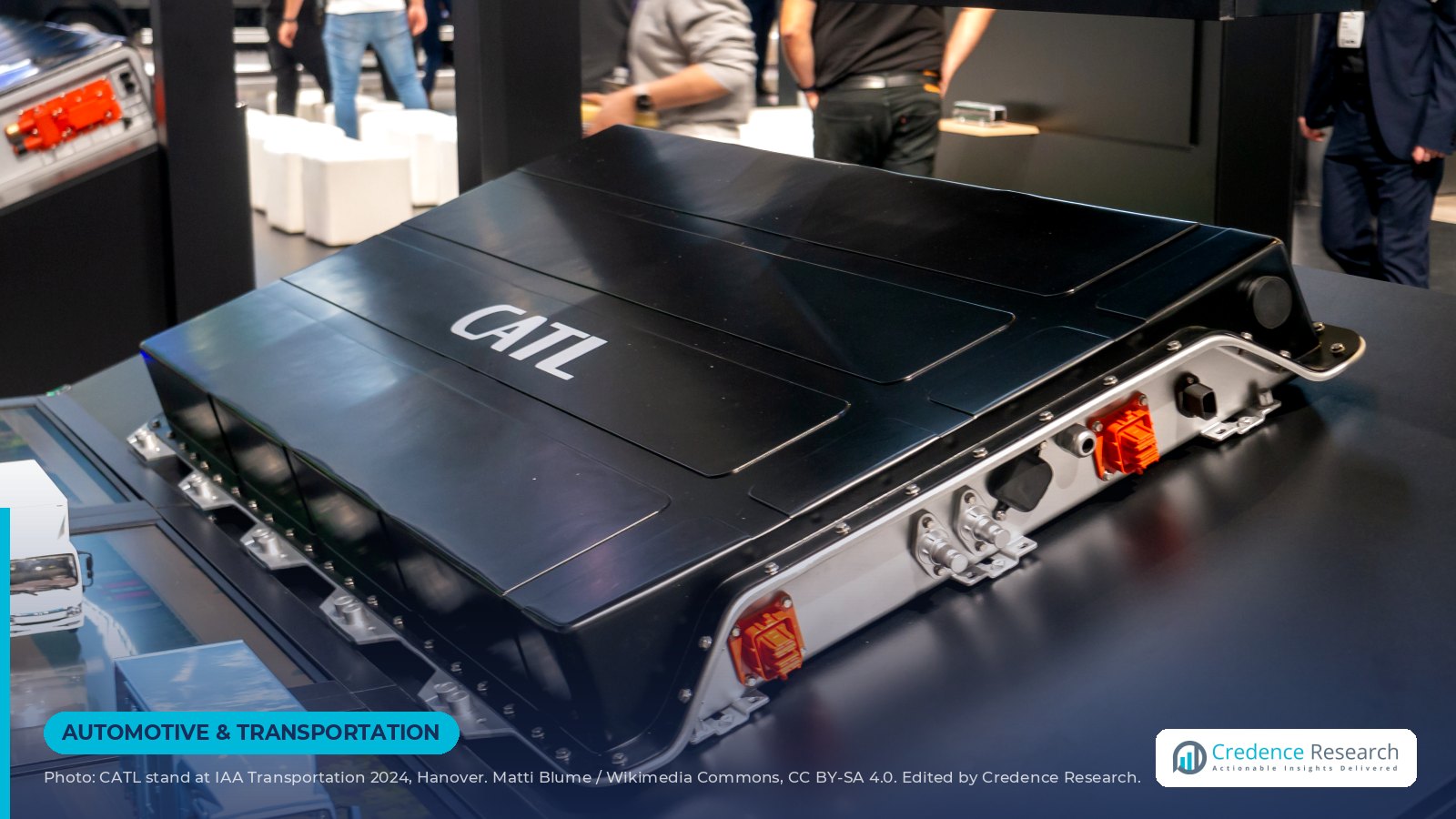
Image: CATL battery pack on display at IAA Transportation 2024 in Hanover, by Matti Blume via Wikimedia Commons, CC BY-SA 4.0. Cropped and edited by Credence Research.

About the Author

Senior News Editor at Credence Research Inc