
Hudbay and Mitsubishi Approve $2.07 Billion Copper World Mine in Arizona
Hudbay Minerals and Mitsubishi Corporation have approved construction of the Copper World project in southern Arizona, committing about $2.07 billion in initial capital to an open-pit copper mine that the partners expect to begin production in the second half of 2029. Toronto-based Hudbay, which owns 70% of the project, announced the final investment decision on Oct. 21, 2026, alongside a definitive feasibility study and a financing package that leaves the company funding roughly one-quarter of the build cost. The site lies about 31 miles southeast of Tucson.
Key developments
- Hudbay and Mitsubishi, which holds the remaining 30% through a joint venture formed in January 2026, sanctioned Copper World with initial growth capital of $2.07 billion, or $1.84 billion net of a precious metals stream payment, to be spent over 36 months.
- The base case calls for about 102,000 tonnes of copper a year over the first 10 years, rising to roughly 120,000 tonnes in years six through 10, with molybdenum concentrate as a by-product.
- Funding combines Mitsubishi's $600 million initial equity, a $230 million stream deposit from Wheaton Precious Metals for 92.5% of contained gold and silver, about $650 million of planned project-level debt and roughly $500 million in Hudbay contributions starting in 2028.
- Hudbay said all major permits for construction and initial operations are in hand, and the base case needs only state and local approvals.
- The company expects more than 1,000 construction jobs, about 500 permanent operating roles and up to 3,000 indirect jobs.
Project background
Copper World is the redesigned successor to Hudbay's long-contested Rosemont project on the east side of the Santa Rita Mountains, which stalled after federal courts set aside its U.S. Forest Service approval. Hudbay reworked the plan around deposits on the western flank of the range, largely on private land, so that the initial phase could advance under Arizona state permits instead of a federal review. That redesign is the main reason the company can now move to construction without waiting on federal agencies.
The mine will be a conventional truck-and-shovel operation across four pits, East, Broadtop, West and Peach-Elgin, feeding an on-site flotation concentrator. The plant starts at 60,000 tons per day and expands to 90,000 tons per day in year five, with an in-pit crushing and conveying system planned for year four. The feasibility study reports proven and probable reserves of 390 million tonnes grading 0.47% copper, supporting a 15-year base case mine life. An extension case, which would push mining onto federal land around year 10 and requires federal permits, stretches the life to 37 years.
Mitsubishi's entry earlier this year was the step that made sanction possible. The Japanese trading house closed its 30% stake in January, paying about $420 million at closing with the balance of its $600 million commitment due within 18 months.
Industry implications
Large greenfield copper mines rarely reach a construction decision in the United States, where permitting timelines have historically run a decade or longer. A sanctioned project with state permits secured gives the domestic industry a rare near-term addition to mine supply, at a time when demand from grid upgrades, electric vehicles, data centers and defense programs is drawing policy attention to where copper comes from. Hudbay itself said the U.S. is expected to remain a net importer of copper metal.
The decision also highlights the gap between mining and processing. Copper World's base case produces concentrate, not refined metal. Hudbay has outlined an optional concentrate leach facility that would make copper cathode on site, which it markets under an "Arizona Copper Made for America" theme, but that plant is not part of the sanctioned scope. Until it is built, the concentrate must still be smelted and refined somewhere, and U.S. smelting capacity is limited.
Competitive and supply chain implications
For Hudbay, the project is a step change in scale. The company expects consolidated copper output to reach about 250,000 tonnes a year once Copper World is running, alongside its Constancia mine in Peru, Snow Lake operations in Manitoba and Copper Mountain in British Columbia. That puts it closer to the mid-tier producers competing for capital and offtake partners in the Americas.
For Mitsubishi, the investment fits a broader pattern of Japanese trading houses buying equity in overseas mines to secure raw materials for domestic smelters, cable makers and electronics suppliers. Wheaton's stream, which converts the gold and silver by-products into upfront cash, shows how royalty and streaming companies continue to fill part of the funding gap that banks and equity markets leave in large mine builds. Equipment makers, engineering firms and reagent suppliers stand to benefit from a three-year construction program in a region that already hosts several large copper operations.
Regional implications
Arizona already produces the majority of U.S. mined copper, and Copper World adds another major operation to the Pima County mining district south of Tucson, near existing open pits around Sahuarita and Green Valley. Hudbay estimates total U.S. tax payments of about $1.1 billion under the base case and up to $3.7 billion under the extension case, along with the construction and operating jobs it has outlined.
The project's history means local scrutiny will continue. Water use in a desert basin, dust and traffic are recurring concerns for nearby communities, and the extension case will need federal permits that could revive the legal debates that halted Rosemont. Hudbay pointed to faster federal reviews for Arizona mines under the FAST-41 permitting program, noting recent approvals in about three years.
Credence Research analysis
The structure of this decision matters as much as the decision itself. By bringing in Mitsubishi and Wheaton before sanction and limiting project debt to under 30% leverage, Hudbay has cut its own exposure to roughly a quarter of the initial capital and deferred its first contribution to 2028. That approach reduces balance sheet risk for a mid-sized miner taking on a project of this size, but it also hands a meaningful share of future cash flows to partners. The model is likely to be copied by other developers holding permitted but capital-heavy U.S. deposits.
The bigger strategic question is downstream. A domestic mine that ships concentrate abroad for smelting adds less to supply chain resilience than its headline tonnage suggests. The optional leach facility is the piece that would turn Copper World into a source of U.S.-made cathode, and Hudbay's own assumption of a 10% U.S. cathode premium signals that it sees value in that local processing step. Whether that plant is built will be a better test of the project's role in domestic supply security than today's construction decision.
What comes next
- Filing of the NI 43-101 technical report for the definitive feasibility study on SEDAR+ and EDGAR.
- Closing of Hudbay's upsized $700 million credit facilities, extended to November 2030, expected in the fourth quarter of 2026.
- Hudbay's third-quarter 2026 results call on Nov. 12, 2026, likely to include early construction updates.
- Project-level debt financing of about $650 million and Hudbay's first capital contribution in 2028.
- First copper production targeted for the second half of 2029, with the concentrator expansion to 90,000 tons per day in year five.
Sources
- Hudbay Minerals: Hudbay and Mitsubishi Approve Copper World Project Construction (Oct. 21, 2026)
- Hudbay Minerals: Closing of $600 Million Strategic Investment from Mitsubishi Corporation (Jan. 12, 2026)
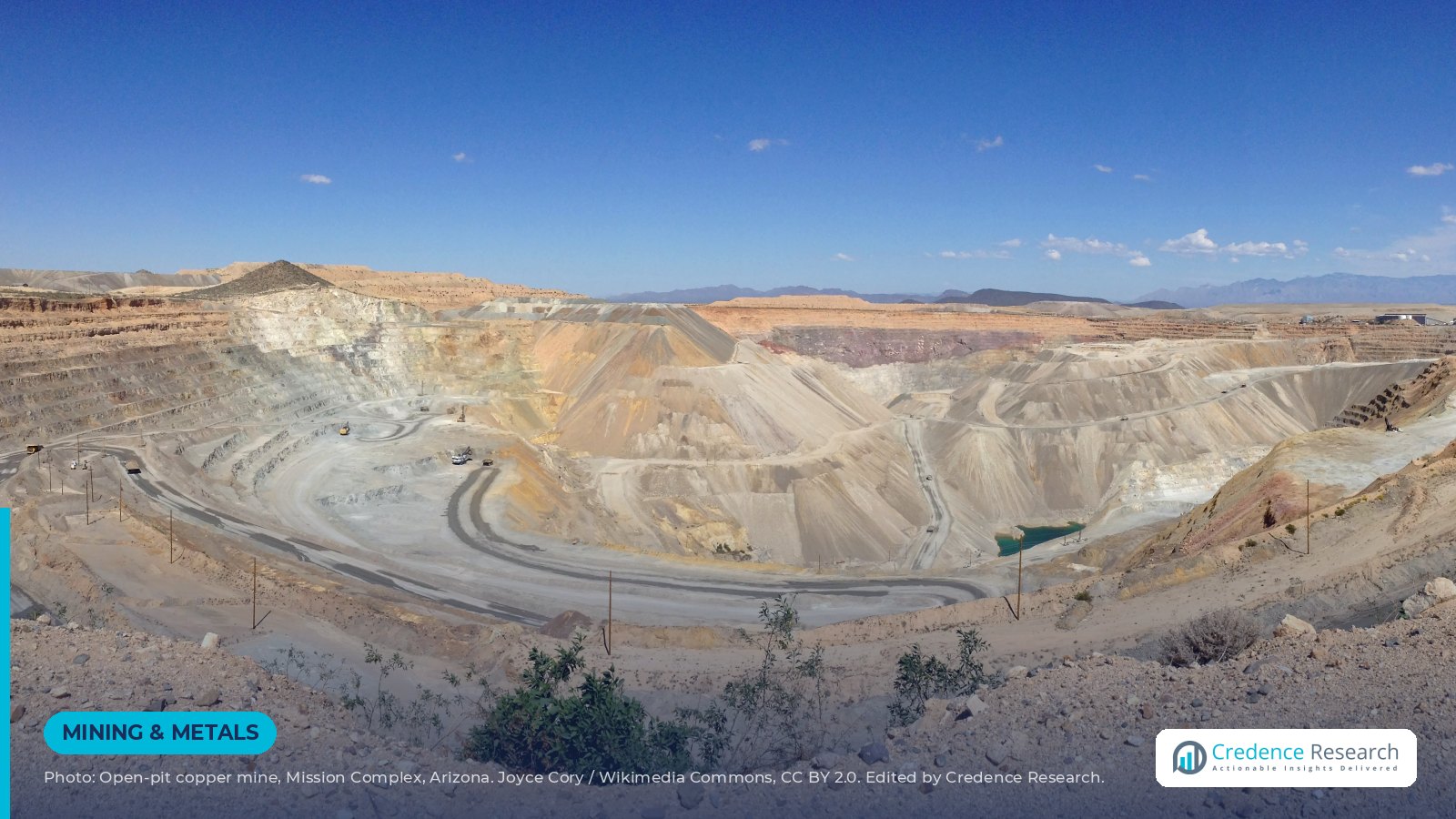
Image: Open-pit copper mine at the Mission Complex in southern Arizona, by Joyce Cory via Wikimedia Commons, CC BY 2.0. Cropped and edited by Credence Research.

About the Author

Senior News Editor at Credence Research Inc