
Electric Mid Large 14m Bus Market Size and Outlook
How big is the Electric Mid Large 14m Bus market?
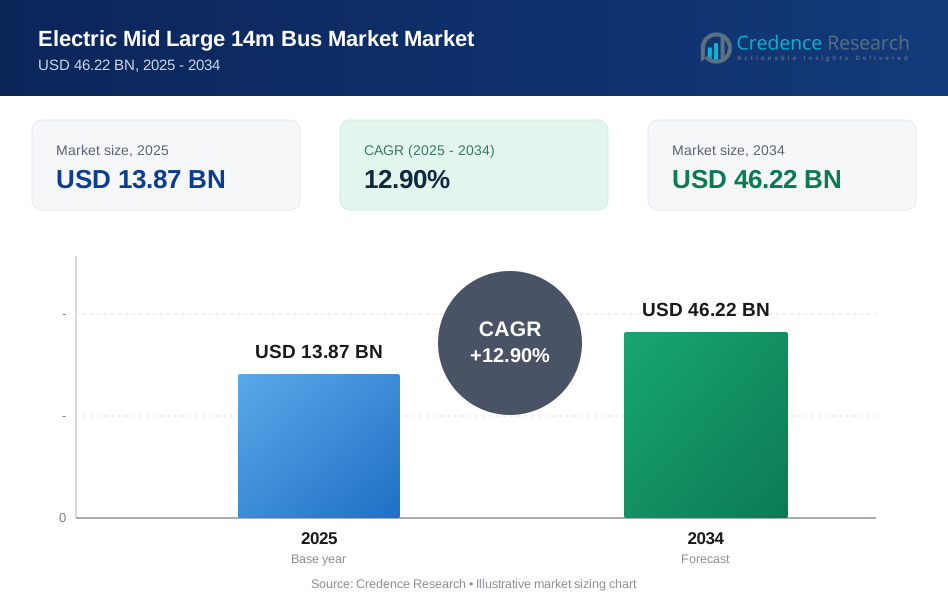
The Electric Mid Large 14m Bus market was valued at USD 13.87 billion in 2025 and is projected to reach USD 46.22 billion by 2034, reflecting a compound annual growth rate (CAGR) of 12.90% from 2025 to 2034. These figures represent robust growth driven by electrification mandates and evolving fleet requirements.
Underlying demand for Electric Mid Large 14m Buses is propelled by global efforts to decarbonize public transportation, reduce urban emissions, and modernize transit fleets. Historical context shows a shift from diesel to electric propulsion, with cities and transit authorities increasingly prioritizing sustainability and operational efficiency. This transition is further supported by government incentives, regulatory mandates, and public procurement programs that favor zero-emission vehicles.
Operational indicators such as battery cost reductions, improved charging infrastructure, and advancements in battery chemistry have made electric buses more viable for longer routes and higher utilization. Customer behavior is shifting as transit agencies seek lower total cost of ownership and improved passenger experience. Regulatory frameworks and competitive supplier offerings are accelerating adoption, with suppliers investing in R&D and partnerships to meet evolving requirements.
Geographically, Asia Pacific leads in both production and deployment, supported by large-scale government initiatives and urbanization. Europe and North America are also significant, driven by policy mandates and funding for fleet renewal. Competitive positioning is shaped by technology leadership, local manufacturing, and aftersales support, with the principal outlook condition being the pace of infrastructure deployment and policy consistency.
Report Attributes
| Attribute | Detail |
|---|---|
| Historical period | 2018-2024 |
| Base year | 2025 |
| Forecast period | 2025-2034 |
| Base-year market size | USD 13.87 billion |
| Forecast-year market size | USD 46.22 billion |
| Revenue CAGR (2025-2034) | 12.90% |
| Segments covered | Propulsion, Length, Application, Battery Chemistry, Charging/Fueling, Configuration |
| Geographic scope | Global |
| Measurement basis | Revenue (USD billion) |
Electric Mid Large 14m Bus Market Key Indicators
- In 2023, over 60,000 electric buses were delivered globally, with Asia Pacific accounting for more than 70% of new registrations, highlighting the region’s dominance in adoption and manufacturing scale.
- Battery pack prices for electric buses fell below USD 150 per kWh in 2024, enabling more cost-effective procurement and supporting the economic case for fleet electrification.
- Major cities in Europe and North America have set targets for 100% zero-emission bus fleets by 2035, driving forward public procurement and infrastructure investment.
- Charging infrastructure deployment reached over 15,000 depot and opportunity charging points worldwide in 2024, reducing operational barriers and supporting higher utilization rates.
Market Size and Growth Outlook From 2025 to 2034
What is the Electric Mid Large 14m Bus market forecast for 2034?
The Electric Mid Large 14m Bus market is forecast to reach USD 46.22 billion by 2034, growing at a CAGR of 12.90% from the 2025 base year, reflecting strong momentum in fleet electrification and policy support.
| Year or period | Metric | Value | Basis |
|---|---|---|---|
| 2018-2024 | Historical period | - | Reported |
| 2025 | Base-year market size | USD 13.87 billion | Estimate |
| 2025-2034 | Revenue CAGR | 12.90% | Forecast interval |
| 2034 | Forecast-year market size | USD 46.22 billion | Forecast |
Market growth is driven by rising adoption rates, replacement of aging diesel fleets, and expanding urban transit networks. Revenue expansion reflects both increased unit demand and higher-value configurations, with pricing influenced by battery and technology advancements.
Electric Mid Large 14m Bus Market Scope
The Electric Mid Large 14m Bus market includes battery electric, fuel cell, hybrid, and other low-emission buses ranging from 9 to 14 meters in length, serving city/transit, coach, school, and shuttle applications. The market covers buses by battery chemistry, charging/fueling method, and configuration, measured by supplier revenue. Exclusions include non-electric and sub-9m buses, aftermarket services, and unrelated vehicle categories.
| Category | Segments |
|---|---|
| By Propulsion | Battery Electric (BEV), Fuel Cell Electric (FCEV), HEV/PHEV, Other Low-Emission Powertrains |
| By Length | 9-10.5 m, 10.5-12 m, 12-14 m |
| By Application | City/Transit Bus, Coaches, School Bus, Midi/Shuttle Bus |
| By Battery Chemistry | LFP, NMC/NCA, LTO, Other |
| By Charging/Fueling | Depot Plug-in, Opportunity/Pantograph, Inductive, Hydrogen Refueling |
| By Configuration | Low-Floor/Low-Entry, Standard-Floor; Single-Deck, Double-Deck |
What this report answers
This report provides actionable insights for market entry, portfolio development, pricing, regional prioritization, and competitive benchmarking in the Electric Mid Large 14m Bus market, supporting informed strategic decisions.
Electric Mid Large 14m Bus Market Segmentation Insights
The Electric Mid Large 14m Bus market is segmented by propulsion, length, application, battery chemistry, charging/fueling method, and configuration. Each dimension reflects evolving technology, operational requirements, and buyer preferences, shaping supplier strategies and revenue opportunities.
By Propulsion
Battery Electric (BEV) leads adoption and revenue growth
Battery Electric (BEV) buses represent the largest and fastest-growing propulsion segment, driven by zero-emission mandates, lower operating costs, and maturing battery technology. BEVs are favored for city and transit applications, where route predictability and depot charging align with operational needs. Fuel Cell Electric (FCEV) buses are gaining traction in regions with hydrogen infrastructure, offering longer range and faster refueling, but face higher upfront costs and limited fueling networks. HEV/PHEV and other low-emission powertrains serve niche applications or transitional fleets, with declining share as full electrification accelerates.
| Segment | Revenue model | Growth profile |
|---|---|---|
| Battery Electric (BEV) | Direct sales, fleet tenders | High, policy-driven |
| Fuel Cell Electric (FCEV) | Direct sales, pilot projects | Emerging, infrastructure-dependent |
| HEV/PHEV | Direct sales, replacement | Declining, transitional |
| Other Low-Emission Powertrains | Direct sales | Niche, limited |
By Length
The 12-14 meter segment dominates revenue, aligning with standard city and intercity bus requirements. These buses offer optimal passenger capacity and operational flexibility for urban and regional routes. The 10.5-12 meter segment serves medium-density corridors and school transport, while 9-10.5 meter buses are preferred for shuttle and midi applications, especially in congested or low-demand areas. Length selection is influenced by route structure, passenger volumes, and regulatory limits.
By Application
City/transit buses account for the majority of Electric Mid Large 14m Bus deployments, reflecting urban fleet renewal and emission-reduction targets. Coaches are increasingly electrified for intercity and tourism routes, though adoption is constrained by range and charging infrastructure. School buses and midi/shuttle buses represent growing segments, supported by safety, noise, and air-quality benefits, with procurement often tied to public funding and local policy.
By Battery Chemistry
LFP (Lithium Iron Phosphate) batteries are widely adopted for their safety, cycle life, and cost advantages, especially in high-utilization city buses. NMC/NCA chemistries offer higher energy density, supporting longer-range applications and premium configurations. LTO (Lithium Titanate Oxide) is used in fast-charging or opportunity-charging scenarios, while other chemistries address niche requirements or emerging technologies. Battery selection impacts vehicle cost, range, charging speed, and lifecycle economics.
By Charging/Fueling
Depot plug-in charging is the most common method, favored for overnight charging and operational simplicity. Opportunity/pantograph charging supports high-frequency routes and rapid turnaround, particularly in dense urban networks. Inductive charging is emerging for select applications, offering wireless convenience but requiring infrastructure investment. Hydrogen refueling is essential for FCEV buses, with adoption tied to regional hydrogen availability and policy support.
By Configuration
Low-floor and low-entry configurations dominate city and transit applications, enabling accessibility and efficient passenger flow. Standard-floor buses are used in specific regional or intercity contexts. Single-deck buses are the norm, but double-deck models are deployed in high-capacity corridors or markets with space constraints. Configuration choices reflect regulatory requirements, passenger needs, and operator economics.
Detailed Segmentation Coverage
- By Propulsion: Battery Electric (BEV); Fuel Cell Electric (FCEV); HEV/PHEV; Other Low-Emission Powertrains.
- By Length: 9-10.5 m; 10.5-12 m; 12-14 m.
- By Application: City/Transit Bus; Coaches; School Bus; Midi/Shuttle Bus.
- By Battery Chemistry: LFP; NMC/NCA; LTO; Other.
- By Charging/Fueling: Depot Plug-in; Opportunity/Pantograph; Inductive; Hydrogen Refueling.
- By Configuration: Low-Floor/Low-Entry; Standard-Floor; Single-Deck; Double-Deck.
Request a Free Sample
Fill in your details and we'll send you a free sample report.
- Sample data tables & charts
- Research methodology
Market Dynamics
Electric Mid Large 14m Bus Market Recent Trends
The Electric Mid Large 14m Bus market is shaped by rapid technology innovation, evolving procurement models, and new approaches to fleet management. Key trends include modular battery systems, digital fleet management, public-private partnerships, and the emergence of new business models for charging and maintenance.
Modular battery and platform architectures
Manufacturers are adopting modular battery and chassis designs to enable flexible configurations, faster assembly, and easier maintenance. This trend supports customization for different route profiles and operational needs, allowing operators to optimize range, capacity, and charging strategies. Modular platforms also facilitate technology upgrades and reduce lifecycle costs, enhancing supplier competitiveness.
Digitalization and fleet management solutions
Digital fleet management platforms are increasingly integrated into Electric Mid Large 14m Buses, providing real-time monitoring, predictive maintenance, and route optimization. These solutions improve operational efficiency, reduce downtime, and support data-driven decision-making. Digitalization also enables remote diagnostics and over-the-air updates, strengthening supplier-customer relationships and enabling new service models.
Public-private partnerships and financing innovation
Public-private partnerships (PPPs) and innovative financing models are emerging to address high upfront costs and accelerate fleet renewal. Leasing, pay-per-use, and performance-based contracts allow operators to access new technology without large capital outlays. PPPs also facilitate infrastructure deployment and risk-sharing, expanding market access for both established and new entrants.
Emergence of new charging and energy service models
Energy-as-a-service and managed charging solutions are gaining traction, enabling operators to outsource charging infrastructure, energy procurement, and maintenance. These models reduce operational complexity and capital requirements, while supporting grid integration and renewable energy use. The trend is particularly relevant in regions with fragmented infrastructure or evolving regulatory frameworks.
Electric Mid Large 14m Bus Market Opportunities
The biggest opportunities in the Electric Mid Large 14m Bus market lie in underserved geographies, new applications, and innovative service models. Addressing infrastructure gaps, expanding financing options, and tailoring solutions to local needs will unlock additional demand and revenue streams.
Expanding into emerging markets
Emerging markets in Latin America, the Middle East, and Africa present significant untapped demand for Electric Mid Large 14m Buses. Urbanization, air quality concerns, and growing public transport needs create a favorable environment. Success requires localized solutions, partnerships with local stakeholders, and adaptation to regulatory and infrastructure constraints. Execution risk centers on funding availability and policy continuity.
Electrification of intercity and coach segments
While city/transit buses lead adoption, the electrification of intercity and coach segments offers substantial growth potential. Meeting longer-range and comfort requirements demands advances in battery technology, charging infrastructure, and vehicle design. Operators require reliable range, fast charging, and competitive total cost of ownership. The main risk is technology readiness and infrastructure coverage on intercity routes.
Innovative financing and business models
Leasing, pay-per-use, and performance-based contracts can lower adoption barriers for operators with limited capital. These models enable broader market participation and support fleet renewal in budget-constrained environments. Providers must manage credit risk, asset utilization, and service quality to ensure commercial viability. The opportunity is greatest where public funding is limited or procurement cycles are long.
Integration with smart city and mobility ecosystems
Integrating Electric Mid Large 14m Buses into smart city and multi-modal mobility platforms creates new value propositions. Data sharing, interoperability, and seamless passenger experiences enhance public transport attractiveness and operational efficiency. Realizing this opportunity requires collaboration across technology, infrastructure, and policy domains. The principal risk is fragmentation and lack of standardization across systems and stakeholders.
Electric Mid Large 14m Bus Market Challenges
The main barriers to adoption in the Electric Mid Large 14m Bus market include high upfront costs, infrastructure limitations, and supply chain constraints. These challenges affect procurement, deployment, and operational economics, requiring coordinated solutions from suppliers, operators, and policymakers.
High upfront capital costs and funding constraints
Electric Mid Large 14m Buses typically require higher initial investment than diesel alternatives, driven by battery and technology costs. This barrier is most acute for operators with limited access to financing or public subsidies. High capital requirements can delay procurement, limit fleet renewal, and restrict market entry for smaller operators. Addressing this challenge requires innovative financing, leasing, and public-private partnerships to spread costs and reduce risk.
Charging and fueling infrastructure gaps
Insufficient charging and hydrogen refueling infrastructure remains a significant constraint, particularly outside major urban centers. Operators face operational uncertainty, range anxiety, and scheduling challenges when infrastructure is lacking or unreliable. Infrastructure deployment is often uneven, with regulatory, permitting, and investment hurdles slowing progress. This barrier limits route flexibility and can delay or reduce the scale of electric bus adoption, especially in emerging markets.
Supply chain and technology risks
The Electric Mid Large 14m Bus market is exposed to supply chain volatility, including battery raw material shortages, component lead times, and technology obsolescence. Rapid innovation can render existing models less competitive, while supply disruptions can delay deliveries and increase costs. Operators and suppliers must manage technology risk, ensure aftersales support, and maintain flexibility to adapt to evolving standards and customer requirements. These risks can affect both procurement decisions and long-term fleet economics.
Trade and Supply Context
Electric Mid Large 14m Bus Supply Conditions in 2025
Global supply of Electric Mid Large 14m Buses is concentrated in Asia Pacific, particularly China, which dominates both manufacturing and exports. Europe and North America rely on a mix of local assembly and imports, with increasing emphasis on regional supply chains and technology partnerships. Cross-border trade is shaped by regulatory standards, local content requirements, and evolving procurement policies.
Electric Mid Large 14m Bus Market Growth Drivers
Growth in the Electric Mid Large 14m Bus market is driven by electrification mandates, battery cost declines, total cost of ownership advantages, and expanding charging infrastructure. These factors collectively accelerate fleet renewal and support higher adoption rates across regions and applications.
Public-transport electrification mandates and fleet tenders
Government mandates for zero-emission public transport are a primary driver, with cities and regions setting ambitious targets for fleet electrification. Large-scale tenders and procurement programs create predictable demand, enabling suppliers to scale production and invest in technology. Transit agencies prioritize compliance and operational efficiency, driving adoption of Electric Mid Large 14m Buses. The effect is strongest in regions with clear policy frameworks and funding support, but can be limited by budget constraints and political changes.
Battery cost declines and higher energy density improving route economics
Advancements in battery technology have reduced costs and increased energy density, making electric buses more competitive with diesel alternatives. Lower battery prices enable broader adoption, while improved range and charging speed expand operational flexibility. Operators benefit from reduced capital and operating expenses, supporting larger and more diverse fleets. However, supply chain volatility and raw material costs can moderate these benefits.
Evidence. In 2024, average battery pack prices for electric buses fell below USD 150 per kWh, supporting more cost-effective procurement and enabling longer-range deployments.
Lower total cost of ownership versus diesel fleets as utilization rises
Electric Mid Large 14m Buses offer lower total cost of ownership (TCO) compared to diesel fleets, especially as utilization increases. Savings stem from reduced fuel, maintenance, and regulatory compliance costs. High-utilization routes and urban networks see the greatest TCO benefits, encouraging operators to accelerate replacement cycles. The impact is moderated by upfront capital costs and the need for charging infrastructure investment.
Expansion of charging and fueling infrastructure
The deployment of depot, opportunity, and hydrogen refueling infrastructure is critical to market growth. Expanded charging networks reduce operational barriers, enable higher utilization, and support diverse route profiles. Infrastructure investment is often coordinated with public procurement and urban planning, enhancing the commercial case for electric buses. Delays in infrastructure rollout or interoperability issues can constrain adoption, particularly in emerging markets.
Driver Impact Summary
| Driver | Expected Market Effect | Geographic Relevance | Impact Timeline |
|---|---|---|---|
| Public-transport electrification mandates and fleet tenders | Accelerates fleet renewal and adoption of electric buses | Global, strongest in APAC and Europe | Medium term |
| Battery cost declines and higher energy density | Improves route economics and expands addressable market | Global | Short to medium term |
| Lower total cost of ownership versus diesel fleets | Drives replacement of diesel buses and increases utilization | Global, urban markets | Medium to long term |
| Expansion of charging and fueling infrastructure | Enables higher adoption and operational flexibility | Global, emerging markets | Medium to long term |
Electric Mid Large 14m Bus Market Geographical Outlook
Asia Pacific leads the Electric Mid Large 14m Bus market, accounting for 37.48% of global revenue, followed by Europe at 25% and North America at 22%. Regional leadership is shaped by policy mandates, procurement scale, and infrastructure investment, with each region exhibiting distinct adoption drivers and constraints.
North America
North America represents 22% of global Electric Mid Large 14m Bus revenue, with the United States and Canada driving demand through federal and state-level zero-emission mandates. Major cities are investing in fleet electrification, supported by grants and incentives. Procurement is often centralized, with competitive tenders favoring established OEMs and local assembly. Infrastructure deployment is accelerating, but regional disparities persist, especially in rural and low-density areas. The market is characterized by high specification requirements and a focus on total cost of ownership.
Europe
Europe accounts for 25% of global market share, led by countries such as Germany, France, the UK, and the Nordics. The region benefits from stringent emission regulations, ambitious fleet renewal targets, and coordinated funding mechanisms. Urban transit agencies are at the forefront of adoption, with integrated charging infrastructure and multi-modal mobility strategies. Competition is intense, with both European and international suppliers active. Policy harmonization and cross-border procurement initiatives support market growth, though supply chain and cost challenges remain.
Asia Pacific
Asia Pacific dominates the Electric Mid Large 14m Bus market with a 37.48% share, driven by China’s large-scale deployment and manufacturing leadership. National and municipal policies mandate electrification, with extensive public funding and vertically integrated supply chains. Other key markets include Japan, South Korea, and India, each with unique regulatory and operational contexts. The region benefits from cost advantages, rapid technology adoption, and export-oriented production, but faces challenges in standardization and aftersales support.
Latin America
Latin America holds a 6% share, with Brazil, Chile, and Mexico leading adoption. The region is characterized by pilot projects, international partnerships, and growing interest in sustainable urban mobility. Funding constraints and infrastructure gaps limit large-scale deployment, but international development finance and city-level initiatives are expanding the addressable market. Suppliers often collaborate with local partners to navigate regulatory and operational complexities.
Middle East
The Middle East is an emerging market for Electric Mid Large 14m Buses, with adoption concentrated in the Gulf states and select urban centers. Government-led sustainability agendas and high-profile pilot projects are driving initial demand. Infrastructure development is ongoing, with a focus on integrating electric buses into broader smart city and public transport strategies. Market access is influenced by procurement standards, climate adaptation, and local content requirements.
Africa
Africa remains at an early stage of adoption, with limited but growing interest in electric buses for urban transit modernization. South Africa, Egypt, and Kenya are piloting projects, often supported by international donors and technology partners. Barriers include high upfront costs, limited charging infrastructure, and policy uncertainty. However, urbanization and air quality concerns are expected to drive gradual market entry and localized solutions.
Recent Developments and Strategic Implications
October 2024 – VDL Groep and Arriva
In October 2024, VDL Groep said Arriva ordered 157 new-generation VDL Citea electric buses for West Brabant, including 58 LE-122 and 99 LE-135 units, with deliveries starting in the first half of 2025 for the new concession that began on July 6, 2025. This matters for the electric mid-large 14 m bus market because it shows that regional operators are shifting 12 m to 13.5 m high-utilization fleets to battery-electric platforms at tender scale, not only on compact inner-city routes. For competitors, the award raises the bar on charging flexibility, concession execution and whole-fleet operating economics in European public transport bids.
March 2025 – Volvo Buses
In March 2025, Volvo Buses launched the locally manufactured Volvo 7800 Electric in Mexico as articulated and bi-articulated models for BRT systems, positioning the product as a turnkey zero-emission solution with up to 300 km range per charge. This matters because it expands the high-capacity electric bus opportunity in Latin America and shows that localized production can accelerate adoption in larger bus classes where procurement often depends on domestic content, service support and lifecycle guarantees. For customers and investors, local assembly strengthens confidence in supply continuity, service responsiveness and the commercial viability of large-bus electrification programs.
October 2025 – Daimler Buses
In October 2025, Daimler Buses world-premiered the series-production Mercedes-Benz eIntouro at Busworld Europe, describing it as its first battery-electric intercity bus and stating that first customer vehicles are expected in the second half of 2026. This matters because it extends electrification from city operations into intercity and regional duty cycles, a key step for the mid-large bus market where range, charging windows and route flexibility directly influence replacement demand. For competitors, the move increases pressure to offer credible electric intercity platforms rather than relying only on urban bus portfolios.
October 2025 – Yutong
In October 2025, Yutong delivered 400 battery-electric buses to Pakistan, including E12PRO and E9 models, and said the vehicles had progressively entered service across 19 cities in Punjab Province. This matters because it converts a large order into actual multi-city deployment, demonstrating that electric bus programs can scale in hot-climate emerging markets when vehicle customization, service coverage and workforce training are built into the rollout. For customers and investors, the deployment is a practical proof point that execution capability is becoming as important as vehicle price in winning large bus contracts.
December 2025 – BYD and De Lijn
In December 2025, BYD won a new order from De Lijn for 268 B12.b electric buses under an existing framework agreement for up to 500 standard 12-meter e-buses, with phased deliveries expected to begin in the second quarter of 2027. This matters because it reflects repeat procurement based on operating performance and highlights how next-generation battery-chassis integration is becoming a differentiator in large fleet renewal programs. For competitors, repeat awards from major public operators signal that installed-base performance and platform efficiency now carry more weight than first-entry pricing alone.
May 2026 – MAN Truck & Bus
In May 2026, MAN Truck & Bus received an order for 112 fully electric Lion’s City E buses for Vilnius, comprising 84 solo 12-meter buses and 28 articulated 18-meter buses, in what MAN described as the largest e-bus procurement in Lithuanian history. This matters because it shows continued scale-up in Central and Eastern European electrification and reinforces the volume backbone of the mid-large bus market, where 12 m and higher-capacity formats support manufacturing scale, battery standardization and depot investment cases. For suppliers and investors, orders of this size improve visibility on demand pipelines for batteries, charging infrastructure and long-term maintenance services.
Need a Custom Version of This Report?
Tailor the scope, geography, or segments to your exact requirements.
- Custom geography or segment scope
- Direct access to our analyst team
Electric Mid Large 14m Bus Market Competitive Analysis
Leading companies in the Electric Mid Large 14m Bus market include AB Volvo, BYD Company Ltd., Yutong Bus Co., Ltd., CAF Group, VDL Groep, Daimler Buses, Solaris Bus & Coach, MAN Truck & Bus, and Tata Motors. These firms compete on technology, regional presence, and aftersales support rather than solely on price.
The competitive landscape is characterized by a mix of established global OEMs and regional specialists. Companies such as BYD and Yutong leverage scale, vertical integration, and strong domestic demand to maintain leadership, particularly in Asia Pacific. European players like AB Volvo, VDL Groep, and Solaris Bus & Coach focus on compliance with stringent emission standards and customization for local markets. Daimler Buses and MAN Truck & Bus benefit from extensive distribution networks and established relationships with transit agencies. Tata Motors and CAF Group are expanding their presence through partnerships and technology investments, targeting emerging markets and niche applications.
Competition is intensifying as new entrants and technology providers seek to capture share through innovation, modular platforms, and digital services. Switching costs are moderate, with operators valuing reliability, lifecycle support, and integration with existing infrastructure. Strategic alliances, joint ventures, and local assembly are common strategies to address regulatory requirements and enhance market access. The market remains dynamic, with differentiation increasingly based on total cost of ownership, operational flexibility, and service quality.
Key Companies
- AB Volvo
- BYD Company Ltd.
- Yutong Bus Co., Ltd.
- CAF Group
- VDL Groep
- Daimler Buses
- Solaris Bus & Coach
- MAN Truck & Bus
- Tata Motors
Frequently Asked Questions
What is the Electric Mid Large 14m Bus market size in 2025?
What is its forecast value by 2034?
What is the expected CAGR?
Which product or service segment leads the market?
Which region leads the market?
What drives demand in this market?
Who are the major companies in this market?
What are the main challenges and opportunities in this market?
Table of Content
Chapter 1. Report Introduction
- 1.1 Report Description & Purpose
- 1.1.1 Report Title & Market Definition
- 1.1.2 Unique Selling Propositions (USP) & Key Differentiators
- 1.1.3 Value Proposition for Stakeholders
- 1.2 Research Objectives
- 1.2.1 Market Sizing Objectives (Volume & Revenue) (Volume Where Applicable)
- 1.2.2 Segmentation Objectives
- 1.2.3 Competitive Intelligence Objectives
- 1.2.4 Forecast & Scenario Objectives
- 1.3 Report Scope
- 1.3.1 Electric Mid Large 14m Bus Market Scope – Segments & Subsegments Covered
- 1.3.2 Geographic Scope – Regions & Countries Covered
- 1.3.3 Historical Period, Base Year & Forecast Period (2018-2025; forecast to 2034)
- 1.3.4 Inclusions & Exclusions
- 1.4 Industry Classification & Applicable Codes
- 1.5 Currency, Measurement Units & Valuation Basis
- 1.6 Target Stakeholders
- 1.7 Limitations & Assumptions
Chapter 2. Executive Summary
- 2.1 Global Electric Mid Large 14m Bus Market Market Snapshot
- 2.1.1 Market Size – Historical (2018-2025) & Forecast (2025-2034) (2025: USD 13.87 BN → 2034: USD 46.22 BN)
- 2.1.2 Volume & Revenue – Global Totals (Volume Where Applicable)
- 2.1.3 Key Market Highlights – Top Five Facts
- 2.2 Electric Mid Large 14m Bus Market Market Segmentation Snapshot
- 2.2.1 Market Split – By Propulsion – 2025 vs. 2034 (Volume & Revenue) (Volume Where Applicable)
- 2.2.2 Market Split – By Length – 2025 vs. 2034 (Volume & Revenue) (Volume Where Applicable)
- 2.2.3 Market Split – By Application – 2025 vs. 2034 (Volume & Revenue) (Volume Where Applicable)
- 2.2.4 Market Split – By Battery Chemistry – 2025 vs. 2034 (Volume & Revenue) (Volume Where Applicable)
- 2.2.5 Market Split – By Charging/Fueling – 2025 vs. 2034 (Volume & Revenue) (Volume Where Applicable)
- 2.2.6 Market Split – By Configuration – 2025 vs. 2034 (Volume & Revenue) (Volume Where Applicable)
- 2.2.7 Market Split by Region – 2025 vs. 2034
- 2.3 Competitive Snapshot
- 2.3.1 Top 10 Players by Revenue Share – 2025
- 2.3.2 Top 10 Players by Volume Share – 2025 (Volume Where Applicable)
- 2.3.3 Recent Strategic Developments (18-Month Summary)
- 2.4 Key Investment Highlights & Strategic Conclusions
Chapter 3. Electric Mid Large 14m Bus Market Market Dynamics & Industry Analysis
- 3.1 Market Overview & Context
- 3.1.1 Electric Mid Large 14m Bus Market Market Position in the Broader Industry Value Chain
- 3.1.2 Demand Structure & Purchasing Dynamics
- 3.1.3 Market Maturity & Development Stage by Region
- 3.2 Electric Mid Large 14m Bus Market Market Drivers
- 3.3 Electric Mid Large 14m Bus Market Market Restraints & Challenges
- 3.4 Electric Mid Large 14m Bus Market Market Opportunities
- 3.5 Porter's Five Forces Analysis
- 3.5.1 Threat of New Entrants
- 3.5.2 Bargaining Power of Suppliers
- 3.5.3 Bargaining Power of Buyers
- 3.5.4 Threat of Substitutes
- 3.5.5 Competitive Rivalry – Intensity Assessment
- 3.6 Electric Mid Large 14m Bus Market Value Chain Analysis
- 3.6.1 Upstream – Key Inputs, Resources & Suppliers
- 3.6.1.1 Key Input/Resource 1
- 3.6.1.2 Key Input/Resource 2
- 3.6.1.3 Key Input/Resource 3
- 3.6.2 Midstream – Core Operations & Value Creation
- 3.6.2.1 Operating Model & Process Overview
- 3.6.2.2 Key Operating Locations & Capabilities by Company
- 3.6.3 Downstream – Market Channels & End Users
- 3.6.3.1 Direct Sales & Customer Engagement Channels
- 3.6.3.2 Indirect Sales, Intermediaries & Partner Channels
- 3.6.4 Value Chain Profitability Analysis
- 3.6.1 Upstream – Key Inputs, Resources & Suppliers
- 3.7 PESTEL Analysis
- 3.7.1 Political Factors
- 3.7.2 Economic Factors
- 3.7.3 Social Factors
- 3.7.4 Technological Factors
- 3.7.5 Environmental Factors
- 3.7.6 Legal Factors
- 3.8 Electric Mid Large 14m Bus Market Supply Chain Analysis
- 3.8.1 Critical Input & Resource Availability Risk Assessment
- 3.8.2 Supplier & Operational Concentration Risk (Geographic Exposure)
- 3.8.3 Supply & Service Disruption Impact Analysis
- 3.9 Regulatory & Policy Landscape
Note: The regulatory and policy landscape section covers regulations based on their applicability to the market, Electric Mid Large 14m Bus Market category, geography, and scope of the study. Only regulatory frameworks with a material impact on operations, compliance, trade, sustainability, or market access are analyzed in detail.
Chapter 4. Key Investment Pockets & Opportunity Analysis
- 4.1 Electric Mid Large 14m Bus Market Market Attractiveness Analysis
- 4.1.1 By Region – Investment Attractiveness Matrix (Market Size × CAGR)
- 4.1.2 By Propulsion – Investment Attractiveness Matrix
- 4.1.3 By Length – Investment Attractiveness Matrix
- 4.1.4 By Application – Investment Attractiveness Matrix
- 4.1.5 By Battery Chemistry – Investment Attractiveness Matrix
- 4.1.6 By Charging/Fueling – Investment Attractiveness Matrix
- 4.1.7 By Configuration – Investment Attractiveness Matrix
- 4.2 Absolute Revenue Growth Opportunity
- 4.2.1 By Region – Absolute Revenue Growth Through 2034
- 4.2.2 By Propulsion – Absolute Revenue Growth
- 4.2.3 By Length – Absolute Revenue Growth
- 4.2.4 By Application – Absolute Revenue Growth
- 4.2.5 By Battery Chemistry – Absolute Revenue Growth
- 4.2.6 By Charging/Fueling – Absolute Revenue Growth
- 4.2.7 By Configuration – Absolute Revenue Growth
- 4.3 Incremental Demand Opportunity
- 4.3.1 By Region – Incremental Demand Through 2034
- 4.3.2 By Propulsion – Incremental Demand
- 4.4 Emerging Submarket Opportunity Deep Dive (Subject to Applicability)
- 4.5 Priority Market Opportunity Scorecards
- 4.5.1 United States
- 4.5.2 Europe
- 4.5.3 Asia
- 4.5.4 Middle East & Africa
Note: Priority market opportunity scorecards reflect the geographic scope and strategic relevance of the study. Listed markets are indicative and may be adapted to the industry.
Chapter 5. Electric Mid Large 14m Bus Market Cross-Border Trade & Market Access Analysis
- 5.1 International Trade & Cross-Border Activity Overview
- 5.1.1 Global Export Value by Country (2018-2025)
- 5.1.2 Global Export Volume by Country (2018-2025) (Volume Where Applicable)
- 5.1.3 Global Import Value by Country (2018-2025)
- 5.1.4 Global Import Volume by Country (2018-2025) (Volume Where Applicable)
- 5.1.5 Net Trade Balance by Country (2018-2025)
- 5.2 Export Analysis – By Propulsion
- 5.2.1 Category 1 (Applicable Classification Code)
- 5.2.2 Category 2 (Applicable Classification Code)
- 5.2.3 Category 3 (Applicable Classification Code)
- 5.2.4 Category 4 (Applicable Classification Code)
- 5.2.5 Category 5 (Applicable Classification Code)
- 5.3 Import Analysis – By Propulsion
- 5.3.1 Category 1 (Applicable Classification Code)
- 5.3.2 Category 2 (Applicable Classification Code)
- 5.3.3 Category 3 (Applicable Classification Code)
- 5.3.4 Category 4 (Applicable Classification Code)
- 5.3.5 Category 5 (Applicable Classification Code)
- 5.4 Cross-Border Pricing & Transaction Benchmarks
- 5.4.1 Export Pricing – By Propulsion & Country
- 5.4.2 Import Pricing – By Propulsion & Source Country
- 5.4.3 Price Trends (2018-2025)
- 5.5 Key Cross-Border Trade & Delivery Routes
- 5.5.1 Cross-Border Trade/Delivery Route 1
- 5.5.2 Cross-Border Trade/Delivery Route 2
- 5.5.3 Cross-Border Trade/Delivery Route 3
- 5.5.4 Cross-Border Trade/Delivery Route 4
- 5.5.5 Cross-Border Trade/Delivery Route 5
- 5.6 Trade Policy & Market Access Impact Assessment
- 5.6.1 Tariff & Non-Tariff Barriers
- 5.6.2 Regional Trade & Economic Integration Frameworks
- 5.6.3 Bilateral & Multilateral Trade Agreements
- 5.6.4 Cross-Border Operating, Licensing & Localization Requirements
Note: This chapter applies where cross-border trade or delivery is relevant to Electric Mid Large 14m Bus Market. Goods, services, and digital offerings are assessed using applicable classifications and transaction measures. Import-export volumes, trade balances, and route analyses are included only where meaningful to the market.
Chapter 6. Competitive Landscape & Company Benchmarking
- 6.1 Electric Mid Large 14m Bus Market Market Concentration & Structure
- 6.1.1 Herfindahl-Hirschman Index (HHI) – 2018 vs. 2025
- 6.1.2 Leading, Mid-Sized & Emerging Player Structure
- 6.1.3 Global, Regional & Local Player Dynamics
- 6.2 Electric Mid Large 14m Bus Market Market Share Analysis – 2025
- 6.2.1 Global Revenue Share by Company
- 6.2.2 Global Volume Share by Company (Volume Where Applicable)
- 6.2.3 Regional Revenue Share
- 6.2.4 Market Share Evolution (2018 vs. 2025)
- 6.2.5 Company Market Share by Key Segment
- 6.2.6 Company Market Share by Customer Group
- 6.3 Operating Scale, Capacity & Infrastructure Analysis
- 6.3.1 Global Operating Scale & Supply Capacity
- 6.3.2 Resource Utilization & Operating Efficiency
- 6.3.3 Output, Service Delivery & Activity Metrics
- 6.3.4 Operating Footprint & Infrastructure Map
- 6.3.5 Planned Operational & Capacity Expansion
- 6.4 Electric Mid Large 14m Bus Market Competitive Benchmarking Matrix
- 6.4.1 Revenue, Growth, Profitability & Operating Metric Comparison
- 6.4.2 Channel Revenue Mix
- 6.4.3 Geographic Revenue Exposure
- 6.4.4 R&D Intensity
- 6.4.5 Sustainability Maturity
- 6.5 Strategic Developments in Electric Mid Large 14m Bus Market (Last 24 Months)
- 6.5.1 Mergers, Acquisitions & Divestments
- 6.5.2 New Products, Services & Solutions in Electric Mid Large 14m Bus Market
- 6.5.3 Operational & Infrastructure Expansions
- 6.5.4 Strategic Alliances, Joint Ventures & Partnerships
- 6.5.5 Distribution Expansion & Market Entry
- 6.5.6 Sustainability & ESG Initiatives
- 6.6 Competitive Strategy Mapping
- 6.6.1 Leader, Challenger, Follower & Niche Classification
- 6.6.2 Pricing Strategy Comparison
- 6.6.3 Channel Strategy Matrix
Note: Strategic developments are included based on their materiality and the availability of reliable information.
Chapter 7. Global Electric Mid Large 14m Bus Market Market – By Propulsion
- 7.1 Segment Overview
- 7.1.1 Market Volume Share (2018, 2025 & 2026) (Volume Where Applicable)
- 7.1.2 Market Revenue Share (2018, 2025 & 2026)
- 7.1.3 Market Forecast Through 2034
- 7.1.4 Key Growth Drivers & Restraints
- 7.1.5 Leading Companies & Offerings
- 7.2 Subsegments Covered – By Propulsion
- Battery Electric (BEV)
- Fuel Cell Electric (FCEV)
- HEV/PHEV
- Other Low-Emission Powertrains
Chapter 8. Global Electric Mid Large 14m Bus Market Market – By Length
- 8.1 Segment Overview
- 8.1.1 Market Volume Share (2018, 2025 & 2026) (Volume Where Applicable)
- 8.1.2 Market Revenue Share (2018, 2025 & 2026)
- 8.1.3 Market Forecast Through 2034
- 8.1.4 Key Growth Drivers & Restraints
- 8.1.5 Leading Companies & Offerings
- 8.2 Subsegments Covered – By Length
- 9-10.5 m
- 10.5-12 m
- 12-14 m
Chapter 9. Global Electric Mid Large 14m Bus Market Market – By Application
- 9.1 Segment Overview
- 9.1.1 Market Volume Share (2018, 2025 & 2026) (Volume Where Applicable)
- 9.1.2 Market Revenue Share (2018, 2025 & 2026)
- 9.1.3 Market Forecast Through 2034
- 9.1.4 Key Growth Drivers & Restraints
- 9.1.5 Leading Companies & Offerings
- 9.2 Subsegments Covered – By Application
- City/Transit Bus
- Coaches
- School Bus
- Midi/Shuttle Bus
Chapter 10. Global Electric Mid Large 14m Bus Market Market – By Battery Chemistry
- 10.1 Segment Overview
- 10.1.1 Market Volume Share (2018, 2025 & 2026) (Volume Where Applicable)
- 10.1.2 Market Revenue Share (2018, 2025 & 2026)
- 10.1.3 Market Forecast Through 2034
- 10.1.4 Key Growth Drivers & Restraints
- 10.1.5 Leading Companies & Offerings
- 10.2 Subsegments Covered – By Battery Chemistry
- LFP
- NMC/NCA
- LTO
- Other
Chapter 11. Global Electric Mid Large 14m Bus Market Market – By Charging/Fueling
- 11.1 Segment Overview
- 11.1.1 Market Volume Share (2018, 2025 & 2026) (Volume Where Applicable)
- 11.1.2 Market Revenue Share (2018, 2025 & 2026)
- 11.1.3 Market Forecast Through 2034
- 11.1.4 Key Growth Drivers & Restraints
- 11.1.5 Leading Companies & Offerings
- 11.2 Subsegments Covered – By Charging/Fueling
- Depot Plug-in
- Opportunity/Pantograph
- Inductive
- Hydrogen Refueling
Chapter 12. Global Electric Mid Large 14m Bus Market Market – By Configuration
- 12.1 Segment Overview
- 12.1.1 Market Volume Share (2018, 2025 & 2026) (Volume Where Applicable)
- 12.1.2 Market Revenue Share (2018, 2025 & 2026)
- 12.1.3 Market Forecast Through 2034
- 12.1.4 Key Growth Drivers & Restraints
- 12.1.5 Leading Companies & Offerings
- 12.2 Subsegments Covered – By Configuration
- Low-Floor/Low-Entry
- Standard-Floor
- Single-Deck
- Double-Deck
Chapter 13. Global Electric Mid Large 14m Bus Market Market – By Sales & Delivery Channel
- 13.1 Segment Overview
- 13.1.1 Volume & Revenue Split by Channel (2025 & 2034) (Volume Where Applicable)
- 13.1.2 Channel Mix Evolution (2018-2034)
Chapter 14. Regional Market Analysis – Global Overview
- 14.1 Global Regional Overview
- 14.1.1 Regional Volume Share (Volume Where Applicable)
- 14.1.2 Regional Revenue Share
- 14.1.3 Regional Volume by Region (Volume Where Applicable)
- 14.1.4 Regional Revenue by Region
- 14.1.5 Regional Forecast Through 2034
- 14.2 Cross-Regional Segment Analysis
- 14.2.1 By Propulsion
- 14.2.2 By Length
- 14.2.3 By Application
- 14.2.4 By Battery Chemistry
- 14.2.5 By Charging/Fueling
- 14.2.6 By Configuration
- 14.2.7 By Sales & Delivery Channel
- 14.2.8 By Competitive Positioning & Price Tier
Chapter 15. North America Electric Mid Large 14m Bus Market Market
- 15.1 United States
- 15.2 Canada
- 15.3 Mexico
Chapter 16. Europe Electric Mid Large 14m Bus Market Market
- 16.1 Germany
- 16.2 France
- 16.3 Italy
- 16.4 United Kingdom
- 16.5 Spain
- 16.6 Poland
- 16.7 Russia
- 16.8 Netherlands
- 16.9 Belgium
- 16.10 Sweden
- 16.11 Denmark
- 16.12 Norway
- 16.13 Rest of Europe
Chapter 17. Asia Pacific Electric Mid Large 14m Bus Market Market
- 17.1 China
- 17.2 India
- 17.3 Japan
- 17.4 South Korea
- 17.5 Thailand
- 17.6 Indonesia
- 17.7 Vietnam
- 17.8 Malaysia
- 17.9 Australia
- 17.10 Rest of Asia Pacific
Chapter 18. Latin America Electric Mid Large 14m Bus Market Market
- 18.1 Brazil
- 18.2 Argentina
- 18.3 Colombia
- 18.4 Chile
- 18.5 Rest of Latin America
Chapter 19. Middle East Electric Mid Large 14m Bus Market Market
- 19.1 Saudi Arabia
- 19.2 United Arab Emirates
- 19.3 Turkey
- 19.4 Israel
- 19.5 Iran
- 19.6 Rest of the Middle East
Chapter 20. Africa Electric Mid Large 14m Bus Market Market
- 20.1 South Africa
- 20.2 Egypt
- 20.3 Nigeria
- 20.4 Morocco
- 20.5 Rest of Africa
Chapter 21. Electric Mid Large 14m Bus Market Company Profiles
- 21.1 "AB Volvo; BYD Company Ltd.; Yutong Bus Co.
- 21.1.1 Company Overview
- 21.1.2 Key Management Personnel
- 21.1.3 Products & Services Portfolio
- 21.1.4 Financial Performance
- 21.1.5 Key Market Focus & Geographic Presence
- 21.1.6 Recent Developments & Strategic Initiatives
- 21.2 Ltd.; CAF Group; VDL Groep; Daimler Buses; Solaris Bus & Coach; MAN Truck & Bus; Tata Motors"
Note: The company profile list is preliminary and may change based on research findings, market developments, data availability, and client requirements.
Chapter 22. Appendices
- Appendix A – List of Abbreviations & Acronyms
- Appendix B – Industry Classification Code Reference – Full Series
- Appendix C – Supply, Output & Operating Capacity Data Tables
- Appendix D – End-Use & Demand Base Tables
- Appendix E – Demand, Adoption & Usage Assumptions
- Appendix F – Pricing & Revenue Metric Reference Tables
- Appendix G – Company Operations & Infrastructure Database
- Appendix H – Cross-Border Trade & Activity Data Tables (Where Applicable)
- Appendix I – Regulatory Summary Tables
- Appendix J – Primary Research Participant List (Anonymized)
- Appendix K – Primary Research Questionnaire Framework
- Appendix L – Data Sources & Bibliography
- Appendix M – Market Size Divergence & Source Comparison
Chapter 23. Research Methodology
- 23.1 Research Framework & Philosophy
- 23.2 Secondary Research – Sources, Hierarchy & Data Extraction
- 23.3 Data Modeling – Bottom-Up & Top-Down Market Sizing
- 23.4 Primary Research – Stakeholder Framework, LOI & Sample Sizes
- 23.5 Forecast Methodology – Regression, Scenario & Sensitivity Analysis
- 23.6 Quality Control – Four-Layer Validation Framework
- 23.7 Limitations & Standard Assumptions
- 23.8 Disclaimer
