
Trump Orders Trade Talks, Not Tariffs, on Wind Turbine Imports After Section 232 Probe
President Donald Trump on Oct. 22 signed a proclamation that finds imports of wind turbines and their parts threaten to impair U.S. national security, but he stopped short of new tariffs. Instead, the White House directed Commerce Secretary Howard Lutnick and U.S. Trade Representative Jamieson Greer to negotiate with foreign trading partners and report back within 180 days, leaving the door open to further action if talks fail. The order closes a Section 232 investigation that the Commerce Department opened in August 2025.
Key developments
- The proclamation, titled "Adjusting Imports of Wind Turbines and Their Parts and Components into the United States," was signed Oct. 22, 2026, under Section 232 of the Trade Expansion Act of 1962.
- The president concurred with a Commerce Department finding that wind turbines, components and subcomponents are imported in quantities and circumstances that threaten to impair national security.
- Commerce and USTR must jointly pursue negotiations with trading partners they deem appropriate and update the president on progress within 180 days.
- No new duty rate or product-specific tariff was imposed. Existing Section 232 tariffs on steel, aluminum and copper content in some turbine parts remain unchanged.
- Commerce will keep monitoring wind turbine imports and may recommend further action, which the president can take if no agreement is reached or an agreement proves ineffective.
Background to the Section 232 probe
Commerce initiated the investigation on Aug. 13, 2025, and published a Federal Register notice later that month seeking public comment by Sept. 9, 2025. The notice covered "wind turbines and their parts and components" without listing specific products. It asked commenters to address domestic production capacity, the concentration of imports among a small number of suppliers or countries, foreign subsidies, potential export restrictions and the risk that foreign-built equipment could be exploited.
The proclamation says the Secretary of Commerce delivered a report within the 90 days before signing. According to the text, imports of wind components have grown over the past decade while domestic capacity for products such as blades has not meaningfully increased. It also states that the vast majority of wind-related inverters are produced abroad, and it describes networked inverters, particularly foreign-made units, as a potential path for remote access that could disrupt power supply.
The document adds two further concerns. It says turbines can create radar clutter that obscures real targets or produces false ones, affecting air traffic control, weather forecasting and defense radar. It also characterizes wind as an intermittent source that forces grid operators to keep fast-ramping fossil generation in reserve.
Industry implications
For turbine buyers, the immediate effect is relief from the prospect of a broad new tariff layer on nacelles, blades, towers and electrical equipment. Developers that had delayed equipment orders while the probe was open now know that no product-specific duty applies today. They do not, however, have a settled cost basis. The 180-day clock and the explicit reservation of further action mean procurement teams will likely price in a second decision point in spring 2027.
The emphasis on inverters and cybersecurity is the most concrete signal in the text. Utilities and independent power producers may face pressure from regulators and customers to document the origin, firmware controls and remote-access architecture of power electronics at wind farms, even before any trade outcome is settled. That scrutiny could extend to solar and battery storage sites, which rely on similar inverter technology.
Competitive and supply chain implications
The order keeps the U.S. wind supply chain in a holding pattern. Global original equipment manufacturers such as GE Vernova, Vestas, Siemens Gamesa and Nordex all serve the U.S. market with a mix of domestic assembly and imported parts. Suppliers that already manufacture blades, towers or nacelles in the United States gain a relative advantage, because the proclamation explicitly flags limited domestic blade capacity as a problem that negotiations are meant to address.
Component makers still face cost pressure from metals. Parts made substantially of steel, aluminum or copper remain subject to earlier Section 232 proclamations 9705, 9704 and 10962, as amended. Towers, castings, flanges and cabling therefore carry tariff exposure regardless of the outcome of the new talks.
The approach mirrors a July 2026 proclamation on commercial aircraft, jet engines and parts, which also chose negotiation over immediate tariffs after a Section 232 finding. Other recent probes, including those covering drones, furniture and some semiconductors, ended in duties, as Utility Dive reported, which shows the negotiation track is not guaranteed to hold.
Regional implications
The proclamation does not name any country. In practice, talks are likely to involve the jurisdictions that host major turbine and component exporters, including the European Union, where several leading turbine makers are headquartered, and Asian suppliers of blades, castings and power electronics. Partners that already have framework trade agreements with Washington may seek to fold wind equipment into those arrangements.
Within the United States, the order lands in a difficult week for wind. The Justice Department has asked federal courts to revoke Biden-era approvals for three offshore projects: the 2.2-gigawatt Maryland Offshore Wind project developed by US Wind, Avangrid's 2.6-gigawatt New England Wind and the 700-megawatt Revolution Wind, which has delivered power to the New England grid since March. Onshore developers in wind-heavy states such as Texas, Iowa and Oklahoma, the leading states for installed wind capacity, stand to benefit most from early clarity on equipment costs.
Credence Research analysis
The proclamation is less a trade action than a framework for leverage. By pairing a national security finding with an open negotiating mandate and a fixed reporting date, the administration keeps the option of tariffs while avoiding an immediate cost shock to projects already under contract. The most durable outcome may be technical rather than tariff-based. Commitments on inverter sourcing, firmware access and data controls are easier to negotiate than broad duty schedules, and they align with concerns the electricity sector has raised separately about grid cybersecurity.
For investors and equipment buyers, the key variable is policy consistency across agencies. A trade order that favors negotiation sits alongside legal moves to unwind offshore approvals and a Senate permitting bill that seeks to stop agencies from favoring some energy sources over others. Until those threads converge, wind projects will carry a policy risk premium that has little to do with turbine technology or demand for power.
What comes next
- Commerce and USTR open or continue talks with trading partners on wind turbines, components and inverters.
- A first progress update to the president is due within 180 days of Oct. 22, 2026, or by late April 2027.
- If no agreement is reached or an agreement is not carried out, the president may take other actions under Section 232(c)(3)(A).
- Commerce continues monitoring import volumes and may recommend additional measures at any time.
- The Senate Energy and Natural Resources Committee is expected to consider amendments to the permitting bill when the Senate returns in November.
Sources
- The White House: Adjusting Imports of Wind Turbines and Their Parts and Components into the United States
- Federal Register: Notice of Section 232 investigation of imports of wind turbines (Aug. 25, 2025)
- Federal Register: Adjusting Imports of Commercial Aircraft, Jet Engines, and Aircraft and Engine Parts
- Utility Dive: DOJ moves to revoke offshore wind permits
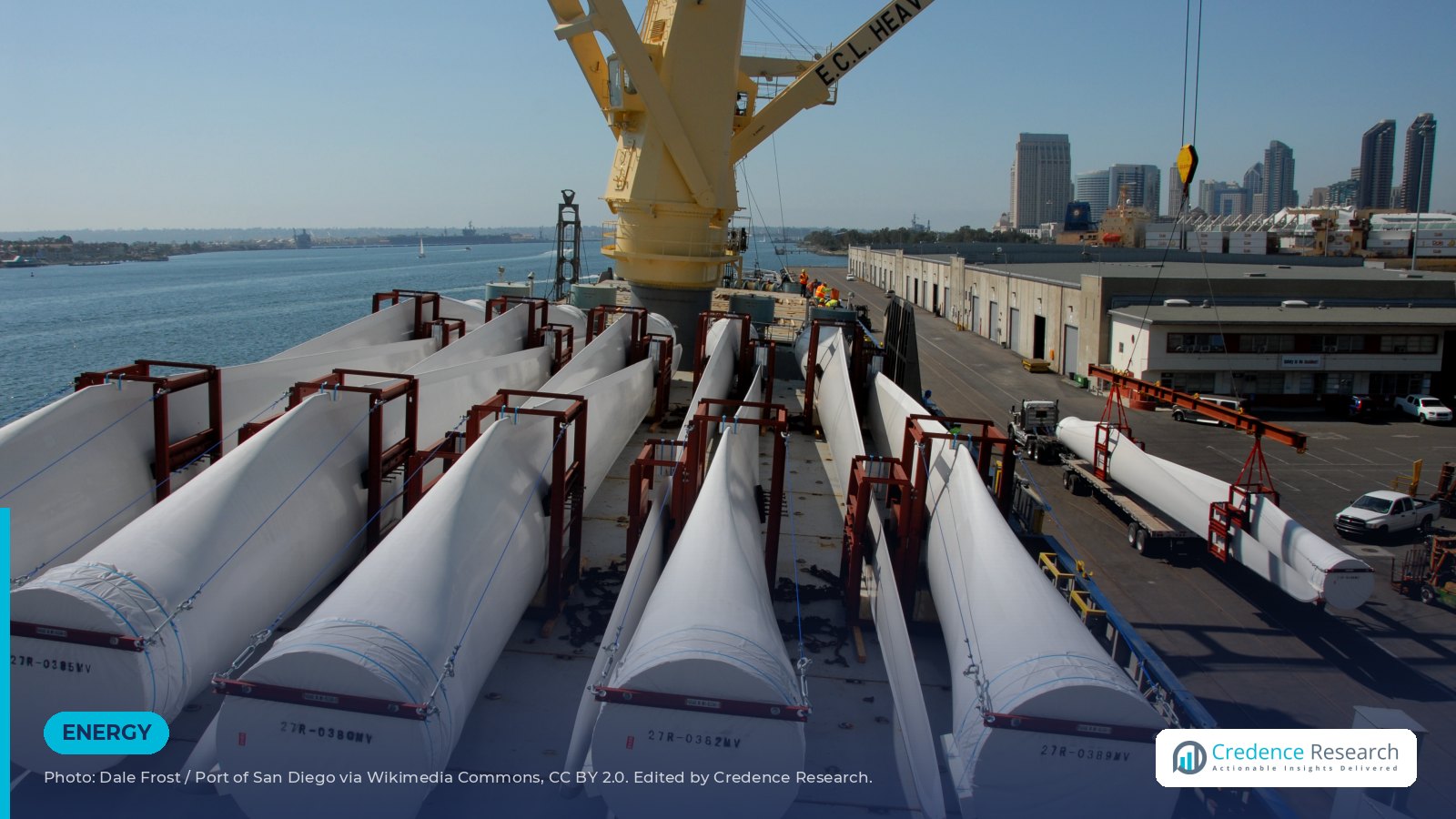
Image: Wind turbine blades unloaded at the Port of San Diego, by Dale Frost/Port of San Diego via Wikimedia Commons, CC BY 2.0. Cropped and edited by Credence Research.

About the Author

Senior News Editor at Credence Research Inc