
Quick answer
An aluminum powder manufacturing plant melts primary aluminum ingot and atomizes it with nitrogen into fine particles for explosives, autoclaved aerated concrete, paints, solar pastes, refractories and propellants. A greenfield plant of about 10,000 metric tons a year needs an estimated USD 23–30 million of CapEx. Metal is about 85% of operating cost, so the business earns on its conversion premium, giving a gross margin of 8–15% and a payback of about 5–14 years.
Viable for entrants with low-cost metal, qualified customers and a strong dust safety culture, but thin-margin and unforgiving as a plain commodity powder maker.
Aluminum Powder plant: key highlights
| Parameter | Indicative value | Note |
|---|---|---|
| Plant capacity | About 10,000 metric tons per year | Ingot-fed melting and nitrogen atomizing line with classification |
| Total CapEx | USD 23–30 million | Greenfield, Asian or emerging-market industrial park; U.S. and EU sites usually higher |
| Raw material share of operating cost | 83–87% | Primary aluminum ingot including melt and yield loss |
| Gross margin | 8–15% | Price minus metal, power, gases, labor, packing and freight |
| Payback period | 5–14 years | At 85% utilization and mid-range CapEx, before tax and financing |
| IRR | Available in report | Post-tax, 10-year model |
| Break-even | Available in report | Capacity utilization basis |
Ranges assume a greenfield 10,000 metric ton a year nitrogen atomizing plant fed with purchased ingot, an Asian or emerging-market industrial park (U.S./EU costs higher), 2026 prices, 85% utilization, aluminum near USD 3,280 per metric ton (IMF, September 2026) and assumed ingot premiums, powder premiums, power and conversion costs. Rupees converted at an assumed 88 per USD. Customizable to any country.
What is aluminum powder?
Aluminum powder is aluminum metal reduced to fine particles, usually by blowing molten metal through a nozzle with air or an inert gas, or by milling metal into thin flakes. Buyers value its high reactivity, light weight and bright metallic surface.
Grades are defined by particle shape, size and active metal content. Irregular or nodular atomized powder goes into mining explosives, refractories and chemical reduction, while spherical gas-atomized grades with tight size bands serve solid propellants, cold spray, solar cell pastes and 3D printing. Flake grades, milled with a lubricant such as stearic acid, act as the gas-forming agent in aerated concrete and as pigment in paints, inks and roof coatings.
Trade falls under Harmonized System heading 7603. Subheading 7603.10 covers powders of nonlamellar structure and 7603.20 covers powders of lamellar structure and flakes, as listed in the U.S. Schedule B tariff schedule for aluminum. An atomizing plant mainly ships under 7603.10, and a flake line under 7603.20.
Aluminum powder market overview and global demand
No single public figure sizes the world aluminum powder market, so demand is best read from trade flows and from the markets that consume powder. Aluminum paste, which is made from flake powder, stands at about USD 1.29 billion in 2025, based on Credence Research's aluminum paste market estimate of USD 1.23 billion for 2024 and a 5.3% CAGR. Metal powders of all kinds for 3D printing reach about USD 623 million in 2025, based on Credence Research's USD 517 million for 2024 and a 20.4% CAGR in its metal powders for additive manufacturing report, with aluminum alloys as one of several metals.
UN Comtrade data for HS 7603 show 2024 exports of about USD 830 million from 66 reporting economies. The United States reported USD 197 million, Malaysia USD 126 million, Germany USD 85 million, Austria USD 56 million, Australia USD 54 million and China USD 41 million. Unit values tell the real story. Germany's exports averaged about USD 6,700 per metric ton and India's about USD 3,700, while U.S. and Malaysian flows near USD 1,400–1,600 sat below the metal price, which points to scrap-derived flake in those figures.
Most powder never crosses a border, because China, India, Russia and the United States make much of their own. One Indian producer's fiscal 2025 powder sales split shows the usual mix: construction and aerated concrete 36%, mining explosives 33%, agrochemicals 11%, atomized specialty uses 11%, and the rest in leafing and fireworks grades. Growth is fastest at the specialty end. Missile and space programs need spherical propellant grades, and in January 2026 a Nammo engineering executive told Breaking Defense that switching aluminum powder supplier can force a propellant to be requalified, which makes qualified supply valuable and slow to replace.
Aluminum powder manufacturing process from ingot to drum
Most aluminum powder is made by atomizing, in which molten metal is broken into droplets by a high-pressure gas jet, and the droplets freeze in flight into particles. The reference plant melts purchased ingot and uses nitrogen, which gives rounder, cleaner particles than air and keeps oxygen low enough to avoid explosions in the collection system.
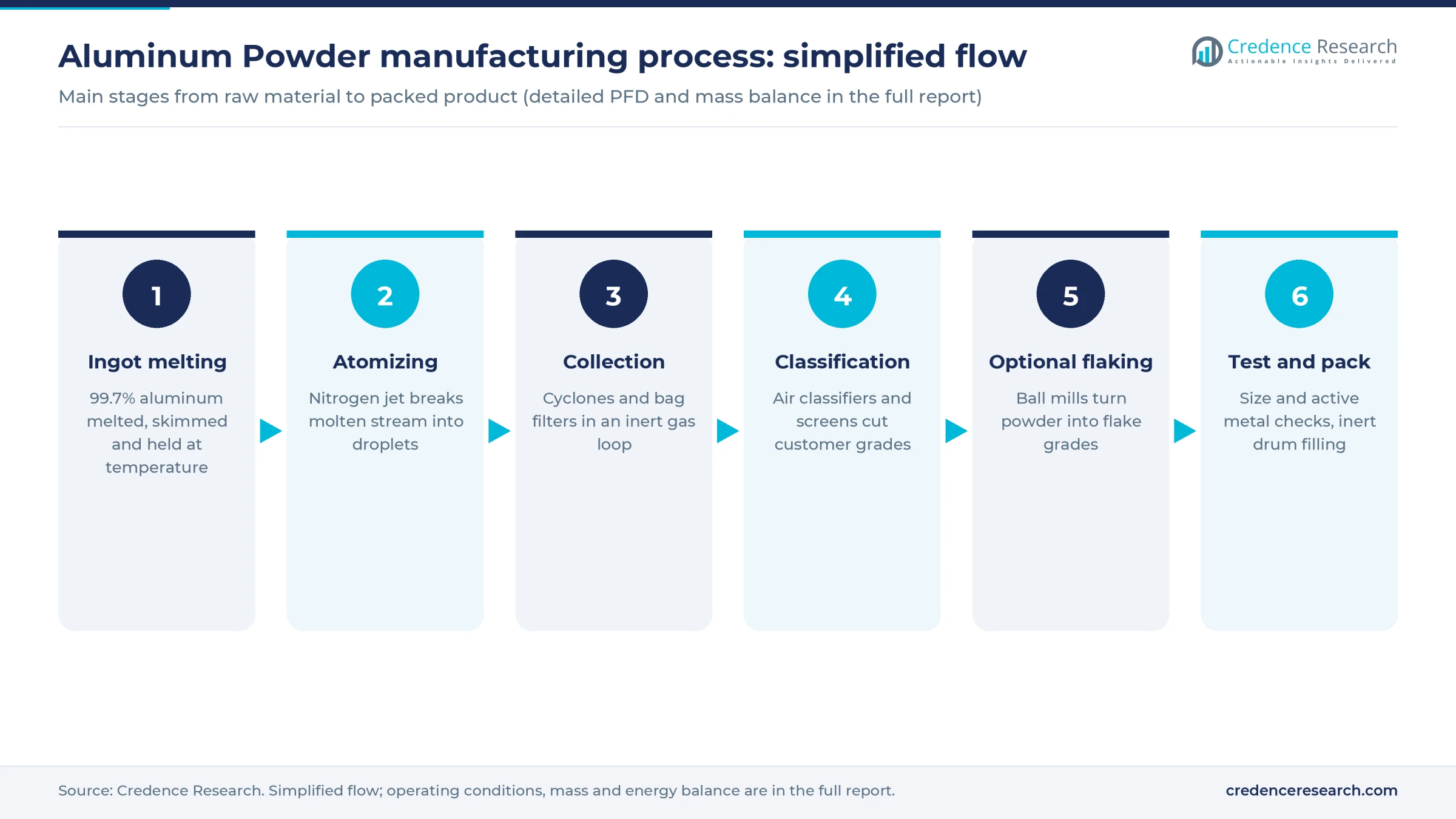
- Ingot melting. Primary aluminum of at least 99.7% purity is charged into gas-fired or induction furnaces and held at a controlled temperature. Dross skimming and degassing matter, because oxide films in the melt become inclusions in the powder.
- Atomizing. Metal flows through a heated tundish into a close-coupled nozzle, where nitrogen at roughly 40–80 bar shatters the stream. Gas pressure, nozzle design and metal flow set the particle size distribution, which is the single most important quality variable.
- Cooling and collection. Particles fall through a water-jacketed chamber and are carried to cyclones and bag filters. Nitrogen is cooled and recirculated, which cuts gas cost and keeps the loop inert.
- Classification and sieving. Air classifiers and screens split the powder into customer cuts, for example coarse explosive grades and fine propellant grades. Off-size material is remelted, so yield on metal stays high even when the sellable cut is narrow.
- Flake milling, optional. Some plants feed atomized powder into ball mills with a lubricant to make flake for aerated concrete, paint and pyrotechnics. Milling adds value but is a second explosion risk and often runs under inert gas or in solvent.
- Testing and packing. Each lot is checked for particle size, active aluminum and moisture, then filled into sealed steel drums or bags under inert gas. Packaging follows dangerous goods rules because the powder is a flammable solid.
Dust safety is designed in, not added later. Every vessel that holds fine powder needs explosion venting, suppression or isolation, spark detection and grounding, and housekeeping rules that stop dust layers from building up on beams and floors.
Aluminum powder plant setup cost
The reference plant is a greenfield unit producing about 10,000 metric tons a year on one nitrogen atomizing line, with ingot melting furnaces, classifiers, inert gas recirculation and a drum filling area. At this scale, total CapEx is estimated at USD 23–30 million, covering land, buildings, utilities, explosion protection, preoperative cost and a working capital margin.
The range is scaled from a disclosed project. A December 2025 feasibility report filed with the Odisha investment agency budgets 3 billion rupees for a 15,000 metric ton gas-atomized plant in two phases, with 1.05 billion rupees for the first 6,000 metric tons. At an assumed 88 rupees per dollar, that is about USD 2,000–2,300 per metric ton of capacity, or USD 20–23 million for 10,000 metric tons. That project takes molten metal from a neighboring smelter on sublet land, so an ingot-fed greenfield plant adds melting furnaces, land and working capital, lifting the total to the stated range.
For the land row, the plant needs about 6 acres, or 24,000 square meters, for the melt shop, atomizing tower, classifier hall, separated drum stores and safe truck access. At an assumed USD 40–100 per square meter in an Asian industrial park, land costs about USD 1–2.4 million, close to 6% of CapEx at mid-range. The report can be customized to any country or region.
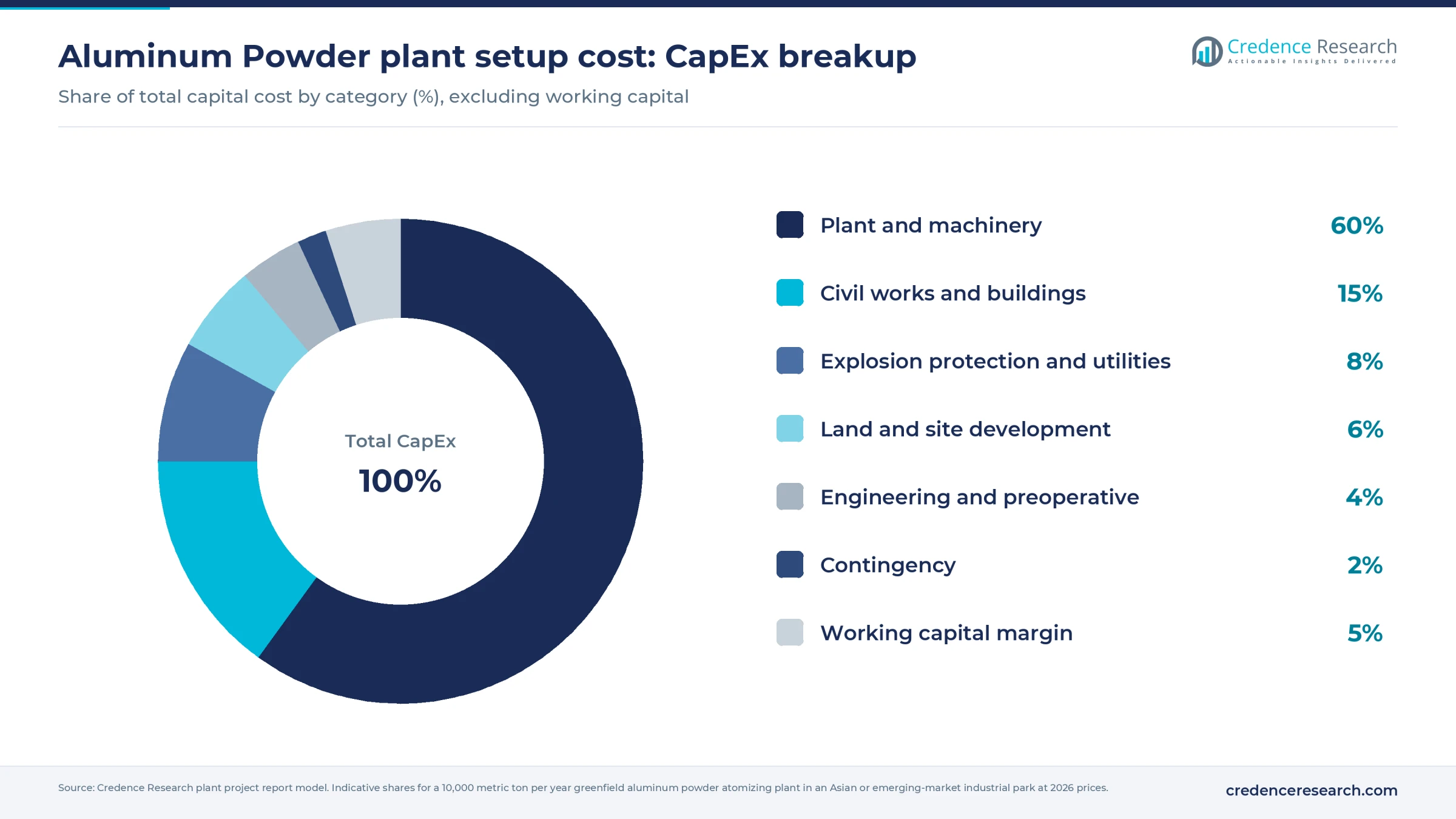
Plant and machinery take about 60% of CapEx, and explosion protection is a meaningful slice inside that share. One month of metal at full output is worth about USD 3 million, so a metal financing line matters more than the small working capital margin in the budget.
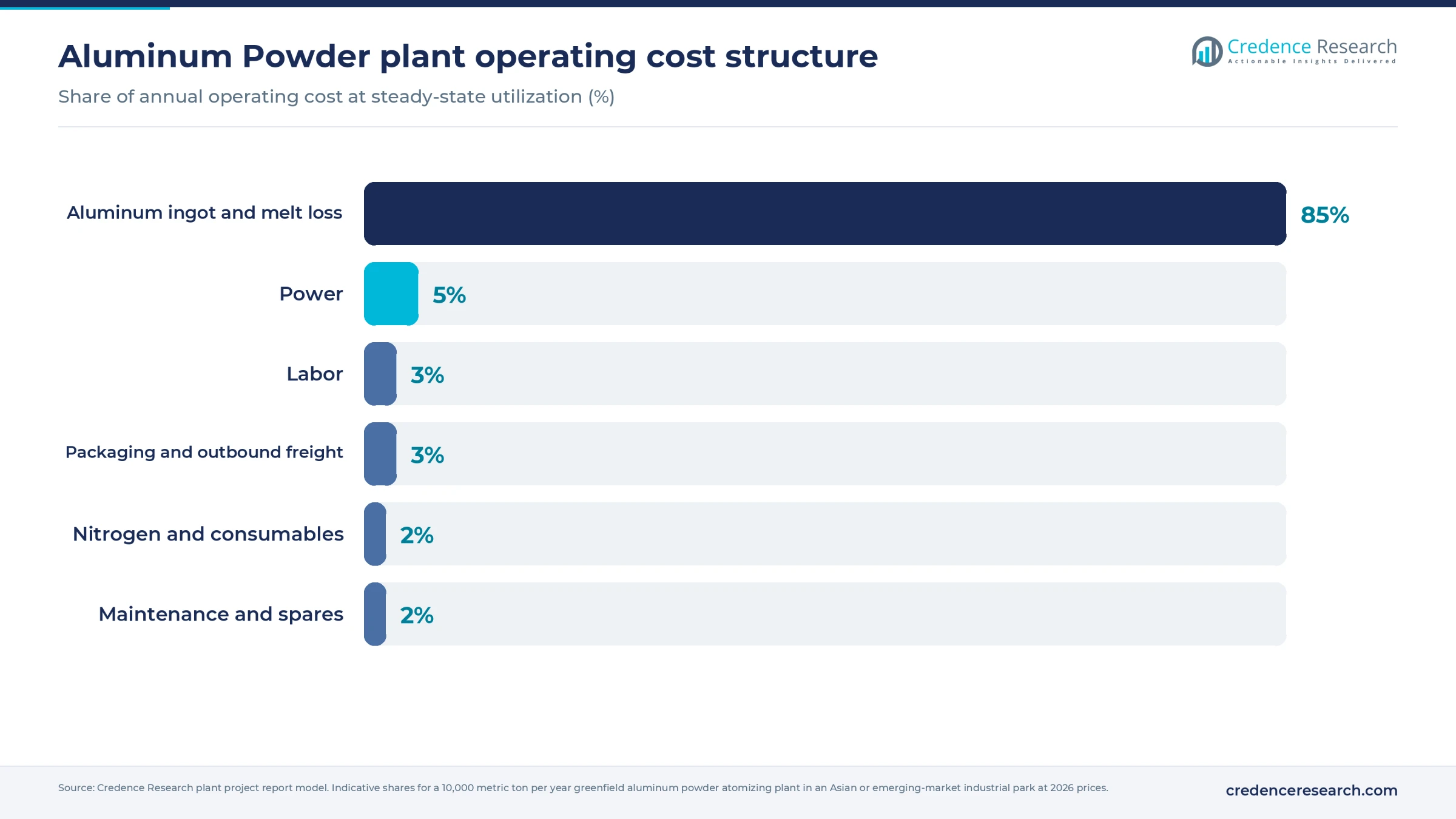
Aluminum is about 85% of operating cost, followed by power at roughly 5%. The feasibility report puts power use near 2.5 MWh per metric ton, so electricity price is the main local cost difference between sites.
Machinery and raw materials for an aluminum powder plant
The main equipment groups are listed below. Line ratings, nozzle designs and the full equipment schedule are in the report.
- Ingot charging, melting and holding furnaces with dross handling
- Heated tundish, close-coupled atomizing nozzle and water-jacketed atomizing chamber
- Nitrogen supply, by on-site generation or liquid storage, with gas cooling, recirculation and oxygen analyzers
- Cyclones and bag filters fitted with explosion venting, suppression or isolation valves
- Air classifiers, vibrating screens and blenders
- Ball mills for flake grades, if included
- Inert drum filling, spark detection, grounding and fire protection suited to metal fires
- Laboratory with laser particle sizing and active aluminum analysis
The main raw material is primary aluminum ingot, typically P1020 grade of 99.7% purity, produced mainly in China, India, the Gulf states, Russia, Canada, Norway and Australia. Alloy powders add silicon, magnesium or scandium, and flake lines need stearic or oleic acid and mineral spirits. Nitrogen is made on site or bought from industrial gas companies, and steel drums come from regional packaging suppliers.
Siting next to a smelter, as the Odisha project does, saves the cost and metal loss of remelting and can reduce power use. Plants without that option compete on ingot premium and logistics, which can swing landed metal cost by a few hundred dollars per metric ton.
Aluminum powder business profit margin and ROI
At central direct cost, gross margin for the reference plant is estimated at 8–15%, measured as selling price minus metal, melt loss, power, gases, labor, maintenance, packing and freight. The build starts from export unit values. In 2023, nonlamellar powder from Germany, China, the United States and the United Kingdom sold for about USD 1,800–2,600 per metric ton above that year's average aluminum price, while India's 2024 exports averaged about USD 1,280 above it. A new commodity plant is assumed to earn a premium of USD 1,250–1,650 over aluminum at about USD 3,280, giving a price of USD 4,530–4,930. Revenue in the Odisha feasibility report implies a spread nearer USD 1,150, which would put a plant fed with purchased ingot below this margin range.
Against that, delivered ingot, melt loss, power, nitrogen, labor, maintenance, drums and freight are assumed to bring direct cost to about USD 4,180 per metric ton, with metal near 87% of it.
At 85% utilization, or 8,500 metric tons, cash profit after assumed overheads of about USD 120 per metric ton is roughly USD 1.9–5.3 million a year, so mid-range CapEx of USD 26.5 million pays back in about 5–14 years, near 7 years at the midpoint. As a cross-check, an Indian producer guided in May 2026 to EBITDA of about USD 420–480 per metric ton. A USD 100 change in the premium moves annual cash profit by about USD 850,000.
| Metric | Value |
|---|---|
| Gross margin | 8–15% |
| Payback period | 5–14 years |
| IRR (post-tax) | Available in report |
| NPV | Available in report |
| Return on investment | Available in report |
| DSCR | Available in report |
| Break-even utilization | Available in report |
How to start an aluminum powder business, licenses and approvals
Approvals follow a similar path in most countries: company and tax registration, land use and building permits, an air and water permit for the melt shop, a factory or workplace safety approval, fire service clearance, chemical registration and labeling, and import-export registration. For aluminum powder, combustible dust and dangerous goods rules carry the most weight. Uncoated powder that releases flammable gas in contact with water ships as UN1396 in Division 4.3, while coated powder ships as UN1309, a Division 4.1 flammable solid.
Examples by market
| Market | Key approvals for an aluminum powder plant |
|---|---|
| United States | OSHA combustible dust enforcement under the National Emphasis Program (CPL 03-00-008) and the General Duty Clause; NFPA 484 for combustible metals, applied through state and local fire codes; state air permit for melting and dust collection; DOT hazardous materials rules at 49 CFR for UN1396 and UN1309; EPA Toxics Release Inventory reporting for aluminum fume or dust |
| European Union | ATEX Directive 2014/34/EU for equipment and Directive 1999/92/EC, which requires an explosion protection document for the workplace; REACH registration and CLP labeling as a flammable solid that releases flammable gas with water (H228, H261); national environmental permit; ADR for road transport |
| India | Consent to establish and operate from the state pollution control board; factory license and plan approval under state factory rules; fire service clearance; dangerous goods rules for road transport and IMDG compliance for sea exports; buyers in explosives and fireworks hold their own PESO licenses |
Insurers often ask for a dust hazard analysis before they cover the plant, and propellant buyers add their own qualification audits.
Key aluminum powder manufacturers and recent developments
Leading producers include ECKART in Germany, part of Altana, Toyo Aluminium in Japan, Valimet and AMPAL in the United States, MMP Industries in India, M-tec Powder in South Africa and Germany, and Gränges Powder Metallurgy in France, alongside many Chinese makers. Their powders feed products from aerated concrete blocks to powder metallurgy parts.
- January 2026: Runaya and ECKART launched a joint venture to make spherical gas-atomized aluminum powder at Jharsuguda, India, with a planned 15,000 metric tons a year over two phases and production expected by the end of 2026.
- May 2026: MMP Industries said on its earnings call that it plans no new powder capacity for at least two years and will shift existing lines toward value-added grades, after starting supplies to Germany and Italy.
- August 2026: Valimet gained AS9100 aerospace certification for its gas-atomized aluminum alloy powders used in propellants, cold spray and 3D printing.
New investment is aimed at spherical and alloy grades, while commodity powder competes mostly on metal cost.
What's inside the Aluminum Powder project report PDF
The report runs to 21 chapters. Open a chapter to see its sections.
1. Preface
2. Scope and Methodology
- 2.1 Objectives of the Study
- 2.2 Stakeholders
- 2.3 Research Methodology
- 2.4 Data Sources and Key Assumptions
3. Executive Summary
- 3.1 Market Snapshot
- 3.2 Project at a Glance (Capacity, CapEx, OpEx)
- 3.3 Key Financial Indicators (IRR, NPV, Payback, Break-even)
- 3.4 Feasibility Verdict
4. Product Overview
- 4.1 Aluminum Powder Definition and Properties
- 4.2 Grades and Specifications (BIS / ISO / ASTM)
- 4.3 HS Code and Classification
- 4.4 Key Applications
- 4.5 Substitutes
5. Global Aluminum Powder Market
- 5.1 Market Overview
- 5.2 Historical and Current Market Performance (Volume and Value)
- 5.3 Market Breakup by Grade / Type
- 5.4 Market Breakup by End-Use Industry
- 5.5 Market Breakup by Region
- 5.6 Market Drivers, Restraints and Trends
- 5.7 Value Chain Analysis
- 5.8 Market Forecast
6. Target Country Aluminum Powder Market Analysis
- 6.1 Demand and Supply Analysis
- 6.2 Installed Capacity vs Demand Gap
- 6.3 Import Dependence
- 6.4 Demand Forecast by End-Use
7. Trade Analysis
- 7.1 Imports by Volume, Value and Country
- 7.2 Exports by Volume, Value and Country
- 7.3 Trade Balance and Opportunities
8. Price Analysis
- 8.1 Historical Aluminum Powder Price Trends by Region
- 8.2 Raw Material / Feedstock Price Trends and Linkage
- 8.3 Price Forecast
- 8.4 Margins Across the Value Chain
9. Competitive Landscape
- 9.1 Market Structure
- 9.2 Key Players and Installed Capacities
- 9.3 Profiles of Key Players
- 9.4 Recent Developments (Expansions, M&A, New Plants)
10. Manufacturing Process and Technology
- 10.1 Comparison of Technology Routes
- 10.2 Selected Route and Process Flow Diagram
- 10.3 Unit Operations Involved
- 10.4 Chemical Reactions Involved
- 10.5 Mass Balance and Raw Material Requirements
- 10.6 Energy Balance
- 10.7 Quality Assurance Criteria and Technical Tests
- 10.8 By-products and Waste Handling
- 10.9 Technology Licensors / Providers
11. Project Details, Requirements and Costs
- 11.1 Land, Location and Site Development
- 11.1.1 Site Selection Criteria
- 11.1.2 Location Analysis
- 11.1.3 Land Requirement and Costs
- 11.1.4 Site Development Costs
- 11.2 Plant Layout
- 11.2.1 Layout Principles
- 11.2.2 Proposed Layout
- 11.2.3 Factors Influencing Layout
- 11.3 Civil Works and Buildings
- 11.4 Plant Machinery
- 11.4.1 Machinery Requirements and Specifications
- 11.4.2 Machinery Costs
- 11.4.3 Machinery Suppliers
- 11.5 Raw Materials
- 11.5.1 Requirements per Tonne of Output
- 11.5.2 Procurement and Sourcing
- 11.5.3 Costs
- 11.5.4 Suppliers
- 11.6 Packaging
- 11.6.1 Packaging Requirements
- 11.6.2 Packaging Costs
- 11.6.3 Packaging Suppliers
- 11.7 Storage and Material Handling
- 11.8 Transportation Requirements and Costs
- 11.9 Utilities
- 11.9.1 Power Requirements and Costs
- 11.9.2 Water Requirements and Costs
- 11.9.3 Steam, Fuel and Other Utilities
- 11.10 Manpower Requirements and Wages
12. Environment, Health, Safety and Sustainability
- 12.1 Effluent and Emissions Management
- 12.2 Hazard Classification and Safety Measures
- 12.3 Carbon Footprint
- 12.4 Green / Low-Carbon Process Options
13. Regulatory Procedures, Approvals and Certifications
- 13.1 Licences and Registrations
- 13.2 Environmental Clearances
- 13.3 Product Certifications (BIS, REACH, etc.)
- 13.4 Approval Timeline
14. Project Implementation Schedule
15. Project Economics
- 15.1 Capital Cost of the Project
- 15.2 Techno-Economic Parameters
- 15.3 Capacity Utilization and Ramp-up
- 15.4 Product Pricing and Margins
- 15.5 Income Projections
- 15.6 Expenditure Projections
- 15.7 Working Capital Requirement
- 15.8 Taxation
- 15.9 Depreciation
16. Financial Analysis
- 16.1 Projected Profit and Loss Account
- 16.2 Projected Cash Flow Statement
- 16.3 Projected Balance Sheet
- 16.4 Liquidity Analysis
- 16.5 Profitability Analysis (Payback, NPV, IRR, ROI)
- 16.6 Break-even Analysis
- 16.7 Debt Service Coverage Ratio (DSCR)
- 16.8 Sensitivity Analysis
- 16.9 Scenario and Uncertainty Analysis
17. Funding and Incentives
- 17.1 Means of Finance and Debt-Equity Structure
- 17.2 Loans and Financial Assistance
- 17.3 Government Schemes and Subsidies (PLI, State Policies)
18. Risk Assessment
- 18.1 Key Success Factors
- 18.2 Key Risk Factors
- 18.3 Risk Mitigation
19. Strategic Recommendations
20. Case Study of a Successful Venture
21. Appendix
- 21.1 Detailed Assumptions
- 21.2 Abbreviations
- 21.3 List of Tables and Figures
- 21.4 Sources
This page vs. the full report
| Data point | On this page (free) | In the full report |
|---|---|---|
| Total CapEx | One rounded range at one capacity | Exact figure at three capacities with a line-item breakup |
| CapEx breakup | Category shares (%) only | Cost, quantity and supplier for every machine |
| Operating cost | Share of raw materials, utilities and labor | Per-unit cost sheet with each input price and consumption |
| Profitability | Gross margin range and payback band | Exact IRR, NPV, ROI, break-even and DSCR |
| Financial statements | List of what is included | 10-year P&L, cash flow, balance sheet and Excel model |
| Sensitivity | One directional line | Full sensitivity and scenario tables |
| Process | Simplified flow diagram | Detailed process flow, mass and energy balance, operating conditions |
| Machinery | Names of the main machines | Specifications, capacity, cost and supplier list |
| Market | Headline size, growth and global demand | Segment, region, trade and price forecast tables |
| Suppliers and buyers | Supplier types and sourcing hubs | Named suppliers and buyers |
Aluminum Powder project report: FAQs
How much does it cost to set up an aluminum powder manufacturing plant?
Should a new plant use air or nitrogen atomizing?
What is the profit margin in aluminum powder manufacturing?
What is the payback period for an aluminum powder plant?
Which approvals does an aluminum powder plant need?
Who buys aluminum powder?
Why is dust safety so central to an aluminum powder project?

About the analyst
Nisha Gupta, Senior Research Analyst
Nisha Gupta is a Senior Research Analyst at Credence Research Inc. who works across industry domains, including packaging, automotive parts and machinery. Her focus is the modelling engine behind each study: she builds quantitative market databases and econometric forecasting frameworks, and developed automated Excel-based market modelling templates that cut client turnaround time by 30%.
Related market research
- Aluminum Paste Market Size, Share, Growth and Forecast 2032
- Metal Powders for Additive Manufacturing Market Size, Share and Forecast 2032
- Metal Powder for 3D Printing Market Size, Share and Forecast 2032
- Autoclaved Aerated Concrete Block Market Size and Forecast 2032
- Powder Metallurgy Market Size, Growth, Share and Forecast 2032
More plant project reports
- Welding Electrode Manufacturing Plant Project Report (DPR) 2026
- Recycled Copper Manufacturing Plant Project Report (DPR) 2026
- Copper Wire Manufacturing Plant Project Report (DPR) 2026
- Urea Manufacturing Plant Project Report (DPR) 2026
- Green Beans Processing Plant Project Report (DPR) 2026
- Methacrylic Acid Manufacturing Plant Project Report (DPR) 2026