
Quick answer
A welding electrode plant draws low-carbon wire rod into core wire, coats it with a pressed mineral and ferroalloy flux, then bakes and packs stick electrodes for fabricators, contractors and repair shops. A greenfield unit making about 10,000 metric tons a year needs an estimated USD 5–9 million of CapEx. Core wire and coating minerals take roughly two-thirds of operating cost, gross margin is estimated at 19–28%, and payback runs about 3–5 years.
Viable where a growing regional market still imports most of its electrodes and the plant can qualify low-hydrogen grades, but thin if it competes only on basic rutile rods against large Chinese exporters.
Welding Electrode plant: key highlights
| Parameter | Indicative value | Note |
|---|---|---|
| Plant capacity | About 10,000 metric tons per year | Mild steel rutile and low-hydrogen stick electrodes, in-house core wire drawing and flux preparation |
| Total CapEx | USD 5–9 million | Greenfield, Asian or Middle Eastern industrial park; U.S. and EU sites usually higher |
| Raw material share of operating cost | 64–71% | Low-carbon wire rod, rutile, limestone, fluorspar, ferroalloys and silicate binder |
| Gross margin | 19–28% | At an assumed ex-works price of USD 1,250–1,400 per metric ton for mild steel grades |
| Payback period | 3–5 years | At 85% utilization and mid-range CapEx of USD 7 million, before tax |
| IRR | Available in report | Post-tax, 10-year model |
| Break-even | Available in report | Capacity utilization basis |
Ranges assume a greenfield plant making about 10,000 metric tons a year of mild steel stick electrodes, an Asian or Middle Eastern industrial park (U.S./EU costs higher), 2026 prices, 85% utilization, and assumed prices for wire rod, coating minerals, electrodes, land, buildings and labor. Rupee machinery quotes converted at an assumed 88 per USD. Customizable to any country.
What is a welding electrode?
A welding electrode, in the sense used here, is a covered stick electrode for shielded metal arc welding, also called manual metal arc or stick welding. It is a cut length of solid core wire, usually low-carbon steel, wrapped in a pressed coating of minerals, ferroalloys and silicate binder. When the arc strikes, the core melts into the joint while the coating releases shielding gas, forms a protective slag and adds alloying elements to the weld.
Grades are defined by the coating and the metal deposited. Rutile types such as AWS E6013 are easy to strike and dominate general fabrication and repair. Basic low-hydrogen types such as E7018 serve structural steel, pressure vessels and shipbuilding, where cracking risk matters. Cellulosic E6010 and E6011 suit pipeline root passes, while stainless, low-alloy, cast iron and hardfacing electrodes fill smaller, higher-priced niches.
The World Customs Organization's HS 2022 nomenclature classifies coated electrodes of base metal for electric arc welding under subheading 8311.10. Flux-cored wire sits under 8311.20, a separate code. Buyers include construction contractors, steel fabricators, shipyards, power plant and refinery maintenance crews, and farm and workshop users.
Welding electrode market overview and global demand
Credence Research estimates the global welding consumables market at about USD 18.8 billion in 2025, based on its USD 17.85 billion figure for 2024 and a 5.3% CAGR through 2032. Covered electrodes are one part of that total, alongside solid wire, flux-cored wire and submerged arc flux. Their share is slipping in automated factories, which favor continuous wire, but they remain the default for site work, repair and smaller shops because a stick welder needs no gas cylinder or wire feeder.
Steel use sets the ceiling on demand. The World Steel Association reported world crude steel production of 1,849.4 million metric tons in 2025, down 2% from 2024. China produced 960.8 million metric tons, down 4.4%, while India rose 10.4% to 164.9 million and the United States rose 3.1% to 82.0 million. Electrode demand follows fabrication and construction more closely than mill output, so the faster-growing steel users in South Asia, Southeast Asia, the Middle East and Africa matter most for new capacity.
China is a leading exporter, and TrendEconomy data drawn from UN trade statistics put its 2023 exports under HS 8311.10 at about USD 435 million. Gulf states are steady importers, with Saudi Arabia's 2023 imports at about USD 34 million, alongside African, Southeast Asian and Latin American markets with thin local supply. Credence Research values the India welding consumables market at USD 1.32 billion in 2025, a market where mandatory BIS certification shapes who can sell.
The opening for a new plant usually lies in replacing imports in a growing regional market or in qualified low-hydrogen and stainless grades, not in selling basic rutile rods against large Chinese exporters.
Welding electrode manufacturing process from rod to baked stick
The reference plant draws its own core wire from purchased wire rod and prepares its own coating, the two steps that most affect weld quality. Small plants sometimes buy drawn wire, which saves capital but gives up control of wire cleanliness and diameter.
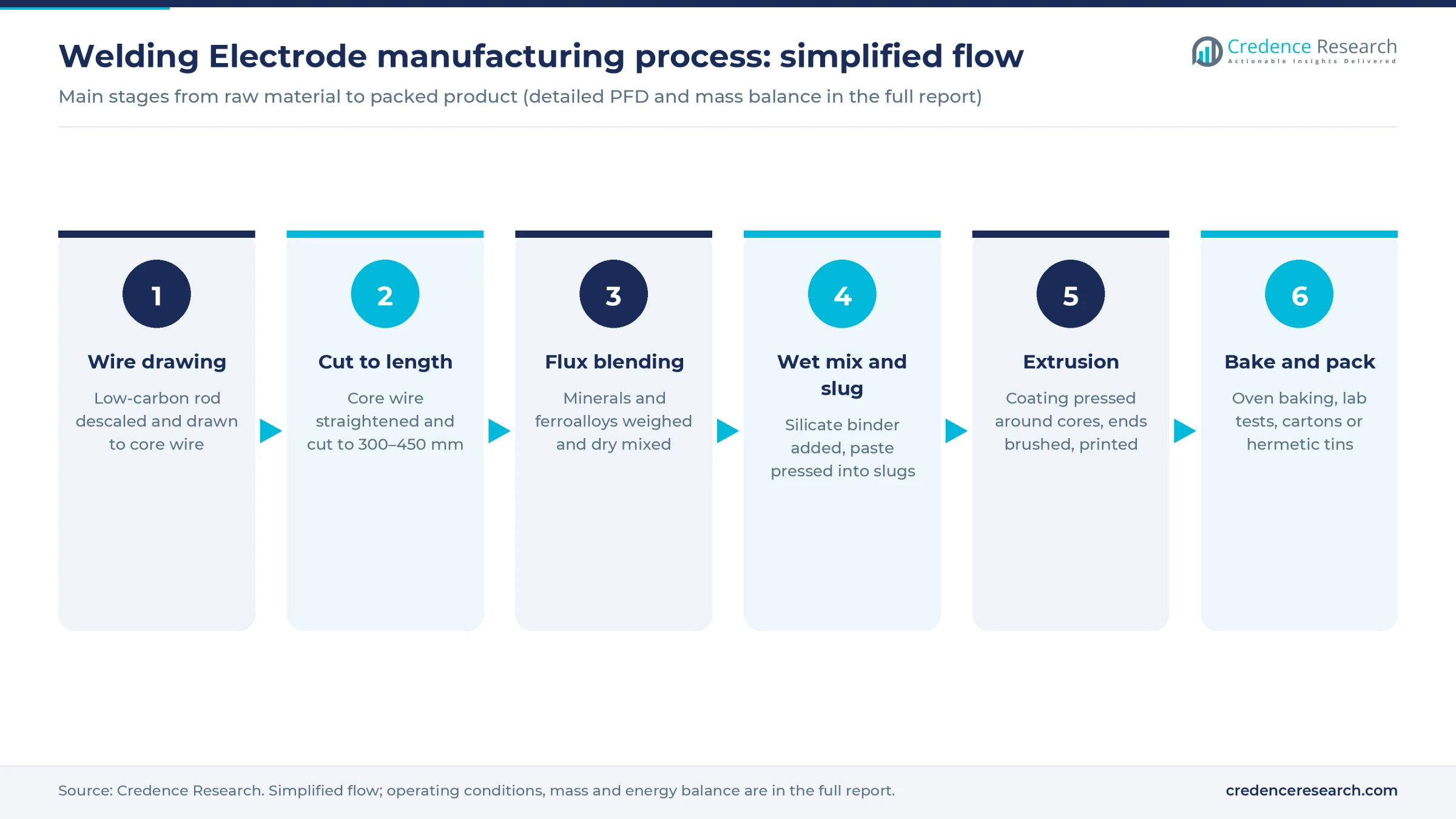
- Rod cleaning and core wire drawing. Low-carbon rod of about 5.5–6.5 mm is descaled and drawn to core diameters of roughly 2.5–5 mm. Clean wire held to tight tolerance matters, because residue and ovality later show up as porosity and uneven coatings.
- Straightening and cutting. High-speed machines straighten the wire and cut it into lengths of typically 300–450 mm. Bent or burred cores jam the coating press and raise scrap.
- Flux weighing and dry blending. Rutile, limestone, fluorspar, ferromanganese, ferrosilicon, cellulose, clay, mica and iron powder are weighed to the recipe for each grade and dry mixed. Weighing accuracy controls the arc behavior and weld chemistry that customers test.
- Wet mixing and briquetting. Sodium or potassium silicate binder turns the blend into a stiff paste, which a hydraulic press forms into dense slugs for the extruder. Silicate ratio and moisture decide whether the coating cracks in the oven.
- Extrusion, brushing and printing. A coating press forces paste around cores fed at high speed so the coating stays concentric. Machines then brush bare the grip end, chamfer the striking tip and print the grade on each rod. Eccentric coating is the most watched defect, since it makes the arc wander.
- Baking, testing and packing. Rods air dry, then pass through conveyor or batch ovens. Rutile grades need moderate heat, while low-hydrogen grades are baked much hotter to drive coating moisture very low. The lab checks moisture, weld-metal chemistry, tensile and impact properties and, for low-hydrogen grades, diffusible hydrogen before rods go into cartons or hermetic tins.
Dust from flux handling is the main health and housekeeping issue, because manganese and silica fines need extraction at every transfer point. Rejected rods are stripped so paste and wire can be reworked or sold as scrap.
Welding electrode plant setup cost
The reference plant makes about 10,000 metric tons a year of mild steel electrodes, mostly rutile E6013 with a low-hydrogen E7018 share, on three automated extrusion lines. Total CapEx is estimated at USD 5–9 million, covering land, buildings, machinery, utilities, preoperative cost and a working capital margin.
Machinery is the most checkable part. Indian business-to-business listings price basic electrode extrusion lines at about 1–5.4 million rupees, or USD 11,000–61,000 at an assumed 88 rupees per dollar, for rated outputs of 0.5–12 metric tons per shift. One automated extrusion and conveyor line is listed at 43.4 million rupees, about USD 490,000. A plant opened in Kazakhstan's Zhambyl region in 2015 reported about USD 250,000 of investment for 1,500 metric tons a year on Chinese equipment, a figure that appears to cover equipment rather than a full greenfield site. For the reference plant, three automated lines plus wire drawing, mixing, ovens, packing and a test lab are estimated at USD 2.0–3.5 million.
For the land row, the plant needs about 12,000 square meters, or about 3 acres. At an assumed USD 30–80 per square meter in an Asian or Middle Eastern industrial park, land costs about USD 0.4–1.0 million, close to 10% of mid-range CapEx. Buildings of about 6,000 square meters at an assumed USD 200–350 per square meter add USD 1.2–2.1 million. U.S. and EU sites cost more for land, construction and labor, and the report can be customized to any country or region.
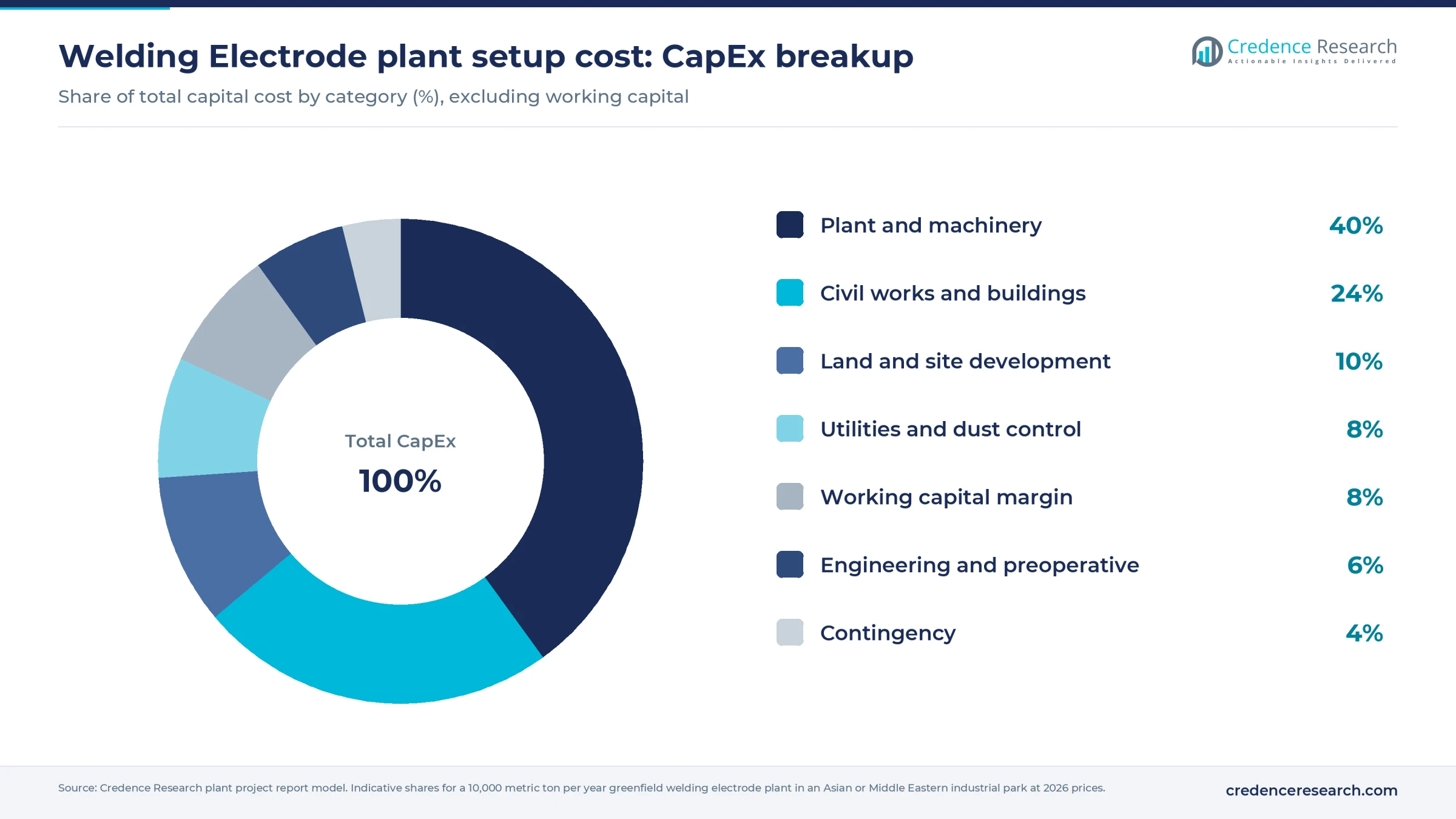
Machinery accounts for about 40% of CapEx and buildings about 24%, a fairly even split because electrode lines are inexpensive while ovens, dust control and dry covered storage need floor space.
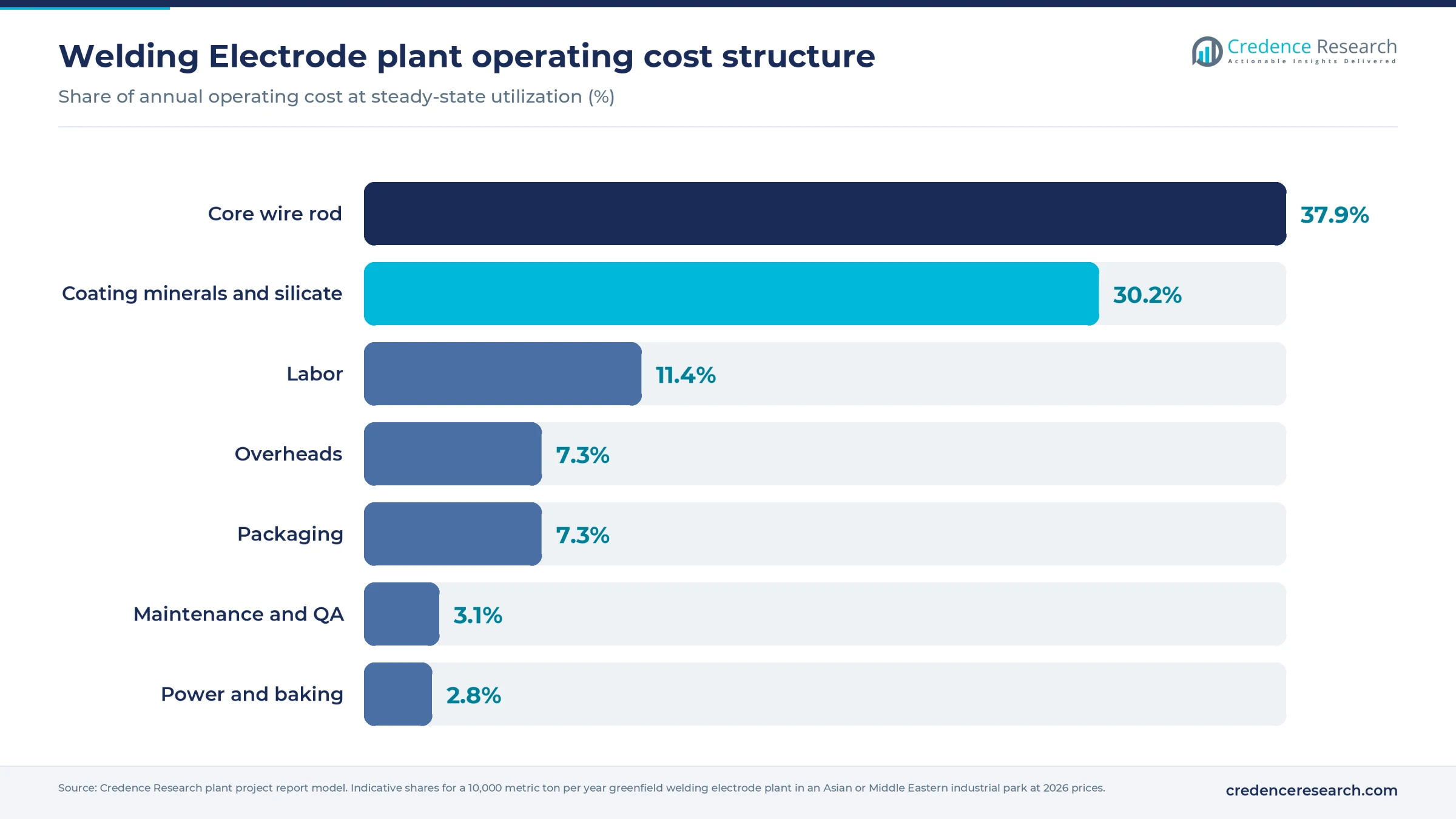
Core wire and coating materials make up roughly two-thirds of operating cost, so rod purchasing and recipe control decide margin more than line speed does.
Machinery and raw materials for a welding electrode plant
The main equipment groups are listed below. Machine counts, speeds and the full schedule are in the report.
- Rod descaler, wire drawing machines and take-up spoolers
- Wire straightening and cutting machines
- Weighing hoppers, dry blenders and wet mixers
- Hydraulic briquetting presses
- Electrode extrusion presses with wire feeders, brushing and printing conveyors
- Drying and baking ovens with temperature recording
- Packing lines, including hermetic packing for low-hydrogen grades
- Dust extraction, compressors, substation and a lab with spectrometer, tensile and impact testers
Low-carbon wire rod is made by steel mills in China, India, Turkey, Southeast Asia, Europe and the Americas, and buying it close to the plant limits freight on the heaviest input. Rutile, the base of E6013 coatings, comes mainly from mineral sands in Australia, South Africa and Sierra Leone. Fluorspar for basic coatings is mined largely in China, Mexico and Mongolia, as tracked in the fluorspar market report. Plants buy ferromanganese and other deoxidizing alloys from producers in China, India and South Africa, while silicate binder is made locally in most regions.
Coating minerals are small by weight but recipe-critical, so plants usually qualify two suppliers for each one. A quiet change in rutile or fluorspar source can alter arc behavior and trigger customer complaints long before any lab test flags it.
Welding electrode business profit margin and ROI
At central costs, gross margin for the reference plant is estimated at 19–28%, measured as selling price minus raw materials, packaging, power, labor and maintenance. Low-hydrogen, stainless and specialty grades earn more per ton, while commodity E6013 sold through distributors earns less.
No public price series exists for stick electrodes, so the build uses an assumed blended ex-works price of USD 1,250–1,400 per metric ton for mild steel grades. Costs per ton are assumed at about USD 415 for core wire, USD 330 for coating minerals and silicate, USD 80 for packaging, USD 125 for labor and USD 65 for power and maintenance, or about USD 1,015 in all. As a cross-check, Ador Welding reported a 34.2% gross margin for July to September 2026, across consumables and equipment. On a similar materials-only basis, the reference plant earns about 34–41%.
At 85% utilization, or 8,500 metric tons, and after assumed overheads of USD 80 per metric ton, cash profit is about USD 1.3–2.6 million a year. Mid-range CapEx of USD 7 million then pays back in about 3–5 years before tax. A USD 50 change in the price per ton moves cash profit by about USD 0.4 million.
| Metric | Value |
|---|---|
| Gross margin | 19–28% |
| Payback period | 3–5 years |
| IRR (post-tax) | Available in report |
| NPV | Available in report |
| Return on investment | Available in report |
| DSCR | Available in report |
| Break-even utilization | Available in report |
How to start a welding electrode business, licenses and approvals
The steps are similar in most countries: company and tax registration, land use and building permits, an environmental permit or consent covering flux dust and oven emissions, occupational safety and fire approvals, product classification and certification, and import-export registration for rod, minerals and finished electrodes. Worker exposure to manganese and silica dust draws the closest attention from inspectors. Hazard communication also applies to the product, since welding fumes carry health risks, so safety data sheets and warning labels are expected in major markets.
Examples by market
| Market | Key approvals for a stick electrode plant |
|---|---|
| United States | State air permit where mixing and baking emissions require one; OSHA Hazard Communication Standard (29 CFR 1910.1200) for safety data sheets and labels; classification to AWS A5.1 for carbon steel or A5.5 for low-alloy electrodes, with class society approval such as ABS for marine work |
| European Union | CE marking under the Construction Products Regulation against harmonized standard EN 13479, with factory production control certified by a notified body under system 2+ and a declaration of performance; classification to EN ISO 2560; REACH safety data sheets; national environmental permit |
| India | BIS certification to IS 814:2004, compulsory under the Welding Rods and Electrodes (Quality Control) Order, 2023, enforced from January 2024 for larger firms and July 2024 for micro enterprises; consent to establish and operate from the state pollution control board; factory license |
Fabricators, shipyards and inspection bodies also run procedure tests before accepting a new brand, and that qualification often takes longer than the permits.
Key welding electrode manufacturers and recent developments
Global leaders include ESAB and Lincoln Electric in the United States, Kobe Steel's welding business in Japan, voestalpine Böhler Welding in Austria, Hyundai Welding and Kiswel in South Korea, and Atlantic China Welding Consumables and Tianjin Golden Bridge in China. Regional makers such as Ador Welding, GEE and Classic Electrodes in India, and Magmaweld and Gedik Welding in Turkey, compete hard on price and distribution near home.
- November 2025: Classic Electrodes (India) announced, in an exchange filing, the start of commercial flux-cored wire production, adding to its stick electrode and MIG wire range. In February 2026 it reported wire-drawing automation lifting that stage's output by about 20–25%.
- February 2026: Ador Welding and ITW Welding India agreed to offer Miller submerged arc and high-amperage MIG systems to Indian power, wind and shipbuilding customers through Ador's network.
- June 2026: ESAB completed its acquisition of inspection technology company Eddyfi Holding, according to its quarterly SEC filing.
Established electrode makers are adding wire, equipment and services rather than more stick capacity, which leaves room for new plants with qualified grades in import-dependent regions.
What's inside the Welding Electrode project report PDF
The report runs to 21 chapters. Open a chapter to see its sections.
1. Preface
2. Scope and Methodology
- 2.1 Objectives of the Study
- 2.2 Stakeholders
- 2.3 Research Methodology
- 2.4 Data Sources and Key Assumptions
3. Executive Summary
- 3.1 Market Snapshot
- 3.2 Project at a Glance (Capacity, CapEx, OpEx)
- 3.3 Key Financial Indicators (IRR, NPV, Payback, Break-even)
- 3.4 Feasibility Verdict
4. Product Overview
- 4.1 Welding Electrode Definition and Properties
- 4.2 Grades and Specifications (BIS / ISO / ASTM)
- 4.3 HS Code and Classification
- 4.4 Key Applications
- 4.5 Substitutes
5. Global Welding Electrode Market
- 5.1 Market Overview
- 5.2 Historical and Current Market Performance (Volume and Value)
- 5.3 Market Breakup by Grade / Type
- 5.4 Market Breakup by End-Use Industry
- 5.5 Market Breakup by Region
- 5.6 Market Drivers, Restraints and Trends
- 5.7 Value Chain Analysis
- 5.8 Market Forecast
6. Target Country Welding Electrode Market Analysis
- 6.1 Demand and Supply Analysis
- 6.2 Installed Capacity vs Demand Gap
- 6.3 Import Dependence
- 6.4 Demand Forecast by End-Use
7. Trade Analysis
- 7.1 Imports by Volume, Value and Country
- 7.2 Exports by Volume, Value and Country
- 7.3 Trade Balance and Opportunities
8. Price Analysis
- 8.1 Historical Welding Electrode Price Trends by Region
- 8.2 Raw Material / Feedstock Price Trends and Linkage
- 8.3 Price Forecast
- 8.4 Margins Across the Value Chain
9. Competitive Landscape
- 9.1 Market Structure
- 9.2 Key Players and Installed Capacities
- 9.3 Profiles of Key Players
- 9.4 Recent Developments (Expansions, M&A, New Plants)
10. Manufacturing Process and Technology
- 10.1 Comparison of Technology Routes
- 10.2 Selected Route and Process Flow Diagram
- 10.3 Unit Operations Involved
- 10.4 Chemical Reactions Involved
- 10.5 Mass Balance and Raw Material Requirements
- 10.6 Energy Balance
- 10.7 Quality Assurance Criteria and Technical Tests
- 10.8 By-products and Waste Handling
- 10.9 Technology Licensors / Providers
11. Project Details, Requirements and Costs
- 11.1 Land, Location and Site Development
- 11.1.1 Site Selection Criteria
- 11.1.2 Location Analysis
- 11.1.3 Land Requirement and Costs
- 11.1.4 Site Development Costs
- 11.2 Plant Layout
- 11.2.1 Layout Principles
- 11.2.2 Proposed Layout
- 11.2.3 Factors Influencing Layout
- 11.3 Civil Works and Buildings
- 11.4 Plant Machinery
- 11.4.1 Machinery Requirements and Specifications
- 11.4.2 Machinery Costs
- 11.4.3 Machinery Suppliers
- 11.5 Raw Materials
- 11.5.1 Requirements per Tonne of Output
- 11.5.2 Procurement and Sourcing
- 11.5.3 Costs
- 11.5.4 Suppliers
- 11.6 Packaging
- 11.6.1 Packaging Requirements
- 11.6.2 Packaging Costs
- 11.6.3 Packaging Suppliers
- 11.7 Storage and Material Handling
- 11.8 Transportation Requirements and Costs
- 11.9 Utilities
- 11.9.1 Power Requirements and Costs
- 11.9.2 Water Requirements and Costs
- 11.9.3 Steam, Fuel and Other Utilities
- 11.10 Manpower Requirements and Wages
12. Environment, Health, Safety and Sustainability
- 12.1 Effluent and Emissions Management
- 12.2 Hazard Classification and Safety Measures
- 12.3 Carbon Footprint
- 12.4 Green / Low-Carbon Process Options
13. Regulatory Procedures, Approvals and Certifications
- 13.1 Licences and Registrations
- 13.2 Environmental Clearances
- 13.3 Product Certifications (BIS, REACH, etc.)
- 13.4 Approval Timeline
14. Project Implementation Schedule
15. Project Economics
- 15.1 Capital Cost of the Project
- 15.2 Techno-Economic Parameters
- 15.3 Capacity Utilization and Ramp-up
- 15.4 Product Pricing and Margins
- 15.5 Income Projections
- 15.6 Expenditure Projections
- 15.7 Working Capital Requirement
- 15.8 Taxation
- 15.9 Depreciation
16. Financial Analysis
- 16.1 Projected Profit and Loss Account
- 16.2 Projected Cash Flow Statement
- 16.3 Projected Balance Sheet
- 16.4 Liquidity Analysis
- 16.5 Profitability Analysis (Payback, NPV, IRR, ROI)
- 16.6 Break-even Analysis
- 16.7 Debt Service Coverage Ratio (DSCR)
- 16.8 Sensitivity Analysis
- 16.9 Scenario and Uncertainty Analysis
17. Funding and Incentives
- 17.1 Means of Finance and Debt-Equity Structure
- 17.2 Loans and Financial Assistance
- 17.3 Government Schemes and Subsidies (PLI, State Policies)
18. Risk Assessment
- 18.1 Key Success Factors
- 18.2 Key Risk Factors
- 18.3 Risk Mitigation
19. Strategic Recommendations
20. Case Study of a Successful Venture
21. Appendix
- 21.1 Detailed Assumptions
- 21.2 Abbreviations
- 21.3 List of Tables and Figures
- 21.4 Sources
This page vs. the full report
| Data point | On this page (free) | In the full report |
|---|---|---|
| Total CapEx | One rounded range at one capacity | Exact figure at three capacities with a line-item breakup |
| CapEx breakup | Category shares (%) only | Cost, quantity and supplier for every machine |
| Operating cost | Share of raw materials, utilities and labor | Per-unit cost sheet with each input price and consumption |
| Profitability | Gross margin range and payback band | Exact IRR, NPV, ROI, break-even and DSCR |
| Financial statements | List of what is included | 10-year P&L, cash flow, balance sheet and Excel model |
| Sensitivity | One directional line | Full sensitivity and scenario tables |
| Process | Simplified flow diagram | Detailed process flow, mass and energy balance, operating conditions |
| Machinery | Names of the main machines | Specifications, capacity, cost and supplier list |
| Market | Headline size, growth and global demand | Segment, region, trade and price forecast tables |
| Suppliers and buyers | Supplier types and sourcing hubs | Named suppliers and buyers |
Welding Electrode project report: FAQs
How much does it cost to set up a welding electrode manufacturing plant?
What is the profit margin in welding electrode manufacturing?
What is the payback period for a welding electrode plant?
Which raw materials does a welding electrode plant need?
Which approvals does a welding electrode plant need?
Why do low-hydrogen electrodes need special handling?
Can a new plant compete with Chinese electrode exporters?

About the analyst
Nisha Gupta, Senior Research Analyst
Nisha Gupta is a Senior Research Analyst at Credence Research Inc. who works across industry domains, including packaging, automotive parts and machinery. Her focus is the modelling engine behind each study: she builds quantitative market databases and econometric forecasting frameworks, and developed automated Excel-based market modelling templates that cut client turnaround time by 30%.
Related market research
- Welding Consumables Market Size, Growth and Forecast 2032
- India Welding Consumables Market Size, Share, Growth and Forecast, 2025-2035
- Arc Welding Equipment Market Size, Share & Growth Report 2032
- Ferromanganese Market Size, Growth, Trend and Forecast 2032
- Fluorspar Market Size, Trends, Share, Growth and Forecast 2032
- Aluminium Welding Wire Market Size, Share and Forecast 2032
More plant project reports
- Aluminum Powder Manufacturing Plant Project Report (DPR) 2026
- Recycled Copper Manufacturing Plant Project Report (DPR) 2026
- Copper Wire Manufacturing Plant Project Report (DPR) 2026
- Urea Manufacturing Plant Project Report (DPR) 2026
- Green Beans Processing Plant Project Report (DPR) 2026
- Methacrylic Acid Manufacturing Plant Project Report (DPR) 2026