
Quick answer
An avocado oil processing plant presses ripe avocado flesh into extra virgin, virgin and refined oil. A representative 500 kg per hour line handling about 4 tonnes of fruit a day costs USD 0.6–0.8 million in a lower-cost producing region. Gross margin runs 30–45% on off-grade fruit at an assumed USD 0.15–0.35 per kg, and payback takes 4–7 years. Cheap, assured fruit supply decides feasibility more than machinery does.
Feasible where a mill sits next to packhouses that reject export fruit; milling table-grade fruit or importing fresh fruit to crush rarely pays.
Avocado Oil plant: key highlights
| Parameter | Indicative value | Note |
|---|---|---|
| Plant capacity | 500 kg fruit per hour (about 4 TPD) | One shift, 250 days; 55–65 tonnes of oil a year at 60% utilization |
| Total CapEx | USD 0.6–0.8 million | Lower-cost producing region with a Chinese-built line; a European line at a U.S. or EU site can reach USD 1.5–2.5 million |
| Raw material share of operating cost | 30–45% | Off-grade fruit at an assumed USD 0.15–0.35 per kg, 9–11% oil yield |
| Gross margin | 30–45% | 50% bottled extra virgin, 50% bulk oil |
| Payback period | 4–7 years | Pre-tax, including a ramp-up year |
| IRR | Available in report | Post-tax, 10-year model |
| Break-even | Available in report | Capacity utilization basis |
Ranges assume a 500 kg per hour fruit line, one shift, 250 days, 60% utilization, a greenfield site in a lower-cost producing region, 2026 prices, off-grade fruit at an assumed USD 0.15–0.35 per kg, a 9–11% oil yield and a 50:50 bottled and bulk mix. Building, land and support costs are benchmarked to South Asian build costs converted at 88 rupees per USD, used as a proxy for lower-cost producing regions (assumed). Customizable to any country.
What is avocado oil?
Avocado oil is the fixed oil pressed from the flesh, or mesocarp, of the avocado fruit (Persea americana) rather than from a seed, so its extraction resembles olive oil milling far more than oilseed crushing. The oil is rich in monounsaturated oleic acid, carries palmitic, linoleic and palmitoleic acids, and gains a high smoke point once refined, which supports its pricing as a premium cooking oil.
The trade works with three broad grades. Extra virgin oil comes from sound, ripe fruit processed mechanically at controlled temperatures and keeps a green color and grassy, buttery flavor. Virgin or cold-pressed oil tolerates higher free fatty acids and milder sensory defects. Refined oil is degummed, neutralized, bleached and deodorized from lower-grade crude, giving the pale, neutral oil that cosmetic formulators and high-heat cooking brands prefer. In November 2024 the Codex Alimentarius Commission agreed to add avocado oil to the Standard for Named Vegetable Oils (CXS 210-1999), giving buyers an identity benchmark against blending fraud.
Internationally the oil falls under Harmonized System subheading 1515.90, other fixed vegetable fats and oils, and national schedules split it further, for example into edible and other grades. Main uses are premium cooking and salad oil, mayonnaise and dressings, and skin and hair care products that use it as a carrier oil.
Avocado oil market overview and global demand
Credence Research estimates the global extra virgin avocado oil market at about USD 663 million in 2025, based on its USD 635 million for 2024 and a 4.4% CAGR, rising to USD 896.1 million by 2032. Refined and cosmetic grades add to that figure. The extra virgin segment grows faster in value than in volume because branded bottles carry most of the price.
Oil supply follows fruit production closely. World avocado output reached about 9 million tonnes in 2022, with Mexico alone at 2.53 million tonnes and the Americas at roughly 72%, according to figures compiled by Peru's Agraria.pe. Mills cluster in Mexico, Peru, Chile, Kenya, South Africa and New Zealand, where packhouses reject fruit for size, blemishes or maturity. Kenya shows how fast that can shift: the USDA Foreign Agricultural Service expected 2025 production to reach a record 694,000 tonnes while exports fell to 121,000 tonnes, pushing more fruit into crushing.
Demand is concentrated in high-income markets. North American and European retailers sell avocado oil as a high-heat cooking oil, food makers use it in mayonnaise, dressings and snacks marketed as seed-oil free, and cosmetic formulators buy refined oil in drums. Newer consumer markets import fruit rather than oil inputs: India brought in nearly 12,000 tonnes of fresh avocados in FY2025, Mint reported, but has no sizable crushing industry. The commercial logic for a new mill is therefore a site near surplus fruit and a sales route into those high-value markets.
Avocado oil manufacturing process
Avocado oil milling is a wet, fruit-based process, and the extra virgin route uses no solvent. Fruit must be fully ripe, because oil cells release cleanly only after the flesh softens, so a mill needs ripening rooms as well as cold storage.
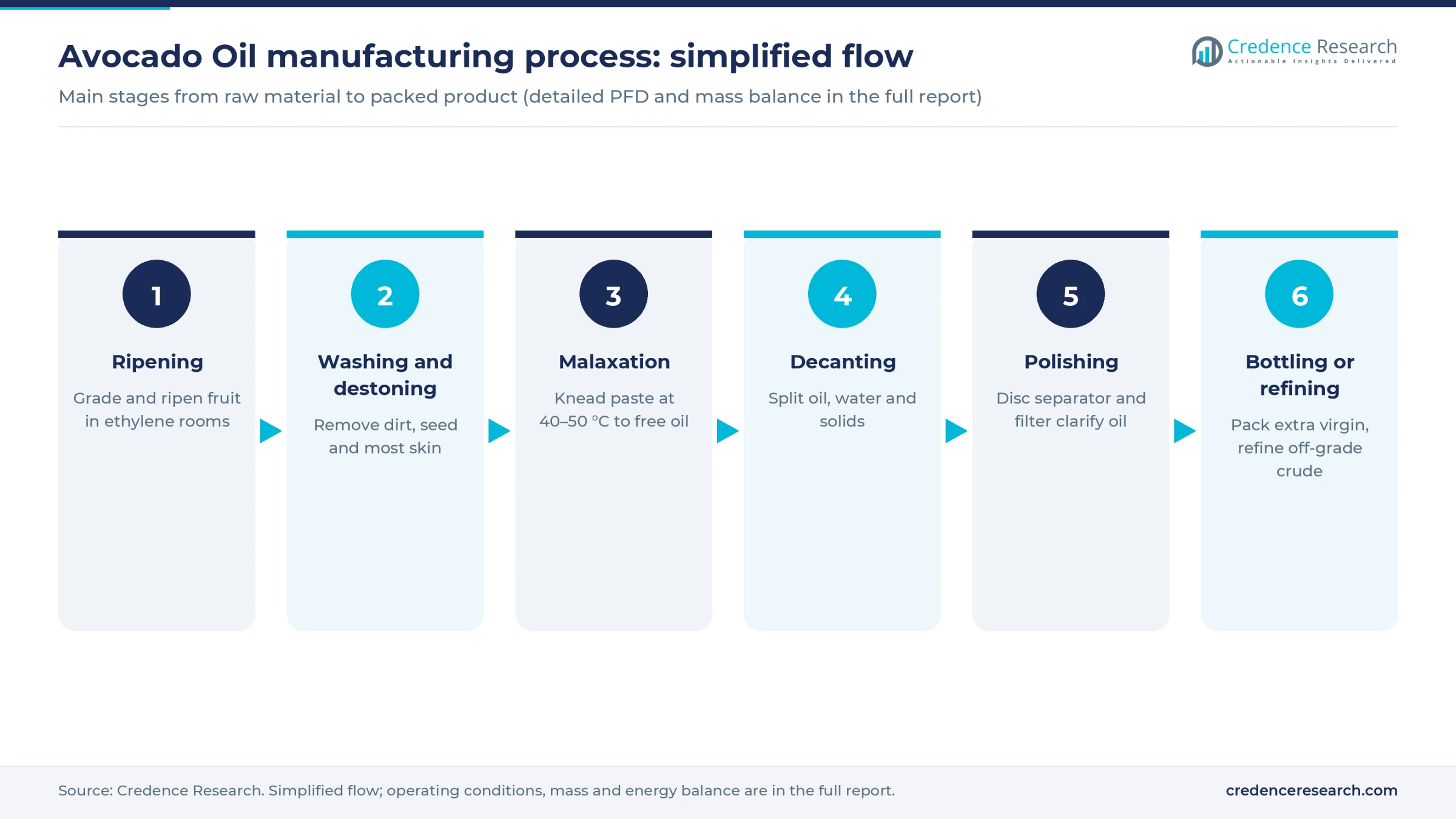
- Receiving and ripening. Fruit is graded, weighed and held in ethylene-controlled rooms for several days until the flesh yields to pressure. Rotten fruit is culled because it raises free fatty acids and spoils the extra virgin grade.
- Washing and destoning. A brush washer removes dirt and spray residue, and a destoner separates the seed and most of the skin, since skin pigments darken the oil and seed compounds add bitterness.
- Pulping and malaxation. Flesh is milled to a paste and kneaded in jacketed malaxers at 40–50 °C. Laboratory work by Ramírez-Anaya and colleagues found about 80–83% of pulp fat released after 120 minutes of malaxation at 40–50 °C, against almost none without kneading.
- Decanter separation. A horizontal decanter centrifuge splits the paste into oil, water and solids. Two-phase models use less process water and discharge a wet pomace.
- Polishing and filtration. A vertical disc separator removes fine water and solids, and a plate filter clarifies the oil before nitrogen-blanketed storage.
- Bottling or refining. Extra virgin oil goes into dark glass or tins. Off-grade crude is degummed, neutralized, bleached and deodorized, usually by a toll refiner at this scale.
Yield depends more on fruit than on machinery. Hass-type fruit with 17–20% pulp fat returns about 9–12% oil on whole-fruit weight, Kenyan processors report 4–10% depending on variety, and green-skinned seedling fruit sits toward the lower end. Process wastewater carries a heavy organic load and needs an effluent treatment plant, while pomace and seeds can go to biogas, cattle feed or cosmetic seed extracts.
Avocado oil plant setup cost
Indicative CapEx for a 500 kg per hour extraction line, run one shift to process about 4 tonnes of fruit a day, or about 1,000 tonnes a year at full use, is USD 0.6–0.8 million for a greenfield plant in a lower-cost producing region such as Mexico, Peru, Kenya or South Africa. The build scales a publicly listed complete avocado oil line from a Chinese supplier, covering washer to disc separator, loaded for duty, freight and installation, and adds ripening rooms, a chiller and hot-water system, an effluent plant, nitrogen-blanketed tanks, a semi-automatic bottling line and a quality lab.
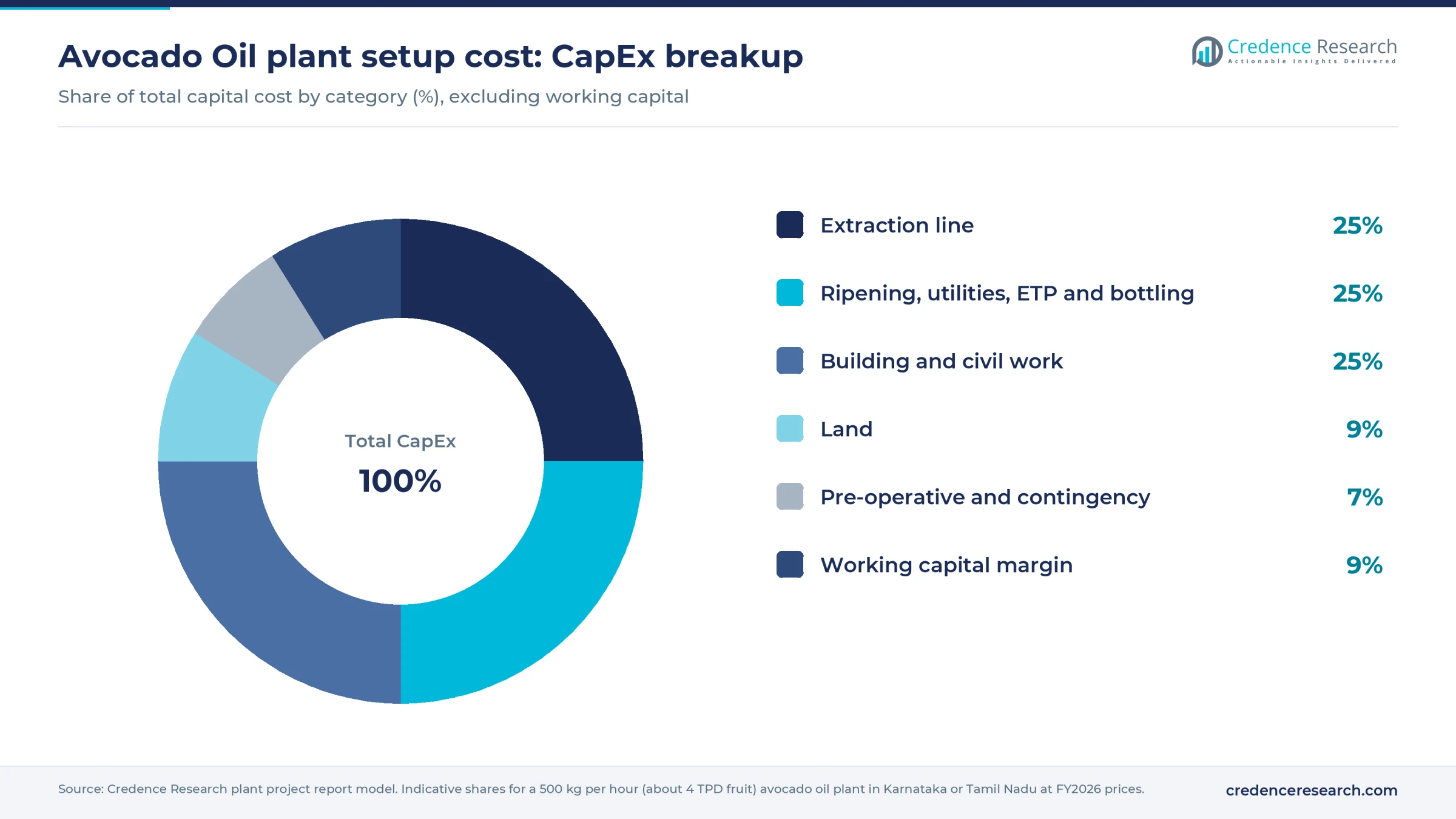
Plant and machinery, split evenly between the extraction line and the support systems, take about half of the budget. Building and civil work for about 7,000 square feet, covering the process hall, ripening and cold rooms, bottling area and warehouse, take another quarter.
Example row, land: about 1 acre in an industrial zone near growing districts is budgeted, as an assumption, at USD 40,000–90,000 in lower-cost producing regions, about 9% of the total. Comparable plots in the United States, the European Union or New Zealand can cost several times more, and leasing lowers upfront spending. Pre-operative expenses and contingency take about 7%, and working capital margin about 9%, because seasonal oil must be stocked for year-round sales.
A European turnkey line at a higher-cost site moves the budget to roughly USD 1.5–2.5 million. As a cross-check, the planned Kaimosi plant in western Kenya, 5 tonnes a day with Italian machinery, was budgeted at KES 300 million, about USD 2.3 million.
Operating cost is split between fruit and people.
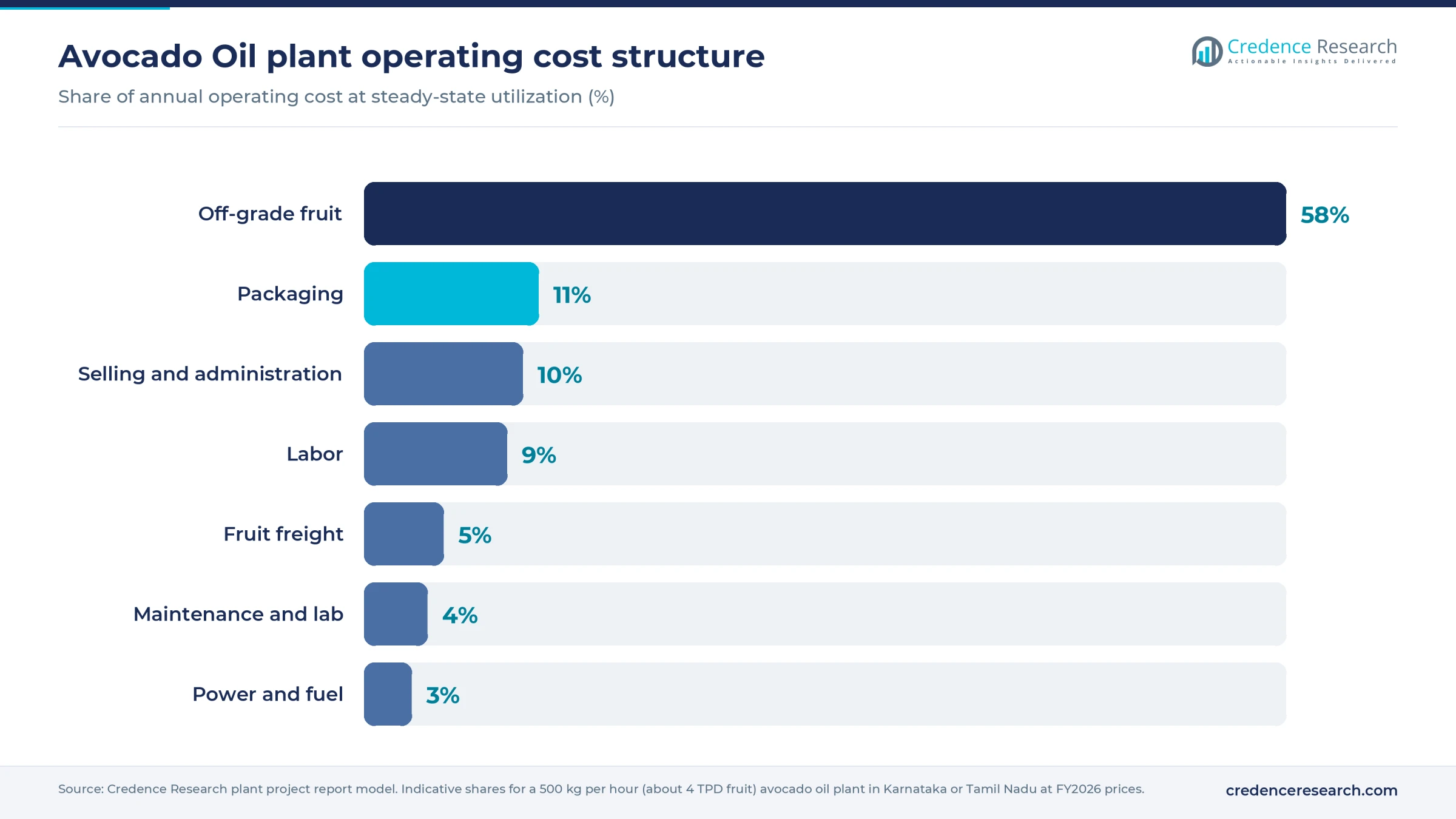
At an assumed USD 0.15–0.35 per kg for off-grade fruit and a 9–11% oil yield, fruit costs USD 1.4–3.9 per kg of oil, about 37% of operating cost. Labor adds about 20%, selling and administration 15%, glass bottles and labels 12%, inbound fruit freight 6%, power and fuel 5%, and maintenance and lab tests 5%. Labor and land shares swing most between countries, which is why the full report can be customized to any location.
Machinery and raw materials for an avocado oil plant
The core machinery list covers a fruit receiving conveyor and weighbridge scale, ethylene ripening rooms, a brush and spray washer, a destoner and pulper, a paste mill, two or three jacketed malaxers, a two- or three-phase horizontal decanter, a vertical disc separator, a plate filter, stainless steel tanks with nitrogen blanketing, a hot-water generator and chiller, an effluent treatment plant, semi-automatic filling, capping and labeling machines, and a lab for free fatty acids, peroxide value and moisture. Decanter design is shared with olive milling, so many olive oil decanter centrifuge suppliers offer avocado configurations.
Raw material is the binding constraint. Export-grade fruit is worth far more fresh than as oil: at a 9–11% oil yield, even fruit at USD 1 per kg puts USD 9–11 of fruit into each kg of oil, above bulk oil values of USD 6–8 per kg. Mills therefore run on fruit that export packhouses reject as overripe, bruised, undersized or blemished. The main sourcing regions are Michoacán and Jalisco in Mexico, La Libertad and Lima in Peru, Valparaíso in Chile, Antioquia in Colombia, Murang'a and Kisii in Kenya, Limpopo in South Africa and the Bay of Plenty in New Zealand. Mills beside packhouses buy rejects cheaply, while mills in importing countries face fruit costs several times higher. Swings in the wider avocado market matter, because export gluts and shipping disruptions push surplus fruit to crushers.
Avocado oil business profit margin and ROI
At 60% utilization a 500 kg per hour mill crushes about 600 tonnes of fruit and produces roughly 55–65 tonnes of oil a year. Assuming half is sold as bottled extra virgin oil at an assumed ex-factory USD 12–15 per kg and half as bulk oil at USD 6–8 per kg, in line with Mexican avocado oil export records of roughly USD 6–14 per kg in 2024 compiled by trade-data platforms, gross margin after fruit, packaging and conversion costs comes to 30–45%. Payback, including a ramp-up year, falls in a 4–7 year band.
Fruit price and oil yield move together against the operator. Each USD 0.05 per kg rise in fruit cost removes about USD 30,000 a year, or 5 percentage points of gross margin, and each one-point drop in oil yield costs about 6 tonnes of saleable oil. Grade mix is the other lever, since bottled extra virgin oil earns roughly twice the bulk price. The main commercial risk is bulk oversupply: as Kenya and other origins add crushing capacity, bulk prices can fall faster than fruit costs. Buyers also test for adulteration, so mills that document Codex identity parameters win longer contracts.
| Metric | Value |
|---|---|
| Project IRR (post-tax) | Available in report |
| NPV | Available in report |
| Return on investment | Available in report |
| DSCR | Available in report |
| Break-even utilization | Available in report |
How to start an avocado oil business, licenses and approvals
Approvals for an avocado oil mill follow a similar sequence in most countries.
- Business registration and tax identification.
- Land use or zoning clearance and building permits.
- Environmental permit or consent covering wastewater from washing and decanting, which carries a heavy organic load.
- Food business registration or license and a HACCP-based food safety plan.
- Occupational safety approvals, including boiler and pressure vessel inspection.
- Labeling and weights-and-measures compliance for packaged oil.
- Import or export registration, plus phytosanitary certificates when fresh fruit crosses borders.
| Market | Key approvals for an avocado oil plant |
|---|---|
| United States | FDA food facility registration, renewed every two years; preventive controls for human food under 21 CFR Part 117; wastewater discharge permit under the Clean Water Act (NPDES or local pretreatment permit) |
| European Union | Registration with the national food authority under Regulation (EC) No 852/2004; labeling under Regulation (EU) No 1169/2011; national environmental and water discharge permits, since a mill this size sits below the Industrial Emissions Directive threshold of 300 tonnes a day of finished product from vegetable raw materials |
| India | FSSAI license; registration and monthly returns under the Vegetable Oil Products, Production and Availability (Regulation) Order as amended in 2025; state pollution control board consent; Legal Metrology packer registration |
Key avocado oil manufacturers and recent developments
Global production is led by fruit-integrated processors. Chosen Foods sells avocado oil across U.S. retail with Mexican sourcing, Olivado operates in New Zealand and Kenya, and Westfalia Fruit makes crude, virgin and refined avocado oil for food and personal care and has announced oil plants in Mozambique and Kenya. AvoFresh Processors runs a mill in Kisii, Kenya, rated for up to 70 tonnes of fruit a day. Ecovado in South Africa is a newer regional entrant, and many retail brands in importing markets bottle bulk oil bought from these origins.
- December 2025. New Zealand and India concluded a free trade agreement under which New Zealand avocados move to duty-free access in India over 10 years, opening a new outlet for export fruit.
- April 2026. The USDA Foreign Agricultural Service reported that Kenyan avocado oil processing was expected to triple from 3,326 tonnes in 2024 to about 10,188 tonnes in 2025, as Red Sea disruptions and export controls cut fresh fruit exports.
- July 2026. Ecovado opened an avocado oil plant in the Vhembe district of Limpopo, South Africa, equipped with a full Alfa Laval processing line and supplied by small-scale growers.
What's inside the Avocado Oil project report PDF
The report runs to 21 chapters. Open a chapter to see its sections.
1. Preface
2. Scope and Methodology
- 2.1 Objectives of the Study
- 2.2 Stakeholders
- 2.3 Research Methodology
- 2.4 Data Sources and Key Assumptions
3. Executive Summary
- 3.1 Market Snapshot
- 3.2 Project at a Glance (Capacity, CapEx, OpEx)
- 3.3 Key Financial Indicators (IRR, NPV, Payback, Break-even)
- 3.4 Feasibility Verdict
4. Product Overview
- 4.1 Avocado Oil Definition and Properties
- 4.2 Grades and Specifications (BIS / ISO / ASTM)
- 4.3 HS Code and Classification
- 4.4 Key Applications
- 4.5 Substitutes
5. Global Avocado Oil Market
- 5.1 Market Overview
- 5.2 Historical and Current Market Performance (Volume and Value)
- 5.3 Market Breakup by Grade / Type
- 5.4 Market Breakup by End-Use Industry
- 5.5 Market Breakup by Region
- 5.6 Market Drivers, Restraints and Trends
- 5.7 Value Chain Analysis
- 5.8 Market Forecast
6. Target Country Avocado Oil Market Analysis
- 6.1 Demand and Supply Analysis
- 6.2 Installed Capacity vs Demand Gap
- 6.3 Import Dependence
- 6.4 Demand Forecast by End-Use
7. Trade Analysis
- 7.1 Imports by Volume, Value and Country
- 7.2 Exports by Volume, Value and Country
- 7.3 Trade Balance and Opportunities
8. Price Analysis
- 8.1 Historical Avocado Oil Price Trends by Region
- 8.2 Raw Material / Feedstock Price Trends and Linkage
- 8.3 Price Forecast
- 8.4 Margins Across the Value Chain
9. Competitive Landscape
- 9.1 Market Structure
- 9.2 Key Players and Installed Capacities
- 9.3 Profiles of Key Players
- 9.4 Recent Developments (Expansions, M&A, New Plants)
10. Manufacturing Process and Technology
- 10.1 Comparison of Technology Routes
- 10.2 Selected Route and Process Flow Diagram
- 10.3 Unit Operations Involved
- 10.4 Chemical Reactions Involved
- 10.5 Mass Balance and Raw Material Requirements
- 10.6 Energy Balance
- 10.7 Quality Assurance Criteria and Technical Tests
- 10.8 By-products and Waste Handling
- 10.9 Technology Licensors / Providers
11. Project Details, Requirements and Costs
- 11.1 Land, Location and Site Development
- 11.1.1 Site Selection Criteria
- 11.1.2 Location Analysis
- 11.1.3 Land Requirement and Costs
- 11.1.4 Site Development Costs
- 11.2 Plant Layout
- 11.2.1 Layout Principles
- 11.2.2 Proposed Layout
- 11.2.3 Factors Influencing Layout
- 11.3 Civil Works and Buildings
- 11.4 Plant Machinery
- 11.4.1 Machinery Requirements and Specifications
- 11.4.2 Machinery Costs
- 11.4.3 Machinery Suppliers
- 11.5 Raw Materials
- 11.5.1 Requirements per Tonne of Output
- 11.5.2 Procurement and Sourcing
- 11.5.3 Costs
- 11.5.4 Suppliers
- 11.6 Packaging
- 11.6.1 Packaging Requirements
- 11.6.2 Packaging Costs
- 11.6.3 Packaging Suppliers
- 11.7 Storage and Material Handling
- 11.8 Transportation Requirements and Costs
- 11.9 Utilities
- 11.9.1 Power Requirements and Costs
- 11.9.2 Water Requirements and Costs
- 11.9.3 Steam, Fuel and Other Utilities
- 11.10 Manpower Requirements and Wages
12. Environment, Health, Safety and Sustainability
- 12.1 Effluent and Emissions Management
- 12.2 Hazard Classification and Safety Measures
- 12.3 Carbon Footprint
- 12.4 Green / Low-Carbon Process Options
13. Regulatory Procedures, Approvals and Certifications
- 13.1 Licences and Registrations
- 13.2 Environmental Clearances
- 13.3 Product Certifications (BIS, REACH, etc.)
- 13.4 Approval Timeline
14. Project Implementation Schedule
15. Project Economics
- 15.1 Capital Cost of the Project
- 15.2 Techno-Economic Parameters
- 15.3 Capacity Utilization and Ramp-up
- 15.4 Product Pricing and Margins
- 15.5 Income Projections
- 15.6 Expenditure Projections
- 15.7 Working Capital Requirement
- 15.8 Taxation
- 15.9 Depreciation
16. Financial Analysis
- 16.1 Projected Profit and Loss Account
- 16.2 Projected Cash Flow Statement
- 16.3 Projected Balance Sheet
- 16.4 Liquidity Analysis
- 16.5 Profitability Analysis (Payback, NPV, IRR, ROI)
- 16.6 Break-even Analysis
- 16.7 Debt Service Coverage Ratio (DSCR)
- 16.8 Sensitivity Analysis
- 16.9 Scenario and Uncertainty Analysis
17. Funding and Incentives
- 17.1 Means of Finance and Debt-Equity Structure
- 17.2 Loans and Financial Assistance
- 17.3 Government Schemes and Subsidies (PLI, State Policies)
18. Risk Assessment
- 18.1 Key Success Factors
- 18.2 Key Risk Factors
- 18.3 Risk Mitigation
19. Strategic Recommendations
20. Case Study of a Successful Venture
21. Appendix
- 21.1 Detailed Assumptions
- 21.2 Abbreviations
- 21.3 List of Tables and Figures
- 21.4 Sources
This page vs. the full report
| Data point | On this page (free) | In the full report |
|---|---|---|
| Total CapEx | One rounded range at one capacity | Exact figure at three capacities with a line-item breakup |
| CapEx breakup | Category shares (%) only | Cost, quantity and supplier for every machine |
| Operating cost | Share of raw materials, utilities and labor | Per-unit cost sheet with each input price and consumption |
| Profitability | Gross margin range and payback band | Exact IRR, NPV, ROI, break-even and DSCR |
| Financial statements | List of what is included | 10-year P&L, cash flow, balance sheet and Excel model |
| Sensitivity | One directional line | Full sensitivity and scenario tables |
| Process | Simplified flow diagram | Detailed process flow, mass and energy balance, operating conditions |
| Machinery | Names of the main machines | Specifications, capacity, cost and supplier list |
| Market | Headline size, growth and India demand trend | Segment, region, trade and price forecast tables |
| Suppliers and buyers | Supplier types and sourcing hubs | Named suppliers and buyers |
Avocado Oil project report: FAQs
How much does it cost to set up an avocado oil plant?
Where should an avocado oil plant be located?
What oil yield can an avocado oil plant expect?
What is the profit margin in avocado oil processing?
What is the difference between extra virgin and refined avocado oil?
Which licenses are needed to start an avocado oil business?
What is the payback period for an avocado oil plant?

About the analyst
Rajdeep Kumar Deb, Lead Analyst - Consumer & Finance
Rajdeep brings a decade of consumer goods and financial services insight to strategic market analysis.
Related market research
- Extra Virgin Avocado Oil Market Size, Growth and Forecast 2032
- Avocado Market Size, Share, Growth, Trends and Forecast 2032
- Olive Oil Decanter Centrifuge Market Size, Share and Forecast 2032
- Edible Oils and Fats Market Size, Trends, Share and Forecast 2032
- Cooking Oils and Fats Market Size, Growth and Forecast 2032
- Avocado Puree Market Size, Growth, Share and Forecast 2032
More plant project reports
- Paper Cups Manufacturing Plant Project Report (DPR) 2026
- Cigarette Manufacturing Plant Project Report (DPR) 2026
- Ceiling Fan Manufacturing Plant Project Report (DPR) 2026
- Aluminium Cans Manufacturing Plant Project Report (DPR) 2026
- Aloe Vera Gel Manufacturing Plant Project Report (DPR) 2026
- Shrimp Processing Plant Project Report (DPR) 2026