Avocado Market Overview:
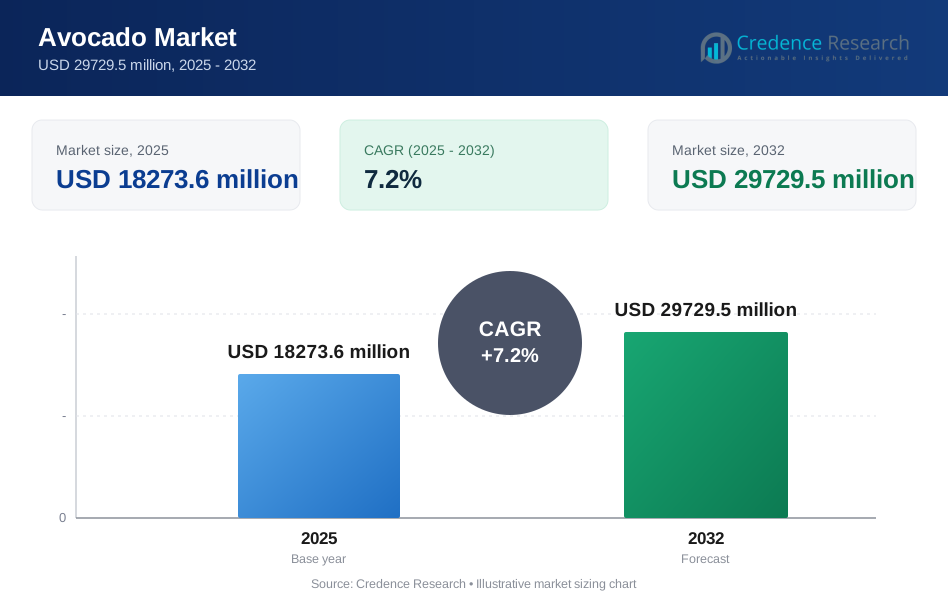
The global Avocado Market size was estimated at USD 18273.6 million in 2025 and is expected to reach USD 29729.5 million by 2032, growing at a CAGR of 7.2% from 2025 to 2032. Rising consumer preference for nutrient-dense foods with healthy fats continues to expand avocado consumption across household, retail, and foodservice channels in multiple regions. Strong year-round sourcing networks and wider availability of ripe-ready fruit are also improving category penetration and repeat purchase frequency.
| REPORT ATTRIBUTE | DETAILS |
|---|---|
| Historical Period | 2020-2024 |
| Base Year | 2025 |
| Forecast Period | 2026-2032 |
| Avocado Market Size 2025 | USD 18273.6 million |
| Avocado Market, CAGR | 7.2% |
| Avocado Market Size 2032 | USD 29729.5 million |
Key Market Trends & Insights
- North America accounted for 34.0% of the global Avocado Market in 2025, making it the largest regional market.
- Europe represented 28.0% of the global market in 2025, supported by strong retail and foodservice demand.
- Asia Pacific held 19.0% of the market in 2025 and remains one of the most dynamic growth regions for avocado consumption.
- Fresh / Raw Avocados accounted for 76.5% of the market, reflecting the category’s strong alignment with produce-led household demand.
- The global Avocado Market is projected to grow at a CAGR of 7.2% from 2025 to 2032, reaching USD 29729.5 million by 2032.

Segment Analysis
The Avocado Market remains structurally concentrated in fresh produce formats, with demand supported by strong consumer association between avocados and healthy everyday eating. Buyers increasingly integrate avocados into breakfast items, salads, sandwiches, dips, and plant-forward meals, which reinforces steady retail turnover. Product visibility in mainstream grocery formats has improved category accessibility across both developed and emerging markets. Ripening programs, branded packaging, and quality consistency have also strengthened merchandising effectiveness. These factors support a market structure in which high-volume fresh consumption continues to shape overall revenue distribution.
Demand patterns across the Avocado Market also reflect a combination of affordability, convenience, and broadening usage occasions. Conventional fruit retains a wider consumer base because it is more available at scale and is typically offered at lower price points than organic alternatives. Supermarkets and hypermarkets remain central to the category because shoppers often prefer to assess ripeness, firmness, and visual quality before purchase. Household consumption remains highly influential, though food and beverage applications continue to expand through guacamole, sauces, frozen products, and ingredient use. End-use diversification into personal care further supports value creation beyond direct fresh consumption.
By Form Insights
Fresh / Raw Avocados accounted for the largest share of 76.5%. The segment leads because avocados are primarily purchased as fresh produce for immediate household and foodservice use across a broad range of meal occasions. Consumers strongly associate fresh avocados with natural nutrition, healthy fats, and minimal processing, which supports repeat purchase behavior. Retailers also prioritize fresh avocados because ripeness-based merchandising programs help improve turnover and shelf productivity. Widespread use in salads, toast, dips, sandwiches, and bowls continues to reinforce the category’s dominant fresh-fruit orientation.
By Nature / Cultivation Method Insights
Conventional accounted for the largest share of 84.0%. The segment leads because conventional cultivation supports larger production volumes, wider year-round supply availability, and stronger price accessibility for mainstream buyers. Mass retail channels are still anchored by conventional assortments, which allows broader penetration across household and foodservice demand. Conventional fruit also benefits from established sourcing and distribution systems that support scale across major importing markets. Organic avocados continue to gain interest, but conventional offerings remain the commercial backbone of the market.
By Distribution Channel Insights
Hypermarkets / Supermarkets accounted for the largest share of 46.0%. The channel leads because shoppers often prefer to physically inspect avocados for ripeness, firmness, size, and external quality before purchase. Large-format grocery retailers also offer high category visibility, frequent replenishment, and promotional pricing that supports consistent purchase volume. These outlets are well suited to both loose and bagged avocado merchandising, which improves accessibility across different shopper preferences. Broad geographic reach and integrated fresh-produce supply chains further strengthen the leading position of supermarkets and hypermarkets.
By End Use Insights
Retail / Household Consumers accounted for the largest share of 51.5%. The segment leads because a substantial portion of avocado demand comes from direct at-home consumption across breakfast, snacking, and meal preparation occasions. Household buyers increasingly view avocados as a staple fresh item that supports wellness, convenience, and culinary versatility. Regular use in home-prepared dips, salads, sandwiches, smoothies, and side dishes contributes to strong recurring demand. The segment also benefits from rising grocery penetration and improved availability of ripe-ready fruit in modern retail channels.
Avocado Market Drivers
Rising consumer preference for healthy and nutrient-dense foods
Consumer food choices increasingly favor products associated with healthy fats, fiber, vitamins, and satiety, and avocados fit this positioning strongly. The category benefits from broad relevance across wellness, plant-forward, and clean-eating consumption patterns. Avocados also appeal to buyers seeking minimally processed foods that can be integrated into everyday meals without complex preparation. This health-oriented demand base supports both volume expansion and premiumization across multiple markets. As nutrition awareness deepens, avocado consumption continues to move from occasional purchase to routine basket inclusion.
- For instance, a 100 gram serving of avocado provides about 6.7 grams of fiber and 14.7 grams of fat, predominantly heart-healthy monounsaturated fatty acids such as oleic acid, which supports cardiovascular health and satiety, according to analyses of Hass avocado composition and USDA-based nutrition data.
Wider retail penetration and improved merchandising quality
Retail distribution has become a major catalyst for avocado market expansion as supermarkets, hypermarkets, and specialty produce channels improve category management. Ripening programs, ready-to-eat assortments, bagged formats, and quality-focused display strategies help reduce purchase uncertainty for consumers. Stronger in-store execution supports repeat buying by improving consistency and usability. Retailers are also giving avocados more prominent placement because the category delivers attractive turnover and aligns with healthy-eating trends. These developments strengthen mainstream accessibility and help widen the consumer base.
Expanding foodservice and processed avocado applications
Foodservice demand continues to support avocado market growth as restaurants, cafes, and quick-service operators integrate avocado into sandwiches, bowls, salads, wraps, and breakfast formats. Processed avocado products such as guacamole, purees, sauces, frozen items, and spreads are also broadening commercial usage. These applications increase demand beyond whole-fruit household purchases and help absorb larger market volumes. Ingredient versatility makes avocados relevant across both premium and everyday menu formats. The result is a more diversified demand structure that supports category resilience.
- For instance, Mission Produce’s AvoIntel data show that 75.5% of surveyed consumers order guacamole and 71.8% order Mexican dishes with avocado in restaurants, followed by salads at 62.0%, sandwiches at 56.2%, and avocado toast at 48.1%, underscoring widespread menu penetration across formats.
Stronger global sourcing and year-round supply availability
The Avocado Market benefits from expanding multinational sourcing models that reduce seasonal constraints and improve market continuity. Suppliers increasingly manage fruit from multiple origins to ensure more stable year-round availability for retailers and distributors. This reduces supply gaps and helps maintain consumer engagement across major demand centers. Better cold-chain handling, ripening control, and logistics integration also improve quality consistency at the point of sale. A more dependable supply environment supports market growth by making avocados easier to merchandise and consume on a regular basis.
Avocado Market Challenges
Price volatility and supply inconsistency remain important challenges in the Avocado Market. Production is influenced by weather patterns, water availability, crop cycles, and phytosanitary conditions, which can create fluctuations in yield and export flow. Because avocados are highly sensitive to handling and maturity conditions, supply disruptions can quickly affect quality, pricing, and retailer confidence. Import-dependent markets are particularly exposed to logistics and sourcing disruptions. These factors can limit purchasing momentum during periods of elevated prices.
- For instance, when the U.S. government suspended all imports of Mexican avocados after a safety threat to a plant inspector, the nearly 3‑billion‑dollar export industry from Mexico was abruptly interrupted, creating near‑term supply risk for U.S. buyers.
The market also faces challenges related to perishability and quality variability. Avocados require careful post-harvest handling, ripening management, and inventory timing to reach consumers in saleable condition. Inconsistent ripeness can reduce shopper satisfaction and create waste across retail and distribution channels. Quality control becomes more complex as sourcing networks extend across multiple origins and transit routes. Maintaining a consistent consumer experience remains essential for sustaining repeat purchase behavior.
Avocado Market Trends and Opportunities
One important trend in the Avocado Market is the growing commercial emphasis on ripe-ready, bagged, and convenience-oriented retail offerings. These formats improve usability for shoppers and support higher merchandising efficiency for retailers. Category players are also using branding, packaging, and assortment strategies to differentiate fruit by convenience, quality, and use occasion. Such approaches can improve shopper confidence and expand basket penetration. This trend creates opportunities for suppliers that can combine ripening expertise with retail execution.
Another opportunity lies in the expansion of value-added avocado applications across foodservice, frozen, processed, and personal care categories. As avocado usage broadens beyond whole-fruit consumption, suppliers can capture additional value through ingredient formats and product innovation. Demand for avocado-based dips, oils, purees, and skin or hair care formulations can help diversify revenue streams. Emerging urban markets also offer room for category expansion as modern retail and health-focused consumption increase. These trends support longer-term market development across both mature and developing regions.
- For instance, major brands such as Chosen Foods have built extensive lines of 100% pure and cold-pressed avocado oils specifically formulated for high-heat cooking and salad applications, enabling food manufacturers and consumers to switch from conventional oils to avocado-based alternatives in packaged products.
Regional Insights
North America
North America accounted for 34.0% of the global Avocado Market, making the region the largest revenue contributor. The region benefits from high household penetration, well-developed import infrastructure, and strong foodservice integration across major consumption channels. The United States remains the principal demand center due to broad consumer familiarity with avocado-based meal occasions and sustained retail visibility. Mexico also plays a critical role within the regional landscape through production strength, trade integration, and domestic consumption. These factors keep North America at the forefront of global market demand.
Europe
Europe represented 28.0% of the global market and remains a major center for avocado consumption. Demand is supported by growing preference for healthy fresh produce, broader foodservice use, and strong supermarket distribution networks across key countries. The UK, Germany, France, and Spain are among the most influential demand markets in the region. Retailers continue to support category expansion through ready-to-eat assortments, premium fruit positioning, and improved shelf presentation. Europe’s mature import structure and growing mainstream acceptance continue to reinforce regional market strength.
Asia Pacific
Asia Pacific held 19.0% of the global Avocado Market and is emerging as a strong growth region. Rising urbanization, premium fresh produce demand, and increasing awareness of avocado nutrition are expanding consumption across several countries. Markets such as Japan, China, Australia, and South Korea are contributing to broader regional adoption. Modern retail development and shifting dietary preferences are also supporting category growth. Asia Pacific is positioned for continued expansion as awareness and availability improve further.
Latin America
Latin America accounted for 12.5% of the market and remains deeply important to the global avocado industry. The region combines major production capacity with growing domestic consumption, creating both supply-side and demand-side importance. Mexico anchors the regional landscape, and countries such as Chile, Peru, and Brazil also support market development. Although export orientation remains strong, in-region avocado usage continues to expand across household and commercial channels. This creates a balanced role for Latin America as both a producing and consuming region.
Middle East & Africa
Middle East & Africa captured 6.5% of the global Avocado Market. The region remains smaller than the major mature markets, but demand is gradually expanding through modern retail development and greater availability of imported fruit. Urban consumers are showing increasing interest in health-oriented fresh foods and premium produce categories. Growth is particularly supported by organized retail channels in selected Gulf markets and by export-linked activity in parts of Africa. Long-term regional potential is improving as supply access and consumer awareness continue to broaden.
Competitive Landscape
The Avocado Market is characterized by competition centered on sourcing scale, ripening capability, year-round supply continuity, product quality, and customer relationships across retail and foodservice channels. Companies differentiate themselves through vertical integration, origin diversification, packaging formats, and logistics efficiency that support freshness and consistency. Market participants are also strengthening their positions through acquisitions, regional expansion, and value-added offerings tailored to retailer and distributor requirements. Competitive intensity is shaped not only by supply access but also by the ability to manage ripeness, reduce waste, and deliver dependable service across multiple destination markets.
Calavo Growers, Inc. remains one of the most visible companies in the market and benefits from a strong specialization in avocado sourcing, packing, ripening, and distribution. The company’s approach is centered on category management capability, customer service, and broad market participation across fresh produce channels. Calavo Growers has built recognition through its established industry presence and operational focus on avocado commercialization. The company’s positioning reflects the importance of supply coordination and market access in a category where quality, timing, and consistency strongly influence performance.
The industry research and growth report includes detailed analyses of the competitive landscape of the market and information about key companies, including:
- Calavo Growers, Inc.
- Mission Produce Inc.
- West Pak Avocado Inc.
- Westfalia Fruit
- Del Rey Avocado Company, Inc.
- JBR Avocados / Aguacates JBR
- Empacadora Avehass S.A. de C.V.
- Henry Avocado Corporation
- Brooks Tropicals LLC / Brooks Tropicals Holding, Inc.
- Simpson Farms and Duclos Farms
- Oppy (The Oppenheimer Group)
Qualitative and quantitative analysis of companies has been conducted to help clients understand the wider business environment as well as the strengths and weaknesses of key industry players. Data is qualitatively analyzed to categorize companies as pure play, category-focused, industry-focused, and diversified; it is quantitatively analyzed to categorize companies as dominant, leading, strong, tentative, and weak.
Recent Developments
- In January 2026, Mission Produce announced it had entered into a definitive agreement to acquire Calavo Growers in a cash‑and‑stock transaction valued at about 430 million dollars, aiming to expand its North American avocado business and enter the high‑growth prepared foods segment, including guacamole.
- In October 2025, West Pak Avocado Inc. unveiled its “Amplifying AVO360” campaign, an evolution of its earlier AVO360 Experience program, positioning the initiative as a 2025–2026 marketing platform focused on seasonal planning, performance growth, data‑driven tools, and collaborative case studies to help retail and foodservice partners grow avocado category sales.
- In July 2025, Westfalia Fruit completed the acquisition of Dutch foodservice avocado specialist Greenpoint Trading B.V., a move designed to strengthen its presence in the European foodservice channel and broaden its offering of ripened, high‑quality avocados to restaurant and catering customers across the region.
Report Scope
| Report Attribute | Details |
| Market size value in 2025 | USD 18273.6 million |
| Revenue forecast in 2032 | USD 29729.5 million |
| Growth rate (CAGR) | 7.2% (2025–2032) |
| Base year | 2025 |
| Forecast period | 2026-2032 |
| Quantitative units | USD million |
| Segments covered | By Form Outlook: Fresh / Raw Avocados, Processed Avocado Products; By Nature / Cultivation Method Outlook: Conventional, Organic; By Distribution Channel Outlook: Hypermarkets / Supermarkets, Departmental Stores / Specialty Stores, Online Channels (D2C and marketplaces), Others; By End Use Outlook: Food & Beverages Industry, Retail / Household Consumers, Cosmetics & Personal Care, Others |
| Regional scope | North America, Europe, Asia Pacific, Latin America, Middle East & Africa |
| Key companies profiled | Calavo Growers, Inc., Mission Produce Inc., West Pak Avocado Inc., Westfalia Fruit, Del Rey Avocado Company, Inc., JBR Avocados / Aguacates JBR, Empacadora Avehass S.A. de C.V., Henry Avocado Corporation, Brooks Tropicals LLC / Brooks Tropicals Holding, Inc., Simpson Farms and Duclos Farms, Oppy (The Oppenheimer Group) |
| No. of Pages | 338 |
Segmentation
By Form
- Fresh / Raw Avocados
- Processed Avocado Products
By Nature / Cultivation Method
- Conventional
- Organic
By Distribution Channel
- Hypermarkets / Supermarkets
- Departmental Stores / Specialty Stores
- Online Channels (D2C and marketplaces)
- Others
By End Use
- Food & Beverages Industry
- Retail / Household Consumers
- Cosmetics & Personal Care
- Others
By Region
- North America
- U.S.
- Canada
- Mexico
- Europe
- Germany
- France
- U.K.
- Italy
- Spain
- Rest of Europe
- Asia Pacific
- China
- Japan
- India
- South Korea
- South-east Asia
- Rest of Asia Pacific
- Latin America
- Brazil
- Argentina
- Rest of Latin America
- Middle East & Africa
- GCC Countries
- South Africa
- Rest of the Middle East and Africa
Request a Free Sample
Fill in your details and we'll send you a free sample report.
- Sample data tables & charts
- Research methodology
Need a Custom Version of This Report?
Tailor the scope, geography, or segments to your exact requirements.
- Custom geography or segment scope
- Direct access to our analyst team
Frequently Asked Questions
What is the current size of the Avocado Market?
What is the forecast value of the Avocado Market by 2032?
What is the CAGR of the Avocado Market?
Which is the largest segment in the Avocado Market?
Which companies are profiled in the Avocado Market report?
Which region leads the Avocado Market?
Table of Content
Chapter 1 Market Segmentation
- 1.1 Segmentation Framework
- 1.1.1 Product and Service Classification
- 1.1.2 Application and End-Use Classification
- 1.1.3 Technology and Solution Classification
- 1.1.4 Customer and Distribution Channel Classification
- 1.1.5 Geographic Segmentation
- 1.1.6 Market Segment Definitions and Boundaries
Chapter 2 Introduction
- 2.1 Report Objectives and Scope
- 2.2 Product Definition and Industry Terminology
- 2.3 Market Inclusions and Exclusions
- 2.4 Research Process
- 2.4.1 Primary Research and Expert Interviews
- 2.4.2 Secondary Research and Source Review
- 2.4.3 Top-Down and Bottom-Up Estimation
- 2.4.4 Data Triangulation and Verification
- 2.5 Market Size Measurement Basis
- 2.5.1 2025: USD 18273.6 million → 2032: USD 29729.5 million
- 2.6 Historical and Forecast Reference Periods
- 2.6.1 Base Year: 2025
- 2.6.2 Forecast Period: 2025-2032
- 2.7 Research Assumptions and Limitations
Chapter 3 Executive Summary
- 3.1 Market Snapshot and Key Findings
- 3.2 Base-Year Market Size, 2025
- 3.3 Forecast Market Size, 2032
- 3.4 Revenue and Volume Growth Outlook
- 3.5 Key Demand and Supply Indicators
- 3.6 Leading Market Segments
- 3.7 Fastest-Growing Market Opportunities
- 3.8 Regional Performance Highlights
- 3.9 Technology and Industry Transformation
- 3.10 Competitive Landscape Summary
- 3.11 Analyst View and Strategic Implications
Chapter 4 Global Avocado Market Trends and Developments
- 4.1 Historical Industry Development
- 4.2 Recent Market Trends and Developments
- 4.3 Demand and Customer Behavior Trends
- 4.4 Technology and Product Innovation
- 4.5 Artificial Intelligence, Automation and Digitalization
- 4.6 Local Manufacturing and Supply Chain Realignment
- 4.7 Industry Partnerships, Mergers and Acquisitions
- 4.8 Sustainability and Circular Economy Developments
- 4.9 Government and Private Sector Investment Trends
- 4.10 Emerging Business Models and Commercialization
- 4.11 Industry Developments and Announcements
Chapter 5 Global Avocado Market Production, Supply and Demand Analysis
- 5.1 Demand Trend and Consumption Analysis
- 5.2 Demand Forecast, 2025-2032
- 5.3 Production and Output Trend
- 5.4 Production and Output Forecast, 2025-2032
- 5.5 Installed Capacity and Capacity Utilization
- 5.6 Company-Wise Production Plants and Statistics
- 5.6.1 Installed Production Capacity
- 5.6.2 Actual Production
- 5.6.3 Planned Capacity and Expansion Targets
- 5.7 Supply Chain Structure and Procurement Trends
- 5.8 Supply-Demand Gap and Bottlenecks
- 5.9 Import Dependence and Sourcing Structure
- 5.10 Contract Manufacturing and Outsourcing
- 5.11 Regional Supply and Demand Concentration
Chapter 6 Global Avocado Market Pricing Analysis
- 6.1 Pricing Structure and Measurement
- 6.2 Historical Pricing Trends
- 6.3 Pricing Outlook, 2025-2032
- 6.4 Average Selling Price and Unit Economics
- 6.5 Pricing by Product and Market Segment
- 6.6 Geographic Pricing Differences
- 6.7 Key Input, Energy, Labor and Logistics Costs
- 6.8 Contract Pricing and Purchasing Models
- 6.9 Pricing Sensitivity and Competitive Positioning
- 6.10 Price, Margin and Profitability Implications
Chapter 7 Global Avocado Market Dynamics
- 7.1 Market Growth Drivers
- 7.1.1 Demand-Side Drivers
- 7.1.2 Technology and Innovation Drivers
- 7.1.3 Infrastructure and Investment Drivers
- 7.1.4 Regulatory and Policy Drivers
- 7.2 Market Restraints
- 7.2.1 Cost and Affordability Constraints
- 7.2.2 Technology and Adoption Barriers
- 7.2.3 Supply Chain and Operational Constraints
- 7.3 Market Challenges
- 7.3.1 Competitive Pressure and Margin Erosion
- 7.3.2 Skills, Infrastructure and Implementation Gaps
- 7.4 Emerging Market Opportunities
- 7.5 Market Dynamics Impact and Time-Horizon Assessment
Chapter 8 Global Avocado Value Chain Analysis
- 8.1 Industry Value Chain Overview
- 8.2 Upstream Suppliers and Critical Inputs
- 8.3 Technology and Component Providers
- 8.4 Manufacturing or Service Delivery
- 8.5 Distribution, Channel Partners and Integrators
- 8.6 Downstream Applications and End Users
- 8.7 Value Addition and Profit Pools
- 8.8 Vertical Integration and Outsourcing
- 8.9 Supplier Concentration and Risk
- 8.10 Supply Chain Localization and Resilience
Chapter 9 Global Avocado Market Regulations and Policies
- 9.1 Relevant Laws, Standards and Compliance Frameworks
- 9.2 Product, Service, Safety and Quality Requirements
- 9.3 Government Policies, Incentives and Subsidies
- 9.4 Imports, Exports and Trade Barriers
- 9.5 Public Procurement and Local Content Requirements
- 9.6 Environmental and Sustainability Compliance
- 9.7 Upcoming Policy Changes and Market Implications
Chapter 10 Global Avocado Market Hotspots and Opportunities
- 10.1 Market Opportunity Mapping and Growth Hotspots
- 10.2 High-Growth Applications and Customer Groups
- 10.3 Underserved Markets and White-Space Opportunities
- 10.4 Emerging Technology and Product Opportunities
- 10.5 New Capacity and Investment Hotspots
- 10.6 Market Entry and Expansion Opportunities
- 10.7 Distribution and Partnership Opportunities
- 10.8 Near-Term and Long-Term Commercial Potential
- 10.9 Opportunity Attractiveness and Execution Risks
Chapter 11 Global Avocado Market Outlook, 2025-2032
- 11.1 Market Size and Analysis
- 11.1.1 Revenue (Market Measurement: 2025: USD 18273.6 million → 2032: USD 29729.5 million)
- 11.1.2 Market Volume and Quantity Sold
- 11.1.3 Historical Market Size
- 11.1.4 Base-Year Market Size, 2025
- 11.2 Market Forecast, 2025-2032
- 11.2.1 Revenue Forecast to 2032
- 11.2.2 Volume Forecast to 2032
- 11.2.3 CAGR and Year-on-Year Growth
- 11.2.4 Incremental Revenue Opportunity
- 11.3 Forecast Assumptions and Scenario Analysis
- 11.3.1 Base-Case Forecast
- 11.3.2 Optimistic and Conservative Scenarios
- 11.3.3 Technology, Pricing and Policy Sensitivities
- 11.4 Market Attractiveness and Growth Outlook
Chapter 12 Global Avocado Market Segmentation and Outlook
- 12.1 Segmentation Summary and Market Shares, 2025
- 12.2 Largest and Fastest-Growing Segments
- 12.3 Segment Growth Comparison
- 12.4 Segment Attractiveness and Priority Matrix
Chapter 13 Global Avocado Geographic Market Outlook, 2025-2032
- 13.1 Regional Market Size and Share, 2025
- 13.2 Regional Market Forecast, 2025-2032
- 13.3 Regional Pricing, Production and Demand Differences
- 13.4 North America
- 13.4.1 United States
- 13.4.2 Canada
- 13.4.3 Mexico
- 13.5 Europe
- 13.5.1 Germany
- 13.5.2 France
- 13.5.3 Italy
- 13.5.4 United Kingdom
- 13.5.5 Spain
- 13.5.6 Poland
- 13.5.7 Russia
- 13.5.8 Netherlands
- 13.5.9 Belgium
- 13.5.10 Sweden
- 13.5.11 Denmark
- 13.5.12 Norway
- 13.5.13 Rest of Europe
- 13.6 Asia Pacific
- 13.6.1 China
- 13.6.2 India
- 13.6.3 Japan
- 13.6.4 South Korea
- 13.6.5 Thailand
- 13.6.6 Indonesia
- 13.6.7 Vietnam
- 13.6.8 Malaysia
- 13.6.9 Australia
- 13.6.10 Rest of Asia Pacific
- 13.7 Latin America
- 13.7.1 Brazil
- 13.7.2 Argentina
- 13.7.3 Colombia
- 13.7.4 Chile
- 13.7.5 Rest of Latin America
- 13.8 Middle East
- 13.8.1 Saudi Arabia
- 13.8.2 United Arab Emirates
- 13.8.3 Turkey
- 13.8.4 Israel
- 13.8.5 Iran
- 13.8.6 Rest of the Middle East
- 13.9 Africa
- 13.9.1 South Africa
- 13.9.2 Egypt
- 13.9.3 Nigeria
- 13.9.4 Morocco
- 13.9.5 Rest of Africa
- 13.10 Regional Investment, Policy and Supply Chain Differences
- 13.11 Regional Competitive Landscape
- 13.12 Geographic Growth Hotspots
Chapter 14 Global Avocado Technology, Innovation and Sustainability Outlook
- 14.1 Technology Landscape and Maturity
- 14.2 Product, Process and Service Innovation
- 14.3 AI, Automation and Digital Tools in the Industry
- 14.4 Technology Adoption and Performance Benchmarking
- 14.5 Innovation Pipeline and R&D Investment
- 14.6 Patent and Intellectual Property Trends
- 14.7 Energy Efficiency and Resource Management
- 14.8 Sustainability, Recycling and Circularity
- 14.9 Technology Roadmap, 2025-2032
- 14.10 Risks of Obsolescence and Technology Substitution
Chapter 15 Global Avocado Market Key Strategic Imperatives
- 15.1 Growth and Market Entry Priorities
- 15.2 High-Return Products and Segments
- 15.3 Pricing, Profitability and Cost Optimization
- 15.4 Technology Investment and Product Differentiation
- 15.5 Supply Chain Localization and Resilience
- 15.6 Distribution and Customer Acquisition
- 15.7 Partnership, Acquisition and Capacity Strategy
- 15.8 Regional Expansion Priorities
- 15.9 Short-, Medium- and Long-Term Actions
Chapter 16 Competition Outlook
- 16.1 Industry Competition Characteristics
- 16.2 Market Structure and Concentration
- 16.3 Market Share and Competitive Positioning, 2025
- 16.4 Company-Wise Revenue and Product Benchmarking
- 16.5 Production and Service Capacity Benchmarking
- 16.6 Technology, Pricing and Differentiation
- 16.7 Regional Footprint and Distribution Strength
- 16.8 Mergers, Acquisitions and Strategic Alliances
- 16.9 New Entrants and Competitive Threats
- 16.10 Porter's Five Forces and Industry Attractiveness
- 16.11 Competitive Outlook, 2025-2032
Chapter 17 Company Profiles
- 17.1 Company Coverage and Selection Criteria
- 17.2 Leading Market Participants – Standard Profile Structure
- 17.2.1 Business Description
- 17.2.2 Company Ownership and Geographic Presence
- 17.2.3 Product and Service Portfolio
- 17.2.4 Manufacturing and Operating Footprint
- 17.2.5 Production Capacity and Expansion Plans
- 17.2.6 Financial Performance and Investment
- 17.2.7 Market Share and Competitive Position
- 17.2.8 Technology and Innovation Capabilities
- 17.2.9 Strategic Alliances or Partnerships
- 17.2.10 Recent Developments
- 17.2.11 Growth Strategy and Outlook
- 17.3 Other Relevant Market Participants
Note: Every listed company is profiled on the structure shown under the first company. The company list is preliminary and may change based on research findings, market developments, data availability and client requirements.
Chapter 18 Disclaimer
- 18.1 Research and Forecast Disclaimer
- 18.2 Data Source and Estimation Limitations
Note: The depth of individual sections depends on data availability for this market. Volume, capacity, trade and other unit-based metrics are included where applicable.