
Quick answer
A ceiling fan assembly plant making about 300,000 fans a year, with in-house stator winding, powder coating and a test lab, needs total CapEx of roughly USD 0.6–1.0 million in a South Asian industrial park, including land and working capital margin. Gross margin typically runs 12–18% on ex-factory price, higher on BLDC models, and payback falls in a 3.5–6 year band at 65–75% utilization through the peak season.
Feasible for entrants with an OEM contract or regional brand plan and BLDC capability; plain induction fans alone face thin margins and copper price risk.
Ceiling Fan plant: key highlights
| Parameter | Indicative value | Note |
|---|---|---|
| Plant capacity | 300,000 fans per year | About 1,000 fans a day, two shifts, 300 working days |
| Total CapEx | USD 0.6–1.0 million | South Asian industrial park; land, shed, machinery, test lab, working capital margin |
| Raw material share of operating cost | 72–80% | Copper winding wire, stampings, castings, blades, electronics |
| Gross margin | 12–18% | On ex-factory price after materials and direct conversion |
| Payback period | 3.5–6 years | At 65–75% utilization from year two |
| IRR | Available in report | Post-tax, 10-year model |
| Break-even | Available in report | Capacity utilization basis |
Ranges assume a 300,000 fans a year assembly plant (mix of induction and BLDC models) on 0.75 acre in a South Asian industrial park with a 15,000 sq ft shed, 2026 prices converted at INR 88 per USD, copper near USD 16 per kg, bought-in castings and stampings, in-house winding, coating, assembly and testing, and 65–75% utilization from year two. U.S. or EU sites cost more. The full report can be customized to any country.
What is a ceiling fan?
A ceiling fan is a fractional-horsepower electric fan suspended from a ceiling hook or flush mount, with three to five blades driven by an outer-rotor motor. The 1,200 mm (48-inch) sweep is the volume size across South and Southeast Asia, while 42- to 60-inch models dominate North American retail, and larger 1,400 to 1,500 mm units serve halls and commercial floors. Two motor types dominate the category: conventional induction fans use a capacitor-run single-phase motor drawing about 70–75 W at top speed, while BLDC fans use a permanent-magnet rotor and an electronic driver board and draw roughly 28–35 W for similar air delivery.
Product grades follow sweep, motor type, energy rating, finish and controls, from basic white fans to decorative, light-kit, remote and app-controlled models. Internationally, ceiling fans fall under HS subheading 8414.51, which covers table, floor, wall, window, ceiling and roof fans with a self-contained electric motor of 125 W or less, and countries add national digits below it. Buyers include households, home builders, hotels, schools, offices, public agencies, retail chains and importers that source private-label fans for North America, Europe and the Middle East.
Ceiling fan market overview and global demand
China dominates world supply of small electric fans, and UN Comtrade data on WITS show China exported about 430 million fans under HS 841451, worth USD 5.79 billion, in 2023. The European Union, Mexico and the United States followed at roughly USD 120 million to 145 million each. That works out to an average export value near USD 13–15 per unit across all fan types in the code, which shows how price-driven the commodity end of the market is.
Demand is concentrated in hot, fast-urbanizing countries and in North American housing. India is one of the largest ceiling fan markets, where CEEW estimated in October 2023 that about 40 million ceiling fans are sold a year. Southeast Asia, the Middle East, Africa and Latin America add large replacement and new-build demand, and the United States is the main import market for decorative fans with light kits. Sales are seasonal, with retailers stocking ahead of summer.
Efficiency regulation is moving the product mix toward BLDC motors. Federal efficiency standards for ceiling fans have applied in the United States since January 2020, and India made star labeling mandatory in 2023. BLDC fans carry a clear price premium, and remote and Wi-Fi control links the category to the wider smart home appliances market. Supply is also shifting: Taiwanese maker Yuan Long broke ground on a USD 120 million ceiling fan plant in Vietnam in May 2025 to serve European and American buyers, and contract manufacturers supply many global brands, which gives a new plant an OEM route alongside its own brand.
Ceiling fan manufacturing process
Most mid-size plants worldwide assemble rather than cast and stamp everything in-house. They buy electrical steel stampings, aluminum die-cast top and bottom covers and blade sheet from vendors, then add value through winding, finishing, assembly and testing. The flow below fits both induction and BLDC lines, with the driver board step applying only to BLDC models.
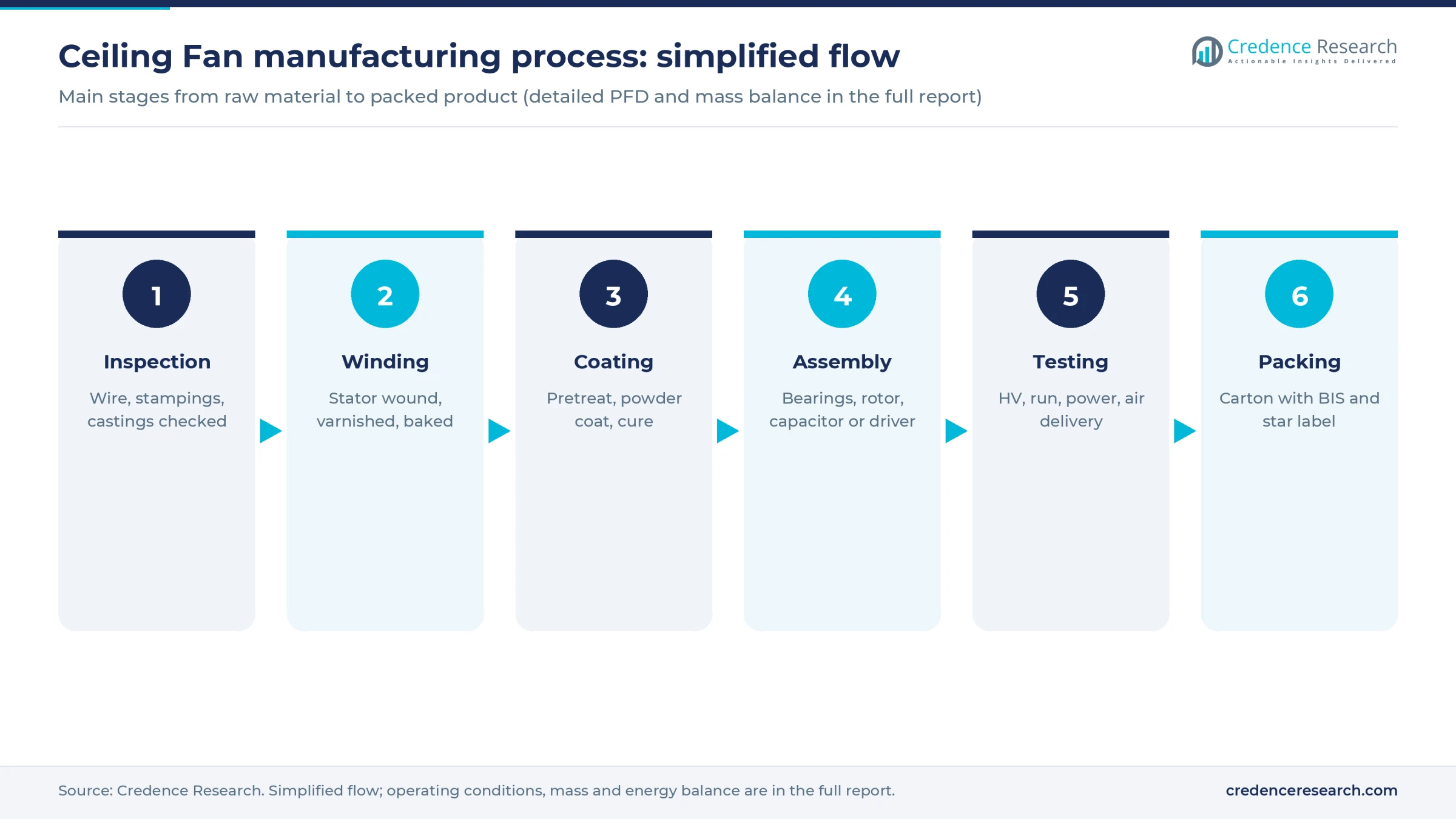
- Incoming inspection. Copper enameled wire is checked for gauge and insulation, stampings for burrs and stack height, castings for porosity and bore size, and bearings and capacitors against specification.
- Stator winding and impregnation. Lamination stacks are insulated and wound on automatic winding machines, single-phase for induction fans and three-phase for BLDC fans. Wound stators are dipped in varnish and baked so the coils resist vibration and humidity.
- Surface finishing. Covers, canopies, downrods and blades go through pretreatment, powder coating and a curing oven at about 180 to 200 C. Decorative models add metallic, wood-grain or two-tone finishes, which drive much of the price premium.
- Motor and fan assembly. The shaft and stator are pressed, two ball bearings fitted, the rotor housing closed and the capacitor or BLDC driver board and remote receiver mounted. Blade sets are weighed and matched so the fan runs without wobble.
- Testing. Every fan gets a high-voltage test, insulation resistance check, run test and power reading. Sample fans go into an air delivery chamber to confirm the declared air delivery and efficiency figures used on energy labels.
- Packing. Motor, blades, downrod, canopy and hardware are packed in a carton with the energy label, safety certification mark, price label and warranty card.
Yield losses come mainly from winding faults, unbalanced blade sets and paint rejects, so first-pass test results and blade matching discipline decide warranty cost later in the field.
Ceiling fan plant setup cost
For a plant rated at 300,000 fans a year, about 1,000 fans a day on two shifts, total project cost lands at roughly USD 0.6–1.0 million in a South Asian industrial park, the cost region used for this range. The spread comes from land prices and from whether the promoter presses blades and machines castings in-house or buys them finished. The full report can be customized to any country.
Land shows how the build works. A plant of this size needs about 0.75 acre, or roughly 3,000 sq m, for the shed, a powder coating bay, finished goods storage and truck movement. Gujarat's state industrial agency lists FY2026-27 allotment prices equal to about USD 2 per sq m in remote estates and USD 69 per sq m at Sanand-II, converted at 88 rupees per dollar. Taking USD 30–70 per sq m for an estate with good highway access gives a land cost of about USD 90,000–210,000. Leased plots in Vietnamese or Mexican industrial parks typically cost more (assumed), and U.S. or EU sites can push total CapEx to two or three times the South Asian figure (assumed).
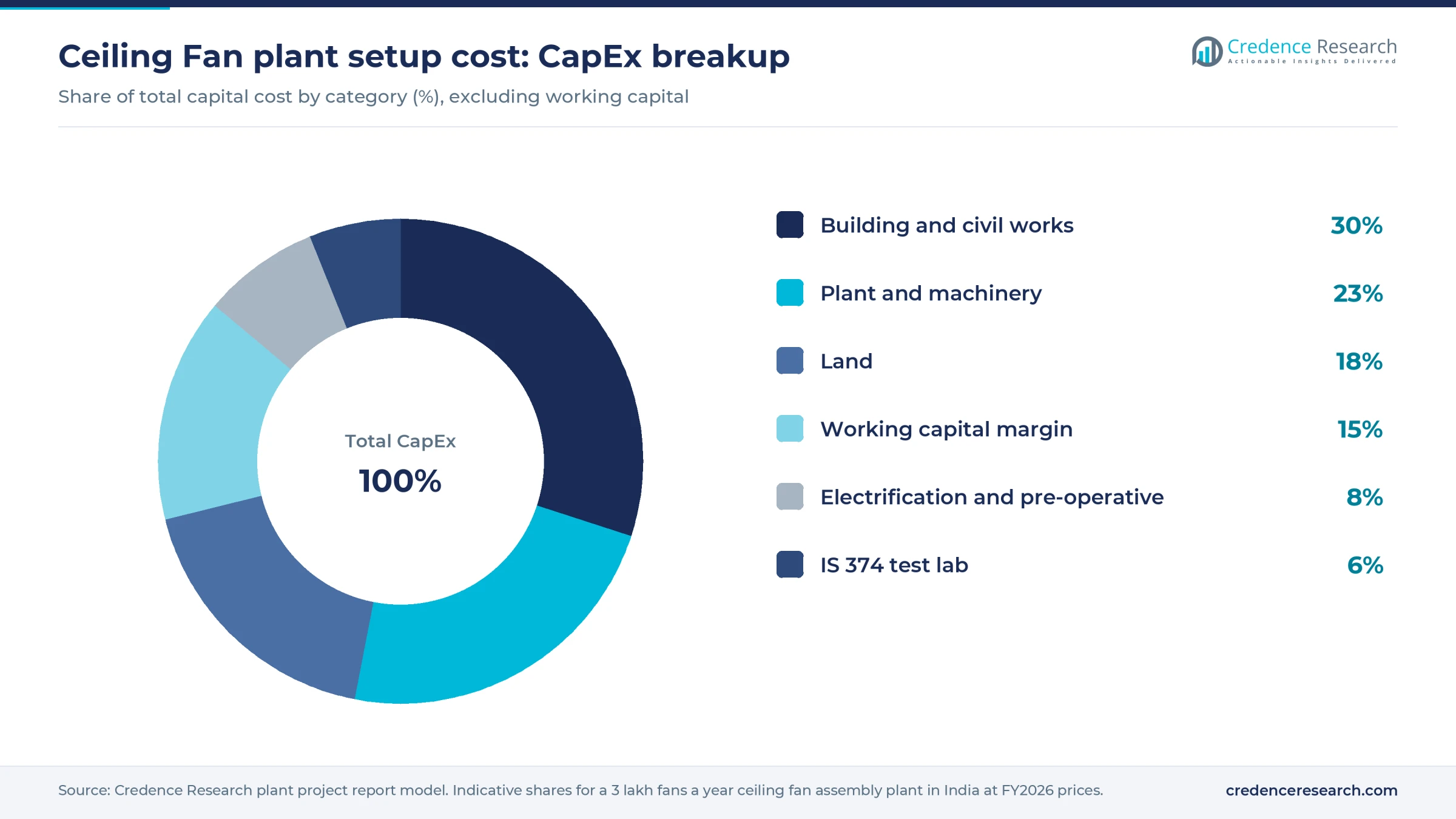
A 15,000 sq ft pre-engineered shed with flooring, office and utilities adds about USD 200,000–270,000. Plant and machinery, including winding machines, a conveyorized powder coating line, assembly conveyors, balancing and varnish equipment and utilities, accounts for roughly USD 140,000–240,000, and the test lab another USD 35,000–55,000. Electrification, pre-operative expenses and contingency take USD 45,000–80,000. Working capital margin of USD 90,000–150,000 is higher than for many assembly businesses because dealers expect stock and credit ahead of the summer peak.
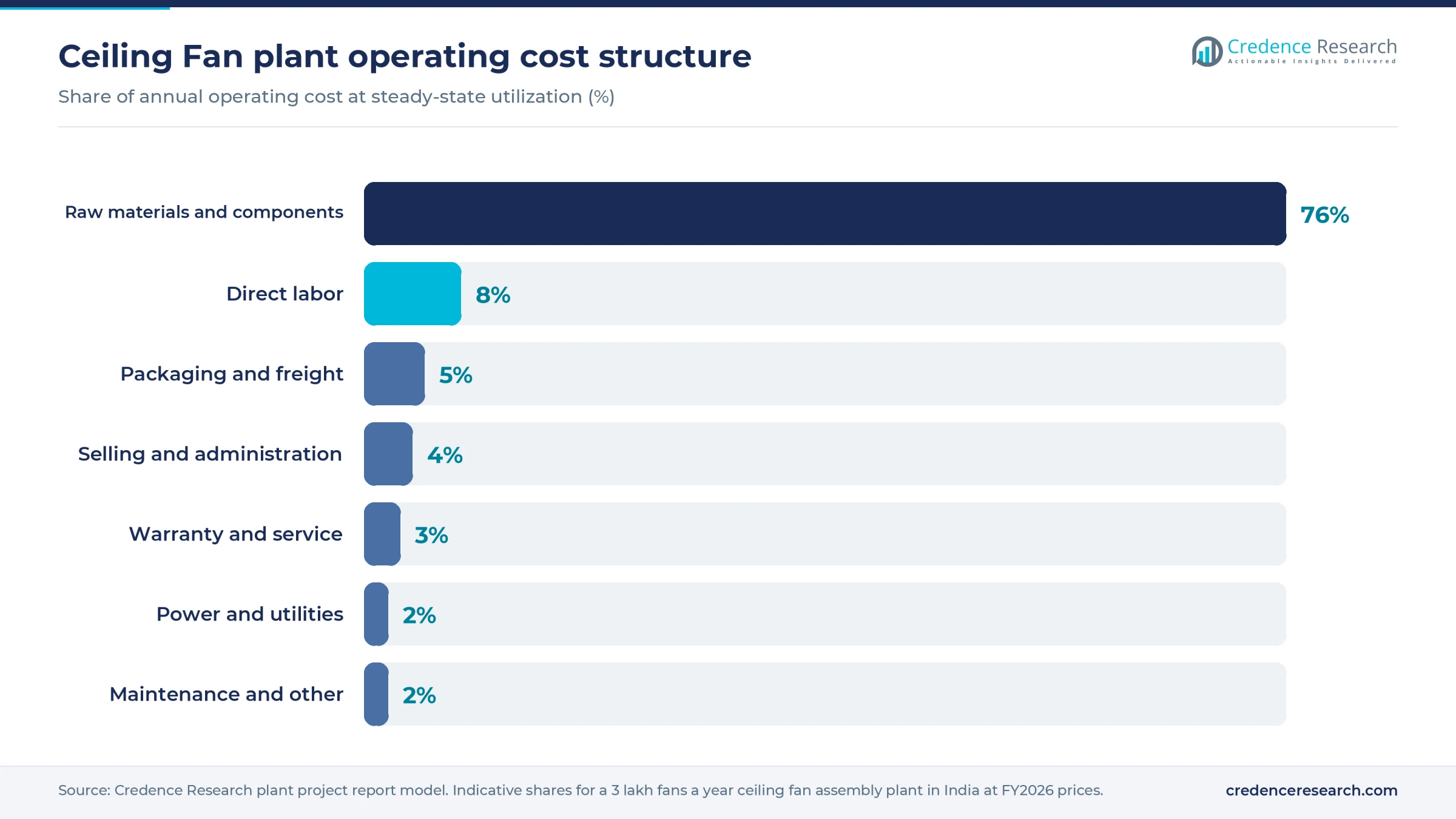
Operating cost is dominated by bought materials. Copper winding wire alone can be a third of the material bill of an induction fan, so the 2026 rally in copper prices squeezes margins until list prices are revised. BLDC fans use less copper but add magnets, power electronics and a remote.
Machinery and raw materials for a ceiling fan plant
The core machinery list covers automatic stator winding machines, varnish impregnation and baking ovens, a pretreatment and powder coating line with curing oven, hydraulic and pneumatic presses for bearing and shaft fitting, blade balancing and weighing stations, assembly conveyors with torque tools, and an air compressor, transformer and diesel generator set. The test lab needs a high-voltage tester, insulation resistance meter, power analyzer, speed measurement and an air delivery test chamber built to the method of the target market standard, such as IS 374 in India or the DOE test procedure in the United States.
Raw materials are copper enameled winding wire, cold-rolled electrical steel laminations, aluminum die-cast covers, aluminum or steel blade sheet, ball bearings, shafts and downrods, capacitors, polyester powder paint and corrugated cartons. BLDC lines add ferrite or rare-earth magnets, driver boards and IR or RF remotes, so buyers tracking the brushless DC motors market watch magnet and chip prices closely. Lamination quality sets motor losses, which is why the electric motor core market matters for star ratings.
Sourcing for these inputs is global, and China supplies most rare-earth magnets and a large share of driver chips, castings and finished components, while copper winding wire comes from China, India, Vietnam and Mexico, and electrical steel from China, Japan, South Korea and India. Vietnam and Malaysia have grown as component hubs for plants serving U.S. buyers that want to diversify away from China.
Ceiling fan business profit margin and ROI
Margins in ceiling fans depend on three levers: motor type, channel and copper. A basic induction fan sold through distributors earns a thin spread over its material bill, so gross margin for an assembler usually sits at 12–15% of ex-factory price. BLDC and decorative models carry higher realization and can lift blended gross margin toward 16–18%. OEM supply to national brands brings lower prices but steady offtake and lower selling cost.
At 65–75% utilization, a 300,000 fans a year plant sells about 195,000–225,000 fans, and after selling, warranty and administrative overheads the cash profit supports a payback of 3.5–6 years on the USD 0.6–1.0 million investment. The main risks are copper price spikes, unsold stock after a cool or rainy summer, warranty claims from bearing and winding failures, and efficiency standard revisions that can make a rated model obsolete.
| Metric | Value |
|---|---|
| Gross margin | 12–18% |
| Payback period | 3.5–6 years |
| IRR (post-tax) | Available in report |
| NPV | Available in report |
| ROI | Available in report |
| DSCR | Available in report |
Sensitivity is strongest to copper price and realization: a sustained 10% rise in winding wire cost without a price revision trims gross margin by about 3 percentage points on induction models.
How to start a ceiling fan business, licenses and approvals
A new plant needs business and tax registration, land use and building permits, an environmental permit that reflects the finishing line, since phosphating pretreatment and paint baking usually draw stricter conditions than dry assembly, occupational safety registration and import-export registration for components. Market access depends on two product approvals: an electrical safety certification and an energy efficiency rating for each model, both backed by test reports.
| Market | Product safety | Energy efficiency |
|---|---|---|
| United States | Listing to UL 507, the standard for electric fans, by a nationally recognized testing laboratory | Mandatory DOE ceiling fan standards in CFM per watt since Jan. 21, 2020; ENERGY STAR is optional; FTC EnergyGuide label under 16 CFR Part 305; FCC Part 15 for remote-controlled and BLDC models |
| European Union | CE marking under the Low Voltage Directive 2014/35/EU and EMC Directive 2014/30/EU, plus RoHS and WEEE | Ecodesign Regulation (EU) No 206/2012 information requirements for comfort fans of 125 W or less |
| India | BIS license under the Electric Ceiling Type Fans (Quality Control) Order, 2023 for IS 374:2019 | Mandatory BEE star label since Jan. 1, 2023, with bands revised periodically |
Higher energy ratings in each market increasingly push makers toward BLDC motors.
Key ceiling fan manufacturers and recent developments
Global ceiling fan supply mixes brand owners and contract makers. Leading brands include Hunter Fan Company, Minka Group and Big Ass Fans in the United States, Panasonic in Japan and Southeast Asia, and Crompton Greaves Consumer Electricals, Havells, Orient Electric, Usha and Atomberg in South Asia, while Chinese, Taiwanese and Vietnamese factories build much of the private-label volume sold in North America and Europe. Polycab runs a plant in Gujarat with capacity of more than 9 million fans a year, which shows the scale a small plant competes against.
- February 2026. Griffon Corp. moved Hunter Fan into its Home and Building Products segment and kept it separate from its AMES tools business, while AMES moves into a joint venture.
- March 2026. Atomberg said its engineering subsidiary is building BLDC motor and controller capacity in Pune for appliance OEMs such as Godrej and Voltas, with an investment of about USD 17–23 million.
- August 2026. Atomberg filed draft IPO papers with SEBI for a fresh issue of up to about USD 51 million, with part earmarked for research and development.
For a new entrant, these moves signal rising in-house motor capacity and research spending among brands, so OEM contracts increasingly favor suppliers with BLDC know-how and clean certification records.
What's inside the Ceiling Fan project report PDF
The report runs to 21 chapters. Open a chapter to see its sections.
1. Preface
2. Scope and Methodology
- 2.1 Objectives of the Study
- 2.2 Stakeholders
- 2.3 Research Methodology
- 2.4 Data Sources and Key Assumptions
3. Executive Summary
- 3.1 Market Snapshot
- 3.2 Project at a Glance (Capacity, CapEx, OpEx)
- 3.3 Key Financial Indicators (IRR, NPV, Payback, Break-even)
- 3.4 Feasibility Verdict
4. Product Overview
- 4.1 Ceiling Fan Definition and Properties
- 4.2 Grades and Specifications (BIS / ISO / ASTM)
- 4.3 HS Code and Classification
- 4.4 Key Applications
- 4.5 Substitutes
5. Global Ceiling Fan Market
- 5.1 Market Overview
- 5.2 Historical and Current Market Performance (Volume and Value)
- 5.3 Market Breakup by Grade / Type
- 5.4 Market Breakup by End-Use Industry
- 5.5 Market Breakup by Region
- 5.6 Market Drivers, Restraints and Trends
- 5.7 Value Chain Analysis
- 5.8 Market Forecast
6. Target Country Ceiling Fan Market Analysis
- 6.1 Demand and Supply Analysis
- 6.2 Installed Capacity vs Demand Gap
- 6.3 Import Dependence
- 6.4 Demand Forecast by End-Use
7. Trade Analysis
- 7.1 Imports by Volume, Value and Country
- 7.2 Exports by Volume, Value and Country
- 7.3 Trade Balance and Opportunities
8. Price Analysis
- 8.1 Historical Ceiling Fan Price Trends by Region
- 8.2 Raw Material / Feedstock Price Trends and Linkage
- 8.3 Price Forecast
- 8.4 Margins Across the Value Chain
9. Competitive Landscape
- 9.1 Market Structure
- 9.2 Key Players and Installed Capacities
- 9.3 Profiles of Key Players
- 9.4 Recent Developments (Expansions, M&A, New Plants)
10. Manufacturing Process and Technology
- 10.1 Comparison of Technology Routes
- 10.2 Selected Route and Process Flow Diagram
- 10.3 Unit Operations Involved
- 10.4 Chemical Reactions Involved
- 10.5 Mass Balance and Raw Material Requirements
- 10.6 Energy Balance
- 10.7 Quality Assurance Criteria and Technical Tests
- 10.8 By-products and Waste Handling
- 10.9 Technology Licensors / Providers
11. Project Details, Requirements and Costs
- 11.1 Land, Location and Site Development
- 11.1.1 Site Selection Criteria
- 11.1.2 Location Analysis
- 11.1.3 Land Requirement and Costs
- 11.1.4 Site Development Costs
- 11.2 Plant Layout
- 11.2.1 Layout Principles
- 11.2.2 Proposed Layout
- 11.2.3 Factors Influencing Layout
- 11.3 Civil Works and Buildings
- 11.4 Plant Machinery
- 11.4.1 Machinery Requirements and Specifications
- 11.4.2 Machinery Costs
- 11.4.3 Machinery Suppliers
- 11.5 Raw Materials
- 11.5.1 Requirements per Tonne of Output
- 11.5.2 Procurement and Sourcing
- 11.5.3 Costs
- 11.5.4 Suppliers
- 11.6 Packaging
- 11.6.1 Packaging Requirements
- 11.6.2 Packaging Costs
- 11.6.3 Packaging Suppliers
- 11.7 Storage and Material Handling
- 11.8 Transportation Requirements and Costs
- 11.9 Utilities
- 11.9.1 Power Requirements and Costs
- 11.9.2 Water Requirements and Costs
- 11.9.3 Steam, Fuel and Other Utilities
- 11.10 Manpower Requirements and Wages
12. Environment, Health, Safety and Sustainability
- 12.1 Effluent and Emissions Management
- 12.2 Hazard Classification and Safety Measures
- 12.3 Carbon Footprint
- 12.4 Green / Low-Carbon Process Options
13. Regulatory Procedures, Approvals and Certifications
- 13.1 Licences and Registrations
- 13.2 Environmental Clearances
- 13.3 Product Certifications (BIS, REACH, etc.)
- 13.4 Approval Timeline
14. Project Implementation Schedule
15. Project Economics
- 15.1 Capital Cost of the Project
- 15.2 Techno-Economic Parameters
- 15.3 Capacity Utilization and Ramp-up
- 15.4 Product Pricing and Margins
- 15.5 Income Projections
- 15.6 Expenditure Projections
- 15.7 Working Capital Requirement
- 15.8 Taxation
- 15.9 Depreciation
16. Financial Analysis
- 16.1 Projected Profit and Loss Account
- 16.2 Projected Cash Flow Statement
- 16.3 Projected Balance Sheet
- 16.4 Liquidity Analysis
- 16.5 Profitability Analysis (Payback, NPV, IRR, ROI)
- 16.6 Break-even Analysis
- 16.7 Debt Service Coverage Ratio (DSCR)
- 16.8 Sensitivity Analysis
- 16.9 Scenario and Uncertainty Analysis
17. Funding and Incentives
- 17.1 Means of Finance and Debt-Equity Structure
- 17.2 Loans and Financial Assistance
- 17.3 Government Schemes and Subsidies (PLI, State Policies)
18. Risk Assessment
- 18.1 Key Success Factors
- 18.2 Key Risk Factors
- 18.3 Risk Mitigation
19. Strategic Recommendations
20. Case Study of a Successful Venture
21. Appendix
- 21.1 Detailed Assumptions
- 21.2 Abbreviations
- 21.3 List of Tables and Figures
- 21.4 Sources
This page vs. the full report
| Data point | On this page (free) | In the full report |
|---|---|---|
| Total CapEx | One rounded range at one capacity | Exact figure at three capacities with a line-item breakup |
| CapEx breakup | Category shares (%) only | Cost, quantity and supplier for every machine |
| Operating cost | Share of raw materials, utilities and labor | Per-unit cost sheet with each input price and consumption |
| Profitability | Gross margin range and payback band | Exact IRR, NPV, ROI, break-even and DSCR |
| Financial statements | List of what is included | 10-year P&L, cash flow, balance sheet and Excel model |
| Sensitivity | One directional line | Full sensitivity and scenario tables |
| Process | Simplified flow diagram | Detailed process flow, mass and energy balance, operating conditions |
| Machinery | Names of the main machines | Specifications, capacity, cost and supplier list |
| Market | Headline size, growth and India demand trend | Segment, region, trade and price forecast tables |
| Suppliers and buyers | Supplier types and sourcing hubs | Named suppliers and buyers |
Ceiling Fan project report: FAQs
How much does it cost to set up a ceiling fan manufacturing plant?
What certifications does a ceiling fan need?
Are energy efficiency labels mandatory for ceiling fans?
Should a new plant make induction or BLDC ceiling fans?
What is the profit margin in ceiling fan manufacturing?
What is the payback period for a ceiling fan plant?
Which environmental permit does a ceiling fan plant need?

About the analyst
Rajdeep Kumar Deb, Lead Analyst - Consumer & Finance
Rajdeep brings a decade of consumer goods and financial services insight to strategic market analysis.
Related market research
- Portable Fan Market Size, Growth and Forecast 2032
- Brushless DC Motors Market Size, Growth and Forecast 2032
- Bladeless Fans Market Size, Share, Growth and Forecast 2032
- Smart Home Appliances Market Size, Growth and Forecast 2032
- Electric Motors Market Size, Trends, Growth and Forecast 2032
- Industrial Fans and Blowers Market Size, Growth and Forecast 2032
More plant project reports
- Avocado Oil Processing Plant Project Report (DPR) 2026
- Aluminium Cans Manufacturing Plant Project Report (DPR) 2026
- Aloe Vera Gel Manufacturing Plant Project Report (DPR) 2026
- Potato Processing Plant Prefeasibility Report 2026
- Corn Starch Manufacturing Plant Project Report (DPR) 2026
- Copper Sulphate Manufacturing Plant Project Report (DPR) 2026