
Quick answer
A cigarette manufacturing plant blends and cuts cured tobacco leaf, then makes, filters and packs sticks under excise and health regulation. This overview models a greenfield plant making 5 billion sticks a year, with estimated CapEx of USD 15–60 million depending on cost region and machinery. Gross margin before excise is estimated at 18–30% for an unbranded or contract producer, and payback at 4–8 years, in a market where global volumes are falling.
Feasible only for licensed, well-capitalized operators with an existing brand or contract offtake; global volumes are shrinking, entry is legally closed or restricted in some markets, and regulatory risk is high.
Cigarette plant: key highlights
| Parameter | Indicative value | Note |
|---|---|---|
| Plant capacity | 5 billion sticks per year | About 250 million packs of 20; roughly two high-speed making and packing lines |
| Total CapEx | USD 15–60 million | Greenfield; low end Asian build, high end new international-standard lines |
| Raw material share of operating cost | 75–85% | Leaf, filter materials and packaging; excludes excise |
| Gross margin | 18–30% | On net revenue before excise, for an unbranded or contract producer |
| Payback period | 4–8 years | From commissioning, including a ramp-up year; longer at low utilization |
| IRR | Available in report | Post-tax, 10-year model |
| Break-even | Available in report | Capacity utilization basis |
Ranges assume a greenfield plant rated at 5 billion sticks a year, 70–85% utilization and 2026 prices; net price of USD 10–14 per 1,000 sticks before excise, assumed from export unit values; leaf from 2024 export values; other materials and land rates assumed. CapEx is scaled from disclosed plant costs and excludes working capital and excise bonds. The full report can be customized to any country or region.
What is a cigarette?
A cigarette is a paper-wrapped rod of cut, blended tobacco, normally fitted with a cellulose acetate filter and sold in packs of 20. It is a combustible tobacco product, and it delivers nicotine, an addictive substance, along with tar and carbon monoxide. Standard cigarettes are classified under Harmonized System subheading 2402.20, cigarettes containing tobacco, while products made wholly from substitutes fall under 2402.90.
Product types include American-style blends of flue-cured, burley and oriental leaf, Virginia-style blends built mainly on flue-cured leaf, and the clove kretek made largely in Indonesia. Producers also differentiate by stick format, from king size to slim and super slim, and by pack format. Options that were once standard are now limited by law in many places, since the European Union bans characterizing flavors and several countries require plain packaging.
Cigarettes have no use other than consumption, and the World Health Organization's June 2026 fact sheet says tobacco kills more than 7 million people a year. This report treats the plant as a regulated investment question and does not recommend the product or its use.
Cigarette market overview and global demand
Cigarette demand is declining by volume while value holds up on price increases. The WHO counted 1.2 billion tobacco users in 2024, down from 1.38 billion in 2000, and about 80% live in low- and middle-income countries. British American Tobacco's half-year report of July 2026 expects global industry cigarette volume to fall about 3% in 2026, and the same filing shows its own volume down 4.6% to 218 billion sticks in the first half. The 2022 Tobacco Atlas put world consumption at nearly 5 trillion cigarettes a year.
Credence Research's global tobacco market study values all tobacco products at about USD 379.5 billion in 2025, based on its USD 365.2 billion for 2024 and a 3.9% CAGR. That figure is wider than cigarettes alone and reflects retail value and pricing, so it should not be read as volume growth.
Most cigarettes are made and taxed in the country where they are smoked, and China's state monopoly supplies its home market. Trade is therefore concentrated in export hubs. UN Comtrade data for 2024 show Poland shipping USD 4.9 billion at about USD 29 per kilogram, Czechia USD 1.5 billion, Germany USD 1.4 billion and Indonesia USD 1.3 billion at about USD 7 per kilogram. That spread separates premium brands made in Europe from value product in Asia, and it is the main pricing fact for a new entrant.
Tax drives the retail price in most markets. The WHO recommends that tax make up at least 75% of retail price, a level 41 countries have reached. Buyers are licensed distributors, national monopolies and brand owners seeking contract capacity. Large groups are also moving capital toward other nicotine products, which limits the room for new cigarette capacity.
Cigarette manufacturing process
Cigarette production has two linked halves, a primary department that turns leaf into blended cut filler and a secondary department that turns filler into packed sticks. Output is high and largely automated, so consistency and waste control decide conversion cost more than labor does.
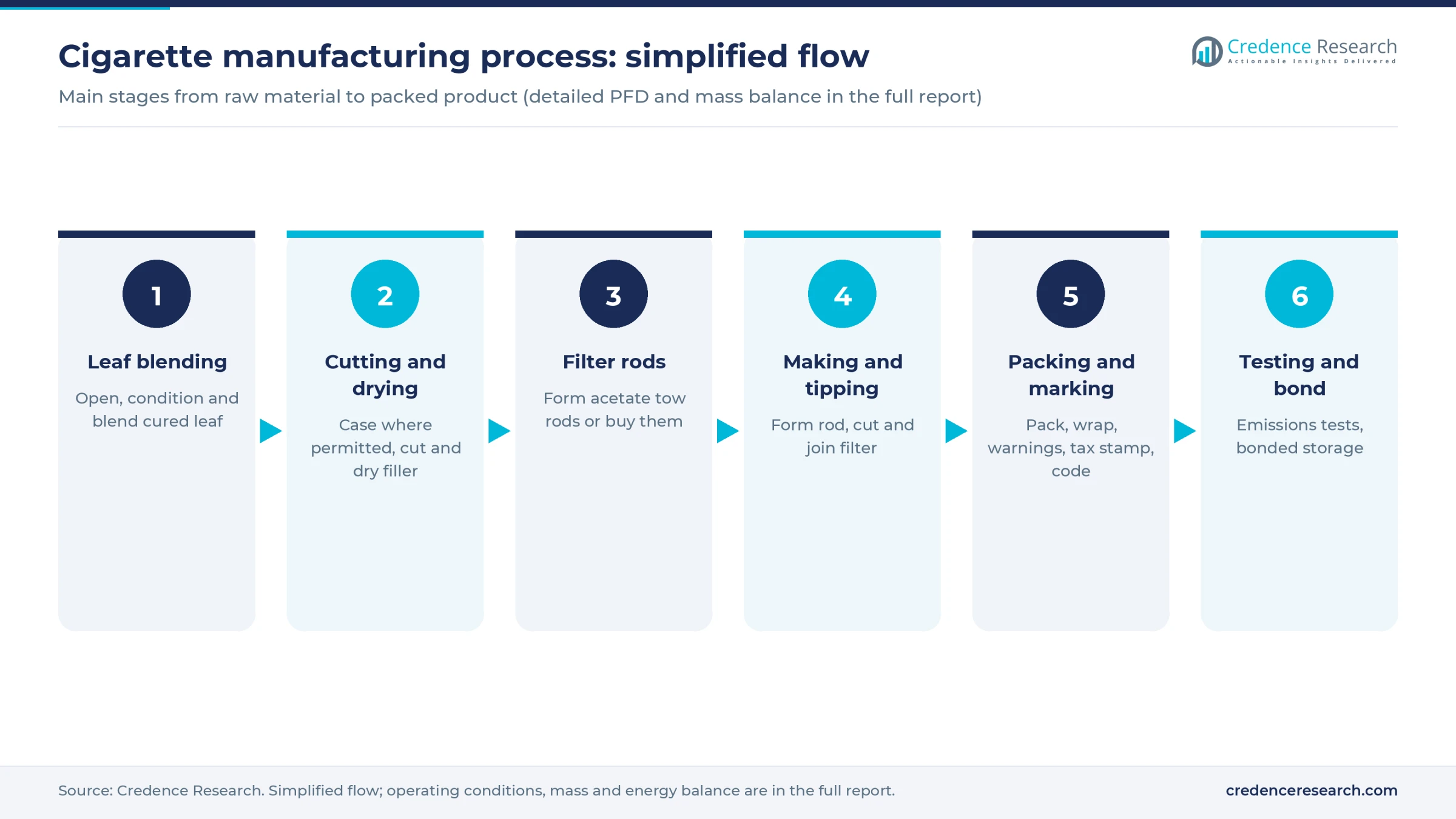
- Leaf blending and conditioning. Cased hogsheads or cartons of cured leaf are opened and sliced, then steam and moisture make the lamina pliable so that it can be handled without shattering. Leaf grades are held in blending silos against a recipe, since blend consistency defines the brand.
- Casing, cutting and drying. Permitted casings are applied where the law allows them, and the lamina is cut into fine strands. A rotary or flash dryer brings the filler to its target moisture, and stem and expanded material may be added to reduce the tobacco weight per stick.
- Filter rod making. Cellulose acetate tow is opened, plasticized and wrapped into rods, or plants buy finished rods from a specialist. Buying rods lowers capital needs but cuts margin.
- Making and tipping. A making machine forms a continuous tobacco rod in cigarette paper, cuts it to length and joins it to the filter with tipping paper. Laser ventilation and inline checks on weight, density and loose ends run here.
- Packing and tax marking. Packers fold the foil, pre-printed pack with its health warnings and carton, then apply film. Most markets also require tax stamps, while the EU and others require a unique traceability code on each pack.
- Testing and bonded storage. Laboratories test tar, nicotine and carbon monoxide under ISO smoking methods, along with ignition propensity where required. Finished goods wait in bonded or tax-warehouse conditions, since excise normally falls due on release.
Tobacco dust, odor from dryers and packaging waste need extraction and treatment, and they are the main site-permit issues. Fire control matters throughout the leaf and filler stores.
Cigarette plant setup cost
Setup cost for a plant rated at 5 billion sticks a year is estimated at USD 15–60 million. Few complete project costs are public, so the range rests on two disclosed plants scaled to this capacity. KT&G put total investment in its Turkish factory at USD 110 million for 12 billion sticks of capacity across 25,000 square meters. Vietnam's Khatoco opened a USD 24 million plant in 2023 on 11.95 hectares, which it said would lift output from 550 million to 1 billion packs a year, or about 9 billion added sticks at 20 to a pack.
Scaling each with a 0.7 cost exponent gives about USD 60 million and USD 16 million. The low end reflects an Asian build with regional or refurbished equipment, and the high end reflects new high-speed lines to international standards. Machinery choice therefore moves the budget more than any other item.
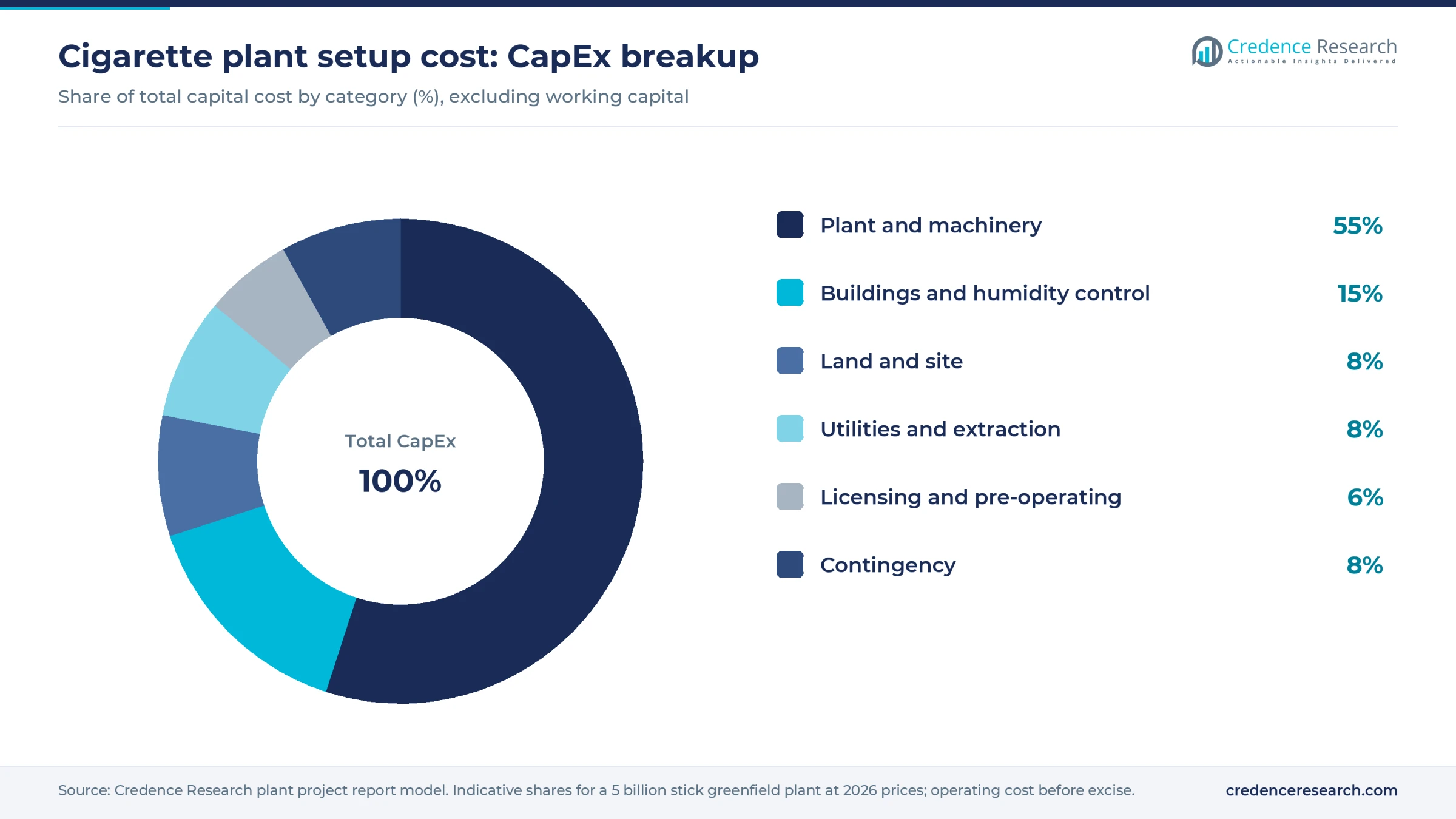
Land shows how one row is built. A plant this size needs about 3.5 hectares, including leaf stores and finished-goods warehouses, and an assumed industrial land rate of USD 40–120 per square meter gives USD 1.4–4.2 million. A leased site in an Asian industrial park sits at the lower end, while a U.S. or EU site can sit well above it. Excise bonds, stamp deposits and leaf stocks are extra, and they often bind harder than plant cost.
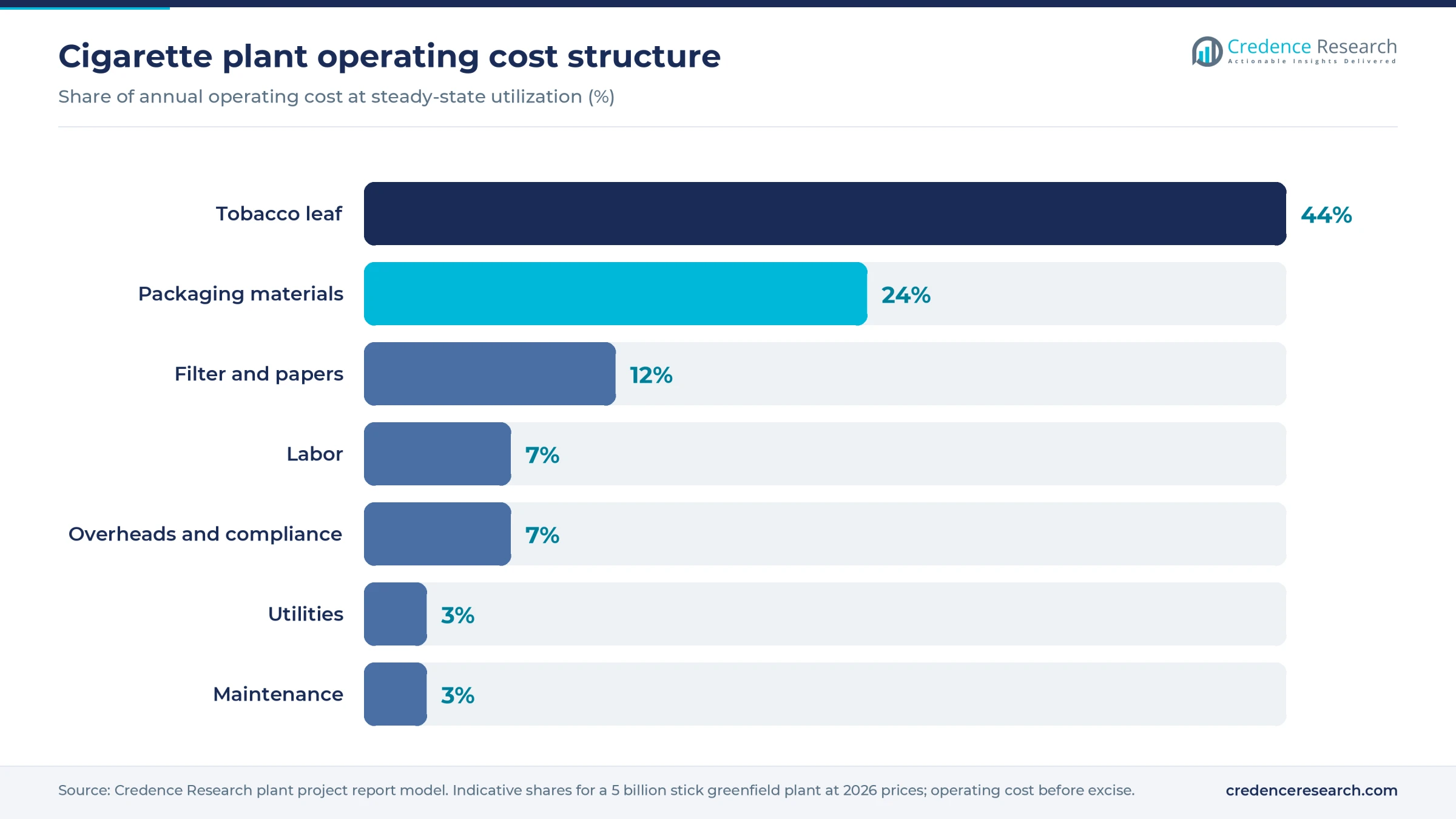
Operating cost is shown before excise. Leaf is the largest line, followed by packaging, because a pack of 20 uses board, foil, film and printing against an assumed 14 grams of tobacco. Labor is a small share, so low-wage locations gain less here than in other consumer goods. The full report can be customized to any country or region, with line-item costs and a tax model for the chosen market.
Machinery and raw materials for a cigarette plant
The primary department needs a case slicer, conditioning cylinders, blending silos, casing drums, cutters, a dryer, flavor and filler handling, and dust extraction. The secondary department needs filter rod makers, cigarette makers with tipping units, packers, carton and film wrappers, tray and conveying systems, and tax-stamp and coding units. Support items include humidity-controlled halls, boilers, compressed air and a smoking-machine laboratory. Credence Research covers this equipment segment in its cigarette making equipment market report.
Several countries license or restrict the sale and import of this machinery, because the WHO FCTC illicit trade protocol treats it as a control point. Buyers should confirm that before ordering.
Leaf is bought by grade and style. UN Comtrade data for 2024 show Brazil as the top exporter of stemmed and partly stemmed leaf, with about 323,600 tonnes at about USD 8.2 per kilogram, followed by Zimbabwe at USD 7.2, India at USD 5.1 and the U.S. at USD 9.5. Malawi, Tanzania and China add further supply at USD 4.7–6.8. Oriental leaf comes mainly from Turkey, Greece and neighboring countries.
Acetate tow comes from a small group of producers in the U.S., Europe, Japan and China, and that concentrated base makes a second source worth arranging. Board and foil are available regionally, and tobacco packaging suppliers must handle changing warning rules. Large buyers also audit leaf supply for child labor and deforestation risk.
Cigarette business profit margin and ROI
Gross margin is estimated at 18–30% of net revenue before excise, for a plant selling unbranded, private-label or contract volume. Net prices of USD 10–14 per 1,000 sticks are assumed from 2024 export unit values, such as about USD 10 per kilogram for Turkey and USD 13 for South Korea, at an assumed 1 kilogram per 1,000 sticks. Direct cost uses leaf priced from the export values above and assumed filter, paper and packaging costs.
Global brand owners earn far more because brand strength supports prices that an entrant cannot charge. European export values above USD 20 per kilogram reflect that premium. A new plant should not model brand margins without owning a brand.
Payback of 4–8 years comes from CapEx and cash profit. At 70–85% utilization, net revenue would be about USD 35–60 million a year and after-tax cash profit about USD 3–11 million, assuming 25% tax. High CapEx combined with low margin would push payback past 15 years, so that case fails.
Margins are most sensitive to selling price and utilization. An excise increase that cuts volume, or a pack rule that forces new tooling, can erase profit quickly, and illicit product undercuts legal sellers in many markets.
| Return metric | Value |
|---|---|
| IRR (post-tax) | Available in report |
| NPV | Available in report |
| ROI | Available in report |
| DSCR | Available in report |
How to start a cigarette business, licenses and approvals
Cigarette manufacturing is among the most tightly licensed consumer industries, and entry should be checked before any other work. The WHO Framework Convention on Tobacco Control, with 183 Parties, frames national rules on tax, packaging, advertising and industry interference. Its illicit trade protocol, in force since 2018, adds licensing of manufacture and tracking and tracing.
A typical sequence covers business registration and tax, a manufacturing license and excise registration, land use and building permits, an environmental permit, occupational safety approvals, product and ingredient filings, tax stamps or traceability setup, and export and import registration. Advertising and sponsorship are banned or restricted in most markets.
Examples by market
| Market | Regulator | Key requirements |
|---|---|---|
| United States | TTB; FDA Center for Tobacco Products | TTB permit as a manufacturer of tobacco products, with federal excise of USD 50.33 per 1,000 small cigarettes; FDA establishment registration and product listing; FDA marketing authorization for new products; state licensing and stamps |
| European Union | National customs and excise authorities; national health authorities | Tax warehouse authorization under Directive (EU) 2020/262; minimum excise under Directive 2011/64/EU; Tobacco Products Directive 2014/40/EU on limits of 10 mg tar, 1 mg nicotine and 10 mg carbon monoxide, ingredient reporting, 65% warnings and traceability |
| India | DPIIT; Central Board of Indirect Taxes and Customs; Ministry of Health | Compulsory industrial license under the Industries (Development and Regulation) Act 1951, with none issued since 1999 per a March 2020 reply in Parliament; FDI prohibited; central excise registration; pack and advertising rules under the cigarettes and Other Tobacco Products Act 2003 |
Entry can be closed outright, as India shows, so counsel should confirm the position in each target market first.
Key cigarette manufacturers and recent developments
The global cigarette industry is highly concentrated. China National Tobacco Corporation is the largest producer by volume and serves a mostly closed home market. Philip Morris International, British American Tobacco, Japan Tobacco and Imperial Brands lead international sales, and Altria sells in the U.S. Regional makers include KT&G in South Korea, ITC in India, and Gudang Garam and Djarum in Indonesia, while Khatoco and other state-linked firms serve national markets.
Three recent moves show where capacity is going:
- March 2026. Japan Tobacco International said it would invest EUR 300 million in a new Romanian factory at Ștefăneștii de Jos, replacing its Bucharest site by 2027. More than 70% of its Romanian output is exported.
- July 2026. British American Tobacco reported a global review of its manufacturing assets and machinery, with a GBP 228 million non-cash charge, to move toward more efficient equipment.
- October 2026. KT&G began full-scale operations at its second Indonesian plant, in Pasuruan, rated at up to 21 billion cigarettes a year once all nine lines are installed, taking Indonesian capacity to 35 billion.
Together these moves point to fewer, larger and more export-focused plants, which adds to the pressure on small entrants.
What's inside the Cigarette project report PDF
The report runs to 21 chapters. Open a chapter to see its sections.
1. Preface
2. Scope and Methodology
- 2.1 Objectives of the Study
- 2.2 Stakeholders
- 2.3 Research Methodology
- 2.4 Data Sources and Key Assumptions
3. Executive Summary
- 3.1 Market Snapshot
- 3.2 Project at a Glance (Capacity, CapEx, OpEx)
- 3.3 Key Financial Indicators (IRR, NPV, Payback, Break-even)
- 3.4 Feasibility Verdict
4. Product Overview
- 4.1 Cigarette Definition and Properties
- 4.2 Grades and Specifications (BIS / ISO / ASTM)
- 4.3 HS Code and Classification
- 4.4 Key Applications
- 4.5 Substitutes
5. Global Cigarette Market
- 5.1 Market Overview
- 5.2 Historical and Current Market Performance (Volume and Value)
- 5.3 Market Breakup by Grade / Type
- 5.4 Market Breakup by End-Use Industry
- 5.5 Market Breakup by Region
- 5.6 Market Drivers, Restraints and Trends
- 5.7 Value Chain Analysis
- 5.8 Market Forecast
6. Target Country Cigarette Market Analysis
- 6.1 Demand and Supply Analysis
- 6.2 Installed Capacity vs Demand Gap
- 6.3 Import Dependence
- 6.4 Demand Forecast by End-Use
7. Trade Analysis
- 7.1 Imports by Volume, Value and Country
- 7.2 Exports by Volume, Value and Country
- 7.3 Trade Balance and Opportunities
8. Price Analysis
- 8.1 Historical Cigarette Price Trends by Region
- 8.2 Raw Material / Feedstock Price Trends and Linkage
- 8.3 Price Forecast
- 8.4 Margins Across the Value Chain
9. Competitive Landscape
- 9.1 Market Structure
- 9.2 Key Players and Installed Capacities
- 9.3 Profiles of Key Players
- 9.4 Recent Developments (Expansions, M&A, New Plants)
10. Manufacturing Process and Technology
- 10.1 Comparison of Technology Routes
- 10.2 Selected Route and Process Flow Diagram
- 10.3 Unit Operations Involved
- 10.4 Chemical Reactions Involved
- 10.5 Mass Balance and Raw Material Requirements
- 10.6 Energy Balance
- 10.7 Quality Assurance Criteria and Technical Tests
- 10.8 By-products and Waste Handling
- 10.9 Technology Licensors / Providers
11. Project Details, Requirements and Costs
- 11.1 Land, Location and Site Development
- 11.1.1 Site Selection Criteria
- 11.1.2 Location Analysis
- 11.1.3 Land Requirement and Costs
- 11.1.4 Site Development Costs
- 11.2 Plant Layout
- 11.2.1 Layout Principles
- 11.2.2 Proposed Layout
- 11.2.3 Factors Influencing Layout
- 11.3 Civil Works and Buildings
- 11.4 Plant Machinery
- 11.4.1 Machinery Requirements and Specifications
- 11.4.2 Machinery Costs
- 11.4.3 Machinery Suppliers
- 11.5 Raw Materials
- 11.5.1 Requirements per Tonne of Output
- 11.5.2 Procurement and Sourcing
- 11.5.3 Costs
- 11.5.4 Suppliers
- 11.6 Packaging
- 11.6.1 Packaging Requirements
- 11.6.2 Packaging Costs
- 11.6.3 Packaging Suppliers
- 11.7 Storage and Material Handling
- 11.8 Transportation Requirements and Costs
- 11.9 Utilities
- 11.9.1 Power Requirements and Costs
- 11.9.2 Water Requirements and Costs
- 11.9.3 Steam, Fuel and Other Utilities
- 11.10 Manpower Requirements and Wages
12. Environment, Health, Safety and Sustainability
- 12.1 Effluent and Emissions Management
- 12.2 Hazard Classification and Safety Measures
- 12.3 Carbon Footprint
- 12.4 Green / Low-Carbon Process Options
13. Regulatory Procedures, Approvals and Certifications
- 13.1 Licences and Registrations
- 13.2 Environmental Clearances
- 13.3 Product Certifications (BIS, REACH, etc.)
- 13.4 Approval Timeline
14. Project Implementation Schedule
15. Project Economics
- 15.1 Capital Cost of the Project
- 15.2 Techno-Economic Parameters
- 15.3 Capacity Utilization and Ramp-up
- 15.4 Product Pricing and Margins
- 15.5 Income Projections
- 15.6 Expenditure Projections
- 15.7 Working Capital Requirement
- 15.8 Taxation
- 15.9 Depreciation
16. Financial Analysis
- 16.1 Projected Profit and Loss Account
- 16.2 Projected Cash Flow Statement
- 16.3 Projected Balance Sheet
- 16.4 Liquidity Analysis
- 16.5 Profitability Analysis (Payback, NPV, IRR, ROI)
- 16.6 Break-even Analysis
- 16.7 Debt Service Coverage Ratio (DSCR)
- 16.8 Sensitivity Analysis
- 16.9 Scenario and Uncertainty Analysis
17. Funding and Incentives
- 17.1 Means of Finance and Debt-Equity Structure
- 17.2 Loans and Financial Assistance
- 17.3 Government Schemes and Subsidies (PLI, State Policies)
18. Risk Assessment
- 18.1 Key Success Factors
- 18.2 Key Risk Factors
- 18.3 Risk Mitigation
19. Strategic Recommendations
20. Case Study of a Successful Venture
21. Appendix
- 21.1 Detailed Assumptions
- 21.2 Abbreviations
- 21.3 List of Tables and Figures
- 21.4 Sources
This page vs. the full report
| Data point | On this page (free) | In the full report |
|---|---|---|
| Total CapEx | One rounded range at one capacity | Exact figure at three capacities with a line-item breakup |
| CapEx breakup | Category shares (%) only | Cost, quantity and supplier for every machine |
| Operating cost | Share of raw materials, utilities and labor | Per-unit cost sheet with each input price and consumption |
| Profitability | Gross margin range and payback band | Exact IRR, NPV, ROI, break-even and DSCR |
| Financial statements | List of what is included | 10-year P&L, cash flow, balance sheet and Excel model |
| Sensitivity | One directional line | Full sensitivity and scenario tables |
| Process | Simplified flow diagram | Detailed process flow, mass and energy balance, operating conditions |
| Machinery | Names of the main machines | Specifications, capacity, cost and supplier list |
| Market | Headline size, growth and India demand trend | Segment, region, trade and price forecast tables |
| Suppliers and buyers | Supplier types and sourcing hubs | Named suppliers and buyers |
Cigarette project report: FAQs
How much does it cost to set up a cigarette plant?
What gross margin can a new cigarette plant expect?
What is the payback period for a cigarette factory?
What licenses does a cigarette manufacturer need?
Are any markets closed to new cigarette factories?
How does the WHO FCTC affect a cigarette plant investment?

About the analyst
Rajdeep Kumar Deb, Lead Analyst - Consumer & Finance
Rajdeep brings a decade of consumer goods and financial services insight to strategic market analysis.
Related market research
- Tobacco Market Size, Growth, Analysis & Forecast to 2032
- Cigarette Making Equipment Market Size, Share and Forecast 2032
- Tobacco Packaging Market Size, Growth & Forecast 2032
- Luxury Cigarette Market Size, Growth, Trends and Forecast 2032
- Clove Cigarettes Market Size, Growth, Share and Forecast 2032
- Cigarette Inner Frame Market Size, Share and Forecast 2032
More plant project reports
- Paper Cups Manufacturing Plant Project Report (DPR) 2026
- Ceiling Fan Manufacturing Plant Project Report (DPR) 2026
- Avocado Oil Processing Plant Project Report (DPR) 2026
- Aluminium Cans Manufacturing Plant Project Report (DPR) 2026
- Aloe Vera Gel Manufacturing Plant Project Report (DPR) 2026
- Shrimp Processing Plant Project Report (DPR) 2026