
Quick answer
A cassava processing plant turns fresh roots into shelf-stable products; the model here makes tapioca pearls (sago) on its main line and edible cassava flour from dried chips on a second line. At a stated capacity of 100 tonnes of roots a day, total CapEx is estimated at USD 0.9–1.5 million for an Asian site. Gross margin runs 10–16% in a normal crop year, and payback is 4–8 years.
Viable for operators with assured root supply and enough working capital to hold stock into peak demand; thin, cyclical margins punish weak procurement.
Cassava plant: key highlights
| Parameter | Indicative value | Note |
|---|---|---|
| Plant capacity | 100 tonnes of fresh roots per day | 80 tonnes to tapioca pearls, 20 tonnes to flour, about 250 operating days |
| Total CapEx | USD 0.9–1.5 million | South or Southeast Asian site; includes land, effluent plant with biogas and working capital margin |
| Raw material share of operating cost | 78–85% | Fresh roots bought at the gate and priced on starch content |
| Gross margin | 10–16% | Normal crop year; turns negative when root prices outrun product prices |
| Payback period | 4–8 years | Pre-tax, after a one-season ramp-up |
| IRR | Available in report | Post-tax, 10-year model |
| Break-even | Available in report | Capacity utilization basis |
Ranges assume 100 t of fresh roots a day (80 t to tapioca pearls, 20 t to flour), 250 operating days, a South or Southeast Asian site, 2026 prices, roots at USD 80–95 a tonne, pearl recovery of 20–23%, pearls at USD 500–570 a tonne and an assumed flour price of USD 400–510 a tonne. CapEx scales a 2017 survey of Indian sago units, converted at INR 88 per USD. The full report can be customized to any country.
What is cassava processing?
Cassava (Manihot esculenta), also called tapioca or manioc, is a starchy tropical root that spoils within two to three days of harvest, so it has to be processed close to the farm. A cassava processing plant turns fresh roots into shelf-stable products such as dried chips and pellets, flour, starch, gari and tapioca pearls. This page models an integrated unit that sends most roots to a tapioca pearl (sago) line and the rest to a chip-and-flour line, and sells the fibrous residue as animal feed. Native starch for paper, textile and pharmaceutical buyers is a different business and is not the focus here.
Trade codes differ by product: tapioca pearls fall under HS 190300, tapioca prepared from starch in flakes, grains or pearls; cassava flour under HS 110620; and dried chips and pellets under HS 071410. Pearl makers sell two broad types, small sago pearls cooked as porridge or snacks and larger pearls used in bubble tea and desserts, each graded by size. Buyers include food wholesalers in Asia, bubble tea and dessert chains in East Asia and North America, snack makers, and gluten-free bakeries that use cassava flour as a wheat substitute.
Cassava market overview and global demand
Credence Research valued the global cassava market at USD 174.94 billion in 2024, or about USD 182 billion in 2025 based on that figure and its forecast CAGR of 4.2% through 2032. World root output reached about 315 million tonnes in 2021, up from 286 million in 2017, according to a 2024 study in Discover Agriculture. Nigeria led with about 63 million tonnes, followed by the Democratic Republic of Congo, Thailand, Ghana and Brazil, and Africa grew about two-thirds of the total, mostly for local food such as gari and fufu.
Cassava trade is concentrated in Asia, where Thailand is the largest exporter, with about 35% of world cassava export value in 2021, according to the same study, and Vietnam, Cambodia and Laos supply both finished products and roots to Thai mills. China takes nearly all traded chips. Thai exports of chips and pellets reached 4.4 million tonnes in January to November 2025, more than double the year before, and starch exports reached 3.4 million tonnes in January to October 2025, nearly half of it to China.
Tapioca pearl demand comes from two main pools. India, which grew 5.94 million tonnes of cassava in 2023, consumes sago during fasting seasons and makes most of it in Tamil Nadu, while bubble tea chains drive demand for larger pearls in East Asia, North America and Europe. Cassava flour sells to snack makers and bakeries tracking wider gluten-free flour demand.
Cassava manufacturing process for tapioca pearls and flour
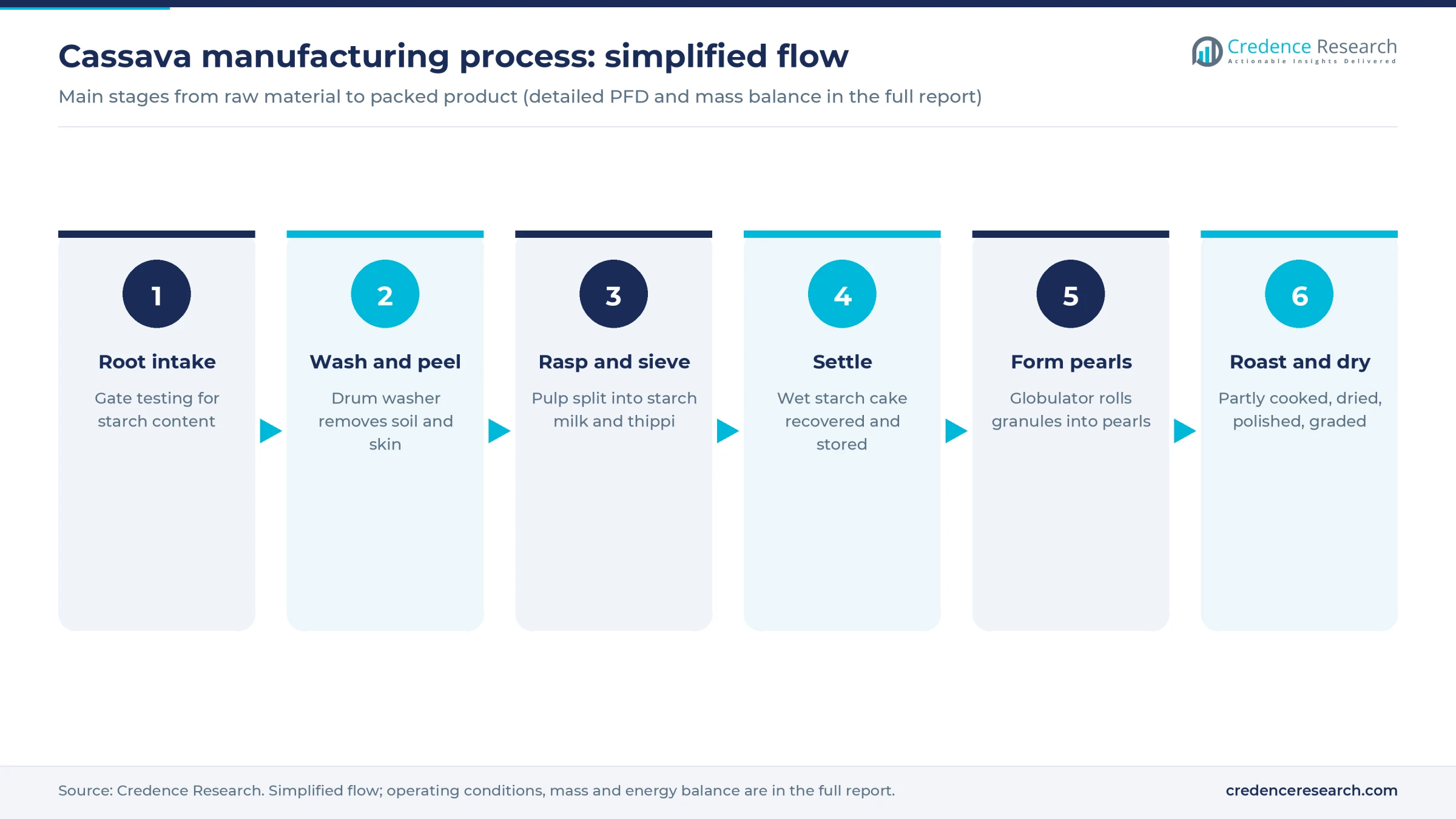
The pearl route is a wet process. Trucks bring roots from surrounding farms, and each load is tested for starch content at the gate, because mills in Thailand and India pay on starch content rather than weight alone. The main steps are:
- Washing and peeling. Rotary drum washers remove soil and the thin outer skin.
- Rasping. A high-speed rasper grinds the roots into pulp and releases starch granules.
- Sieving. Brush or vibrating sieves separate starch milk from fiber, which is pressed and sun-dried as feed pulp.
- Settling. Starch milk settles in tanks or passes through hydrocyclones. The wet starch cake can be stored for weeks, which keeps the pearl line running after the harvest ends.
- Pearl forming. Partly dried starch is broken into granules, rolled into pearls in a gyrating globulator and sized on screens; bubble tea pearls are usually made larger and may be colored or flavored.
- Gelatinizing and drying. Pearls are partly cooked in roasting pans or ovens, dried on concrete yards or in dryers, then polished and graded.
The flour line is a dry route. Peeled roots are sliced into chips, dried to below about 12% moisture in a mechanical dryer, milled in a hammer mill and sifted, giving roughly 1 tonne of flour from 4 tonnes of roots. Food-grade flour needs fast drying after slicing to keep the color white and microbial counts low, which is why yard drying alone suits only feed-grade chips.
Recovery from each tonne of roots decides profit. A survey of ten sago factories recorded 18.6% pearls and 3.9% dry pulp from root weight, with water use of about 4.5 cubic meters per tonne of roots. Hydrocyclones with water recycling can cut that water use by 40–50%. The effluent carries a heavy organic load, so modern units route it to anaerobic digesters, and the biogas replaces part of the firewood burned for roasting and drying.
Cassava plant setup cost
For an integrated unit crushing 100 tonnes of fresh roots a day, 80 tonnes to tapioca pearls and 20 tonnes to flour, total capital cost is estimated at USD 0.9–1.5 million at 2026 prices for a South or Southeast Asian site. The range scales a 2017 published survey of Indian sago units, which reported capital outlays of about USD 0.37–0.57 million at today's exchange rate with land at 33–37% and machinery at 30–40% of the total, to current prices. It then adds a flour line, an effluent plant with biogas digesters and a working capital margin that older units did not carry. A U.S. or EU build would cost more, mainly for land, civil works and labor.
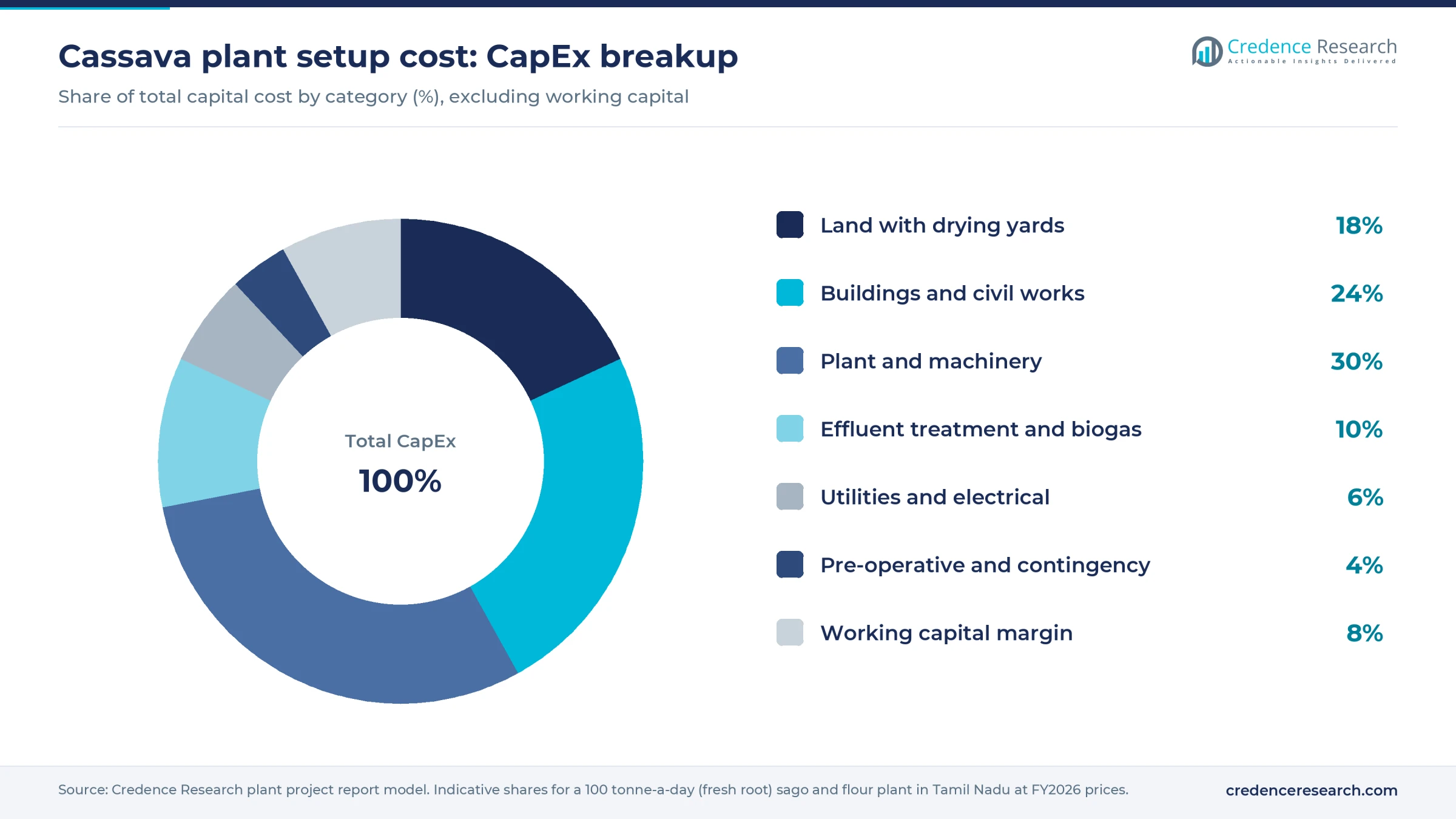
Worked example of one row, land. A pearl unit needs more land than its machinery suggests because pearls and pulp are dried on open concrete yards. The model assumes 5 acres at an assumed USD 35,000–50,000 an acre for a rural or industrial-park site in South or Southeast Asia, or USD 175,000–250,000, about 18% of the mid-case CapEx. U.S. and EU industrial land usually costs more per acre, and a site without yards must add mechanical dryers and the fuel to run them.
Civil works, about 24% of CapEx, cover the process shed, settling tanks, drying yards and a warehouse large enough to hold several months of stock before peak demand. Plant machinery takes about 30%, effluent treatment and biogas about 10%, utilities and electrical about 6%, pre-operative costs and contingency about 4%, and the working capital margin about 8%. Working capital runs heavy because mills pay farmers on delivery during the harvest but sell much of the year's sago into seasonal demand peaks.
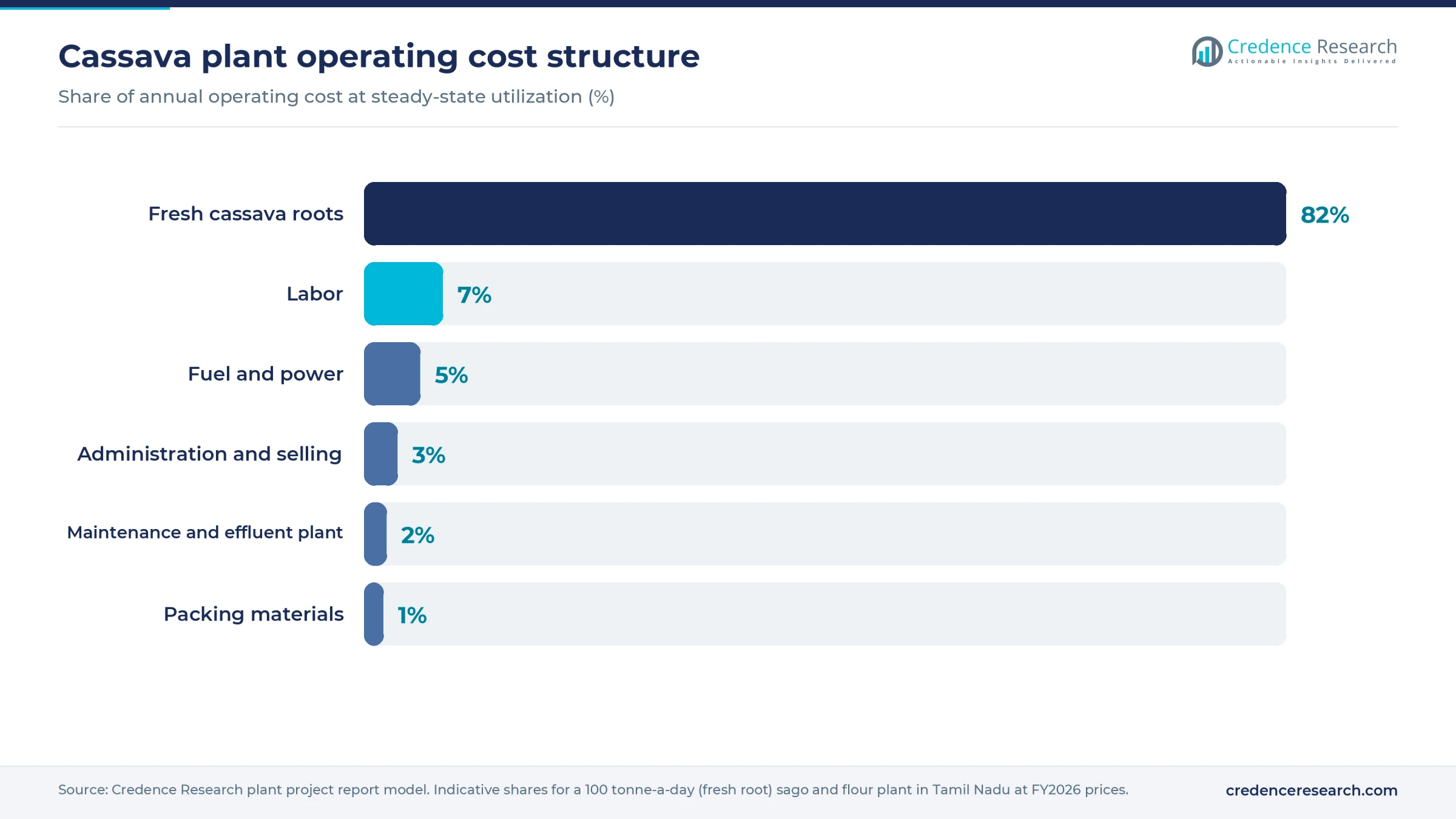
On the operating side, fresh roots dominate at about 82% of annual cost in the base case, followed by labor for peeling, yard work and bagging at about 7%, firewood and power at about 5%, and maintenance, packing, administration and selling for the rest. A USD 10 a tonne rise in root price that product prices do not follow cuts gross margin by roughly 8–9 percentage points, which is the single largest risk in the model.
Machinery and raw materials for a cassava plant
The pearl line needs a root washer and peeler, a rasper, brush or centrifugal sieves, settling tanks or hydrocyclones, a starch cake breaker, a globulator, sizing screens, roasting pans or a continuous roaster, a mechanical dryer, a polisher and a grader. The flour line adds a chipper, a tray or flash dryer, a hammer mill, a sifter and a bagging station. Shared utilities include wells and water storage, a biomass furnace or biogas burner, an anaerobic digester with a lagoon-based effluent plant, and a weighbridge. Machine specifications and quotations are in the full report.
Roots have to come from within a short haul, so the plant belongs in a growing belt. The main processing clusters are northeastern and eastern Thailand, southern Vietnam and Cambodia, southwestern Nigeria and Tamil Nadu in India, with large starch industries also in Indonesia and Brazil. Thai roots sold for USD 65–86 a tonne in December 2025 at 21–25% starch. Thai mills also import roots and chips from Laos and Cambodia when local supply runs short. Other inputs are woven polypropylene bags for pearls, retail pouches for flour, and firewood or biogas.
Cassava business profit margin and ROI
Gross margin, defined as revenue minus roots and direct conversion cost, is estimated at 10–16% in a normal crop year. The base case assumes roots at USD 80–95 a tonne, pearl recovery of 20–23% and ex-factory pearls at USD 500–570 a tonne, in line with Indian wholesale sago prices in the first half of 2026. Each tonne of pearls then carries about USD 350–480 of roots and USD 57–68 of labor, fuel and bags, partly offset by sales of dried pulp.
Profit depends on the spread between root and product prices, not on volume. In late 2025 Indian roots fell to about USD 68 a tonne and sago to about USD 36 a 90 kg bag; by June 2026 roots had roughly doubled while sago rose more slowly. Thai export prices showed the same squeeze, with the average unit value of cassava exports rising to USD 478 a tonne in the first half of 2026 from USD 319 a year earlier as roots ran short. Mills that bought roots cheaply and held wet starch or pearls into peak season earned the most. With annual revenue of roughly USD 2.6–3.3 million and fixed overheads near USD 115,000, cash profit supports a payback of 4–8 years on the USD 0.9–1.5 million investment.
| Metric | Value |
|---|---|
| IRR (post-tax) | Available in report |
| NPV | Available in report |
| ROI | Available in report |
| DSCR | Available in report |
| Break-even utilization | Available in report |
How to start a cassava business, licenses and approvals
Approval steps are similar in most countries: business and tax registration, land-use and building permits, an environmental permit covering wastewater, which is the main issue for a wet cassava plant, occupational safety and factory registration, food business registration or licensing with hygiene and HACCP controls, packaging and labeling compliance, and export registration. Cassava products must also meet limits on hydrocyanic acid, the toxin released from cyanogenic glucosides in the root; the EU limit is 10 mg/kg for cassava and tapioca flour and 50 mg/kg for fresh peeled root.
| Market | Food safety | Environment and other |
|---|---|---|
| United States | FDA food facility registration and the FSMA Preventive Controls for Human Food rule (21 CFR Part 117) | NPDES discharge permit from EPA or the state, or a local pretreatment permit for sewer discharge |
| European Union | Food business registration with the national authority under Regulation (EC) No 852/2004; hydrocyanic acid limits under Regulation (EU) 2023/915 | National environmental and water-discharge permit; the plant sits below the 300 tonne-a-day Industrial Emissions Directive threshold for vegetable raw materials |
| India | Central FSSAI license, since output exceeds 2 tonnes a day | Consent to Establish and Operate from the state pollution control board (Orange category for starch and sago), factory license, Legal Metrology registration |
Key cassava processors and recent developments
The industry mixes a few integrated groups with thousands of small mills. Named players include:
- Thai Wah Public Company, Thailand, a tapioca starch, vermicelli and food maker that sources roots in Thailand, Vietnam and Cambodia.
- Tay Ninh Tapioca JSC, Vietnam, a starch maker set up in 1994 as a joint venture of Thai Wah and Tay Ninh Sugar.
- Matna Foods, Akure, Nigeria, a cassava starch processor operating since 2002.
- SAGOSERVE, Salem, India, a cooperative of 334 sago and starch manufacturers that markets their output and holds GI user rights for Salem Sago.
- Shri Varalakshmi Sago Foods, Salem, India, a family business established in 1985 that makes sago, native tapioca starch and papad for the native starch and food trade.
Recent developments:
- January 2026. Agbeyewa Industries, a Cavista Holdings unit, acquired Matna Foods to link its cassava farms in Ekiti State with processing in Ondo State.
- July 2026. Thai Wah opened a new manufacturing plant in China and began commercial production.
- August 2026. Thailand's cassava exports fell 51.6% to 2.52 million tonnes in the first half of 2026, the Department of Foreign Trade reported, as root imports from Laos and Cambodia dropped.
What's inside the Cassava project report PDF
The report runs to 21 chapters. Open a chapter to see its sections.
1. Preface
2. Scope and Methodology
- 2.1 Objectives of the Study
- 2.2 Stakeholders
- 2.3 Research Methodology
- 2.4 Data Sources and Key Assumptions
3. Executive Summary
- 3.1 Market Snapshot
- 3.2 Project at a Glance (Capacity, CapEx, OpEx)
- 3.3 Key Financial Indicators (IRR, NPV, Payback, Break-even)
- 3.4 Feasibility Verdict
4. Product Overview
- 4.1 Cassava Definition and Properties
- 4.2 Grades and Specifications (BIS / ISO / ASTM)
- 4.3 HS Code and Classification
- 4.4 Key Applications
- 4.5 Substitutes
5. Global Cassava Market
- 5.1 Market Overview
- 5.2 Historical and Current Market Performance (Volume and Value)
- 5.3 Market Breakup by Grade / Type
- 5.4 Market Breakup by End-Use Industry
- 5.5 Market Breakup by Region
- 5.6 Market Drivers, Restraints and Trends
- 5.7 Value Chain Analysis
- 5.8 Market Forecast
6. Target Country Cassava Market Analysis
- 6.1 Demand and Supply Analysis
- 6.2 Installed Capacity vs Demand Gap
- 6.3 Import Dependence
- 6.4 Demand Forecast by End-Use
7. Trade Analysis
- 7.1 Imports by Volume, Value and Country
- 7.2 Exports by Volume, Value and Country
- 7.3 Trade Balance and Opportunities
8. Price Analysis
- 8.1 Historical Cassava Price Trends by Region
- 8.2 Raw Material / Feedstock Price Trends and Linkage
- 8.3 Price Forecast
- 8.4 Margins Across the Value Chain
9. Competitive Landscape
- 9.1 Market Structure
- 9.2 Key Players and Installed Capacities
- 9.3 Profiles of Key Players
- 9.4 Recent Developments (Expansions, M&A, New Plants)
10. Manufacturing Process and Technology
- 10.1 Comparison of Technology Routes
- 10.2 Selected Route and Process Flow Diagram
- 10.3 Unit Operations Involved
- 10.4 Chemical Reactions Involved
- 10.5 Mass Balance and Raw Material Requirements
- 10.6 Energy Balance
- 10.7 Quality Assurance Criteria and Technical Tests
- 10.8 By-products and Waste Handling
- 10.9 Technology Licensors / Providers
11. Project Details, Requirements and Costs
- 11.1 Land, Location and Site Development
- 11.1.1 Site Selection Criteria
- 11.1.2 Location Analysis
- 11.1.3 Land Requirement and Costs
- 11.1.4 Site Development Costs
- 11.2 Plant Layout
- 11.2.1 Layout Principles
- 11.2.2 Proposed Layout
- 11.2.3 Factors Influencing Layout
- 11.3 Civil Works and Buildings
- 11.4 Plant Machinery
- 11.4.1 Machinery Requirements and Specifications
- 11.4.2 Machinery Costs
- 11.4.3 Machinery Suppliers
- 11.5 Raw Materials
- 11.5.1 Requirements per Tonne of Output
- 11.5.2 Procurement and Sourcing
- 11.5.3 Costs
- 11.5.4 Suppliers
- 11.6 Packaging
- 11.6.1 Packaging Requirements
- 11.6.2 Packaging Costs
- 11.6.3 Packaging Suppliers
- 11.7 Storage and Material Handling
- 11.8 Transportation Requirements and Costs
- 11.9 Utilities
- 11.9.1 Power Requirements and Costs
- 11.9.2 Water Requirements and Costs
- 11.9.3 Steam, Fuel and Other Utilities
- 11.10 Manpower Requirements and Wages
12. Environment, Health, Safety and Sustainability
- 12.1 Effluent and Emissions Management
- 12.2 Hazard Classification and Safety Measures
- 12.3 Carbon Footprint
- 12.4 Green / Low-Carbon Process Options
13. Regulatory Procedures, Approvals and Certifications
- 13.1 Licences and Registrations
- 13.2 Environmental Clearances
- 13.3 Product Certifications (BIS, REACH, etc.)
- 13.4 Approval Timeline
14. Project Implementation Schedule
15. Project Economics
- 15.1 Capital Cost of the Project
- 15.2 Techno-Economic Parameters
- 15.3 Capacity Utilization and Ramp-up
- 15.4 Product Pricing and Margins
- 15.5 Income Projections
- 15.6 Expenditure Projections
- 15.7 Working Capital Requirement
- 15.8 Taxation
- 15.9 Depreciation
16. Financial Analysis
- 16.1 Projected Profit and Loss Account
- 16.2 Projected Cash Flow Statement
- 16.3 Projected Balance Sheet
- 16.4 Liquidity Analysis
- 16.5 Profitability Analysis (Payback, NPV, IRR, ROI)
- 16.6 Break-even Analysis
- 16.7 Debt Service Coverage Ratio (DSCR)
- 16.8 Sensitivity Analysis
- 16.9 Scenario and Uncertainty Analysis
17. Funding and Incentives
- 17.1 Means of Finance and Debt-Equity Structure
- 17.2 Loans and Financial Assistance
- 17.3 Government Schemes and Subsidies (PLI, State Policies)
18. Risk Assessment
- 18.1 Key Success Factors
- 18.2 Key Risk Factors
- 18.3 Risk Mitigation
19. Strategic Recommendations
20. Case Study of a Successful Venture
21. Appendix
- 21.1 Detailed Assumptions
- 21.2 Abbreviations
- 21.3 List of Tables and Figures
- 21.4 Sources
This page vs. the full report
| Data point | On this page (free) | In the full report |
|---|---|---|
| Total CapEx | One rounded range at one capacity | Exact figure at three capacities with a line-item breakup |
| CapEx breakup | Category shares (%) only | Cost, quantity and supplier for every machine |
| Operating cost | Share of raw materials, utilities and labor | Per-unit cost sheet with each input price and consumption |
| Profitability | Gross margin range and payback band | Exact IRR, NPV, ROI, break-even and DSCR |
| Financial statements | List of what is included | 10-year P&L, cash flow, balance sheet and Excel model |
| Sensitivity | One directional line | Full sensitivity and scenario tables |
| Process | Simplified flow diagram | Detailed process flow, mass and energy balance, operating conditions |
| Machinery | Names of the main machines | Specifications, capacity, cost and supplier list |
| Market | Headline size, growth and India demand trend | Segment, region, trade and price forecast tables |
| Suppliers and buyers | Supplier types and sourcing hubs | Named suppliers and buyers |
Cassava project report: FAQs
How much does it cost to set up a cassava processing plant?
How many tapioca pearls come from one tonne of cassava roots?
What is the profit margin in a cassava processing business?
Where should a cassava processing plant be located?
Which licenses does a cassava processing plant need?
Who buys tapioca pearls and cassava flour?
What is the payback period for a cassava processing plant?

About the analyst
Priyanka Mor, Senior Consultant
Senior Consultant at Credence Research Inc directing strategic market advisory, cross-border commercial due diligence and enterprise intelligence frameworks for global B2B clients. Combines quantitative modeling with executive advisory, translating macroeconomic variables and supply chain data into go-to-market blueprints, M&A screenings and competitive war-gaming strategies.
Related market research
- Cassava Market Size, Growth, Share and Forecast Report 2032
- Tapioca Maltodextrin Market Size, Share, Trend and Forecast 2032
- Native Starches Market Size, Growth, Share and Forecast 2032
- Gluten Free Flour Market Size, Share, Growth and Forecast 2032
- Modified Starch Market Size, Growth, Share and Forecast 2032
- Industrial Starch Market Size, Share, Growth and Forecast 2032
More plant project reports
- Potato Processing Plant Prefeasibility Report 2026
- Corn Starch Manufacturing Plant Project Report (DPR) 2026
- Cassava Starch Manufacturing Plant Project Report (DPR) 2026
- Copper Sulphate Manufacturing Plant Project Report (DPR) 2026
- Ceiling Fan Manufacturing Plant Project Report (DPR) 2026
- Avocado Processing Plant Project Report (DPR) 2026