
Quick answer
A corn starch manufacturing plant wet mills maize into starch plus gluten meal, gluten feed, germ and steep liquor. Because wet milling has a large minimum efficient scale, this overview models a greenfield plant grinding 1,000 tonnes of maize per day, with estimated CapEx of USD 35–100 million depending on cost region. Gross margin after maize and conversion costs is estimated at 12–20%, with co-products contributing 25–30% of revenue, and payback at 5–9 years.
Viable for well-capitalized processors grinding 500–1,000 tonnes of maize a day or more inside a growing region, with secure feed buyers for co-products; weak below that scale.
Corn Starch plant: key highlights
| Parameter | Indicative value | Note |
|---|---|---|
| Plant capacity | 1,000 tonnes of maize per day | About 560–600 tonnes of starch a day, 330 operating days |
| Total CapEx | USD 35–100 million | Greenfield; low end Asian build, high end international-standard engineering |
| Raw material share of operating cost | 70–78% | Maize at about 1.65–1.8 tonnes per tonne of starch |
| Gross margin | 12–20% | After maize and direct conversion costs, with co-product credits |
| Payback period | 5–9 years | From commissioning, including a ramp-up year |
| IRR | Available in report | Post-tax, 10-year model |
| Break-even | Available in report | Capacity utilization basis |
Ranges assume a greenfield wet mill grinding 1,000 tonnes of maize per day, 330 operating days, 85–90% steady-state utilization and 2026 prices; native starch plus gluten meal, gluten feed and germ, no derivative lines; maize at USD 190–300 per tonne delivered; rupee costs converted at 88 per USD. CapEx is scaled from disclosed plant costs and excludes working capital. The full report can be customized to any country or region.
What is corn starch?
Corn starch, also called maize starch, is the white, odorless carbohydrate powder extracted from the endosperm of maize kernels by wet milling. Native corn starch contains roughly 25% amylose and 75% amylopectin, which gives it a firm, opaque gel on cooling, while waxy maize varieties yield an almost pure amylopectin starch with clearer and more freeze-stable pastes. Commercial product leaves the plant at about 12–13% moisture in 25 kg or 50 kg bags or in bulk.
Producers sell three broad grades, and food grade goes into custard powder, retail corn flour packs, soups, sauces, bakery fillings and confectionery. Pharmaceutical grade is made to pharmacopoeia monographs such as the USP-NF corn starch and Ph. Eur. maize starch texts and used as a tablet binder, diluent and disintegrant. Industrial grade serves textile warp sizing, paper surface and wet-end sizing, corrugation adhesives and fermentation. Much native starch is pumped as slurry straight into glucose, dextrose, sorbitol or modified starch lines. Maize starch is classified under Harmonized System subheading 1108.12.
Corn starch market overview and global demand
Corn starch supply depends on the size of the maize crop and on where wet milling capacity sits. The October 2026 USDA World Agricultural Supply and Demand Estimates project world corn output at 1,293.75 million tonnes for 2026/27, after an estimated 1,330.62 million tonnes in 2025/26. The U.S., China and the European Union host most of the world's wet milling capacity, with South Asia, Southeast Asia, Turkey, Ukraine and South America adding regional plants. Credence Research tracks the downstream value chain in its global corn ingredients market study, which values that segment at USD 44.72 billion in 2024 with a 3.12% CAGR through 2032.
China, the largest producer, harvested 301.2 million tonnes of corn in 2025/26, and its corn starch industry ran at an average operating rate of only 59% in 2024/25, according to a USDA Foreign Agricultural Service update on China from January 2026, a sign of overcapacity that keeps Chinese starch prices competitive. In India, starch makers used about 5.0 million tonnes of maize in 2025/26 while ethanol distilleries took about 9 million tonnes, the USDA reports, an example of how fuel ethanol competes with starch for grain in several producing countries.
Most corn starch is consumed near where it is made, so trade is small relative to output. UN Comtrade data for 2024 show India exporting about 634,000 tonnes worth USD 274 million and the U.S. about 200,000 tonnes worth USD 155 million, while Germany imported about 168,000 tonnes. India's shipments fell to about 337,000 tonnes in 2025. The U.S. average export value of about USD 776 per tonne, against about USD 430 for the largest exporter, reflects a richer mix of specialty and pharmaceutical grades.
Buyers are paper and board mills, textile mills, food and beverage processors, pharmaceutical formulators, corrugated box makers and sweetener converters. Food and pharmaceutical grades earn premiums for batch consistency and audit compliance.
Corn starch manufacturing process
Corn starch is made by wet milling, a continuous, water-recirculating process that splits the kernel into starch, protein, fiber and germ. Each stage keeps the germ whole and strips out protein, since residual protein lowers grade and price.
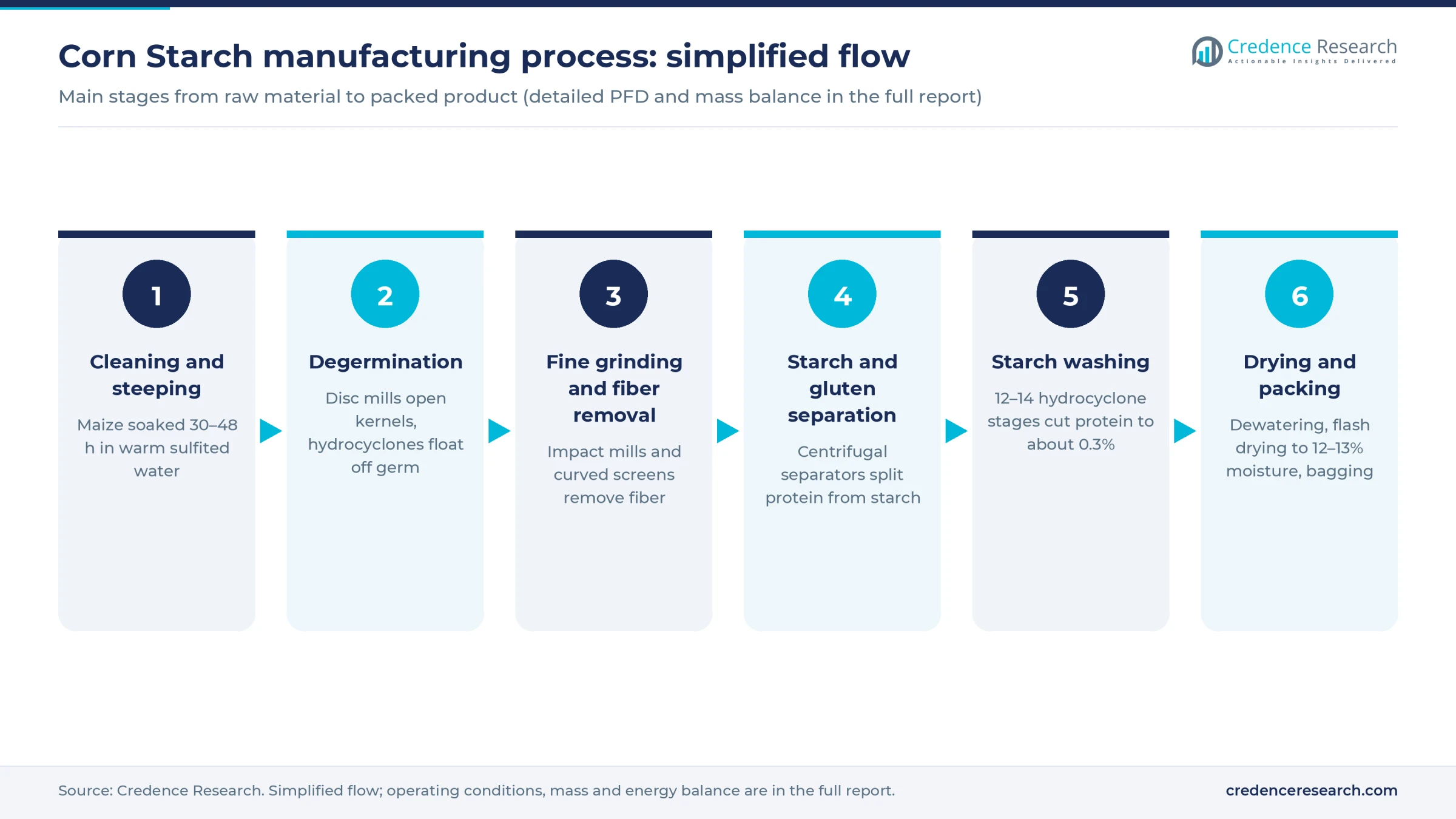
- Cleaning and steeping. Shelled maize is screened of stones, cobs and broken grain, then soaked in stainless steel steep tanks for about 30–48 hours in water held near 50°C and carrying 0.1–0.2% sulfur dioxide. Sulfite and lactic acid bacteria loosen the protein matrix while kernels swell to about 45% moisture. Drained steep water goes to evaporators.
- Degermination. Softened kernels pass through disc mills that tear them open without crushing the oil-rich germ, which floats off in hydrocyclones and is washed, pressed and dried.
- Fine grinding and fiber removal. Impact mills free starch granules from the endosperm, and pressure-fed curved screens wash the hull fiber out in a countercurrent sequence.
- Starch and gluten separation. Nozzle centrifugal separators split the dense starch slurry from the lighter protein stream, which is thickened, filtered and dried into gluten meal of about 60% protein.
- Starch washing. A battery of 12–14 hydrocyclone stages washes the starch against fresh water until protein falls to about 0.3%.
- Dewatering, drying and packing. Peeler centrifuges or vacuum filters remove water, flash dryers bring the starch to 12–13% moisture, and the powder is sifted and bagged.
Fiber is mixed with concentrated steep liquor and dried as corn gluten feed. Kansas State University extension figures show one 56-pound bushel of corn yielding about 31.5 pounds of starch, 12.5 pounds of gluten feed, 2.5 pounds of gluten meal and 1.6 pounds of corn oil, so roughly 30% of the grain's weight is sold as feed and oil co-products rather than starch.
Corn starch plant setup cost
Corn wet milling has a large minimum efficient scale. Separators, evaporators, dryers, boiler and effluent plant carry high fixed costs, so new plants are rarely built below about 500 tonnes of maize per day, and U.S. and EU plants often grind several thousand tonnes a day. This overview models a greenfield plant grinding 1,000 tonnes of maize per day, about 330,000 tonnes a year over 330 operating days, producing roughly 560–600 tonnes of starch daily plus co-products, at an estimated total CapEx of USD 35–100 million.
The low end reflects an Asian build with regionally sourced equipment, benchmarked to two Indian projects disclosed in 2026, an 850 tonnes-per-day greenfield plant at about USD 38 million and a 1,250 tonnes-per-day brownfield expansion at about USD 21 million, converted to dollars and scaled with a standard capacity-cost exponent. The high end reflects international-standard engineering, benchmarked to a multinational's 800 tonnes-per-day corn mill in Karnataka, initially estimated at about USD 64 million in 2015 (later cited at about USD 96 million including derivative lines), escalated to 2026 costs with a plant cost index. U.S. or EU sites can cost more.
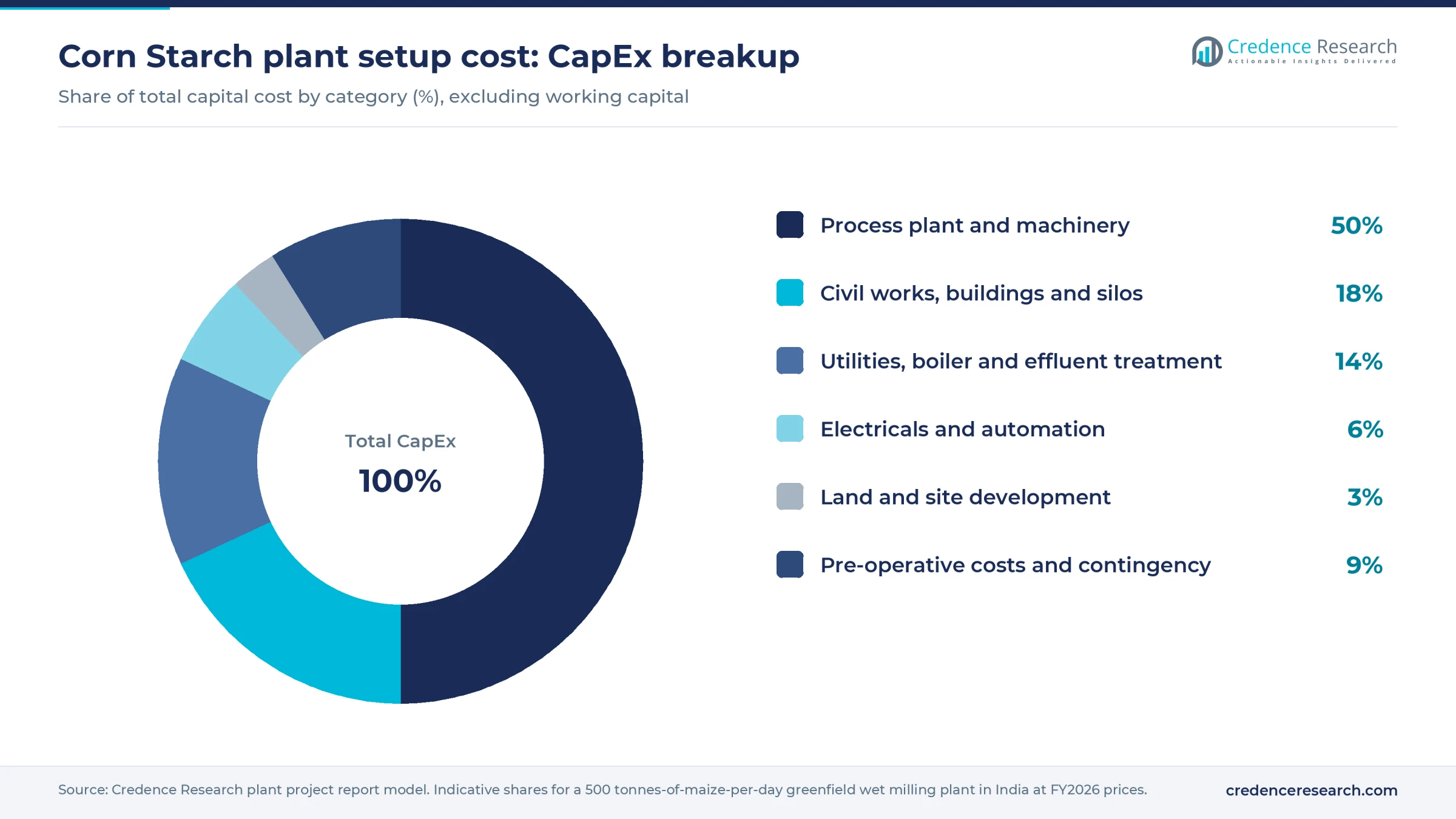
Worked example, land and site development. A 1,000 tonnes-per-day plant needs about 35–45 acres, or 140,000–180,000 square meters, for silos, process buildings, utilities, effluent treatment and truck parking. In a state industrial park in a central Indian maize district, the land premium in an April 2025 MPIDC allotment notice works out to about USD 1.75 per square meter, or roughly USD 0.25–0.3 million for the plot. At an assumed USD 10–40 per square meter for a serviced agro-industrial site in the U.S. Midwest or the EU, the same plot costs about USD 1.4–7.2 million. Site works add an assumed USD 1–3 million, so this row ranges from about 4% of CapEx in low-cost regions to about 10% at high-cost sites.
Working capital is a separate and heavy requirement. In most origins maize arrives in one or two harvest windows, and processors that stock one to three months of grain tie up roughly USD 6–20 million at this scale.
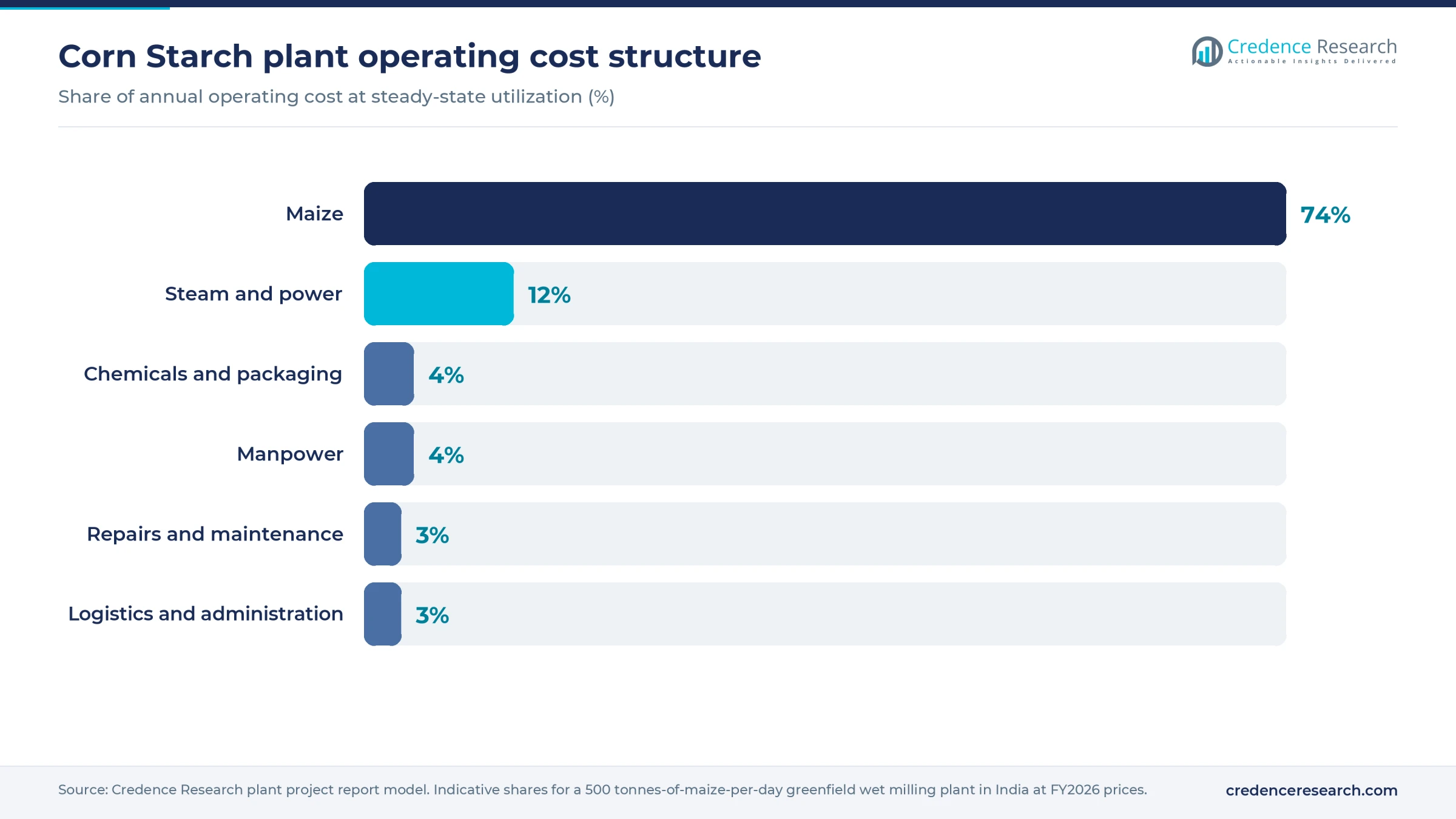
Maize accounts for about 70–78% of operating cost, followed by steam and power. Drying starch, gluten and fiber is the largest energy load, so vapor recompression evaporators and combined heat and power cut utility cost per tonne.
Machinery and raw materials for a corn starch plant
The main machinery groups are listed below; capacities, specifications and quotations are available in the report.
- Grain intake: weighbridge, pre-cleaner, destoner, bucket elevators and steel silos
- Steeping: stainless steel steep tanks, sulfur burner with sulfur dioxide absorption tower, steep water circulation
- Milling and separation: degermination disc mills, germ hydrocyclones, impact mills, pressure curved screens, fiber presses, nozzle centrifugal separators, starch washing hydrocyclones
- Drying: peeler centrifuge or vacuum filter, starch flash dryer, gluten vacuum filter and dryer, fiber and germ steam tube dryers
- Utilities and co-products: multiple-effect or mechanical vapor recompression evaporator, boiler, cooling towers, water treatment, anaerobic and aerobic effluent treatment, automatic bagging
Maize is the only bulk raw material, at about 1.65–1.8 tonnes per tonne of starch. The main sourcing regions are the U.S. Corn Belt, northeast China, Brazil and Argentina, Ukraine, France and the Danube basin, and the maize belts of South Asia. Plants are almost always built inside a growing region, because about 1.7 tonnes of grain must be hauled for every tonne of starch shipped. Wet millers prefer yellow dent maize with low moisture and low aflatoxin, because mold-damaged grain lowers starch recovery and the feed value of gluten meal. Sulfur, caustic soda, hydrochloric acid, packaging and boiler fuel are the main consumables.
Corn starch business profit margin and ROI
Corn starch is a spread business. Starch prices broadly follow maize, so profit depends on the gap between grain cost and the combined value of starch and co-products. For the modeled 1,000 tonnes-per-day plant, gross margin after maize and direct conversion costs is estimated at 12–20%, with payback of 5–9 years after commissioning, including a ramp-up year.
Co-products are what make the economics work: gluten meal, gluten feed and germ together account for an estimated 25–30% of revenue per tonne of maize at 2026 prices. Germ goes to oil extractors or in-house crushing, which ties the plant to the corn oil market. Gluten meal sells to poultry, pet food and aquaculture feed makers and gluten feed to dairy and beef cattle feeders, so weak feed prices hurt margin even when starch holds. Feed prices swing widely: India's average export value for starch residues fell from about USD 341 per tonne in 2024 to USD 249 in 2025, per UN Comtrade.
A USD 10 per tonne rise in maize cost that cannot be passed through cuts gross margin by roughly 2–3 percentage points. Converting part of the starch into glucose, dextrose, modified or pharmaceutical grades lifts margin, which is why most operators add derivative lines.
| Metric | Value |
|---|---|
| Project IRR (post-tax) | Available in report |
| NPV | Available in report |
| Return on investment | Available in report |
| DSCR | Available in report |
| Break-even utilization | Available in report |
How to start a corn starch business, licenses and approvals
A corn starch plant needs approvals in five areas wherever it is built. These are business and tax registration; land use, zoning and building permits; an environmental permit covering dryer and boiler emissions, steeping and washing wastewater and water abstraction; safety approvals for boilers, pressure vessels, sulfur dioxide handling and combustible starch dust; and food and feed registration, because the starch enters food and the co-products enter animal feed. Export sales also need customs registration.
| Market | Food and feed | Environment and safety |
|---|---|---|
| United States | FDA food facility registration and the Preventive Controls for Human Food rule (21 CFR 117); 21 CFR 507 for animal food co-products | State air construction and operating permits, with Title V for major sources; NPDES or local pretreatment permit for wastewater; OSHA workplace rules including combustible dust hazards |
| European Union | Food business registration under Regulation (EC) No 852/2004; feed business registration under Regulation (EC) No 183/2005 | Integrated permit under the Industrial Emissions Directive, which covers vegetable raw material processing above 300 tonnes of finished product a day; ATEX rules for dust explosion zones |
| India | FSSAI central license, required above 2 tonnes a day of installed capacity | State pollution control board consents for an Orange category starch unit, groundwater no-objection certificate, factory license and boiler registration |
Pharmaceutical-grade output must also meet the relevant pharmacopoeia, and customers audit excipient makers against good manufacturing practice.
Key corn starch manufacturers and recent developments
Wet milling is led by companies based in the U.S., China and the EU. Cargill, ADM and Ingredion operate the largest networks in the Americas, Primient, the former Tate & Lyle primary products business, runs U.S. wet mills, and Roquette and Tereos are the main European producers. In China, groups such as COFCO and Xiwang run large corn processing complexes. Regional makers include Gujarat Ambuja Exports, Sanstar and Sukhjit Starch & Chemicals in India.
- May 2026. Ingredion agreed to subscribe to about USD 23 million of new Sanstar shares and signed a joint venture to make specialty pharmaceutical excipients.
- August 2026. Biostarch Technologies disclosed plans for a plant in Ukraine's Odesa region to grind 600 tonnes of corn a day, about 198,000 tonnes a year, into starch, gluten, germ and feed.
- September 2026. Gujarat Ambuja Exports disclosed an 850 tonnes-per-day greenfield plant at Hubli, Karnataka, budgeted at about USD 38 million, as part of a goal of 9,000 tonnes per day of total capacity by 2030.
Investment is shifting toward derivatives, where modified starch demand supports higher realizations.
What's inside the Corn Starch project report PDF
The report runs to 21 chapters. Open a chapter to see its sections.
1. Preface
2. Scope and Methodology
- 2.1 Objectives of the Study
- 2.2 Stakeholders
- 2.3 Research Methodology
- 2.4 Data Sources and Key Assumptions
3. Executive Summary
- 3.1 Market Snapshot
- 3.2 Project at a Glance (Capacity, CapEx, OpEx)
- 3.3 Key Financial Indicators (IRR, NPV, Payback, Break-even)
- 3.4 Feasibility Verdict
4. Product Overview
- 4.1 Corn Starch Definition and Properties
- 4.2 Grades and Specifications (BIS / ISO / ASTM)
- 4.3 HS Code and Classification
- 4.4 Key Applications
- 4.5 Substitutes
5. Global Corn Starch Market
- 5.1 Market Overview
- 5.2 Historical and Current Market Performance (Volume and Value)
- 5.3 Market Breakup by Grade / Type
- 5.4 Market Breakup by End-Use Industry
- 5.5 Market Breakup by Region
- 5.6 Market Drivers, Restraints and Trends
- 5.7 Value Chain Analysis
- 5.8 Market Forecast
6. Target Country Corn Starch Market Analysis
- 6.1 Demand and Supply Analysis
- 6.2 Installed Capacity vs Demand Gap
- 6.3 Import Dependence
- 6.4 Demand Forecast by End-Use
7. Trade Analysis
- 7.1 Imports by Volume, Value and Country
- 7.2 Exports by Volume, Value and Country
- 7.3 Trade Balance and Opportunities
8. Price Analysis
- 8.1 Historical Corn Starch Price Trends by Region
- 8.2 Raw Material / Feedstock Price Trends and Linkage
- 8.3 Price Forecast
- 8.4 Margins Across the Value Chain
9. Competitive Landscape
- 9.1 Market Structure
- 9.2 Key Players and Installed Capacities
- 9.3 Profiles of Key Players
- 9.4 Recent Developments (Expansions, M&A, New Plants)
10. Manufacturing Process and Technology
- 10.1 Comparison of Technology Routes
- 10.2 Selected Route and Process Flow Diagram
- 10.3 Unit Operations Involved
- 10.4 Chemical Reactions Involved
- 10.5 Mass Balance and Raw Material Requirements
- 10.6 Energy Balance
- 10.7 Quality Assurance Criteria and Technical Tests
- 10.8 By-products and Waste Handling
- 10.9 Technology Licensors / Providers
11. Project Details, Requirements and Costs
- 11.1 Land, Location and Site Development
- 11.1.1 Site Selection Criteria
- 11.1.2 Location Analysis
- 11.1.3 Land Requirement and Costs
- 11.1.4 Site Development Costs
- 11.2 Plant Layout
- 11.2.1 Layout Principles
- 11.2.2 Proposed Layout
- 11.2.3 Factors Influencing Layout
- 11.3 Civil Works and Buildings
- 11.4 Plant Machinery
- 11.4.1 Machinery Requirements and Specifications
- 11.4.2 Machinery Costs
- 11.4.3 Machinery Suppliers
- 11.5 Raw Materials
- 11.5.1 Requirements per Tonne of Output
- 11.5.2 Procurement and Sourcing
- 11.5.3 Costs
- 11.5.4 Suppliers
- 11.6 Packaging
- 11.6.1 Packaging Requirements
- 11.6.2 Packaging Costs
- 11.6.3 Packaging Suppliers
- 11.7 Storage and Material Handling
- 11.8 Transportation Requirements and Costs
- 11.9 Utilities
- 11.9.1 Power Requirements and Costs
- 11.9.2 Water Requirements and Costs
- 11.9.3 Steam, Fuel and Other Utilities
- 11.10 Manpower Requirements and Wages
12. Environment, Health, Safety and Sustainability
- 12.1 Effluent and Emissions Management
- 12.2 Hazard Classification and Safety Measures
- 12.3 Carbon Footprint
- 12.4 Green / Low-Carbon Process Options
13. Regulatory Procedures, Approvals and Certifications
- 13.1 Licences and Registrations
- 13.2 Environmental Clearances
- 13.3 Product Certifications (BIS, REACH, etc.)
- 13.4 Approval Timeline
14. Project Implementation Schedule
15. Project Economics
- 15.1 Capital Cost of the Project
- 15.2 Techno-Economic Parameters
- 15.3 Capacity Utilization and Ramp-up
- 15.4 Product Pricing and Margins
- 15.5 Income Projections
- 15.6 Expenditure Projections
- 15.7 Working Capital Requirement
- 15.8 Taxation
- 15.9 Depreciation
16. Financial Analysis
- 16.1 Projected Profit and Loss Account
- 16.2 Projected Cash Flow Statement
- 16.3 Projected Balance Sheet
- 16.4 Liquidity Analysis
- 16.5 Profitability Analysis (Payback, NPV, IRR, ROI)
- 16.6 Break-even Analysis
- 16.7 Debt Service Coverage Ratio (DSCR)
- 16.8 Sensitivity Analysis
- 16.9 Scenario and Uncertainty Analysis
17. Funding and Incentives
- 17.1 Means of Finance and Debt-Equity Structure
- 17.2 Loans and Financial Assistance
- 17.3 Government Schemes and Subsidies (PLI, State Policies)
18. Risk Assessment
- 18.1 Key Success Factors
- 18.2 Key Risk Factors
- 18.3 Risk Mitigation
19. Strategic Recommendations
20. Case Study of a Successful Venture
21. Appendix
- 21.1 Detailed Assumptions
- 21.2 Abbreviations
- 21.3 List of Tables and Figures
- 21.4 Sources
This page vs. the full report
| Data point | On this page (free) | In the full report |
|---|---|---|
| Total CapEx | One rounded range at one capacity | Exact figure at three capacities with a line-item breakup |
| CapEx breakup | Category shares (%) only | Cost, quantity and supplier for every machine |
| Operating cost | Share of raw materials, utilities and labor | Per-unit cost sheet with each input price and consumption |
| Profitability | Gross margin range and payback band | Exact IRR, NPV, ROI, break-even and DSCR |
| Financial statements | List of what is included | 10-year P&L, cash flow, balance sheet and Excel model |
| Sensitivity | One directional line | Full sensitivity and scenario tables |
| Process | Simplified flow diagram | Detailed process flow, mass and energy balance, operating conditions |
| Machinery | Names of the main machines | Specifications, capacity, cost and supplier list |
| Market | Headline size, growth and India demand trend | Segment, region, trade and price forecast tables |
| Suppliers and buyers | Supplier types and sourcing hubs | Named suppliers and buyers |
Corn Starch project report: FAQs
How much does it cost to set up a corn starch plant?
What is the minimum viable size for a corn starch plant?
What co-products come from corn starch manufacturing?
What profit margin can a corn starch plant earn?
Which licenses does a corn starch plant need?
How does ethanol demand affect corn starch makers?

About the analyst
Priyanka Mor, Senior Consultant
Senior Consultant at Credence Research Inc directing strategic market advisory, cross-border commercial due diligence and enterprise intelligence frameworks for global B2B clients. Combines quantitative modeling with executive advisory, translating macroeconomic variables and supply chain data into go-to-market blueprints, M&A screenings and competitive war-gaming strategies.
Related market research
- Corn Ingredients Market Size, Share, Growth and Forecast 2032
- Modified Starch Market Size, Growth, Share and Forecast 2032
- Native Starches Market Size, Growth, Share and Forecast 2032
- Corn Oil Market Size, Share, Trends, Growth and Forecast 2032
- Industrial Starch Market Size, Share, Growth and Forecast 2032
- High Fructose Corn Syrup Market Size, Trends and Forecast 2032
More plant project reports
- Shrimp Processing Plant Project Report (DPR) 2026
- Instant Coffee Manufacturing Plant Project Report (DPR) 2026
- Pectin Manufacturing Plant Project Report (DPR) 2026
- Parboiled White Rice Processing Plant Project Report (DPR) 2026
- Potato Processing Plant Prefeasibility Report 2026
- Cassava Starch Manufacturing Plant Project Report (DPR) 2026