
Quick answer
A cassava starch plant extracts native tapioca starch from fresh roots by rasping, sieving, hydrocyclone refining and flash drying. A greenfield plant producing 5 tonnes of starch an hour, about 36,000 tonnes a year, needs roughly USD 7–15 million, depending on country and vendor mix. Gross margin typically runs 12–20%, driven by the root-to-starch price spread and extraction yield, with payback of 5–7 years at normal root prices.
Feasible for promoters inside a dense cassava belt who can contract roots, treat effluent properly and sell graded starch to paper, food and Chinese import buyers; root and export price swings are the main risk.
Cassava Starch plant: key highlights
| Parameter | Indicative value | Note |
|---|---|---|
| Plant capacity | 5 tonnes of starch an hour | About 36,000 tonnes a year from roughly 500 tonnes of roots a day |
| Total CapEx | USD 7–15 million | Order-of-magnitude international turnkey estimate, including land, effluent treatment and working capital |
| Raw material share of operating cost | 70–80% | Fresh roots at 4.0–4.5 tonnes per tonne of starch |
| Gross margin | 12–20% | On starch and pulp revenue at normal root prices |
| Payback period | 5–7 years | Longer in years of root price spikes or weak export prices |
| IRR | Available in report | Post-tax, 10-year model |
| Break-even | Available in report | Capacity utilization basis |
Ranges assume 5 tonnes of starch an hour (about 36,000 tonnes a year over 300 days at 4.0–4.5 tonnes of roots per tonne), a greenfield rural site in an Asian or Latin American cassava belt, 2026 prices, Thai root and FOB starch prices, 33 baht per USD; CapEx is an order-of-magnitude international turnkey estimate. Customizable to any country.
What is cassava starch?
Cassava starch, also called tapioca starch, is the native carbohydrate washed out of fresh Manihot esculenta roots, purified and flash dried to a white powder with about 12–13% moisture. Unlike cereal starches, it carries almost no protein or fat, so it cooks to a clear, bland paste with high viscosity at a lower gelatinization temperature, which is why food formulators and paper mills value it.
It trades under Harmonized System code 1108.14, manioc (cassava) starch. Plants usually sell three commercial grades:
- Food grade, used in snacks, noodles, bakery fillings, dairy desserts, bubble tea pearls and as feedstock for glucose and maltodextrin.
- Pharmaceutical grade to pharmacopeia specifications, used as a tablet binder and disintegrant.
- Industrial grade for paper wet-end and surface sizing, textile warp sizing, corrugating and other adhesives, often converted further into oxidized, cationic and other modified starches.
Wet starch cake from the same line can also feed sago pearl production, a separate food product.
Cassava starch market overview and global demand
No cassava-specific market valuation is published by Credence Research, so this overview relies on dated trade indicators. Asia dominates both supply and demand. Thailand, the largest exporter, shipped 2.49 million tonnes of native tapioca starch in January to October 2025, below 2.65 million tonnes a year earlier, according to Thai customs data compiled by the Thai Tapioca Trade Association, with premium-grade starch quoted at USD 450–455 per tonne FOB Bangkok in early December 2025.
China, the largest importer, bought 2.35 million tonnes of cassava starch in January to May 2025, up 50.2% year on year, at an average USD 370.7 per tonne, down 31%, with Vietnam supplying about 49%, ahead of Thailand and Laos, Tridge reported from Chinese customs data. Vietnam earned about USD 1.26 billion from 3.9 million tonnes of cassava and cassava products in 2025, with China taking about 94% of the volume. Indonesia processes a large crop mainly for its own food and paper industries. Brazil produced about 539,000 tonnes of starch in 2020, according to Cepea, while Nigeria, the largest root grower, converts only a small share into starch.
Demand comes from paper and board, textile sizing, adhesives, sweeteners and processed food, the core of the industrial starch customer base, while the broader cassava market and corn starch set the substitution ceiling. The commercial risk is price volatility, not demand, as the 2025 price fall in China showed.
Cassava starch manufacturing process
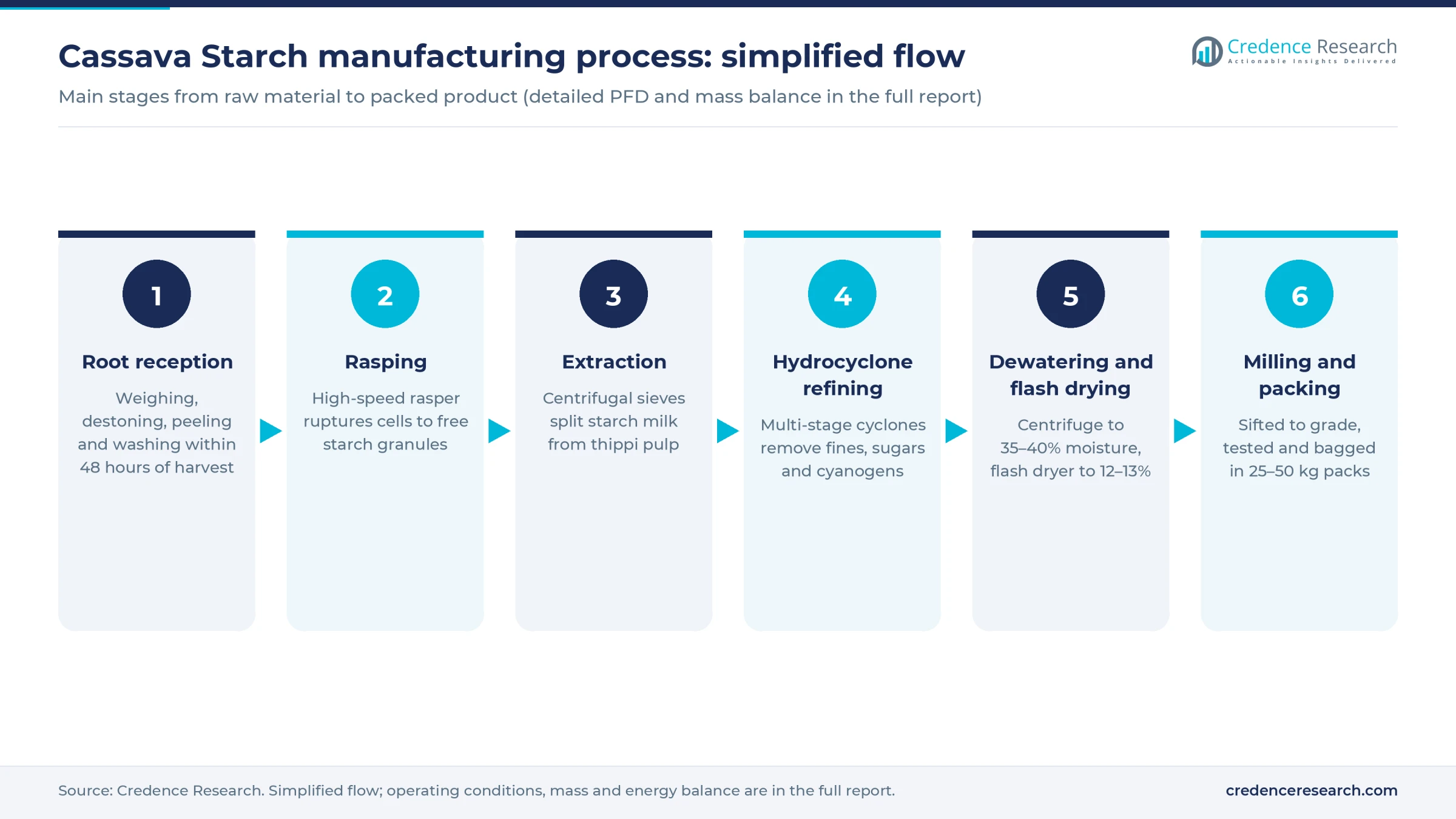
Native cassava starch extraction is a purely physical wet process. It needs no steeping, sulfur dioxide or protein separation, which makes it simpler than corn wet milling, but it runs against a hard clock, because harvested roots begin to deteriorate within 24 to 48 hours.
Root reception, washing and rasping
Roots are weighed, tested for starch content, stripped of soil and stones in a dry drum, then peeled and washed in a paddle or rotary washer. A high-speed rasper tears the cell walls so starch granules can be released into water. Rasping efficiency decides how much starch leaves with the fiber, so blade condition is checked every shift.
Extraction and hydrocyclone refining
Centrifugal sieves separate the starch milk from the fibrous pulp in two or three counter-current stages. A desanding cyclone removes grit, and an 18- to 24-stage hydrocyclone battery then washes out fine fiber, soluble sugars, protein traces and cyanogenic compounds while concentrating the slurry. Fresh water enters at the last stage only, which keeps consumption to about 3–7 cubic meters per tonne of starch in modern lines.
Dewatering, flash drying and finishing
A peeler centrifuge or vacuum drum filter takes the refined slurry to a cake with roughly 35–40% moisture. A flash dryer suspends the cake in hot air for a few seconds, dropping moisture to 12–13% without gelatinizing the granules. The powder is cooled, milled, sifted to mesh specification, passed over a metal detector and packed in 25 kilogram bags or one-tonne bulk bags. Whiteness, viscosity, pH, ash and residual cyanide are tested per lot, because paper and food buyers reject on these parameters. Typical yield is one tonne of starch from 4.0–4.5 tonnes of fresh roots.
Cassava starch plant setup cost
The ranges below assume a greenfield plant producing 5 tonnes of starch an hour, about 120 tonnes a day from roughly 500 tonnes of fresh roots, over 300 operating days, or about 36,000 tonnes a year, at 2026 prices. An international turnkey estimate puts total capital expenditure at about USD 7–15 million, an order-of-magnitude figure that varies with country, vendor mix and automation level. The full report can be customized to any country.
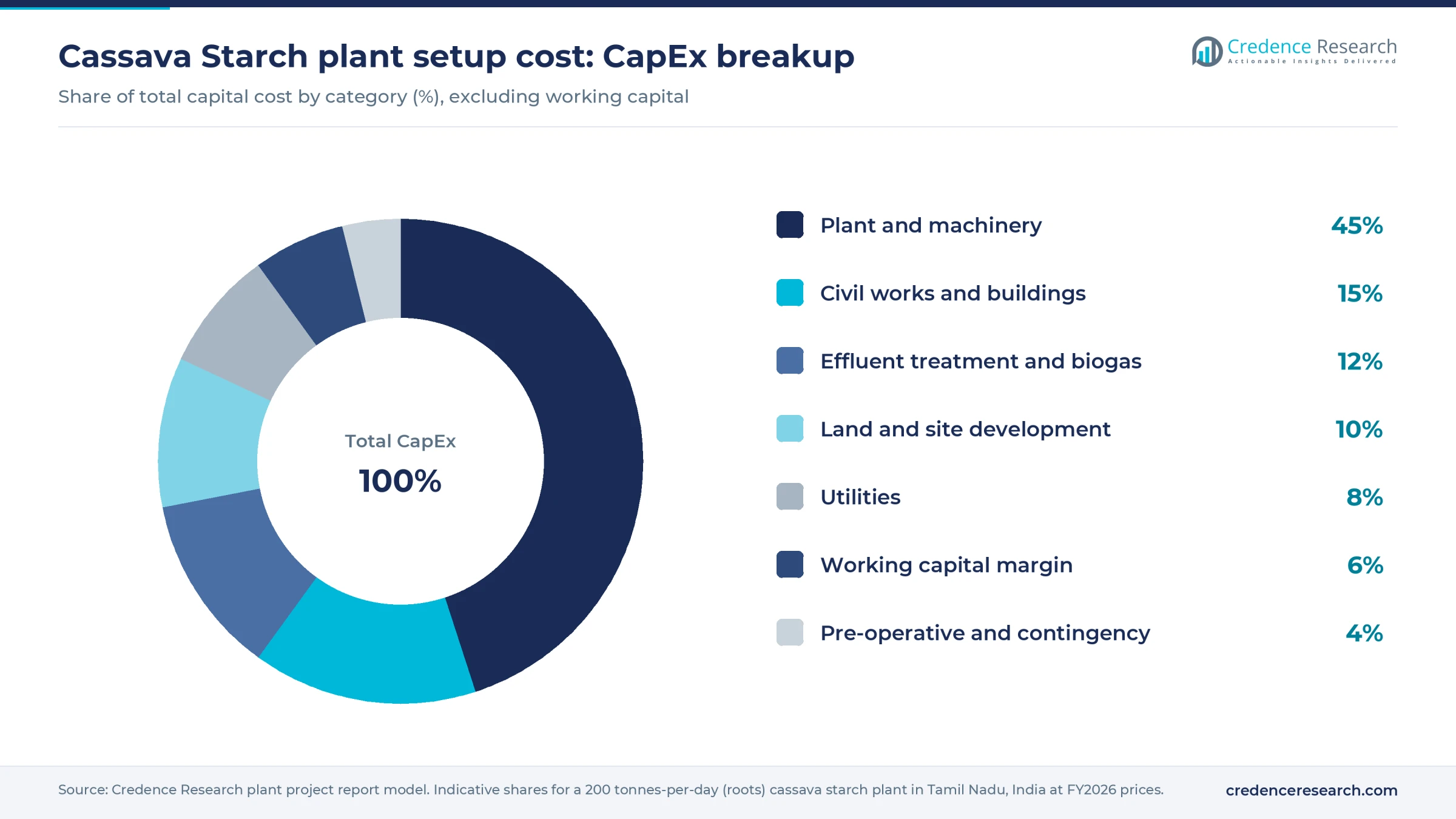
Plant and machinery account for the largest share, about 45%, covering the root handling line, rasper, sieves, hydrocyclones, centrifuge, flash dryer and packing. Civil works take about 15%, with long wet-process halls on acid-resistant flooring. Utilities such as power supply, hot air generator, water storage and compressed air take about 10%.
Example cost row, land and site
A starch unit of this size needs about 4 to 6 hectares for root yards, pulp handling and effluent lagoons. Land and site development take about 8% of CapEx, or roughly USD 0.5–1.2 million, a figure that reflects an assumed rural industrial site in a Southeast Asian, South Asian or Latin American cassava belt. A comparable site in the United States or the European Union would cost several times more, but few starch plants are built there because roots cannot travel far.
Effluent treatment and biogas
At 3–7 cubic meters of wastewater per tonne of starch, the plant must treat about 360–840 cubic meters a day of acidic, high-organic water; a 2020 study of sago and starch factories in southern India found untreated effluent at pH 4.3–5.2 with free cyanide of 1.2–5.2 mg per liter. An anaerobic reactor or covered lagoon with biogas piped to the dryer takes about 12% of CapEx. Working capital takes about 6% and pre-operative costs and contingency about 4%.
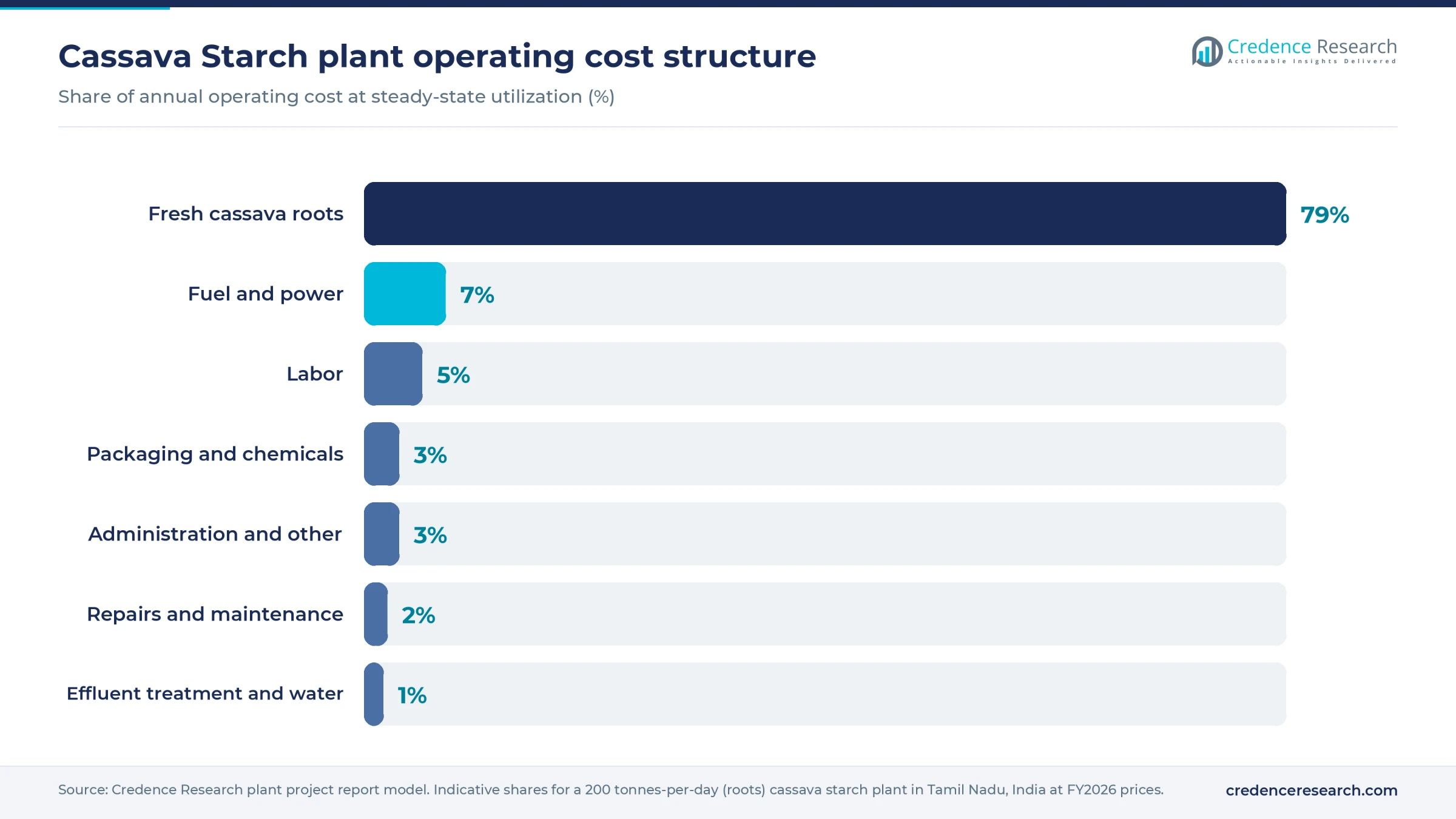
Roots dominate operating cost, at about 70–80% of the total. Fuel and power, labor, packaging and effluent handling make up most of the balance.
Machinery and raw materials for a cassava starch plant
The core machinery list for a native cassava starch line covers the following:
- Root receiving hopper, belt conveyors, dry cleaning drum and paddle or rotary peeler-washer
- High-speed rasper or cassava grater
- Centrifugal extraction sieves and pulp dewatering screw press
- Desanding cyclone and multi-stage hydrocyclone station
- Peeler centrifuge or vacuum drum filter
- Flash dryer with hot air generator, cyclones and bag filter
- Pin mill, vibratory sifter, metal detector and bagging machine
- Anaerobic effluent treatment with biogas line, quality laboratory
Fresh roots are the only significant raw material, and because they spoil within two days, the plant must sit inside its growing area. The main industrial root belts are northeastern and eastern Thailand, southern and central Vietnam, Laos and Cambodia, Lampung and other Indonesian provinces, Brazil's Parana and Mato Grosso do Sul, southern India's Tamil Nadu, and West Africa's Nigeria and Ghana, where industrial supply chains are still thin. Thai mills price roots on a 25% starch-content basis, so a plant that tests every load and pays premiums for high-starch varieties lifts its yield. Process water and woven polypropylene or bulk bags complete the input list. The fibrous pulp residue is sold wet or dried to animal feed makers and adds a modest second revenue line.
Cassava starch business profit margin and ROI
Gross margin for a 5 tonnes-an-hour cassava starch plant typically falls in the 12–20% range on starch and pulp revenue, with payback of 5–7 years on the stated CapEx. The margin is a spread business. Each tonne of starch consumes 4.0–4.5 tonnes of roots. At Thai root prices of about 2.05–2.70 baht a kilogram in December 2025, roughly USD 62–82 a tonne at an assumed 33 baht per dollar, roots alone cost about USD 250–350 per tonne of starch, against a starch price of USD 450–455 FOB. Conversion cost adds about USD 60–120 a tonne.
Three operating levers decide profit in a cassava starch plant. Extraction efficiency matters most, since every percentage point of starch left in the pulp is lost revenue. Grade mix comes second, because pharmaceutical and food grades sold to contracted buyers carry a premium over bulk industrial starch. Root sourcing comes third, as plants that contract growers avoid buying at seasonal peaks. Sensitivity runs one way: a 10% rise in root price without a matching starch price rise cuts gross margin by roughly 5 to 8 points.
| Metric | Value |
|---|---|
| Project IRR | Available in report |
| NPV | Available in report |
| Return on investment | Available in report |
| Average DSCR | Available in report |
How to start a cassava starch business, licenses and approvals
A cassava starch plant typically needs business registration and tax registration, land use and building permits, an environmental permit covering wastewater discharge and dryer emissions, occupational safety and fire approvals, food safety registration or licensing for food-grade output, and export registration where it ships abroad. Effluent approval usually takes the longest, because cassava wastewater is acidic and carries cyanide.
Examples by market
| Market | Key approvals for a cassava starch plant |
|---|---|
| United States | FDA food facility registration and compliance with current good manufacturing practice and preventive controls rules (21 CFR Part 117) for food grade; NPDES discharge permit from EPA or the state agency, or a local pretreatment permit for sewer discharge; state air permit for the dryer |
| European Union | Food business registration with the national competent authority under Regulation (EC) No 852/2004; national environmental permit, since a plant below 300 tonnes a day of finished product falls below the IED Annex I 6.4(b)(ii) threshold of 300 tonnes a day of finished product |
| India | Consent to Establish and Consent to Operate from the state pollution control board, where starch and sago manufacturing is an Orange category industry; FSSAI central license for food grade; factory license under the Factories Act |
Key cassava starch manufacturers and recent developments
Thailand's Thai Wah and General Starch are among the largest native and modified tapioca starch exporters, and Ingredion processes tapioca in Thailand for its specialty starch range. Indonesia's Budi Starch and Sweetener and Vietnam's many provincial processors supply the China trade, while India's Spac Starch Products and Varalakshmi Starch Industries serve paper, textile and food buyers in South Asia. Producers that also run maize lines can switch feedstock when root prices spike.
Recent developments
- May 2026: Thai Wah reported 20.4% year-on-year growth in native tapioca starch volume for the first quarter of 2026, led by exports to China.
- June 2026: Root prices in India's Tamil Nadu cluster rose to about USD 135 a tonne from USD 50–75 (at 88 rupees per USD), cutting local starch and sago output by nearly 20%, DT Next reported.
What's inside the Cassava Starch project report PDF
The report runs to 21 chapters. Open a chapter to see its sections.
1. Preface
2. Scope and Methodology
- 2.1 Objectives of the Study
- 2.2 Stakeholders
- 2.3 Research Methodology
- 2.4 Data Sources and Key Assumptions
3. Executive Summary
- 3.1 Market Snapshot
- 3.2 Project at a Glance (Capacity, CapEx, OpEx)
- 3.3 Key Financial Indicators (IRR, NPV, Payback, Break-even)
- 3.4 Feasibility Verdict
4. Product Overview
- 4.1 Cassava Starch Definition and Properties
- 4.2 Grades and Specifications (BIS / ISO / ASTM)
- 4.3 HS Code and Classification
- 4.4 Key Applications
- 4.5 Substitutes
5. Global Cassava Starch Market
- 5.1 Market Overview
- 5.2 Historical and Current Market Performance (Volume and Value)
- 5.3 Market Breakup by Grade / Type
- 5.4 Market Breakup by End-Use Industry
- 5.5 Market Breakup by Region
- 5.6 Market Drivers, Restraints and Trends
- 5.7 Value Chain Analysis
- 5.8 Market Forecast
6. Target Country Cassava Starch Market Analysis
- 6.1 Demand and Supply Analysis
- 6.2 Installed Capacity vs Demand Gap
- 6.3 Import Dependence
- 6.4 Demand Forecast by End-Use
7. Trade Analysis
- 7.1 Imports by Volume, Value and Country
- 7.2 Exports by Volume, Value and Country
- 7.3 Trade Balance and Opportunities
8. Price Analysis
- 8.1 Historical Cassava Starch Price Trends by Region
- 8.2 Raw Material / Feedstock Price Trends and Linkage
- 8.3 Price Forecast
- 8.4 Margins Across the Value Chain
9. Competitive Landscape
- 9.1 Market Structure
- 9.2 Key Players and Installed Capacities
- 9.3 Profiles of Key Players
- 9.4 Recent Developments (Expansions, M&A, New Plants)
10. Manufacturing Process and Technology
- 10.1 Comparison of Technology Routes
- 10.2 Selected Route and Process Flow Diagram
- 10.3 Unit Operations Involved
- 10.4 Chemical Reactions Involved
- 10.5 Mass Balance and Raw Material Requirements
- 10.6 Energy Balance
- 10.7 Quality Assurance Criteria and Technical Tests
- 10.8 By-products and Waste Handling
- 10.9 Technology Licensors / Providers
11. Project Details, Requirements and Costs
- 11.1 Land, Location and Site Development
- 11.1.1 Site Selection Criteria
- 11.1.2 Location Analysis
- 11.1.3 Land Requirement and Costs
- 11.1.4 Site Development Costs
- 11.2 Plant Layout
- 11.2.1 Layout Principles
- 11.2.2 Proposed Layout
- 11.2.3 Factors Influencing Layout
- 11.3 Civil Works and Buildings
- 11.4 Plant Machinery
- 11.4.1 Machinery Requirements and Specifications
- 11.4.2 Machinery Costs
- 11.4.3 Machinery Suppliers
- 11.5 Raw Materials
- 11.5.1 Requirements per Tonne of Output
- 11.5.2 Procurement and Sourcing
- 11.5.3 Costs
- 11.5.4 Suppliers
- 11.6 Packaging
- 11.6.1 Packaging Requirements
- 11.6.2 Packaging Costs
- 11.6.3 Packaging Suppliers
- 11.7 Storage and Material Handling
- 11.8 Transportation Requirements and Costs
- 11.9 Utilities
- 11.9.1 Power Requirements and Costs
- 11.9.2 Water Requirements and Costs
- 11.9.3 Steam, Fuel and Other Utilities
- 11.10 Manpower Requirements and Wages
12. Environment, Health, Safety and Sustainability
- 12.1 Effluent and Emissions Management
- 12.2 Hazard Classification and Safety Measures
- 12.3 Carbon Footprint
- 12.4 Green / Low-Carbon Process Options
13. Regulatory Procedures, Approvals and Certifications
- 13.1 Licences and Registrations
- 13.2 Environmental Clearances
- 13.3 Product Certifications (BIS, REACH, etc.)
- 13.4 Approval Timeline
14. Project Implementation Schedule
15. Project Economics
- 15.1 Capital Cost of the Project
- 15.2 Techno-Economic Parameters
- 15.3 Capacity Utilization and Ramp-up
- 15.4 Product Pricing and Margins
- 15.5 Income Projections
- 15.6 Expenditure Projections
- 15.7 Working Capital Requirement
- 15.8 Taxation
- 15.9 Depreciation
16. Financial Analysis
- 16.1 Projected Profit and Loss Account
- 16.2 Projected Cash Flow Statement
- 16.3 Projected Balance Sheet
- 16.4 Liquidity Analysis
- 16.5 Profitability Analysis (Payback, NPV, IRR, ROI)
- 16.6 Break-even Analysis
- 16.7 Debt Service Coverage Ratio (DSCR)
- 16.8 Sensitivity Analysis
- 16.9 Scenario and Uncertainty Analysis
17. Funding and Incentives
- 17.1 Means of Finance and Debt-Equity Structure
- 17.2 Loans and Financial Assistance
- 17.3 Government Schemes and Subsidies (PLI, State Policies)
18. Risk Assessment
- 18.1 Key Success Factors
- 18.2 Key Risk Factors
- 18.3 Risk Mitigation
19. Strategic Recommendations
20. Case Study of a Successful Venture
21. Appendix
- 21.1 Detailed Assumptions
- 21.2 Abbreviations
- 21.3 List of Tables and Figures
- 21.4 Sources
This page vs. the full report
| Data point | On this page (free) | In the full report |
|---|---|---|
| Total CapEx | One rounded range at one capacity | Exact figure at three capacities with a line-item breakup |
| CapEx breakup | Category shares (%) only | Cost, quantity and supplier for every machine |
| Operating cost | Share of raw materials, utilities and labor | Per-unit cost sheet with each input price and consumption |
| Profitability | Gross margin range and payback band | Exact IRR, NPV, ROI, break-even and DSCR |
| Financial statements | List of what is included | 10-year P&L, cash flow, balance sheet and Excel model |
| Sensitivity | One directional line | Full sensitivity and scenario tables |
| Process | Simplified flow diagram | Detailed process flow, mass and energy balance, operating conditions |
| Machinery | Names of the main machines | Specifications, capacity, cost and supplier list |
| Market | Headline size, growth and India demand trend | Segment, region, trade and price forecast tables |
| Suppliers and buyers | Supplier types and sourcing hubs | Named suppliers and buyers |
Cassava Starch project report: FAQs
How much does it cost to set up a cassava starch plant?
How many tonnes of cassava roots make one tonne of starch?
What is the profit margin in cassava starch manufacturing?
What is the payback period for a cassava starch plant?
Which countries lead cassava starch trade?
Where should a cassava starch plant be located?
How does cassava starch differ from corn starch for buyers?

About the analyst
Priyanka Mor, Senior Consultant
Senior Consultant at Credence Research Inc directing strategic market advisory, cross-border commercial due diligence and enterprise intelligence frameworks for global B2B clients. Combines quantitative modeling with executive advisory, translating macroeconomic variables and supply chain data into go-to-market blueprints, M&A screenings and competitive war-gaming strategies.
Related market research
- Cassava Market Size, Growth, Share and Forecast Report 2032
- Native Starches Market Size, Growth, Share and Forecast 2032
- Modified Starch Market Size, Growth, Share and Forecast 2032
- Industrial Starch Market Size, Share, Growth and Forecast 2032
- Tapioca Maltodextrin Market Size, Share, Trend and Forecast 2032
- Clean Label Starch Market Size, Share, Growth and Forecast 2032
More plant project reports
- Potato Processing Plant Prefeasibility Report 2026
- Corn Starch Manufacturing Plant Project Report (DPR) 2026
- Cassava Processing Plant Project Report (DPR) 2026
- Copper Sulphate Manufacturing Plant Project Report (DPR) 2026
- Ceiling Fan Manufacturing Plant Project Report (DPR) 2026
- Avocado Processing Plant Project Report (DPR) 2026