
Quick answer
Detergent powder is a granular laundry product built on a synthetic surfactant, alkaline builders and fillers, usually spray dried and then dosed with enzymes and perfume. A greenfield plant making 30,000 tonnes a year needs an estimated USD 8–25 million of CapEx, excluding working capital. A regional mid-tier or private-label maker can expect a gross margin of about 15–25%, with payback in about 3–8 years. Surfactant prices and freight decide most outcomes.
Feasible for a regional producer with secured distribution and a low-cost tower; a high-cost build selling commodity powder against multinational brands is the main way this project fails.
Detergent Powder plant: key highlights
| Parameter | Indicative value | Note |
|---|---|---|
| Plant capacity | 30,000 tonnes per year | Spray-dried powder with post-dosing, about 100 tonnes a day over 300 operating days |
| Total CapEx | USD 8–25 million | Greenfield, excluding working capital; buys LABSA rather than running a sulfonation unit |
| Raw material share of operating cost | 65–75% | Surfactant acid, soda ash, sodium sulfate, builders and minor ingredients, before packaging |
| Gross margin | 15–25% | At an assumed ex-factory price of USD 800–1,000 per tonne |
| Payback period | 3–8 years | From commissioning, including about six months of ramp-up |
| IRR | Available in report | Post-tax, 10-year model |
| Break-even | Available in report | Capacity utilization basis |
Ranges assume 30,000 tonnes a year of spray-dried powder, a representative greenfield site from an Asian industrial park to a U.S. or EU location, 2026 prices, 85% steady-state utilization, purchased LABSA, an assumed ex-factory price of USD 800–1,000 a tonne, KES at an assumed 103 and INR at an assumed 82.5 per USD, and a 0.65 capacity exponent. Excludes working capital and brand marketing. The full report can be customized to any country or region.
What is detergent powder?
Detergent powder is a free-flowing granular laundry product built around a synthetic surfactant, most often linear alkylbenzene sulfonate, together with alkaline builders, fillers and small doses of enzymes, optical brighteners and perfume. It cleans by lowering the surface tension of wash water, lifting soil from fabric and holding it in suspension, while builders such as soda ash or zeolite soften hard water so the surfactant is not wasted on calcium and magnesium.
Grades follow price and density, and economy and mid-tier powders, which make up the bulk of volume in South Asia, Africa, Latin America and parts of Southeast Asia, are usually spray dried, with a modest share of active matter and a large share of sodium sulfate filler. Premium and concentrated powders are denser, carry more enzymes and bleach, and are often made by agglomeration rather than in a tower. Hand-wash and machine-wash formulas differ mainly in foam level.
Internationally, powders put up for retail sale fall under HS code 3402.50 of the 2022 Harmonized System, which replaced subheading 3402.20, while bulk preparations not for retail sale fall under 3402.90. Buyers are households reached through grocery and general trade, institutional laundries and retailers that commission private labels.
Detergent powder market overview and global demand
Powder sits inside a wider laundry category that Credence Research's laundry care market analysis puts at about USD 115 billion in 2025, based on its USD 109.68 billion for 2024 and a 4.5% CAGR through 2032. That total spans powders, liquids, unit doses, softeners and additives. Liquids alone accounted for USD 48.17 billion in 2024, according to the company's liquid laundry detergent report, a sign of how far the format has advanced in high-income markets.
Demand for powder is therefore split by geography. In the United States, Western Europe and Japan, liquids and unit doses lead, and some makers have cut powder capacity, as when Unilever put its Warrington, England, powder plant under review in 2020 because demand had fallen. In India, Indonesia, Pakistan, Nigeria, Kenya, Egypt and much of Latin America, powder remains the default because it is cheaper per wash, suits hand washing and semi-automatic machines, and sells in small sachets.
Raw material supply gives a physical measure of scale, and the U.S. Geological Survey estimates world soda ash output at about 71 million metric tons in 2025, led by China at 38 million, the United States at 12 million and Turkey at 6 million, with soap and detergents taking about 5% of U.S. distribution. Anionic types such as LAS form the largest category in Credence Research's surfactants market study.
For a new plant, the opportunity is regional. Powder is bulky and low in value per tonne, so freight erodes margin quickly beyond a few hundred kilometers, which favors local producers that replace imports or serve price-sensitive brands.
Detergent powder manufacturing process
Most mid-sized powder plants use the spray-drying route, which turns a wet slurry into hollow, light granules that dissolve quickly. A non-tower route, dry neutralization and agglomeration in high-shear mixers, needs less fuel and capital and makes denser powders, and many small makers in Asia and Africa rely on simple dry blending. This overview models a tower plant with post-dosing.
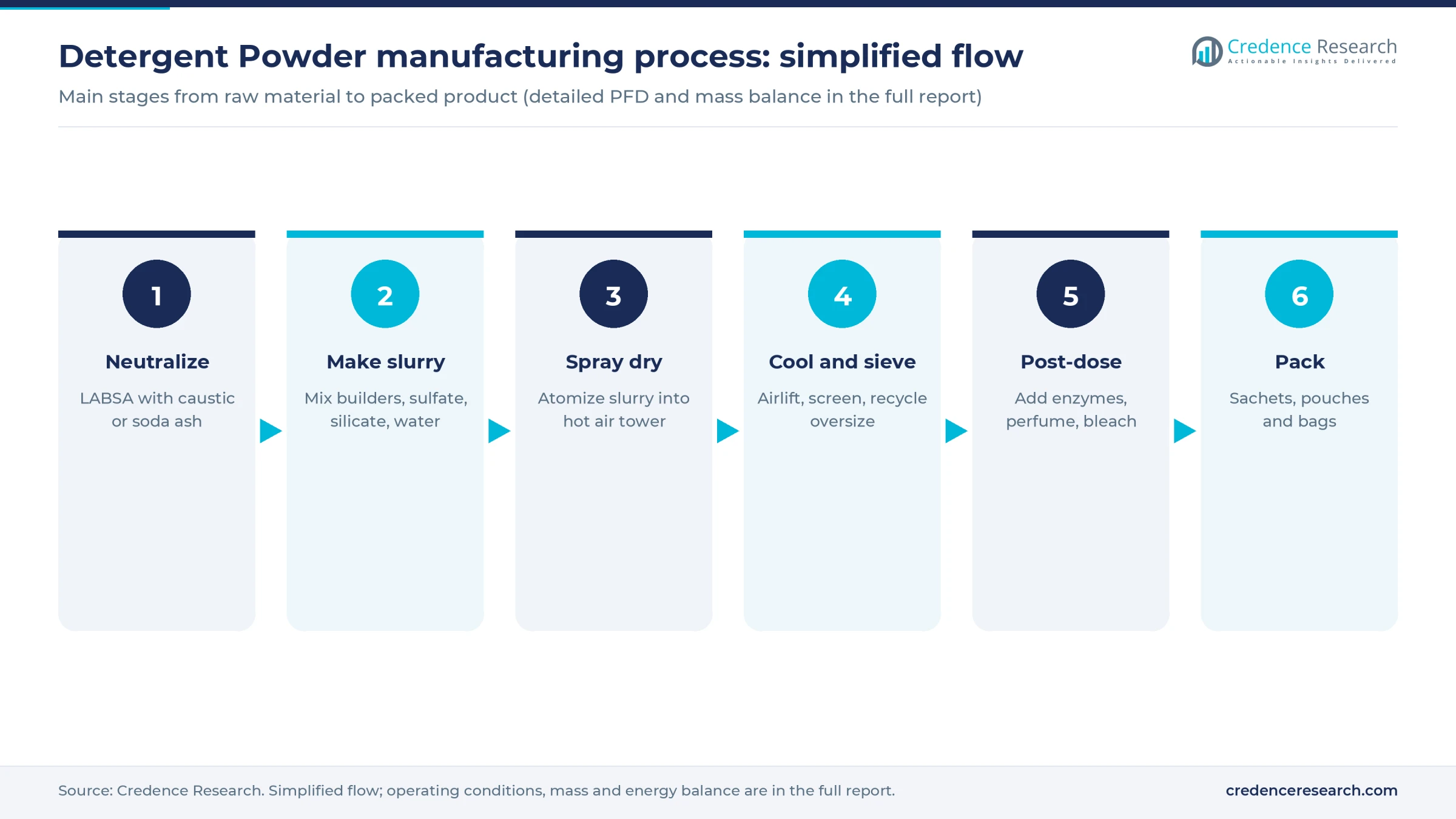
- Neutralization. Linear alkylbenzene sulfonic acid, known as LABSA or HLAS, is neutralized with caustic soda or soda ash to form the active surfactant. Integrated producers make the acid themselves by sulfonating LAB with sulfur trioxide, but that adds a sulfur burner and gas handling, so this model buys it.
- Slurry making. In a crutcher, the neutralized paste is mixed with sodium silicate, sodium sulfate, soda ash, zeolite or phosphate builders, carboxymethyl cellulose and water into a pumpable slurry of roughly 30–40% moisture, then aged, deaerated and strained.
- Spray drying. High-pressure pumps force the slurry through nozzles near the top of a tall tower against a rising stream of hot air from a gas, oil or biomass furnace. Droplets dry into porous beads as they fall.
- Cooling and sieving. Base powder leaves the tower warm, is cooled and conditioned in an airlift and is screened to remove oversize lumps, which are recycled.
- Post-dosing. Heat-sensitive ingredients, including enzymes, perfume, sodium percarbonate bleach, optical brightener and colored speckles, are added in a rotary drum after drying, since tower temperatures would destroy them.
- Packing. Form-fill-seal machines pack sachets and pouches from about 20 grams to 1 kilogram, while sack fillers handle 5–25 kilogram bags for institutional buyers.
The tower is the energy center of the plant and its main environmental issue. Exhaust air carries fine dust and an organic plume, so cyclones, bag filters and wet scrubbers are standard, and captured fines go back into the slurry. Quality is judged on bulk density, moisture, active matter, flow and solubility, all of which shift with slurry solids and inlet air temperature. Operators who hold those two variables steady burn less fuel and reject fewer packs.
Detergent powder plant setup cost
This overview models a greenfield spray-dried powder plant making 30,000 tonnes a year, at an estimated CapEx of USD 8–25 million excluding working capital. The low end reflects tower lines from Asian equipment makers in an Asian industrial park. The high end reflects European process technology, a fully enclosed building and a U.S. or EU site.
A disclosed plant anchors the upper half. Bidco Africa inaugurated a KSh 2 billion detergent factory in Thika, Kenya, in September 2017, with initial output of about 3,000 tonnes a month. At an assumed 103 shillings per dollar, that is about USD 19 million for 36,000 tonnes a year. Escalated to current prices and scaled to 30,000 tonnes, it implies about USD 24 million. Hindustan Unilever's Sumerpur site in India, inaugurated in July 2022 with a planned investment equal to about USD 85 million by 2025, shows where multi-line brand-owner complexes sit, well above this model. Assumed bottom-up estimates for equipment, buildings and utilities support the USD 8 million floor.
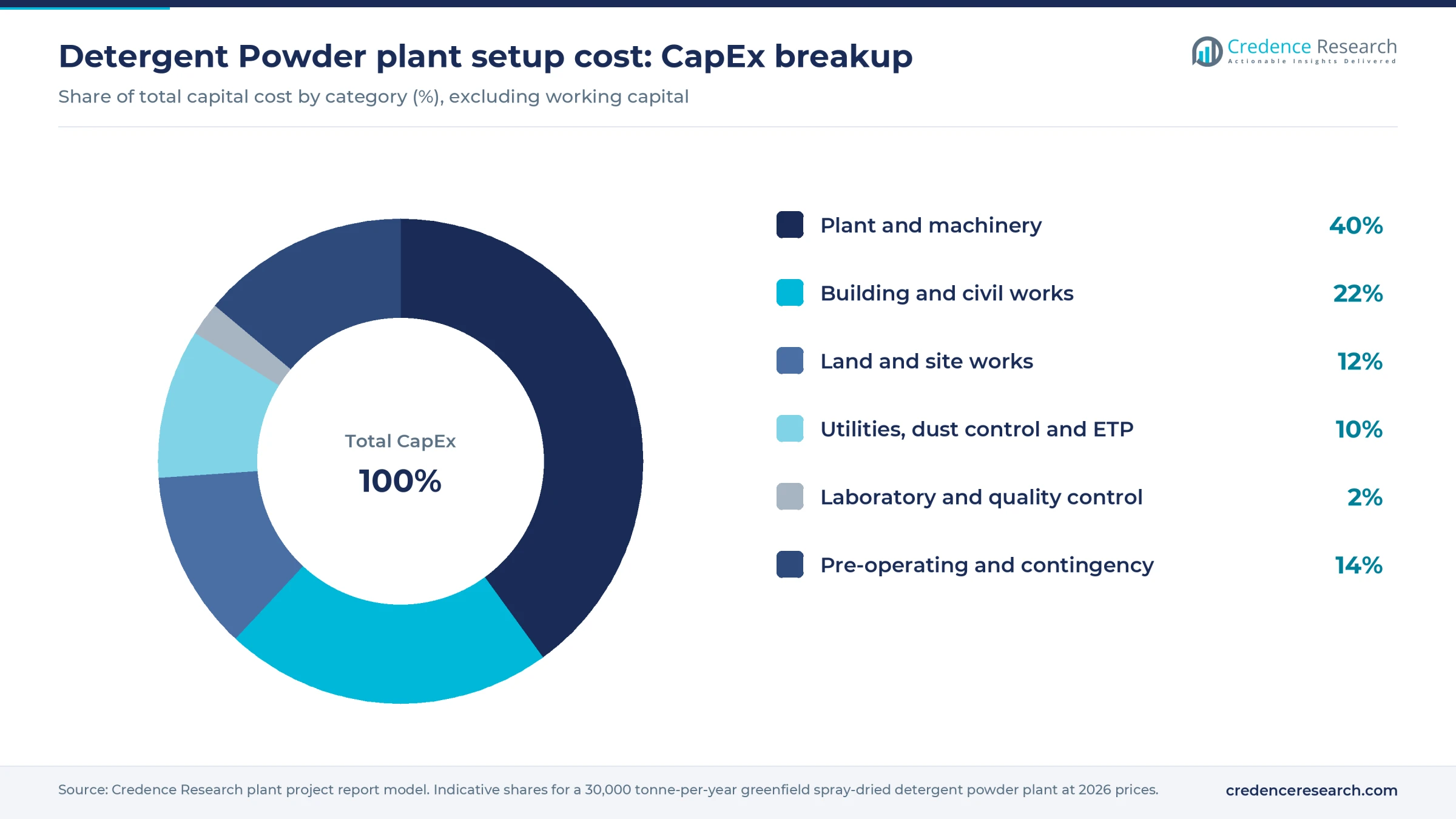
Worked example, land and site development. The model uses an assumed 12,000–20,000 square meters for the tower, raw material stores, finished goods warehouse and truck circulation. At an assumed USD 30–80 per square meter in an Asian industrial park, the plot costs about USD 0.4–1.6 million, and at an assumed USD 60–200 at a U.S. or EU site, about USD 0.7–4 million. Site works add an assumed USD 0.3–0.8 million, so this row is about 9–19% of CapEx.
Working capital adds an estimated USD 3–5 million, mainly surfactant and builder stocks and about 45 days of receivables from distributors.
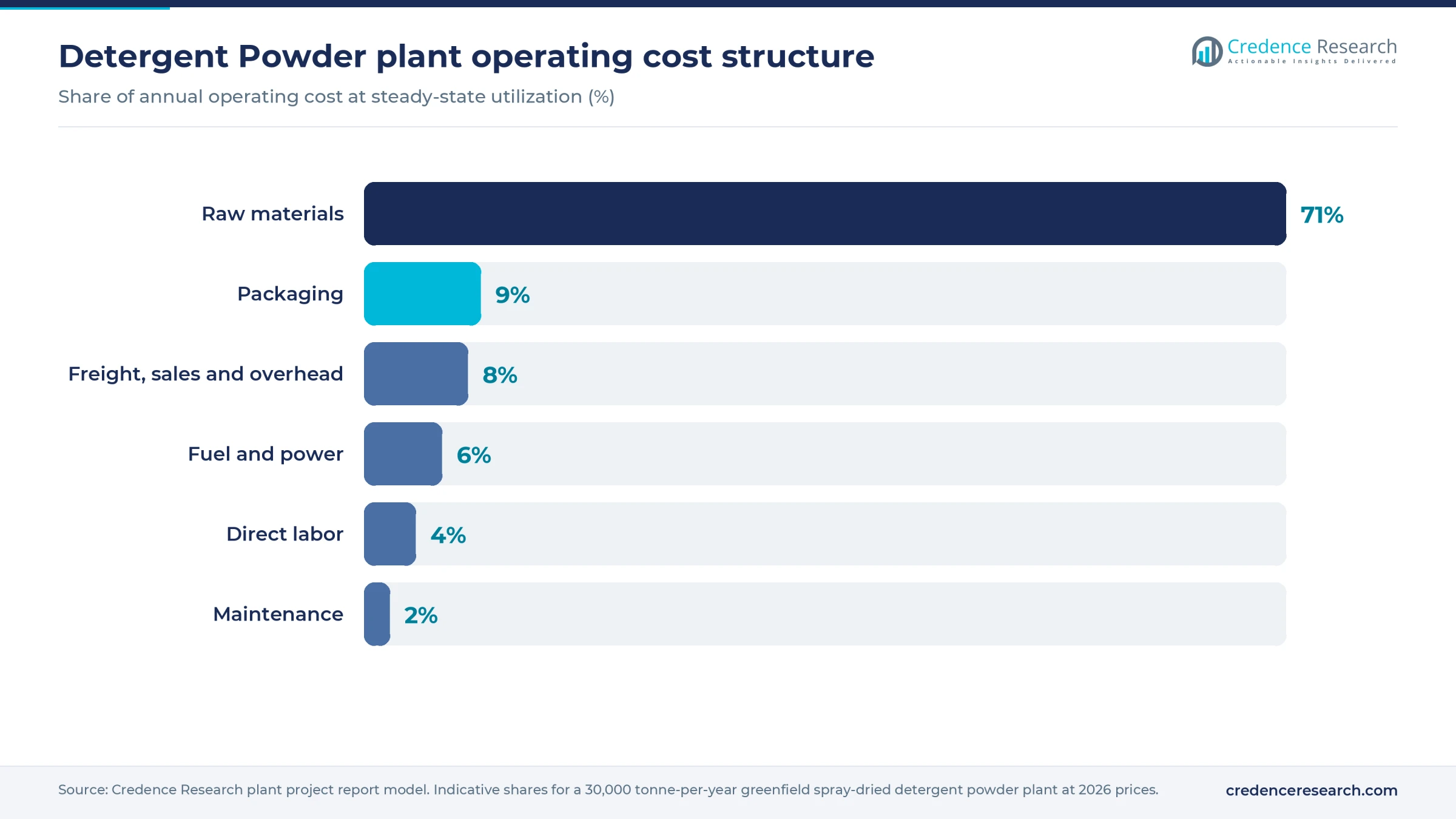
Raw materials dominate operating cost, and a 10% rise in LABSA prices takes about 3 points off gross margin at the mid-range selling price, so surfactant contracts matter more than any other line. The full report can be customized to any country or region.
Machinery and raw materials for a detergent powder plant
Core equipment includes LABSA, caustic and silicate storage tanks, a neutralizer, crutchers and slurry aging vessels, a magnetic filter and homogenizer, high-pressure slurry pumps, the spray tower with its nozzles and hot-air furnace, cyclones, bag filters and a wet scrubber. Downstream sit an airlift, vibrating sieves, base-powder silos, a rotary post-dosing drum with liquid spray for perfume, belt conveyors, form-fill-seal packers, sack fillers and a palletizer. The laboratory needs titration, moisture, bulk density and whiteness testing.
Raw materials come from a handful of industrial regions. LAB is made from paraffins and benzene at refinery-linked plants in Asia, the Middle East, Europe and the Americas, and Africa is adding supply. Soda ash comes mainly from synthetic plants in China and from natural trona in the United States and Turkey. Sodium sulfate is mined from natural deposits and recovered as a byproduct of chemical processes in China, Europe and North America. Zeolite A is usually made close to alumina and silicate production, while phosphate builders, still allowed in many developing markets, come largely from China and North Africa. Detergent enzymes are made by fermentation, with output concentrated in Europe, the United States and China, as covered in Credence Research's detergent enzymes analysis. Packaging film and cartons are sourced locally almost everywhere.
Detergent powder business profit margin and ROI
Margins in powder are thin because the product is heavy, the formula is mostly commodity chemicals and price competition is intense. At an assumed ex-factory price of USD 800–1,000 per tonne for a regional mid-tier brand or private label, and an assumed USD 650–790 per tonne for materials, packaging and direct conversion, gross margin runs about 15–25%. The model assumes LABSA at USD 1,300–1,600 per tonne, with soda ash, sulfate and builders at assumed regional delivered prices.
Formulation drives the spread, since replacing active matter with sulfate filler cuts cost, but it also weakens cleaning, and repeat buyers notice. Premium powders with enzymes and bleach sell for far more, though brand owners spend heavily on advertising and distribution to hold that position.
At 85% utilization, the plant sells about 25,500 tonnes a year. Estimated post-tax cash generation of about USD 1.6–3.9 million supports a payback of about 3–8 years, including about six months of ramp-up. A top-of-range build reaches payback inside that window only at the upper end of the margin range, so a low-cost tower and a secured distribution partner make the difference. Main risks are surfactant price swings, diesel and freight costs, and price wars with multinational brands.
| Metric | Value |
|---|---|
| IRR | Available in report |
| NPV | Available in report |
| ROI | Available in report |
| DSCR | Available in report |
How to start a detergent powder business, licenses and approvals
A detergent powder plant needs approvals in seven areas in most jurisdictions. These are business and tax registration; land use, zoning and building permits; an environmental permit covering tower dust, stack emissions and wastewater; fire and occupational safety approval, particularly for acid and caustic handling; chemical registration or notification of ingredients; detergent labeling and composition rules, including phosphate limits where they apply; and packaged-goods and customs registration. The tower air permit usually takes longest.
| Market | Product rules | Plant permits |
|---|---|---|
| United States | EPA TSCA Inventory status for every ingredient; Federal Hazardous Substances Act labeling, enforced by the Consumer Product Safety Commission; state limits on phosphorus in household laundry detergents; ingredient disclosure under California's Cleaning Product Right to Know Act | State air permit under the Clean Air Act for spray-dryer particulate; NPDES or local pretreatment permit for wastewater; OSHA Hazard Communication Standard |
| European Union | Detergents Regulation (EC) No 648/2004, as amended by Regulation (EU) No 259/2012, which caps consumer laundry detergents at less than 0.5 gram of phosphorus per standard dose in consumer laundry detergents; REACH registration and CLP classification and labeling, with poison center notification | National environmental permit for air and water emissions; national safety and fire rules |
| India | BIS standard IS 4955 for household laundry detergent powders, under which makers can obtain ISI mark certification; packer registration under the Legal Metrology (Packaged Commodities) Rules, 2011 | Consent to establish and consent to operate from the state pollution control board; factory license; fire no-objection certificate |
Rules are moving, and the EU published the replacement Detergents and Surfactants Regulation (EU) 2026/405 in March 2026, adding digital labels and a digital product passport, with application from Sept. 23, 2029. In India, BIS issued a draft amendment to IS 4955 on June 1, 2026, covering phosphate-free requirements.
Key detergent powder manufacturers and recent developments
Global production is led by Procter & Gamble, with Tide and Ariel, Unilever, with Surf, OMO, Rin and Wheel, and Henkel, with Persil, alongside Kao and Lion in Japan. Regional makers hold a large share of powder volume, including Nirma, RSPL and Jyothy Labs in India, Wings in Indonesia, Guangzhou Liby and Nice Group in China, and Bidco in East Africa.
- February 2026. Dangote Group announced a 400,000-tonne-per-year linear alkylbenzene plant within its Lekki refinery complex in Nigeria, expected to be completed within 30 months, which would give African powder makers a regional surfactant feedstock.
- July 2026. The International Finance Corp. signed financing for CSCHEM, a Nigerian producer of HLAS and sodium silicate, within a USD 61 million expansion that includes a USD 25 million IFC loan.
- October 2026. Hindustan Unilever reported that premiumization in powders, through its Surf Excel Easy Wash pack, continued to scale in the September quarter.
Taken together, these point to surfactant supply chains localizing in Africa and to brands trading consumers up within powder in Asia rather than out of it.
What's inside the Detergent Powder project report PDF
The report runs to 21 chapters. Open a chapter to see its sections.
1. Preface
2. Scope and Methodology
- 2.1 Objectives of the Study
- 2.2 Stakeholders
- 2.3 Research Methodology
- 2.4 Data Sources and Key Assumptions
3. Executive Summary
- 3.1 Market Snapshot
- 3.2 Project at a Glance (Capacity, CapEx, OpEx)
- 3.3 Key Financial Indicators (IRR, NPV, Payback, Break-even)
- 3.4 Feasibility Verdict
4. Product Overview
- 4.1 Detergent Powder Definition and Properties
- 4.2 Grades and Specifications (BIS / ISO / ASTM)
- 4.3 HS Code and Classification
- 4.4 Key Applications
- 4.5 Substitutes
5. Global Detergent Powder Market
- 5.1 Market Overview
- 5.2 Historical and Current Market Performance (Volume and Value)
- 5.3 Market Breakup by Grade / Type
- 5.4 Market Breakup by End-Use Industry
- 5.5 Market Breakup by Region
- 5.6 Market Drivers, Restraints and Trends
- 5.7 Value Chain Analysis
- 5.8 Market Forecast
6. Target Country Detergent Powder Market Analysis
- 6.1 Demand and Supply Analysis
- 6.2 Installed Capacity vs Demand Gap
- 6.3 Import Dependence
- 6.4 Demand Forecast by End-Use
7. Trade Analysis
- 7.1 Imports by Volume, Value and Country
- 7.2 Exports by Volume, Value and Country
- 7.3 Trade Balance and Opportunities
8. Price Analysis
- 8.1 Historical Detergent Powder Price Trends by Region
- 8.2 Raw Material / Feedstock Price Trends and Linkage
- 8.3 Price Forecast
- 8.4 Margins Across the Value Chain
9. Competitive Landscape
- 9.1 Market Structure
- 9.2 Key Players and Installed Capacities
- 9.3 Profiles of Key Players
- 9.4 Recent Developments (Expansions, M&A, New Plants)
10. Manufacturing Process and Technology
- 10.1 Comparison of Technology Routes
- 10.2 Selected Route and Process Flow Diagram
- 10.3 Unit Operations Involved
- 10.4 Chemical Reactions Involved
- 10.5 Mass Balance and Raw Material Requirements
- 10.6 Energy Balance
- 10.7 Quality Assurance Criteria and Technical Tests
- 10.8 By-products and Waste Handling
- 10.9 Technology Licensors / Providers
11. Project Details, Requirements and Costs
- 11.1 Land, Location and Site Development
- 11.1.1 Site Selection Criteria
- 11.1.2 Location Analysis
- 11.1.3 Land Requirement and Costs
- 11.1.4 Site Development Costs
- 11.2 Plant Layout
- 11.2.1 Layout Principles
- 11.2.2 Proposed Layout
- 11.2.3 Factors Influencing Layout
- 11.3 Civil Works and Buildings
- 11.4 Plant Machinery
- 11.4.1 Machinery Requirements and Specifications
- 11.4.2 Machinery Costs
- 11.4.3 Machinery Suppliers
- 11.5 Raw Materials
- 11.5.1 Requirements per Tonne of Output
- 11.5.2 Procurement and Sourcing
- 11.5.3 Costs
- 11.5.4 Suppliers
- 11.6 Packaging
- 11.6.1 Packaging Requirements
- 11.6.2 Packaging Costs
- 11.6.3 Packaging Suppliers
- 11.7 Storage and Material Handling
- 11.8 Transportation Requirements and Costs
- 11.9 Utilities
- 11.9.1 Power Requirements and Costs
- 11.9.2 Water Requirements and Costs
- 11.9.3 Steam, Fuel and Other Utilities
- 11.10 Manpower Requirements and Wages
12. Environment, Health, Safety and Sustainability
- 12.1 Effluent and Emissions Management
- 12.2 Hazard Classification and Safety Measures
- 12.3 Carbon Footprint
- 12.4 Green / Low-Carbon Process Options
13. Regulatory Procedures, Approvals and Certifications
- 13.1 Licences and Registrations
- 13.2 Environmental Clearances
- 13.3 Product Certifications (BIS, REACH, etc.)
- 13.4 Approval Timeline
14. Project Implementation Schedule
15. Project Economics
- 15.1 Capital Cost of the Project
- 15.2 Techno-Economic Parameters
- 15.3 Capacity Utilization and Ramp-up
- 15.4 Product Pricing and Margins
- 15.5 Income Projections
- 15.6 Expenditure Projections
- 15.7 Working Capital Requirement
- 15.8 Taxation
- 15.9 Depreciation
16. Financial Analysis
- 16.1 Projected Profit and Loss Account
- 16.2 Projected Cash Flow Statement
- 16.3 Projected Balance Sheet
- 16.4 Liquidity Analysis
- 16.5 Profitability Analysis (Payback, NPV, IRR, ROI)
- 16.6 Break-even Analysis
- 16.7 Debt Service Coverage Ratio (DSCR)
- 16.8 Sensitivity Analysis
- 16.9 Scenario and Uncertainty Analysis
17. Funding and Incentives
- 17.1 Means of Finance and Debt-Equity Structure
- 17.2 Loans and Financial Assistance
- 17.3 Government Schemes and Subsidies (PLI, State Policies)
18. Risk Assessment
- 18.1 Key Success Factors
- 18.2 Key Risk Factors
- 18.3 Risk Mitigation
19. Strategic Recommendations
20. Case Study of a Successful Venture
21. Appendix
- 21.1 Detailed Assumptions
- 21.2 Abbreviations
- 21.3 List of Tables and Figures
- 21.4 Sources
This page vs. the full report
| Data point | On this page (free) | In the full report |
|---|---|---|
| Total CapEx | One rounded range at one capacity | Exact figure at three capacities with a line-item breakup |
| CapEx breakup | Category shares (%) only | Cost, quantity and supplier for every machine |
| Operating cost | Share of raw materials, utilities and labor | Per-unit cost sheet with each input price and consumption |
| Profitability | Gross margin range and payback band | Exact IRR, NPV, ROI, break-even and DSCR |
| Financial statements | List of what is included | 10-year P&L, cash flow, balance sheet and Excel model |
| Sensitivity | One directional line | Full sensitivity and scenario tables |
| Process | Simplified flow diagram | Detailed process flow, mass and energy balance, operating conditions |
| Machinery | Names of the main machines | Specifications, capacity, cost and supplier list |
| Market | Headline size, growth and global demand | Segment, region, trade and price forecast tables |
| Suppliers and buyers | Supplier types and sourcing hubs | Named suppliers and buyers |
Detergent Powder project report: FAQs
How much does it cost to set up a detergent powder plant?
What gross margin can a detergent powder manufacturer expect?
How long is the payback on a detergent powder factory?
Does a detergent powder plant need a spray drying tower?
Which raw material matters most in detergent powder?
Which approvals matter most for detergent powder manufacturing?

About the analyst
Rajdeep Kumar Deb, Lead Analyst - Consumer & Finance
Rajdeep brings a decade of consumer goods and financial services insight to strategic market analysis.
Related market research
- Laundry Care Market Size, Share, Growth and Forecast 2032
- Liquid Laundry Detergent Market Size, Growth and Forecast 2032
- Surfactants Market Size, Share, Growth & Forecast to 2032
- Detergent Chemicals Market Size, Growth and Forecast to 2032
- Bio Derived Enzymes for Detergents Market Size, Growth and Forecast 2032
- Biodegradable Detergents Market Size, Growth & Forecast 2032
More plant project reports
- Mustard Oil Processing Plant Project Report (DPR) 2026
- Liquid Detergent Manufacturing Plant Project Report (DPR) 2026
- Hair Color Manufacturing Plant Project Report (DPR) 2026
- Cotton Seed Oil Processing Plant Project Report (DPR) 2026
- Essential Oil Manufacturing Plant Project Report (DPR) 2026
- Cigarette Lighter Manufacturing Plant Project Report (DPR) 2026