
Quick answer
A cotton seed oil processing plant delints and dehulls cottonseed, extracts crude oil and refines it into cooking oil, with meal, hulls and linters as co-products. A representative mill crushing 300 tonnes of seed a day costs USD 11–15 million at an Asian industrial site. Gross margin after seed cost runs 26–34% on U.S. reference prices, and payback takes about 2–6 years. Seasonal seed supply decides feasibility more than machinery.
Feasible where a mill sits inside a cotton belt and can contract gin seed each season; thin oil-to-seed spreads and competition from whole-seed dairy feeding are the main risks.
Cotton Seed Oil plant: key highlights
| Parameter | Indicative value | Note |
|---|---|---|
| Plant capacity | 300 tonnes of cottonseed per day | 300 days, 80% utilization; about 72,000 tonnes of seed and 8,700–10,800 tonnes of crude oil a year |
| Total CapEx | USD 11–15 million | Asian greenfield site with refinery, built from equipment list prices; African turnkey budgets run far higher |
| Raw material share of operating cost | 79–85% | Delivered cottonseed, on USDA 2025/26 U.S. prices |
| Gross margin | 26–34% | Oil, meal, hulls and linters less seed cost, before processing cost |
| Payback period | 2–6 years | Pre-tax, USD 13 million Asian-site CapEx, U.S. 2024/25–2025/26 price spreads, 80% utilization |
| IRR | Available in report | Post-tax, 10-year model |
| Break-even | Available in report | Capacity utilization basis |
Ranges assume a 300 tonne per day cottonseed mill with delinting, dehulling, pre-press solvent extraction and refining, 300 days, 80% utilization, a greenfield Asian industrial site, Indian equipment list prices at an assumed 88 rupees per dollar, USDA 2024/25 and 2025/26 U.S. prices, U.S. mill yields, and assumed processing cost of USD 50–75 per tonne. Customizable to any country.
What is cottonseed oil?
Cottonseed oil is the edible vegetable oil extracted from the kernel of the cotton plant's seed, which is left over after ginning separates the lint. A cottonseed oil processing plant, usually called a cottonseed crushing mill, strips the short fibers and hulls, extracts the oil by pressing, solvent or both, and refines the dark red crude oil into a light, neutral cooking oil. The color comes from gossypol, a natural pigment that alkali refining removes. Mild flavor and stability in hot fryers make the oil a favorite for snack foods, restaurant frying, shortening and margarine.
Crude oil, whether or not gossypol has been removed, falls under HS code 151221, while refined oil and its fractions fall under HS code 151229. A mill earns from four products rather than one: oil, high-protein meal for cattle and poultry feed, hulls sold as roughage, and linters, the short fibers that supply the cotton linter pulp used for cellulose ethers and specialty papers. Because seed arrives with the cotton harvest, a mill's year is shaped by the ginning season.
Cottonseed oil market overview and global demand
World cottonseed oil output is steady rather than growing. USDA's September 2026 oilseeds circular puts production at 4.71 million metric tons in both 2024/25 and 2025/26 and forecasts 4.50 million tons for 2026/27, as the world cottonseed crop slips from 42.15 million tons to 39.58 million. India and China dominate, with about 1.30 million and 1.16 million tons of oil in 2025/26, together more than half of world output. Turkey follows at 185,000 tons and the United States at 125,000 tons, with Pakistan, Brazil and Central Asia also significant.
The oil is overwhelmingly consumed where it is made. World exports reach only about 80,000 tons in 2025/26, under 2% of output, so a new mill sells mainly into its home market and competes with imported palm, soybean and sunflower oil on price. Meal behaves the same way: 14.35 million tons are produced, and only about 320,000 tons cross borders.
Seed availability, not oil demand, sets the pace. USDA counts 31.19 million tons of cottonseed crushed worldwide in 2025/26, about three-quarters of the crop, while the rest is fed whole to dairy cattle, planted or stored. In the United States, ERS data show crush falling from 1.39 million short tons in 2022/23 to a projected 975,000 in 2025/26 as more seed goes straight to feed.
Credence Research values the global cottonseed oil market at about USD 5.68 billion in 2025, based on its USD 5.25 billion figure for 2023 and a 4.0% CAGR, with USD 7.47 billion forecast for 2032. Biofuel demand for soybean oil, which ERS puts at 17.8 billion pounds in the U.S. for 2026/27, keeps competing frying oils firm.
Cottonseed oil manufacturing process
Cottonseed is harder to process than most oilseeds because each seed carries lint, a tough hull and gossypol. A crushing mill deals with all three before the oil can be refined for food. The flow below shows the main stages of a dehulled, solvent extraction mill with its own refinery.
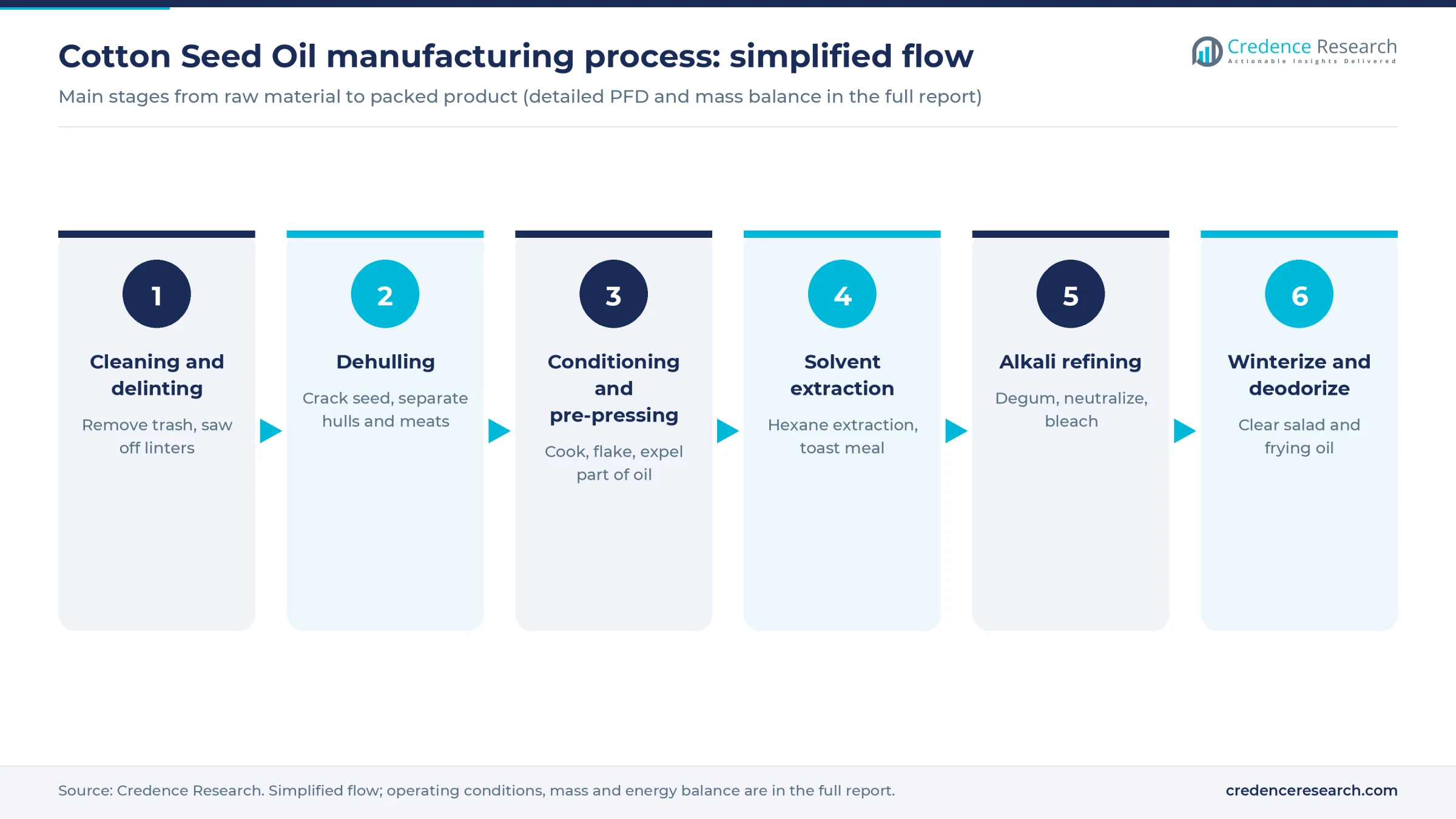
- Cleaning and delinting. Magnets, screens and air separators remove trash and stones, then saw delinters strip the short fibers in one or two cuts.
- Dehulling and separation. Bar hullers crack the seed, and shakers and aspirators split hulls from kernels, known as meats. A clean split raises oil yield and meal protein.
- Conditioning and pre-pressing. Meats are cooked, flaked and either expanded into porous collets or pre-pressed in screw expellers, which removes part of the oil and leaves a cake ready for extraction.
- Solvent extraction. Hexane washes the remaining oil from the flakes or cake in a continuous extractor. A desolventizer-toaster strips solvent from the meal, and its heat binds much of the free gossypol, which makes the meal safer for livestock.
- Refining. Crude oil is degummed and alkali refined with caustic soda, the classic step that removes gossypol and free fatty acids, then bleached.
- Winterization and deodorization. Chilling removes the high-melting fraction to give a clear salad oil, and steam stripping under vacuum yields a bland frying oil.
Smaller mills in South Asia and Africa often skip dehulling and run whole seed through expellers. That route is cheaper to build but, on planning figures assumed here, leaves 6–8% oil in the cake against about 1% after solvent extraction. Hexane is the main safety and environmental issue: the extraction building is a hazardous area with explosion-proof equipment, and solvent losses are both a cost and a regulated emission.
Cottonseed oil plant setup cost
Indicative CapEx for a greenfield mill crushing 300 tonnes of cottonseed a day, with delinting, dehulling, pre-press solvent extraction and a refinery for its crude oil, is USD 11–15 million at an Asian industrial location using Asian-built equipment. The budget is built from equipment list prices: Indian suppliers list a 10 tonne per hour seed preparation plant at about USD 400,000, a 200 tonne per day solvent extraction plant at about USD 450,000 and a 100 tonne per day miscella refining plant at about USD 450,000, converted at an assumed 88 rupees per dollar. Scaled to this capacity, with delinting, hulling and pre-press machinery added as an assumption, process equipment comes to about USD 1.9–2.4 million before installation.
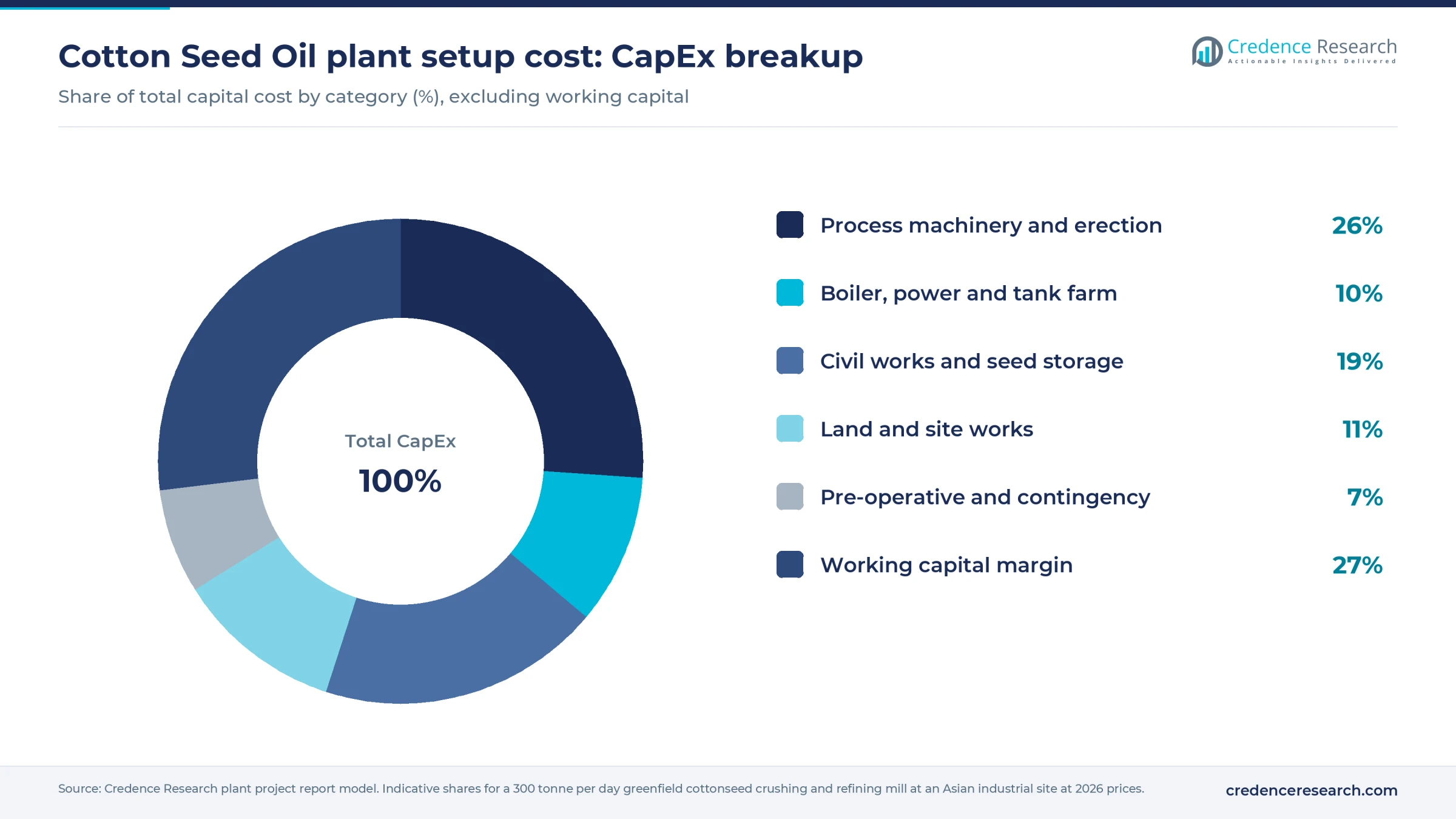
Process machinery and its erection take about 26% of the budget, the boiler, power, cooling and hexane tank farm 10%, and civil works with seed warehousing 19%. Storage is large because seed arrives over a four- to six-month ginning season. Working capital is the biggest single line at about 27%, covering roughly two months of seed purchases. Pre-operative expenses and contingency take about 7%.
Example row, land: about 6 hectares for the plant, warehouse and truck yard is budgeted, as an assumption, at USD 15–35 per square meter, or USD 0.9–2.1 million, about 11% of the total. A plot in a cotton belt industrial estate in South or Central Asia sits at the low end, while serviced land near ports costs more.
Costs also vary widely by location: Cameroon's state cotton company SODECOTON budgeted XAF 25 billion, about USD 45.5 million, for a 300 tonne per day cottonseed oil plant at Ngaoundere, according to a 2021 report on the project. That is three to four times the Asian estimate, reflecting imported turnkey supply, inland logistics and a broader scope, so African and Western sites need their own budget.
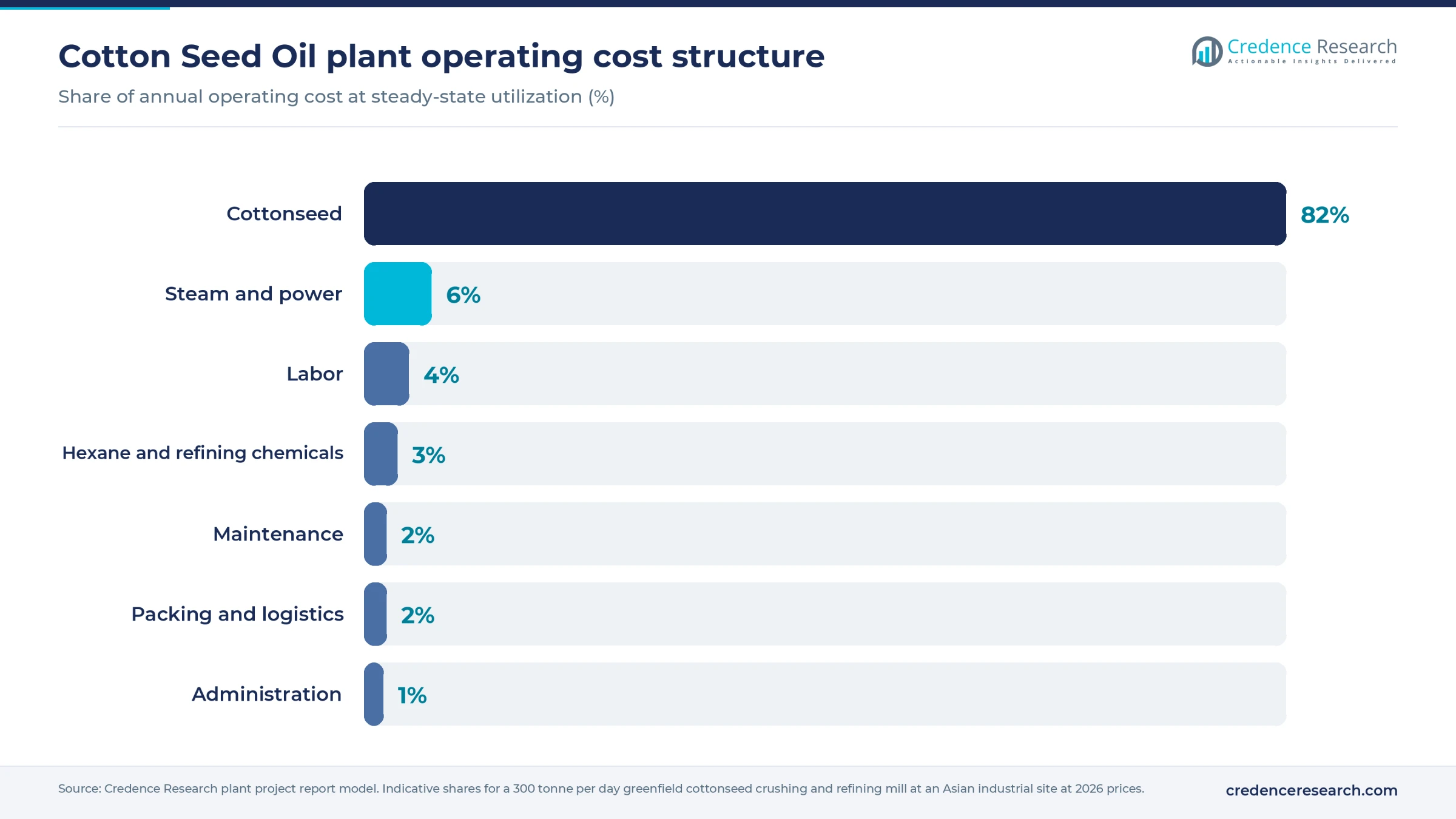
Seed dominates operating cost at about 79–85% of cash cost on U.S. seed prices. Energy for steam and power takes about 6%, labor 4%, hexane and refining chemicals 3%, maintenance 2%, packing and logistics 2% and administration 1%. These non-seed shares are assumed for planning. Seed prices, land and labor vary most between countries, so the full report can be customized to any location.
Machinery and raw materials for a cottonseed oil plant
A complete line starts with seed cleaners, linter saws and a lint press, followed by bar hullers, hull and meat separators, a cooker-conditioner, flaking mills and either an expander or screw pre-presses. The solvent plant has a continuous extractor, desolventizer-toaster, dryer-cooler, miscella distillation and solvent recovery. The refinery adds neutralizing vessels with centrifuges, a bleacher and filters, a winterization unit and a deodorizer. Utilities include a steam boiler, cooling towers, inert gas cover, a laboratory and meal pelleting and bagging. Trends in the oilseed extraction equipment market shape lead times and prices. Machine costs and supplier lists are held for the report.
The raw material is fuzzy, undelinted seed from gins, and it is bulky and seasonal. Supply is concentrated in India, China, the United States, Brazil, Pakistan, Uzbekistan, Turkey, Australia and the West African cotton belt from Mali to Cameroon. The National Cotton Council puts seed output at about 162 pounds for every 100 pounds of fiber, so a mill taking 72,000 tonnes a year needs the seed from gins producing about 44,000 tonnes of lint.
Seed competes with dairy farms that feed it whole, so mills usually sign seasonal contracts with gins.
Cottonseed oil business profit margin and ROI
Gross margin here means sales of oil, meal, hulls and linters less delivered seed cost, before processing cost, and the band is 26–34%. USDA's Oil Crops Yearbook puts the 2024/25 U.S. season-average cottonseed price at USD 223 per short ton, crude oil at 79.05 cents per pound at Mississippi Valley points and solvent meal at USD 290 per short ton in Memphis, with 2025/26 projections of USD 240, 87 cents and USD 281. U.S. mills recovered about 242 pounds of oil and 856 pounds of meal per ton crushed in 2024/25.
On those prices, one short ton of seed yields about USD 191–211 of oil and USD 120–124 of meal, plus an assumed USD 30–45 from hulls and linters. With an assumed USD 15–25 a ton to deliver seed to the mill, the spread is USD 96–122 per short ton, or about USD 106–134 per metric tonne.
Payback follows from cash profit: after assumed processing and overhead costs of USD 50–75 per tonne, cash profit of about USD 31–84 per tonne on 72,000 tonnes gives USD 2.2–6.0 million a year, so a USD 13 million plant pays back in about 2–6 years. The main sensitivity is the oil-to-seed price ratio: a 10-cent move in the oil price shifts the spread by about USD 24 per short ton, roughly a fifth to a quarter of it.
| Return metric | Value |
|---|---|
| IRR | Available in report |
| NPV | Available in report |
| ROI | Available in report |
| DSCR | Available in report |
How to start a cottonseed oil business, licenses and approvals
The approval path for a cottonseed mill is similar in most countries, with two product-specific additions: hexane, a flammable solvent, and meal, which is regulated as animal feed.
- Business registration and tax identification.
- Land use or zoning clearance and building permits, including hazardous-area design for the extraction plant.
- An environmental permit or consent covering air emissions, including solvent losses, and refinery wastewater.
- Fire and explosives safety approval for hexane storage, plus boiler and pressure vessel inspection.
- Food business licensing or registration for refined oil, and edible oil product standards.
- Feed registration for meal and hulls, with free gossypol limits where they apply.
- Export or import registration.
Permit rules change, so each should be confirmed locally.
| Market | Key approvals for a cottonseed oil mill |
|---|---|
| United States | FDA food facility registration and preventive controls rules for human food (21 CFR Part 117) and animal food (21 CFR Part 507); EPA standard for solvent extraction for vegetable oil production (40 CFR Part 63, Subpart GGGG) under a state Clean Air Act permit; state feed licensing for meal |
| European Union | Food business registration under Regulation (EC) No 852/2004 and feed business registration under Regulation (EC) No 183/2005 with the national authority; solvent emission limits for vegetable oil extraction under Chapter V of the Industrial Emissions Directive 2010/75/EU; free gossypol limits for feed under Directive 2002/32/EC |
| India | FSSAI license; registration and returns with the Directorate of Sugar and Vegetable Oils under the Vegetable Oil Products, Production and Availability (Regulation) Order, 2025; PESO license for hexane storage under the Petroleum Rules, 2002; state pollution control board consent to establish and operate |
Key cottonseed oil manufacturers and recent developments
Cottonseed crushing is a fragmented business. In the United States, ADM is moving its cottonseed crushing into joint ventures, a PYCO Industries-majority venture in Lubbock, Texas, agreed in 2025, and a planned venture with Planters Cotton Oil Mill in Arkansas. Cargill crushes cottonseed in Australia, dehulling at Narrabri and extracting oil at Newcastle. In Africa, cotton companies such as SODECOTON in Cameroon run their own oil mills, while India, China, Pakistan and Uzbekistan host many regional crushers and refiners serving local brands. Refined oil competes for shelf space across the wider edible oils and fats market.
Two recent developments show the direction of the industry:
- December 2025. ADM and Planters Cotton Oil Mill agreed to form a cottonseed joint venture, 60% owned by ADM, combining the Pine Bluff crush plant with ADM's Memphis site, where crushing will end and the refinery will continue. Closing was planned for the first quarter of 2026.
- October 2026. Turkmenistan approved a plant to process up to 60,000 tons of cottonseed a year in Dashoguz province, producing refined oil and meal, and construction started on Nov. 5, 2026.
What's inside the Cotton Seed Oil project report PDF
The report runs to 21 chapters. Open a chapter to see its sections.
1. Preface
2. Scope and Methodology
- 2.1 Objectives of the Study
- 2.2 Stakeholders
- 2.3 Research Methodology
- 2.4 Data Sources and Key Assumptions
3. Executive Summary
- 3.1 Market Snapshot
- 3.2 Project at a Glance (Capacity, CapEx, OpEx)
- 3.3 Key Financial Indicators (IRR, NPV, Payback, Break-even)
- 3.4 Feasibility Verdict
4. Product Overview
- 4.1 Cotton Seed Oil Definition and Properties
- 4.2 Grades and Specifications (BIS / ISO / ASTM)
- 4.3 HS Code and Classification
- 4.4 Key Applications
- 4.5 Substitutes
5. Global Cotton Seed Oil Market
- 5.1 Market Overview
- 5.2 Historical and Current Market Performance (Volume and Value)
- 5.3 Market Breakup by Grade / Type
- 5.4 Market Breakup by End-Use Industry
- 5.5 Market Breakup by Region
- 5.6 Market Drivers, Restraints and Trends
- 5.7 Value Chain Analysis
- 5.8 Market Forecast
6. Target Country Cotton Seed Oil Market Analysis
- 6.1 Demand and Supply Analysis
- 6.2 Installed Capacity vs Demand Gap
- 6.3 Import Dependence
- 6.4 Demand Forecast by End-Use
7. Trade Analysis
- 7.1 Imports by Volume, Value and Country
- 7.2 Exports by Volume, Value and Country
- 7.3 Trade Balance and Opportunities
8. Price Analysis
- 8.1 Historical Cotton Seed Oil Price Trends by Region
- 8.2 Raw Material / Feedstock Price Trends and Linkage
- 8.3 Price Forecast
- 8.4 Margins Across the Value Chain
9. Competitive Landscape
- 9.1 Market Structure
- 9.2 Key Players and Installed Capacities
- 9.3 Profiles of Key Players
- 9.4 Recent Developments (Expansions, M&A, New Plants)
10. Manufacturing Process and Technology
- 10.1 Comparison of Technology Routes
- 10.2 Selected Route and Process Flow Diagram
- 10.3 Unit Operations Involved
- 10.4 Chemical Reactions Involved
- 10.5 Mass Balance and Raw Material Requirements
- 10.6 Energy Balance
- 10.7 Quality Assurance Criteria and Technical Tests
- 10.8 By-products and Waste Handling
- 10.9 Technology Licensors / Providers
11. Project Details, Requirements and Costs
- 11.1 Land, Location and Site Development
- 11.1.1 Site Selection Criteria
- 11.1.2 Location Analysis
- 11.1.3 Land Requirement and Costs
- 11.1.4 Site Development Costs
- 11.2 Plant Layout
- 11.2.1 Layout Principles
- 11.2.2 Proposed Layout
- 11.2.3 Factors Influencing Layout
- 11.3 Civil Works and Buildings
- 11.4 Plant Machinery
- 11.4.1 Machinery Requirements and Specifications
- 11.4.2 Machinery Costs
- 11.4.3 Machinery Suppliers
- 11.5 Raw Materials
- 11.5.1 Requirements per Tonne of Output
- 11.5.2 Procurement and Sourcing
- 11.5.3 Costs
- 11.5.4 Suppliers
- 11.6 Packaging
- 11.6.1 Packaging Requirements
- 11.6.2 Packaging Costs
- 11.6.3 Packaging Suppliers
- 11.7 Storage and Material Handling
- 11.8 Transportation Requirements and Costs
- 11.9 Utilities
- 11.9.1 Power Requirements and Costs
- 11.9.2 Water Requirements and Costs
- 11.9.3 Steam, Fuel and Other Utilities
- 11.10 Manpower Requirements and Wages
12. Environment, Health, Safety and Sustainability
- 12.1 Effluent and Emissions Management
- 12.2 Hazard Classification and Safety Measures
- 12.3 Carbon Footprint
- 12.4 Green / Low-Carbon Process Options
13. Regulatory Procedures, Approvals and Certifications
- 13.1 Licences and Registrations
- 13.2 Environmental Clearances
- 13.3 Product Certifications (BIS, REACH, etc.)
- 13.4 Approval Timeline
14. Project Implementation Schedule
15. Project Economics
- 15.1 Capital Cost of the Project
- 15.2 Techno-Economic Parameters
- 15.3 Capacity Utilization and Ramp-up
- 15.4 Product Pricing and Margins
- 15.5 Income Projections
- 15.6 Expenditure Projections
- 15.7 Working Capital Requirement
- 15.8 Taxation
- 15.9 Depreciation
16. Financial Analysis
- 16.1 Projected Profit and Loss Account
- 16.2 Projected Cash Flow Statement
- 16.3 Projected Balance Sheet
- 16.4 Liquidity Analysis
- 16.5 Profitability Analysis (Payback, NPV, IRR, ROI)
- 16.6 Break-even Analysis
- 16.7 Debt Service Coverage Ratio (DSCR)
- 16.8 Sensitivity Analysis
- 16.9 Scenario and Uncertainty Analysis
17. Funding and Incentives
- 17.1 Means of Finance and Debt-Equity Structure
- 17.2 Loans and Financial Assistance
- 17.3 Government Schemes and Subsidies (PLI, State Policies)
18. Risk Assessment
- 18.1 Key Success Factors
- 18.2 Key Risk Factors
- 18.3 Risk Mitigation
19. Strategic Recommendations
20. Case Study of a Successful Venture
21. Appendix
- 21.1 Detailed Assumptions
- 21.2 Abbreviations
- 21.3 List of Tables and Figures
- 21.4 Sources
This page vs. the full report
| Data point | On this page (free) | In the full report |
|---|---|---|
| Total CapEx | One rounded range at one capacity | Exact figure at three capacities with a line-item breakup |
| CapEx breakup | Category shares (%) only | Cost, quantity and supplier for every machine |
| Operating cost | Share of raw materials, utilities and labor | Per-unit cost sheet with each input price and consumption |
| Profitability | Gross margin range and payback band | Exact IRR, NPV, ROI, break-even and DSCR |
| Financial statements | List of what is included | 10-year P&L, cash flow, balance sheet and Excel model |
| Sensitivity | One directional line | Full sensitivity and scenario tables |
| Process | Simplified flow diagram | Detailed process flow, mass and energy balance, operating conditions |
| Machinery | Names of the main machines | Specifications, capacity, cost and supplier list |
| Market | Headline size, growth and global demand | Segment, region, trade and price forecast tables |
| Suppliers and buyers | Supplier types and sourcing hubs | Named suppliers and buyers |
Cotton Seed Oil project report: FAQs
How much does it cost to set up a cottonseed oil plant?
What gross margin does a cottonseed oil mill earn?
What is the payback period for a cottonseed oil plant?
How much oil does a tonne of cottonseed yield?
What is the HS code for cottonseed oil?
Which licenses does a cottonseed oil mill need?

About the analyst
Rajdeep Kumar Deb, Lead Analyst - Consumer & Finance
Rajdeep brings a decade of consumer goods and financial services insight to strategic market analysis.
Related market research
- Cottonseed Oil Market Size, Growth & Forecast to 2032
- Edible Oils and Fats Market Size, Trends, Share and Forecast 2032
- Oilseed Extraction Equipment Market Size, Growth and Forecast 2032
- Cotton Linter Pulp Market Size, Share, Growth and Forecast 2032
- Oilseeds Market Size, Share, Growth and Forecast 2032
- Cooking Oils and Fats Market Size, Growth and Forecast 2032
More plant project reports
- Mustard Oil Processing Plant Project Report (DPR) 2026
- Liquid Detergent Manufacturing Plant Project Report (DPR) 2026
- Hair Color Manufacturing Plant Project Report (DPR) 2026
- Detergent Powder Manufacturing Plant Project Report (DPR) 2026
- Essential Oil Manufacturing Plant Project Report (DPR) 2026
- Cigarette Lighter Manufacturing Plant Project Report (DPR) 2026