
Quick answer
A mustard oil processing plant presses cleaned mustard seed in two stages, filters and packs the pungent oil, and sells the cake. A mill crushing 100 tonnes of seed a day costs an estimated USD 2–4 million in fixed CapEx at an Asian industrial site, or USD 5–7 million including seed working capital for harvest buying. Gross margin over seed runs 0–15% on 2026 Indian prices, and payback takes about 2–8 years when spreads hold above 10%.
Feasible for a mill that buys seed at harvest, earns a kachi ghani brand premium and sells mainly in South Asia or diaspora markets; thin seasonal spreads and U.S. and EU erucic acid limits are the main risks.
Mustard Oil plant: key highlights
| Parameter | Indicative value | Note |
|---|---|---|
| Plant capacity | 100 tonnes of mustard seed per day | 300 days, 80% utilization; about 24,000 tonnes of seed, 8,400–8,900 tonnes of oil and 14,400–14,900 tonnes of cake a year |
| Total CapEx | USD 2–4 million | Fixed assets for an Asian greenfield expeller mill; seed working capital of about USD 2.7–3.1 million brings total project cost to USD 5–7 million |
| Raw material share of operating cost | 93–95% | Delivered mustard seed, on 2026 Indian wholesale prices |
| Gross margin | 0–15% | Oil and cake sales less delivered seed, before processing and packing; about 7% at mid-case prices |
| Payback period | 2–8 years | Pre-tax, USD 6 million total project cost, needs a 10–15% spread over seed; thinner spreads push payback past a decade |
| IRR | Available in report | Post-tax, 10-year model |
| Break-even | Available in report | Capacity utilization basis |
Ranges assume a 100 tonne per day expeller mill with two-stage pressing, filtration and packing, no solvent extraction, 300 days, 80% utilization, a greenfield Asian industrial site, Indian equipment list prices, 2026 Indian seed and oil prices at an assumed 88 rupees per dollar, oil recovery of 35–37% and assumed non-seed cash cost of 4.2–5.7 rupees per kg of seed. Customizable to any country.
What is mustard oil?
Mustard oil is the pungent, golden to amber edible oil pressed from the seeds of brown or Indian mustard, Brassica juncea, and related Brassica species. Its sharp bite comes from allyl isothiocyanate, a compound released when crushed seed meets moisture. Traditional cold pressing, sold as kachi ghani oil, keeps that pungency intact, while expeller-grade oil from a hotter second pressing is milder, and some processors refine part of the output for a neutral taste.
The oil is a staple cooking fat across northern and eastern India, Bangladesh, Nepal and Pakistan, used for frying, pickling and tempering spices, and it also sells worldwide as a massage, hair and body oil. Because conventional mustard oil carries a high share of erucic acid, customs schedules separate it from canola-type oil: crude mustard oil falls under HS code 151491 and other or refined oil under HS code 151499, while low erucic rapeseed oil has its own subheadings, 151411 and 151419. Seed for crushing trades under HS code 120750. The pressed cake, which keeps a few percent of oil, is sold to solvent extractors and cattle feed makers.
Mustard oil market overview and global demand
Demand for mustard oil is deep but geographically narrow. Credence Research values the market at about USD 21.5 billion in 2025, based on its USD 20.7 billion figure for 2024 and a 3.5% CAGR, and forecasts USD 27.3 billion by 2032 in its global mustard oil market analysis. South Asia accounts for most of that value, while diaspora buyers in the United Kingdom, the Gulf states, North America and Southeast Asia pay a premium for branded packs.
Seed supply sets the ceiling on output. The Solvent Extractors' Association of India estimated the 2025-26 rapeseed-mustard crop at 11.94 million tons, up from 11.52 million, on 9.39 million hectares, with Rajasthan alone at 5.39 million tons, according to a March 2026 PTI report. At a 33–35% expeller recovery, that crop could yield roughly 4 million tons of oil, a Credence Research estimate, although solvent plants process part of it into refined rapeseed oil. USDA's Foreign Agricultural Service forecast Bangladesh's rapeseed-mustard harvest at about 1.5 million tons for 2025/26. Western Canada harvested 139,802 tons of mustard seed in 2025, mostly for condiment mustard and export.
Cross-border trade in the oil is small next to output. Most mustard oil is pressed and eaten in the same country, and the U.S. and EU restrict it as a cooking oil because of erucic acid. Policy in the largest market favors domestic crushing: India's cabinet raised the minimum support price for rapeseed and mustard to 6,613 rupees per quintal for the 2027-28 season, from 6,200 rupees, in September 2026.
Mustard oil manufacturing process
Most mustard oil is made without solvent. Mills rely on mechanical pressing because buyers pay for pungency and aroma, which hexane extraction and full refining strip out. A modern mill replaces the bullock-driven wooden ghani with continuous screw presses but keeps the low-temperature first press that defines kachi ghani oil. The flow below shows a two-stage expeller mill.
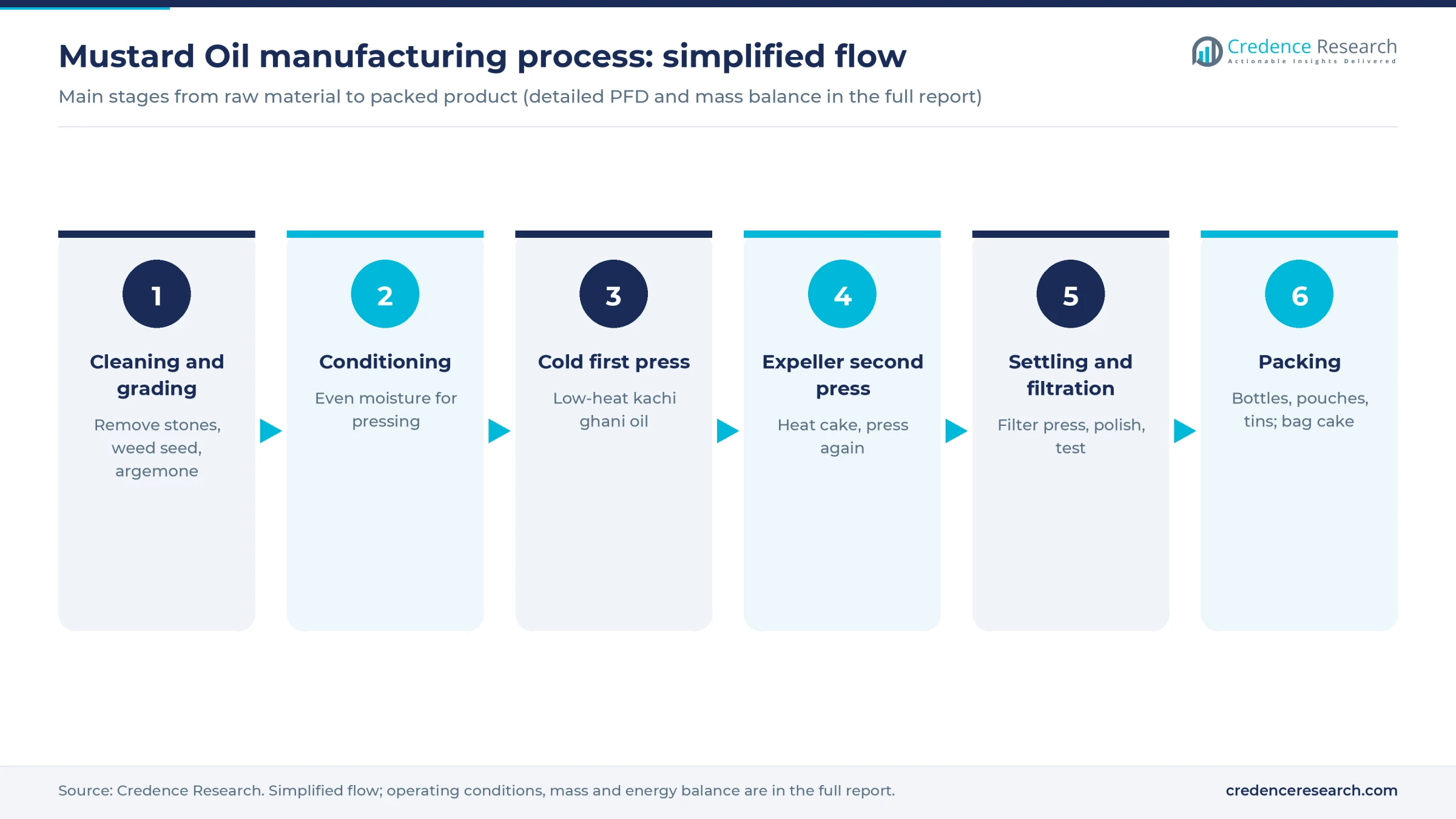
- Cleaning and grading. Sieves, destoners, magnets and aspirators remove dust, stones, weed seed and immature grain. Weed seed matters here: Argemone mexicana, a prickly poppy whose seed resembles mustard, can contaminate oil and has caused dropsy outbreaks, so intake testing is critical.
- Moisture conditioning. Seed is brought to a uniform moisture so that the presses run steadily and myrosinase, the seed enzyme, can release allyl isothiocyanate during crushing.
- Cold first pressing. Screw presses run slowly with no added heat, keeping oil below about 50 degrees Celsius on planning figures assumed here, to yield the sharp kachi ghani grade.
- Expeller second pressing. The cake is heated in a cooking kettle and pressed again, recovering milder expeller-grade oil and leaving cake with a few percent of residual oil.
- Settling and filtration. Oil settles in tanks, passes through filter presses and a polishing filter, and is tested for acidity, pungency, argemone oil and erucic acid.
- Packing. Oil is filled into PET bottles, pouches, jars and 15-liter tins, while cake is bagged for cattle feed or sold to solvent plants.
Some processors neutralize, bleach and deodorize part of the oil for customers who want a bland product, but refining adds a separate plant and erases the pungency premium. Oil recovery depends heavily on seed type. Canadian grading data for 2025 show mean oil content of 40.2% for oriental mustard, 34.9% for brown and 30.4% for yellow, so juncea seed of the type grown across South Asia crushes far more efficiently than yellow condiment seed.
Mustard oil plant setup cost
Indicative CapEx for a greenfield mill pressing 100 tonnes of mustard seed a day, with cleaning, two-stage pressing, filtration, a quality laboratory and packing lines, is USD 2–4 million in fixed CapEx at an Asian industrial site using Asian-built machinery, or USD 5–7 million with seed working capital. Equipment list prices anchor the estimate. On an Indian business marketplace, a Ludhiana press maker lists a 150 HP expeller rated at 45–55 tonnes a day in final crush, or 110–125 tonnes as a pre-press, at about USD 118,000, and a Hyderabad supplier lists a complete 100 tonne per day automatic oil plant at about USD 341,000, both converted at an assumed 88 rupees per dollar. With cleaning, tanks, filling lines and a laboratory added as assumptions, machinery comes to about USD 580,000–730,000 before erection.
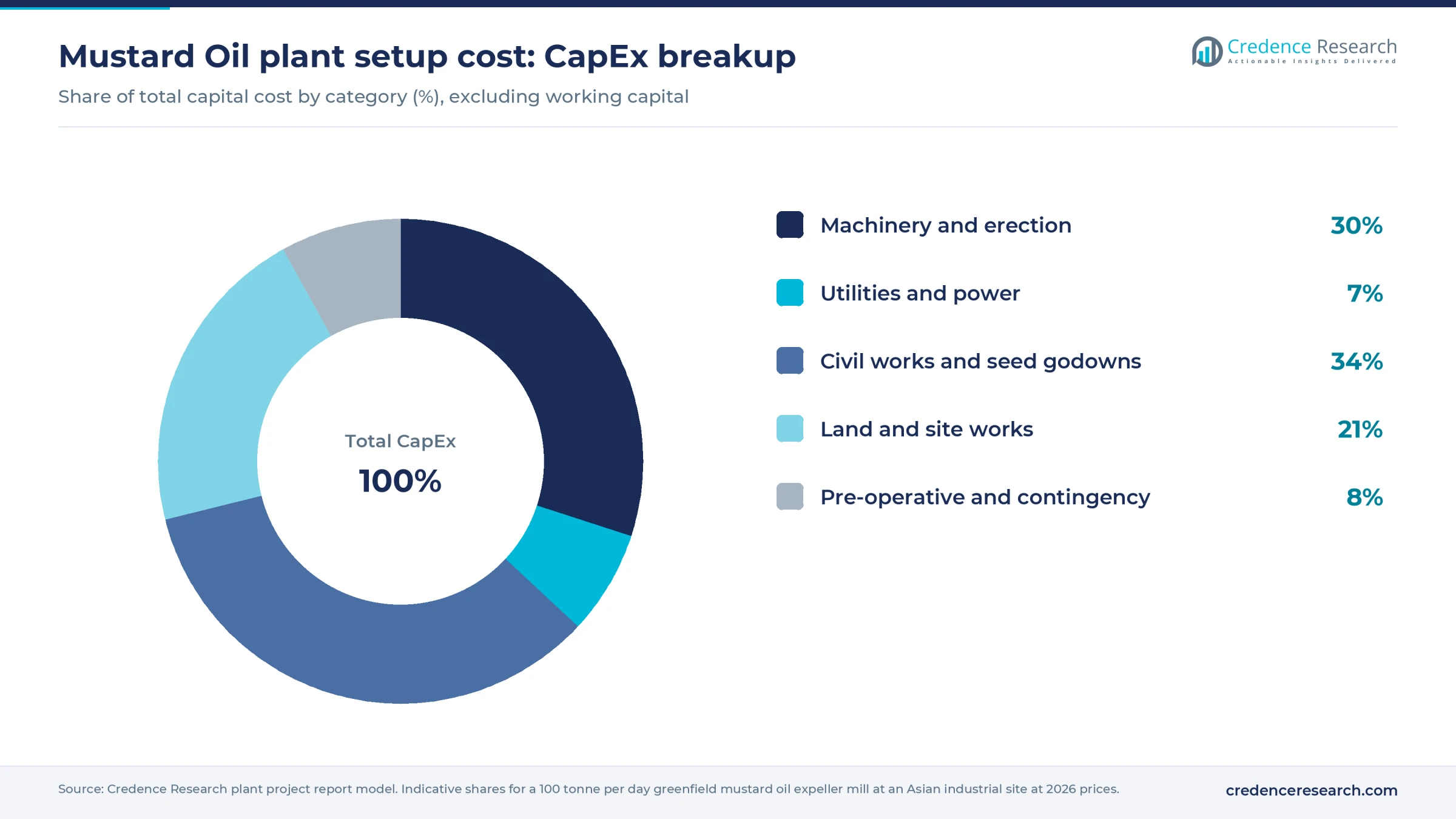
Seed working capital, held outside CapEx, is the defining cost at about USD 2.7–3.1 million. Mustard is a winter crop harvested from late February to April in South Asia, and a mill that buys when arrivals peak, rather than paying lean-season prices, needs cash to hold about six weeks of crushing, roughly 3,000 tonnes of seed worth USD 2.5–2.8 million, plus oil and packaging stock. Within fixed CapEx, civil works, seed godowns and the tank farm take about 34%, machinery and erection 30%, land 21%, utilities 7% and pre-operative costs with contingency 8%.
Land is the line shown in full here. A 2.5-hectare plot is budgeted, as an assumption, at USD 15–35 per square meter, or USD 375,000–875,000, about a fifth of fixed CapEx. Estates in the mustard belts of Rajasthan, Bangladesh or Nepal's Terai sit at the low end.
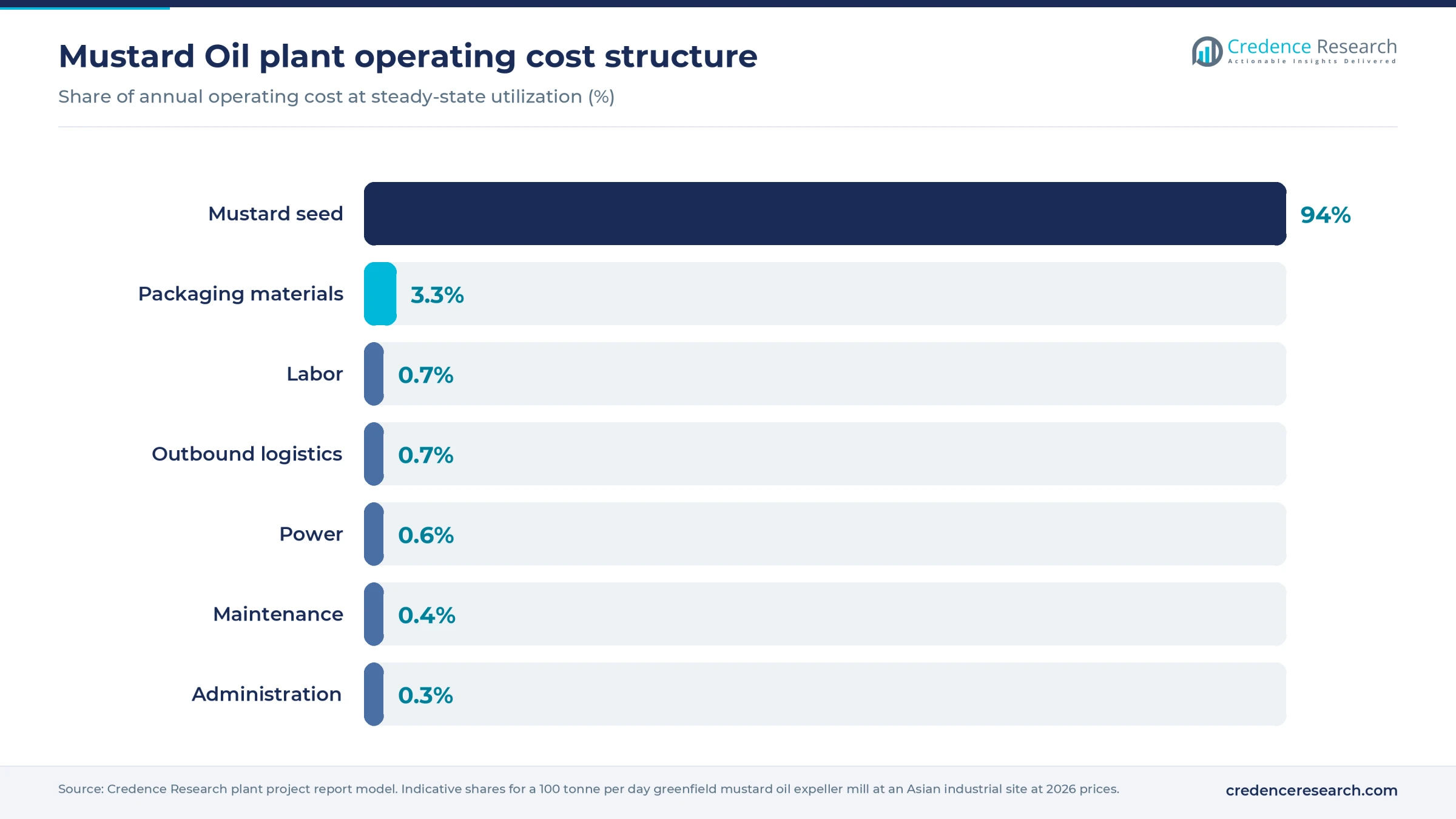
Delivered seed makes up about 94% of cash operating cost. Packaging materials take about 3.3%, labor and outbound logistics about 0.7% each, power 0.6%, maintenance 0.4% and administration 0.3%, shares assumed for planning. A U.S. or European site would carry much higher land, construction and labor costs, so the full report can be customized to any country.
Machinery and raw materials for a mustard oil plant
The core line runs from seed intake pits, bucket elevators and silos or bag godowns to a pre-cleaner, destoner and grader, then to a conditioning screw, cold presses, a cooking kettle and finishing expellers. Oil handling uses settling tanks, plate-and-frame filter presses, polishing filters and stainless steel storage. Packing needs bottle, pouch and tin fillers, cappers, labelers and checkweighers. A laboratory with a gas chromatograph checks the fatty acid profile, alongside tests for argemone oil and pungency, and cake conveyors and baggers complete the plant. Trends in the oilseed extraction equipment market shape press prices and lead times. Machine costs and supplier lists are held for the report.
Seed comes mainly from Brassica juncea grown in South Asia, led by India's Rajasthan, Uttar Pradesh, Madhya Pradesh and Haryana, plus Bangladesh, Nepal's Terai and Pakistan. Canada, Russia, Ukraine and Kazakhstan grow brown, oriental and yellow mustard largely for export, and yellow seed goes mostly into condiments, a trade tracked in the mustard seed market. Seed choice also decides which markets a mill can serve. The Canadian Grain Commission's 2025 harvest survey found erucic acid averaging 21.9% of the oil in oriental, 23.2% in brown and 32.7% in yellow seed, far above the European Union's 5% ceiling, so export cooking oil needs low-erucic varieties.
Mustard oil business profit margin and ROI
Gross margin here means oil and cake sales less delivered seed, before processing and packing, and across 2026 Indian price pairs it runs from about zero to 15%, with a mid-case near 7%. A mid-October 2026 market report put the national median wholesale seed price at 7,900–7,950 rupees per quintal, with oil in several markets in the upper 18,000s. Packed oil traded near 19,231 rupees per quintal at all-India wholesale in late September, while Jaipur seed sold at about 7,350 rupees in May, after harvest arrivals.
On those prices, with assumed oil recovery of 35–37%, cake output of 60–62% and an assumed cake price of 2,300–2,800 rupees per quintal, each kilogram of seed returns about 79–88 rupees of product against 74.5–81 rupees of delivered seed. The best case pairs harvest buying with packed-oil prices and a 37% yield for a 15.6% margin, while lean-season seed against loose-oil prices leaves a small loss.
After assumed non-seed costs of 4.2–5.7 rupees per kilogram of seed, annual cash profit on 24,000 tonnes is about USD 0.76–2.6 million when the spread holds at 10–15%, so a mill with a USD 6 million total project cost recovers its cost in about 2–8 years. At mid-case spreads the plant barely covers cash costs. Seed price is the critical variable: a rise of 500 rupees per quintal with oil unchanged removes about USD 1.4 million of yearly cash profit.
| Return metric | Value |
|---|---|
| IRR | Available in report |
| NPV | Available in report |
| ROI | Available in report |
| DSCR | Available in report |
How to start a mustard oil business, licenses and approvals
An expeller-only mustard mill avoids the solvent permits that extraction plants need, but its product raises a question most edible oils do not: whether the target market accepts high-erucic mustard oil as food at all.
- Business registration and tax identification.
- Land use or zoning clearance and building permits.
- An environmental permit or consent covering dust, any boiler emissions and wash water.
- Occupational safety, fire and electrical inspections.
- Food business licensing or registration, with product standards for pungency, acidity, adulterants and erucic acid.
- Cosmetic product notification where oil is sold for massage or hair care.
- Feed registration for cake sold to feed makers, plus export or import registration.
Rules change, so each approval should be confirmed locally.
| Market | Key approvals for a mustard oil plant |
|---|---|
| United States | FDA treats erucic acid in expressed mustard oil as an unsafe food additive, and Import Alert 26-04 allows detention without physical examination, even if labeled for topical use; massage and hair oil needs cosmetic facility registration and product listing under the Modernization of Cosmetics Regulation Act of 2022 |
| European Union | Food business registration under Regulation (EC) No 852/2004; an erucic acid limit of 50 g/kg for mustard oil under Regulation (EU) 2023/915, against 20 g/kg for most vegetable oils, which the competent authority may waive for oil produced and consumed locally; CPNP notification under Cosmetics Regulation (EC) No 1223/2009 |
| India | FSSAI license under the Food Safety and Standards Act, 2006, with oil meeting FSSAI standards for mustard oil, including a negative argemone oil test, and its bar on blending mustard oil with other edible oils; registration with the Directorate of Sugar and Vegetable Oils under the Vegetable Oil Products, Production and Availability (Regulation) Order, 2011, as amended in 2025; state pollution control board consent to operate |
Key mustard oil manufacturers and recent developments
Branded mustard oil is concentrated among a few Indian packers, surrounded by thousands of small expeller mills. AWL Agri Business, formerly Adani Wilmar, sells Fortune kachi ghani oil, and Emami Agrotech markets the Healthy & Tasty brand. Patanjali Foods, Mother Dairy through its Dhara brand, and Dabur, mainly for hair and body care, also sell mustard oil. HAFED, Haryana's cooperative marketing federation, plans a 150 tonne per day mill at Rewari under a public-private partnership. Local crushers supply domestic brands in Nepal and Bangladesh. Bottled oil competes for shelf space across the wider edible oils and fats market.
Two recent developments stand out:
- June 2026. Nepal's Vital Pro Oil Industry was reported building a 200 ton per day edible oil refining plant in Bara district, budgeted at 515 million Nepali rupees and covering mustard, soybean and sunflower oil.
- August 2026. AWL Agri Business launched Fortune Yellow mustard oil in 1-liter PET packs, starting in Delhi NCR and urban Punjab and Haryana.
What's inside the Mustard Oil project report PDF
The report runs to 21 chapters. Open a chapter to see its sections.
1. Preface
2. Scope and Methodology
- 2.1 Objectives of the Study
- 2.2 Stakeholders
- 2.3 Research Methodology
- 2.4 Data Sources and Key Assumptions
3. Executive Summary
- 3.1 Market Snapshot
- 3.2 Project at a Glance (Capacity, CapEx, OpEx)
- 3.3 Key Financial Indicators (IRR, NPV, Payback, Break-even)
- 3.4 Feasibility Verdict
4. Product Overview
- 4.1 Mustard Oil Definition and Properties
- 4.2 Grades and Specifications (BIS / ISO / ASTM)
- 4.3 HS Code and Classification
- 4.4 Key Applications
- 4.5 Substitutes
5. Global Mustard Oil Market
- 5.1 Market Overview
- 5.2 Historical and Current Market Performance (Volume and Value)
- 5.3 Market Breakup by Grade / Type
- 5.4 Market Breakup by End-Use Industry
- 5.5 Market Breakup by Region
- 5.6 Market Drivers, Restraints and Trends
- 5.7 Value Chain Analysis
- 5.8 Market Forecast
6. Target Country Mustard Oil Market Analysis
- 6.1 Demand and Supply Analysis
- 6.2 Installed Capacity vs Demand Gap
- 6.3 Import Dependence
- 6.4 Demand Forecast by End-Use
7. Trade Analysis
- 7.1 Imports by Volume, Value and Country
- 7.2 Exports by Volume, Value and Country
- 7.3 Trade Balance and Opportunities
8. Price Analysis
- 8.1 Historical Mustard Oil Price Trends by Region
- 8.2 Raw Material / Feedstock Price Trends and Linkage
- 8.3 Price Forecast
- 8.4 Margins Across the Value Chain
9. Competitive Landscape
- 9.1 Market Structure
- 9.2 Key Players and Installed Capacities
- 9.3 Profiles of Key Players
- 9.4 Recent Developments (Expansions, M&A, New Plants)
10. Manufacturing Process and Technology
- 10.1 Comparison of Technology Routes
- 10.2 Selected Route and Process Flow Diagram
- 10.3 Unit Operations Involved
- 10.4 Chemical Reactions Involved
- 10.5 Mass Balance and Raw Material Requirements
- 10.6 Energy Balance
- 10.7 Quality Assurance Criteria and Technical Tests
- 10.8 By-products and Waste Handling
- 10.9 Technology Licensors / Providers
11. Project Details, Requirements and Costs
- 11.1 Land, Location and Site Development
- 11.1.1 Site Selection Criteria
- 11.1.2 Location Analysis
- 11.1.3 Land Requirement and Costs
- 11.1.4 Site Development Costs
- 11.2 Plant Layout
- 11.2.1 Layout Principles
- 11.2.2 Proposed Layout
- 11.2.3 Factors Influencing Layout
- 11.3 Civil Works and Buildings
- 11.4 Plant Machinery
- 11.4.1 Machinery Requirements and Specifications
- 11.4.2 Machinery Costs
- 11.4.3 Machinery Suppliers
- 11.5 Raw Materials
- 11.5.1 Requirements per Tonne of Output
- 11.5.2 Procurement and Sourcing
- 11.5.3 Costs
- 11.5.4 Suppliers
- 11.6 Packaging
- 11.6.1 Packaging Requirements
- 11.6.2 Packaging Costs
- 11.6.3 Packaging Suppliers
- 11.7 Storage and Material Handling
- 11.8 Transportation Requirements and Costs
- 11.9 Utilities
- 11.9.1 Power Requirements and Costs
- 11.9.2 Water Requirements and Costs
- 11.9.3 Steam, Fuel and Other Utilities
- 11.10 Manpower Requirements and Wages
12. Environment, Health, Safety and Sustainability
- 12.1 Effluent and Emissions Management
- 12.2 Hazard Classification and Safety Measures
- 12.3 Carbon Footprint
- 12.4 Green / Low-Carbon Process Options
13. Regulatory Procedures, Approvals and Certifications
- 13.1 Licences and Registrations
- 13.2 Environmental Clearances
- 13.3 Product Certifications (BIS, REACH, etc.)
- 13.4 Approval Timeline
14. Project Implementation Schedule
15. Project Economics
- 15.1 Capital Cost of the Project
- 15.2 Techno-Economic Parameters
- 15.3 Capacity Utilization and Ramp-up
- 15.4 Product Pricing and Margins
- 15.5 Income Projections
- 15.6 Expenditure Projections
- 15.7 Working Capital Requirement
- 15.8 Taxation
- 15.9 Depreciation
16. Financial Analysis
- 16.1 Projected Profit and Loss Account
- 16.2 Projected Cash Flow Statement
- 16.3 Projected Balance Sheet
- 16.4 Liquidity Analysis
- 16.5 Profitability Analysis (Payback, NPV, IRR, ROI)
- 16.6 Break-even Analysis
- 16.7 Debt Service Coverage Ratio (DSCR)
- 16.8 Sensitivity Analysis
- 16.9 Scenario and Uncertainty Analysis
17. Funding and Incentives
- 17.1 Means of Finance and Debt-Equity Structure
- 17.2 Loans and Financial Assistance
- 17.3 Government Schemes and Subsidies (PLI, State Policies)
18. Risk Assessment
- 18.1 Key Success Factors
- 18.2 Key Risk Factors
- 18.3 Risk Mitigation
19. Strategic Recommendations
20. Case Study of a Successful Venture
21. Appendix
- 21.1 Detailed Assumptions
- 21.2 Abbreviations
- 21.3 List of Tables and Figures
- 21.4 Sources
This page vs. the full report
| Data point | On this page (free) | In the full report |
|---|---|---|
| Total CapEx | One rounded range at one capacity | Exact figure at three capacities with a line-item breakup |
| CapEx breakup | Category shares (%) only | Cost, quantity and supplier for every machine |
| Operating cost | Share of raw materials, utilities and labor | Per-unit cost sheet with each input price and consumption |
| Profitability | Gross margin range and payback band | Exact IRR, NPV, ROI, break-even and DSCR |
| Financial statements | List of what is included | 10-year P&L, cash flow, balance sheet and Excel model |
| Sensitivity | One directional line | Full sensitivity and scenario tables |
| Process | Simplified flow diagram | Detailed process flow, mass and energy balance, operating conditions |
| Machinery | Names of the main machines | Specifications, capacity, cost and supplier list |
| Market | Headline size, growth and global demand | Segment, region, trade and price forecast tables |
| Suppliers and buyers | Supplier types and sourcing hubs | Named suppliers and buyers |
Mustard Oil project report: FAQs
How much does it cost to set up a mustard oil plant?
What profit margin does a mustard oil mill earn?
What is the payback period for a mustard oil plant?
Can mustard oil be sold as cooking oil in the U.S. and EU?
What is the HS code for mustard oil?
What is the difference between kachi ghani and expeller mustard oil?

About the analyst
Rajdeep Kumar Deb, Lead Analyst - Consumer & Finance
Rajdeep brings a decade of consumer goods and financial services insight to strategic market analysis.
Related market research
- Mustard Oil Market Size, Share, Growth and Forecast 2032
- Mustard Seed Market Industry Size, Growth and Forecast 2032
- Rapeseed Oil Market Size, Share, Trends and Forecast 2032
- Edible Oils and Fats Market Size, Trends, Share and Forecast 2032
- Oilseed Extraction Equipment Market Size, Growth and Forecast 2032
- Prepared Mustard Market Size, Share, Growth and Forecast 2032
More plant project reports
- Liquid Detergent Manufacturing Plant Project Report (DPR) 2026
- Hair Color Manufacturing Plant Project Report (DPR) 2026
- Cotton Seed Oil Processing Plant Project Report (DPR) 2026
- Detergent Powder Manufacturing Plant Project Report (DPR) 2026
- Essential Oil Manufacturing Plant Project Report (DPR) 2026
- Cigarette Lighter Manufacturing Plant Project Report (DPR) 2026