
Quick answer
Hair color is a cosmetic that tints hair, most often as an oxidative cream mixed with a hydrogen peroxide developer just before use. A greenfield plant making 12 million retail kits a year needs an estimated USD 7–22 million of CapEx, excluding working capital. Regional brands and private-label makers can expect a gross margin of about 28–45%, with payback in about 3–6 years once retailers list the range.
Feasible for a maker with retail listings or private-label contracts and strong regulatory capability; an unknown brand without shelf space is the main way this project fails.
Hair Color plant: key highlights
| Parameter | Indicative value | Note |
|---|---|---|
| Plant capacity | 12 million kits per year | About 40,000 kits a day over 300 days, roughly 1,600 tonnes of filled product |
| Total CapEx | USD 7–22 million | Greenfield, excluding USD 4–7 million of working capital |
| Raw material share of operating cost | 50–60% | Dye intermediates, cream base, developer and packaging components |
| Gross margin | 28–45% | At an assumed ex-factory USD 1.80–3.50 per kit |
| Payback period | 3–6 years | From commissioning, including about 18 months of ramp-up |
| IRR | Available in report | Post-tax, 10-year model |
| Break-even | Available in report | Capacity utilization basis |
Ranges assume 12 million retail kits a year (about 50 g colorant cream, 60 ml developer and a conditioner sachet), a representative greenfield site from an Asian industrial park to a U.S. or EU location, 2026 prices, 85% steady-state utilization and an assumed ex-factory price of USD 1.80–3.50 a kit. Scaled from a disclosed plant with a 0.65 capacity exponent. Excludes brand launch spending. The full report can be customized to any country or region.
What is hair color?
Hair color is a cosmetic product that changes or restores the shade of human hair. Most of the market is permanent oxidative color, sold as a two-part kit. One part is a cream or gel holding dye precursors such as p-phenylenediamine or toluene-2,5-diamine with couplers and an alkali, usually ammonia or ethanolamine. The other is a hydrogen peroxide developer. Mixed on the head, the precursors oxidize into large colored molecules trapped inside the hair shaft, which is why the result survives washing.
Other grades serve different needs. Demi-permanent color uses less alkali and peroxide, semi-permanent products deposit ready-made direct dyes that fade over several weeks, and plant-based colors rely on henna and indigo. Professional salon ranges sit alongside at-home retail kits, and beard and root-touch-up products form smaller niches.
Internationally, hair dyes fall under HS code 3305.90, other preparations for use on the hair, which also covers hair creams and lotions. Buyers include drugstores, supermarkets, salons and online retailers. Because consumers rarely switch shade once satisfied, repeat purchase is high, and shelf listing is the asset a new maker must win.
Hair color market overview and global demand
Demand rests on two habits, covering gray hair and changing shade for fashion. The first grows with aging populations in Europe, North America, Japan and China, while the second is driven by younger consumers and social media. Gray coverage buyers are especially loyal, coloring roots every four to eight weeks.
Credence Research tracks the category from several angles. Its global hair care report sized the wider sector at USD 94.07 billion in 2024 with a 3% CAGR, which implies about USD 96.9 billion in 2025. The customizable hair dye segment, covering personalized shades sold online and in salons, implies about USD 7.3 billion in 2025, based on USD 6.75 billion for 2024 and an 8.7% CAGR.
Trade data show how concentrated supply is. The United States exported about USD 1.0 billion and imported about USD 1.3 billion of other hair preparations under HS 3305.90 in 2023, according to UN Comtrade-based statistics, with Mexico and Canada its main suppliers of hair products. A single site helps explain the Mexican flow. L'Oréal's San Luis Potosí plant, opened in 2012 as the largest hair color factory in the world, was rated at 210 million units a year by 2014.
Asia is the fastest-moving region, as consumers with dark hair adopt lighter and fashion shades. For a new 12-million-kit plant, the opportunity lies in regional brands, retailer private labels and salon ranges, where global leaders leave room on price and shade range.
Hair color manufacturing process
Making oxidative hair color is batch emulsion work with one unusual risk. The dye precursors begin to react as soon as they meet oxygen, so much of the process is designed to keep air out until the consumer opens the tube.
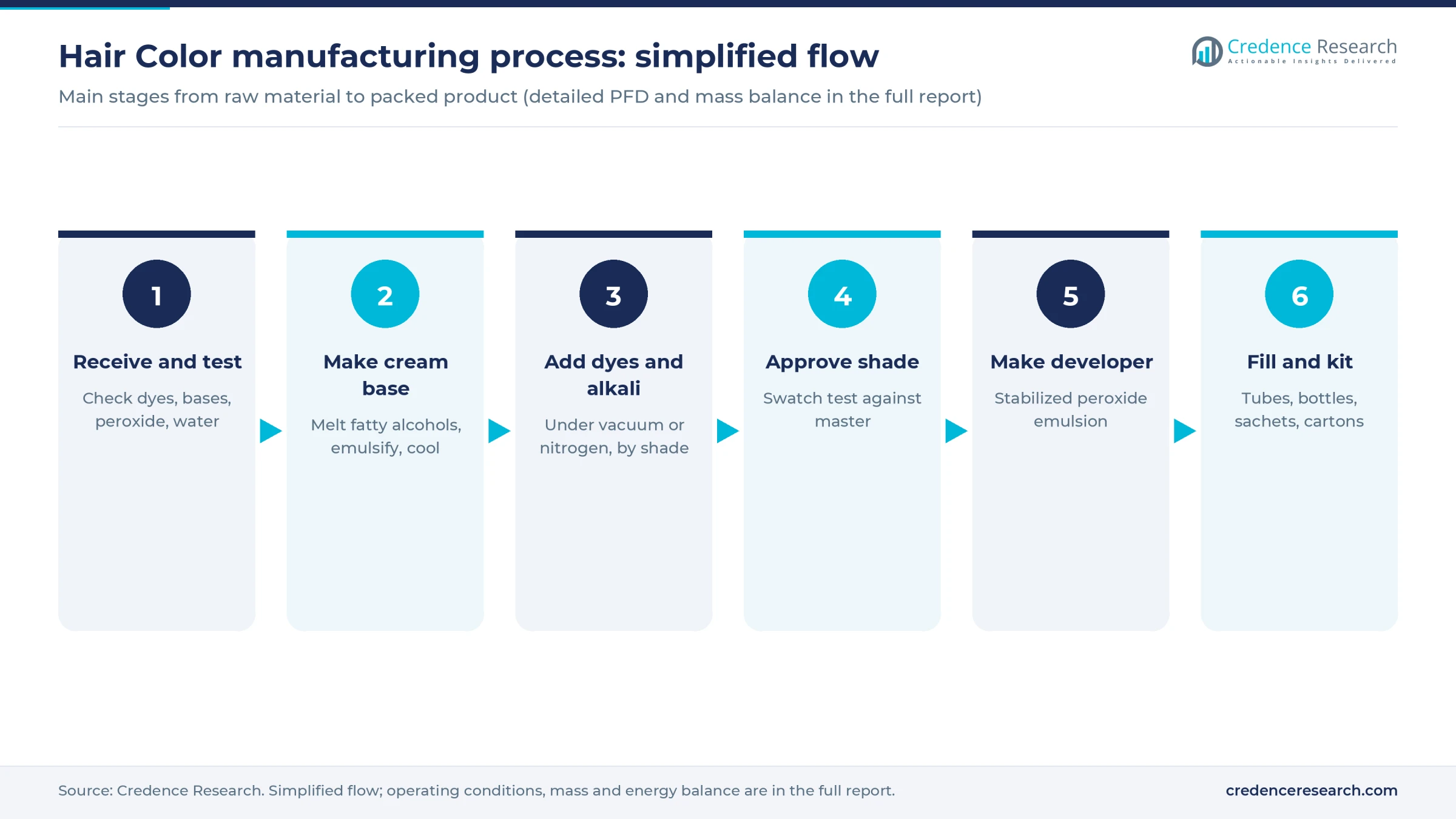
- Receiving and testing. Dye intermediates, fatty alcohols, surfactants, alkalis and hydrogen peroxide are checked for identity and purity, often by HPLC. Water is purified by reverse osmosis and deionization, since metal traces can destabilize peroxide and shift shades.
- Cream base. Fatty alcohols and emulsifiers are melted at about 70–80 degrees Celsius and emulsified with hot water in a vacuum homogenizer, then cooled to form a thick cream.
- Dyeing and alkalizing. Precursors and couplers, dissolved with antioxidants such as sodium sulfite or ascorbic acid, are added at low temperature, followed by ammonia or ethanolamine. Vessels run under vacuum or a nitrogen blanket, and each shade is weighed to tight tolerances.
- Shade approval. A sample from every batch is mixed with developer and applied to standard hair swatches, and the result is measured against a master with a colorimeter.
- Developer. A separate line makes a stabilized peroxide emulsion, typically 6–12% for retail kits, in dedicated stainless equipment kept apart from the dye area.
- Filling and kitting. Cream goes into aluminum tubes, which block oxygen better than plastic, and developer into vented plastic bottles. Tubes, bottles, conditioner sachets, gloves and instructions are packed into printed cartons with batch codes.
Shade count drives cost more than volume. A full range can hold 40–80 shades, each needing its own batch, cleaning cycle and approval, so scheduling and changeover speed decide output. Ammonia odor, sensitizing dust from dye powders and peroxide storage require extraction, protective equipment and segregation.
Hair color plant setup cost
This overview models a plant making 12 million retail kits a year at an estimated CapEx of USD 7–22 million. The spread reflects location, automation and building standard, from a compact cream and filling hall in a low-cost park to a highly automated, export-grade site.
The main public benchmark is L'Oréal's Mexican plant, reported at USD 100 million for 210 million units a year, with a 32,000-square-meter building on a 95,000-square-meter site. Scaled to 12 million kits with a standard capacity exponent and escalated from 2012 to 2026 prices, it implies about USD 21 million, which sets the top of the range. An earlier USD 50 million figure for the first phase of that plant scales to about USD 11 million. Assumed building and equipment estimates for a smaller site in Asia support the USD 7 million floor.
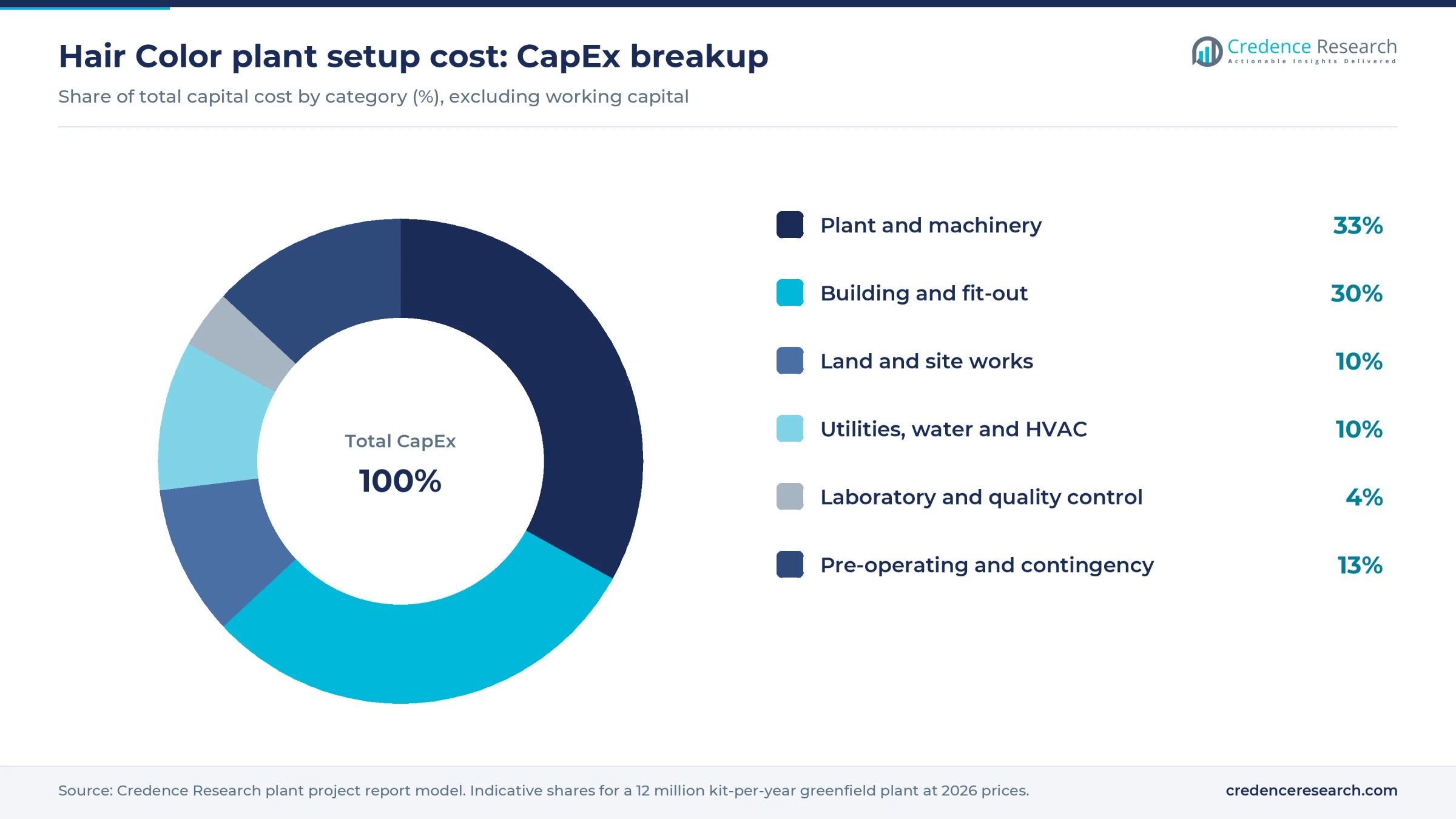
Worked example, land and site development. The model uses an assumed 8,000–12,000 square meters, allowing segregated stores for peroxide and ammonia. At an assumed USD 30–80 per square meter in an Asian industrial park, the plot costs about USD 0.25–1 million, and at an assumed USD 60–250 at a U.S. or EU site, about USD 0.5–3 million. Site works add an assumed USD 0.3–0.8 million, so this row is about 7–17% of CapEx.
Working capital is separate. A full shade range means dozens of stock-keeping units, along with printed cartons ordered months ahead and about 60 days of retailer receivables, which together tie up an estimated USD 4–7 million.
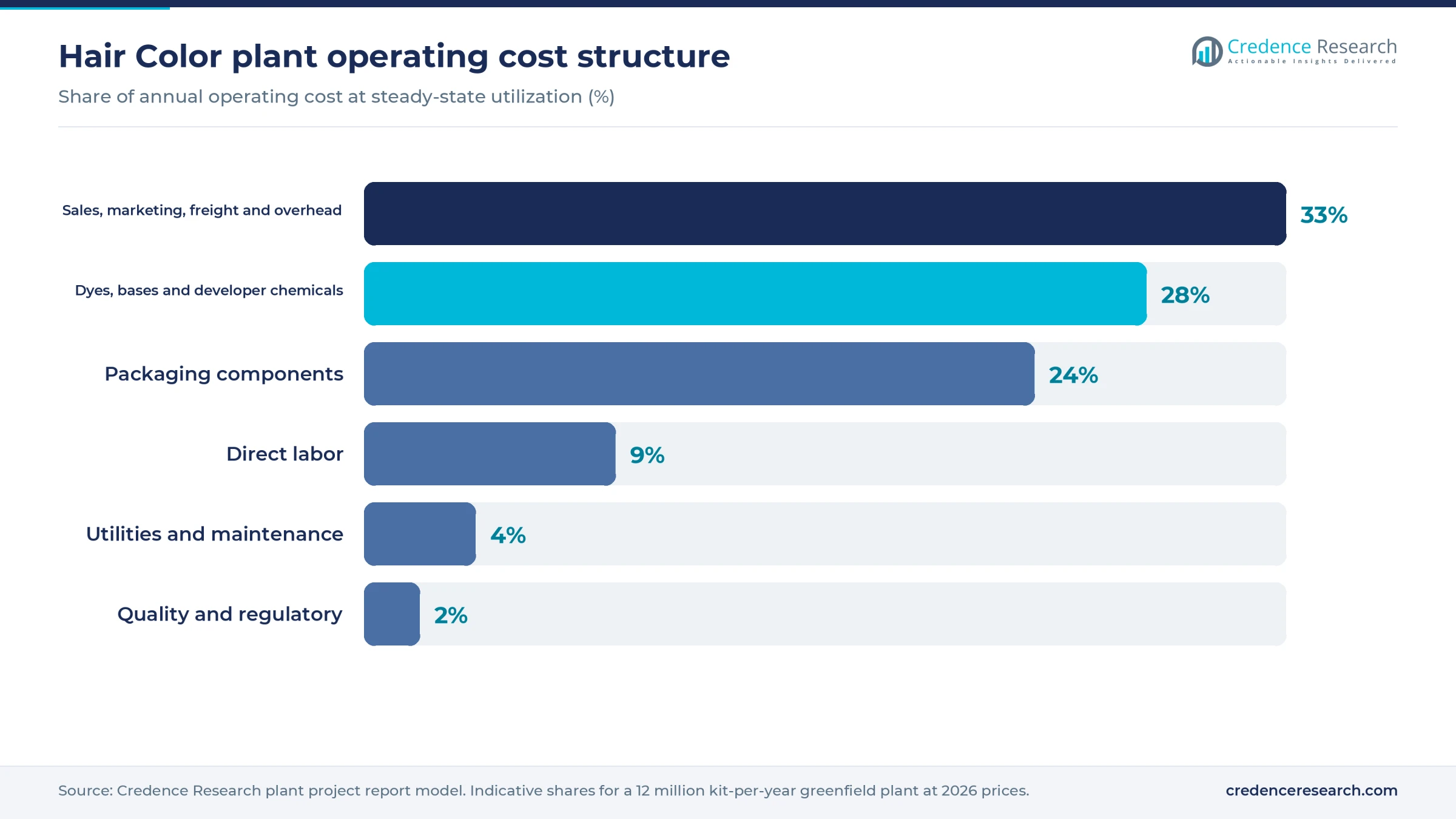
Marketing and trade spending is the largest single cost block for a branded maker, followed by chemicals and packaging. A 10% rise in packaging prices takes about 2 points off gross margin at a mid-range selling price. The full report can be customized to any country or region.
Machinery and raw materials for a hair color plant
The core equipment list covers a water purification unit, vacuum emulsifying homogenizers with heating and cooling jackets, a dye dispensing and weighing room with dust extraction, nitrogen supply, holding tanks, a dedicated developer line and clean-in-place systems. Packing needs aluminum tube fillers and crimpers, bottle fillers and cappers, sachet machines, cartoners, case packers and coding equipment. A laboratory holds HPLC, pH and viscosity meters, colorimeters, stability chambers and a swatch dyeing station.
Raw materials come from a few clusters. Aromatic dye intermediates such as p-phenylenediamine, p-aminophenol and resorcinol are produced mainly in China, India and Europe, and qualified cosmetic grades with low impurity levels carry a premium. Hydrogen peroxide is made in every major region, and the hydrogen peroxide market sets developer costs. Fatty alcohols such as cetearyl alcohol derive largely from palm and palm kernel oil processed in Indonesia and Malaysia.
Plant-based lines add other sources. Henna is grown mainly in India, notably around Sojat in Rajasthan, as well as in Pakistan, Egypt and Sudan, while indigo leaf comes largely from India. Aluminum tubes and printed cartons are sourced regionally, because freight and lead time matter more than unit price.
Hair color business profit margin and ROI
Margins depend on channel and brand strength. At the modeled position, with an assumed ex-factory price of USD 1.80–3.50 per kit and an assumed USD 1.30–1.95 of chemicals, packaging and direct conversion, gross margin runs about 28–45%. Private-label contracts sit near the low end, while a regional brand with a strong gray-coverage range can reach the top.
Brand building is where the money goes. Mass-market hair color is sold through retailers that charge listing fees, promotions and shelf space, and new brands typically spend heavily on advertising and influencers. This model allows about USD 0.70 per kit for sales, marketing, freight and overhead, which leaves estimated post-tax cash of about USD 2–5.5 million at 85% utilization, or about 10.2 million kits.
That supports a payback of about 3–6 years, including roughly 18 months of ramp-up while retailers test the range. A top-of-range build sold mainly to private-label clients at low prices would fall outside that window, so capital should follow confirmed listings. Key risks are a failed launch, a regulatory ban on a key dye, and allergic reaction claims.
| Metric | Value |
|---|---|
| IRR | Available in report |
| NPV | Available in report |
| ROI | Available in report |
| DSCR | Available in report |
How to start a hair color business, licenses and approvals
A hair color plant needs approvals in six areas in most jurisdictions. These are business and tax registration; land use, zoning and building permits; an environmental permit covering ammonia emissions and wash water; fire and occupational safety approval for peroxide and sensitizing dyes; cosmetic manufacturing and product registration with safety documentation; and import and export registration. Hair dyes face stricter ingredient rules than most cosmetics, so each shade formula must be checked against market-specific lists before launch.
| Market | Regulator and key rule | What it means for hair color |
|---|---|---|
| United States | FDA, under the Federal Food, Drug, and Cosmetic Act and the Modernization of Cosmetics Regulation Act of 2022, with facility registration renewed every two years and product listing | Coal-tar hair dyes are exempt from color additive approval only if labels carry the caution statement and skin test directions; henna and other plant or mineral colors must be listed color additives |
| European Union | Regulation (EC) No 1223/2009, with a Responsible Person, safety report, CPNP notification and good manufacturing practice | Only hair dye substances in Annex III, assessed by the Scientific Committee on Consumer Safety, may be used; p-phenylenediamine is capped at 2% on the head after mixing, with mandatory allergy warnings |
| India | CDSCO framework under the Cosmetics Rules, 2020, with a manufacturing license applied for on Form COS-5 and granted on Form COS-8 by the State Licensing Authority | Products must meet Bureau of Indian Standards specifications, including IS 15205 for emulsion oxidation hair dyes, revised in 2026, plus state pollution control board consents |
Many large retailers and export buyers also ask for ISO 22716 certification of good manufacturing practice before listing a new range.
Key hair color manufacturers and recent developments
Global supply is led by L'Oréal, Henkel through Schwarzkopf, Wella Company with Clairol and Koleston, Kao, Hoyu and Revlon. Regional makers carry strong local share, including Godrej Consumer Products and CavinKare in India, and several private-label producers in Europe and Latin America.
- December 2025. Coty agreed to sell its remaining 25.8% stake in Wella to affiliates of KKR for USD 750 million in cash plus a share of future sale proceeds, leaving the Clairol and Wella Professionals owner under private equity control.
- July 2026. Kao announced a launch of its Liese hair color series with a new repair technology in seven Asian markets from August 2026, targeting damage that continues for days after coloring.
- July 2026. Henkel closed its purchase of Olaplex, a bond-building brand widely used alongside salon color, and said the deal made it the global number two in professional hair care.
These moves show leaders consolidating salon channels and competing on hair health claims, which raises the bar for newcomers. The anti-graying hair and beard segment shows where smaller niche brands still find room.
What's inside the Hair Color project report PDF
The report runs to 21 chapters. Open a chapter to see its sections.
1. Preface
2. Scope and Methodology
- 2.1 Objectives of the Study
- 2.2 Stakeholders
- 2.3 Research Methodology
- 2.4 Data Sources and Key Assumptions
3. Executive Summary
- 3.1 Market Snapshot
- 3.2 Project at a Glance (Capacity, CapEx, OpEx)
- 3.3 Key Financial Indicators (IRR, NPV, Payback, Break-even)
- 3.4 Feasibility Verdict
4. Product Overview
- 4.1 Hair Color Definition and Properties
- 4.2 Grades and Specifications (BIS / ISO / ASTM)
- 4.3 HS Code and Classification
- 4.4 Key Applications
- 4.5 Substitutes
5. Global Hair Color Market
- 5.1 Market Overview
- 5.2 Historical and Current Market Performance (Volume and Value)
- 5.3 Market Breakup by Grade / Type
- 5.4 Market Breakup by End-Use Industry
- 5.5 Market Breakup by Region
- 5.6 Market Drivers, Restraints and Trends
- 5.7 Value Chain Analysis
- 5.8 Market Forecast
6. Target Country Hair Color Market Analysis
- 6.1 Demand and Supply Analysis
- 6.2 Installed Capacity vs Demand Gap
- 6.3 Import Dependence
- 6.4 Demand Forecast by End-Use
7. Trade Analysis
- 7.1 Imports by Volume, Value and Country
- 7.2 Exports by Volume, Value and Country
- 7.3 Trade Balance and Opportunities
8. Price Analysis
- 8.1 Historical Hair Color Price Trends by Region
- 8.2 Raw Material / Feedstock Price Trends and Linkage
- 8.3 Price Forecast
- 8.4 Margins Across the Value Chain
9. Competitive Landscape
- 9.1 Market Structure
- 9.2 Key Players and Installed Capacities
- 9.3 Profiles of Key Players
- 9.4 Recent Developments (Expansions, M&A, New Plants)
10. Manufacturing Process and Technology
- 10.1 Comparison of Technology Routes
- 10.2 Selected Route and Process Flow Diagram
- 10.3 Unit Operations Involved
- 10.4 Chemical Reactions Involved
- 10.5 Mass Balance and Raw Material Requirements
- 10.6 Energy Balance
- 10.7 Quality Assurance Criteria and Technical Tests
- 10.8 By-products and Waste Handling
- 10.9 Technology Licensors / Providers
11. Project Details, Requirements and Costs
- 11.1 Land, Location and Site Development
- 11.1.1 Site Selection Criteria
- 11.1.2 Location Analysis
- 11.1.3 Land Requirement and Costs
- 11.1.4 Site Development Costs
- 11.2 Plant Layout
- 11.2.1 Layout Principles
- 11.2.2 Proposed Layout
- 11.2.3 Factors Influencing Layout
- 11.3 Civil Works and Buildings
- 11.4 Plant Machinery
- 11.4.1 Machinery Requirements and Specifications
- 11.4.2 Machinery Costs
- 11.4.3 Machinery Suppliers
- 11.5 Raw Materials
- 11.5.1 Requirements per Tonne of Output
- 11.5.2 Procurement and Sourcing
- 11.5.3 Costs
- 11.5.4 Suppliers
- 11.6 Packaging
- 11.6.1 Packaging Requirements
- 11.6.2 Packaging Costs
- 11.6.3 Packaging Suppliers
- 11.7 Storage and Material Handling
- 11.8 Transportation Requirements and Costs
- 11.9 Utilities
- 11.9.1 Power Requirements and Costs
- 11.9.2 Water Requirements and Costs
- 11.9.3 Steam, Fuel and Other Utilities
- 11.10 Manpower Requirements and Wages
12. Environment, Health, Safety and Sustainability
- 12.1 Effluent and Emissions Management
- 12.2 Hazard Classification and Safety Measures
- 12.3 Carbon Footprint
- 12.4 Green / Low-Carbon Process Options
13. Regulatory Procedures, Approvals and Certifications
- 13.1 Licences and Registrations
- 13.2 Environmental Clearances
- 13.3 Product Certifications (BIS, REACH, etc.)
- 13.4 Approval Timeline
14. Project Implementation Schedule
15. Project Economics
- 15.1 Capital Cost of the Project
- 15.2 Techno-Economic Parameters
- 15.3 Capacity Utilization and Ramp-up
- 15.4 Product Pricing and Margins
- 15.5 Income Projections
- 15.6 Expenditure Projections
- 15.7 Working Capital Requirement
- 15.8 Taxation
- 15.9 Depreciation
16. Financial Analysis
- 16.1 Projected Profit and Loss Account
- 16.2 Projected Cash Flow Statement
- 16.3 Projected Balance Sheet
- 16.4 Liquidity Analysis
- 16.5 Profitability Analysis (Payback, NPV, IRR, ROI)
- 16.6 Break-even Analysis
- 16.7 Debt Service Coverage Ratio (DSCR)
- 16.8 Sensitivity Analysis
- 16.9 Scenario and Uncertainty Analysis
17. Funding and Incentives
- 17.1 Means of Finance and Debt-Equity Structure
- 17.2 Loans and Financial Assistance
- 17.3 Government Schemes and Subsidies (PLI, State Policies)
18. Risk Assessment
- 18.1 Key Success Factors
- 18.2 Key Risk Factors
- 18.3 Risk Mitigation
19. Strategic Recommendations
20. Case Study of a Successful Venture
21. Appendix
- 21.1 Detailed Assumptions
- 21.2 Abbreviations
- 21.3 List of Tables and Figures
- 21.4 Sources
This page vs. the full report
| Data point | On this page (free) | In the full report |
|---|---|---|
| Total CapEx | One rounded range at one capacity | Exact figure at three capacities with a line-item breakup |
| CapEx breakup | Category shares (%) only | Cost, quantity and supplier for every machine |
| Operating cost | Share of raw materials, utilities and labor | Per-unit cost sheet with each input price and consumption |
| Profitability | Gross margin range and payback band | Exact IRR, NPV, ROI, break-even and DSCR |
| Financial statements | List of what is included | 10-year P&L, cash flow, balance sheet and Excel model |
| Sensitivity | One directional line | Full sensitivity and scenario tables |
| Process | Simplified flow diagram | Detailed process flow, mass and energy balance, operating conditions |
| Machinery | Names of the main machines | Specifications, capacity, cost and supplier list |
| Market | Headline size, growth and global demand | Segment, region, trade and price forecast tables |
| Suppliers and buyers | Supplier types and sourcing hubs | Named suppliers and buyers |
Hair Color project report: FAQs
How much does it cost to set up a hair color plant?
What gross margin can a hair color manufacturer expect?
How long is the payback on a hair color factory?
Why are hair color tubes made of aluminum?
Which approvals matter most for hair color manufacturing?
What are the main raw materials for hair color?
Is ammonia-free hair color harder to make?

About the analyst
Rajdeep Kumar Deb, Lead Analyst - Consumer & Finance
Rajdeep brings a decade of consumer goods and financial services insight to strategic market analysis.
Related market research
- Hair Care Market Size, Share, Growth, Trends and Forecast 2032
- Customizable Hair Dye Market Size, Growth and Forecast 2032
- Anti graying hair and beard Market Size, Growth and Forecast 2032
- Hydrogen Peroxide Market Size, Share, Growth and Forecast 2032
- Hair Salon Service Market Size, Share, Growth and Forecast 2032
- Hair and Scalp Care Market Size, Growth, Share & Forecast 2032
More plant project reports
- Mustard Oil Processing Plant Project Report (DPR) 2026
- Liquid Detergent Manufacturing Plant Project Report (DPR) 2026
- Cotton Seed Oil Processing Plant Project Report (DPR) 2026
- Detergent Powder Manufacturing Plant Project Report (DPR) 2026
- Essential Oil Manufacturing Plant Project Report (DPR) 2026
- Cigarette Lighter Manufacturing Plant Project Report (DPR) 2026