
Market Overview:
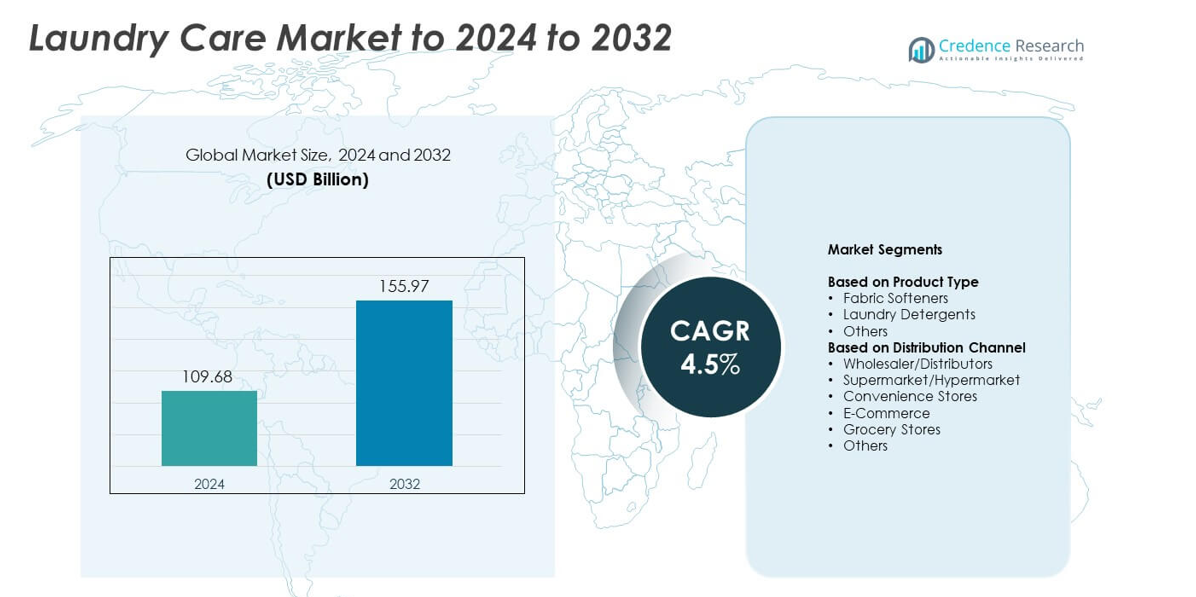
Laundry Care Market size was valued USD 109.68 Billion in 2024 and is anticipated to reach USD 155.97 Billion by 2032, at a CAGR of 4.5% during the forecast period.
| REPORT ATTRIBUTE | DETAILS |
|---|---|
| Historical Period | 2020-2023 |
| Base Year | 2024 |
| Forecast Period | 2025-2032 |
| Laundry Care Market Size 2024 | USD 109.68 Billion |
| Laundry Care Market, CAGR | 4.5% |
| Laundry Care Market Size 2032 | USD 155.97 Billion |
The Laundry Care Market is driven by major players such as Henkel AG & Co. KGaA, Colgate-Palmolive Company, LG Household & Health Care Ltd, Church & Dwight Co., Reckitt Benckiser Group PLC, Procter & Gamble Co., Lion Corporation, Golrang Industrial Group, Amway Corporation, Unilever PLC, S.C. Johnson & Son Inc., Kao Corporation, and Alicorp S.A.A. These companies compete through advanced formulations, strong brand positioning, and expanding sustainable product lines. Asia Pacific led the market in 2024 with about 36% share, supported by rising urbanization and growing detergent consumption. North America followed with roughly 32% due to strong premium product adoption, while Europe held around 28% driven by sustainability-focused purchasing trends.
Market Insights
- Laundry Care Market was valued at USD 109.68 Billion in 2024 and is expected to reach USD 155.97 Billion by 2032, growing at a CAGR of 4.5%.
- Rising hygiene awareness and growing use of liquid detergents and pods drive steady demand, while premium and eco-friendly formulations expand their share across urban households.
- Sustainability trends strengthen as consumers shift toward biodegradable detergents, recyclable packaging, and plant-based ingredients, with e-commerce boosting subscription-based purchases.
- Competitive activity intensifies as global brands upgrade fragrance capsules, stain-removal efficiency, and concentrated formulas, while private-label products pressure pricing in mature markets.
- Asia Pacific led the market with about 36% share, followed by North America at nearly 32% and Europe around 28%, while laundry detergents dominated the product segment with about 62% share due to strong household penetration.
Market Segmentation Analysis:
By Product Type
Laundry detergents dominated the product segment in 2024 with about 62% share, supported by strong household penetration and rising liquid and pod-based detergent use. Growth rose as consumers preferred high-efficiency formulas that work in cold water and reduce energy use. Fabric softeners held a steady base due to demand for long-lasting fragrance and fabric conditioning needs. Other laundry products such as stain removers and bleach expanded as hygiene awareness grew across urban regions. The shift toward eco-friendly and hypoallergenic detergent options further supported segment expansion worldwide.
- For instance, Unilever states that about 3.4 billion people use its products every day in over 190 countries, giving its OMO and Surf laundry detergents one of the widest active user bases in the fabric and home care category worldwide.
By Distribution Channel
Supermarket and hypermarket outlets led the distribution channel segment in 2024 with nearly 38% share, driven by wide product visibility, bulk purchase options, and strong brand placement. Consumers preferred these stores because they offer multiple detergent formats and frequent promotional deals. E-commerce grew at a fast pace due to rising online shopping and subscription-based detergent delivery models. Grocery stores and convenience stores retained steady demand in rural and semi-urban regions. Wholesalers and distributors continued to support large-volume supply for commercial and institutional users.
- For instance, Walmart reports that each week approximately 270 million customers and members visit more than 10,750 stores and numerous e-commerce websites in 19 countries.
Key Growth Drivers
Rising Hygiene Awareness
Growing focus on health and sanitation boosted laundry product demand across households. Consumers adopted premium detergents with deeper cleaning abilities as concerns over bacteria and allergens increased. Brands expanded germ-protection and anti-odor ranges, which helped strengthen category growth. Urbanization and higher washing machine penetration created steady need for liquid detergents and pods. This shift toward advanced cleaning solutions made hygiene awareness a core growth driver.
- For instance, Reckitt highlights that its Dettol hygiene brand is now sold in over 124 countries (often cited as present in as many as 180 markets), reflecting how growing concern over germs and infection control has driven sustained demand for antibacterial cleaning and laundry products.
Shift Toward Convenience Formats
Busy lifestyles increased adoption of liquid detergents, pods, and concentrated formulas. These formats offered faster dissolving, easier measuring, and better compatibility with modern washing machines, creating strong appeal across young consumers. Brands pushed compact packaging to reduce waste and enhance portability. Convenience-focused innovations supported higher repeat purchases, making this shift an important growth driver in the Laundry Care Market.
- For instance, Procter & Gamble voluntarily recalled about 8,200,000 laundry pod bags in the U.S. and 56,741 in Canada in April 2024, covering Tide Pods, Gain Flings, Ace Pods, and Ariel Pods manufactured between September 2023 and February 2024.
Expansion of Premium and Sustainable Products
Demand grew for eco-friendly detergents, biodegradable softeners, and plant-based ingredients. Premium segments expanded as consumers valued fragrance retention, fabric protection, and low-chemical formulations. Companies invested in recyclable packaging and enzyme-rich formulas to meet sustainability expectations. This steady movement toward cleaner and premium solutions acted as a major growth driver and reshaped product positioning globally.
Key Trends & Opportunities
Growth of E-Commerce Laundry Care Sales
Online channels created strong opportunities through doorstep delivery, subscription packs, and bundled offers. Digital platforms enhanced product visibility and enabled niche brands to reach wider audiences at lower distribution cost. Rising mobile shopping increased demand for liquid detergents and value packs. Improved logistics and faster delivery made e-commerce a major trend driving long-term expansion.
- For instance, Amazon’s Delivery Service Partner network works with over 4,400 small businesses that employ more than 390,000 drivers to deliver over 20 million packages a day across 20 countries, supporting fast-growing online sales of household and laundry essentials.
Innovation in Fabric-Care and Fragrance Technologies
Brands introduced long-lasting fragrance capsules, color-protection technologies, and fabric-strengthening additives. These innovations helped companies attract customers seeking improved clothing durability and enhanced scent experience. Growth opportunities expanded as advanced formulas supported cold-water washing, reducing household energy use. Such product upgrades created strong differentiation in a competitive market.
- For instance, Henkel’s Persil Deep Clean Plus formula was engineered so its active substances penetrate deep into fibers and remove tough stains even at 20 degrees Celsius, demonstrating how enzyme technology now enables effective low-temperature washing with strong fragrance and care benefits.
Sustainable Packaging and Green Formulations
Companies adopted recyclable bottles, refill pouches, and low-plastic packaging to address environmental expectations. Demand for plant-based detergents increased as consumers preferred safer and greener cleaning solutions. Sustainability-focused innovation opened new growth opportunities in premium categories. This trend encouraged companies to redesign supply chains and reduce carbon footprints.
Key Challenges
Price Sensitivity in Mass Markets
Many consumers remain highly price-driven, limiting adoption of premium detergents and softeners. Discount competition across supermarket chains and online platforms pressures brand margins. Economic fluctuations reduce willingness to purchase specialized or high-cost laundry products. This price sensitivity acts as a major challenge for companies targeting mass-market households.
Environmental and Regulatory Pressures
Growing restrictions on chemical ingredients and wastewater emissions require continuous reformulation. Compliance increases production cost and slows market expansion for legacy products. Pressure to reduce plastic packaging adds further operational challenges. Companies must balance performance, safety, and environmental targets, making regulatory pressure a key challenge for the Laundry Care Market.
Regional Analysis
North America
North America held about 32% share in 2024, supported by high adoption of liquid detergents, pods, and premium fabric-care products. Growth increased as households shifted toward convenience formats compatible with high-efficiency washing machines. Strong presence of leading brands and rising interest in hypoallergenic and green formulations shaped consumer choices. Retail expansion across supermarket chains and rapid online delivery strengthened product accessibility. Demand rose further as dual-income homes favored compact and concentrated detergents, making North America a key regional market with steady purchasing power.
Europe
Europe captured nearly 28% share in 2024, driven by strong demand for sustainable detergents and biodegradable softeners. Consumers preferred eco-certified formulas as environmental awareness and regulatory standards increased across major countries. Cold-water washing trends pushed adoption of enzyme-rich detergents that offer strong cleaning with lower energy use. Private-label brands expanded shelf presence in hypermarkets, influencing price competition. E-commerce sales rose as consumers valued bulk packs and subscription models. Strong focus on sustainability and product safety kept Europe a mature yet innovation-driven market.
Asia Pacific
Asia Pacific led the Laundry Care Market with around 36% share in 2024, supported by large population size, urbanization, and rising middle-income households. Expanding washing machine penetration in China, India, and Southeast Asia boosted use of liquid detergents and fabric conditioners. Local brands gained traction through affordable pricing, while global players pushed premium and high-performance products. E-commerce adoption accelerated detergent and softener sales, particularly in urban hubs. Growing hygiene awareness and lifestyle upgrades continued to drive strong regional momentum.
Latin America
Latin America accounted for roughly 7% share in 2024, driven by increasing use of liquid detergents and fragrance-focused softeners. Economic recovery in key markets improved household spending on branded laundry products. Traditional trade channels such as neighborhood stores remained important, though supermarket expansion improved product variety. Price sensitivity shaped buying patterns, encouraging demand for concentrated and budget-friendly formulas. Promotional campaigns and value packs supported adoption across mass-market segments, keeping growth steady despite regional cost pressures.
Middle East & Africa
Middle East & Africa held close to 5% share in 2024, supported by rising urbanization and growing availability of global detergent brands. Adoption increased as modern retail formats expanded across Gulf countries and major African cities. Powder detergents remained widely used, while liquid detergents gained popularity among higher-income consumers. Climate conditions increased need for strong stain-removal and fragrance-enhancing products. Economic disparities kept demand mixed, but improving infrastructure and e-commerce access supported gradual market expansion across the region.
Market Segmentations:
By Product Type
- Fabric Softeners
- Laundry Detergents
- Others
By Distribution Channel
- Wholesaler/Distributors
- Supermarket/Hypermarket
- Convenience Stores
- E-Commerce
- Grocery Stores
- Others
By Geography
- North America
- U.S.
- Canada
- Mexico
- Europe
- Germany
- France
- U.K.
- Italy
- Spain
- Rest of Europe
- Asia Pacific
- China
- Japan
- India
- South Korea
- South-east Asia
- Rest of Asia Pacific
- Latin America
- Brazil
- Argentina
- Rest of Latin America
- Middle East & Africa
- GCC Countries
- South Africa
- Rest of the Middle East and Africa
Competitive Landscape
The Laundry Care Market is shaped by leading companies such as Henkel AG & Co. KGaA, Colgate-Palmolive Company, LG Household & Health Care Ltd, Church & Dwight Co., Reckitt Benckiser Group PLC, Procter & Gamble Co., Lion Corporation, Golrang Industrial Group, Amway Corporation, Unilever PLC, S.C. Johnson & Son Inc., Kao Corporation, and Alicorp S.A.A. The competitive landscape features strong product diversification, continuous formulation upgrades, and expanding premium ranges tailored to evolving consumer needs. Companies focus on liquid detergents, pods, and eco-friendly solutions to strengthen brand presence. Innovation in fragrance technology, fabric protection, and stain-removal performance remains central to gaining market advantage. Digital expansion through e-commerce, subscription models, and targeted online promotions enhances customer reach. Sustainability remains a major area of competition as global brands adopt recyclable packaging and plant-based formulations. Price competition remains intense across supermarket shelves, while private-label offerings continue to pressure established brands in mature markets.
Key Player Analysis
- Henkel AG & Co. KGaA
- Colgate-Palmolive Company
- LG Household & Health Care Ltd
- Church & Dwight Co.
- Reckitt Benckiser Group PLC
- Procter & Gamble Co.
- Lion Corporation
- Golrang Industrial Group
- Amway Corporation
- Unilever PLC
- S.C. Johnson & Son Inc.
- Kao Corporation
- Alicorp S.A.A
Recent Developments
- In 2025, SC Johnson’s Ecover brand expanded closed-loop and refill solutions for its laundry liquids at scale in Europe.
- In 2024, Unilever launched Persil Wonder Wash, a liquid laundry detergent for short cycles as quick as 15 minutes.
- In 2024, Kao launched Attack ActivClean+ Laundry Stick in Singapore, an all-in-one powder stick detergent.
Report Coverage
The research report offers an in-depth analysis based on Product Type, Distribution Channel and Geography. It details leading market players, providing an overview of their business, product offerings, investments, revenue streams, and key applications. Additionally, the report includes insights into the competitive environment, SWOT analysis, current market trends, as well as the primary drivers and constraints. Furthermore, it discusses various factors that have driven market expansion in recent years. The report also explores market dynamics, regulatory scenarios, and technological advancements that are shaping the industry. It assesses the impact of external factors and global economic changes on market growth. Lastly, it provides strategic recommendations for new entrants and established companies to navigate the complexities of the market.
Future Outlook
- The market will shift further toward liquid detergents and pods due to convenience.
- Demand for eco-friendly and plant-based laundry products will rise across regions.
- E-commerce platforms will gain more share through subscription packs and faster delivery.
- Brands will invest in low-water and cold-wash technologies to support energy savings.
- Premium fragrances and long-lasting scent technologies will see strong adoption.
- Concentrated detergents will expand as consumers seek compact and low-waste options.
- Smart dosing and connected laundry devices will improve product efficiency.
- Private-label laundry products will grow due to competitive pricing.
- Refill packs and recyclable packaging will become standard across major markets.
- Growth in emerging economies will strengthen demand for both budget and mid-range products.

Request a Free Sample
Fill in your details and we'll send you a free sample report.
- Sample data tables & charts
- Research methodology
Market Dynamics
Rising Hygiene Awareness
Increased focus on health and sanitation has driven demand for laundry care products with antibacterial and deep-cleaning properties, especially as consumers seek to protect against germs and allergens in household fabrics.
Shift Toward Convenience Formats
Busy lifestyles and higher washing machine penetration have accelerated the adoption of liquid detergents, pods, and concentrated formulas, which offer ease of use, faster dissolving, and compatibility with modern appliances.
Expansion of Premium and Sustainable Products
Consumers are increasingly seeking eco-friendly, plant-based, and biodegradable laundry products, prompting brands to innovate with recyclable packaging and low-chemical formulations, thus expanding the premium segment.
Growth of E-Commerce and Subscription Models
The rise of online shopping and subscription-based delivery services has made laundry care products more accessible, enabling consumers to purchase in bulk, benefit from bundled offers, and enjoy doorstep delivery, which boosts market penetration.
Innovation in Fabric-Care and Fragrance Technologies
Brands are differentiating through advanced fragrance capsules, color-protection, and fabric-strengthening additives, attracting consumers who value enhanced scent, fabric durability, and energy-saving cold-water washing solutions.
Need a Custom Version of This Report?
Tailor the scope, geography, or segments to your exact requirements.
- Custom geography or segment scope
- Direct access to our analyst team
Frequently Asked Questions
What is the current market size for Laundry Care Market, and what is its projected size in 2032?
At what Compound Annual Growth Rate is the Laundry Care Market projected to grow between 2025 and 2032?
Which is the leading market for Laundry Care?
What are the key drivers for the growth of the Laundry Care Market?
What are the primary factors fueling the growth of the Laundry Care Market?
Who are the leading companies in the Laundry Care Market?
Table of Content
Chapter 1 Market Segmentation
- 1.1 Segmentation Framework
- 1.1.1 Product and Service Classification
- 1.1.2 Application and End-Use Classification
- 1.1.3 Technology and Solution Classification
- 1.1.4 Customer and Distribution Channel Classification
- 1.1.5 Geographic Segmentation
- 1.1.6 Market Segment Definitions and Boundaries
- 1.2 By Product Type
- 1.2.1 Laundry Detergents
- 1.2.2 Fabric Softeners
- 1.2.3 Others (Stain Removers, Bleach, Additives)
Chapter 2 Introduction
- 2.1 Report Objectives and Scope
- 2.2 Product Definition and Industry Terminology
- 2.3 Market Inclusions and Exclusions
- 2.4 Research Process
- 2.4.1 Primary Research and Expert Interviews
- 2.4.2 Secondary Research and Source Review
- 2.4.3 Top-Down and Bottom-Up Estimation
- 2.4.4 Data Triangulation and Verification
- 2.5 Market Size Measurement Basis
- 2.5.1 2024: USD 109.68 Billion → 2032: USD 155.97 Billion
- 2.6 Historical and Forecast Reference Periods
- 2.6.1 Base Year: 2024
- 2.6.2 Forecast Period: 2024-2032
- 2.7 Research Assumptions and Limitations
Chapter 3 Executive Summary
- 3.1 Market Snapshot and Key Findings
- 3.2 Base-Year Market Size, 2024
- 3.3 Forecast Market Size, 2032
- 3.4 Revenue and Volume Growth Outlook
- 3.5 Key Demand and Supply Indicators
- 3.6 Leading Market Segments
- 3.7 Fastest-Growing Market Opportunities
- 3.8 Regional Performance Highlights
- 3.9 Technology and Industry Transformation
- 3.10 Competitive Landscape Summary
- 3.11 Analyst View and Strategic Implications
Chapter 4 Global Laundry Care Market Trends and Developments
- 4.1 Historical Industry Development
- 4.2 Recent Market Trends and Developments
- 4.3 Demand and Customer Behavior Trends
- 4.4 Technology and Product Innovation
- 4.5 Artificial Intelligence, Automation and Digitalization
- 4.6 Local Manufacturing and Supply Chain Realignment
- 4.7 Industry Partnerships, Mergers and Acquisitions
- 4.8 Sustainability and Circular Economy Developments
- 4.9 Government and Private Sector Investment Trends
- 4.10 Emerging Business Models and Commercialization
- 4.11 Industry Developments and Announcements
Chapter 5 Global Laundry Care Market Production, Supply and Demand Analysis
- 5.1 Demand Trend and Consumption Analysis
- 5.2 Demand Forecast, 2024-2032
- 5.3 Production and Output Trend
- 5.4 Production and Output Forecast, 2024-2032
- 5.5 Installed Capacity and Capacity Utilization
- 5.6 Company-Wise Production Plants and Statistics
- 5.6.1 Installed Production Capacity
- 5.6.2 Actual Production
- 5.6.3 Planned Capacity and Expansion Targets
- 5.7 Supply Chain Structure and Procurement Trends
- 5.8 Supply-Demand Gap and Bottlenecks
- 5.9 Import Dependence and Sourcing Structure
- 5.10 Contract Manufacturing and Outsourcing
- 5.11 Regional Supply and Demand Concentration
Chapter 6 Global Laundry Care Market Pricing Analysis
- 6.1 Pricing Structure and Measurement
- 6.2 Historical Pricing Trends
- 6.3 Pricing Outlook, 2024-2032
- 6.4 Average Selling Price and Unit Economics
- 6.5 Pricing by Product and Market Segment
- 6.6 Geographic Pricing Differences
- 6.7 Key Input, Energy, Labor and Logistics Costs
- 6.8 Contract Pricing and Purchasing Models
- 6.9 Pricing Sensitivity and Competitive Positioning
- 6.10 Price, Margin and Profitability Implications
Chapter 7 Global Laundry Care Market Dynamics
- 7.1 Market Growth Drivers
- 7.1.1 Demand-Side Drivers
- 7.1.2 Technology and Innovation Drivers
- 7.1.3 Infrastructure and Investment Drivers
- 7.1.4 Regulatory and Policy Drivers
- 7.2 Market Restraints
- 7.2.1 Cost and Affordability Constraints
- 7.2.2 Technology and Adoption Barriers
- 7.2.3 Supply Chain and Operational Constraints
- 7.3 Market Challenges
- 7.3.1 Competitive Pressure and Margin Erosion
- 7.3.2 Skills, Infrastructure and Implementation Gaps
- 7.4 Emerging Market Opportunities
- 7.5 Market Dynamics Impact and Time-Horizon Assessment
Chapter 8 Global Laundry Care Value Chain Analysis
- 8.1 Industry Value Chain Overview
- 8.2 Upstream Suppliers and Critical Inputs
- 8.3 Technology and Component Providers
- 8.4 Manufacturing or Service Delivery
- 8.5 Distribution, Channel Partners and Integrators
- 8.6 Downstream Applications and End Users
- 8.7 Value Addition and Profit Pools
- 8.8 Vertical Integration and Outsourcing
- 8.9 Supplier Concentration and Risk
- 8.10 Supply Chain Localization and Resilience
Chapter 9 Global Laundry Care Market Regulations and Policies
- 9.1 Relevant Laws, Standards and Compliance Frameworks
- 9.2 Product, Service, Safety and Quality Requirements
- 9.3 Government Policies, Incentives and Subsidies
- 9.4 Imports, Exports and Trade Barriers
- 9.5 Public Procurement and Local Content Requirements
- 9.6 Environmental and Sustainability Compliance
- 9.7 Upcoming Policy Changes and Market Implications
Chapter 10 Global Laundry Care Market Hotspots and Opportunities
- 10.1 Market Opportunity Mapping and Growth Hotspots
- 10.2 High-Growth Applications and Customer Groups
- 10.3 Underserved Markets and White-Space Opportunities
- 10.4 Emerging Technology and Product Opportunities
- 10.5 New Capacity and Investment Hotspots
- 10.6 Market Entry and Expansion Opportunities
- 10.7 Distribution and Partnership Opportunities
- 10.8 Near-Term and Long-Term Commercial Potential
- 10.9 Opportunity Attractiveness and Execution Risks
Chapter 11 Global Laundry Care Market Outlook, 2024-2032
- 11.1 Market Size and Analysis
- 11.1.1 Revenue (Market Measurement: 2024: USD 109.68 Billion → 2032: USD 155.97 Billion)
- 11.1.2 Market Volume and Quantity Sold
- 11.1.3 Historical Market Size
- 11.1.4 Base-Year Market Size, 2024
- 11.2 Market Forecast, 2024-2032
- 11.2.1 Revenue Forecast to 2032
- 11.2.2 Volume Forecast to 2032
- 11.2.3 CAGR and Year-on-Year Growth
- 11.2.4 Incremental Revenue Opportunity
- 11.3 Forecast Assumptions and Scenario Analysis
- 11.3.1 Base-Case Forecast
- 11.3.2 Optimistic and Conservative Scenarios
- 11.3.3 Technology, Pricing and Policy Sensitivities
- 11.4 Market Attractiveness and Growth Outlook
Chapter 12 Global Laundry Care Market Segmentation and Outlook
- 12.1 Segmentation Summary and Market Shares, 2024
- 12.2 Largest and Fastest-Growing Segments
- 12.3 By Product Type - Market Size and Forecast, 2024-2032
- 12.3.1 Segment Definition and Scope
- 12.3.2 Historical Market Size
- 12.3.3 Revenue Forecast, 2024-2032
- 12.3.4 Volume Forecast, 2024-2032
- 12.3.5 Base-Year Market Share, 2024
- 12.3.6 Segment CAGR and Growth Drivers
- 12.3.7 Subsegment Market Size and Forecast
- 12.3.7.1 Laundry Detergents
- 12.3.7.2 Fabric Softeners
- 12.3.7.3 Others (Stain Removers, Bleach, Additives)
- 12.3.8 Subsegment Pricing and Adoption Trends
- 12.3.9 Leading Suppliers and Competition
- 12.3.10 Regional Demand and Opportunities
- 12.4 Segment Growth Comparison
- 12.5 Segment Attractiveness and Priority Matrix
Chapter 13 Global Laundry Care Geographic Market Outlook, 2024-2032
- 13.1 Regional Market Size and Share, 2024
- 13.2 Regional Market Forecast, 2024-2032
- 13.3 Regional Pricing, Production and Demand Differences
- 13.4 North America
- 13.4.1 United States
- 13.4.2 Canada
- 13.4.3 Mexico
- 13.5 Europe
- 13.5.1 Germany
- 13.5.2 France
- 13.5.3 Italy
- 13.5.4 United Kingdom
- 13.5.5 Spain
- 13.5.6 Poland
- 13.5.7 Russia
- 13.5.8 Netherlands
- 13.5.9 Belgium
- 13.5.10 Sweden
- 13.5.11 Denmark
- 13.5.12 Norway
- 13.5.13 Rest of Europe
- 13.6 Asia Pacific
- 13.6.1 China
- 13.6.2 India
- 13.6.3 Japan
- 13.6.4 South Korea
- 13.6.5 Thailand
- 13.6.6 Indonesia
- 13.6.7 Vietnam
- 13.6.8 Malaysia
- 13.6.9 Australia
- 13.6.10 Rest of Asia Pacific
- 13.7 Latin America
- 13.7.1 Brazil
- 13.7.2 Argentina
- 13.7.3 Colombia
- 13.7.4 Chile
- 13.7.5 Rest of Latin America
- 13.8 Middle East
- 13.8.1 Saudi Arabia
- 13.8.2 United Arab Emirates
- 13.8.3 Turkey
- 13.8.4 Israel
- 13.8.5 Iran
- 13.8.6 Rest of the Middle East
- 13.9 Africa
- 13.9.1 South Africa
- 13.9.2 Egypt
- 13.9.3 Nigeria
- 13.9.4 Morocco
- 13.9.5 Rest of Africa
- 13.10 Regional Investment, Policy and Supply Chain Differences
- 13.11 Regional Competitive Landscape
- 13.12 Geographic Growth Hotspots
Chapter 14 Global Laundry Care Technology, Innovation and Sustainability Outlook
- 14.1 Technology Landscape and Maturity
- 14.2 Product, Process and Service Innovation
- 14.3 AI, Automation and Digital Tools in the Industry
- 14.4 Technology Adoption and Performance Benchmarking
- 14.5 Innovation Pipeline and R&D Investment
- 14.6 Patent and Intellectual Property Trends
- 14.7 Energy Efficiency and Resource Management
- 14.8 Sustainability, Recycling and Circularity
- 14.9 Technology Roadmap, 2024-2032
- 14.10 Risks of Obsolescence and Technology Substitution
Chapter 15 Global Laundry Care Market Key Strategic Imperatives
- 15.1 Growth and Market Entry Priorities
- 15.2 High-Return Products and Segments
- 15.3 Pricing, Profitability and Cost Optimization
- 15.4 Technology Investment and Product Differentiation
- 15.5 Supply Chain Localization and Resilience
- 15.6 Distribution and Customer Acquisition
- 15.7 Partnership, Acquisition and Capacity Strategy
- 15.8 Regional Expansion Priorities
- 15.9 Short-, Medium- and Long-Term Actions
Chapter 16 Competition Outlook
- 16.1 Industry Competition Characteristics
- 16.2 Market Structure and Concentration
- 16.3 Market Share and Competitive Positioning, 2024
- 16.4 Company-Wise Revenue and Product Benchmarking
- 16.5 Production and Service Capacity Benchmarking
- 16.6 Technology, Pricing and Differentiation
- 16.7 Regional Footprint and Distribution Strength
- 16.8 Mergers, Acquisitions and Strategic Alliances
- 16.9 New Entrants and Competitive Threats
- 16.10 Porter's Five Forces and Industry Attractiveness
- 16.11 Competitive Outlook, 2024-2032
Chapter 17 Company Profiles
- 17.1 Company Coverage and Selection Criteria
- 17.2 Procter & Gamble Co.
- 17.2.1 Business Description
- 17.2.2 Company Ownership and Geographic Presence
- 17.2.3 Product and Service Portfolio
- 17.2.4 Manufacturing and Operating Footprint
- 17.2.5 Production Capacity and Expansion Plans
- 17.2.6 Financial Performance and Investment
- 17.2.7 Market Share and Competitive Position
- 17.2.8 Technology and Innovation Capabilities
- 17.2.9 Strategic Alliances or Partnerships
- 17.2.10 Recent Developments
- 17.2.11 Growth Strategy and Outlook
- 17.3 Unilever PLC
- 17.4 Henkel AG & Co. KGaA
- 17.5 Reckitt Benckiser Group PLC
- 17.6 Kao Corporation
- 17.7 Colgate-Palmolive Company
- 17.8 LG Household & Health Care Ltd
- 17.9 Church & Dwight Co.
- 17.10 Lion Corporation
- 17.11 S.C. Johnson & Son Inc.
- 17.12 Other Relevant Market Participants
Note: Every listed company is profiled on the structure shown under the first company. The company list is preliminary and may change based on research findings, market developments, data availability and client requirements.
Chapter 18 Disclaimer
- 18.1 Research and Forecast Disclaimer
- 18.2 Data Source and Estimation Limitations
Note: The depth of individual sections depends on data availability for this market. Volume, capacity, trade and other unit-based metrics are included where applicable.

