
Quick answer
A cigarette lighter is a small gas-fueled ignition device, usually a molded disposable filled with butane. A greenfield plant making 100 million lighters a year needs an estimated USD 5–13 million of CapEx, excluding working capital. Gross margin is about 12–22%, depending on whether output is commodity export stock or certified child-resistant product, and payback runs about 5–11 years. China's cost lead is the main risk.
Feasible only with a certified product, a regulated or protected market and secured buyers; a new plant selling commodity lighters against Chinese export prices is unlikely to earn its capital back quickly.
Cigarette Lighter plant: key highlights
| Parameter | Indicative value | Note |
|---|---|---|
| Plant capacity | 100 million lighters per year | Disposable pocket lighters, two automated assembly lines, about 85 million sold at steady state |
| Total CapEx | USD 5–13 million | Greenfield, excluding working capital; low end an Asian park, high end a U.S. or EU site |
| Raw material share of operating cost | 60–70% | Includes resin, fuel, metal components, igniters and packaging; indicative |
| Gross margin | 12–22% | Before depreciation, at an assumed ex-factory USD 0.09–0.16 a lighter |
| Payback period | 5–11 years | From commissioning; the long end reflects commodity export pricing |
| IRR | Available in report | Post-tax, 10-year model |
| Break-even | Available in report | Capacity utilization basis |
Ranges assume 100 million disposable lighters a year, 85% utilization, one greenfield site from an Asian industrial park to a U.S. or EU location, 2026 prices, an assumed ex-factory USD 0.09–0.16 a lighter and CNY at an assumed 7.2 per USD. CapEx items are assumed, loosely checked against one disclosed automation program. Excludes working capital. The full report can be customized to any country or region.
What is a cigarette lighter?
A cigarette lighter is a handheld device that produces a small flame on demand. Most modern units hold liquefied butane or isobutane in a molded plastic tank. Pressing a lever opens a valve, and a spark from a flint wheel or a piezoelectric igniter lights the escaping gas.
The product comes in three broad types. Non-refillable disposable lighters dominate unit volumes and sell in bulk through convenience stores, kiosks and wholesalers. Refillable pocket lighters, including metal windproof designs, sell at far higher prices in smaller numbers. Electronic and child-resistant versions sit between them, and those features decide which countries a model can legally enter.
Under the Harmonized System, non-refillable gas pocket lighters fall under code 9613.10 and refillable ones under 9613.20. Other lighters are in 9613.80, and parts are in 9613.90. Use goes beyond cigarettes, since households also light stoves, candles and incense with them. This report covers a plant making disposable pocket lighters under 9613.10, because that format accounts for the bulk of world output and sets the price every new entrant has to meet.
Cigarette lighter market overview and global demand
Around 20 billion lighters are sold worldwide each year, and about 75% of them are made in the single Chinese county-level city of Shaodong in Hunan province, China Daily reported in December 2024. Other Chinese state media put Shaodong's output above 15 billion a year and its share near 70%. These are press figures rather than audited statistics, but they are consistent with each other and show how concentrated supply is.
Customs data offers a harder check. Hunan's provincial government said the province exported 3.89 billion lighters worth CNY 2.46 billion in 2025, up 21.3% by volume and 21% by value, and more than half of China's lighter exports. Africa took CNY 850 million, up 54.1%, and ASEAN countries took CNY 460 million, up 17.7%. Export numbers sit well below the output claim, so the two series should not be read as the same measure.
Demand therefore looks strongest in price-sensitive emerging markets, while North America and Europe are branded and regulated. BIC, in an April 2026 investor presentation, claimed about 15% of global lighter volume excluding China, with shares above 60% in North America and above 25% in Europe. Regulation, not manufacturing cost, explains much of that gap.
Credence Research has no dedicated lighter report. Its nearest demand signal is the global tobacco products market, about USD 379 billion in 2025, based on USD 365.2 billion for 2024 and a 3.90% CAGR. It values portable butane gas canisters, a related fuel product, at USD 1,233 million in 2024, with a 4.84% CAGR.
Cigarette lighter manufacturing process
A disposable lighter looks simple, but Chinese business press has described 13 main processes, more than 30 components and 16 test standards behind it. The economic challenge is to run all of that at several hundred units a minute while keeping scrap low and gas handling safe.
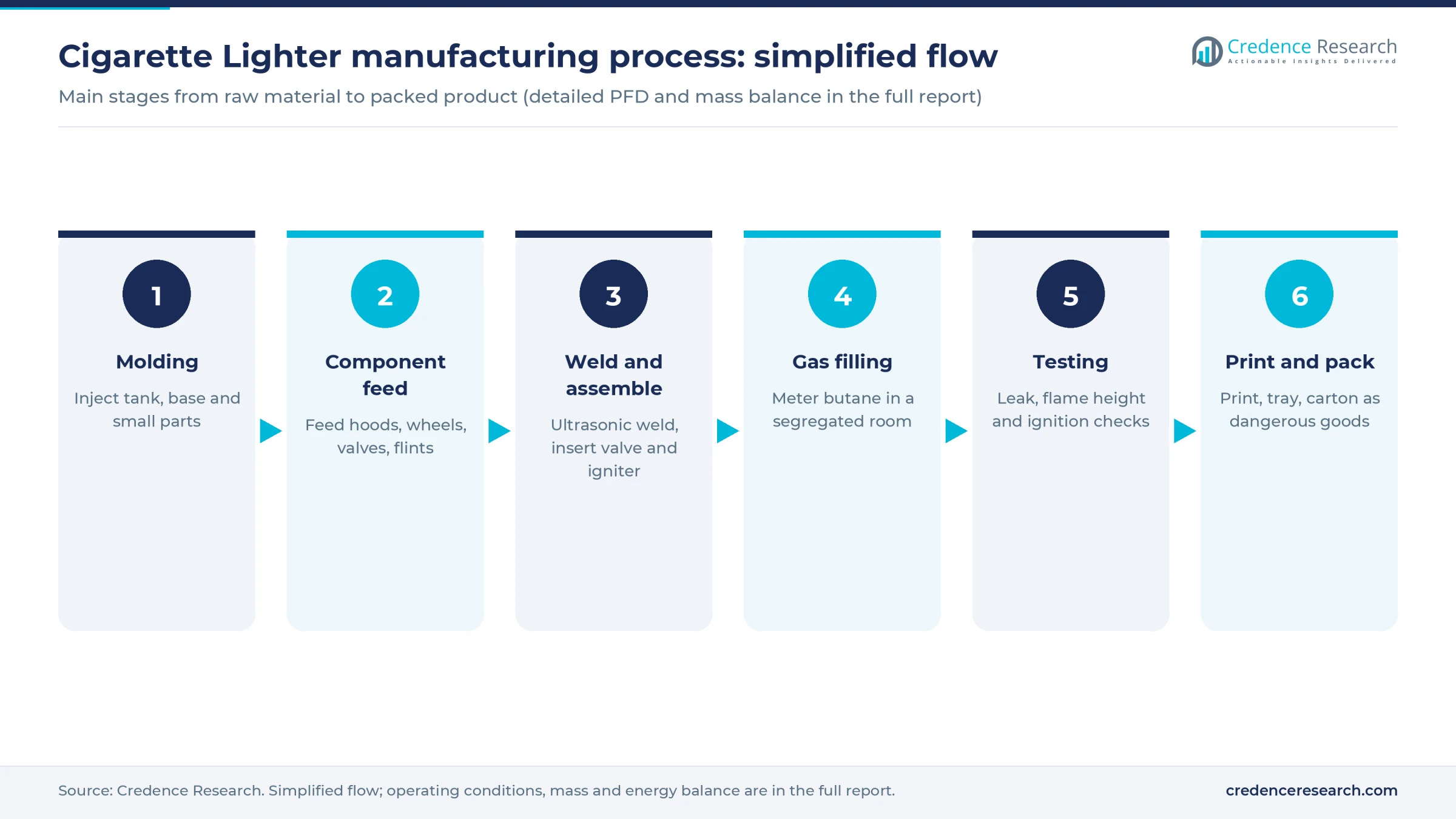
- Molding. Injection presses form the tank, base and small plastic parts. Tank resin must hold pressurized gas for years, so buyers specify grade closely. BIC, for example, says its J25 body uses Delrin technical resin, while low-price lighters generally use less costly transparent resins.
- Component preparation. Metal hoods, spark wheels, valves, burners, springs and flints are fed from bowls and vision-checked. Most plants buy these rather than make them.
- Welding and assembly. Tank and base are ultrasonically welded, then the valve, lever and igniter are inserted by automatic stations. A weak weld is both a scrap cost and a safety failure.
- Gas filling. Liquefied gas is metered into each tank in a segregated, ventilated room with flameproof electrical equipment. Fill weight control affects cost directly, since overfilling wastes gas and can make a unit unsafe.
- Testing. Lighters go through leak checks, flame height tests and ignition checks. Samples are also tested for drop, heat and pressure resistance against ISO 9994. Child-resistant models need a separate protocol with panels of children, usually carried out by a third-party lab.
- Printing and packing. Bodies are printed or labeled, then packed in display trays and cartons. Filled lighters ship as dangerous goods under UN 1057, which limits carton and freight options.
Automation is what made the industry's low price possible. Hunan Dongyi Electric, Xinhua reported in May 2025, cut one workshop from 200 workers to 40 while output rose ninefold. A new plant has to begin at that level, because manual assembly cannot compete anywhere.
Cigarette lighter plant setup cost
Setup cost for a plant rated at 100 million lighters a year is estimated at USD 5–13 million, excluding working capital. That capacity matches a mid-sized real producer, as Haopai Electric made more than 100 million lighters in 2024. Few complete lighter plant budgets are public, so this range is led by stated assumptions, with one disclosed automation program as a loose check, and should be treated as indicative.
The check is Dongyi Electric, which Chinese state media said spent CNY 20 million a year from 2016 and reached full automation in about four years. That is about CNY 80 million, or USD 11 million at an assumed 7.2 per dollar, though some reports describe the spending as R&D. Reported output ranges from about 300 million to 2 billion lighters a year, so scaling gives only a loose guide, roughly USD 2–5 million. The USD 5 million machinery ceiling is therefore an assumption. The lower end assumes about half of that, because a buyer of existing machine designs avoids Dongyi's development spending.
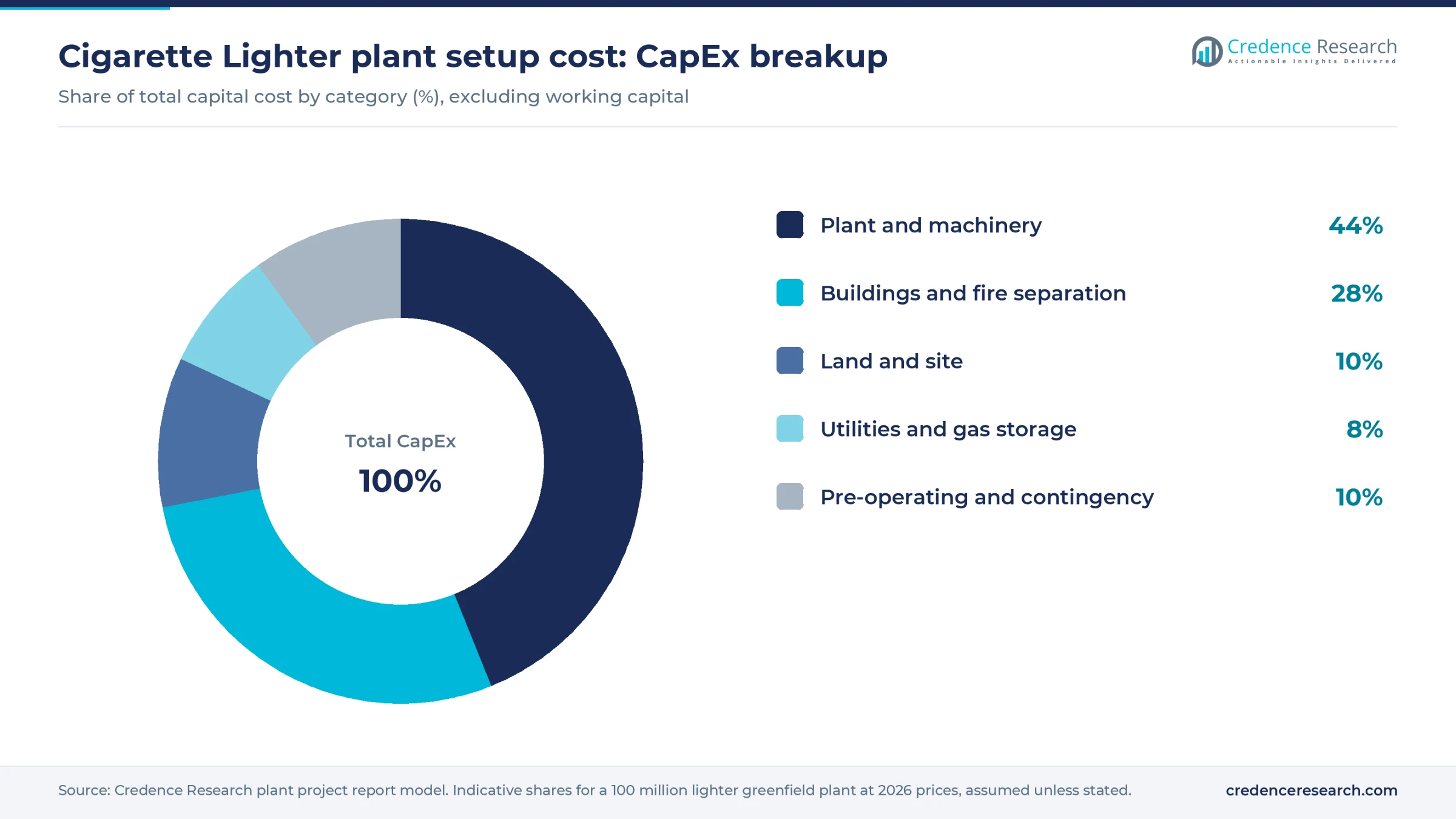
Land shows how one row is built. A plant this size needs about 1 hectare, including segregated gas storage and filling. An assumed land rate of USD 30–150 per square meter gives USD 300,000–1.5 million, with leased Asian parks at the low end and U.S. or EU sites at the high end. Buildings carry a similar spread, and fire separation adds cost anywhere.
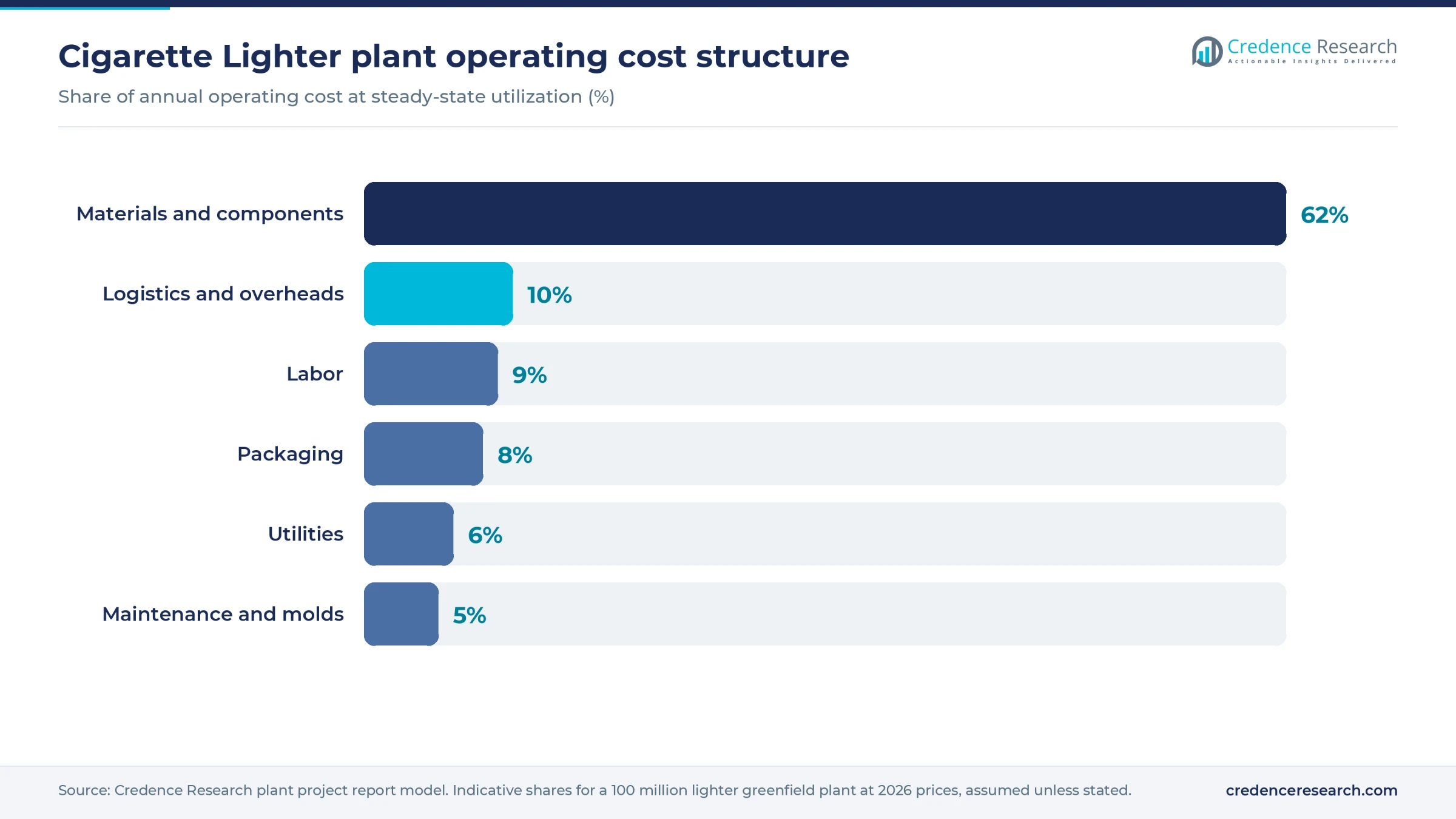
Operating cost is dominated by purchased materials and components. Labor is a small share once lines are automated, and a Dongyi executive has said it must stay under 7% of cost to hold the price. The largest hidden cost sits outside the budget, since Shaodong's makers buy over 200 component types within about 20 kilometers while a new plant elsewhere would import them. The full report can be customized to any country or region, with line-item costs for the chosen location.
Machinery and raw materials for a cigarette lighter plant
The core equipment list covers injection molding machines with multi-cavity molds, ultrasonic welders, automatic assembly lines with vibratory feeders and vision inspection, gas filling stations, leak and flame test units, pad or label printers and carton packers. Support plant includes butane storage with vapor detection, chillers, compressed air and a test laboratory. Molds and feeders wear quickly at these speeds, so spare tooling matters as much as the main machines. Credence Research values the plastic injection molding machine sector at USD 12,303 million for 2024, with a 4.63% CAGR, so press supply is broad.
Automated lighter assembly lines are a narrower market, with most builders linked to the Chinese supply base. A buyer outside China should budget for commissioning support, spare parts and the risk of slow service.
Raw materials come from distinct global chains:
- Plastic resins. Acetal and styrene-based grades come from producers in China, South Korea, Japan, Europe and the United States.
- Butane and isobutane. Refined from natural gas liquids and refinery streams, with major export supply from the Middle East and the United States.
- Flints. Ferrocerium alloys rely on rare earths, a chain led by China.
- Metal and electronic parts. Stamped hoods, wheels, springs and piezo igniters are concentrated in China, with smaller supply in Spain and Turkey.
India's import data shows the same pattern, with lighter parts mainly from China and smaller volumes from Spain, Turkey and the UAE.
Cigarette lighter business profit margin and ROI
Price is the starting point, and it is low. Hunan's 2025 export figures imply about CNY 0.63 a lighter, or about USD 0.09 at an assumed 7.2 per dollar. A 2025 newsletter account, without a direct source for the figure, puts Shaodong's profit at only about CNY 0.02–0.04 a lighter. Certified child-resistant product and markets with import barriers earn more, so the model uses an assumed ex-factory range of USD 0.09–0.16.
At 85 million lighters sold, that gives annual revenue of about USD 7.7–13.6 million. Gross margin before depreciation is estimated at 12–22%, based on assumed costs. After assumed overheads of 6% of revenue, cash profit runs about USD 0.5–2.2 million.
Payback follows directly from those cash profit figures. A low-cost site selling commodity product at export prices takes about 11 years. An Asian site earning USD 0.12 a lighter takes about 5 years, and a U.S. or EU site at USD 0.16 takes about 6. A plant behind import barriers could recover faster, though that gain depends on trade policy staying in place. Sensitivity is high, since a USD 0.01 price change moves cash profit by about USD 850,000, a large share of the total.
| Return metric | Value |
|---|---|
| IRR | Available in report |
| NPV | Available in report |
| ROI | Available in report |
| DSCR | Available in report |
How to start a cigarette lighter business, licenses and approvals
Lighters combine a flammable gas with a consumer product, so approvals fall into two groups. For the business and site, a promoter typically needs company and tax registration, land use and building permits, an environmental permit, fire and gas storage clearances, and occupational safety registration. For the product, the key requirements are safety certification, child-resistance testing where required, dangerous goods packaging and export or import registration.
Market rules often matter more than plant permits. In the United States, disposable models under a USD 2.75 customs value or factory price and all novelty lighters must resist operation by at least 85% of test children, and the U.S. regulator requires a report 30 days before first distribution.
Examples by market
| Market | Product rules | Plant and gas rules |
|---|---|---|
| United States | Consumer Product Safety Commission: 16 CFR Part 1210, pre-distribution report, General Certificate of Compliance; Part 1212 for multipurpose lighters | OSHA 29 CFR 1910.110 for LP gas handling, state fire codes based on NFPA 58, state air permits where applicable |
| European Union | General Product Safety Regulation (EU) 2023/988; child-resistance and novelty lighter rules first set by Commission Decision 2006/502/EC, whose current status exporters should confirm; EN ISO 9994 and EN 13869 as test standards | ATEX workplace rules, national environmental permit, Seveso rules if gas stocks exceed thresholds |
| India | Bureau of Indian Standards mark under IS/ISO 9994:2018, set by the Quality Control Order for flame-producing lighters; DGFT limits on imported lighters and parts | Petroleum and Explosives Safety Organisation license for gas storage, State Pollution Control Board consents, Factories Act registration |
Key cigarette lighter manufacturers and recent developments
The field splits into global brands and Chinese volume producers. BIC of France leads branded disposables. Flamagas of Spain makes Clipper refillables, Tokai of Japan is known for Scripto, and Zippo builds metal windproof lighters in Bradford, Pennsylvania. In Shaodong, Hunan Dongyi Electric, Huanxing and Shunfa supply export and domestic buyers, while Haopai focuses more on China's domestic market.
Three developments from the past year show where pressure is building:
- October 2026. BIC reported a 4.6% organic decline in third-quarter lighter sales, with all major regions affected, especially Europe and Latin America.
- April 2026. The U.S. regulator announced a recall of about 4,300 China-made Prestige torch lighters from importer Prestige Import Group, which lacked child-resistant mechanisms. It had issued a similar warning on novelty dice lighters in February.
- February 2026. Hunan reported its 2025 export gains, with 18 exporters and sharp growth in Africa. Customs officials advised firms to meet market access rules and move to safer, higher-value products.
Together these point to the same conclusion, that compliance is becoming a stronger competitive edge than price alone.
What's inside the Cigarette Lighter project report PDF
The report runs to 21 chapters. Open a chapter to see its sections.
1. Preface
2. Scope and Methodology
- 2.1 Objectives of the Study
- 2.2 Stakeholders
- 2.3 Research Methodology
- 2.4 Data Sources and Key Assumptions
3. Executive Summary
- 3.1 Market Snapshot
- 3.2 Project at a Glance (Capacity, CapEx, OpEx)
- 3.3 Key Financial Indicators (IRR, NPV, Payback, Break-even)
- 3.4 Feasibility Verdict
4. Product Overview
- 4.1 Cigarette Lighter Definition and Properties
- 4.2 Grades and Specifications (BIS / ISO / ASTM)
- 4.3 HS Code and Classification
- 4.4 Key Applications
- 4.5 Substitutes
5. Global Cigarette Lighter Market
- 5.1 Market Overview
- 5.2 Historical and Current Market Performance (Volume and Value)
- 5.3 Market Breakup by Grade / Type
- 5.4 Market Breakup by End-Use Industry
- 5.5 Market Breakup by Region
- 5.6 Market Drivers, Restraints and Trends
- 5.7 Value Chain Analysis
- 5.8 Market Forecast
6. Target Country Cigarette Lighter Market Analysis
- 6.1 Demand and Supply Analysis
- 6.2 Installed Capacity vs Demand Gap
- 6.3 Import Dependence
- 6.4 Demand Forecast by End-Use
7. Trade Analysis
- 7.1 Imports by Volume, Value and Country
- 7.2 Exports by Volume, Value and Country
- 7.3 Trade Balance and Opportunities
8. Price Analysis
- 8.1 Historical Cigarette Lighter Price Trends by Region
- 8.2 Raw Material / Feedstock Price Trends and Linkage
- 8.3 Price Forecast
- 8.4 Margins Across the Value Chain
9. Competitive Landscape
- 9.1 Market Structure
- 9.2 Key Players and Installed Capacities
- 9.3 Profiles of Key Players
- 9.4 Recent Developments (Expansions, M&A, New Plants)
10. Manufacturing Process and Technology
- 10.1 Comparison of Technology Routes
- 10.2 Selected Route and Process Flow Diagram
- 10.3 Unit Operations Involved
- 10.4 Chemical Reactions Involved
- 10.5 Mass Balance and Raw Material Requirements
- 10.6 Energy Balance
- 10.7 Quality Assurance Criteria and Technical Tests
- 10.8 By-products and Waste Handling
- 10.9 Technology Licensors / Providers
11. Project Details, Requirements and Costs
- 11.1 Land, Location and Site Development
- 11.1.1 Site Selection Criteria
- 11.1.2 Location Analysis
- 11.1.3 Land Requirement and Costs
- 11.1.4 Site Development Costs
- 11.2 Plant Layout
- 11.2.1 Layout Principles
- 11.2.2 Proposed Layout
- 11.2.3 Factors Influencing Layout
- 11.3 Civil Works and Buildings
- 11.4 Plant Machinery
- 11.4.1 Machinery Requirements and Specifications
- 11.4.2 Machinery Costs
- 11.4.3 Machinery Suppliers
- 11.5 Raw Materials
- 11.5.1 Requirements per Tonne of Output
- 11.5.2 Procurement and Sourcing
- 11.5.3 Costs
- 11.5.4 Suppliers
- 11.6 Packaging
- 11.6.1 Packaging Requirements
- 11.6.2 Packaging Costs
- 11.6.3 Packaging Suppliers
- 11.7 Storage and Material Handling
- 11.8 Transportation Requirements and Costs
- 11.9 Utilities
- 11.9.1 Power Requirements and Costs
- 11.9.2 Water Requirements and Costs
- 11.9.3 Steam, Fuel and Other Utilities
- 11.10 Manpower Requirements and Wages
12. Environment, Health, Safety and Sustainability
- 12.1 Effluent and Emissions Management
- 12.2 Hazard Classification and Safety Measures
- 12.3 Carbon Footprint
- 12.4 Green / Low-Carbon Process Options
13. Regulatory Procedures, Approvals and Certifications
- 13.1 Licences and Registrations
- 13.2 Environmental Clearances
- 13.3 Product Certifications (BIS, REACH, etc.)
- 13.4 Approval Timeline
14. Project Implementation Schedule
15. Project Economics
- 15.1 Capital Cost of the Project
- 15.2 Techno-Economic Parameters
- 15.3 Capacity Utilization and Ramp-up
- 15.4 Product Pricing and Margins
- 15.5 Income Projections
- 15.6 Expenditure Projections
- 15.7 Working Capital Requirement
- 15.8 Taxation
- 15.9 Depreciation
16. Financial Analysis
- 16.1 Projected Profit and Loss Account
- 16.2 Projected Cash Flow Statement
- 16.3 Projected Balance Sheet
- 16.4 Liquidity Analysis
- 16.5 Profitability Analysis (Payback, NPV, IRR, ROI)
- 16.6 Break-even Analysis
- 16.7 Debt Service Coverage Ratio (DSCR)
- 16.8 Sensitivity Analysis
- 16.9 Scenario and Uncertainty Analysis
17. Funding and Incentives
- 17.1 Means of Finance and Debt-Equity Structure
- 17.2 Loans and Financial Assistance
- 17.3 Government Schemes and Subsidies (PLI, State Policies)
18. Risk Assessment
- 18.1 Key Success Factors
- 18.2 Key Risk Factors
- 18.3 Risk Mitigation
19. Strategic Recommendations
20. Case Study of a Successful Venture
21. Appendix
- 21.1 Detailed Assumptions
- 21.2 Abbreviations
- 21.3 List of Tables and Figures
- 21.4 Sources
This page vs. the full report
| Data point | On this page (free) | In the full report |
|---|---|---|
| Total CapEx | One rounded range at one capacity | Exact figure at three capacities with a line-item breakup |
| CapEx breakup | Category shares (%) only | Cost, quantity and supplier for every machine |
| Operating cost | Share of raw materials, utilities and labor | Per-unit cost sheet with each input price and consumption |
| Profitability | Gross margin range and payback band | Exact IRR, NPV, ROI, break-even and DSCR |
| Financial statements | List of what is included | 10-year P&L, cash flow, balance sheet and Excel model |
| Sensitivity | One directional line | Full sensitivity and scenario tables |
| Process | Simplified flow diagram | Detailed process flow, mass and energy balance, operating conditions |
| Machinery | Names of the main machines | Specifications, capacity, cost and supplier list |
| Market | Headline size, growth and India demand trend | Segment, region, trade and price forecast tables |
| Suppliers and buyers | Supplier types and sourcing hubs | Named suppliers and buyers |
Cigarette Lighter project report: FAQs
How much does a cigarette lighter plant cost to set up?
What is the profit margin in lighter manufacturing?
How long is the payback on a lighter plant?
Which HS code applies to disposable lighters?
Do lighters need to be child-resistant?
Can a new plant compete with Chinese lighter makers?

About the analyst
Rajdeep Kumar Deb, Lead Analyst - Consumer & Finance
Rajdeep brings a decade of consumer goods and financial services insight to strategic market analysis.
Related market research
- Tobacco Market Size, Growth, Analysis & Forecast to 2032
- Butane Gas Canisters Market Size, Growth, Trend and Forecast 2032
- Plastic Injection Molding Machine Market Size, Share and Forecast 2032
- Tobacco Packaging Market Size, Growth & Forecast 2032
- Luxury Cigarette Market Size, Growth, Trends and Forecast 2032
- Polypropylene Injection Molding Market Size, Share & Growth Report 2032
More plant project reports
- Palm Oil Processing Plant Project Report (DPR) 2026
- Perfume Manufacturing Plant Project Report (DPR) 2026
- Paper Cups Manufacturing Plant Project Report (DPR) 2026
- Cigarette Manufacturing Plant Project Report (DPR) 2026
- Ceiling Fan Manufacturing Plant Project Report (DPR) 2026
- Avocado Oil Processing Plant Project Report (DPR) 2026