
| REPORT ATTRIBUTE | DETAILS |
|---|---|
| Historical Period | 2019-2022 |
| Base Year | 2023 |
| Forecast Period | 2024-2032 |
| Optocoupler IC Market Size 2024 | USD 2716.48 Million |
| Optocoupler IC Market, CAGR | 4.99% |
| Optocoupler IC Market Size 2032 | USD 4010.42 Million |
Market Overview:
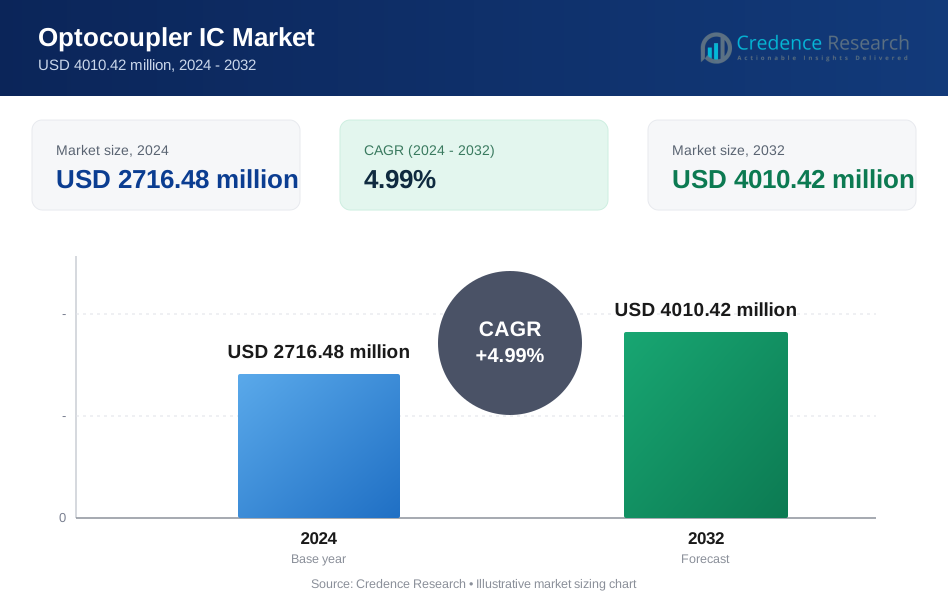
The Optocoupler IC Market is projected to grow from USD 2716.48 million in 2024 to an estimated USD 4010.42 million by 2032, with a compound annual growth rate (CAGR) of 4.99% from 2024 to 2032.
Key drivers of the optocoupler IC market include the increasing demand for reliable isolation in electronic devices, particularly in industries like automotive, industrial automation, telecommunications, and consumer electronics. The growing adoption of automation in manufacturing processes and the rising demand for energy-efficient electronic devices are further fueling the market's growth. Additionally, the ongoing shift toward smart homes, electric vehicles (EVs), and renewable energy solutions are contributing to the demand for optocouplers, as they provide essential protection and signal isolation in high-voltage and sensitive applications. Technological advancements, such as the development of high-speed optocouplers and miniaturization of components, are also enhancing the market outlook. The shift toward electric and hybrid vehicles, with their complex electronic systems, has led to increased use of optocoupler ICs in automotive applications, especially for battery management and power control systems.
Regionally, North America and Europe are leading the optocoupler IC market, driven by strong demand from the automotive and industrial automation sectors. In Asia Pacific, particularly in countries like China, Japan, and South Korea, the market is witnessing significant growth due to the region's manufacturing capabilities and technological advancements in electronics. The rising demand for consumer electronics, coupled with investments in industrial automation, is supporting growth in this region. Latin America and the Middle East & Africa are also expected to see steady growth in the adoption of optocouplers as part of the expanding electronics and automotive industries.
Market Drivers:
Increasing Demand for Reliable Isolation in Electronics:
The need for reliable isolation in electronic systems is a key driver in the optocoupler IC market. Optocouplers are critical in ensuring safety by isolating sensitive circuits from high-voltage systems. This is particularly important in sectors such as industrial automation, telecommunications, and consumer electronics. According to the International Electrotechnical Commission (IEC), as industries increasingly adopt connected systems and automation, the demand for isolation technologies like optocouplers will continue to grow. For instance, the global industrial automation market is projected to grow from $200 billion in 2023 to over $350 billion by 2030, according to the International Energy Agency (IEA). As automation systems become more integrated, the demand for optocouplers in industrial machinery to ensure safe operations and prevent electrical interference will escalate.
Growth in Automotive Industry and Electrification:
The automotive sector, particularly the shift toward electric vehicles (EVs), is significantly driving the demand for optocoupler ICs. As EVs and hybrid vehicles adopt more complex electronic systems, the need for signal isolation and high-voltage protection becomes increasingly critical. The U.S. Department of Energy has forecasted that the number of electric vehicles in the U.S. will grow by 30% annually through 2025. For instance, Tesla has used optocouplers in their battery management systems to monitor and control high-voltage components safely. The global electric vehicle market, according to the International Energy Agency (IEA), is expected to witness sales of over 10 million electric vehicles annually by 2025. As the number of electric vehicles increases, so does the need for optocouplers to ensure the safety and reliability of these vehicles' electronic systems.
Rising Adoption of Renewable Energy and Smart Homes:
The transition toward renewable energy sources and the rise of smart home technologies are also major drivers for the optocoupler IC market. Renewable energy systems, such as solar and wind, require reliable isolation to prevent damage to components caused by electrical surges. Similarly, the growing adoption of smart homes, which rely on interconnected devices, also demands robust signal isolation. For instance, global renewable energy capacity is expected to grow by 50% from 2020 to 2030, according to the International Renewable Energy Agency (IRENA). The increasing demand for solar and wind power generation systems, which rely on optocouplers for electrical protection, will significantly boost the market for these components. In the smart home sector, the number of connected devices is expected to increase dramatically. The World Economic Forum (WEF) estimates that by 2030, there will be over 50 billion connected devices globally, many of which will require optocouplers to ensure the safety and reliability of communication systems.
Technological Advancements and Miniaturization of Components:
Technological advancements, such as the development of high-speed optocouplers and miniaturization of components, are driving the growth of the optocoupler IC market. These innovations allow for faster, smaller, and more energy-efficient components to meet the growing demand for compact and high-performance electronics. For instance, Intel and Qualcomm have incorporated advanced optocoupler ICs in their telecommunications equipment to facilitate high-speed data transmission. The Global System for Mobile Communications Association (GSMA) projects that global 5G connections will exceed 1.5 billion by 2025. This increase in demand for high-speed communication networks will further drive the need for high-performance optocouplers. Moreover, as consumer electronics continue to become smaller and more powerful, the miniaturization of electronic components is becoming critical. The World Bank reports that innovation and miniaturization in electronics will significantly boost the global semiconductor market, which includes optocoupler ICs, over the next decade.
Market Trends:
Advancements in High-Speed and Miniaturized Optocouplers:
Technological advancements, particularly the development of high-speed optocouplers and the miniaturization of components, are transforming the optocoupler IC market. These innovations enable faster data transmission, improved isolation, and more compact designs, making optocouplers increasingly suitable for next-generation electronic systems. High-speed optocouplers, are essential for telecommunications and automotive applications where high-frequency signal transmission and reliable isolation are critical. For instance, the International Telecommunication Union (ITU) has projected that global internet traffic will reach approximately 4.8 zettabytes per year by 2025. This massive increase in data demand is driving the need for high-speed optocouplers to support advanced data centers, telecom infrastructures, and communication networks. These high-speed devices are being integrated into the latest communication equipment, allowing for the seamless flow of data over 5G and fiber-optic networks. Miniaturization is also a major trend, as electronic devices become more compact while maintaining high performance. The trend toward smaller, more efficient electronic components aligns with the push for smaller optocouplers, which can now fit into more compact and energy-efficient systems. Qualcomm, a leader in telecommunications technology, has incorporated miniaturized optocouplers into its 5G infrastructure to enhance performance and reduce power consumption.
Shift Toward Smart, Connected Devices and IoT Integration:
Another significant trend in the optocoupler IC market is the rapid rise of the Internet of Things (IoT) and the integration of smart, connected devices into everyday life. IoT systems often require precise signal isolation to ensure the security and efficiency of communication between devices, making optocouplers critical in these systems. As more devices become interconnected in smart homes, factories, and transportation networks, the demand for optocouplers is expected to rise. For instance, the International Monetary Fund (IMF) has forecasted that global IoT spending will reach over $1 trillion by 2025. This surge in investment in IoT technologies is leading to greater use of optocouplers in a wide range of IoT devices, including sensors, wearables, and smart home automation systems. Companies like Bosch and Samsung are already incorporating optocouplers in their smart home products to ensure data integrity and device safety. The demand for optocouplers in these applications will continue to grow as smart cities and industrial IoT systems expand globally. The growing adoption of connected devices in healthcare, automotive, and industrial sectors is another factor driving the integration of optocouplers into IoT systems. According to The World Bank, IoT applications in healthcare alone are expected to reduce healthcare costs globally by more than $100 billion annually by 2025, which will further increase the demand for optocouplers that ensure the safe operation of medical devices and connected systems.
Market Challenge Analysis:
Competitive Landscape and Technological Advancements:
The Optocoupler IC market is highly competitive, with numerous global players vying for market share. Key market participants, such as Toshiba Corporation, Broadcom, ON Semiconductor, and Vishay Intertechnology, dominate the landscape with a broad range of optocoupler products. The competition in this market is intensifying as companies continually innovate and improve their product offerings to meet the growing demand for high-performance, cost-effective solutions. Technological advancements are at the forefront of these developments, with significant improvements in speed, efficiency, and miniaturization of optocoupler ICs. The increasing use of optocouplers in high-speed communication systems, automotive electronics, renewable energy systems, and industrial automation is pushing manufacturers to deliver solutions with enhanced capabilities and greater reliability. However, while technological innovation is crucial, it also presents a challenge for market participants to stay ahead of rapidly evolving customer demands. The shift toward smaller, more integrated systems has led to the rise of complex product designs, requiring manufacturers to invest in research and development (R&D) to meet the latest standards. Furthermore, the shift towards solid-state technologies and the growing interest in alternatives like transformers and solid-state relays create added pressure for traditional optocoupler IC manufacturers. Companies must focus on continuous innovation, reducing product costs, and improving performance to remain competitive in an increasingly fragmented and technologically demanding market.
Supply Chain Disruptions and Cost Pressures:
The global Optocoupler IC market is also faced with significant challenges due to ongoing supply chain disruptions and rising component costs. These challenges, which have been exacerbated by the COVID-19 pandemic and geopolitical tensions, are leading to longer lead times, production delays, and increased material costs. Optocoupler ICs rely on specific raw materials, such as semiconductors, and disruptions in the supply of these materials can severely affect production schedules and product availability. For instance, the global semiconductor shortage has created a bottleneck in the manufacturing of optocouplers, forcing companies to adjust their production capacity or seek alternative sourcing strategies. Additionally, inflationary pressures on raw materials and transportation costs have led to increased pricing for optocoupler ICs. This cost escalation is challenging for manufacturers who are already dealing with price-sensitive customers in industries like consumer electronics, automotive, and industrial automation. To mitigate these pressures, companies need to adopt effective supply chain management practices, build strategic partnerships with suppliers, and explore automation and alternative production techniques to lower costs. Moreover, the growing demand for energy-efficient and environmentally friendly components adds another layer of complexity, as manufacturers must invest in sustainable practices and technologies, further raising production costs. Thus, the market faces a delicate balance between maintaining profitability and meeting customer expectations in a volatile economic environment.
Market Segmentation Analysis:
By Type
The optocoupler IC market is segmented by type into phototransistor, photometric, and photodiode optocouplers. Phototransistor optocouplers are widely used due to their ability to provide high isolation and signal amplification, making them suitable for industrial and automotive applications. Photometric optocouplers, which offer fast switching speeds and high current transfer ratios, are increasingly favored in telecom and data communication systems. Photodiode optocouplers are commonly employed in low-power applications, providing accurate signal isolation and operating efficiently in compact systems.
By Technology
Optocoupler ICs are categorized by technology into traditional optocouplers and newer, more advanced optocouplers, including high-speed and miniaturized types. Traditional optocouplers remain essential in applications requiring basic isolation and signal transmission, while high-speed optocouplers are designed for advanced data transmission systems, such as 5G telecom and high-speed networking. Miniaturized optocouplers are particularly critical in consumer electronics, where space and power efficiency are vital. The transition towards newer technologies is being driven by increasing demands for faster, smaller, and more efficient components across industries.
By End-User
The end-user segmentation of the optocoupler IC market includes automotive, industrial automation, consumer electronics, telecommunications, and renewable energy. The automotive sector is a key contributor, with increasing demand for optocouplers in electric vehicles for battery management and power control. Industrial automation requires optocouplers for machine control and safety systems, while the telecommunications sector utilizes them for signal isolation in high-speed communication systems. Consumer electronics, driven by the rise of IoT and smart devices, also drives significant demand. Furthermore, renewable energy applications, particularly in solar and wind power systems, require optocouplers for safe and efficient operation of power systems.
Segmentation:
Based on Product Type:
- Phototransistor Optocouplers
- Photometric Optocouplers
- Photodiode Optocouplers
Based on Technology:
- Traditional Optocouplers
- High-Speed Optocouplers
- Miniaturized Optocouplers
Based on End-User:
- Automotive
- Industrial Automation
- Consumer Electronics
- Telecommunications
- Renewable Energy
Based on Region:
- North America
- U.S.
- Canada
- Mexico
- Europe
- Germany
- France
- U.K.
- Italy
- Spain
- Rest of Europe
- Asia Pacific
- China
- Japan
- India
- South Korea
- South-east Asia
- Rest of Asia Pacific
- Latin America
- Brazil
- Argentina
- Rest of Latin America
- Middle East & Africa
- GCC Countries
- South Africa
- Rest of the Middle East and Africa
Regional Analysis:
North America
North America holds a significant share of the optocoupler IC market, accounting for approximately 30% of the global market. The region's dominance can be attributed to its well-established technology infrastructure and high demand for optocoupler ICs in various industries such as automotive, telecommunications, industrial automation, and consumer electronics. The United States, in particular, is a major player in the adoption and development of advanced electronic systems, leading to the high consumption of optocoupler ICs, which are integral for signal isolation, safety, and noise reduction in these applications. Additionally, North America's focus on renewable energy systems, electric vehicles (EVs), and industrial automation is driving the demand for optocoupler ICs. In the automotive sector, the increasing adoption of advanced driver-assistance systems (ADAS) and electric vehicle components is a key factor influencing the market. Furthermore, the region's strong emphasis on research and development and its presence of key market players, such as Broadcom and Texas Instruments, contribute to the steady growth of the optocoupler IC market. However, challenges like supply chain disruptions and high component costs are starting to affect the overall market growth in this region, requiring manufacturers to adopt new strategies for efficient production and cost management.
Europe
Europe is another important region for the optocoupler IC market, holding a market share of about 25% globally. The region's demand for optocoupler ICs is primarily driven by the automotive, industrial, and consumer electronics sectors, particularly in countries like Germany, France, and the United Kingdom. The growing adoption of electric vehicles, renewable energy systems, and automation technologies in Europe is significantly influencing the demand for optocoupler ICs. These components are crucial in ensuring safety, reducing noise, and providing signal isolation in high-voltage applications, making them indispensable for automotive and industrial applications. Europe’s market growth is also supported by stringent regulatory standards that push for more energy-efficient and environmentally friendly electronic systems, particularly in the automotive and industrial automation sectors. As a result, manufacturers in Europe are focusing on producing high-performance optocoupler ICs that meet the region's increasingly stringent safety, reliability, and energy efficiency requirements. However, the market is also facing challenges, including competition from lower-cost manufacturers in Asia-Pacific and the increasing costs of raw materials. Despite this, Europe's commitment to sustainable technologies and the adoption of cutting-edge electronic solutions ensure a steady demand for optocoupler ICs in the coming years.
Asia-Pacific
Asia-Pacific (APAC) is the largest and fastest-growing market for optocoupler ICs, commanding a market share of approximately 40% globally. The region’s dominance is driven by its rapid industrialization, large-scale manufacturing capabilities, and strong presence in key electronic sectors. Countries such as China, Japan, South Korea, and India are major consumers and producers of optocoupler ICs. The booming electronics manufacturing industry, especially in China and South Korea, plays a pivotal role in the region's market share, as optocoupler ICs are integral to a wide range of applications, including consumer electronics, automotive, telecommunications, and industrial equipment. The strong growth of the automotive industry in countries like China and Japan, particularly with the increasing adoption of electric vehicles and autonomous driving technologies, has significantly boosted the demand for optocoupler ICs. Additionally, the increasing focus on smart grids, industrial automation, and renewable energy projects across APAC further contributes to the growing need for these components. The region also benefits from a large number of low-cost manufacturing facilities, which enables the production of optocoupler ICs at competitive prices, making them attractive to global markets. However, APAC faces challenges such as the rising cost of raw materials and the intense competition from local manufacturers. Despite these challenges, the region’s overall market growth is expected to continue, driven by technological advancements, increased investment in electronics infrastructure, and the ongoing demand for consumer electronics and automotive applications.
Key Player Analysis:
- Broadcom Inc.
- Toshiba Corporation
- ON Semiconductor
- Vishay Intertechnology
- Renesas Electronics Corporation
- Microchip Technology Inc.
- NTE Electronics, Inc.
- Lite-On Technology Corporation
- Sharp Corporation
- Avago Technologies (now part of Broadcom
Competitive Analysis:
The competitive landscape of the optocoupler IC market is characterized by a high degree of rivalry, with several well-established global players competing for market share. Leading companies such as Broadcom, Toshiba, ON Semiconductor, Vishay Intertechnology, and Renesas Electronics dominate the market, offering a diverse range of optocoupler ICs designed for various applications across automotive, industrial, telecommunications, and consumer electronics sectors. These companies focus heavily on innovation, continually enhancing the performance, efficiency, and miniaturization of their products to meet the growing demands for high-speed data transfer, noise isolation, and safety in electronic systems. In response to market needs, manufacturers are also introducing optocoupler ICs that offer improved energy efficiency, greater reliability, and compact designs. Strategic partnerships, mergers, and acquisitions play a crucial role in strengthening market positions, enabling companies to expand their product portfolios and reach a broader customer base. However, the market is also witnessing increasing competition from low-cost manufacturers, particularly in the Asia-Pacific region, where production capabilities and cost advantages provide a competitive edge. To maintain leadership, major players must address challenges such as rising raw material costs, supply chain disruptions, and increasing pressure to meet stringent regulatory standards for safety and environmental impact. As the market evolves, ongoing investments in research and development, as well as cost-effective production processes, are key factors for companies seeking to secure their position in this competitive market.
Recent Developments:
- In September 2022, Broadcom launched a new high-speed optocoupler IC designed to improve signal integrity in data transmission systems. This new IC featured enhanced isolation and faster switching speeds, which allowed for more efficient and secure communication in industrial applications. Additionally, companies like ON Semiconductor and Toshiba introduced optocoupler ICs with better thermal performance and increased reliability, meeting the expanding needs for more robust and energy-efficient solutions in power supplies and motor control systems. The rising adoption of electric vehicles (EVs) and renewable energy systems further fueled demand for optocouplers, particularly for their ability to provide electrical isolation and prevent voltage spikes.
- In February 2024, Vishay Intertechnology introduced a new optocoupler IC with enhanced electromagnetic interference (EMI) suppression, targeting applications in automotive and industrial control systems. This IC is designed to ensure high performance in environments with high electrical noise, offering increased reliability for critical safety systems.
- In March 2024, Lite-On Technology released an optocoupler that supports faster data transfer rates and is optimized for 5G network infrastructure. These developments reflect the growing need for optocoupler ICs to meet the demands of advanced communication technologies and the increasing emphasis on safety and performance in automotive and industrial applications.
Market Concentration & Characteristics:
The optocoupler IC market exhibits moderate market concentration, with a few dominant players holding a significant portion of the market share, while a large number of smaller regional manufacturers contribute to market diversity. Leading companies such as Broadcom, Toshiba, ON Semiconductor, Vishay Intertechnology, and Renesas Electronics collectively command a substantial share, benefiting from their strong brand recognition, extensive R&D capabilities, and established customer relationships across various industries like automotive, industrial automation, telecommunications, and consumer electronics. Despite this concentration, the market is characterized by a high degree of competition, especially in regions like Asia-Pacific, where cost-efficient production and a rapidly growing electronics industry have enabled local manufacturers to capture significant market shares. This has created a dynamic competitive environment, with both global and regional players striving to innovate and offer products that cater to evolving market needs such as higher speed, greater efficiency, and smaller form factors. The market is also influenced by technological advancements, with an increasing demand for optocoupler ICs that offer enhanced features such as improved thermal performance, miniaturization, and higher isolation voltages. Furthermore, the market is shifting towards more integrated solutions, leading to greater product differentiation among manufacturers. The growing focus on energy-efficient and environmentally friendly components has spurred innovation, with companies developing more sustainable optocoupler ICs to meet stringent regulatory requirements. Overall, while a few major players dominate the market, the diversity of regional manufacturers and constant technological innovations ensure a competitive and evolving landscape.
Report Coverage:
This report provides a comprehensive analysis of the global optocoupler IC market, encompassing key trends, growth drivers, challenges, and regional dynamics. It offers an in-depth examination of the market's competitive landscape, highlighting major players such as Broadcom, Toshiba, ON Semiconductor, and Vishay Intertechnology, along with emerging competitors in key regions like North America, Europe, and Asia-Pacific. The report also delves into the market’s technological advancements, including innovations in speed, miniaturization, and energy efficiency, which are driving the demand for optocoupler ICs across industries such as automotive, telecommunications, industrial automation, and consumer electronics. Additionally, it explores the regional market share, with particular focus on the dominance of the Asia-Pacific region, which holds the largest market share due to its manufacturing capacity and growing electronics sector. The analysis further covers the challenges the market faces, including supply chain disruptions, rising raw material costs, and increasing competition from low-cost manufacturers. It provides insights into market concentration and characteristics, noting the balance between global players and regional manufacturers. Furthermore, the report evaluates market opportunities arising from the increasing adoption of electric vehicles, renewable energy systems, and industrial automation, which are expected to fuel future growth. The report serves as a valuable resource for stakeholders in the optocoupler IC market, offering data-driven insights to guide decision-making and strategic planning in this competitive and rapidly evolving industry.
Future Outlook:
- The optocoupler IC market is expected to experience sustained growth driven by the increasing demand for reliable isolation in electronic systems across various industries.
- Technological advancements in high-speed optocouplers will continue to enhance data transmission capabilities and improve overall system performance.
- The miniaturization of components will make optocouplers more efficient, enabling their integration into compact and energy-efficient systems.
- The shift toward electric vehicles will increase demand for optocouplers in battery management and power control systems.
- The growing adoption of smart home technologies will drive the need for optocouplers to ensure the safety and reliability of interconnected devices.
- Expanding industrial automation and robotics will further propel the need for optocouplers in machinery and control systems.
- The rise of 5G networks will create new opportunities for optocouplers in telecom infrastructure to support high-speed, reliable communication.
- The renewable energy sector, including solar and wind power, will continue to contribute to optocoupler demand due to their role in electrical protection.
- The healthcare industry’s adoption of connected medical devices will lead to increased reliance on optocouplers for system safety and isolation.
- Regional growth in Asia Pacific, driven by industrial expansion and advancements in manufacturing technologies, will be a key factor in market development.
Request a Free Sample
Fill in your details and we'll send you a free sample report.
- Sample data tables & charts
- Research methodology
Market Dynamics
Increasing Demand for Reliable Isolation in Electronics
Optocoupler ICs are essential for providing electrical isolation between high-voltage and low-voltage circuits, which is critical for safety and noise reduction in industrial automation, telecommunications, and consumer electronics. As electronic systems become more complex and integrated, the need for robust isolation solutions is driving market growth.
Growth in Automotive Industry and Electrification
The rapid adoption of electric and hybrid vehicles, which require advanced battery management and power control systems, is significantly increasing the use of optocoupler ICs for signal isolation and high-voltage protection. Automotive electronics' complexity and safety requirements are fueling demand for these components.
Rising Adoption of Renewable Energy and Smart Homes
Renewable energy systems such as solar and wind power, as well as the proliferation of smart home devices, require reliable signal isolation to protect sensitive electronics from electrical surges and interference. The expansion of these sectors is boosting the need for optocoupler ICs.
Technological Advancements and Miniaturization
Innovations in high-speed and miniaturized optocouplers are enabling faster data transmission and integration into compact, energy-efficient devices. This trend is expanding the application scope of optocoupler ICs in next-generation electronics, telecommunications, and IoT devices.
Expansion of Industrial Automation and Robotics
The increasing automation of manufacturing processes and the deployment of robotics in industry require optocoupler ICs for machine control, safety systems, and reliable signal transmission. This industrial shift is a major driver for the market as factories modernize and adopt more sophisticated electronic controls.
Need a Custom Version of This Report?
Tailor the scope, geography, or segments to your exact requirements.
- Custom geography or segment scope
- Direct access to our analyst team
Frequently Asked Questions
What is the projected growth of the Optocoupler IC market?
What are the main factors driving the growth of the Optocoupler IC market?
How is the automotive sector influencing the demand for Optocoupler ICs?
Which regions are leading the Optocoupler IC market?
What technological advancements are shaping the Optocoupler IC market?
Table of Content
Chapter 1 Market Segmentation
- 1.1 Segmentation Framework
- 1.1.1 Product and Service Classification
- 1.1.2 Application and End-Use Classification
- 1.1.3 Technology and Solution Classification
- 1.1.4 Customer and Distribution Channel Classification
- 1.1.5 Geographic Segmentation
- 1.1.6 Market Segment Definitions and Boundaries
- 1.2 By End-User
- 1.2.1 Automotive
- 1.2.2 Industrial Automation
- 1.2.3 Consumer Electronics
- 1.2.4 Telecommunications
- 1.2.5 Renewable Energy
- 1.3 By Technology
- 1.3.1 Traditional Optocouplers
- 1.3.2 High-Speed Optocouplers
- 1.3.3 Miniaturized Optocouplers
- 1.4 By Product Type
- 1.4.1 Phototransistor Optocouplers
- 1.4.2 Photometric Optocouplers
- 1.4.3 Photodiode Optocouplers
Chapter 2 Introduction
- 2.1 Report Objectives and Scope
- 2.2 Product Definition and Industry Terminology
- 2.3 Market Inclusions and Exclusions
- 2.4 Research Process
- 2.4.1 Primary Research and Expert Interviews
- 2.4.2 Secondary Research and Source Review
- 2.4.3 Top-Down and Bottom-Up Estimation
- 2.4.4 Data Triangulation and Verification
- 2.5 Market Size Measurement Basis
- 2.5.1 2024: USD 2716.48 million → 2032: USD 4010.42 million
- 2.6 Historical and Forecast Reference Periods
- 2.6.1 Base Year: 2024
- 2.6.2 Forecast Period: 2024-2032
- 2.7 Research Assumptions and Limitations
Chapter 3 Executive Summary
- 3.1 Market Snapshot and Key Findings
- 3.2 Base-Year Market Size, 2024
- 3.3 Forecast Market Size, 2032
- 3.4 Revenue and Volume Growth Outlook
- 3.5 Key Demand and Supply Indicators
- 3.6 Leading Market Segments
- 3.7 Fastest-Growing Market Opportunities
- 3.8 Regional Performance Highlights
- 3.9 Technology and Industry Transformation
- 3.10 Competitive Landscape Summary
- 3.11 Analyst View and Strategic Implications
Chapter 4 Global Optocoupler IC Market Trends and Developments
- 4.1 Historical Industry Development
- 4.2 Recent Market Trends and Developments
- 4.3 Demand and Customer Behavior Trends
- 4.4 Technology and Product Innovation
- 4.5 Artificial Intelligence, Automation and Digitalization
- 4.6 Local Manufacturing and Supply Chain Realignment
- 4.7 Industry Partnerships, Mergers and Acquisitions
- 4.8 Sustainability and Circular Economy Developments
- 4.9 Government and Private Sector Investment Trends
- 4.10 Emerging Business Models and Commercialization
- 4.11 Industry Developments and Announcements
Chapter 5 Global Optocoupler IC Market Production, Supply and Demand Analysis
- 5.1 Demand Trend and Consumption Analysis
- 5.2 Demand Forecast, 2024-2032
- 5.3 Production and Output Trend
- 5.4 Production and Output Forecast, 2024-2032
- 5.5 Installed Capacity and Capacity Utilization
- 5.6 Company-Wise Production Plants and Statistics
- 5.6.1 Installed Production Capacity
- 5.6.2 Actual Production
- 5.6.3 Planned Capacity and Expansion Targets
- 5.7 Supply Chain Structure and Procurement Trends
- 5.8 Supply-Demand Gap and Bottlenecks
- 5.9 Import Dependence and Sourcing Structure
- 5.10 Contract Manufacturing and Outsourcing
- 5.11 Regional Supply and Demand Concentration
Chapter 6 Global Optocoupler IC Market Pricing Analysis
- 6.1 Pricing Structure and Measurement
- 6.2 Historical Pricing Trends
- 6.3 Pricing Outlook, 2024-2032
- 6.4 Average Selling Price and Unit Economics
- 6.5 Pricing by Product and Market Segment
- 6.6 Geographic Pricing Differences
- 6.7 Key Input, Energy, Labor and Logistics Costs
- 6.8 Contract Pricing and Purchasing Models
- 6.9 Pricing Sensitivity and Competitive Positioning
- 6.10 Price, Margin and Profitability Implications
Chapter 7 Global Optocoupler IC Market Dynamics
- 7.1 Market Growth Drivers
- 7.1.1 Demand-Side Drivers
- 7.1.2 Technology and Innovation Drivers
- 7.1.3 Infrastructure and Investment Drivers
- 7.1.4 Regulatory and Policy Drivers
- 7.2 Market Restraints
- 7.2.1 Cost and Affordability Constraints
- 7.2.2 Technology and Adoption Barriers
- 7.2.3 Supply Chain and Operational Constraints
- 7.3 Market Challenges
- 7.3.1 Competitive Pressure and Margin Erosion
- 7.3.2 Skills, Infrastructure and Implementation Gaps
- 7.4 Emerging Market Opportunities
- 7.5 Market Dynamics Impact and Time-Horizon Assessment
Chapter 8 Global Optocoupler IC Value Chain Analysis
- 8.1 Industry Value Chain Overview
- 8.2 Upstream Suppliers and Critical Inputs
- 8.3 Technology and Component Providers
- 8.4 Manufacturing or Service Delivery
- 8.5 Distribution, Channel Partners and Integrators
- 8.6 Downstream Applications and End Users
- 8.7 Value Addition and Profit Pools
- 8.8 Vertical Integration and Outsourcing
- 8.9 Supplier Concentration and Risk
- 8.10 Supply Chain Localization and Resilience
Chapter 9 Global Optocoupler IC Market Regulations and Policies
- 9.1 Relevant Laws, Standards and Compliance Frameworks
- 9.2 Product, Service, Safety and Quality Requirements
- 9.3 Government Policies, Incentives and Subsidies
- 9.4 Imports, Exports and Trade Barriers
- 9.5 Public Procurement and Local Content Requirements
- 9.6 Environmental and Sustainability Compliance
- 9.7 Upcoming Policy Changes and Market Implications
Chapter 10 Global Optocoupler IC Market Hotspots and Opportunities
- 10.1 Market Opportunity Mapping and Growth Hotspots
- 10.2 High-Growth Applications and Customer Groups
- 10.3 Underserved Markets and White-Space Opportunities
- 10.4 Emerging Technology and Product Opportunities
- 10.5 New Capacity and Investment Hotspots
- 10.6 Market Entry and Expansion Opportunities
- 10.7 Distribution and Partnership Opportunities
- 10.8 Near-Term and Long-Term Commercial Potential
- 10.9 Opportunity Attractiveness and Execution Risks
Chapter 11 Global Optocoupler IC Market Outlook, 2024-2032
- 11.1 Market Size and Analysis
- 11.1.1 Revenue (Market Measurement: 2024: USD 2716.48 million → 2032: USD 4010.42 million)
- 11.1.2 Market Volume and Quantity Sold
- 11.1.3 Historical Market Size
- 11.1.4 Base-Year Market Size, 2024
- 11.2 Market Forecast, 2024-2032
- 11.2.1 Revenue Forecast to 2032
- 11.2.2 Volume Forecast to 2032
- 11.2.3 CAGR and Year-on-Year Growth
- 11.2.4 Incremental Revenue Opportunity
- 11.3 Forecast Assumptions and Scenario Analysis
- 11.3.1 Base-Case Forecast
- 11.3.2 Optimistic and Conservative Scenarios
- 11.3.3 Technology, Pricing and Policy Sensitivities
- 11.4 Market Attractiveness and Growth Outlook
Chapter 12 Global Optocoupler IC Market Segmentation and Outlook
- 12.1 Segmentation Summary and Market Shares, 2024
- 12.2 Largest and Fastest-Growing Segments
- 12.3 By End-User - Market Size and Forecast, 2024-2032
- 12.3.1 Segment Definition and Scope
- 12.3.2 Historical Market Size
- 12.3.3 Revenue Forecast, 2024-2032
- 12.3.4 Volume Forecast, 2024-2032
- 12.3.5 Base-Year Market Share, 2024
- 12.3.6 Segment CAGR and Growth Drivers
- 12.3.7 Subsegment Market Size and Forecast
- 12.3.7.1 Automotive
- 12.3.7.2 Industrial Automation
- 12.3.7.3 Consumer Electronics
- 12.3.7.4 Telecommunications
- 12.3.7.5 Renewable Energy
- 12.3.8 Subsegment Pricing and Adoption Trends
- 12.3.9 Leading Suppliers and Competition
- 12.3.10 Regional Demand and Opportunities
- 12.4 By Technology - Market Size and Forecast, 2024-2032
- 12.4.1 Segment Definition and Scope
- 12.4.2 Historical Market Size
- 12.4.3 Revenue Forecast, 2024-2032
- 12.4.4 Volume Forecast, 2024-2032
- 12.4.5 Base-Year Market Share, 2024
- 12.4.6 Segment CAGR and Growth Drivers
- 12.4.7 Subsegment Market Size and Forecast
- 12.4.7.1 Traditional Optocouplers
- 12.4.7.2 High-Speed Optocouplers
- 12.4.7.3 Miniaturized Optocouplers
- 12.4.8 Subsegment Pricing and Adoption Trends
- 12.4.9 Leading Suppliers and Competition
- 12.4.10 Regional Demand and Opportunities
- 12.5 By Product Type - Market Size and Forecast, 2024-2032
- 12.5.1 Segment Definition and Scope
- 12.5.2 Historical Market Size
- 12.5.3 Revenue Forecast, 2024-2032
- 12.5.4 Volume Forecast, 2024-2032
- 12.5.5 Base-Year Market Share, 2024
- 12.5.6 Segment CAGR and Growth Drivers
- 12.5.7 Subsegment Market Size and Forecast
- 12.5.7.1 Phototransistor Optocouplers
- 12.5.7.2 Photometric Optocouplers
- 12.5.7.3 Photodiode Optocouplers
- 12.5.8 Subsegment Pricing and Adoption Trends
- 12.5.9 Leading Suppliers and Competition
- 12.5.10 Regional Demand and Opportunities
- 12.6 Segment Growth Comparison
- 12.7 Segment Attractiveness and Priority Matrix
Chapter 13 Global Optocoupler IC End-Use and Application Market Outlook
- 13.1 End-Use Industry and Customer Demand Structure
- 13.2 Leading Applications and Customer Groups
- 13.3 End-Use Market Size, Share and Forecast
- 13.4 Major End-Use Industry Deep Dives
- 13.4.1 Customer Requirements and Use Cases
- 13.4.2 Demand and Replacement Cycles
- 13.4.3 Technical and Regulatory Considerations
- 13.4.4 Purchasing and Procurement Models
- 13.4.5 Leading Vendors and Distribution Channels
- 13.4.6 Forecast and Commercial Opportunities
- 13.5 Emerging Applications and Cross-Segment Demand
- 13.6 End-Use Industry Investment Priorities
Chapter 14 Global Optocoupler IC Geographic Market Outlook, 2024-2032
- 14.1 Regional Market Size and Share, 2024
- 14.2 Regional Market Forecast, 2024-2032
- 14.3 Regional Pricing, Production and Demand Differences
- 14.4 North America
- 14.4.1 United States
- 14.4.2 Canada
- 14.4.3 Mexico
- 14.5 Europe
- 14.5.1 Germany
- 14.5.2 France
- 14.5.3 Italy
- 14.5.4 United Kingdom
- 14.5.5 Spain
- 14.5.6 Poland
- 14.5.7 Russia
- 14.5.8 Netherlands
- 14.5.9 Belgium
- 14.5.10 Sweden
- 14.5.11 Denmark
- 14.5.12 Norway
- 14.5.13 Rest of Europe
- 14.6 Asia Pacific
- 14.6.1 China
- 14.6.2 India
- 14.6.3 Japan
- 14.6.4 South Korea
- 14.6.5 Thailand
- 14.6.6 Indonesia
- 14.6.7 Vietnam
- 14.6.8 Malaysia
- 14.6.9 Australia
- 14.6.10 Rest of Asia Pacific
- 14.7 Latin America
- 14.7.1 Brazil
- 14.7.2 Argentina
- 14.7.3 Colombia
- 14.7.4 Chile
- 14.7.5 Rest of Latin America
- 14.8 Middle East
- 14.8.1 Saudi Arabia
- 14.8.2 United Arab Emirates
- 14.8.3 Turkey
- 14.8.4 Israel
- 14.8.5 Iran
- 14.8.6 Rest of the Middle East
- 14.9 Africa
- 14.9.1 South Africa
- 14.9.2 Egypt
- 14.9.3 Nigeria
- 14.9.4 Morocco
- 14.9.5 Rest of Africa
- 14.10 Regional Investment, Policy and Supply Chain Differences
- 14.11 Regional Competitive Landscape
- 14.12 Geographic Growth Hotspots
Chapter 15 Global Optocoupler IC Technology, Innovation and Sustainability Outlook
- 15.1 Technology Landscape and Maturity
- 15.2 Product, Process and Service Innovation
- 15.3 AI, Automation and Digital Tools in the Industry
- 15.4 Technology Adoption and Performance Benchmarking
- 15.5 Innovation Pipeline and R&D Investment
- 15.6 Patent and Intellectual Property Trends
- 15.7 Energy Efficiency and Resource Management
- 15.8 Sustainability, Recycling and Circularity
- 15.9 Technology Roadmap, 2024-2032
- 15.10 Risks of Obsolescence and Technology Substitution
Chapter 16 Global Optocoupler IC Market Key Strategic Imperatives
- 16.1 Growth and Market Entry Priorities
- 16.2 High-Return Products and Segments
- 16.3 Pricing, Profitability and Cost Optimization
- 16.4 Technology Investment and Product Differentiation
- 16.5 Supply Chain Localization and Resilience
- 16.6 Distribution and Customer Acquisition
- 16.7 Partnership, Acquisition and Capacity Strategy
- 16.8 Regional Expansion Priorities
- 16.9 Short-, Medium- and Long-Term Actions
Chapter 17 Competition Outlook
- 17.1 Industry Competition Characteristics
- 17.2 Market Structure and Concentration
- 17.3 Market Share and Competitive Positioning, 2024
- 17.4 Company-Wise Revenue and Product Benchmarking
- 17.5 Production and Service Capacity Benchmarking
- 17.6 Technology, Pricing and Differentiation
- 17.7 Regional Footprint and Distribution Strength
- 17.8 Mergers, Acquisitions and Strategic Alliances
- 17.9 New Entrants and Competitive Threats
- 17.10 Porter's Five Forces and Industry Attractiveness
- 17.11 Competitive Outlook, 2024-2032
Chapter 18 Company Profiles
- 18.1 Company Coverage and Selection Criteria
- 18.2 Broadcom Inc.
- 18.2.1 Business Description
- 18.2.2 Company Ownership and Geographic Presence
- 18.2.3 Product and Service Portfolio
- 18.2.4 Manufacturing and Operating Footprint
- 18.2.5 Production Capacity and Expansion Plans
- 18.2.6 Financial Performance and Investment
- 18.2.7 Market Share and Competitive Position
- 18.2.8 Technology and Innovation Capabilities
- 18.2.9 Strategic Alliances or Partnerships
- 18.2.10 Recent Developments
- 18.2.11 Growth Strategy and Outlook
- 18.3 Toshiba Corporation
- 18.4 ON Semiconductor
- 18.5 Vishay Intertechnology
- 18.6 Renesas Electronics Corporation
- 18.7 Microchip Technology Inc.
- 18.8 Lite-On Technology Corporation
- 18.9 Sharp Corporation
- 18.10 Texas Instruments
- 18.11 NTE Electronics, Inc.
- 18.12 Other Relevant Market Participants
Note: Every listed company is profiled on the structure shown under the first company. The company list is preliminary and may change based on research findings, market developments, data availability and client requirements.
Chapter 19 Disclaimer
- 19.1 Research and Forecast Disclaimer
- 19.2 Data Source and Estimation Limitations
Note: The depth of individual sections depends on data availability for this market. Volume, capacity, trade and other unit-based metrics are included where applicable.

