
Market Overview
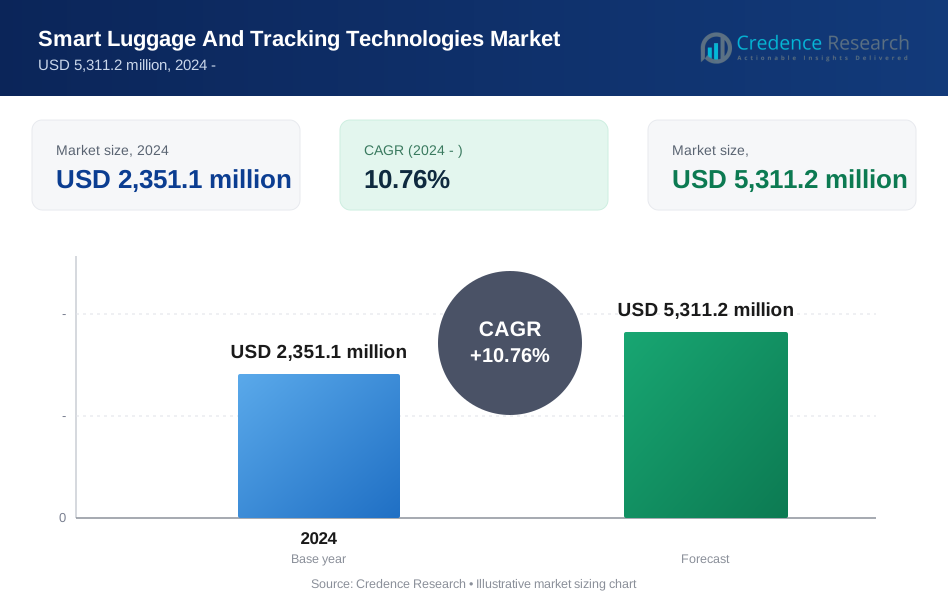
The Smart Luggage and Tracking Technologies Market size was valued at USD 1,253.0million in 2018 to USD 2,351.1 million in 2024 and is anticipated to reach USD 5,311.2 million by 2032, at a CAGR of 10.76% during the forecast period.
| REPORT ATTRIBUTE | DETAILS |
|---|---|
| Historical Period | 2020-2023 |
| Base Year | 2024 |
| Forecast Period | 2025-2032 |
| Smart Luggage and Tracking Technologies Market Size 2024 | USD 2,351.1 Million |
| Smart Luggage and Tracking Technologies Market, CAGR | 10.76% |
| Smart Luggage and Tracking Technologies Market Size 2032 | USD 5,311.2 Million |
The Smart Luggage and Tracking Technologies Market is driven by the growing demand for convenience, security, and real-time tracking in travel experiences. Increasing air passenger traffic, particularly among tech-savvy millennials and business travelers, is fueling adoption of smart luggage equipped with GPS, RFID, Bluetooth, and biometric locks. The integration of IoT and AI technologies enhances functionality, enabling features such as location tracking, weight sensors, remote locking, and mobile app connectivity. Airlines' focus on reducing lost baggage incidents and improving passenger satisfaction further accelerates market growth. Additionally, the rise of premium and business travel segments is creating demand for high-end smart luggage solutions. Key trends include the emergence of solar-powered luggage, modular luggage systems, and partnerships between luggage brands and tech startups. Sustainability is also gaining traction, with companies incorporating recycled materials and energy-efficient components. As global travel rebounds post-pandemic, smart luggage is evolving into an essential accessory, transforming traditional baggage into connected, intelligent travel gear.
The Smart Luggage and Tracking Technologies Market spans key regions including North America, Europe, Asia Pacific, Latin America, the Middle East, and Africa. North America leads the market due to high air travel volume and early tech adoption, followed by Europe with strong tourism and regulatory support. Asia Pacific shows rapid growth driven by expanding middle-class travel and digital infrastructure. Latin America and the Middle East are emerging markets supported by increasing airline connectivity and luxury travel. Africa holds potential in urban centers with rising air traffic. Key players shaping the global landscape include Rimowa, Samsonite International S.A., Away Travel, Inc., Bluesmart, Inc., G-RO, LLC, Arlo Skye Inc., TRAXPACK LLC, Barracuda, Inc., Floatti, Inc., and Tile Inc. These companies compete through innovation, sustainable design, and smart connectivity features, strengthening global reach via partnerships, online platforms, and airport retail networks.
Market Insights
- The Smart Luggage and Tracking Technologies Market was valued at USD 1,253.0 million in 2018 and is projected to reach USD 5,311.2 million by 2032, growing at a CAGR of 10.76%.
- Rising demand for convenience, security, and real-time tracking among tech-savvy travelers is driving widespread adoption of smart luggage.
- Integration of IoT, GPS, Bluetooth, and AI enables features such as geofencing, biometric locks, weight sensors, and mobile app control.
- North America leads with 31% market share, followed by Europe and Asia Pacific, driven by high travel volume and digital adoption.
- Airline regulations around lithium-ion batteries and high product costs pose challenges for broader market penetration.
- Latin America and the Middle East show strong potential due to increasing air connectivity and growing demand for luxury and connected travel gear.
- Key players including Rimowa, Samsonite, Away Travel, and Bluesmart compete through innovation, smart connectivity, sustainable design, and strategic distribution networks.

Market Drivers
Rising Demand for Seamless Travel Experience
The Smart Luggage and Tracking Technologies Market is gaining traction due to increasing traveler preference for convenience and efficiency. Consumers want real-time updates on their belongings, faster check-ins, and simplified baggage handling. Smart luggage equipped with location tracking, digital locks, and weight sensors enhances overall travel comfort. It addresses concerns of misplacement, delays, and theft. Frequent flyers and tech-savvy millennials are driving demand. It caters to the lifestyle shift toward tech-enabled personal mobility solutions.
- For instance, Alaska Airlines upgraded its mobile application to provide passengers with real-time baggage updates from check-in until arrival at baggage claim, enhancing transparency and reducing travel-related anxiety.
Growth in Air Travel and Tourism Sector
Rising global air traffic is a major driver of the Smart Luggage and Tracking Technologies Market. Business and leisure travel have rebounded sharply, prompting travelers to invest in smarter baggage options. Airports and airlines are upgrading infrastructure to support smart baggage handling. It aligns with efforts to reduce baggage loss and improve customer service. Smart luggage reduces airport bottlenecks. Consumers view it as essential to a modern, stress-free travel experience.
Integration of IoT and Mobile Technologies
The integration of IoT, GPS, Bluetooth, and app-based control into luggage products significantly boosts market growth. The Smart Luggage and Tracking Technologies Market benefits from widespread smartphone adoption and mobile connectivity. Consumers rely on mobile apps for remote locking, geofencing, and lost-luggage alerts. IoT connectivity enhances user control and security. It aligns with the broader shift toward smart ecosystems in consumer electronics. Travelers increasingly expect their baggage to be part of a connected lifestyle.
- For instance, Bluesmart launched a suitcase that allows travelers to lock and unlock their luggage remotely, receive notifications if it moves out of a designated area (geofencing), and track its location globally through a mobile app and GPS module.
Rising Focus on Safety and Security
The need for enhanced safety in travel is driving adoption of intelligent luggage solutions. The Smart Luggage and Tracking Technologies Market addresses growing concerns around theft, loss, and tampering. Advanced security features such as biometric locks, TSA-approved remote access, and tamper alerts offer travelers peace of mind. Airlines are also advocating for such systems to streamline operations. It supports regulatory compliance and security protocols. These solutions reinforce brand trust and customer loyalty.
Market Trends
Integration of Sustainable Materials in Smart Luggage Design
The Smart Luggage and Tracking Technologies Market is witnessing a strong shift toward eco-conscious product development. Leading manufacturers are incorporating recycled plastics, biodegradable fabrics, and energy-efficient electronics into luggage systems. This trend is aligned with growing consumer awareness around environmental impact and brand sustainability. It supports regulatory compliance across Europe and North America. Smart luggage with low-emission footprints is gaining appeal among climate-conscious travelers. It also enables companies to differentiate through responsible innovation and attract green-minded buyers.
- For instance, Paravel’s Aviator collection is recognized as the world’s first carbon-neutral suitcase, utilizing recycled polycarbonate, recycled aluminum, and vegan leather, and even features zippers crafted from recycled plastic bottles.
Expansion of AI-Enabled and Predictive Tracking Features
Artificial Intelligence is transforming the Smart Luggage and Tracking Technologies Market with predictive analytics and behavioral insights. Smart bags are now offering predictive alerts for potential loss or delay, based on travel history and movement patterns. AI-enabled luggage enhances security through facial recognition and adaptive locking. It improves route optimization for luggage retrieval in crowded airports. Travelers benefit from faster updates and more personalized services. It also helps brands offer differentiated, intelligent user experiences.
- For instance, Lufthansa has partnered with SITA to deploy AI-based solutions that can automatically rebook mishandled baggage on the next available flight and send passengers real-time updates on their luggage location, improving the speed and accuracy of lost baggage recovery.
Increased Adoption of App-Based Ecosystems and Connectivity
The rise of smartphone integration continues to shape product development in the Smart Luggage and Tracking Technologies Market. App-connected luggage allows travelers to monitor, lock, and locate their bags in real time. These ecosystems support Bluetooth, Wi-Fi, and GPS synchronization with enhanced UI/UX features. It offers instant push notifications and geofencing options for added security. Seamless interoperability with travel platforms is becoming a key differentiator. It promotes user engagement and brand loyalty through continuous digital interaction.
Emergence of Modular and Convertible Smart Luggage Solutions
A growing trend in the Smart Luggage and Tracking Technologies Market is modular luggage systems that adapt to travel needs. Travelers prefer customizable components such as detachable compartments, foldable wheels, and expandable shells. It enables flexible use across short business trips or extended vacations. Modular designs support tech upgrades without replacing entire units. These solutions appeal to premium customers seeking performance and personalization. It drives innovation while improving long-term product value and user satisfaction.
Market Challenges Analysis
Airline Regulations and Battery Restrictions Limit Adoption
The Smart Luggage and Tracking Technologies Market faces significant hurdles due to airline policies on lithium-ion batteries. Many smart luggage models rely on non-removable power sources, which airlines classify as safety risks. This has led to confusion among travelers and restricted usage on certain carriers. It reduces the appeal of smart luggage, especially for frequent flyers. Brands must redesign products to comply with aviation guidelines. Strict enforcement of regulations creates friction in the buying decision process.
High Product Costs and Limited Consumer Awareness
Price sensitivity and lack of awareness present major challenges in the Smart Luggage and Tracking Technologies Market. Smart luggage often costs substantially more than traditional options, limiting access for budget-conscious travelers. Many consumers remain unfamiliar with its features or benefits, affecting demand. It hampers growth in developing regions where travel infrastructure is still evolving. Companies must invest in education and pricing strategies. Effective marketing and cost optimization are essential for broader adoption.
Market Opportunities
Expansion into Emerging Travel Markets Creates New Demand
The Smart Luggage and Tracking Technologies Market has strong growth potential in emerging economies experiencing a surge in middle-class air travel. Rising disposable incomes and expanding aviation networks in Asia, Latin America, and the Middle East are creating new demand for advanced luggage solutions. It allows brands to introduce affordable smart luggage models tailored to first-time and budget travelers. Government investments in airport modernization further support adoption. Strategic localization and regional distribution will unlock untapped market segments.
Partnerships with Airlines and Travel Tech Firms Enhance Reach
Collaborations with airlines, booking platforms, and travel tech companies present a significant opportunity for the Smart Luggage and Tracking Technologies Market. Bundled offerings such as smart luggage rental or loyalty-based upgrades can drive volume sales and boost visibility. It aligns product innovation with travel service ecosystems, enhancing customer experience. Co-branded initiatives improve brand trust and accelerate market penetration. These partnerships also support data integration for personalized travel services, increasing consumer value perception and repeat usage.
Market Segmentation Analysis:
By Product
The Smart Luggage and Tracking Technologies Market is segmented by product into suitcases, backpacks, and others. Suitcases hold the largest market share due to high adoption among frequent flyers and business travelers. Their spacious design supports integration of advanced technologies such as biometric locks and built-in chargers. Backpacks are gaining momentum among younger and tech-savvy users who prioritize portability. It provides compact smart features suitable for short trips and daily commuting. The “others” segment includes duffels and travel totes with integrated tracking features.
- For instance, Samsonite’s latest models are equipped with built-in USB ports for charging devices, integrated weight scales to avoid overweight luggage fees, and advanced anti-theft RFID-blocking pockets to protect personal data.
By Luggage Connectivity
Based on connectivity, the Smart Luggage and Tracking Technologies Market includes GPS, Wi-Fi, and Bluetooth-enabled products. GPS connectivity leads in terms of market value due to its ability to provide real-time location tracking across long distances. Bluetooth-enabled luggage is widely preferred for short-range, energy-efficient applications, especially in urban settings. Wi-Fi connectivity supports more complex functions such as data syncing and cloud storage access. It enables broader ecosystem integration with travel platforms and mobile apps.
- For instance, Travelmate Robotics’ autonomous suitcase uses integrated GPS to send its location to your smartphone in case of loss and supports remote monitoring via dedicated app functionalities.
By Distribution Channel
By distribution channel, the Smart Luggage and Tracking Technologies Market is categorized into specialty stores, online stores, brand stores, and others. Online stores dominate due to ease of access, broader selection, and competitive pricing. Specialty stores cater to high-end consumers seeking expert assistance and premium models. Brand stores focus on delivering exclusive products and personalized services. It strengthens brand loyalty through direct engagement. The “others” segment includes airports and travel gear outlets with limited but strategic sales reach.

Segments:
Based on Product
- Suitcases
- Backpacks
- Others
Based on Luggage Connectivity
- GPS
- Wi-Fi
- Bluetooth
Based on Distribution Channel
- Specialty Stores
- Online Stores
- Brand Stores
- Others
Based on Region
North America
- U.S.
- Canada
- Mexico
Europe
- UK
- Germany
- France
- Italy
- Spain
- Russia
- Rest of Europe
Asia Pacific
- China
- Japan
- South Korea
- India
- Australia
- Southeast Asia
- Rest of Asia Pacific
Latin America
- Brazil
- Argentina
- Rest of Latin America
Middle East
- GCC Countries
- Israel
- Turkey
- Rest of Middle East
Africa
- South Africa
- Egypt
- Rest of Africa
Regional Analysis
North America
The North America Smart Luggage and Tracking Technologies Market size was valued at USD 402.33 million in 2018 to USD 738.21 million in 2024 and is anticipated to reach USD 1,617.27 million by 2032, at a CAGR of 10.3% during the forecast period. North America accounts for the largest share in the global market, holding around 31%. High air travel volume, strong consumer spending, and early adoption of connected technologies drive regional growth. Leading manufacturers actively launch premium models tailored to tech-savvy and business travelers. It benefits from well-developed airport infrastructure and supportive airline partnerships. Strong online retail penetration further accelerates product availability and awareness.
Europe
The Europe Smart Luggage and Tracking Technologies Market size was valued at USD 329.78 million in 2018 to USD 623.45 million in 2024 and is anticipated to reach USD 1,422.35 million by 2032, at a CAGR of 10.9% during the forecast period. Europe contributes over 26% of the global market share. Rising tourism across countries such as Germany, France, and the UK supports adoption. It reflects growing demand for advanced luggage solutions in both leisure and corporate travel segments. Regulatory focus on safety and sustainability also influences product innovation. Established brands are expanding their presence through retail partnerships and airport-based outlets.
Asia Pacific
The Asia Pacific Smart Luggage and Tracking Technologies Market size was valued at USD 284.05 million in 2018 to USD 547.51 million in 2024 and is anticipated to reach USD 1,280.54 million by 2032, at a CAGR of 11.2% during the forecast period. Asia Pacific holds approximately 23% of the global market. Rapid urbanization, rising disposable incomes, and expanding middle-class air travelers drive demand. Countries like China, Japan, India, and South Korea show strong growth in smart consumer electronics and travel accessories. It benefits from regional manufacturing hubs and growing e-commerce networks. Local and global brands are targeting young, mobile-first consumers through digital channels.
Latin America
The Latin America Smart Luggage and Tracking Technologies Market size was valued at USD 133.69 million in 2018 to USD 254.19 million in 2024 and is anticipated to reach USD 584.24 million by 2032, at a CAGR of 11.0% during the forecast period. Latin America contributes roughly 11% to the global market. Growing international travel and regional tourism are key factors influencing product demand. Brazil and Mexico lead the market, supported by rising airline connectivity and tech adoption. It is witnessing greater availability of smart luggage through online platforms and brand partnerships. Regional players are enhancing product customization to match consumer preferences.
Middle East
The Middle East Smart Luggage and Tracking Technologies Market size was valued at USD 67.66 million in 2018 to USD 127.16 million in 2024 and is anticipated to reach USD 287.87 million by 2032, at a CAGR of 10.8% during the forecast period. The region holds about 5% of the global market share. High-volume airports in the UAE and Qatar drive product visibility and sales. Business travel and luxury tourism create demand for premium, connected baggage solutions. It benefits from growing interest in digital transformation across transportation hubs. Partnerships with duty-free retailers and airport lounges strengthen distribution and brand exposure.
Africa
The Africa Smart Luggage and Tracking Technologies Market size was valued at USD 35.46 million in 2018 to USD 60.59 million in 2024 and is anticipated to reach USD 118.97 million by 2032, at a CAGR of 8.8% during the forecast period. Africa accounts for around 4% of the global market. Slower adoption reflects infrastructure challenges and lower per capita income. However, air travel is increasing across countries like South Africa, Egypt, and Kenya. It opens new growth opportunities for affordable smart luggage models. Market expansion depends on logistics improvements and growing middle-class demand for travel accessories with digital features.
Key Player Analysis
- Rimowa
- Samsonite International S.A.
- Away Travel, Inc.
- Bluesmart, Inc.
- G-RO, LLC
- Arlo Skye Inc.
- TRAXPACK LLC
- Barracuda, Inc.
- Floatti, Inc.
- Tile Inc.
- Other Key Players
Competitive Analysis
The Smart Luggage and Tracking Technologies Market features a competitive landscape driven by innovation, brand positioning, and strategic collaborations. Leading players such as Rimowa, Samsonite, and Away Travel focus on integrating advanced features like GPS tracking, biometric locks, and mobile connectivity into their products. It continues to evolve with tech startups such as Bluesmart, Tile, and TRAXPACK introducing modular, app-based, and AI-driven solutions. Companies invest in R&D and design to meet consumer demand for functionality and style. Market players also expand distribution through e-commerce platforms and airport retail outlets. Mergers, partnerships, and regional expansion remain key strategies to enhance market share. Players also prioritize sustainable materials and smart battery compliance to meet regulatory and consumer expectations, further driving differentiation. Competitive intensity is expected to increase as more consumer electronics companies and travel accessory brands enter the market, leveraging advanced connectivity, personalized features, and cross-platform integration to capture a tech-savvy and mobile-first customer base.
Recent Developments
- In July 2025, VIP Industries sold a 32% stake to Multiples PE, Aakash Bhansali, and Mithun Sacheti for ₹1,800 crore, gaining management control to boost smart luggage growth.
- In July 2025, Safari entered into a partnership with boAt to launch 'Safari Trackr', a Bluetooth-enabled smart luggage line designed to help users track their baggage easily.
- In July 2024, Arista Vault launched its latest smart luggage model, the JARVIZ Gen-JARVIZ, featuring advanced tracking and Intelligent Theft Detection, showcasing the brand’s continued commitment to smart travel solutions.
- In October 2023, Samsung launched the Galaxy SmartTag2, an advanced Bluetooth and ultra-wideband tracker designed primarily for backpacks but applicable to luggage as well.
Market Concentration & Characteristics
The Smart Luggage and Tracking Technologies Market exhibits moderate market concentration with a mix of established luggage brands and innovative tech startups. Key players such as Samsonite, Rimowa, and Away Travel dominate premium segments, while emerging firms like Bluesmart, TRAXPACK, and Tile bring specialized tracking and connectivity features. It is characterized by rapid product innovation, short upgrade cycles, and strong focus on functionality and aesthetics. Companies compete by integrating IoT, biometric, and app-controlled technologies into compact, travel-friendly formats. Brand differentiation relies on smart features, sustainable materials, and battery compliance with airline regulations. Consumer preference for real-time tracking, personalized mobility, and secure handling continues to shape product development. Distribution channels include e-commerce, brand outlets, and airport-based retail, with online platforms gaining momentum due to convenience and global reach. It shows increasing cross-industry collaboration between luggage manufacturers and tech firms to enhance user experience, expand market access, and support integration with broader travel ecosystems.
Report Coverage
The research report offers an in-depth analysis based on Product, Luggage Connectivity, Distribution Channel, End-User and Geography. It details leading market players, providing an overview of their business, product offerings, investments, revenue streams, and key applications. Additionally, the report includes insights into the competitive environment, SWOT analysis, current market trends, as well as the primary drivers and constraints. Furthermore, it discusses various factors that have driven market expansion in recent years. The report also explores market dynamics, regulatory scenarios, and technological advancements that are shaping the industry. It assesses the impact of external factors and global economic changes on market growth. Lastly, it provides strategic recommendations for new entrants and established companies to navigate the complexities of the market.
Future Outlook
- Demand for smart luggage will increase with rising global air travel and growing adoption of connected travel accessories.
- Travelers will prefer luggage with integrated GPS, biometric locks, and app-based controls for added convenience.
- Battery-safe and airline-compliant models will dominate new product development and design strategies.
- Sustainability will influence purchasing decisions, encouraging use of recycled materials and energy-efficient components.
- AI-driven features such as predictive tracking and intelligent alerts will become standard in premium segments.
- Modular and customizable luggage systems will attract business travelers and tech-savvy consumers.
- Online retail platforms will expand their share of smart luggage sales through targeted digital marketing.
- Strategic partnerships between luggage brands and travel tech companies will drive feature integration and innovation.
- Emerging markets in Asia Pacific, Latin America, and the Middle East will present strong growth opportunities.
- Competition will intensify as new entrants and electronics brands enter the smart luggage ecosystem.
Request a Free Sample
Fill in your details and we'll send you a free sample report.
- Sample data tables & charts
- Research methodology
Market Dynamics
Demand for Seamless and Secure Travel Experience
Travelers increasingly seek convenience, real-time tracking, and enhanced security, driving adoption of smart luggage with features like GPS, biometric locks, and mobile app integration. This addresses concerns over lost or delayed baggage and appeals to tech-savvy and frequent flyers.
Growth in Global Air Travel and Tourism
The rebound in business and leisure travel, especially among millennials and business travelers, is fueling demand for advanced luggage solutions. Airports and airlines are upgrading infrastructure to support smart baggage handling, reducing bottlenecks and improving customer satisfaction.
Integration of IoT, AI, and Mobile Technologies
The proliferation of IoT, GPS, Bluetooth, and AI in luggage enables features such as geofencing, predictive tracking, and remote locking. Widespread smartphone adoption allows travelers to control and monitor their luggage, aligning with the broader trend toward connected consumer ecosystems.
Sustainability and Eco-Conscious Product Development
Manufacturers are incorporating recycled materials and energy-efficient components into smart luggage, responding to consumer demand for sustainable travel products. This trend is particularly strong in regions with regulatory focus on environmental impact, such as Europe and North America.
Strategic Partnerships and Distribution Expansion
Collaborations between luggage brands, airlines, and travel tech firms are expanding the reach of smart luggage through bundled offerings, loyalty programs, and enhanced retail presence. These partnerships drive innovation, improve brand trust, and accelerate market penetration, especially in emerging markets.
Need a Custom Version of This Report?
Tailor the scope, geography, or segments to your exact requirements.
- Custom geography or segment scope
- Direct access to our analyst team
Frequently Asked Questions
What is the current size of the Smart Luggage and Tracking Technologies Market?
What factors are driving the growth of the Smart Luggage and Tracking Technologies Market?
What are the key segments within the Smart Luggage and Tracking Technologies Market?
What are some challenges faced by the Smart Luggage and Tracking Technologies Market?
Who are the major players in the Smart Luggage and Tracking Technologies Market?
Table of Content
Chapter 1 Market Segmentation
- 1.1 Segmentation Framework
- 1.1.1 Product and Service Classification
- 1.1.2 Application and End-Use Classification
- 1.1.3 Technology and Solution Classification
- 1.1.4 Customer and Distribution Channel Classification
- 1.1.5 Geographic Segmentation
- 1.1.6 Market Segment Definitions and Boundaries
- 1.2 By Product
- 1.2.1 Suitcases
- 1.2.2 Backpacks
- 1.2.3 Others (Duffels, Travel Totes)
- 1.3 By Luggage Connectivity
- 1.3.1 GPS
- 1.3.2 Wi-Fi
- 1.3.3 Bluetooth
Chapter 2 Introduction
- 2.1 Report Objectives and Scope
- 2.2 Product Definition and Industry Terminology
- 2.3 Market Inclusions and Exclusions
- 2.4 Research Process
- 2.4.1 Primary Research and Expert Interviews
- 2.4.2 Secondary Research and Source Review
- 2.4.3 Top-Down and Bottom-Up Estimation
- 2.4.4 Data Triangulation and Verification
- 2.5 Market Size Measurement Basis
- 2.5.1 2024: USD 2,351.1 million → 2032: USD 5,311.2 million
- 2.6 Historical and Forecast Reference Periods
- 2.6.1 Base Year: 2024
- 2.6.2 Forecast Period: 2024-2032
- 2.7 Research Assumptions and Limitations
Chapter 3 Executive Summary
- 3.1 Market Snapshot and Key Findings
- 3.2 Base-Year Market Size, 2024
- 3.3 Forecast Market Size, 2032
- 3.4 Revenue and Volume Growth Outlook
- 3.5 Key Demand and Supply Indicators
- 3.6 Leading Market Segments
- 3.7 Fastest-Growing Market Opportunities
- 3.8 Regional Performance Highlights
- 3.9 Technology and Industry Transformation
- 3.10 Competitive Landscape Summary
- 3.11 Analyst View and Strategic Implications
Chapter 4 Global Smart Luggage And Tracking Technologies Market Trends and Developments
- 4.1 Historical Industry Development
- 4.2 Recent Market Trends and Developments
- 4.3 Demand and Customer Behavior Trends
- 4.4 Technology and Product Innovation
- 4.5 Artificial Intelligence, Automation and Digitalization
- 4.6 Local Manufacturing and Supply Chain Realignment
- 4.7 Industry Partnerships, Mergers and Acquisitions
- 4.8 Sustainability and Circular Economy Developments
- 4.9 Government and Private Sector Investment Trends
- 4.10 Emerging Business Models and Commercialization
- 4.11 Industry Developments and Announcements
Chapter 5 Global Smart Luggage And Tracking Technologies Market Production, Supply and Demand Analysis
- 5.1 Demand Trend and Consumption Analysis
- 5.2 Demand Forecast, 2024-2032
- 5.3 Production and Output Trend
- 5.4 Production and Output Forecast, 2024-2032
- 5.5 Installed Capacity and Capacity Utilization
- 5.6 Company-Wise Production Plants and Statistics
- 5.6.1 Installed Production Capacity
- 5.6.2 Actual Production
- 5.6.3 Planned Capacity and Expansion Targets
- 5.7 Supply Chain Structure and Procurement Trends
- 5.8 Supply-Demand Gap and Bottlenecks
- 5.9 Import Dependence and Sourcing Structure
- 5.10 Contract Manufacturing and Outsourcing
- 5.11 Regional Supply and Demand Concentration
Chapter 6 Global Smart Luggage And Tracking Technologies Market Pricing Analysis
- 6.1 Pricing Structure and Measurement
- 6.2 Historical Pricing Trends
- 6.3 Pricing Outlook, 2024-2032
- 6.4 Average Selling Price and Unit Economics
- 6.5 Pricing by Product and Market Segment
- 6.6 Geographic Pricing Differences
- 6.7 Key Input, Energy, Labor and Logistics Costs
- 6.8 Contract Pricing and Purchasing Models
- 6.9 Pricing Sensitivity and Competitive Positioning
- 6.10 Price, Margin and Profitability Implications
Chapter 7 Global Smart Luggage And Tracking Technologies Market Dynamics
- 7.1 Market Growth Drivers
- 7.1.1 Demand-Side Drivers
- 7.1.2 Technology and Innovation Drivers
- 7.1.3 Infrastructure and Investment Drivers
- 7.1.4 Regulatory and Policy Drivers
- 7.2 Market Restraints
- 7.2.1 Cost and Affordability Constraints
- 7.2.2 Technology and Adoption Barriers
- 7.2.3 Supply Chain and Operational Constraints
- 7.3 Market Challenges
- 7.3.1 Competitive Pressure and Margin Erosion
- 7.3.2 Skills, Infrastructure and Implementation Gaps
- 7.4 Emerging Market Opportunities
- 7.5 Market Dynamics Impact and Time-Horizon Assessment
Chapter 8 Global Smart Luggage And Tracking Technologies Value Chain Analysis
- 8.1 Industry Value Chain Overview
- 8.2 Upstream Suppliers and Critical Inputs
- 8.3 Technology and Component Providers
- 8.4 Manufacturing or Service Delivery
- 8.5 Distribution, Channel Partners and Integrators
- 8.6 Downstream Applications and End Users
- 8.7 Value Addition and Profit Pools
- 8.8 Vertical Integration and Outsourcing
- 8.9 Supplier Concentration and Risk
- 8.10 Supply Chain Localization and Resilience
Chapter 9 Global Smart Luggage And Tracking Technologies Market Regulations and Policies
- 9.1 Relevant Laws, Standards and Compliance Frameworks
- 9.2 Product, Service, Safety and Quality Requirements
- 9.3 Government Policies, Incentives and Subsidies
- 9.4 Imports, Exports and Trade Barriers
- 9.5 Public Procurement and Local Content Requirements
- 9.6 Environmental and Sustainability Compliance
- 9.7 Data Protection, AI and Cybersecurity Compliance
- 9.8 Upcoming Policy Changes and Market Implications
Chapter 10 Global Smart Luggage And Tracking Technologies Market Hotspots and Opportunities
- 10.1 Market Opportunity Mapping and Growth Hotspots
- 10.2 High-Growth Applications and Customer Groups
- 10.3 Underserved Markets and White-Space Opportunities
- 10.4 Emerging Technology and Product Opportunities
- 10.5 New Capacity and Investment Hotspots
- 10.6 Market Entry and Expansion Opportunities
- 10.7 Distribution and Partnership Opportunities
- 10.8 Near-Term and Long-Term Commercial Potential
- 10.9 Opportunity Attractiveness and Execution Risks
Chapter 11 Global Smart Luggage And Tracking Technologies Market Outlook, 2024-2032
- 11.1 Market Size and Analysis
- 11.1.1 Revenue (Market Measurement: 2024: USD 2,351.1 million → 2032: USD 5,311.2 million)
- 11.1.2 Market Volume and Quantity Sold
- 11.1.3 Historical Market Size
- 11.1.4 Base-Year Market Size, 2024
- 11.2 Market Forecast, 2024-2032
- 11.2.1 Revenue Forecast to 2032
- 11.2.2 Volume Forecast to 2032
- 11.2.3 CAGR and Year-on-Year Growth
- 11.2.4 Incremental Revenue Opportunity
- 11.3 Forecast Assumptions and Scenario Analysis
- 11.3.1 Base-Case Forecast
- 11.3.2 Optimistic and Conservative Scenarios
- 11.3.3 Technology, Pricing and Policy Sensitivities
- 11.4 Market Attractiveness and Growth Outlook
Chapter 12 Global Smart Luggage And Tracking Technologies Market Segmentation and Outlook
- 12.1 Segmentation Summary and Market Shares, 2024
- 12.2 Largest and Fastest-Growing Segments
- 12.3 By Product - Market Size and Forecast, 2024-2032
- 12.3.1 Segment Definition and Scope
- 12.3.2 Historical Market Size
- 12.3.3 Revenue Forecast, 2024-2032
- 12.3.4 Volume Forecast, 2024-2032
- 12.3.5 Base-Year Market Share, 2024
- 12.3.6 Segment CAGR and Growth Drivers
- 12.3.7 Subsegment Market Size and Forecast
- 12.3.7.1 Suitcases
- 12.3.7.2 Backpacks
- 12.3.7.3 Others (Duffels, Travel Totes)
- 12.3.8 Subsegment Pricing and Adoption Trends
- 12.3.9 Leading Suppliers and Competition
- 12.3.10 Regional Demand and Opportunities
- 12.4 By Luggage Connectivity - Market Size and Forecast, 2024-2032
- 12.4.1 Segment Definition and Scope
- 12.4.2 Historical Market Size
- 12.4.3 Revenue Forecast, 2024-2032
- 12.4.4 Volume Forecast, 2024-2032
- 12.4.5 Base-Year Market Share, 2024
- 12.4.6 Segment CAGR and Growth Drivers
- 12.4.7 Subsegment Market Size and Forecast
- 12.4.7.1 GPS
- 12.4.7.2 Wi-Fi
- 12.4.7.3 Bluetooth
- 12.4.8 Subsegment Pricing and Adoption Trends
- 12.4.9 Leading Suppliers and Competition
- 12.4.10 Regional Demand and Opportunities
- 12.5 Segment Growth Comparison
- 12.6 Segment Attractiveness and Priority Matrix
Chapter 13 Global Smart Luggage And Tracking Technologies Geographic Market Outlook, 2024-2032
- 13.1 Regional Market Size and Share, 2024
- 13.2 Regional Market Forecast, 2024-2032
- 13.3 Regional Pricing, Production and Demand Differences
- 13.4 North America
- 13.4.1 United States
- 13.4.2 Canada
- 13.4.3 Mexico
- 13.5 Europe
- 13.5.1 Germany
- 13.5.2 France
- 13.5.3 Italy
- 13.5.4 United Kingdom
- 13.5.5 Spain
- 13.5.6 Poland
- 13.5.7 Russia
- 13.5.8 Netherlands
- 13.5.9 Belgium
- 13.5.10 Sweden
- 13.5.11 Denmark
- 13.5.12 Norway
- 13.5.13 Rest of Europe
- 13.6 Asia Pacific
- 13.6.1 China
- 13.6.2 India
- 13.6.3 Japan
- 13.6.4 South Korea
- 13.6.5 Thailand
- 13.6.6 Indonesia
- 13.6.7 Vietnam
- 13.6.8 Malaysia
- 13.6.9 Australia
- 13.6.10 Rest of Asia Pacific
- 13.7 Latin America
- 13.7.1 Brazil
- 13.7.2 Argentina
- 13.7.3 Colombia
- 13.7.4 Chile
- 13.7.5 Rest of Latin America
- 13.8 Middle East
- 13.8.1 Saudi Arabia
- 13.8.2 United Arab Emirates
- 13.8.3 Turkey
- 13.8.4 Israel
- 13.8.5 Iran
- 13.8.6 Rest of the Middle East
- 13.9 Africa
- 13.9.1 South Africa
- 13.9.2 Egypt
- 13.9.3 Nigeria
- 13.9.4 Morocco
- 13.9.5 Rest of Africa
- 13.10 Regional Investment, Policy and Supply Chain Differences
- 13.11 Regional Competitive Landscape
- 13.12 Geographic Growth Hotspots
Chapter 14 Global Smart Luggage And Tracking Technologies Technology, Innovation and Sustainability Outlook
- 14.1 Technology Landscape and Maturity
- 14.2 Product, Process and Service Innovation
- 14.3 AI, Automation and Digital Tools in the Industry
- 14.4 Technology Adoption and Performance Benchmarking
- 14.5 Innovation Pipeline and R&D Investment
- 14.6 Patent and Intellectual Property Trends
- 14.7 Energy Efficiency and Resource Management
- 14.8 Sustainability, Recycling and Circularity
- 14.9 Technology Roadmap, 2024-2032
- 14.10 Risks of Obsolescence and Technology Substitution
Chapter 15 Global Smart Luggage And Tracking Technologies Market Key Strategic Imperatives
- 15.1 Growth and Market Entry Priorities
- 15.2 High-Return Products and Segments
- 15.3 Pricing, Profitability and Cost Optimization
- 15.4 Technology Investment and Product Differentiation
- 15.5 Supply Chain Localization and Resilience
- 15.6 Distribution and Customer Acquisition
- 15.7 Partnership, Acquisition and Capacity Strategy
- 15.8 Regional Expansion Priorities
- 15.9 Short-, Medium- and Long-Term Actions
Chapter 16 Competition Outlook
- 16.1 Industry Competition Characteristics
- 16.2 Market Structure and Concentration
- 16.3 Market Share and Competitive Positioning, 2024
- 16.4 Company-Wise Revenue and Product Benchmarking
- 16.5 Production and Service Capacity Benchmarking
- 16.6 Technology, Pricing and Differentiation
- 16.7 Regional Footprint and Distribution Strength
- 16.8 Mergers, Acquisitions and Strategic Alliances
- 16.9 New Entrants and Competitive Threats
- 16.10 Porter's Five Forces and Industry Attractiveness
- 16.11 Competitive Outlook, 2024-2032
Chapter 17 Company Profiles
- 17.1 Company Coverage and Selection Criteria
- 17.2 Rimowa
- 17.2.1 Business Description
- 17.2.2 Company Ownership and Geographic Presence
- 17.2.3 Product and Service Portfolio
- 17.2.4 Manufacturing and Operating Footprint
- 17.2.5 Production Capacity and Expansion Plans
- 17.2.6 Financial Performance and Investment
- 17.2.7 Market Share and Competitive Position
- 17.2.8 Technology and Innovation Capabilities
- 17.2.9 Strategic Alliances or Partnerships
- 17.2.10 Recent Developments
- 17.2.11 Growth Strategy and Outlook
- 17.3 Samsonite International S.A.
- 17.4 Away Travel, Inc.
- 17.5 Bluesmart, Inc.
- 17.6 G-RO, LLC
- 17.7 Arlo Skye Inc.
- 17.8 TRAXPACK LLC
- 17.9 Barracuda, Inc.
- 17.10 Floatti, Inc.
- 17.11 Tile Inc.
- 17.12 Other Relevant Market Participants
Note: Every listed company is profiled on the structure shown under the first company. The company list is preliminary and may change based on research findings, market developments, data availability and client requirements.
Chapter 18 Disclaimer
- 18.1 Research and Forecast Disclaimer
- 18.2 Data Source and Estimation Limitations
Note: The depth of individual sections depends on data availability for this market. Volume, capacity, trade and other unit-based metrics are included where applicable.

