
| REPORT ATTRIBUTE | DETAILS |
|---|---|
| Historical Period | 2020-2023 |
| Base Year | 2024 |
| Forecast Period | 2025-2032 |
| Acrylic Resins Market Size 2024 | USD 19,378.60 million |
| Acrylic Resins Market, CAGR | 6.52% |
| Acrylic Resins Market Size 2032 | USD 31,960.14 million |
Market Overview:
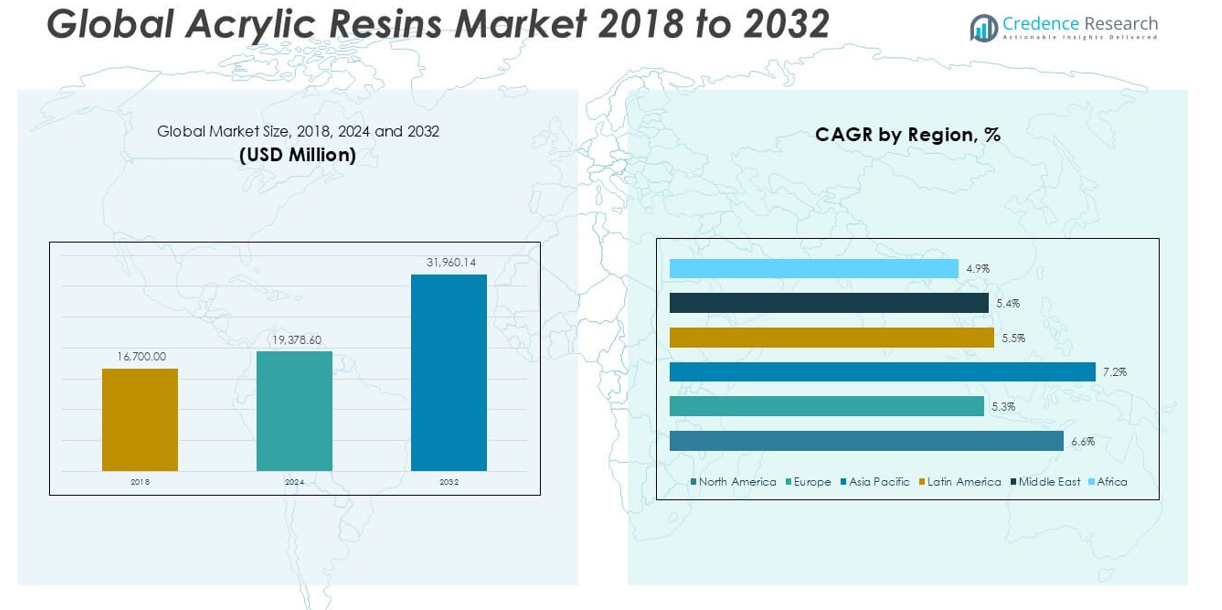
The Acrylic Resins market size was valued at USD 16,700.00 million in 2018, increased to USD 19,378.60 million in 2024, and is anticipated to reach USD 31,960.14 million by 2032, growing at a CAGR of 6.52% during the forecast period.
The Acrylic Resins market is led by key players including Dow, BASF SE, Arkema, Mitsubishi, Nippon Shokubai, DSM, Mitsui Chemicals, Showa Denko Materials, DIC Corporation, and Sumitomo. These companies dominate the market through extensive product portfolios, global distribution networks, and continuous innovation focused on sustainable and high-performance resin solutions. Strategic initiatives such as partnerships, capacity expansions, and development of eco-friendly formulations strengthen their competitive positions. Asia Pacific holds the largest regional share, accounting for 46.9% of the global market in 2024, driven by robust demand from construction, automotive, and packaging industries in China, India, and Southeast Asia.
Market Insights
- The Acrylic Resins market was valued at USD 16,700.00 million in 2018, reached USD 19,378.60 million in 2024, and is projected to reach USD 31,960.14 million by 2032, growing at a CAGR of 6.52%.
- Rising demand from the paints and coatings industry, particularly for water-based, low-VOC formulations, is significantly driving market growth across automotive, construction, and consumer goods sectors.
- Increasing focus on sustainable products and bio-based acrylic resins is a key market trend, with companies investing in eco-friendly solutions to meet regulatory standards and consumer preferences.
- The market is highly competitive, with major players like Dow, BASF SE, Arkema, and Mitsubishi focusing on product innovation and capacity expansion, while smaller manufacturers face challenges from fluctuating raw material prices.
- Asia Pacific dominates the global market with a 46.9% share in 2024, while acrylates lead the chemistry segment with over 55% share, driven by high demand in industrial and construction applications.
Market Segmentation Analysis:
By Chemistry:
In the Acrylic Resins market, the acrylates segment holds the largest market share, exceeding 55% in 2024, driven by its superior adhesion, flexibility, and weather resistance. Acrylates are widely preferred in construction and automotive applications due to their durability and cost-effectiveness. Methacrylates are also gaining traction, particularly in specialty coatings and high-performance adhesives. The hybrid segment is expanding steadily, fueled by rising demand for customized formulations that combine the benefits of multiple resin types. Overall, the growing focus on sustainability and performance efficiency is expected to further boost the use of acrylates in various industrial sectors.
- For instance, Arkema’s ENCOR® 627 latex uses a 100 nm average particle size, has a solid content of 43.5%, Brookfield viscosity of 550 cP, minimum film-forming temperature of 9 °C, and glass transition temperature of 15 °C.
By Application
The paints & coatings segment dominates the market, accounting for over 60% of the revenue share in 2024, supported by increasing construction activities and automotive production worldwide. Acrylic resins are highly valued in this segment for their excellent gloss, UV resistance, and weatherability. Adhesives & sealants follow as the next significant application, driven by the growing packaging and electronics sectors. DIY coatings are also experiencing rising demand due to increasing home renovation trends. The elastomers and others segment contributes modestly but is expected to grow with innovations in specialty products tailored for niche markets.
- For instance, BASF’s Joncryl® 9530‑A, part of the 953X portfolio, offers low VOC (≈140 g/L), self-crosslinking functionality, fine particle size for deep wood penetration, and high scratch resistance - ideal for high‑end wood coatings.
By Solvency
The water-based segment leads the Acrylic Resins market with a market share of over 65% in 2024, supported by stringent environmental regulations favoring low-VOC and eco-friendly products. Water-based acrylic resins are widely adopted in paints, coatings, and adhesives due to their reduced environmental impact and improved safety profiles. The solvent-based segment, while gradually declining, continues to find relevance in applications where superior chemical resistance and quick drying are essential. The "others" segment, including powder-based and radiation-curable resins, is witnessing steady growth as industries increasingly adopt sustainable and high-performance alternatives.
Market Overview
Rising Demand from Paints and Coatings Industry
The rapid expansion of the paints and coatings industry remains a primary growth driver for the acrylic resins market. Acrylic resins are extensively used due to their excellent weatherability, durability, and cost efficiency. Increasing construction activities, particularly in emerging economies, and the growing automotive sector are significantly boosting demand for high-performance coatings. The shift toward water-based, low-VOC coatings further supports the adoption of acrylic resins, as manufacturers focus on sustainable and regulatory-compliant solutions, solidifying their role across multiple end-use applications.
- For instance, Dow’s ROVACE™ 10 emulsion features 50% solids, pH ~8.5, and is widely used in low‑VOC interior wall coatings across Asia Pacific (source claimed by Dow product datasheets).
Regulatory Push Toward Eco-Friendly Formulations
Stringent environmental regulations globally are accelerating the shift towards water-based and low-VOC acrylic resins. Regulatory bodies such as the EPA and REACH promote the adoption of environmentally friendly materials to reduce emissions and occupational hazards. This regulatory landscape is compelling manufacturers to innovate and develop sustainable resin solutions that align with green building practices and eco-friendly consumer products. As a result, companies investing in water-based and bio-based acrylic resins are gaining competitive advantages, fostering rapid growth in this market segment.
- For instance, DSM’s Decovery® platform includes partially bio‑based resins with up to 52% renewable content and VOC < 1 g/L, compliant with European Ecolabel standards.
Expanding Applications in Adhesives and Sealants
The acrylic resins market is witnessing substantial growth from increasing demand in adhesives and sealants. These resins offer strong adhesion, flexibility, and resistance to environmental factors, making them highly suitable for construction, packaging, and automotive industries. The rise in e-commerce and advanced packaging solutions is further driving the need for efficient adhesives. Additionally, the versatility of acrylic resins in formulating pressure-sensitive adhesives (PSAs) strengthens their market position, opening new avenues for application development and market penetration.
Key Trends & Opportunities
Technological Advancements in Resin Formulations
Ongoing technological advancements in resin formulations are creating new growth opportunities in the acrylic resins market. Manufacturers are developing high-performance, multi-functional acrylic resins that offer superior UV resistance, heat stability, and faster curing times. The development of hybrid and self-crosslinking acrylics is particularly gaining momentum, as industries seek enhanced product durability with lower environmental impact. These innovations are enabling acrylic resins to cater to more specialized applications across automotive, electronics, and packaging sectors, widening the market scope.
- For instance, Mitsubishi Chemical's DIANAL BR‑1156 resin offers a Konig hardness of ~160 s and elevated chemical resistance, formulated for fast‑curing automotive coatings.
Rising Popularity of Bio-Based Acrylic Resins
The increasing consumer and regulatory focus on sustainability is driving the emergence of bio-based acrylic resins. Companies are exploring renewable raw materials to develop eco-friendly resins that reduce carbon footprints without compromising performance. This trend is especially prominent in Europe and North America, where demand for green building materials and sustainable packaging is rising sharply. The shift toward bio-based solutions presents a significant opportunity for manufacturers to differentiate their offerings and capture environmentally conscious customer segments.
- For instance, Arkema’s SYNAQUA® 4804 acrylic dispersion contains 50% solids, pH 7, nearly 37% bio‑based content, and a minimum film-forming temperature of 0 °C, enabling eco‑friendly decorative coatings.
Key Challenges
Fluctuating Raw Material Prices
The acrylic resins market faces significant challenges due to the fluctuating prices of key raw materials, including acrylates and methacrylates, which are derived from crude oil. Price volatility directly impacts production costs and profit margins, making it difficult for manufacturers to maintain price stability and long-term supply agreements. These fluctuations are often driven by geopolitical tensions, supply chain disruptions, and changing crude oil dynamics, which can limit the growth potential of smaller market participants.
Stringent Environmental and Health Regulations
While driving eco-friendly innovation, stringent environmental and health regulations also pose compliance challenges for acrylic resin manufacturers. Regulations targeting VOC emissions, hazardous chemical handling, and waste disposal require substantial investment in research, formulation changes, and process upgrades. Smaller manufacturers, in particular, may struggle with the financial burden of adhering to these evolving standards, which could limit market entry and expansion for less-capitalized companies.
Growing Competition from Alternative Resins
The increasing availability and technological improvements in alternative resins such as epoxy, polyurethane, and alkyd resins present a competitive challenge to acrylic resins. These alternatives often offer specialized performance benefits, including enhanced chemical resistance and mechanical strength, which can draw demand away from acrylic-based solutions in specific applications. To maintain market relevance, acrylic resin manufacturers must continuously innovate and position their products based on sustainability, versatility, and cost-effectiveness.
Regional Analysis
North America
In 2024, North America held a significant share of the acrylic resins market, accounting for approximately 24.1% of the global revenue. The market was valued at USD 4,091.50 million in 2018 and increased to USD 4,674.60 million in 2024, with projections to reach USD 7,768.07 million by 2032, growing at a CAGR of 6.6%. Growth is supported by rising demand in the automotive, construction, and packaging industries, alongside strict environmental regulations promoting the adoption of water-based resins. The region’s strong industrial base and advanced manufacturing capabilities further sustain market expansion.
Europe
Europe represented approximately 18.1% of the global acrylic resins market in 2024, with the market valued at USD 3,189.70 million in 2018 and rising to USD 3,503.12 million in 2024. It is expected to reach USD 5,266.16 million by 2032 at a CAGR of 5.3%. The demand is driven by stringent environmental policies and the growing preference for sustainable, low-VOC coatings. The region’s well-established automotive and construction sectors also contribute to consistent growth. European manufacturers are focusing on bio-based acrylic resin innovations, which are likely to further boost market penetration in the coming years.
Asia Pacific
Asia Pacific dominates the acrylic resins market with the largest share of approximately 46.9% in 2024. The market expanded from USD 7,648.60 million in 2018 to USD 9,085.57 million in 2024, and is projected to reach USD 15,753.75 million by 2032, growing at the fastest CAGR of 7.2%. Rapid industrialization, increasing construction activities, and strong automotive production, particularly in China and India, are key growth drivers. Expanding manufacturing bases and rising consumer awareness regarding eco-friendly coatings are further accelerating market growth, solidifying Asia Pacific’s position as the global leader in this sector.
Latin America
In 2024, Latin America accounted for approximately 5.1% of the global acrylic resins market, with the market valued at USD 855.04 million in 2018 and growing to USD 980.36 million in 2024. It is expected to reach USD 1,488.38 million by 2032, advancing at a CAGR of 5.5%. The growth is supported by the increasing demand from the construction and packaging industries, particularly in Brazil and Mexico. Urban development, coupled with the adoption of water-based acrylic resins, is driving market expansion. However, regulatory challenges and economic fluctuations slightly constrain the growth potential across the region.
Middle East
The Middle East held approximately 3.5% of the global acrylic resins market in 2024, with its size increasing from USD 617.90 million in 2018 to USD 670.37 million in 2024. The market is forecast to reach USD 1,009.73 million by 2032, growing at a CAGR of 5.4%. Expansion in the construction and infrastructure sectors, supported by government investments in large-scale projects, fuels the regional demand for acrylic resins. The increasing focus on sustainable coatings and packaging solutions is expected to provide further growth opportunities, although market maturity remains lower compared to developed regions.
Africa
Africa accounted for approximately 2.4% of the global acrylic resins market in 2024, with the market size growing from USD 297.26 million in 2018 to USD 464.56 million in 2024. It is projected to reach USD 674.04 million by 2032, at a CAGR of 4.9%. Growing infrastructure development and construction activities, particularly in South Africa and Nigeria, are key contributors to market growth. The rising adoption of water-based coatings and increasing awareness about eco-friendly products are creating new opportunities. However, the market still faces challenges due to limited industrialization and fluctuating economic conditions across several countries.
Market Segmentations:
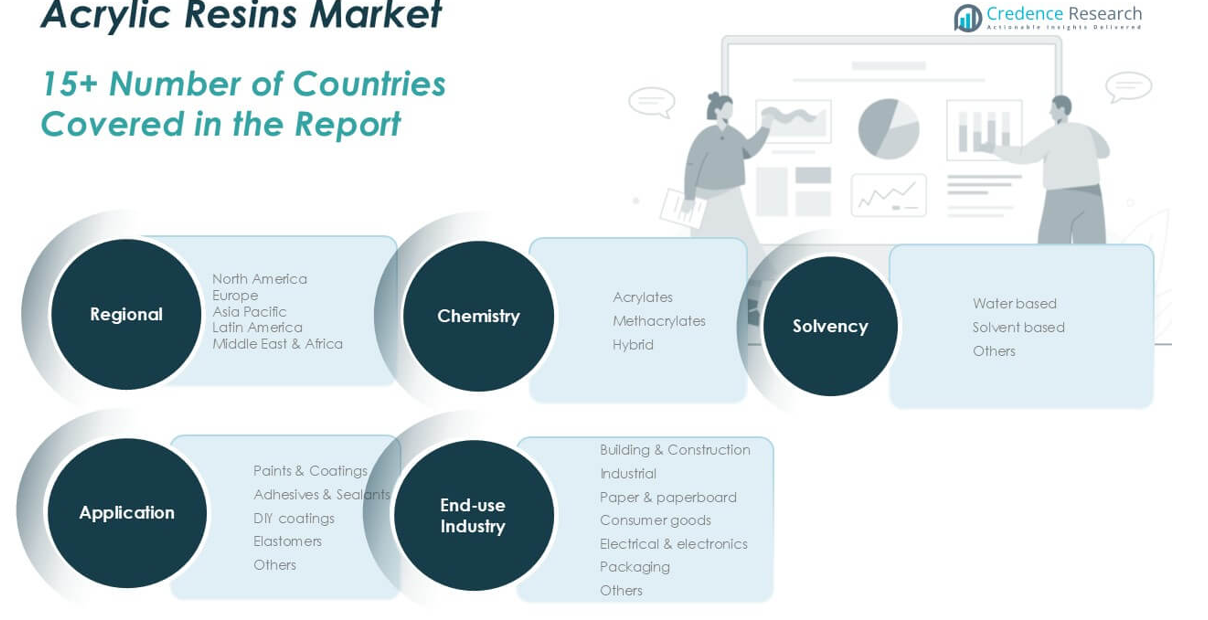
By Chemistry
- Acrylates
- Methacrylates
- Hybrid
By Application
- Paints & Coatings
- Adhesives & Sealants
- DIY Coatings
- Elastomers
- Others
By Solvency
- Water Based
- Solvent Based
- Others
By End-Use Industry
- Building & Construction
- Industrial
- Paper & Paperboard
- Consumer Goods
- Electrical & Electronics
- Packaging
- Others
By Geography
- North America
- U.S.
- Canada
- Mexico
- Europe
- Germany
- France
- U.K.
- Italy
- Spain
- Rest of Europe
- Asia Pacific
- China
- Japan
- India
- South Korea
- South-east Asia
- Rest of Asia Pacific
- Latin America
- Brazil
- Argentina
- Rest of Latin America
- Middle East & Africa
- GCC Countries
- South Africa
- Rest of the Middle East and Africa
Competitive Landscape
The Acrylic Resins market is highly competitive, characterized by the presence of established global players and regional manufacturers striving for market share through product innovation, strategic partnerships, and capacity expansions. Key companies such as Dow, BASF SE, Arkema, Mitsubishi, and Nippon Shokubai dominate the market with their extensive product portfolios and strong distribution networks. These players consistently invest in research and development to introduce advanced, eco-friendly, and high-performance acrylic resins to meet evolving industry demands and comply with stringent environmental regulations. Mergers, acquisitions, and joint ventures are common strategies to enhance geographic reach and strengthen technological capabilities. Additionally, companies are focusing on bio-based and water-based resin solutions to gain a competitive edge in the sustainability-driven market. Regional players, while facing intense competition, are leveraging localized supply chains and cost-effective production to secure niche segments. Overall, innovation and sustainability remain central to maintaining competitiveness in this dynamic market landscape.
Key Player Analysis
- Dow
- BASF SE
- Arkema
- Mitsubishi
- Nippon Shokubai
- DSM
- Mitsui Chemicals
- Showa Denko Materials
- DIC Corporation
- Sumitomo
Recent Developments
- In March 2024, DIC Corporation's subsidiary, IDEAL CHEMI PLAST PRIVATE LTD., opened a new production facility for coating resins in Maharashtra's Supa Japanese Industrial Zone. The facility tripled the production capacity of IDEAL CHEMI PLAST, positioning it to expand its business in India, South Asia, and the Middle East.
- In January 2023, BASF has announced an investment in polymer dispersions capacity expansion at its Merak, Indonesia, production location. The growth is in keeping with the growing trend of high-quality packaging in ASEAN, which is home to major paper and board manufacturers. The expansion will deliver more supply reliability to meet the increasing demand for acrylics and styrene-butadiene dispersions in the Southeast Asia, Australia, and New Zealand markets.
- In December 2022, Sumitomo Chemical has built a new pilot facility for the chemical recycling of acrylic resin (polymethyl methacrylate or PMMA) at its Ehime Works in Niihama City, Ehime Prefecture, Japan. Samples of chemically recycled methyl methacrylate or MMA monomer generated in this facility, as well as acrylic resin produced from the monomer, will be available from spring 2023.
- In November 2022, Arkema announces the certification of a variety of bio-attributed acrylic monomers utilizing the mass balance technique, marking a significant advancement in its revolutionary sustainable offering. Arkema is now able to supply certified bio-attributed specialized acrylic additives and resins for a wide variety of applications. This establishes the company as a global leader in the provision of bio-attributed acrylic materials and a significant market partner for its customer.
- In June 2022, BASF expanded its line of Licity® anode binders to produce Li-ion batteries. The usage of silicon concentrations greater than 20% is made possible by the second-generation styrene-butadiene rubber (SBR) binder Licity® 2698 X F. This binder offers more capacity, a more significant number of charge/discharge cycles, and quicker charging periods in addition to the established qualities of the Licity® product family.
- In May 2022, BASF's water-blown polyurethane insulation spray foam is now used in the latest bus model by Kinglong United Automotive (Suzhou) Co., Ltd. (Suzhou Kinglong). Suzhou Kinglong, China's leading bus manufacturer, their part supplier Changzhou Tianshun Automotive Parts Co., Ltd. (Tianshun), and BASF collaborated to develop the 100% water-blown spray open-cell foam system Elastoflex® CE 3651/108. As verified with a testing report by PONY Testing International Group, the PU foam, which meets stringent VOC standards, provides a better interior air quality in public transportation.
Market Concentration & Characteristics
The Acrylic Resins Market is moderately concentrated, with a mix of global giants and regional players shaping its competitive structure. It is characterized by steady innovation, driven by the demand for sustainable, high-performance, and versatile resin solutions. Companies continuously invest in product development to meet evolving environmental regulations and industry-specific performance standards. The market exhibits strong supplier integration, particularly among top players with backward linkages to raw material production, ensuring cost efficiency and stable supply chains. It shows a significant degree of price sensitivity due to raw material fluctuations, influencing procurement strategies across end-use industries. Demand diversity is a core feature, with applications spanning paints, coatings, adhesives, and packaging, offering consistent growth opportunities. It is also marked by technological advancements, particularly in water-based and bio-based acrylic formulations, which have gained priority among manufacturers and consumers focused on reducing environmental impact. The competitive landscape encourages mergers, acquisitions, and regional expansions to strengthen market positions and capture emerging opportunities in high-growth regions.
Report Coverage
The research report offers an in-depth analysis based on Chemistry, Application, Solvency, End-Use Industry and Geography. It details leading market players, providing an overview of their business, product offerings, investments, revenue streams, and key applications. Additionally, the report includes insights into the competitive environment, SWOT analysis, current market trends, as well as the primary drivers and constraints. Furthermore, it discusses various factors that have driven market expansion in recent years. The report also explores market dynamics, regulatory scenarios, and technological advancements that are shaping the industry. It assesses the impact of external factors and global economic changes on market growth. Lastly, it provides strategic recommendations for new entrants and established companies to navigate the complexities of the market.
Future Outlook
- The acrylic resins market is expected to experience steady growth driven by increasing demand from the construction and automotive sectors.
- Rising adoption of water-based and low-VOC acrylic resins will continue to shape product development and regulatory compliance.
- Bio-based acrylic resins are likely to gain market traction as sustainability becomes a key purchasing factor across industries.
- Technological advancements will lead to the development of high-performance, multi-functional acrylic resins with improved durability.
- The Asia Pacific region will remain the largest and fastest-growing market due to strong industrialization and infrastructure expansion.
- Fluctuating raw material prices may continue to challenge profit margins and impact long-term pricing strategies for manufacturers.
- Increasing applications in adhesives, sealants, and packaging will offer new growth opportunities for acrylic resin producers.
- Strategic collaborations and mergers among leading companies are expected to expand production capabilities and global reach.
- Demand for specialty acrylic resins will rise in niche applications such as electronics, renewable energy, and advanced coatings.
- The shift toward eco-friendly and energy-efficient manufacturing processes will become essential for maintaining market competitiveness.

Request a Free Sample
Fill in your details and we'll send you a free sample report.
- Sample data tables & charts
- Research methodology
Market Dynamics
Shift Toward Water-Based and Low-VOC Formulations
Stringent environmental regulations and growing consumer preference for eco-friendly products are accelerating the adoption of water-based and low-VOC acrylic resins. This shift is particularly strong in paints, coatings, and adhesives, where manufacturers are reformulating products to comply with emission standards and meet sustainability goals, driving market expansion.
Expansion of Construction and Automotive Industries in Asia Pacific
Rapid industrialization and infrastructure development in Asia Pacific, especially in China, India, and Southeast Asia, are fueling demand for acrylic resins in construction and automotive applications. The superior weatherability, durability, and cost-effectiveness of acrylic resins make them the preferred choice for high-performance coatings and adhesives in these fast-growing sectors.
Technological Advancements in Resin Formulations
Continuous innovation in acrylic resin chemistry, including the development of hybrid, self-crosslinking, and high-performance resins, is enabling new applications and improved product performance. These advancements allow manufacturers to offer resins with enhanced UV resistance, faster curing, and greater durability, expanding their use in specialized and high-value applications such as electronics and advanced packaging.
Rising Adoption of Bio-Based Acrylic Resins
Increasing regulatory and consumer focus on sustainability is driving investment in bio-based acrylic resins derived from renewable raw materials. Leading companies are launching partially or fully bio-based products to reduce carbon footprints and differentiate their offerings, opening new market opportunities in regions with strong green building and sustainable packaging initiatives.
Growth in Adhesives, Sealants, and Packaging Applications
The versatility of acrylic resins in formulating pressure-sensitive adhesives, sealants, and specialty packaging materials is supporting market growth beyond traditional coatings. The rise of e-commerce, advanced packaging solutions, and demand for high-performance adhesives in construction and electronics are expanding the application scope and driving additional market demand.
Need a Custom Version of This Report?
Tailor the scope, geography, or segments to your exact requirements.
- Custom geography or segment scope
- Direct access to our analyst team
Frequently Asked Questions
What is the current size of the Acrylic Resins Market?
What factors are driving the growth of the Acrylic Resins Market?
What are the key segments within the Acrylic Resins Market?
Who are the major players in the Acrylic Resins Market?
Table of Content
Chapter 1 Market Segmentation
- 1.1 Segmentation Framework
- 1.1.1 Product and Service Classification
- 1.1.2 Application and End-Use Classification
- 1.1.3 Technology and Solution Classification
- 1.1.4 Customer and Distribution Channel Classification
- 1.1.5 Geographic Segmentation
- 1.1.6 Market Segment Definitions and Boundaries
- 1.2 By Solvency
- 1.2.1 Water Based
- 1.2.2 Solvent Based
- 1.2.3 Others
- 1.3 By Chemistry
- 1.3.1 Acrylates
- 1.3.2 Methacrylates
- 1.3.3 Hybrid
- 1.4 By Application
- 1.4.1 Paints & Coatings
- 1.4.2 Adhesives & Sealants
- 1.4.3 DIY Coatings
- 1.4.4 Elastomers
- 1.4.5 Others
- 1.5 By End-Use Industry
- 1.5.1 Building & Construction
- 1.5.2 Industrial
- 1.5.3 Paper & Paperboard
- 1.5.4 Consumer Goods
- 1.5.5 Electrical & Electronics
- 1.5.6 Packaging
- 1.5.7 Others
Chapter 2 Introduction
- 2.1 Report Objectives and Scope
- 2.2 Product Definition and Industry Terminology
- 2.3 Market Inclusions and Exclusions
- 2.4 Research Process
- 2.4.1 Primary Research and Expert Interviews
- 2.4.2 Secondary Research and Source Review
- 2.4.3 Top-Down and Bottom-Up Estimation
- 2.4.4 Data Triangulation and Verification
- 2.5 Market Size Measurement Basis
- 2.5.1 2024: USD 19,378.60 million → 2032: USD 31,960.14 million
- 2.6 Historical and Forecast Reference Periods
- 2.6.1 Base Year: 2024
- 2.6.2 Forecast Period: 2024-2032
- 2.7 Research Assumptions and Limitations
Chapter 3 Executive Summary
- 3.1 Market Snapshot and Key Findings
- 3.2 Base-Year Market Size, 2024
- 3.3 Forecast Market Size, 2032
- 3.4 Revenue and Volume Growth Outlook
- 3.5 Key Demand and Supply Indicators
- 3.6 Leading Market Segments
- 3.7 Fastest-Growing Market Opportunities
- 3.8 Regional Performance Highlights
- 3.9 Technology and Industry Transformation
- 3.10 Competitive Landscape Summary
- 3.11 Analyst View and Strategic Implications
Chapter 4 Global Acrylic Resins Market Trends and Developments
- 4.1 Historical Industry Development
- 4.2 Recent Market Trends and Developments
- 4.3 Demand and Customer Behavior Trends
- 4.4 Technology and Product Innovation
- 4.5 Artificial Intelligence, Automation and Digitalization
- 4.6 Local Manufacturing and Supply Chain Realignment
- 4.7 Industry Partnerships, Mergers and Acquisitions
- 4.8 Sustainability and Circular Economy Developments
- 4.9 Government and Private Sector Investment Trends
- 4.10 Emerging Business Models and Commercialization
- 4.11 Industry Developments and Announcements
Chapter 5 Global Acrylic Resins Market Production, Supply and Demand Analysis
- 5.1 Demand Trend and Consumption Analysis
- 5.2 Demand Forecast, 2024-2032
- 5.3 Production and Output Trend
- 5.4 Production and Output Forecast, 2024-2032
- 5.5 Installed Capacity and Capacity Utilization
- 5.6 Company-Wise Production Plants and Statistics
- 5.6.1 Installed Production Capacity
- 5.6.2 Actual Production
- 5.6.3 Planned Capacity and Expansion Targets
- 5.7 Supply Chain Structure and Procurement Trends
- 5.8 Supply-Demand Gap and Bottlenecks
- 5.9 Import Dependence and Sourcing Structure
- 5.10 Contract Manufacturing and Outsourcing
- 5.11 Regional Supply and Demand Concentration
Chapter 6 Global Acrylic Resins Market Pricing Analysis
- 6.1 Pricing Structure and Measurement
- 6.2 Historical Pricing Trends
- 6.3 Pricing Outlook, 2024-2032
- 6.4 Average Selling Price and Unit Economics
- 6.5 Pricing by Product and Market Segment
- 6.6 Geographic Pricing Differences
- 6.7 Key Input, Energy, Labor and Logistics Costs
- 6.8 Contract Pricing and Purchasing Models
- 6.9 Pricing Sensitivity and Competitive Positioning
- 6.10 Price, Margin and Profitability Implications
Chapter 7 Global Acrylic Resins Market Dynamics
- 7.1 Market Growth Drivers
- 7.1.1 Demand-Side Drivers
- 7.1.2 Technology and Innovation Drivers
- 7.1.3 Infrastructure and Investment Drivers
- 7.1.4 Regulatory and Policy Drivers
- 7.2 Market Restraints
- 7.2.1 Cost and Affordability Constraints
- 7.2.2 Technology and Adoption Barriers
- 7.2.3 Supply Chain and Operational Constraints
- 7.3 Market Challenges
- 7.3.1 Competitive Pressure and Margin Erosion
- 7.3.2 Skills, Infrastructure and Implementation Gaps
- 7.4 Emerging Market Opportunities
- 7.5 Market Dynamics Impact and Time-Horizon Assessment
Chapter 8 Global Acrylic Resins Value Chain Analysis
- 8.1 Industry Value Chain Overview
- 8.2 Upstream Suppliers and Critical Inputs
- 8.3 Technology and Component Providers
- 8.4 Manufacturing or Service Delivery
- 8.5 Distribution, Channel Partners and Integrators
- 8.6 Downstream Applications and End Users
- 8.7 Value Addition and Profit Pools
- 8.8 Vertical Integration and Outsourcing
- 8.9 Supplier Concentration and Risk
- 8.10 Supply Chain Localization and Resilience
Chapter 9 Global Acrylic Resins Market Regulations and Policies
- 9.1 Relevant Laws, Standards and Compliance Frameworks
- 9.2 Product, Service, Safety and Quality Requirements
- 9.3 Government Policies, Incentives and Subsidies
- 9.4 Imports, Exports and Trade Barriers
- 9.5 Public Procurement and Local Content Requirements
- 9.6 Environmental and Sustainability Compliance
- 9.7 Upcoming Policy Changes and Market Implications
Chapter 10 Global Acrylic Resins Market Hotspots and Opportunities
- 10.1 Market Opportunity Mapping and Growth Hotspots
- 10.2 High-Growth Applications and Customer Groups
- 10.3 Underserved Markets and White-Space Opportunities
- 10.4 Emerging Technology and Product Opportunities
- 10.5 New Capacity and Investment Hotspots
- 10.6 Market Entry and Expansion Opportunities
- 10.7 Distribution and Partnership Opportunities
- 10.8 Near-Term and Long-Term Commercial Potential
- 10.9 Opportunity Attractiveness and Execution Risks
Chapter 11 Global Acrylic Resins Market Outlook, 2024-2032
- 11.1 Market Size and Analysis
- 11.1.1 Revenue (Market Measurement: 2024: USD 19,378.60 million → 2032: USD 31,960.14 million)
- 11.1.2 Market Volume and Quantity Sold
- 11.1.3 Historical Market Size
- 11.1.4 Base-Year Market Size, 2024
- 11.2 Market Forecast, 2024-2032
- 11.2.1 Revenue Forecast to 2032
- 11.2.2 Volume Forecast to 2032
- 11.2.3 CAGR and Year-on-Year Growth
- 11.2.4 Incremental Revenue Opportunity
- 11.3 Forecast Assumptions and Scenario Analysis
- 11.3.1 Base-Case Forecast
- 11.3.2 Optimistic and Conservative Scenarios
- 11.3.3 Technology, Pricing and Policy Sensitivities
- 11.4 Market Attractiveness and Growth Outlook
Chapter 12 Global Acrylic Resins Market Segmentation and Outlook
- 12.1 Segmentation Summary and Market Shares, 2024
- 12.2 Largest and Fastest-Growing Segments
- 12.3 By Solvency - Market Size and Forecast, 2024-2032
- 12.3.1 Segment Definition and Scope
- 12.3.2 Historical Market Size
- 12.3.3 Revenue Forecast, 2024-2032
- 12.3.4 Volume Forecast, 2024-2032
- 12.3.5 Base-Year Market Share, 2024
- 12.3.6 Segment CAGR and Growth Drivers
- 12.3.7 Subsegment Market Size and Forecast
- 12.3.7.1 Water Based
- 12.3.7.2 Solvent Based
- 12.3.7.3 Others
- 12.3.8 Subsegment Pricing and Adoption Trends
- 12.3.9 Leading Suppliers and Competition
- 12.3.10 Regional Demand and Opportunities
- 12.4 By Chemistry - Market Size and Forecast, 2024-2032
- 12.4.1 Segment Definition and Scope
- 12.4.2 Historical Market Size
- 12.4.3 Revenue Forecast, 2024-2032
- 12.4.4 Volume Forecast, 2024-2032
- 12.4.5 Base-Year Market Share, 2024
- 12.4.6 Segment CAGR and Growth Drivers
- 12.4.7 Subsegment Market Size and Forecast
- 12.4.7.1 Acrylates
- 12.4.7.2 Methacrylates
- 12.4.7.3 Hybrid
- 12.4.8 Subsegment Pricing and Adoption Trends
- 12.4.9 Leading Suppliers and Competition
- 12.4.10 Regional Demand and Opportunities
- 12.5 By Application - Market Size and Forecast, 2024-2032
- 12.5.1 Segment Definition and Scope
- 12.5.2 Historical Market Size
- 12.5.3 Revenue Forecast, 2024-2032
- 12.5.4 Volume Forecast, 2024-2032
- 12.5.5 Base-Year Market Share, 2024
- 12.5.6 Segment CAGR and Growth Drivers
- 12.5.7 Subsegment Market Size and Forecast
- 12.5.7.1 Paints & Coatings
- 12.5.7.2 Adhesives & Sealants
- 12.5.7.3 DIY Coatings
- 12.5.7.4 Elastomers
- 12.5.7.5 Others
- 12.5.8 Subsegment Pricing and Adoption Trends
- 12.5.9 Leading Suppliers and Competition
- 12.5.10 Regional Demand and Opportunities
- 12.6 By End-Use Industry - Market Size and Forecast, 2024-2032
- 12.6.1 Segment Definition and Scope
- 12.6.2 Historical Market Size
- 12.6.3 Revenue Forecast, 2024-2032
- 12.6.4 Volume Forecast, 2024-2032
- 12.6.5 Base-Year Market Share, 2024
- 12.6.6 Segment CAGR and Growth Drivers
- 12.6.7 Subsegment Market Size and Forecast
- 12.6.7.1 Building & Construction
- 12.6.7.2 Industrial
- 12.6.7.3 Paper & Paperboard
- 12.6.7.4 Consumer Goods
- 12.6.7.5 Electrical & Electronics
- 12.6.7.6 Packaging
- 12.6.7.7 Others
- 12.6.8 Subsegment Pricing and Adoption Trends
- 12.6.9 Leading Suppliers and Competition
- 12.6.10 Regional Demand and Opportunities
- 12.7 Segment Growth Comparison
- 12.8 Segment Attractiveness and Priority Matrix
Chapter 13 Global Acrylic Resins End-Use and Application Market Outlook
- 13.1 End-Use Industry and Customer Demand Structure
- 13.2 Leading Applications and Customer Groups
- 13.3 End-Use Market Size, Share and Forecast
- 13.4 Major End-Use Industry Deep Dives
- 13.4.1 Customer Requirements and Use Cases
- 13.4.2 Demand and Replacement Cycles
- 13.4.3 Technical and Regulatory Considerations
- 13.4.4 Purchasing and Procurement Models
- 13.4.5 Leading Vendors and Distribution Channels
- 13.4.6 Forecast and Commercial Opportunities
- 13.5 Emerging Applications and Cross-Segment Demand
- 13.6 End-Use Industry Investment Priorities
Chapter 14 Global Acrylic Resins Geographic Market Outlook, 2024-2032
- 14.1 Regional Market Size and Share, 2024
- 14.2 Regional Market Forecast, 2024-2032
- 14.3 Regional Pricing, Production and Demand Differences
- 14.4 North America
- 14.4.1 United States
- 14.4.2 Canada
- 14.4.3 Mexico
- 14.5 Europe
- 14.5.1 Germany
- 14.5.2 France
- 14.5.3 Italy
- 14.5.4 United Kingdom
- 14.5.5 Spain
- 14.5.6 Poland
- 14.5.7 Russia
- 14.5.8 Netherlands
- 14.5.9 Belgium
- 14.5.10 Sweden
- 14.5.11 Denmark
- 14.5.12 Norway
- 14.5.13 Rest of Europe
- 14.6 Asia Pacific
- 14.6.1 China
- 14.6.2 India
- 14.6.3 Japan
- 14.6.4 South Korea
- 14.6.5 Thailand
- 14.6.6 Indonesia
- 14.6.7 Vietnam
- 14.6.8 Malaysia
- 14.6.9 Australia
- 14.6.10 Rest of Asia Pacific
- 14.7 Latin America
- 14.7.1 Brazil
- 14.7.2 Argentina
- 14.7.3 Colombia
- 14.7.4 Chile
- 14.7.5 Rest of Latin America
- 14.8 Middle East
- 14.8.1 Saudi Arabia
- 14.8.2 United Arab Emirates
- 14.8.3 Turkey
- 14.8.4 Israel
- 14.8.5 Iran
- 14.8.6 Rest of the Middle East
- 14.9 Africa
- 14.9.1 South Africa
- 14.9.2 Egypt
- 14.9.3 Nigeria
- 14.9.4 Morocco
- 14.9.5 Rest of Africa
- 14.10 Regional Investment, Policy and Supply Chain Differences
- 14.11 Regional Competitive Landscape
- 14.12 Geographic Growth Hotspots
Chapter 15 Global Acrylic Resins Technology, Innovation and Sustainability Outlook
- 15.1 Technology Landscape and Maturity
- 15.2 Product, Process and Service Innovation
- 15.3 AI, Automation and Digital Tools in the Industry
- 15.4 Technology Adoption and Performance Benchmarking
- 15.5 Innovation Pipeline and R&D Investment
- 15.6 Patent and Intellectual Property Trends
- 15.7 Energy Efficiency and Resource Management
- 15.8 Sustainability, Recycling and Circularity
- 15.9 Technology Roadmap, 2024-2032
- 15.10 Risks of Obsolescence and Technology Substitution
Chapter 16 Global Acrylic Resins Market Key Strategic Imperatives
- 16.1 Growth and Market Entry Priorities
- 16.2 High-Return Products and Segments
- 16.3 Pricing, Profitability and Cost Optimization
- 16.4 Technology Investment and Product Differentiation
- 16.5 Supply Chain Localization and Resilience
- 16.6 Distribution and Customer Acquisition
- 16.7 Partnership, Acquisition and Capacity Strategy
- 16.8 Regional Expansion Priorities
- 16.9 Short-, Medium- and Long-Term Actions
Chapter 17 Competition Outlook
- 17.1 Industry Competition Characteristics
- 17.2 Market Structure and Concentration
- 17.3 Market Share and Competitive Positioning, 2024
- 17.4 Company-Wise Revenue and Product Benchmarking
- 17.5 Production and Service Capacity Benchmarking
- 17.6 Technology, Pricing and Differentiation
- 17.7 Regional Footprint and Distribution Strength
- 17.8 Mergers, Acquisitions and Strategic Alliances
- 17.9 New Entrants and Competitive Threats
- 17.10 Porter's Five Forces and Industry Attractiveness
- 17.11 Competitive Outlook, 2024-2032
Chapter 18 Company Profiles
- 18.1 Company Coverage and Selection Criteria
- 18.2 Dow
- 18.2.1 Business Description
- 18.2.2 Company Ownership and Geographic Presence
- 18.2.3 Product and Service Portfolio
- 18.2.4 Manufacturing and Operating Footprint
- 18.2.5 Production Capacity and Expansion Plans
- 18.2.6 Financial Performance and Investment
- 18.2.7 Market Share and Competitive Position
- 18.2.8 Technology and Innovation Capabilities
- 18.2.9 Strategic Alliances or Partnerships
- 18.2.10 Recent Developments
- 18.2.11 Growth Strategy and Outlook
- 18.3 BASF SE
- 18.4 Arkema
- 18.5 Mitsubishi
- 18.6 Nippon Shokubai
- 18.7 DSM
- 18.8 Mitsui Chemicals
- 18.9 Showa Denko Materials
- 18.10 DIC Corporation
- 18.11 Sumitomo
- 18.12 Other Relevant Market Participants
Note: Every listed company is profiled on the structure shown under the first company. The company list is preliminary and may change based on research findings, market developments, data availability and client requirements.
Chapter 19 Disclaimer
- 19.1 Research and Forecast Disclaimer
- 19.2 Data Source and Estimation Limitations
Note: The depth of individual sections depends on data availability for this market. Volume, capacity, trade and other unit-based metrics are included where applicable.

