
Brazil and Mexico anchor regional fabric demand
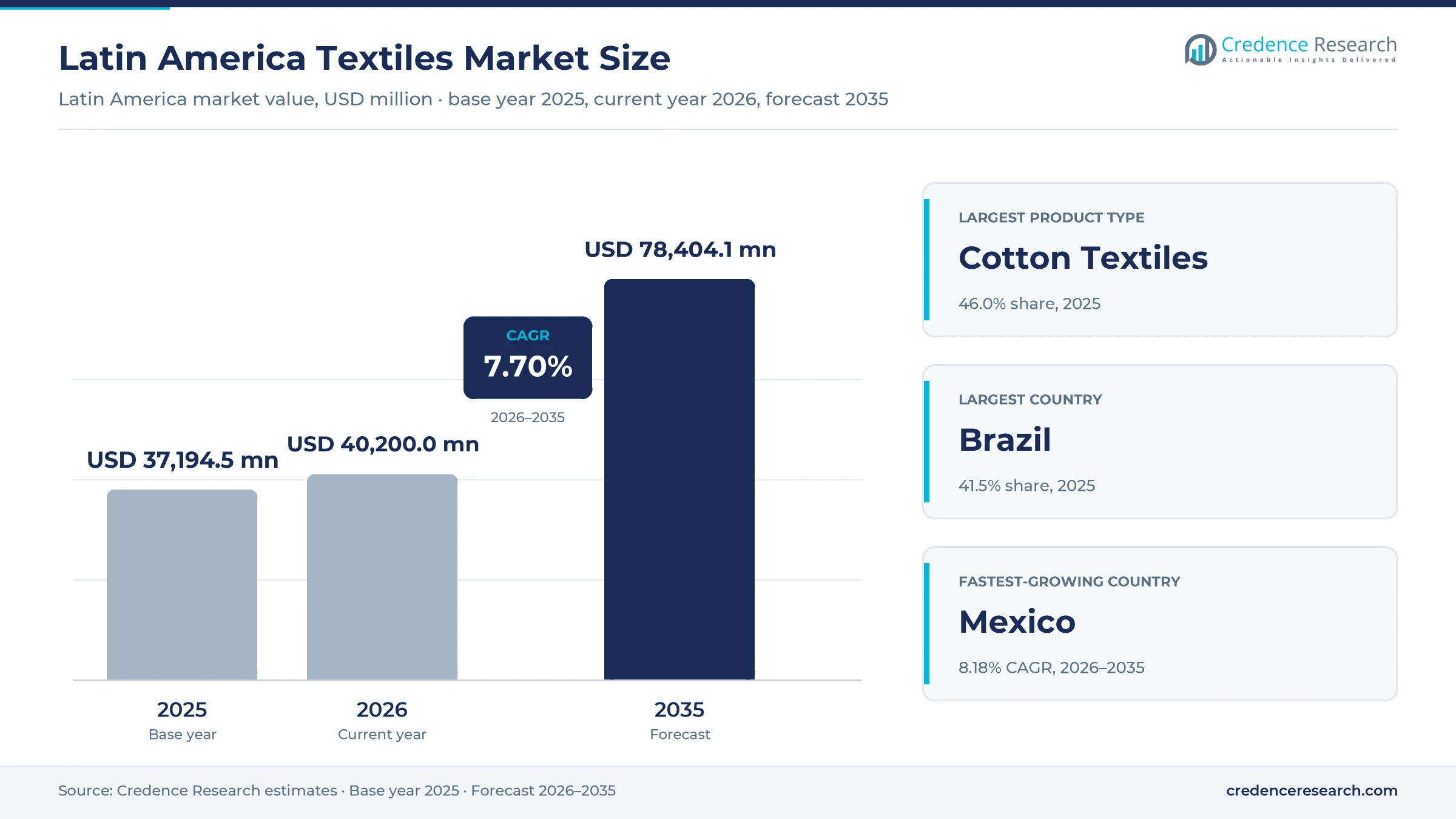
The Latin America textiles market was valued at USD 37.19 billion in 2025 and is projected to increase from USD 40.20 billion in 2026 to USD 78.40 billion by 2035, registering a CAGR of 7.70% during 2026–2035. Demand comes from apparel makers, home furnishing producers and technical converters that buy yarn-based fabrics close to their sewing and assembly plants. Brazil held the largest country share, 41.5% in 2025, because it runs a complete chain from cotton farms to spinning, weaving and retail brands. Mexico is the fastest-growing country at 8.18% a year, as apparel and automotive buyers that serve the United States move sourcing closer to the border. Trade policy also changed quickly, because Mexico approved tariffs of 10% to 50% on 1,463 tariff lines from non-agreement countries that took effect in January 2026. As a result, regional mills gained pricing room against Asian fabric while investing in traceable fibers.
What does the Latin America textiles estimate cover?
The estimate measures the value of woven, knitted and nonwoven fabrics and finished textile goods produced or sold in Brazil, Mexico, Colombia, Argentina and Peru. It counts cotton, polyester, nylon, wool and silk textiles bought by apparel, home, technical, medical and automotive customers. Values are stated in USD million at current prices and are assigned to the country where the fabric is sold.
The estimate excludes raw cotton, fiber and pulp sold before spinning, along with textile machinery, chemicals and finished footwear. Retail margins on garments are also excluded, so the market stops at the mill, distributor or importer price. The value chain runs from fiber and yarn suppliers through weaving, knitting and finishing mills to converters, sourcing agents and brands.
Latin America Textiles Market Insights
- The market was valued at USD 37.19 billion in 2025 and is projected to reach USD 78.40 billion by 2035, registering a CAGR of 7.70% during 2026–2035.
- Brazil held 41.5% of regional textile value in 2025, because its integrated mills cover spinning, weaving, finishing and apparel.
- Cotton textiles led with 46.0% of 2025 value, supported by regional cotton supply and strong denim and knitwear demand.
- Mexico approved tariffs of 10% to 50% on 1,463 tariff lines from non-agreement countries in December 2025, effective January 2026.
- Brazilian textile output rose 6.8% from January to November 2025, according to the national textile association, while apparel output grew only 0.7%.
Cotton fabrics and apparel uses hold the largest shares
Why do cotton fabrics still lead regional demand?
Based on product type, the market is categorized into cotton textiles, polyester textiles, nylon textiles, wool textiles and silk textiles. Cotton Textiles led with 46.0% of 2025 value, because Brazil grows cotton at scale and denim mills in Brazil and Mexico weave mostly cotton-rich fabric. Polyester Textiles grow fastest at 8.19% a year, as sportswear, technical and automotive buyers adopt polyester fiber blends.
Which applications buy the most fabric?
Based on application, the market is categorized into fashion and apparel textiles, home textiles, technical textiles, medical and hygiene textiles and automotive textiles. Fashion and Apparel Textiles led with 52.0% of 2025 value, because garment makers in Brazil, Mexico and Colombia buy most regional fabric. Technical Textiles grow fastest at 8.62% a year, as Mexican nonwoven and industrial fabric exporters serve construction, filtration and vehicle supply chains.
How do mills reach their buyers?
Based on sales channel, the market is categorized into direct mill sales, textile distributors and wholesalers, importers and trading houses, apparel sourcing agents and B2B digital marketplaces. Direct Mill Sales led with 41.0% of 2025 value, because large denim and cotton mills sell straight to garment makers. B2B Digital Marketplaces grow fastest at 9.86% a year from a small base, as smaller converters order fabric samples and short runs online.
| Segment Group | Leading Sub-segment | Share, 2025 | Fastest-growing Sub-segment | CAGR, 2026–2035 |
|---|---|---|---|---|
| By Product Type | Cotton Textiles | 46.0% | Polyester Textiles | 8.19% |
| By Application | Fashion and Apparel Textiles | 52.0% | Technical Textiles | 8.62% |
| By Sales Channel | Direct Mill Sales | 41.0% | B2B Digital Marketplaces | 9.86% |
Request a Free Sample
Fill in your details and we'll send you a free sample report.
- Sample data tables & charts
- Research methodology
Nearshoring and tariff walls lift regional mill demand
How do nearshoring and U.S. sourcing corridors lift demand?
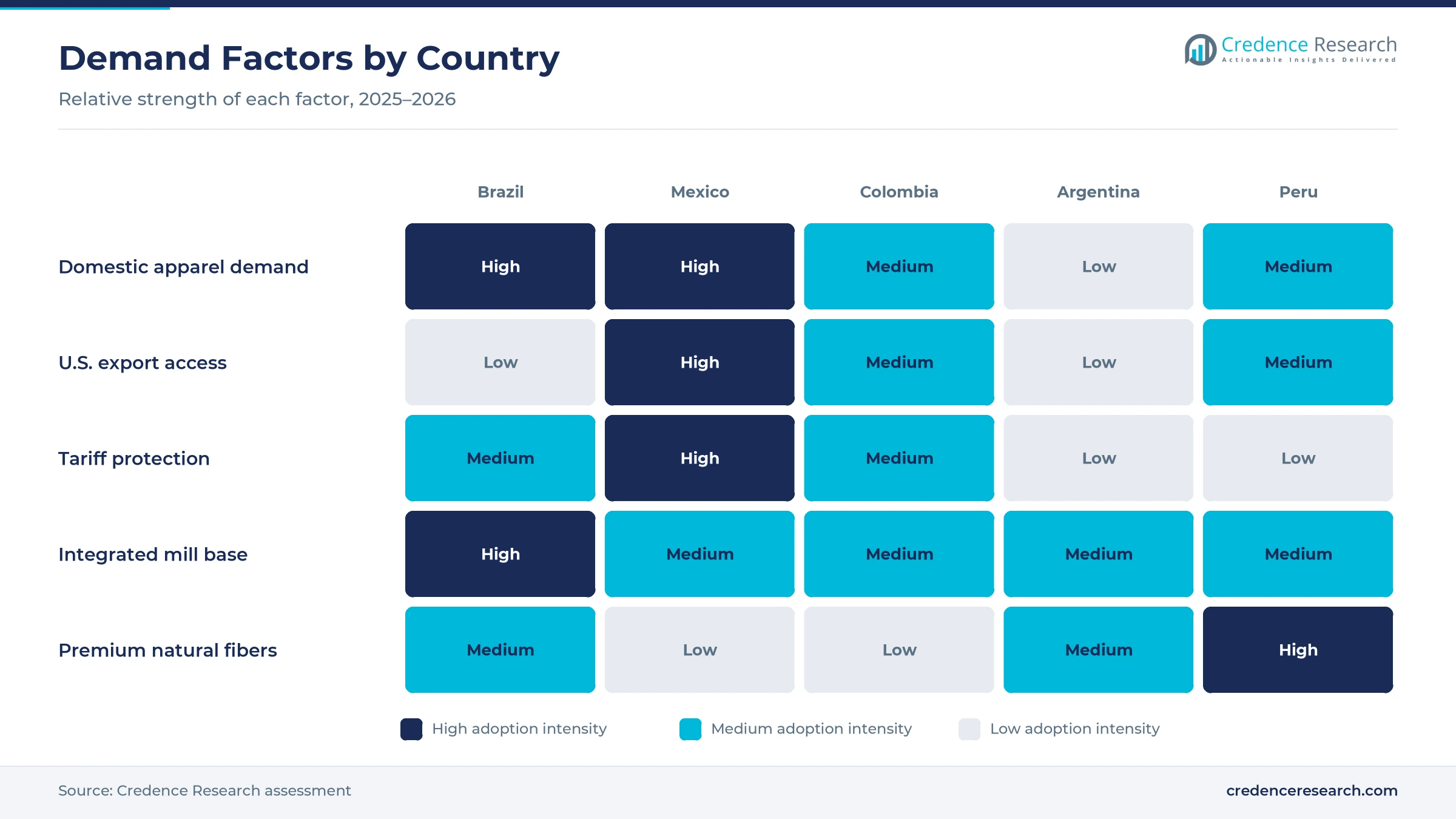
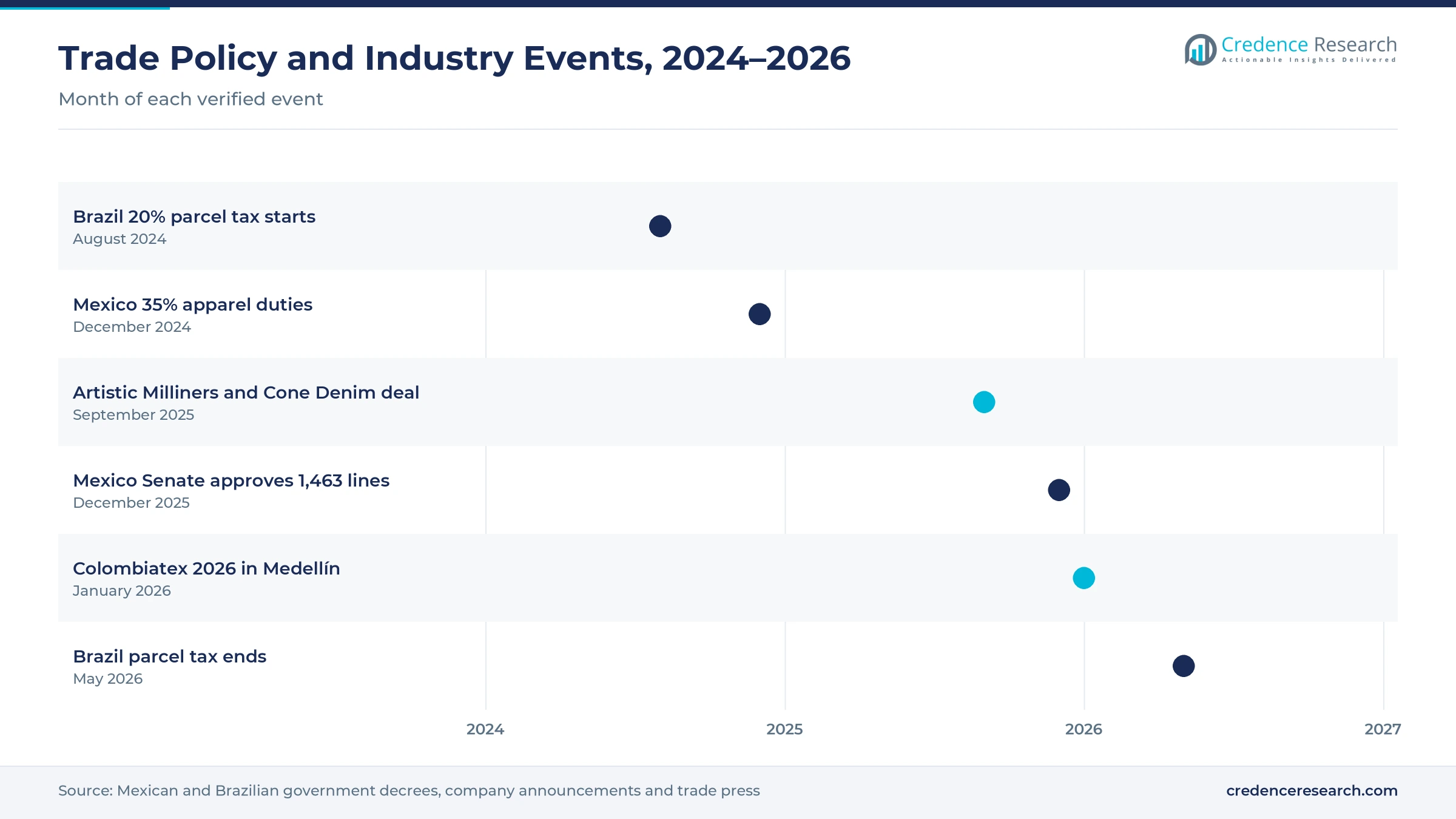
Nearshore sourcing is the strongest demand driver, because brands selling in the United States want shorter lead times and duty-free access. Mexico sends about 92% of its textile and apparel exports to the United States, according to 2025 data from the national textile chamber CANAINTEX. In turn, mills keep adding capacity close to the border, and Artistic Milliners agreed in September 2025 to take a majority stake in Cone Denim, which runs mills in Parras and Yecapixtla. The sector also employs about 242,000 formal apparel workers in Mexico, which gives regional mills a large nearby customer base. As a result, Mexico, which already holds 34.2% of regional value, is the fastest-growing country in the region through 2035, ahead of Colombia and Peru.
Why do trade defense measures support local pricing?
Trade defense measures support local pricing, because they raise the landed cost of Asian fabric and garments in the two largest markets. Mexico applied 35% duties on 138 apparel lines and 15% on 17 textile lines from December 2024 and barred temporary IMMEX imports of finished textile goods. The Mexican Senate then approved tariffs of 10% to 50% on 1,463 lines from non-agreement countries, effective January 2026, according to a Clark Hill trade alert. Brazil also charged a 20% import tax on small online parcels from August 2024 until May 2026. Therefore, domestic mills held price and volume, and direct mill sales kept 41.0% of 2025 value.
How does sustainability investment expand premium profit pools?
Sustainability investment expands premium profit pools, because export brands now pay more for traceable, low-impact fabric. Vicunha launched its Regen Denim line with regenerative cotton from Scheffer Farm and introduced a denim made with recycled and treated water, according to TexSPACE Today. This matters because Calvin Klein Brasil released four Regen Denim styles, which shows that local brands accept the price premium. Lenzing also owns 51% of LD Celulose in Minas Gerais, a 500,000-metric-ton dissolving pulp mill that started in April 2022 and supplies cellulose fibers. As a result, certified and specialty grades gain share within cotton textiles, which hold 46.0% of 2025 value.
Why does Brazil's production rebound matter for regional supply?
Brazil's production rebound matters, because Brazil is the largest supplier and buyer of fabric in the region. Textile output rose 6.8% from January to November 2025, while apparel output rose 0.7%, according to Diário do Comércio, citing the national textile association ABIT. The industry also created 21,900 formal jobs over the same months, which shows that mills added shifts rather than only clearing stock. In turn, Brazil remains the largest country market in the region, and its integrated mills from Ceará to Santa Catarina supply denim, knit and home fabric to neighboring markets in Argentina, Paraguay and Colombia, which keeps Brazilian mills central to Latin America textiles supply.
Traceable fibers and digital sourcing reshape mills
Why is the shift toward cellulosic and recycled fibers rising?
Mills are shifting toward cellulosic and recycled fibers, because export brands set fiber targets for each season. LD Celulose reached its nominal capacity of 500,000 metric tons a year of dissolving pulp less than a year after start-up in April 2022, and Lenzing buys all of the output for viscose, modal and lyocell fibers. In July 2025, Vicunha also showed collections with TENCEL and hemp blends, which gives Brazilian denim a lower-impact story for export buyers. As a result, blended fabrics move into the premium tier, and polyester textiles grow fastest among product types at 8.19% a year as recycled grades replace virgin yarn in sportswear and home fabric.
How is the rise of tariff-driven regional sourcing playing out?
Regional sourcing is rising, because buyers now weigh tariff exposure as heavily as unit cost. About 88.3% of U.S. apparel imports from USMCA partners claimed duty-free treatment from January to October 2025, up from 86.4% a year earlier, according to university trade analysis. Mexico's 2026 tariffs on non-agreement countries add a second incentive to buy fabric that meets regional rules of origin. Colombiatex 2026 in Medellín drew 615 exhibiting brands, of which 410 were Colombian, which shows how actively regional buyers now look for nearby mills. Therefore, B2B digital marketplaces grow fastest among sales channels at 9.86% a year, as regional buyers place sample and short-run orders online.
Can technical and nonwoven fabrics open new margins?
Technical and nonwoven fabrics offer an opening, because they carry higher margins and face less Asian price pressure. Technical textiles made up 17% of Mexico's textile exports and nonwovens another 16% in 2025, according to CANAINTEX. These products feed filtration, construction, medical and vehicle assembly plants that already operate in Mexico and Brazil. Technical textiles grow fastest among applications at 8.62% a year, so mills that add nonwoven, coating and lamination lines can move into this premium tier. In turn, automotive interior suppliers can source fabric locally instead of importing rolls from Asia, which shortens lead times and lowers inventory for vehicle plants in both countries.
Is there room to scale andean premium and alpaca textiles?
Andean premium textiles are a second opening, because Peru and Colombia already export high-value apparel to demanding markets. Peru had 1,052 apparel exporters in 2025 shipping to 91 markets, with apparel exports of US$1,220 million and textile exports of US$515 million, according to Agencia Andina. Colombia's fashion consumption reached 36.7 trillion pesos in 2025, up 10.3% from 2024, which supports local fabric orders. Peru and Colombia together held about 12% of regional value in 2025, so premium cotton and alpaca fabrics could lift their shares as brands seek traceable natural fibers with a clear country of origin and verified farm-level sourcing.
Cheap Asian imports and weak Argentina weigh on mills
How do low-cost Asian imports pressure regional mills?
Low-cost Asian imports remain the main pressure, because Chinese fabric and garments often land below regional mill costs. China supplied about 33% of Mexico's textile and apparel imports in 2025, and Mexico's sector exports fell 15% from January to September 2025. As a result, mills without tariff protection or export contracts cut shifts, and smaller converters switch suppliers quickly. Mitigation depends on enforcement of rules of origin and on faster delivery than Asian rivals can match.
Why is Argentina's textile slump a drag on the region?
Argentina's textile slump drags on regional demand, because its mills serve a large domestic apparel market. Textile activity fell 36.7% year on year in November 2025 and capacity utilization dropped to 29.2%, according to the textile federation FITA. Therefore, Argentina grows slowest in the region at 6.78% a year, as import opening and weak purchasing power keep local mills idle. Recovery depends on consumer income and on whether mills can export denim and knit fabric.
How does policy reversal in Brazil create uncertainty?
Policy reversal in Brazil creates uncertainty, because the 20% tax on online parcels under US$50 ended on May 13, 2026 after less than two years. Brazilian companies competing with imports had defended the tax, which had protected low-price apparel and home textile sellers. In turn, cross-border platforms may regain price advantage, and domestic mills face pressure in the economy grade. Mills can mitigate this by moving toward certified and premium fabric that small parcels rarely match.
Why do high capital costs slow mill upgrades?
High capital costs slow mill upgrades, because new weaving, knitting and finishing lines need long payback periods. Brazilian industry reports said high interest rates delayed new productive investment in 2025, even though output rose. This means that digital printing, waterless dyeing and nonwoven capacity spread more slowly than buyers request. Development bank credit lines and partnerships with fiber suppliers are the main ways mills can fund upgrades.
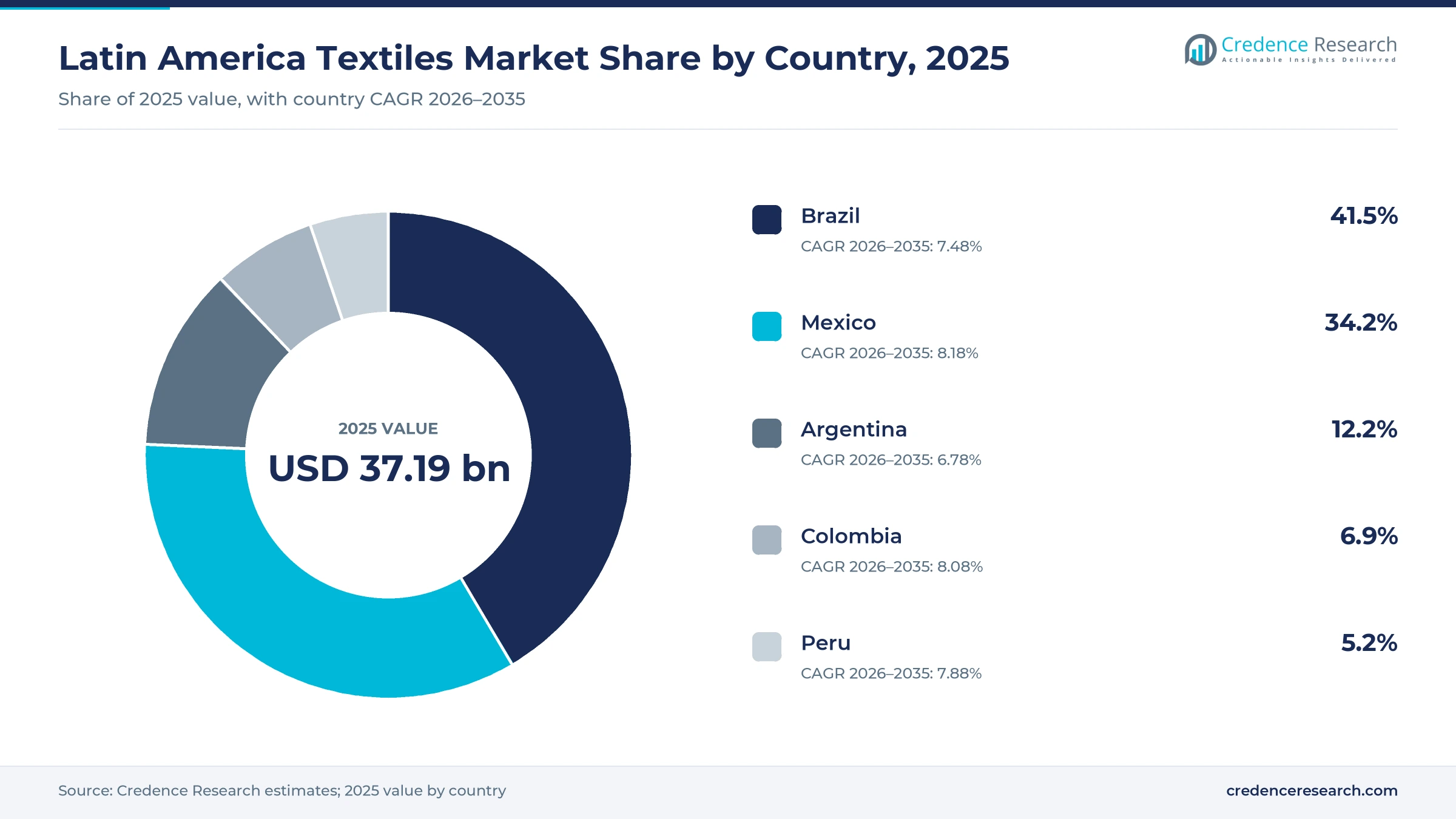
Brazil leads while Mexico grows fastest to 2035
| Country | Value, 2025 (USD billion) | Share, 2025 | CAGR, 2026–2035 |
|---|---|---|---|
| Brazil | 15.44 | 41.5% | 7.48% |
| Mexico | 12.72 | 34.2% | 8.18% |
| Argentina | 4.54 | 12.2% | 6.78% |
| Colombia | 2.57 | 6.9% | 8.08% |
| Peru | 1.93 | 5.2% | 7.88% |
Why does Brazil hold the largest share?
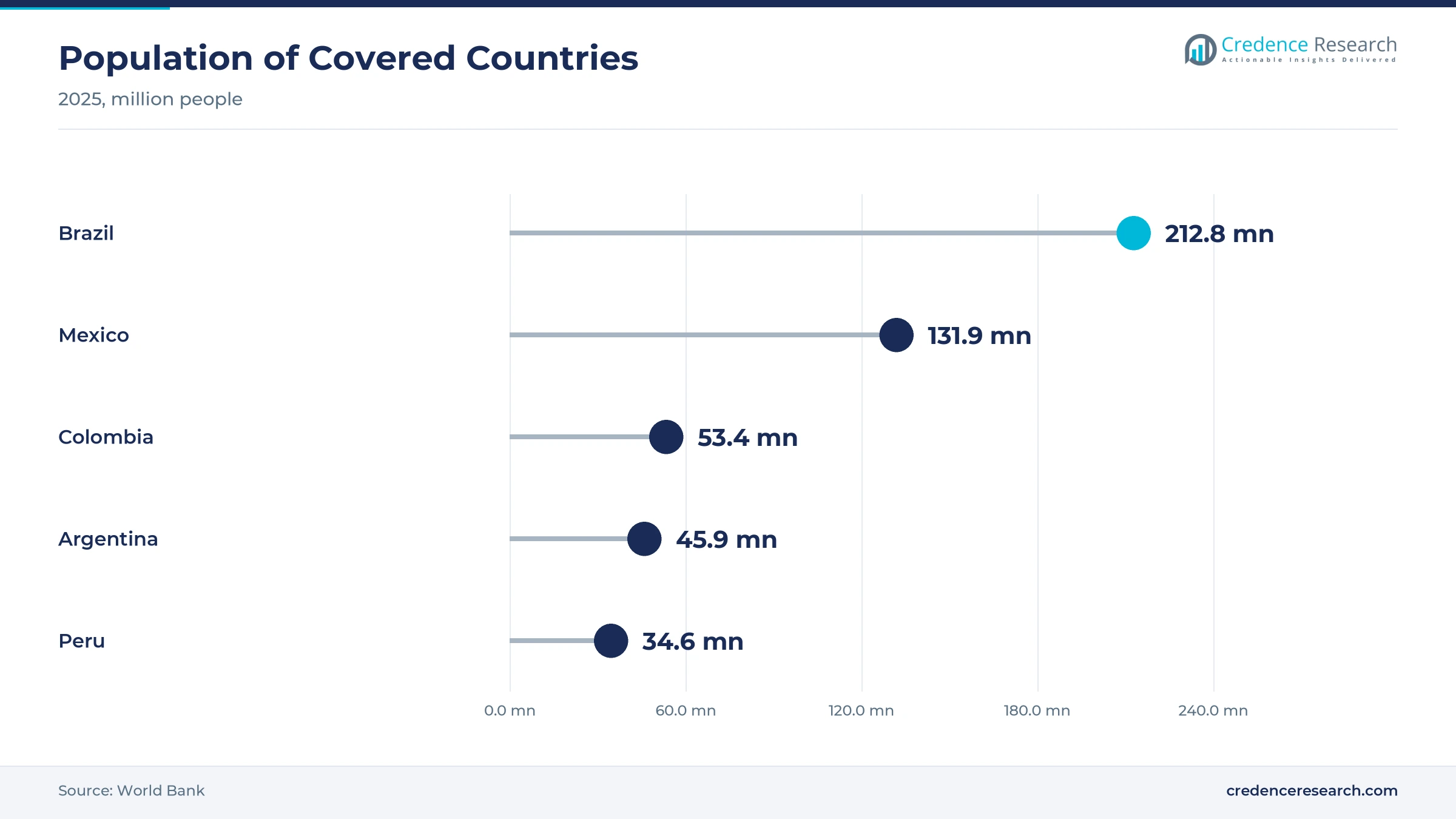
Brazil held 41.5% of 2025 value and grows at 7.48% a year, because it combines the region's largest population with an integrated chain from cotton farms to retail brands. Brazil had about 212.8 million people in 2025, according to World Bank data, which supports large apparel and home textile demand. Vicunha, Santana Textiles, Cedro and Cataguases supply denim and cotton fabric from mills in the Northeast and Minas Gerais to domestic garment makers.
How fast is Mexico gaining share?
Mexico held 34.2% of 2025 value and grows fastest at 8.18% a year, because apparel and vehicle plants serving the United States buy fabric close to the border. Cone Denim runs mills in Parras and Yecapixtla, and the Parras site also hosts a garment facility that ships denim jeans to North American brands. Mexico's 2026 tariff increases on non-agreement countries further favor regional fabric over Asian imports.
Why is Argentina lagging the regional average?
Argentina held 12.2% of 2025 value but grows slowest at 6.78% a year, because import opening and weak demand left many mills idle in 2025. Textile activity fell 6.4% from January to November 2025, while industry overall grew modestly, according to the textile federation FITA. Santana Textiles still operates a denim plant in Chaco, opened in 2007, which shows that integrated mills keep a regional supply role.
What supports Colombia's fashion fabric demand?
Colombia held 6.9% of 2025 value and grows at 8.08% a year, because Medellín and Bogotá host dense networks of own-brand apparel makers. About 45% of Colombiatex 2026 buyers were own-brand apparel manufacturers, which shows how closely mills and garment brands work together. Fashion consumption is forecast to keep growing moderately in real terms in 2026, which keeps local fabric orders steady for Medellín mills.
How do Peru's premium exports shape its share?
Peru held 5.2% of 2025 value and grows at 7.88% a year, because its cotton knit and alpaca mills serve premium export brands. Apparel exports fell 7.6% from January to April 2026, which Agencia Andina linked to U.S. tariff policy. Even so, Peru still serves about 1% of U.S. apparel demand, and pima cotton knits keep regional mills in higher price tiers.
Tariff decrees and denim deals reshaped 2025 and 2026
| Development | Status and market relevance |
|---|---|
| In August 2024, Brazil began charging a 20% import tax on international purchases of up to US$50 under the Remessa Conforme program. | Raised the cost of low-price imported apparel and home textiles until the tax ended in May 2026 |
| In December 2024, Mexico applied 35% duties on 138 apparel lines and 15% duties on 17 textile lines from non-agreement countries. | Also barred temporary IMMEX imports of finished textile goods, favoring regional mills |
| In September 2025, Artistic Milliners agreed to acquire a majority stake in Cone Denim from Elevate Textiles. | Cone Denim keeps its Parras and Yecapixtla mills in Mexico and adds a garment facility in Parras |
| In December 2025, the Mexican Senate approved tariffs of 10% to 50% on 1,463 tariff lines, including textiles and apparel. | Took effect in January 2026 for China, India, Korea and other non-agreement countries |
| In May 2026, Brazil ended the 20% tax on international parcels of up to US$50 through a provisional measure. | Restores price pressure from cross-border platforms on economy-grade apparel fabric |
Knitting, nonwovens and low-water dyeing gain ground
- Circular and warp knitting lets mills switch quickly between jersey, fleece and performance fabrics for sportswear brands that order smaller runs.
- Nonwoven manufacturing supplies hygiene, filtration and automotive parts, and nonwovens already make up 16% of Mexico's textile exports.
- Low-water dyeing and finishing cuts fresh water use, and Vicunha now uses recycled and treated water for one of its denim lines.
- Cellulosic fiber blending combines cotton with lyocell fibers and hemp to give denim and shirting a softer, lower-impact finish.
Need a Custom Version of This Report?
Tailor the scope, geography, or segments to your exact requirements.
- Custom geography or segment scope
- Direct access to our analyst team
Integrated denim and cotton mills set the pace
Competition is led by integrated denim and cotton mills that control spinning, weaving and finishing under one roof. Vicunha Textil and Santana Textiles compete on denim range, sustainability claims and service to brands in Brazil, Argentina and the United States. Cone Denim, now majority owned by Artistic Milliners, competes from Mexico on speed to U.S. buyers. Alpargatas sold 228.7 million pairs of footwear in 2025 and remains a large buyer of fabric and components in Brazil. Lenzing competes upstream through LD Celulose, which supplies pulp for cellulosic fibers. Kaltex, Nien Hsing, Romatex, Cataguases and Cedro also compete in cotton, denim and home fabric. Rivals compete on lead time, rules-of-origin compliance, certified fibers and finishing quality rather than on price alone.
Companies profiled and their roles in this market
| Company | Type | Role in the market |
|---|---|---|
| Vicunha Textil S.A. | Integrated denim mill | Launched Regen Denim with regenerative cotton and a denim made with recycled and treated water |
| Santana Textiles | Integrated denim mill | Runs mills in Ceará and Rio Grande do Norte, a plant in Chaco, Argentina, a Texas plant and a Colombian distribution center |
| Cone Denim | Denim mill | Operates mills in Parras and Yecapixtla, Mexico, now majority owned by Artistic Milliners |
| Grupo Lenzing | Fiber and pulp supplier | Holds 51% of LD Celulose, a 500,000-metric-ton dissolving pulp mill in Minas Gerais |
| Alpargatas S.A. | Footwear and textile buyer | Sold 228.7 million pairs in 2025, mostly in Brazil |
Credence Research view on nearshore fabric supply
Credence Research's view is that Latin America textiles demand will grow on supply security rather than on low prices. Mexico's tariff walls and USMCA rules give regional mills a protected route into U.S. apparel and vehicle supply chains, so Mexico should keep gaining share. Brazil remains the volume base, but its policy swings on imports add risk for economy-grade fabric. Argentina is the swing factor, because a demand recovery there could lift regional growth above this base case. Mills that add certified fibers and technical lines are best placed through 2035.
How the regional fabric estimate was built
The report uses 2025 as the base year, with values in USD million at current prices. Market values come from the Credence Research model, and country, product type, application and sales channel splits are Credence Research estimates. Inputs include national textile association data, trade chamber export statistics, government decrees, World Bank population data, company announcements and trade press. Country shares follow the client's regional split, and growth tilts reflect trade policy and industry activity. No interviews or surveys were used in preparing these estimates.
Mexico and technical uses drive growth to 2035
The market is expected to reach USD 78.40 billion by 2035, a 7.70% CAGR during 2026–2035, as nearshoring and trade defense keep regional mills busy. Mexico should gain the most share, while Brazil stays the largest market through the forecast. Technical, medical and automotive fabrics are expected to grow faster than apparel fabric as plants in Mexico and Brazil buy locally. A lasting recovery in Argentina or stronger enforcement of rules of origin would lift this outlook, while a new wave of low-price parcel imports would lower it.
Frequently Asked Questions
How big is the Latin America textiles market?
Which country leads Latin American textile demand?
Which country grows fastest?
Which product type holds the largest share?
How did Mexico change textile tariffs?
What is holding back Argentina?
Who are the main companies in the market?
Which application grows fastest?
Table of Content
Chapter 1 Market Segmentation
- 1.1 Segmentation Framework
- 1.1.1 Product and Service Classification
- 1.1.2 Application and End-Use Classification
- 1.1.3 Technology and Solution Classification
- 1.1.4 Customer and Distribution Channel Classification
- 1.1.5 Geographic Segmentation
- 1.1.6 Market Segment Definitions and Boundaries
- 1.2 By Product Type
- 1.2.1 Cotton Textiles
- 1.2.2 Polyester Textiles
- 1.2.3 Nylon Textiles
- 1.2.4 Wool Textiles
- 1.2.5 Silk Textiles
- 1.3 By Application
- 1.3.1 Fashion and Apparel Textiles
- 1.3.2 Home Textiles
- 1.3.3 Technical Textiles
- 1.3.4 Medical and Hygiene Textiles
- 1.3.5 Automotive Textiles
- 1.4 By Sales Channel
- 1.4.1 Direct Mill Sales
- 1.4.2 Textile Distributors and Wholesalers
- 1.4.3 Importers and Trading Houses
- 1.4.4 Apparel Sourcing Agents
- 1.4.5 B2B Digital Marketplaces
- 1.5 By Country
- 1.5.1 Brazil
- 1.5.2 Mexico
- 1.5.3 Colombia
- 1.5.4 Argentina
- 1.5.5 Peru
Chapter 2 Introduction
- 2.1 Report Objectives and Scope
- 2.2 Product Definition and Industry Terminology
- 2.3 Market Inclusions and Exclusions
- 2.4 Research Process
- 2.4.1 Primary Research and Expert Interviews
- 2.4.2 Secondary Research and Source Review
- 2.4.3 Top-Down and Bottom-Up Estimation
- 2.4.4 Data Triangulation and Verification
- 2.5 Market Size Measurement Basis
- 2.5.1 2025: USD 37.19 billion → 2035: USD 78.40 billion
- 2.6 Historical and Forecast Reference Periods
- 2.6.1 Historical Period: 2018-2025
- 2.6.2 Base Year: 2025
- 2.6.3 Forecast Period: 2025-2035
- 2.7 Research Assumptions and Limitations
Chapter 3 Executive Summary
- 3.1 Market Snapshot and Key Findings
- 3.2 Base-Year Market Size, 2025
- 3.3 Forecast Market Size, 2035
- 3.4 Revenue and Volume Growth Outlook
- 3.5 Key Demand and Supply Indicators
- 3.6 Leading Market Segments
- 3.7 Fastest-Growing Market Opportunities
- 3.8 Regional Performance Highlights
- 3.9 Technology and Industry Transformation
- 3.10 Competitive Landscape Summary
- 3.11 Analyst View and Strategic Implications
Chapter 4 Global Latin America Textiles Market Trends and Developments
- 4.1 Historical Industry Development, 2018-2025
- 4.2 Recent Market Trends and Developments
- 4.3 Demand and Customer Behavior Trends
- 4.4 Technology and Product Innovation
- 4.5 Artificial Intelligence, Automation and Digitalization
- 4.6 Local Manufacturing and Supply Chain Realignment
- 4.7 Industry Partnerships, Mergers and Acquisitions
- 4.8 Sustainability and Circular Economy Developments
- 4.9 Government and Private Sector Investment Trends
- 4.10 Emerging Business Models and Commercialization
- 4.11 Industry Developments and Announcements
Chapter 5 Global Latin America Textiles Market Production, Supply and Demand Analysis
- 5.1 Demand Trend and Consumption Analysis, 2018-2025
- 5.2 Demand Forecast, 2025-2035
- 5.3 Production and Output Trend, 2018-2025
- 5.4 Production and Output Forecast, 2025-2035
- 5.5 Installed Capacity and Capacity Utilization
- 5.6 Company-Wise Production Plants and Statistics
- 5.6.1 Installed Production Capacity
- 5.6.2 Actual Production
- 5.6.3 Planned Capacity and Expansion Targets
- 5.7 Supply Chain Structure and Procurement Trends
- 5.8 Supply-Demand Gap and Bottlenecks
- 5.9 Import Dependence and Sourcing Structure
- 5.10 Contract Manufacturing and Outsourcing
- 5.11 Regional Supply and Demand Concentration
Chapter 6 Global Latin America Textiles Market Pricing Analysis
- 6.1 Pricing Structure and Measurement
- 6.2 Historical Pricing Trends, 2018-2025
- 6.3 Pricing Outlook, 2025-2035
- 6.4 Average Selling Price and Unit Economics
- 6.5 Pricing by Product and Market Segment
- 6.6 Geographic Pricing Differences
- 6.7 Key Input, Energy, Labor and Logistics Costs
- 6.8 Contract Pricing and Purchasing Models
- 6.9 Pricing Sensitivity and Competitive Positioning
- 6.10 Price, Margin and Profitability Implications
Chapter 7 Global Latin America Textiles Market Dynamics
- 7.1 Market Growth Drivers
- 7.1.1 Demand-Side Drivers
- 7.1.2 Technology and Innovation Drivers
- 7.1.3 Infrastructure and Investment Drivers
- 7.1.4 Regulatory and Policy Drivers
- 7.2 Market Restraints
- 7.2.1 Cost and Affordability Constraints
- 7.2.2 Technology and Adoption Barriers
- 7.2.3 Supply Chain and Operational Constraints
- 7.3 Market Challenges
- 7.3.1 Competitive Pressure and Margin Erosion
- 7.3.2 Skills, Infrastructure and Implementation Gaps
- 7.4 Emerging Market Opportunities
- 7.5 Market Dynamics Impact and Time-Horizon Assessment
Chapter 8 Global Latin America Textiles Value Chain Analysis
- 8.1 Industry Value Chain Overview
- 8.2 Upstream Suppliers and Critical Inputs
- 8.3 Technology and Component Providers
- 8.4 Manufacturing or Service Delivery
- 8.5 Distribution, Channel Partners and Integrators
- 8.6 Downstream Applications and End Users
- 8.7 Value Addition and Profit Pools
- 8.8 Vertical Integration and Outsourcing
- 8.9 Supplier Concentration and Risk
- 8.10 Supply Chain Localization and Resilience
Chapter 9 Global Latin America Textiles Market Regulations and Policies
- 9.1 Relevant Laws, Standards and Compliance Frameworks
- 9.2 Product, Service, Safety and Quality Requirements
- 9.3 Government Policies, Incentives and Subsidies
- 9.4 Imports, Exports and Trade Barriers
- 9.5 Public Procurement and Local Content Requirements
- 9.6 Environmental and Sustainability Compliance
- 9.7 Upcoming Policy Changes and Market Implications
Chapter 10 Global Latin America Textiles Market Hotspots and Opportunities
- 10.1 Market Opportunity Mapping and Growth Hotspots
- 10.2 High-Growth Applications and Customer Groups
- 10.3 Underserved Markets and White-Space Opportunities
- 10.4 Emerging Technology and Product Opportunities
- 10.5 New Capacity and Investment Hotspots
- 10.6 Market Entry and Expansion Opportunities
- 10.7 Distribution and Partnership Opportunities
- 10.8 Near-Term and Long-Term Commercial Potential
- 10.9 Opportunity Attractiveness and Execution Risks
Chapter 11 Global Latin America Textiles Market Outlook, 2025-2035
- 11.1 Market Size and Analysis
- 11.1.1 Revenue (Market Measurement: 2025: USD 37.19 billion → 2035: USD 78.40 billion)
- 11.1.2 Market Volume and Quantity Sold
- 11.1.3 Historical Market Size, 2018-2025
- 11.1.4 Base-Year Market Size, 2025
- 11.2 Market Forecast, 2025-2035
- 11.2.1 Revenue Forecast to 2035
- 11.2.2 Volume Forecast to 2035
- 11.2.3 CAGR and Year-on-Year Growth
- 11.2.4 Incremental Revenue Opportunity
- 11.3 Forecast Assumptions and Scenario Analysis
- 11.3.1 Base-Case Forecast
- 11.3.2 Optimistic and Conservative Scenarios
- 11.3.3 Technology, Pricing and Policy Sensitivities
- 11.4 Market Attractiveness and Growth Outlook
Chapter 12 Global Latin America Textiles Market Segmentation and Outlook
- 12.1 Segmentation Summary and Market Shares, 2025
- 12.2 Largest and Fastest-Growing Segments
- 12.3 By Product Type - Market Size and Forecast, 2025-2035
- 12.3.1 Segment Definition and Scope
- 12.3.2 Historical Market Size, 2018-2025
- 12.3.3 Revenue Forecast, 2025-2035
- 12.3.4 Volume Forecast, 2025-2035
- 12.3.5 Base-Year Market Share, 2025
- 12.3.6 Segment CAGR and Growth Drivers
- 12.3.7 Subsegment Market Size and Forecast
- 12.3.7.1 Cotton Textiles
- 12.3.7.2 Polyester Textiles
- 12.3.7.3 Nylon Textiles
- 12.3.7.4 Wool Textiles
- 12.3.7.5 Silk Textiles
- 12.3.8 Subsegment Pricing and Adoption Trends
- 12.3.9 Leading Suppliers and Competition
- 12.3.10 Regional Demand and Opportunities
- 12.4 By Application - Market Size and Forecast, 2025-2035
- 12.4.1 Segment Definition and Scope
- 12.4.2 Historical Market Size, 2018-2025
- 12.4.3 Revenue Forecast, 2025-2035
- 12.4.4 Volume Forecast, 2025-2035
- 12.4.5 Base-Year Market Share, 2025
- 12.4.6 Segment CAGR and Growth Drivers
- 12.4.7 Subsegment Market Size and Forecast
- 12.4.7.1 Fashion and Apparel Textiles
- 12.4.7.2 Home Textiles
- 12.4.7.3 Technical Textiles
- 12.4.7.4 Medical and Hygiene Textiles
- 12.4.7.5 Automotive Textiles
- 12.4.8 Subsegment Pricing and Adoption Trends
- 12.4.9 Leading Suppliers and Competition
- 12.4.10 Regional Demand and Opportunities
- 12.5 By Sales Channel - Market Size and Forecast, 2025-2035
- 12.5.1 Segment Definition and Scope
- 12.5.2 Historical Market Size, 2018-2025
- 12.5.3 Revenue Forecast, 2025-2035
- 12.5.4 Volume Forecast, 2025-2035
- 12.5.5 Base-Year Market Share, 2025
- 12.5.6 Segment CAGR and Growth Drivers
- 12.5.7 Subsegment Market Size and Forecast
- 12.5.7.1 Direct Mill Sales
- 12.5.7.2 Textile Distributors and Wholesalers
- 12.5.7.3 Importers and Trading Houses
- 12.5.7.4 Apparel Sourcing Agents
- 12.5.7.5 B2B Digital Marketplaces
- 12.5.8 Subsegment Pricing and Adoption Trends
- 12.5.9 Leading Suppliers and Competition
- 12.5.10 Regional Demand and Opportunities
- 12.6 By Country - Market Size and Forecast, 2025-2035
- 12.6.1 Segment Definition and Scope
- 12.6.2 Historical Market Size, 2018-2025
- 12.6.3 Revenue Forecast, 2025-2035
- 12.6.4 Volume Forecast, 2025-2035
- 12.6.5 Base-Year Market Share, 2025
- 12.6.6 Segment CAGR and Growth Drivers
- 12.6.7 Subsegment Market Size and Forecast
- 12.6.7.1 Brazil
- 12.6.7.2 Mexico
- 12.6.7.3 Colombia
- 12.6.7.4 Argentina
- 12.6.7.5 Peru
- 12.6.8 Subsegment Pricing and Adoption Trends
- 12.6.9 Leading Suppliers and Competition
- 12.6.10 Regional Demand and Opportunities
- 12.7 Segment Growth Comparison
- 12.8 Segment Attractiveness and Priority Matrix
Chapter 13 Global Latin America Textiles End-Use and Application Market Outlook
- 13.1 End-Use Industry and Customer Demand Structure
- 13.2 Leading Applications and Customer Groups
- 13.3 End-Use Market Size, Share and Forecast
- 13.4 Major End-Use Industry Deep Dives
- 13.4.1 Customer Requirements and Use Cases
- 13.4.2 Demand and Replacement Cycles
- 13.4.3 Technical and Regulatory Considerations
- 13.4.4 Purchasing and Procurement Models
- 13.4.5 Leading Vendors and Distribution Channels
- 13.4.6 Forecast and Commercial Opportunities
- 13.5 Emerging Applications and Cross-Segment Demand
- 13.6 End-Use Industry Investment Priorities
Chapter 14 Global Latin America Textiles Geographic Market Outlook, 2025-2035
- 14.1 Regional Market Size and Share, 2025
- 14.2 Regional Market Forecast, 2025-2035
- 14.3 Regional Pricing, Production and Demand Differences
- 14.4 North America
- 14.4.1 United States
- 14.4.2 Canada
- 14.4.3 Mexico
- 14.5 Europe
- 14.5.1 Germany
- 14.5.2 France
- 14.5.3 Italy
- 14.5.4 United Kingdom
- 14.5.5 Spain
- 14.5.6 Poland
- 14.5.7 Russia
- 14.5.8 Netherlands
- 14.5.9 Belgium
- 14.5.10 Sweden
- 14.5.11 Denmark
- 14.5.12 Norway
- 14.5.13 Rest of Europe
- 14.6 Asia Pacific
- 14.6.1 China
- 14.6.2 India
- 14.6.3 Japan
- 14.6.4 South Korea
- 14.6.5 Thailand
- 14.6.6 Indonesia
- 14.6.7 Vietnam
- 14.6.8 Malaysia
- 14.6.9 Australia
- 14.6.10 Rest of Asia Pacific
- 14.7 Latin America
- 14.7.1 Brazil
- 14.7.2 Argentina
- 14.7.3 Colombia
- 14.7.4 Chile
- 14.7.5 Rest of Latin America
- 14.8 Middle East
- 14.8.1 Saudi Arabia
- 14.8.2 United Arab Emirates
- 14.8.3 Turkey
- 14.8.4 Israel
- 14.8.5 Iran
- 14.8.6 Rest of the Middle East
- 14.9 Africa
- 14.9.1 South Africa
- 14.9.2 Egypt
- 14.9.3 Nigeria
- 14.9.4 Morocco
- 14.9.5 Rest of Africa
- 14.10 Regional Investment, Policy and Supply Chain Differences
- 14.11 Regional Competitive Landscape
- 14.12 Geographic Growth Hotspots
Chapter 15 Global Latin America Textiles Technology, Innovation and Sustainability Outlook
- 15.1 Technology Landscape and Maturity
- 15.2 Product, Process and Service Innovation
- 15.3 AI, Automation and Digital Tools in the Industry
- 15.4 Technology Adoption and Performance Benchmarking
- 15.5 Innovation Pipeline and R&D Investment
- 15.6 Patent and Intellectual Property Trends
- 15.7 Energy Efficiency and Resource Management
- 15.8 Sustainability, Recycling and Circularity
- 15.9 Technology Roadmap, 2025-2035
- 15.10 Risks of Obsolescence and Technology Substitution
Chapter 16 Global Latin America Textiles Market Key Strategic Imperatives
- 16.1 Growth and Market Entry Priorities
- 16.2 High-Return Products and Segments
- 16.3 Pricing, Profitability and Cost Optimization
- 16.4 Technology Investment and Product Differentiation
- 16.5 Supply Chain Localization and Resilience
- 16.6 Distribution and Customer Acquisition
- 16.7 Partnership, Acquisition and Capacity Strategy
- 16.8 Regional Expansion Priorities
- 16.9 Short-, Medium- and Long-Term Actions
Chapter 17 Competition Outlook
- 17.1 Industry Competition Characteristics
- 17.2 Market Structure and Concentration
- 17.3 Market Share and Competitive Positioning, 2025
- 17.4 Company-Wise Revenue and Product Benchmarking
- 17.5 Production and Service Capacity Benchmarking
- 17.6 Technology, Pricing and Differentiation
- 17.7 Regional Footprint and Distribution Strength
- 17.8 Mergers, Acquisitions and Strategic Alliances
- 17.9 New Entrants and Competitive Threats
- 17.10 Porter's Five Forces and Industry Attractiveness
- 17.11 Competitive Outlook, 2025-2035
Chapter 18 Company Profiles
- 18.1 Company Coverage and Selection Criteria
- 18.2 Vicunha Textil S.A.
- 18.2.1 Business Description
- 18.2.2 Company Ownership and Geographic Presence
- 18.2.3 Product and Service Portfolio
- 18.2.4 Manufacturing and Operating Footprint
- 18.2.5 Production Capacity and Expansion Plans
- 18.2.6 Financial Performance and Investment
- 18.2.7 Market Share and Competitive Position
- 18.2.8 Technology and Innovation Capabilities
- 18.2.9 Strategic Alliances or Partnerships
- 18.2.10 Recent Developments
- 18.2.11 Growth Strategy and Outlook
- 18.3 Santana Textiles
- 18.4 Alpargatas S.A.
- 18.5 Kaltex America
- 18.6 Grupo Lenzing
- 18.7 Nien Hsing Textile Co.
- 18.8 Romatex
- 18.9 Companhia Industrial Cataguases
- 18.10 Cone Denim
- 18.11 Cedro Textil
- 18.12 Other Relevant Market Participants
Note: Every listed company is profiled on the structure shown under the first company. The company list is preliminary and may change based on research findings, market developments, data availability and client requirements.
Chapter 19 Disclaimer
- 19.1 Research and Forecast Disclaimer
- 19.2 Data Source and Estimation Limitations
Note: The depth of individual sections depends on data availability for this market. Volume, capacity, trade and other unit-based metrics are included where applicable.

