
Market Overview:
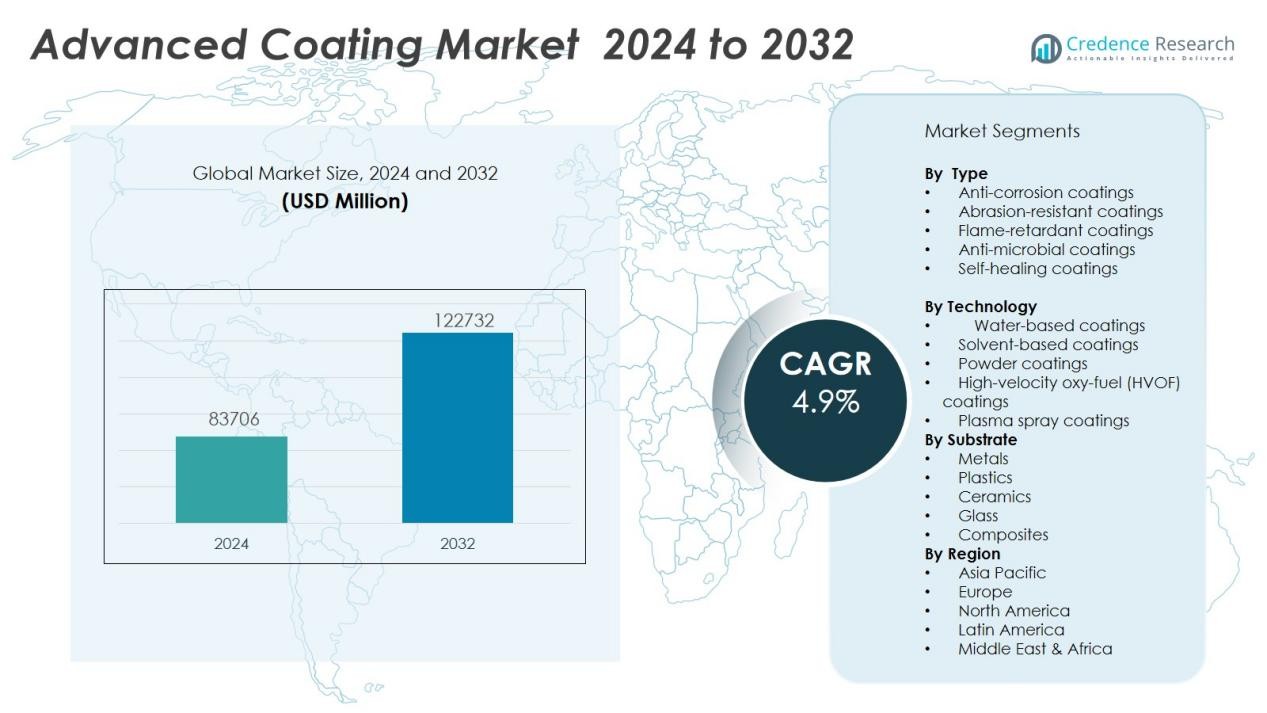
The advanced coating market size was valued at USD 83706 million in 2024 and is anticipated to reach USD 122732 million by 2032, at a CAGR of 4.9 % during the forecast period (2024-2032).
| REPORT ATTRIBUTE | DETAILS |
|---|---|
| Historical Period | 2020-2024 |
| Base Year | 2024 |
| Forecast Period | 2025-2032 |
| Advanced Coating Market Size 2024 | USD 83706 Million |
| Advanced Coating Market, CAGR | 4.9 % |
| Advanced Coating Market Size 2032 | USD 122732 Million |
Market drivers for advanced coatings include increased focus on sustainability, stringent regulatory standards, and the ongoing shift toward lightweight, corrosion-resistant materials. Growing awareness regarding the environmental impact of traditional coatings has driven the adoption of water-based, powder, and bio-based advanced coatings. Rapid industrialization, the need for energy efficiency, and technological advancements such as nanotechnology and smart coatings also contribute to market momentum, supporting manufacturers in meeting performance and regulatory demands.
Regionally, North America and Europe hold significant shares due to advanced manufacturing sectors, high investment in R&D, and strict environmental regulations. The Asia-Pacific region is witnessing the fastest growth, fueled by expanding industrial bases, rising construction activities, and increasing automotive production in countries such as China, India, and Japan.
Market Insights:
- The advanced coating market reached USD 83,706 million in 2024 and is projected to reach USD 122,732 million by 2032, with a CAGR of 4.9% from 2024 to 2032.
- Demand is driven by sustainability, stricter regulations, and a shift toward lightweight, corrosion-resistant, and high-performance materials across key industries.
- Adoption of water-based, powder, and bio-based coatings is accelerating due to environmental concerns and compliance with low-VOC standards.
- Technological advancements, such as nanocoatings and smart coatings, are enabling new functionalities like self-cleaning, anti-microbial, and scratch resistance.
- Asia-Pacific is the fastest-growing region, accounting for 26% of the global market, driven by rapid industrialization, urbanization, and manufacturing growth in China, India, Japan, and South Korea.
- North America and Europe together represent 60% of global revenue, benefiting from robust R&D, strong manufacturing, and stringent environmental regulations.
- The market faces challenges from regulatory complexity, volatile raw material prices, and supply chain disruptions, but opportunities remain strong in eco-friendly and functional coatings for emerging sectors and regions.
Market Drivers:
Rising Demand for High-Performance and Durable Solutions across Industries:
The advanced coating market benefits from increased demand in sectors such as automotive, aerospace, construction, and electronics. These industries require coatings that deliver superior durability, corrosion resistance, and enhanced mechanical properties. Advanced coatings extend product life cycles and reduce maintenance costs, supporting operational efficiency and safety. Manufacturers prioritize innovation to meet strict industry standards and performance expectations.
- For instance, PPG developed its ENVIRO-PRIME EPIC 200X electrocoat technology that demonstrates exceptional sustainability benefits at Toyota Motor Manufacturing Canada North Plant in Cambridge, Ontario, enabling a total reduction of 3,500 metric tons of CO₂ emissions per year.
Stringent Environmental Regulations and Shift toward Sustainable Products:
Strict regulatory frameworks drive the adoption of eco-friendly and low-VOC (volatile organic compound) coatings. Companies focus on developing water-based, powder, and bio-based formulations to comply with environmental standards and reduce emissions. This shift aligns with growing global awareness of sustainability, prompting research into non-toxic alternatives. The advanced coating market capitalizes on these trends by offering sustainable solutions that do not compromise performance.
- For instance, Sherwin-Williams achieved a major breakthrough with their water-based acrylic alkyd technology using recycled PET bottles and soybean oil, eliminating over 800,000 pounds of VOCs in 2010 alone.
Rapid Advancements in Coating Technologies and Nanomaterials:
Innovations in nanotechnology and material science fuel the development of advanced coatings with unique functionalities. Nanocoatings deliver self-cleaning, anti-microbial, anti-fouling, and scratch-resistant properties, expanding the scope of application across sectors. Continuous R&D efforts enable manufacturers to create coatings with enhanced protective features, improved adhesion, and greater surface versatility. The advanced coating market leverages these technological breakthroughs to address evolving customer requirements.
Growing Investments in Infrastructure and Industrial Expansion in Emerging Regions:
Emerging economies in Asia-Pacific and Latin America present new opportunities for the advanced coating market. Infrastructure projects, rapid urbanization, and industrial growth drive demand for high-performance coatings in construction, transportation, and energy sectors. Companies invest in local production facilities and distribution networks to serve rising regional demand. It enables manufacturers to tap into high-growth markets and strengthen their global presence.
Market Trends:
Increasing Adoption of Smart and Functional Coatings Driven by Technological Advancements:
The advanced coating market demonstrates a clear shift toward smart and functional coatings, propelled by significant advances in material science and digital technology integration. Manufacturers introduce coatings that respond to environmental stimuli, such as temperature, humidity, or light, providing applications in automotive, aerospace, and electronics sectors. Demand for anti-microbial, self-healing, anti-fouling, and anti-corrosion coatings continues to rise, supported by growing end-user expectations for performance and product longevity. Research in nanomaterials and hybrid composites enables the development of coatings with multifunctional properties, such as thermal regulation and electrical conductivity. The trend aligns with the need for next-generation protective solutions that combine durability with additional value-added features. The advanced coating market leverages these developments to expand its portfolio and strengthen its competitive positioning.
- For instance, Sherwin-Williams has developed Paint Shield microbicidal paint that achieves 99.9% bacteria kill rate against Staph, E. coli, and MRSA within 2 hours of exposure on painted surfaces.
Sustainability, Circular Economy, and Regulatory Compliance Shape Product Innovation:
Sustainability and circular economy principles play a pivotal role in shaping product innovation within the advanced coating market. Companies focus on creating formulations that minimize environmental impact by reducing volatile organic compounds (VOCs), hazardous chemicals, and energy consumption during application. Bio-based and waterborne coatings are gaining traction, with end users seeking products that comply with stricter global regulations and green building standards. It reflects a broader industry trend toward transparency, recyclability, and lifecycle assessment, driving collaboration between raw material suppliers, manufacturers, and end users. Adoption of eco-labels and certifications is accelerating as customers demand verification of sustainable practices. The emphasis on environmental responsibility supports brand reputation and facilitates market access in regions with rigorous regulatory landscapes.
- For instance, Arkema has developed a biobased, zero-VOC coalescent technology for waterborne paints with 96% biobased carbon content as measured by ASTM D6866, meeting zero-VOC requirements under ASTM D6886.
Market Challenges Analysis:
Evolving Regulatory Environment and Environmental Compliance Drive Up Costs:
The advanced coating market faces increasing pressure from evolving regulatory frameworks and strict environmental mandates. Companies must invest in research and reformulation to eliminate hazardous chemicals and reduce volatile organic compounds, adding to operational costs. Navigating a patchwork of international standards requires significant resources and slows product approvals. This complexity challenges both global players and regional manufacturers seeking broader market access. Delays in certification or non-compliance can limit opportunities and damage reputation. It often creates a barrier for new entrants and small businesses with limited compliance budgets.
Volatility in Raw Material Prices and Supply Chain Disruptions Challenge Profitability:
Frequent fluctuations in raw material prices and ongoing supply chain disruptions pose significant risks for advanced coating manufacturers. High dependence on specialty chemicals and advanced resins leaves companies vulnerable to cost spikes and shortages. Tightening global supply networks can lead to inconsistent quality and delayed delivery schedules, straining customer relationships. Managing costs while maintaining product performance requires advanced procurement strategies and strong supplier partnerships. The advanced coating market must address these hurdles to protect margins and sustain growth in a highly competitive landscape.
Market Opportunities:
Rising Demand for Sustainable and Smart Coating Solutions Fuels Innovation:
The advanced coating market holds significant opportunities in the development of eco-friendly, smart, and functional coatings. Manufacturers can leverage demand for water-based, bio-based, and low-VOC products to meet both regulatory requirements and consumer preferences. Expanding applications in automotive, aerospace, electronics, and healthcare create new avenues for growth, especially for coatings that deliver self-cleaning, anti-microbial, or energy-saving properties. Partnerships with research institutions and technology firms support the rapid commercialization of next-generation coatings. Investments in R&D help companies address sustainability goals and differentiate their offerings in a crowded market. It positions manufacturers to capture share in emerging segments driven by environmental and performance standards.
Expansion into High-Growth Regions and New Industrial Applications Drives Market Potential:
Untapped markets in Asia-Pacific, Latin America, and the Middle East present attractive opportunities for advanced coating providers. Growing infrastructure projects, rising automotive production, and expanding electronics manufacturing stimulate regional demand for high-performance coatings. Companies that establish local manufacturing and distribution networks can strengthen their competitive advantage and enhance responsiveness to local needs. The advanced coating market benefits from targeting new industrial sectors, such as renewable energy, medical devices, and advanced packaging, where specialized coatings improve efficiency and product lifespan. It allows manufacturers to diversify revenue streams and build long-term customer relationships across a broader industrial landscape.
Market Segmentation Analysis:
By Type:
The advanced coating market offers a broad range of types, including anti-corrosion coatings, abrasion-resistant coatings, flame-retardant coatings, anti-microbial coatings, and self-healing coatings. Demand for anti-corrosion and abrasion-resistant coatings remains strong in automotive, aerospace, and industrial sectors due to the need for long-lasting protection and durability. Flame-retardant and anti-microbial coatings gain traction in construction, electronics, and healthcare, driven by stringent safety and hygiene requirements. Self-healing coatings, though still emerging, attract attention for their ability to extend product life and reduce maintenance.
By Technology:
Key technologies in the advanced coating market include water-based, solvent-based, powder coating, and high-velocity oxy-fuel (HVOF) coating. Water-based and powder coatings gain momentum due to environmental regulations and the push for low-VOC solutions. Solvent-based coatings maintain a presence in demanding applications where superior performance is required. HVOF and other advanced deposition methods support the production of high-performance coatings for aerospace, energy, and heavy industry.
- For instance, AkzoNobel Aerospace Coatings’ PTFE-filled polyurethane 23T3 (a solvent-borne anti-chafe coating) dries-to-touch in 5.25 hours, maintains VOC levels below 420 g/L, and remains resistant to hydraulic fluids on aircraft control surfaces.
By Substrate:
The advanced coating market applies solutions to various substrates such as metals, plastics, ceramics, glass, and composites. Metal substrates dominate, supported by applications in transportation, manufacturing, and infrastructure. Coatings for plastics and composites increase in importance in automotive, electronics, and medical devices, reflecting the move toward lightweight, high-performance materials. It drives ongoing innovation to meet diverse application and performance needs across the industry.
- For instance, Japan Airlines achieved a significant breakthrough with riblet-shaped coating technology on their Boeing 787-9 aircraft, reducing drag by 0.24 percent during cruising altitude.
Segmentations:
By Type:
- Anti-corrosion coatings
- Abrasion-resistant coatings
- Flame-retardant coatings
- Anti-microbial coatings
- Self-healing coatings
By Technology:
- Water-based coatings
- Solvent-based coatings
- Powder coatings
- High-velocity oxy-fuel (HVOF) coatings
- Plasma spray coatings
By Substrate:
- Metals
- Plastics
- Ceramics
- Glass
- Composites
By Region:
- North America
- U.S.
- Canada
- Mexico
- Europe
- Germany
- France
- U.K.
- Italy
- Spain
- Rest of Europe
- Asia Pacific
- China
- Japan
- India
- South Korea
- South-east Asia
- Rest of Asia Pacific
- Latin America
- Brazil
- Argentina
- Rest of Latin America
- Middle East & Africa
- GCC Countries
- South Africa
- Rest of the Middle East and Africa
Regional Analysis:
North America and Europe :
North America holds 32% of global revenue in the advanced coating market, while Europe accounts for 28%. Both regions maintain their leadership through strong investment in R&D, early adoption of innovative coating technologies, and adherence to strict environmental regulations. Major players in these markets focus on developing high-performance coatings for automotive, aerospace, and industrial applications. Presence of established manufacturing infrastructure and well-developed distribution networks accelerates product deployment and customer reach. Demand for sustainable and smart coatings continues to rise as regulatory bodies enforce lower VOC emissions and promote circular economy practices. It strengthens the competitive advantage of regional manufacturers and drives consistent growth.
Asia-Pacific :
Asia-Pacific contributes 26% to the global advanced coating market and shows the highest CAGR among all regions. Strong growth in construction, automotive, electronics, and consumer goods sectors fuels demand for innovative coating solutions. China, India, Japan, and South Korea serve as major hubs for both consumption and production, supported by large-scale manufacturing investments and rising urbanization. Regional governments promote foreign investment and technology transfer, enabling local companies to enhance capabilities. Access to cost-effective raw materials and skilled labor makes the region attractive for international players seeking new opportunities. It positions Asia-Pacific as a pivotal market for future expansion and innovation in advanced coatings.
Rest of the World :
Latin America, the Middle East, and Africa collectively account for 14% of global advanced coating market revenue. Steady infrastructure development and modernization projects in these regions create demand for durable and protective coatings in oil and gas, transportation, and energy industries. Adoption of advanced technologies remains moderate but shows upward momentum, especially in urban centers and industrial corridors. International companies form partnerships with local firms to expand product availability and adapt offerings to regional requirements. It supports gradual growth and paves the way for broader acceptance of advanced coating solutions in emerging markets.
Key Player Analysis:
- Axalta Coating Systems
- BASF SE
- AkzoNobel N.V.
- Asian Paints
- Beckers Group
- Hempel A/S
- Nippon Paint Holdings Co., Ltd.
- Dulux Powder & Industrial Coating
- Evonik Industries
- Jotun Powder Coatings
- Kansai Paint Co., Ltd.
- PPG Industries
Competitive Analysis:
The advanced coating market features a competitive landscape dominated by leading global players and a mix of regional and specialty companies. Major firms such as Axalta Coating Systems, BASF SE, AkzoNobel N.V., Asian Paints, Beckers Group, Hempel A/S, Nippon Paint Holdings Co., Ltd., and Dulux Powder & Industrial Coating drive industry innovation and set quality benchmarks. These companies invest heavily in research and development to expand their product portfolios, focusing on sustainable, high-performance coatings tailored for diverse applications. Strategic mergers, acquisitions, and partnerships remain common as firms seek to broaden their geographic reach and strengthen market presence. The advanced coating market demands agility, ongoing investment in technology, and a proactive approach to regulatory changes, enabling leading companies to maintain a competitive edge and respond effectively to dynamic customer requirements.
Recent Developments:
- In April 2025, Axalta Coating Systems launched its next-generation Fast Cure Low Energy System products, enhancing refinish quality and energy efficiency for automotive bodyshops.
- In April 2025, BASF SE launched three new natural-based personal care ingredients-Verdessence® Maize, Lamesoft® OP Plus, and Dehyton® PK45 GA/RA-at the in-cosmetics Global 2025 event, focusing on sustainability.
- In February 2025, AkzoNobel launched a new generation of waterborne basecoat for vehicle repair, designed to boost productivity and sustainability in automotive refinishing.
Market Concentration & Characteristics:
The advanced coating market exhibits a moderately consolidated structure, with leading global players holding significant market shares and regional companies competing through niche product offerings and innovation. Intense competition drives continuous research and development, with firms investing in advanced technologies, sustainable solutions, and high-performance formulations to address evolving industry needs. Strategic alliances, mergers, and acquisitions characterize the competitive landscape as companies seek to expand their product portfolios and geographic reach. The advanced coating market demonstrates a high level of technological sophistication, rapid adoption of new materials, and a strong focus on regulatory compliance and environmental responsibility. It requires manufacturers to remain agile and invest in ongoing capability enhancement to maintain competitiveness and capture new growth opportunities.
Report Coverage:
The research report offers an in-depth analysis based on Type, Technology, Substrate and Region. It details leading Market players, providing an overview of their business, product offerings, investments, revenue streams, and key applications. Additionally, the report includes insights into the competitive environment, SWOT analysis, current Market trends, as well as the primary drivers and constraints. Furthermore, it discusses various factors that have driven Market expansion in recent years. The report also explores Market dynamics, regulatory scenarios, and technological advancements that are shaping the industry. It assesses the impact of external factors and global economic changes on Market growth. Lastly, it provides strategic recommendations for new entrants and established companies to navigate the complexities of the Market.
Future Outlook:
- Manufacturers will prioritize development of smart coatings with multifunctional attributes such as self-healing, anti-microbial, thermal regulation, and conductivity.
- Rising demand for sustainable formulations will push producers to scale water-based, bio-based, and low-VOC advanced coatings.
- Partnerships with research institutions and material science firms will accelerate commercialization of next-generation coatings.
- Companies will invest in digital technologies and automation to enhance process efficiency and application consistency.
- Expansion into industrial sectors like renewable energy, medical devices, and advanced packaging will create new growth avenues.
- Growth in emerging markets will spur industry investment in local plants, logistics infrastructure, and customer service networks.
- Manufacturers will integrate lifecycle assessment and eco-certifications to reinforce brand credibility and market differentiation.
- Raw material sourcing strategies will focus on diversification and supplier collaboration to mitigate volatility and ensure quality.
- Regulatory alignment across global regions will encourage development of universal coating platforms that comply with various standards.
- Companies that embrace sustainability, technological innovation, and strong distribution networks will strengthen global competitiveness and enjoy long-term market leadership.

Request a Free Sample
Fill in your details and we'll send you a free sample report.
- Sample data tables & charts
- Research methodology
Market Dynamics
Sustainability and Regulatory Compliance
Stringent environmental regulations and growing awareness of the environmental impact of traditional coatings are accelerating the adoption of water-based, powder, and bio-based advanced coatings. Companies are innovating to meet low-VOC standards and sustainability goals, driving market growth.
Technological Advancements and Smart Coatings
Rapid progress in nanotechnology and material science is enabling the development of advanced coatings with self-cleaning, anti-microbial, and scratch-resistant properties. These innovations expand application possibilities and meet evolving customer requirements for high-performance solutions.
Industrialization and Infrastructure Growth in Emerging Markets
Rapid industrialization, urbanization, and infrastructure development in Asia-Pacific and Latin America are increasing demand for advanced coatings in construction, automotive, and manufacturing sectors, fueling market expansion in these high-growth regions.
Demand for High-Performance and Durable Solutions
Key industries such as automotive, aerospace, and electronics require coatings that offer superior durability, corrosion resistance, and enhanced mechanical properties. Advanced coatings help extend product lifecycles and reduce maintenance costs, supporting operational efficiency.
Shift Toward Lightweight and Corrosion-Resistant Materials
The ongoing transition to lightweight materials in transportation and manufacturing sectors increases the need for advanced coatings that provide robust protection and performance, further boosting market demand.
Need a Custom Version of This Report?
Tailor the scope, geography, or segments to your exact requirements.
- Custom geography or segment scope
- Direct access to our analyst team
Frequently Asked Questions
What is the current market size for the advanced coating market, and what is its projected size in 2032?
At what compound annual growth rate is the advanced coating market projected to grow between 2024 and 2032?
Which segment held the largest share of the advanced coating market in 2024?
What are the primary factors fueling the growth of the advanced coating market?
Who are the leading companies in the advanced coating market?
Which region commanded the largest share of the advanced coating market in 2024?
Table of Content
Chapter 1 Market Segmentation
- 1.1 Segmentation Framework
- 1.1.1 Product and Service Classification
- 1.1.2 Application and End-Use Classification
- 1.1.3 Technology and Solution Classification
- 1.1.4 Customer and Distribution Channel Classification
- 1.1.5 Geographic Segmentation
- 1.1.6 Market Segment Definitions and Boundaries
- 1.2 By Type
- 1.2.1 Anti-corrosion coatings
- 1.2.2 Abrasion-resistant coatings
- 1.2.3 Flame-retardant coatings
- 1.2.4 Anti-microbial coatings
- 1.2.5 Self-healing coatings
- 1.3 By Substrate
- 1.3.1 Metals
- 1.3.2 Plastics
- 1.3.3 Ceramics
- 1.3.4 Glass
- 1.3.5 Composites
- 1.4 By Technology
- 1.4.1 Water-based coatings
- 1.4.2 Solvent-based coatings
- 1.4.3 Powder coatings
- 1.4.4 High-velocity oxy-fuel (HVOF) coatings
- 1.4.5 Plasma spray coatings
Chapter 2 Introduction
- 2.1 Report Objectives and Scope
- 2.2 Product Definition and Industry Terminology
- 2.3 Market Inclusions and Exclusions
- 2.4 Research Process
- 2.4.1 Primary Research and Expert Interviews
- 2.4.2 Secondary Research and Source Review
- 2.4.3 Top-Down and Bottom-Up Estimation
- 2.4.4 Data Triangulation and Verification
- 2.5 Market Size Measurement Basis
- 2.5.1 2024: USD 83,706 million → 2032: USD 122,732 million
- 2.6 Historical and Forecast Reference Periods
- 2.6.1 Base Year: 2024
- 2.6.2 Forecast Period: 2024-2032
- 2.7 Research Assumptions and Limitations
Chapter 3 Executive Summary
- 3.1 Market Snapshot and Key Findings
- 3.2 Base-Year Market Size, 2024
- 3.3 Forecast Market Size, 2032
- 3.4 Revenue and Volume Growth Outlook
- 3.5 Key Demand and Supply Indicators
- 3.6 Leading Market Segments
- 3.7 Fastest-Growing Market Opportunities
- 3.8 Regional Performance Highlights
- 3.9 Technology and Industry Transformation
- 3.10 Competitive Landscape Summary
- 3.11 Analyst View and Strategic Implications
Chapter 4 Global Advanced Coating Market Trends and Developments
- 4.1 Historical Industry Development
- 4.2 Recent Market Trends and Developments
- 4.3 Demand and Customer Behavior Trends
- 4.4 Technology and Product Innovation
- 4.5 Artificial Intelligence, Automation and Digitalization
- 4.6 Local Manufacturing and Supply Chain Realignment
- 4.7 Industry Partnerships, Mergers and Acquisitions
- 4.8 Sustainability and Circular Economy Developments
- 4.9 Government and Private Sector Investment Trends
- 4.10 Emerging Business Models and Commercialization
- 4.11 Industry Developments and Announcements
Chapter 5 Global Advanced Coating Market Production, Supply and Demand Analysis
- 5.1 Demand Trend and Consumption Analysis
- 5.2 Demand Forecast, 2024-2032
- 5.3 Production and Output Trend
- 5.4 Production and Output Forecast, 2024-2032
- 5.5 Installed Capacity and Capacity Utilization
- 5.6 Company-Wise Production Plants and Statistics
- 5.6.1 Installed Production Capacity
- 5.6.2 Actual Production
- 5.6.3 Planned Capacity and Expansion Targets
- 5.7 Supply Chain Structure and Procurement Trends
- 5.8 Supply-Demand Gap and Bottlenecks
- 5.9 Import Dependence and Sourcing Structure
- 5.10 Contract Manufacturing and Outsourcing
- 5.11 Regional Supply and Demand Concentration
Chapter 6 Global Advanced Coating Market Pricing Analysis
- 6.1 Pricing Structure and Measurement
- 6.2 Historical Pricing Trends
- 6.3 Pricing Outlook, 2024-2032
- 6.4 Average Selling Price and Unit Economics
- 6.5 Pricing by Product and Market Segment
- 6.6 Geographic Pricing Differences
- 6.7 Key Input, Energy, Labor and Logistics Costs
- 6.8 Contract Pricing and Purchasing Models
- 6.9 Pricing Sensitivity and Competitive Positioning
- 6.10 Price, Margin and Profitability Implications
Chapter 7 Global Advanced Coating Market Dynamics
- 7.1 Market Growth Drivers
- 7.1.1 Demand-Side Drivers
- 7.1.2 Technology and Innovation Drivers
- 7.1.3 Infrastructure and Investment Drivers
- 7.1.4 Regulatory and Policy Drivers
- 7.2 Market Restraints
- 7.2.1 Cost and Affordability Constraints
- 7.2.2 Technology and Adoption Barriers
- 7.2.3 Supply Chain and Operational Constraints
- 7.3 Market Challenges
- 7.3.1 Competitive Pressure and Margin Erosion
- 7.3.2 Skills, Infrastructure and Implementation Gaps
- 7.4 Emerging Market Opportunities
- 7.5 Market Dynamics Impact and Time-Horizon Assessment
Chapter 8 Global Advanced Coating Value Chain Analysis
- 8.1 Industry Value Chain Overview
- 8.2 Upstream Suppliers and Critical Inputs
- 8.3 Technology and Component Providers
- 8.4 Manufacturing or Service Delivery
- 8.5 Distribution, Channel Partners and Integrators
- 8.6 Downstream Applications and End Users
- 8.7 Value Addition and Profit Pools
- 8.8 Vertical Integration and Outsourcing
- 8.9 Supplier Concentration and Risk
- 8.10 Supply Chain Localization and Resilience
Chapter 9 Global Advanced Coating Market Regulations and Policies
- 9.1 Relevant Laws, Standards and Compliance Frameworks
- 9.2 Product, Service, Safety and Quality Requirements
- 9.3 Government Policies, Incentives and Subsidies
- 9.4 Imports, Exports and Trade Barriers
- 9.5 Public Procurement and Local Content Requirements
- 9.6 Environmental and Sustainability Compliance
- 9.7 Upcoming Policy Changes and Market Implications
Chapter 10 Global Advanced Coating Market Hotspots and Opportunities
- 10.1 Market Opportunity Mapping and Growth Hotspots
- 10.2 High-Growth Applications and Customer Groups
- 10.3 Underserved Markets and White-Space Opportunities
- 10.4 Emerging Technology and Product Opportunities
- 10.5 New Capacity and Investment Hotspots
- 10.6 Market Entry and Expansion Opportunities
- 10.7 Distribution and Partnership Opportunities
- 10.8 Near-Term and Long-Term Commercial Potential
- 10.9 Opportunity Attractiveness and Execution Risks
Chapter 11 Global Advanced Coating Market Outlook, 2024-2032
- 11.1 Market Size and Analysis
- 11.1.1 Revenue (Market Measurement: 2024: USD 83,706 million → 2032: USD 122,732 million)
- 11.1.2 Market Volume and Quantity Sold
- 11.1.3 Historical Market Size
- 11.1.4 Base-Year Market Size, 2024
- 11.2 Market Forecast, 2024-2032
- 11.2.1 Revenue Forecast to 2032
- 11.2.2 Volume Forecast to 2032
- 11.2.3 CAGR and Year-on-Year Growth
- 11.2.4 Incremental Revenue Opportunity
- 11.3 Forecast Assumptions and Scenario Analysis
- 11.3.1 Base-Case Forecast
- 11.3.2 Optimistic and Conservative Scenarios
- 11.3.3 Technology, Pricing and Policy Sensitivities
- 11.4 Market Attractiveness and Growth Outlook
Chapter 12 Global Advanced Coating Market Segmentation and Outlook
- 12.1 Segmentation Summary and Market Shares, 2024
- 12.2 Largest and Fastest-Growing Segments
- 12.3 By Type - Market Size and Forecast, 2024-2032
- 12.3.1 Segment Definition and Scope
- 12.3.2 Historical Market Size
- 12.3.3 Revenue Forecast, 2024-2032
- 12.3.4 Volume Forecast, 2024-2032
- 12.3.5 Base-Year Market Share, 2024
- 12.3.6 Segment CAGR and Growth Drivers
- 12.3.7 Subsegment Market Size and Forecast
- 12.3.7.1 Anti-corrosion coatings
- 12.3.7.2 Abrasion-resistant coatings
- 12.3.7.3 Flame-retardant coatings
- 12.3.7.4 Anti-microbial coatings
- 12.3.7.5 Self-healing coatings
- 12.3.8 Subsegment Pricing and Adoption Trends
- 12.3.9 Leading Suppliers and Competition
- 12.3.10 Regional Demand and Opportunities
- 12.4 By Substrate - Market Size and Forecast, 2024-2032
- 12.4.1 Segment Definition and Scope
- 12.4.2 Historical Market Size
- 12.4.3 Revenue Forecast, 2024-2032
- 12.4.4 Volume Forecast, 2024-2032
- 12.4.5 Base-Year Market Share, 2024
- 12.4.6 Segment CAGR and Growth Drivers
- 12.4.7 Subsegment Market Size and Forecast
- 12.4.7.1 Metals
- 12.4.7.2 Plastics
- 12.4.7.3 Ceramics
- 12.4.7.4 Glass
- 12.4.7.5 Composites
- 12.4.8 Subsegment Pricing and Adoption Trends
- 12.4.9 Leading Suppliers and Competition
- 12.4.10 Regional Demand and Opportunities
- 12.5 By Technology - Market Size and Forecast, 2024-2032
- 12.5.1 Segment Definition and Scope
- 12.5.2 Historical Market Size
- 12.5.3 Revenue Forecast, 2024-2032
- 12.5.4 Volume Forecast, 2024-2032
- 12.5.5 Base-Year Market Share, 2024
- 12.5.6 Segment CAGR and Growth Drivers
- 12.5.7 Subsegment Market Size and Forecast
- 12.5.7.1 Water-based coatings
- 12.5.7.2 Solvent-based coatings
- 12.5.7.3 Powder coatings
- 12.5.7.4 High-velocity oxy-fuel (HVOF) coatings
- 12.5.7.5 Plasma spray coatings
- 12.5.8 Subsegment Pricing and Adoption Trends
- 12.5.9 Leading Suppliers and Competition
- 12.5.10 Regional Demand and Opportunities
- 12.6 Segment Growth Comparison
- 12.7 Segment Attractiveness and Priority Matrix
Chapter 13 Global Advanced Coating Geographic Market Outlook, 2024-2032
- 13.1 Regional Market Size and Share, 2024
- 13.2 Regional Market Forecast, 2024-2032
- 13.3 Regional Pricing, Production and Demand Differences
- 13.4 North America
- 13.4.1 United States
- 13.4.2 Canada
- 13.4.3 Mexico
- 13.5 Europe
- 13.5.1 Germany
- 13.5.2 France
- 13.5.3 Italy
- 13.5.4 United Kingdom
- 13.5.5 Spain
- 13.5.6 Poland
- 13.5.7 Russia
- 13.5.8 Netherlands
- 13.5.9 Belgium
- 13.5.10 Sweden
- 13.5.11 Denmark
- 13.5.12 Norway
- 13.5.13 Rest of Europe
- 13.6 Asia Pacific
- 13.6.1 China
- 13.6.2 India
- 13.6.3 Japan
- 13.6.4 South Korea
- 13.6.5 Thailand
- 13.6.6 Indonesia
- 13.6.7 Vietnam
- 13.6.8 Malaysia
- 13.6.9 Australia
- 13.6.10 Rest of Asia Pacific
- 13.7 Latin America
- 13.7.1 Brazil
- 13.7.2 Argentina
- 13.7.3 Colombia
- 13.7.4 Chile
- 13.7.5 Rest of Latin America
- 13.8 Middle East
- 13.8.1 Saudi Arabia
- 13.8.2 United Arab Emirates
- 13.8.3 Turkey
- 13.8.4 Israel
- 13.8.5 Iran
- 13.8.6 Rest of the Middle East
- 13.9 Africa
- 13.9.1 South Africa
- 13.9.2 Egypt
- 13.9.3 Nigeria
- 13.9.4 Morocco
- 13.9.5 Rest of Africa
- 13.10 Regional Investment, Policy and Supply Chain Differences
- 13.11 Regional Competitive Landscape
- 13.12 Geographic Growth Hotspots
Chapter 14 Global Advanced Coating Technology, Innovation and Sustainability Outlook
- 14.1 Technology Landscape and Maturity
- 14.2 Product, Process and Service Innovation
- 14.3 AI, Automation and Digital Tools in the Industry
- 14.4 Technology Adoption and Performance Benchmarking
- 14.5 Innovation Pipeline and R&D Investment
- 14.6 Patent and Intellectual Property Trends
- 14.7 Energy Efficiency and Resource Management
- 14.8 Sustainability, Recycling and Circularity
- 14.9 Technology Roadmap, 2024-2032
- 14.10 Risks of Obsolescence and Technology Substitution
Chapter 15 Global Advanced Coating Market Key Strategic Imperatives
- 15.1 Growth and Market Entry Priorities
- 15.2 High-Return Products and Segments
- 15.3 Pricing, Profitability and Cost Optimization
- 15.4 Technology Investment and Product Differentiation
- 15.5 Supply Chain Localization and Resilience
- 15.6 Distribution and Customer Acquisition
- 15.7 Partnership, Acquisition and Capacity Strategy
- 15.8 Regional Expansion Priorities
- 15.9 Short-, Medium- and Long-Term Actions
Chapter 16 Competition Outlook
- 16.1 Industry Competition Characteristics
- 16.2 Market Structure and Concentration
- 16.3 Market Share and Competitive Positioning, 2024
- 16.4 Company-Wise Revenue and Product Benchmarking
- 16.5 Production and Service Capacity Benchmarking
- 16.6 Technology, Pricing and Differentiation
- 16.7 Regional Footprint and Distribution Strength
- 16.8 Mergers, Acquisitions and Strategic Alliances
- 16.9 New Entrants and Competitive Threats
- 16.10 Porter's Five Forces and Industry Attractiveness
- 16.11 Competitive Outlook, 2024-2032
Chapter 17 Company Profiles
- 17.1 Company Coverage and Selection Criteria
- 17.2 Axalta Coating Systems
- 17.2.1 Business Description
- 17.2.2 Company Ownership and Geographic Presence
- 17.2.3 Product and Service Portfolio
- 17.2.4 Manufacturing and Operating Footprint
- 17.2.5 Production Capacity and Expansion Plans
- 17.2.6 Financial Performance and Investment
- 17.2.7 Market Share and Competitive Position
- 17.2.8 Technology and Innovation Capabilities
- 17.2.9 Strategic Alliances or Partnerships
- 17.2.10 Recent Developments
- 17.2.11 Growth Strategy and Outlook
- 17.3 BASF SE
- 17.4 AkzoNobel N.V.
- 17.5 Asian Paints
- 17.6 Beckers Group
- 17.7 Hempel A/S
- 17.8 Nippon Paint Holdings Co., Ltd.
- 17.9 Dulux Powder & Industrial Coating
- 17.10 Evonik Industries
- 17.11 PPG Industries
- 17.12 Other Relevant Market Participants
Note: Every listed company is profiled on the structure shown under the first company. The company list is preliminary and may change based on research findings, market developments, data availability and client requirements.
Chapter 18 Disclaimer
- 18.1 Research and Forecast Disclaimer
- 18.2 Data Source and Estimation Limitations
Note: The depth of individual sections depends on data availability for this market. Volume, capacity, trade and other unit-based metrics are included where applicable.

