
Market Overview:
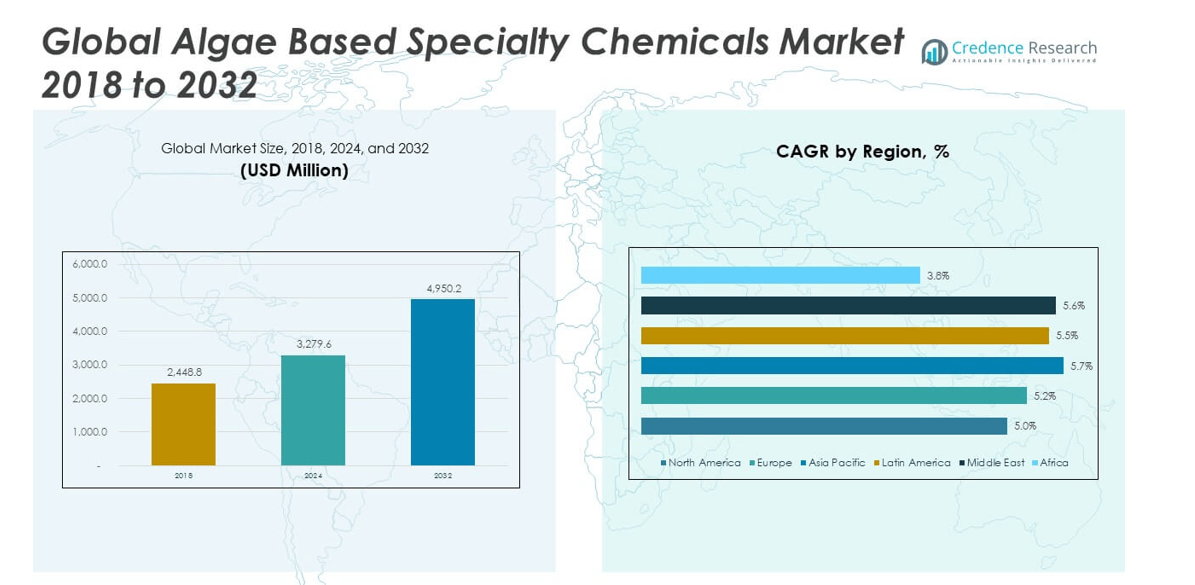
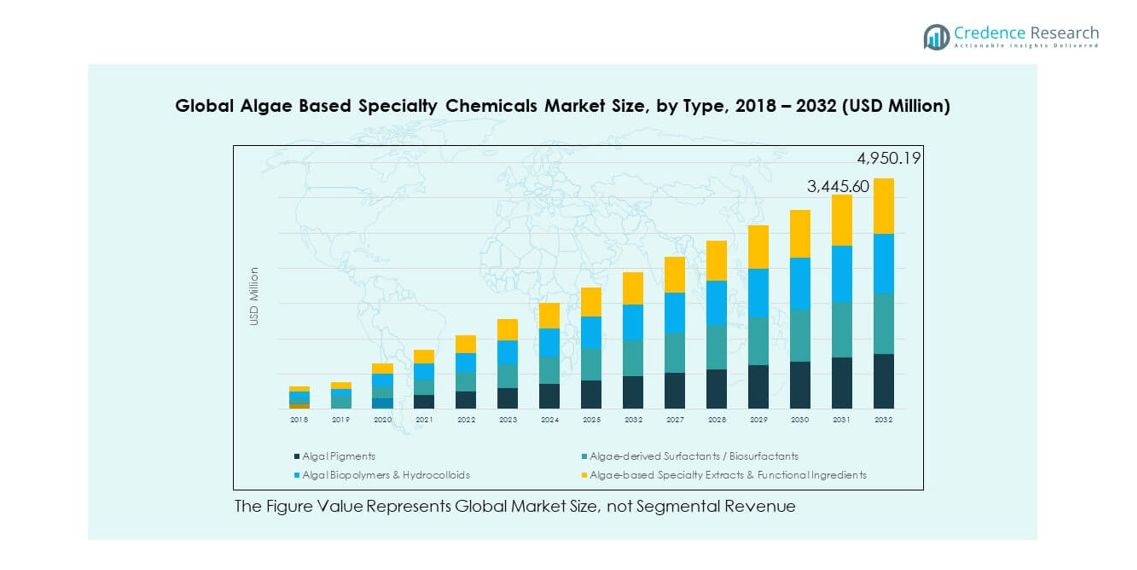
The Global Algae Based Specialty Chemicals Market size was valued at USD 2,448.8 million in 2018 to USD 3,279.6 million in 2024 and is anticipated to reach USD 4,950.2 million by 2032, at a CAGR of 5.31% during the forecast period.
| REPORT ATTRIBUTE | DETAILS |
|---|---|
| Historical Period | 2020-2023 |
| Base Year | 2024 |
| Forecast Period | 2025-2032 |
| Algae Based Specialty Chemicals Market Size 2024 | USD 3,279.6 million |
| Algae Based Specialty Chemicals Market, CAGR | 5.31% |
| Algae Based Specialty Chemicals Market Size 2032 | USD 4,950.2 million |
The Global Algae Based Specialty Chemicals Market is driven by increasing consumer preference for natural ingredients, coupled with stricter environmental regulations. Industries are shifting toward algae-derived polymers, pigments, and biofuels to reduce reliance on petrochemicals. Demand in nutraceuticals and personal care products is also accelerating due to algae’s nutritional and antioxidant properties.
Regionally, North America and Europe lead the market with strong investments in algae research and commercialization. The United States, Germany, and France are major hubs due to advanced biotechnology infrastructure and regulatory support. Asia-Pacific is emerging as a fast-growing market, driven by expanding industrial applications in China, India, and Japan. Favorable climatic conditions and cost-effective production capabilities further strengthen the region’s role in global supply.
Market Insights:
- The Global Algae Based Specialty Chemicals Market was valued at USD 2,448.8 million in 2018, reached USD 3,279.6 million in 2024, and is projected to attain USD 4,950.2 million by 2032, growing at a CAGR of 5.31%.
- Asia Pacific led with 34% share in 2024, supported by large-scale production capacity, favorable climate, and rising demand in nutraceuticals and bioplastics.
- North America held 27.7% share, driven by advanced biotechnology infrastructure and strong adoption in pharmaceuticals and cosmetics, while Europe followed with 23% share, backed by regulatory support for bio-based industries.
- Asia Pacific is also the fastest-growing region, expanding at a CAGR of 5.7%, fueled by government bioeconomy initiatives, increasing disposable income, and rapid consumer shift toward natural products.
- Segment-wise, algal pigments accounted for the largest share at around 35% in 2024, followed by algal biopolymers & hydrocolloids with nearly 28%, reflecting strong adoption in food, nutraceuticals, and packaging industries.
Market Drivers:
Rising Demand for Eco-Friendly and Renewable Specialty Chemicals:
The Global Algae Based Specialty Chemicals Market is expanding due to the global push toward sustainability. Algae provide a renewable alternative to petrochemical-based raw materials, reducing reliance on fossil fuels. It is gaining traction because algae produce pigments, lipids, and bioactive molecules with diverse applications. Industries are under regulatory pressure to cut emissions and comply with green chemistry practices, strengthening algae adoption. Growing consumer interest in natural formulations for cosmetics and food products is also a key factor. Biofuels and bioplastics derived from algae further drive adoption in energy and packaging industries. Continuous R&D investment is improving productivity, making commercial use more viable. This strong alignment with eco-friendly goals positions algae-based chemicals as an essential growth catalyst.
- For instance, Deep Blue BioTech, a British startup, has developed a photosynthesis-based bioproduction platform transforming cyanobacteria into microscopic factories that produce hyaluronic acid, a high-demand skincare chemical, with production processes removing more CO2 than they emit, demonstrating scalability through $800,000 in recent funding for pilot production ramps.
Expanding Role of Algae in Pharmaceuticals and Nutraceutical Applications:
Pharmaceutical and nutraceutical industries are rapidly embracing algae-based compounds for their therapeutic and nutritional properties. The Global Algae Based Specialty Chemicals Market benefits from algae’s omega-3 fatty acids, antioxidants, and polysaccharides. It is being widely used in dietary supplements, functional foods, and advanced drug formulations. Consumer demand for natural health-enhancing products continues to increase globally. Algae-derived compounds offer high bioavailability and minimal toxicity, which appeals to medical and wellness industries. Advances in biotechnology and fermentation are lowering production costs while improving scalability. Collaborations between pharmaceutical firms and algae-focused startups are accelerating product innovation. This demand for healthier, plant-based alternatives is reinforcing market growth.
- For instance, microalgal strains from genera such as Phaeodactylumand Schizochytrium produce omega-3 fatty acids with EPA and DHA content reaching up to 40% of total fatty acids, and Schizochytrium achieves up to 50% oil content (w/w), harvested every 4-6 days, offering faster turnaround compared to land plants, significantly improving supply chain efficiency for omega-3 sources.
Integration of Algae Chemicals in Personal Care and Cosmetic Formulations:
The cosmetics and personal care industry is a major contributor to algae-based specialty chemical adoption. Algae extracts are used in skincare, haircare, and anti-aging products due to their bioactive compounds. The Global Algae Based Specialty Chemicals Market gains strength from consumer preference for natural and plant-based cosmetic solutions. It is benefiting from rising awareness about the harmful effects of synthetic ingredients. Algae provide antioxidants, vitamins, and moisturizing agents that improve product effectiveness and safety. Premium beauty brands are incorporating algae formulations to position their offerings as clean-label products. Growing middle-class spending in emerging economies is creating new demand for algae-based cosmetics. This adoption trend ensures strong growth in the global beauty and personal care industry.
Government Support and R&D Investments Accelerating Commercialization:
Public and private sector funding is critical in boosting algae-based specialty chemical production. The Global Algae Based Specialty Chemicals Market is supported by government policies encouraging bio-based industries. It is experiencing growth through subsidies, tax benefits, and green certification programs. Major biotech research institutes are partnering with industry players to enhance algae cultivation techniques. Continuous innovation in photobioreactors and open-pond systems is improving algae yields. Pilot-scale projects are being scaled to industrial levels, making products more commercially available. Governments in Europe, North America, and Asia-Pacific are actively funding algae-based startups. This collaborative approach is ensuring long-term industry growth and reducing entry barriers.
Market Trends:
Growing Adoption of Algae-Based Bioplastics in Sustainable Packaging:
The Global Algae Based Specialty Chemicals Market is experiencing rising interest in algae-based bioplastics for packaging solutions. It is fueled by global restrictions on single-use plastics and growing corporate sustainability commitments. Algae polymers provide biodegradable alternatives with lower environmental footprints. Companies are integrating these materials into packaging for food, beverages, and consumer goods. R&D is focused on improving strength, durability, and cost-efficiency of algae-derived plastics. Emerging markets are showing strong adoption due to rising awareness of eco-packaging. Startups are collaborating with FMCG companies to scale algae packaging projects. This trend is positioning algae as a key material in the circular economy.
- For instance, recent advances at the National Renewable Energy Laboratory (NREL) have resulted in the development of algae-based non-isocyanate polyurethane foams and coatings with properties comparable to fossil-derived counterparts, improving durability and sustainability in packaging applications.
Expanding Role of Algae Chemicals in Animal Feed and Aquaculture:
Algae-based specialty chemicals are finding significant applications in aquaculture and livestock feed. The Global Algae Based Specialty Chemicals Market benefits from algae’s proteins, lipids, and carotenoids that enhance animal health. It is widely used to improve fish pigmentation, immunity, and growth rates in aquaculture farms. Rising global seafood consumption is increasing demand for sustainable feed alternatives. Livestock producers are adopting algae supplements to reduce reliance on antibiotics. Governments are encouraging eco-friendly feed solutions to align with food safety standards. Innovation in microalgae cultivation is making large-scale feed production feasible. This growing use across aquaculture and animal nutrition strengthens long-term demand.
- For instance, studies show that incorporating 2.5–10% algae into fish diets improves growth and feed utilization efficiencies, though levels exceeding 15–20% can have negative effects. In livestock, these protein-rich algae also help to reduce antibiotic use by enhancing immune responses.
Rising Application of Algae in Industrial and Energy Sectors:
Industrial applications of algae are expanding beyond conventional uses in food and cosmetics. The Global Algae Based Specialty Chemicals Market is gaining traction in biofuels, lubricants, and specialty coatings. It is becoming a reliable raw material for energy-efficient and environmentally friendly solutions. The oil and gas sector is testing algae-derived lubricants for high-performance machinery. Algae-based coatings provide anti-corrosive properties for marine and industrial equipment. Renewable energy companies are investing in algae as a feedstock for biodiesel production. Partnerships between energy firms and biotech companies are accelerating pilot-scale projects. This industrial adoption is reinforcing algae’s role in sustainable innovation.
Increasing Role of Algae-Derived Ingredients in Textile and Material Science:
The textile industry is exploring algae-derived specialty chemicals for sustainable fabrics and dyes. The Global Algae Based Specialty Chemicals Market benefits from the use of algae pigments as natural colorants. It is being adopted in eco-textiles where sustainability is a priority. Algae-based fibers are being tested for lightweight and durable fabric production. Fashion brands are showing strong interest in algae dyes to meet consumer demand for eco-friendly clothing. Universities and R&D labs are conducting trials to improve fiber strength and versatility. Industrial collaborations are supporting algae-based innovations in biopolymer blends for textiles. This trend highlights algae’s potential in reshaping the materials industry.
Market Challenges Analysis:
High Production Costs and Limited Commercial Scalability:
The Global Algae Based Specialty Chemicals Market faces challenges due to high production costs and scalability limits. It is hindered by the expensive cultivation systems, including photobioreactors and controlled open ponds. Energy consumption for drying, extraction, and processing also raises costs significantly. These financial barriers restrict algae chemicals from competing directly with petroleum-based alternatives. Limited infrastructure for large-scale algae processing adds to the difficulty of mass adoption. Investors often hesitate due to long return-on-investment cycles in algae projects. Smaller startups struggle to secure funding required for advanced production systems. These hurdles slow down the pace of commercialization across global industries.
Regulatory Uncertainty and Technical Limitations in Production:
The Global Algae Based Specialty Chemicals Market is also challenged by regulatory complexities and technical gaps. It is impacted by unclear approval pathways for algae-derived ingredients in pharmaceuticals and food. Differing standards across regions create barriers for global trade and commercialization. Technical limitations in strain selection, productivity, and downstream processing further restrict efficiency. Many algae strains require optimization to meet industrial-scale output consistently. Variability in quality due to climatic factors impacts supply reliability. Limited skilled expertise in algae biotechnology creates additional constraints. These issues highlight the need for global harmonization in regulation and stronger technical innovation.
Market Opportunities:
Expanding Use of Algae-Derived Ingredients in High-Value Consumer Segments:
The Global Algae Based Specialty Chemicals Market has strong opportunities in high-value consumer industries such as nutraceuticals, cosmetics, and functional foods. It is gaining traction as consumer demand for natural and sustainable ingredients increases globally. Algae-derived antioxidants, pigments, and polysaccharides are being incorporated into premium products. Rising disposable income in emerging economies is fueling greater adoption of algae-based personal care items. Nutraceutical brands are using algae compounds to differentiate their formulations. This consumer shift creates opportunities for companies to scale production efficiently. Strategic branding around clean-label and eco-friendly solutions further strengthens market penetration.
Technological Advancements Driving Industrial and Energy Applications:
Innovations in algae biotechnology and cultivation methods are creating opportunities in industrial and energy markets. The Global Algae Based Specialty Chemicals Market is supported by breakthroughs in photobioreactor design and genetic engineering. It is enabling higher yields, lower costs, and consistent quality across algae production. Energy firms are increasingly testing algae for biodiesel and green lubricant applications. Advances in algae-based coatings and materials provide new industrial opportunities. Governments supporting renewable energy projects also create favorable conditions for algae-based fuels. Strategic alliances between technology providers and industry leaders are accelerating commercialization. These advancements open growth pathways in sectors beyond consumer applications.
Market Segmentation Analysis:
By Type
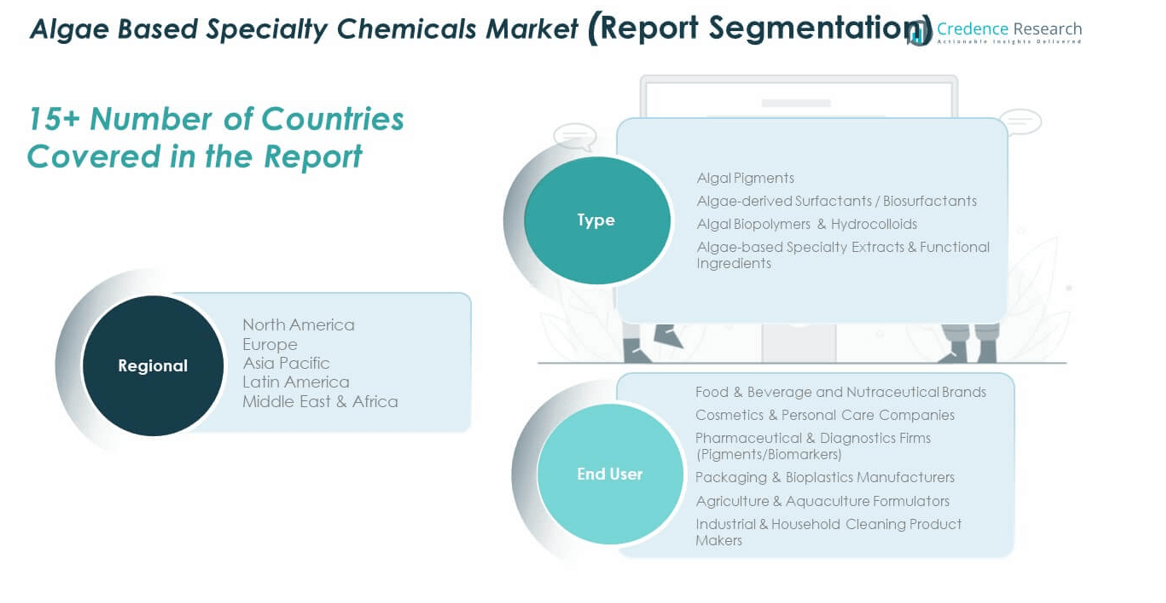
The Global Algae Based Specialty Chemicals Market is segmented into algal pigments, algae-derived surfactants and biosurfactants, algal biopolymers and hydrocolloids, and algae-based specialty extracts and functional ingredients. Algal pigments are witnessing high demand in food, nutraceuticals, and cosmetics due to their natural antioxidant and coloring properties. Surfactants and biosurfactants derived from algae are increasingly adopted in personal care and cleaning applications for their biodegradable profile. Biopolymers and hydrocolloids are gaining market share in food processing and sustainable packaging solutions. Specialty extracts and functional ingredients continue to expand in pharmaceuticals and nutrition, offering bioactive compounds with therapeutic and functional benefits.
- For instance, rhamnolipid biosurfactants produced via fermentation processes from renewable corn feedstocks have been commercialized for use in cleaning and personal care industries, demonstrating strong emulsification and antimicrobial properties.
By End User
End-user segmentation highlights the versatility of algae-based specialty chemicals across industries. Food and beverage and nutraceutical brands lead adoption, supported by consumer demand for plant-based formulations. The Global Algae Based Specialty Chemicals Market also sees strong traction from cosmetics and personal care companies promoting eco-friendly products. Pharmaceutical and diagnostics firms are incorporating algae-based pigments and biomarkers into advanced healthcare applications. Packaging and bioplastics manufacturers are leveraging algae polymers to address sustainability goals. Agriculture and aquaculture formulators use algae additives for crop nutrition and animal health. Industrial and household cleaning product makers are adopting biosurfactants to replace petroleum-derived chemicals. This wide end-user base underscores algae’s role in reshaping specialty chemical applications.
- For instance, Algae-C leverages synthetic biology to reprogram algae strains that produce high-value pharmaceutical active ingredients (APIs) with high purity and scalability, facilitating advanced healthcare and personal care product formulation.
Segmentation:
- By Type
- Algal Pigments
- Algae-derived Surfactants / Biosurfactants
- Algal Biopolymers & Hydrocolloids
- Algae-based Specialty Extracts & Functional Ingredients
- By End User
- Food & Beverage and Nutraceutical Brands
- Cosmetics & Personal Care Companies
- Pharmaceutical & Diagnostics Firms (Pigments/Biomarkers)
- Packaging & Bioplastics Manufacturers
- Agriculture & Aquaculture Formulators
- Industrial & Household Cleaning Product Makers
- By Region
- North America
- S.
- Canada
- Mexico
- Europe
- UK
- France
- Germany
- Italy
- Spain
- Russia
- Rest of Europe
- Asia Pacific
- China
- Japan
- South Korea
- India
- Australia
- Southeast Asia
- Rest of Asia Pacific
- Latin America
- Brazil
- Argentina
- Rest of Latin America
- Middle East
- GCC Countries
- Israel
- Turkey
- Rest of Middle East
- Africa
- South Africa
- Egypt
- Rest of Africa
- North America
Regional Analysis:
North America
The North America Global Algae Based Specialty Chemicals Market size was valued at USD 693.25 million in 2018 to USD 910.03 million in 2024 and is anticipated to reach USD 1,336.55 million by 2032, at a CAGR of 5.0% during the forecast period. North America accounts for 27.7% share of the global market in 2024. The region is driven by strong adoption in pharmaceuticals, nutraceuticals, and cosmetics due to advanced biotechnology infrastructure. It is supported by robust research funding and the presence of key algae-based chemical manufacturers. The United States leads with innovation in algae-derived bioplastics and biofuels, backed by sustainability mandates. Canada contributes through expanding aquaculture applications, while Mexico strengthens demand in food and beverage industries. High awareness of natural and clean-label products supports consumer-driven adoption. Strategic collaborations between universities and industry further enhance product development. North America remains a mature but growing market with high-value application focus.
Europe
The Europe Global Algae Based Specialty Chemicals Market size was valued at USD 565.92 million in 2018 to USD 753.69 million in 2024 and is anticipated to reach USD 1,129.14 million by 2032, at a CAGR of 5.2% during the forecast period. Europe represents 23% share of the global market in 2024. The region benefits from strong environmental regulations and emphasis on bio-based industries. It is supported by growing demand in personal care, pharmaceuticals, and packaging applications. Germany, France, and the UK are leading countries due to advanced research and supportive policies. Cosmetic brands across Europe are incorporating algae-derived antioxidants and pigments into clean-label formulations. Investment in sustainable packaging solutions boosts demand for algal biopolymers and hydrocolloids. Aquaculture industries in Spain and Norway further drive adoption. Europe’s commitment to carbon neutrality ensures continuous demand for algae-based specialty chemicals.
Asia Pacific
The Asia Pacific Global Algae Based Specialty Chemicals Market size was valued at USD 813.24 million in 2018 to USD 1,114.30 million in 2024 and is anticipated to reach USD 1,732.57 million by 2032, at a CAGR of 5.7% during the forecast period. Asia Pacific holds the 34% share of the global market in 2024, making it the largest regional contributor. China and Japan are leaders in scaling algae cultivation for nutraceuticals and bioplastics. India is witnessing rising demand in pharmaceuticals and food applications, supported by growing investment in biotech startups. South Korea and Australia are advancing algae applications in cosmetics and aquaculture. Regional cost advantages in algae cultivation and favorable climatic conditions enhance competitiveness. It is also benefiting from rising disposable income and changing consumer preferences for natural products. Government initiatives promoting bioeconomy growth further stimulate demand. Asia Pacific is the fastest-growing region and a global supply hub.
Latin America
The Latin America Global Algae Based Specialty Chemicals Market size was valued at USD 193.21 million in 2018 to USD 261.71 million in 2024 and is anticipated to reach USD 400.97 million by 2032, at a CAGR of 5.5% during the forecast period. Latin America captures 8% share of the global market in 2024. Brazil is the dominant player, supported by strong food, beverage, and biofuel industries. Mexico is showing growth in cosmetics and household cleaning applications. The region’s expanding aquaculture sector creates steady demand for algae-based formulations. Rising focus on sustainable farming and bioplastics strengthens adoption in agriculture and packaging. It is supported by favorable natural resources for large-scale algae cultivation. Startups and international partnerships are entering the regional market to scale production. Latin America is positioned as an emerging market with untapped potential across multiple end-user industries.
Middle East
The Middle East Global Algae Based Specialty Chemicals Market size was valued at USD 106.28 million in 2018 to USD 144.72 million in 2024 and is anticipated to reach USD 223.25 million by 2032, at a CAGR of 5.6% during the forecast period. The Middle East represents 4.4% share of the global market in 2024. Demand is primarily driven by aquaculture and agricultural applications in GCC countries. It is also expanding in cosmetics, with algae-based formulations used in premium personal care products. Israel is advancing algae research with biotechnology startups focused on specialty ingredients. Governments are investing in sustainable technologies to diversify economies beyond oil dependency. Rising consumer awareness of natural ingredients in food and personal care is supporting adoption. Strategic collaborations with global players are enabling regional production capacity expansion. The Middle East is emerging as a niche market with strong innovation potential.
Africa
The Africa Global Algae Based Specialty Chemicals Market size was valued at USD 76.89 million in 2018 to USD 95.11 million in 2024 and is anticipated to reach USD 127.71 million by 2032, at a CAGR of 3.8% during the forecast period. Africa accounts for 2.9% share of the global market in 2024. South Africa leads the regional market with applications in food, cosmetics, and aquaculture. Egypt contributes through algae cultivation for nutraceuticals and specialty ingredients. The region has abundant natural resources but limited infrastructure for large-scale algae processing. It is challenged by funding constraints and lack of advanced biotechnological expertise. However, growing interest in sustainable agriculture and food security is creating opportunities. International partnerships are introducing algae-based solutions for health and nutrition. Africa remains a developing market with future growth linked to infrastructure expansion and knowledge transfer.
Key Player Analysis:
- DSM-Firmenich
- BASF SE
- I.D. Parry (Parry Nutraceuticals)
- Cyanotech Corporation
- Earthrise Nutritionals
- Algatechnologies (Algatech)
- CP Kelco
- Cargill
- AlgaEnergy
- Other Key Players
Competitive Analysis:
The Global Algae Based Specialty Chemicals Market is characterized by a mix of multinational corporations and specialized biotechnology firms. Leading players such as DSM-Firmenich, BASF SE, E.I.D. Parry, and Cyanotech focus on expanding product portfolios across nutraceuticals, pharmaceuticals, cosmetics, and bioplastics. It is highly competitive, with companies investing in R&D to improve yield efficiency, scalability, and cost-effectiveness. Collaborations with research institutions and startups strengthen innovation pipelines. Market leaders emphasize sustainable production methods and partnerships to enhance global presence. Smaller companies differentiate through niche formulations and region-specific applications. This fragmented yet dynamic competition fosters continuous product development and industry growth.
Recent Developments:
- BASF SE strengthened its personal care business in the United States by entering into a sole distributor agreement with Azelis, effective July 1, 2025. This collaboration enhances BASF's ability to meet customer needs in personal care with a focus on innovation and sustainability.
- In the United States, Earthrise Nutritionals, a subsidiary of DIC Corporation, opened a new facility for Spirulina cultivation in California in March 2025. The facility utilizes sustainable smart farming technologies, including AI and robotics, to produce Spirulina and natural blue food colorant LINABLUE®, powered significantly by renewable energy.
- CP Kelco was acquired by Tate & Lyle in November 2024, a move that has created a leading position in specialty food ingredients and allowed faster innovation in sweetening, mouthfeel, and fortification solutions.
- Cargill strengthened its animal nutrition business in Brazil with a binding offer in July 2025 to acquire Mig-Plus, a family-owned company specializing in animal nutrition, aligning with Cargill’s growth strategy in Brazil.
Report Coverage:
The research report offers an in-depth analysis based on type and end-user segments. It details leading market players, providing an overview of their business, product offerings, investments, revenue streams, and key applications. Additionally, the report includes insights into the competitive environment, SWOT analysis, current market trends, as well as the primary drivers and constraints. Furthermore, it discusses various factors that have driven market expansion in recent years. The report also explores market dynamics, regulatory scenarios, and technological advancements that are shaping the industry. It assesses the impact of external factors and global economic changes on market growth. Lastly, it provides strategic recommendations for new entrants and established companies to navigate the complexities of the market.
Future Outlook:
- Rising demand for natural and sustainable raw materials will shape long-term adoption.
- Expansion of algae-derived bioplastics will support global sustainability initiatives.
- Increased investments in biotechnology will enhance cultivation efficiency.
- Growing use in pharmaceuticals will strengthen therapeutic and nutraceutical applications.
- Cosmetic brands will continue integrating algae-based pigments and antioxidants.
- Expanding aquaculture will drive adoption of algae in animal feed and nutrition.
- Strategic collaborations will improve scalability and commercialization pathways.
- Emerging economies will witness rising adoption due to changing consumer preferences.
- Governments will provide stronger regulatory support for bio-based industries.
- Continuous innovation will unlock new industrial and energy-related applications.

Request a Free Sample
Fill in your details and we'll send you a free sample report.
- Sample data tables & charts
- Research methodology
Market Dynamics
Rising Demand for Eco-Friendly and Renewable Specialty Chemicals
Global sustainability initiatives and stricter environmental regulations are pushing industries to adopt algae-based specialty chemicals as alternatives to petrochemical-derived products. Algae offer renewable sources for pigments, polymers, and biofuels, aligning with corporate and regulatory goals to reduce carbon footprints.
Expanding Role of Algae in Pharmaceuticals and Nutraceuticals
Algae-derived compounds such as omega-3 fatty acids, antioxidants, and polysaccharides are increasingly used in dietary supplements, functional foods, and advanced drug formulations. Their high bioavailability and minimal toxicity drive adoption in health-focused industries seeking natural, plant-based ingredients.
Integration of Algae Chemicals in Personal Care and Cosmetics
Consumer preference for natural and plant-based cosmetic solutions is accelerating the use of algae extracts in skincare, haircare, and anti-aging products. Algae provide antioxidants, vitamins, and moisturizing agents, enabling brands to market clean-label and effective personal care products.
Government Support and R&D Investments
Public and private sector funding, including subsidies, tax incentives, and research grants, is boosting algae-based specialty chemical production. Government policies and collaborations with research institutes are improving cultivation techniques and scaling up commercial production.
Growing Adoption of Algae-Based Bioplastics in Sustainable Packaging
Global restrictions on single-use plastics and corporate sustainability commitments are driving the use of algae-based bioplastics in packaging. Algae polymers offer biodegradable alternatives with lower environmental impact, supporting the shift toward circular economy models.
Need a Custom Version of This Report?
Tailor the scope, geography, or segments to your exact requirements.
- Custom geography or segment scope
- Direct access to our analyst team
Frequently Asked Questions
What is the current market size for Global Algae Based Specialty Chemicals Market, and what is its projected size in 2032?
Which Global Algae Based Specialty Chemicals Market segment held the largest share in 2024?
What are the primary factors fueling the growth of the Global Algae Based Specialty Chemicals Market?
Who are the leading companies in the Global Algae Based Specialty Chemicals Market?
Table of Content
Chapter 1 Market Segmentation
- 1.1 Segmentation Framework
- 1.1.1 Product and Service Classification
- 1.1.2 Application and End-Use Classification
- 1.1.3 Technology and Solution Classification
- 1.1.4 Customer and Distribution Channel Classification
- 1.1.5 Geographic Segmentation
- 1.1.6 Market Segment Definitions and Boundaries
- 1.2 By Type
- 1.2.1 Algal Pigments
- 1.2.2 Algae-derived Surfactants / Biosurfactants
- 1.2.3 Algal Biopolymers & Hydrocolloids
- 1.2.4 Algae-based Specialty Extracts & Functional Ingredients
- 1.3 By End User
- 1.3.1 Food & Beverage and Nutraceutical Brands
- 1.3.2 Cosmetics & Personal Care Companies
- 1.3.3 Pharmaceutical & Diagnostics Firms (Pigments/Biomarkers)
- 1.3.4 Packaging & Bioplastics Manufacturers
- 1.3.5 Agriculture & Aquaculture Formulators
- 1.3.6 Industrial & Household Cleaning Product Makers
Chapter 2 Introduction
- 2.1 Report Objectives and Scope
- 2.2 Product Definition and Industry Terminology
- 2.3 Market Inclusions and Exclusions
- 2.4 Research Process
- 2.4.1 Primary Research and Expert Interviews
- 2.4.2 Secondary Research and Source Review
- 2.4.3 Top-Down and Bottom-Up Estimation
- 2.4.4 Data Triangulation and Verification
- 2.5 Market Size Measurement Basis
- 2.5.1 2018: USD 2,448.8 million → 2032: USD 4,950.2 million
- 2.6 Historical and Forecast Reference Periods
- 2.6.1 Base Year: 2018
- 2.6.2 Forecast Period: 2018-2032
- 2.7 Research Assumptions and Limitations
Chapter 3 Executive Summary
- 3.1 Market Snapshot and Key Findings
- 3.2 Base-Year Market Size, 2018
- 3.3 Forecast Market Size, 2032
- 3.4 Revenue and Volume Growth Outlook
- 3.5 Key Demand and Supply Indicators
- 3.6 Leading Market Segments
- 3.7 Fastest-Growing Market Opportunities
- 3.8 Regional Performance Highlights
- 3.9 Technology and Industry Transformation
- 3.10 Competitive Landscape Summary
- 3.11 Analyst View and Strategic Implications
Chapter 4 Global Algae Based Specialty Chemicals Market Trends and Developments
- 4.1 Historical Industry Development
- 4.2 Recent Market Trends and Developments
- 4.3 Demand and Customer Behavior Trends
- 4.4 Technology and Product Innovation
- 4.5 Artificial Intelligence, Automation and Digitalization
- 4.6 Local Manufacturing and Supply Chain Realignment
- 4.7 Industry Partnerships, Mergers and Acquisitions
- 4.8 Sustainability and Circular Economy Developments
- 4.9 Government and Private Sector Investment Trends
- 4.10 Emerging Business Models and Commercialization
- 4.11 Industry Developments and Announcements
Chapter 5 Global Algae Based Specialty Chemicals Market Production, Supply and Demand Analysis
- 5.1 Demand Trend and Consumption Analysis
- 5.2 Demand Forecast, 2018-2032
- 5.3 Production and Output Trend
- 5.4 Production and Output Forecast, 2018-2032
- 5.5 Installed Capacity and Capacity Utilization
- 5.6 Company-Wise Production Plants and Statistics
- 5.6.1 Installed Production Capacity
- 5.6.2 Actual Production
- 5.6.3 Planned Capacity and Expansion Targets
- 5.7 Supply Chain Structure and Procurement Trends
- 5.8 Supply-Demand Gap and Bottlenecks
- 5.9 Import Dependence and Sourcing Structure
- 5.10 Contract Manufacturing and Outsourcing
- 5.11 Regional Supply and Demand Concentration
Chapter 6 Global Algae Based Specialty Chemicals Market Pricing Analysis
- 6.1 Pricing Structure and Measurement
- 6.2 Historical Pricing Trends
- 6.3 Pricing Outlook, 2018-2032
- 6.4 Average Selling Price and Unit Economics
- 6.5 Pricing by Product and Market Segment
- 6.6 Geographic Pricing Differences
- 6.7 Key Input, Energy, Labor and Logistics Costs
- 6.8 Contract Pricing and Purchasing Models
- 6.9 Pricing Sensitivity and Competitive Positioning
- 6.10 Price, Margin and Profitability Implications
Chapter 7 Global Algae Based Specialty Chemicals Market Dynamics
- 7.1 Market Growth Drivers
- 7.1.1 Demand-Side Drivers
- 7.1.2 Technology and Innovation Drivers
- 7.1.3 Infrastructure and Investment Drivers
- 7.1.4 Regulatory and Policy Drivers
- 7.2 Market Restraints
- 7.2.1 Cost and Affordability Constraints
- 7.2.2 Technology and Adoption Barriers
- 7.2.3 Supply Chain and Operational Constraints
- 7.3 Market Challenges
- 7.3.1 Competitive Pressure and Margin Erosion
- 7.3.2 Skills, Infrastructure and Implementation Gaps
- 7.4 Emerging Market Opportunities
- 7.5 Market Dynamics Impact and Time-Horizon Assessment
Chapter 8 Global Algae Based Specialty Chemicals Value Chain Analysis
- 8.1 Industry Value Chain Overview
- 8.2 Upstream Suppliers and Critical Inputs
- 8.3 Technology and Component Providers
- 8.4 Manufacturing or Service Delivery
- 8.5 Distribution, Channel Partners and Integrators
- 8.6 Downstream Applications and End Users
- 8.7 Value Addition and Profit Pools
- 8.8 Vertical Integration and Outsourcing
- 8.9 Supplier Concentration and Risk
- 8.10 Supply Chain Localization and Resilience
Chapter 9 Global Algae Based Specialty Chemicals Market Regulations and Policies
- 9.1 Relevant Laws, Standards and Compliance Frameworks
- 9.2 Product, Service, Safety and Quality Requirements
- 9.3 Government Policies, Incentives and Subsidies
- 9.4 Imports, Exports and Trade Barriers
- 9.5 Public Procurement and Local Content Requirements
- 9.6 Environmental and Sustainability Compliance
- 9.7 Upcoming Policy Changes and Market Implications
Chapter 10 Global Algae Based Specialty Chemicals Market Hotspots and Opportunities
- 10.1 Market Opportunity Mapping and Growth Hotspots
- 10.2 High-Growth Applications and Customer Groups
- 10.3 Underserved Markets and White-Space Opportunities
- 10.4 Emerging Technology and Product Opportunities
- 10.5 New Capacity and Investment Hotspots
- 10.6 Market Entry and Expansion Opportunities
- 10.7 Distribution and Partnership Opportunities
- 10.8 Near-Term and Long-Term Commercial Potential
- 10.9 Opportunity Attractiveness and Execution Risks
Chapter 11 Global Algae Based Specialty Chemicals Market Outlook, 2018-2032
- 11.1 Market Size and Analysis
- 11.1.1 Revenue (Market Measurement: 2018: USD 2,448.8 million → 2032: USD 4,950.2 million)
- 11.1.2 Market Volume and Quantity Sold
- 11.1.3 Historical Market Size
- 11.1.4 Base-Year Market Size, 2018
- 11.2 Market Forecast, 2018-2032
- 11.2.1 Revenue Forecast to 2032
- 11.2.2 Volume Forecast to 2032
- 11.2.3 CAGR and Year-on-Year Growth
- 11.2.4 Incremental Revenue Opportunity
- 11.3 Forecast Assumptions and Scenario Analysis
- 11.3.1 Base-Case Forecast
- 11.3.2 Optimistic and Conservative Scenarios
- 11.3.3 Technology, Pricing and Policy Sensitivities
- 11.4 Market Attractiveness and Growth Outlook
Chapter 12 Global Algae Based Specialty Chemicals Market Segmentation and Outlook
- 12.1 Segmentation Summary and Market Shares, 2018
- 12.2 Largest and Fastest-Growing Segments
- 12.3 By Type - Market Size and Forecast, 2018-2032
- 12.3.1 Segment Definition and Scope
- 12.3.2 Historical Market Size
- 12.3.3 Revenue Forecast, 2018-2032
- 12.3.4 Volume Forecast, 2018-2032
- 12.3.5 Base-Year Market Share, 2018
- 12.3.6 Segment CAGR and Growth Drivers
- 12.3.7 Subsegment Market Size and Forecast
- 12.3.7.1 Algal Pigments
- 12.3.7.2 Algae-derived Surfactants / Biosurfactants
- 12.3.7.3 Algal Biopolymers & Hydrocolloids
- 12.3.7.4 Algae-based Specialty Extracts & Functional Ingredients
- 12.3.8 Subsegment Pricing and Adoption Trends
- 12.3.9 Leading Suppliers and Competition
- 12.3.10 Regional Demand and Opportunities
- 12.4 By End User - Market Size and Forecast, 2018-2032
- 12.4.1 Segment Definition and Scope
- 12.4.2 Historical Market Size
- 12.4.3 Revenue Forecast, 2018-2032
- 12.4.4 Volume Forecast, 2018-2032
- 12.4.5 Base-Year Market Share, 2018
- 12.4.6 Segment CAGR and Growth Drivers
- 12.4.7 Subsegment Market Size and Forecast
- 12.4.7.1 Food & Beverage and Nutraceutical Brands
- 12.4.7.2 Cosmetics & Personal Care Companies
- 12.4.7.3 Pharmaceutical & Diagnostics Firms (Pigments/Biomarkers)
- 12.4.7.4 Packaging & Bioplastics Manufacturers
- 12.4.7.5 Agriculture & Aquaculture Formulators
- 12.4.7.6 Industrial & Household Cleaning Product Makers
- 12.4.8 Subsegment Pricing and Adoption Trends
- 12.4.9 Leading Suppliers and Competition
- 12.4.10 Regional Demand and Opportunities
- 12.5 Segment Growth Comparison
- 12.6 Segment Attractiveness and Priority Matrix
Chapter 13 Global Algae Based Specialty Chemicals End-Use and Application Market Outlook
- 13.1 End-Use Industry and Customer Demand Structure
- 13.2 Leading Applications and Customer Groups
- 13.3 End-Use Market Size, Share and Forecast
- 13.4 Major End-Use Industry Deep Dives
- 13.4.1 Customer Requirements and Use Cases
- 13.4.2 Demand and Replacement Cycles
- 13.4.3 Technical and Regulatory Considerations
- 13.4.4 Purchasing and Procurement Models
- 13.4.5 Leading Vendors and Distribution Channels
- 13.4.6 Forecast and Commercial Opportunities
- 13.5 Emerging Applications and Cross-Segment Demand
- 13.6 End-Use Industry Investment Priorities
Chapter 14 Global Algae Based Specialty Chemicals Geographic Market Outlook, 2018-2032
- 14.1 Regional Market Size and Share, 2018
- 14.2 Regional Market Forecast, 2018-2032
- 14.3 Regional Pricing, Production and Demand Differences
- 14.4 North America
- 14.4.1 United States
- 14.4.2 Canada
- 14.4.3 Mexico
- 14.5 Europe
- 14.5.1 Germany
- 14.5.2 France
- 14.5.3 Italy
- 14.5.4 United Kingdom
- 14.5.5 Spain
- 14.5.6 Poland
- 14.5.7 Russia
- 14.5.8 Netherlands
- 14.5.9 Belgium
- 14.5.10 Sweden
- 14.5.11 Denmark
- 14.5.12 Norway
- 14.5.13 Rest of Europe
- 14.6 Asia Pacific
- 14.6.1 China
- 14.6.2 India
- 14.6.3 Japan
- 14.6.4 South Korea
- 14.6.5 Thailand
- 14.6.6 Indonesia
- 14.6.7 Vietnam
- 14.6.8 Malaysia
- 14.6.9 Australia
- 14.6.10 Rest of Asia Pacific
- 14.7 Latin America
- 14.7.1 Brazil
- 14.7.2 Argentina
- 14.7.3 Colombia
- 14.7.4 Chile
- 14.7.5 Rest of Latin America
- 14.8 Middle East
- 14.8.1 Saudi Arabia
- 14.8.2 United Arab Emirates
- 14.8.3 Turkey
- 14.8.4 Israel
- 14.8.5 Iran
- 14.8.6 Rest of the Middle East
- 14.9 Africa
- 14.9.1 South Africa
- 14.9.2 Egypt
- 14.9.3 Nigeria
- 14.9.4 Morocco
- 14.9.5 Rest of Africa
- 14.10 Regional Investment, Policy and Supply Chain Differences
- 14.11 Regional Competitive Landscape
- 14.12 Geographic Growth Hotspots
Chapter 15 Global Algae Based Specialty Chemicals Technology, Innovation and Sustainability Outlook
- 15.1 Technology Landscape and Maturity
- 15.2 Product, Process and Service Innovation
- 15.3 AI, Automation and Digital Tools in the Industry
- 15.4 Technology Adoption and Performance Benchmarking
- 15.5 Innovation Pipeline and R&D Investment
- 15.6 Patent and Intellectual Property Trends
- 15.7 Energy Efficiency and Resource Management
- 15.8 Sustainability, Recycling and Circularity
- 15.9 Technology Roadmap, 2018-2032
- 15.10 Risks of Obsolescence and Technology Substitution
Chapter 16 Global Algae Based Specialty Chemicals Market Key Strategic Imperatives
- 16.1 Growth and Market Entry Priorities
- 16.2 High-Return Products and Segments
- 16.3 Pricing, Profitability and Cost Optimization
- 16.4 Technology Investment and Product Differentiation
- 16.5 Supply Chain Localization and Resilience
- 16.6 Distribution and Customer Acquisition
- 16.7 Partnership, Acquisition and Capacity Strategy
- 16.8 Regional Expansion Priorities
- 16.9 Short-, Medium- and Long-Term Actions
Chapter 17 Competition Outlook
- 17.1 Industry Competition Characteristics
- 17.2 Market Structure and Concentration
- 17.3 Market Share and Competitive Positioning, 2018
- 17.4 Company-Wise Revenue and Product Benchmarking
- 17.5 Production and Service Capacity Benchmarking
- 17.6 Technology, Pricing and Differentiation
- 17.7 Regional Footprint and Distribution Strength
- 17.8 Mergers, Acquisitions and Strategic Alliances
- 17.9 New Entrants and Competitive Threats
- 17.10 Porter's Five Forces and Industry Attractiveness
- 17.11 Competitive Outlook, 2018-2032
Chapter 18 Company Profiles
- 18.1 Company Coverage and Selection Criteria
- 18.2 DSM-Firmenich
- 18.2.1 Business Description
- 18.2.2 Company Ownership and Geographic Presence
- 18.2.3 Product and Service Portfolio
- 18.2.4 Manufacturing and Operating Footprint
- 18.2.5 Production Capacity and Expansion Plans
- 18.2.6 Financial Performance and Investment
- 18.2.7 Market Share and Competitive Position
- 18.2.8 Technology and Innovation Capabilities
- 18.2.9 Strategic Alliances or Partnerships
- 18.2.10 Recent Developments
- 18.2.11 Growth Strategy and Outlook
- 18.3 BASF SE
- 18.4 E.I.D. Parry (Parry Nutraceuticals)
- 18.5 Cyanotech Corporation
- 18.6 Earthrise Nutritionals
- 18.7 Algatechnologies (Algatech)
- 18.8 CP Kelco
- 18.9 Cargill
- 18.10 AlgaEnergy
- 18.11 Tate & Lyle
- 18.12 Other Relevant Market Participants
Note: Every listed company is profiled on the structure shown under the first company. The company list is preliminary and may change based on research findings, market developments, data availability and client requirements.
Chapter 19 Disclaimer
- 19.1 Research and Forecast Disclaimer
- 19.2 Data Source and Estimation Limitations
Note: The depth of individual sections depends on data availability for this market. Volume, capacity, trade and other unit-based metrics are included where applicable.

