
| REPORT ATTRIBUTE | DETAILS |
|---|---|
| Historical Period | 2020-2023 |
| Base Year | 2024 |
| Forecast Period | 2025-2032 |
| Aluminum Market Size 2024 | USD 57.8 million |
| Aluminum Market, CAGR | 7.57% |
| Aluminum Market Size 2032 | USD 103.8 million |
Market Overview
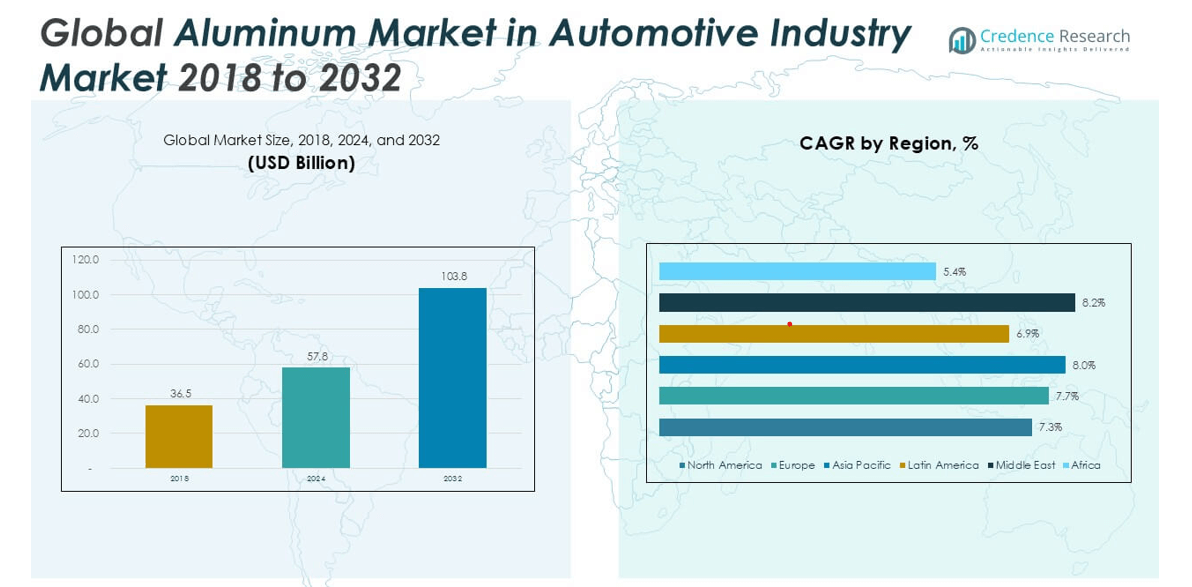
The Global Aluminum Market in Automotive Industry is projected to grow from USD 57.8 million in 2024 to an estimated USD 103.8 million by 2032, with a compound annual growth rate (CAGR) of 7.57% from 2025 to 2032.
The growth of electric vehicles (EVs) and stringent government regulations on fuel economy and emission standards are major drivers boosting aluminum adoption in the automotive sector. Automakers are increasingly incorporating aluminum to extend EV range and meet carbon neutrality targets. Trends such as vehicle electrification, rising focus on sustainability, and increased investment in high-strength, lightweight aluminum alloys are also shaping market dynamics. Furthermore, continuous innovations in aluminum processing technologies are enhancing material efficiency, recyclability, and performance.
Geographically, North America and Europe are leading markets due to strong automotive production bases, regulatory frameworks favoring lightweight materials, and the rapid adoption of EVs. Asia Pacific, particularly China and India, is expected to witness significant growth owing to rising automobile production and urbanization. Key players in the global aluminum automotive market include Alcoa Corporation, Novelis Inc., Constellium SE, Norsk Hydro ASA, and Kaiser Aluminum Corporation, who are actively investing in R&D and capacity expansion to meet growing industry demands.
Market Insights
- The Global Aluminum Market in Automotive Industry is projected to grow from USD 57.8 million in 2024 to USD 103.8 million by 2032, registering a CAGR of 7.57% from 2025 to 2032.
- Growing demand for lightweight vehicles to improve fuel efficiency and meet emission norms is a key driver of aluminum adoption.
- Aluminum plays a vital role in reducing vehicle weight while maintaining structural integrity across body panels, powertrain, and chassis systems.
- High energy consumption and production costs remain major restraints, limiting the competitiveness of aluminum against alternative materials.
- North America and Europe dominate the market due to strict regulations and strong EV production capabilities.
- Asia Pacific is expected to register the fastest growth, led by China and India, driven by expanding automotive manufacturing and urbanization.
- Regional investments in recycling, alloy innovation, and EV infrastructure will further shape the market landscape.
Market Drivers
Surge in Demand for Lightweight Materials in Automotive Manufacturing
The Global Aluminum Market is expanding due to the growing emphasis on lightweight materials in vehicle production. Automakers aim to improve fuel efficiency and lower emissions by reducing vehicle weight. Aluminum provides a favorable strength-to-weight ratio, making it suitable for structural components, body panels, and engine parts. It helps manufacturers meet regulatory standards without compromising safety or performance. The shift from traditional steel to aluminum in vehicle bodies supports long-term cost efficiency and environmental targets. It also enables better handling and acceleration in both conventional and electric vehicles.
- For instance, the average aluminum content per vehicle in North America is projected to reach 570 pounds by 2030, up from 165 pounds in 1990 and 514 pounds in 2026, reflecting a net gain of about 100 pounds per vehicle from 2020 to 2030
Government Regulations Driving Material Substitution in Vehicles
Stringent emission and fuel economy regulations are pushing automakers to substitute heavier metals with aluminum. The Global Aluminum Market is gaining traction due to policy frameworks in regions like Europe and North America that require automakers to meet lower CO₂ emission thresholds. These mandates encourage the integration of aluminum to ensure compliance and avoid penalties. The material's recyclability aligns with regulatory goals promoting circular economy practices. It supports OEMs in achieving sustainability certifications and improving brand image. The legislative push is accelerating the shift toward aluminum-intensive vehicle designs.
- For instance, U.S. tariffs on aluminum imports were raised from 10% in 2018 to 50% in 2025, affecting over half of the aluminum supply that is imported, and adding $22.4 billion to the cost of imported aluminum products for U.S. manufacturers
Growth in Electric Vehicle Production Supporting Market Expansion
The rapid rise in electric vehicle (EV) production continues to fuel demand in the Global Aluminum Market. Automakers use aluminum to offset the weight of EV batteries and extend driving range. Its thermal properties also improve battery safety and performance. It helps reduce vehicle mass, which directly impacts energy consumption per kilometer. Lightweight structures are essential for maximizing battery efficiency in EVs. The ongoing global transition to electrified mobility positions aluminum as a preferred material in new automotive platforms.
Technological Advancements in Aluminum Processing and Alloys
Innovation in aluminum processing and the development of advanced alloys are reshaping the Global Aluminum Market. New manufacturing techniques improve the strength and formability of aluminum parts. These advancements enable automakers to use aluminum in critical components that previously required heavier materials. It also reduces production costs and enhances design flexibility. Improved corrosion resistance and thermal management increase its application in various automotive systems. The industry benefits from continuous R\&D focused on alloy composition and fabrication efficiency.
Market Trends
Rising Adoption of Aluminum in Body-in-White Structures
Automotive manufacturers are increasingly using aluminum in body-in-white (BIW) structures to meet weight reduction targets. The Global Aluminum Market benefits from this shift, driven by the need to enhance vehicle performance and fuel economy. BIW components made from aluminum offer high energy absorption and crash protection. It supports advanced engineering designs while reducing the overall vehicle mass. Luxury and performance brands lead this trend, followed by mainstream manufacturers adopting aluminum in high-volume models. This transition supports automakers in aligning with long-term emission reduction goals.
- For instance, a 2023 survey found that the average aluminum content in North American light vehicles is expected to reach 550 pounds per vehicle by 2030, up from 450 pounds in 2020. Extrusions for BIW and crash management systems alone will gain 47 pounds per vehicle over the decade, with nearly 25% of new vehicles expected to have partial or complete aluminum BIW structures by 2028.
Expansion of Aluminum Usage in Electric Powertrain Components
The integration of aluminum in electric powertrain systems is shaping market dynamics. Battery housings, motor enclosures, and inverter casings increasingly rely on aluminum due to its excellent thermal conductivity and lightweight nature. The Global Aluminum Market gains momentum from these functional applications that improve efficiency and safety in electric vehicles. It enhances heat dissipation while maintaining structural integrity under load. Automakers prioritize aluminum for components that directly affect energy usage and battery life. This trend reinforces aluminum’s role in the evolution of next-generation mobility.
- For instance, by 2030, battery electric light trucks are expected to average 644 pounds of aluminum per vehicle, with key growth areas including battery housings, e-motors, and drives. Plug-in hybrid and full battery electric vehicles use 25–27% more aluminum than comparable internal combustion engine vehicles, mainly due to these new applications
Growing Emphasis on Sustainable and Recycled Aluminum Products
Environmental concerns and carbon neutrality commitments are driving demand for recycled aluminum in automotive manufacturing. The Global Aluminum Market reflects a strong shift toward circular economy principles, with OEMs sourcing low-carbon aluminum to reduce lifecycle emissions. It enables sustainable production without compromising performance. Recycled aluminum requires less energy during processing, which supports corporate sustainability targets. Major producers invest in closed-loop recycling systems to meet OEM requirements. This trend strengthens aluminum's position as a long-term material solution in green mobility.
Technological Innovations Enhancing Formability and Joining Techniques
Advancements in forming and joining technologies are expanding the use of aluminum across various automotive applications. The Global Aluminum Market benefits from improvements in welding, bonding, and casting techniques that enable complex geometries and multi-material integration. It supports lightweight construction without sacrificing design complexity or structural strength. New alloys with improved ductility and fatigue resistance offer greater flexibility in component manufacturing. Automakers gain the ability to design lighter yet more durable parts. These innovations are critical for meeting evolving safety standards and aesthetic expectations.
Market Challenges
High Production Costs and Energy Intensity of Aluminum Manufacturing
The aluminum manufacturing process remains energy-intensive, which directly impacts production costs. The Global Aluminum Market faces challenges due to fluctuating energy prices and rising operational expenses, particularly in smelting and refining stages. It requires significant electricity input, making cost management critical for producers. Carbon emission concerns linked to primary aluminum production also attract regulatory scrutiny. These factors create pressure on margins and limit affordability for cost-sensitive automotive segments. Companies must invest in energy-efficient technologies to remain competitive while meeting environmental standards.
- For instance, producing 1 tonne of aluminum requires approximately 17,000 kilowatt-hours of electricity, and the U.S. aluminum industry consumes about 57.6 billion kilowatt-hours of electricity annually in primary aluminum production, making it the largest single industrial consumer of electricity in the country
Technical Limitations and Integration Challenges in Automotive Applications
Despite its advantages, aluminum presents certain technical limitations that affect its broader application. The Global Aluminum Market encounters challenges related to formability, joining with other materials, and fatigue resistance under high stress. It may require complex processing techniques to achieve desired mechanical properties, which increases manufacturing complexity. Integration with steel or composites in multi-material structures adds engineering difficulties. Automakers must adopt new design approaches and invest in specialized tooling to accommodate aluminum. These technical constraints can slow adoption in specific vehicle categories where cost and durability remain top priorities.
Market Opportunities
Expanding Applications of Aluminum in Electric and Autonomous Vehicles
The Global Aluminum Market benefits from increasing demand driven by the growth of electric and autonomous vehicles. Aluminum’s lightweight properties help extend battery range and improve overall vehicle efficiency. It offers enhanced thermal management critical for electric powertrain components and battery enclosures. It also supports the structural safety requirements needed for autonomous vehicle designs. The shift toward next-generation mobility presents opportunities for aluminum suppliers to innovate and customize alloys specifically for these advanced applications. Investment in lightweight material solutions will drive market expansion across emerging automotive technologies.
Rising Demand for Sustainable and Recycled Aluminum Solutions in Automotive Manufacturing
Sustainability initiatives create significant growth potential in the Global Aluminum Market through increased use of recycled aluminum. Automakers prioritize low-carbon footprint materials to meet tightening environmental regulations and consumer expectations. It enables the automotive industry to reduce lifecycle emissions and improve circularity in manufacturing processes. Expansion of closed-loop recycling and advancements in processing technologies further enhance recycled aluminum availability and quality. Collaborations between suppliers and OEMs can unlock new business models focused on sustainability. This opportunity aligns with the global push toward greener, more responsible production practices in the automotive sector.
Market Segmentation Analysis
By Type
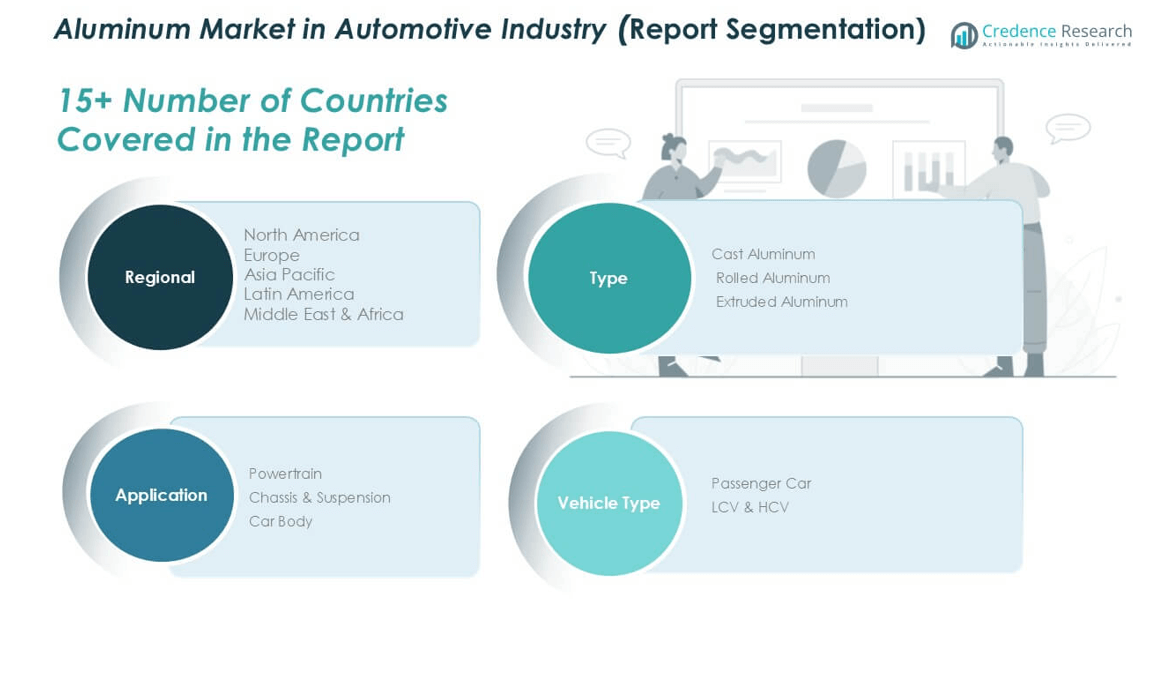
The Global Aluminum Market in the automotive industry is segmented into cast aluminum, rolled aluminum, and extruded aluminum. Cast aluminum holds a major revenue share due to its widespread use in engine blocks, transmission housings, and other structural components. It offers excellent durability and cost-effectiveness, making it suitable for high-volume manufacturing. Rolled aluminum is gaining momentum, particularly in body panel applications where formability and surface finish are critical. It supports weight reduction goals while maintaining structural strength. Extruded aluminum is used in crash management systems, suspension components, and electric vehicle battery housings due to its strength and design flexibility. The growing demand for lightweight, high-performance automotive materials continues to drive growth across all three type segments.
- For instance, nearly 30–40% of aluminum is used per lightweight vehicle annually, and this is likely to reach 70% in the coming years due to stricter regulations on reducing fuel emissions.
By Vehicle Type
The market is classified into passenger cars and light commercial vehicles (LCVs) & heavy commercial vehicles (HCVs). Passenger cars dominate the Global Aluminum Market due to higher production volumes and stricter fuel efficiency norms. It supports lightweighting strategies to reduce emissions and improve performance. LCVs and HCVs are witnessing steady growth in aluminum adoption, particularly in electric trucks and fleet vehicles. These segments demand strong, corrosion-resistant materials to handle heavy loads and extended usage cycles. The increasing electrification of commercial fleets will likely accelerate aluminum usage in this category over the forecast period.
- For instance, global sales of lightweight vehicles reached 15,502,000 units in 2023, reflecting the widespread adoption of aluminum in automotive manufacturing
By Application
The application segment includes powertrain, chassis & suspension, and car body. Powertrain components represent a significant share, where aluminum enhances thermal management and reduces mass. Chassis and suspension systems rely on extruded and cast aluminum to maintain strength while improving vehicle dynamics. The car body segment is rapidly expanding due to demand for lighter, more fuel-efficient vehicles. It supports crash safety and design flexibility, especially in electric and premium vehicles. This application-focused segmentation shows how aluminum contributes across key functional areas in automotive design and manufacturing.
Segments
Based on Type
- Cast Aluminum
- Rolled Aluminum
- Extruded Aluminum
Based on Vehicle Type
- Passenger Car
- LCV & HCV
Based on Application
- Powertrain
- Chassis & Suspension
- Car Body
Based on Region
- North America
- U.S.
- Canada
- Mexico
- Europe
- UK
- France
- Germany
- Italy
- Spain
- Russia
- Belgium
- Netherlands
- Austria
- Sweden
- Poland
- Denmark
- Switzerland
- Rest of Europe
- Asia Pacific
- China
- Japan
- South Korea
- India
- Australia
- Thailand
- Indonesia
- Vietnam
- Malaysia
- Philippines
- Taiwan
- Rest of Asia Pacific
- Latin America
- Brazil
- Argentina
- Peru
- Chile
- Colombia
- Rest of Latin America
- Middle East
- UAE
- KSA
- Israel
- Turkey
- Iran
- Rest of Middle East
- Africa
- Egypt
- Nigeria
- Algeria
- Morocco
- Rest of Africa
Regional Analysis
North America Aluminum Market
North America held a market size of USD 9.43 million in 2024 and is projected to reach USD 16.61 million by 2032, growing at a CAGR of 7.3%. The region accounted for approximately 16.3% of the global aluminum market share in 2024. The demand for aluminum in the automotive industry is rising due to fuel efficiency standards, advancements in EV manufacturing, and high adoption of lightweight materials. It supports vehicle manufacturers in reducing emissions and improving overall performance. The United States leads the regional market, backed by established OEMs and strong investment in electric mobility. The market also benefits from technological innovations in aluminum processing and alloy development.
Europe Aluminum Market
Europe’s aluminum market stood at USD 12.64 million in 2024 and is projected to reach USD 22.83 million by 2032, expanding at a CAGR of 7.7%. The region contributed around 21.9% to the global aluminum market in 2024. Stringent CO₂ emission regulations and the growing popularity of electric vehicles drive demand for aluminum in automotive applications. Germany, France, and the UK represent the largest consumers due to their advanced automotive manufacturing ecosystems. The market favors high-performance aluminum alloys for car body, suspension, and powertrain systems. Manufacturers are investing in sustainable production and recycled aluminum solutions to align with the EU’s climate targets.
Asia Pacific Aluminum Market
Asia Pacific dominates the global aluminum market, with a value of USD 20.76 million in 2024 and a projected value of USD 38.40 million by 2032, growing at a CAGR of 8.0%. The region held the highest share of 36.0% in 2024. China, Japan, South Korea, and India are key contributors, supported by high vehicle production, rapid electrification, and government incentives. It supports mass adoption of aluminum components across all vehicle segments, from economy to premium. Increasing investment in lightweight materials and EV infrastructure further drives regional growth. The strong supply chain and rising exports also contribute to the region’s leadership in aluminum demand.
Latin America Aluminum Market
Latin America’s aluminum market reached USD 4.87 million in 2024 and is expected to rise to USD 8.30 million by 2032, with a CAGR of 6.9%. The region accounted for approximately 8.4% of the global aluminum market in 2024. Brazil and Mexico lead in vehicle production and aluminum usage, driven by OEM expansions and growing demand for affordable, fuel-efficient vehicles. It benefits from increasing automotive exports and trade integration with North America. The adoption of aluminum remains slower than in developed markets but is gaining traction due to environmental awareness and material performance benefits. Local manufacturers are beginning to integrate lightweight solutions in response to emission norms.
Middle East Aluminum Market
The Middle East aluminum market was valued at USD 6.38 million in 2024 and is forecasted to reach USD 11.97 million by 2032, recording a CAGR of 8.2%. The region held a 11.0% share in the global market in 2024. Demand is growing due to increased vehicle imports, infrastructure development, and the expansion of local automotive assembly lines. It benefits from proximity to raw material resources and growing interest in industrial diversification. The UAE and Saudi Arabia lead market growth, supported by investments in sustainable mobility and localized production. Lightweight materials like aluminum are being promoted in national automotive strategies
Africa Aluminum Market
Africa had a market size of USD 3.71 million in 2024 and is expected to grow to USD 5.68 million by 2032, at a CAGR of 5.4%. The region represented about 6.4% of the global aluminum market in 2024. It shows modest but steady growth, supported by improving automotive imports and limited local assembly operations. South Africa remains the leading market, followed by Nigeria and Egypt. Demand for aluminum is growing in commercial vehicles and aftermarket segments. Challenges such as limited industrial infrastructure and slower EV adoption affect faster growth, but urbanization and rising mobility needs provide long-term potential.
Key players
- Alcoa Inc.
- Aleris International
- Aluminum Corporation of China Limited
- BHP Billiton Limited
- Constellium NV
- Kaiser Aluminum Corp.
- Norsk Hydro ASA
- Novelis Inc.
- AstroAI
- United Company Rusal Plc
- Vedanta Resources Plc
- Vimetco N.V.
Competitive Analysis
The Global Aluminum Market is highly competitive and features a mix of vertically integrated giants and specialized manufacturers. Companies like Alcoa Inc., Novelis Inc., and Norsk Hydro ASA dominate with extensive production capacities, global supply networks, and strong R\&D capabilities. It favors firms that can deliver lightweight, high-performance alloys tailored to automotive demands. Strategic investments in recycling technologies, low-carbon aluminum, and joint ventures with automakers enhance competitive positioning. Emerging players focus on regional markets and custom applications to differentiate their offerings. Market leaders continue to expand their presence through mergers, facility upgrades, and innovation in extrusion and rolling technologies.
Recent Developments
- In June 2025, Constellium SE highlighted its sustainable aerospace innovations at the Paris Air Show by showcasing its Airware® aluminum-lithium alloys and unveiling the first recycled aircraft ingot. This aluminum ingot was made from end-of-life aircraft, demonstrating a move towards a circular economy in the aerospace industry. The event took place at the Paris–Le Bourget Exposition Centre from June 16-22.
- In March 2025, Alcoa Inc. publicly acknowledged the impact of the Section 232 tariffs on Canadian aluminum imports and initiated discussions with government bodies regarding the issue. These tariffs, imposed under Section 232 of the Trade Expansion Act of 1962, authorize the U.S. President to adjust imports that threaten national security. Alcoa's actions indicate a proactive response to the trade barriers and a desire to find solutions or mitigations.
- In March 2025, Novelis Inc. launched the first aluminum coil made entirely from 100% recycled automotive scrap, marking a significant step towards circularity and sustainability in the automotive industry. This innovative product, designed for car body outer skin applications, meets the industry's stringent requirements for surface quality and formability. The aluminum scrap was sourced through the Automotive Circularity Platform (ACP), a collaboration with thyssenkrupp Materials Services.
Market Concentration and Characteristics
The Global Aluminum Market shows moderate to high market concentration, with a few key players such as Alcoa Inc., Novelis Inc., and Norsk Hydro ASA holding significant shares. It is characterized by vertical integration, strong supply chain networks, and continuous investment in innovation and sustainability. The market relies heavily on technological advancements in alloy development, recycling capabilities, and energy-efficient production methods. Entry barriers remain high due to capital-intensive operations and the need for advanced processing infrastructure. Price volatility in raw materials and energy further shapes competitive dynamics. Long-term contracts with automotive OEMs and regulatory compliance standards define business strategies across the industry.
Report Coverage
The research report offers an in-depth analysis based on Type, Vehicle Type, Application and Region. It details leading market players, providing an overview of their business, product offerings, investments, revenue streams, and key applications. Additionally, the report includes insights into the competitive environment, SWOT analysis, current market trends, as well as the primary drivers and constraints. Furthermore, it discusses various factors that have driven market expansion in recent years. The report also explores market dynamics, regulatory scenarios, and technological advancements that are shaping the industry. It assesses the impact of external factors and global economic changes on market growth. Lastly, it provides strategic recommendations for new entrants and established companies to navigate the complexities of the market.
Future Outlook
- The automotive industry will remain a primary driver of aluminum demand, with rising use in body structures, battery enclosures, and chassis components. Automakers will continue integrating aluminum to meet emission regulations and efficiency targets.
- Electric vehicle production will significantly boost aluminum consumption. It offers weight reduction, better thermal conductivity, and structural benefits for electric powertrain systems.
- Recycled aluminum will gain market share due to its lower energy consumption and reduced environmental impact. OEMs will favor closed-loop recycling systems to meet sustainability goals.
- Advancements in alloy composition, casting, and forming technologies will improve aluminum performance. These developments will enable broader application in safety-critical and structural automotive parts.
- Producers will expand smelting and rolling capacities in Asia Pacific and the Middle East. These regions offer cost advantages and rising domestic demand for automotive aluminum.
- OEMs will increase R\&D investments in lightweight materials to comply with global emission norms. Aluminum will remain a material of choice in multi-material vehicle designs.
- Aluminum prices will remain sensitive to energy costs, raw material availability, and geopolitical factors. Companies will adopt flexible sourcing and hedging strategies to manage volatility.
- Smart manufacturing technologies will improve operational efficiency in aluminum production. Automation will enhance precision and reduce waste in forming and extrusion processes.
- Governments will support green aluminum initiatives through incentives and carbon credit frameworks. Producers aligning with carbon neutrality targets will gain competitive advantage.
- Companies will pursue mergers, acquisitions, and alliances to strengthen market position. These efforts will focus on expanding geographic reach and developing high-performance aluminum solutions for next-gen vehicles.

Request a Free Sample
Fill in your details and we'll send you a free sample report.
- Sample data tables & charts
- Research methodology
Market Dynamics
Surge in Lightweight Material Demand for Automotive Manufacturing
Automakers are increasingly adopting aluminum to reduce vehicle weight, improve fuel efficiency, and comply with stringent emission standards. Aluminum's favorable strength-to-weight ratio enables manufacturers to meet regulatory targets without sacrificing safety or performance.
Stringent Government Regulations on Emissions and Fuel Economy
Tougher CO₂ emission and fuel economy regulations in regions like North America and Europe are accelerating the substitution of heavier metals with aluminum. These policies incentivize automakers to integrate more aluminum to avoid penalties and align with sustainability goals.
Growth in Electric Vehicle Production
The rapid expansion of electric vehicle manufacturing is boosting aluminum demand, as the material helps offset battery weight and extend driving range. Aluminum's thermal properties also enhance battery safety and efficiency, making it essential for next-generation automotive platforms.
Technological Advancements in Aluminum Processing and Alloys
Innovations in alloy development and processing technologies are enabling broader use of aluminum in critical automotive components. Improved formability, strength, and recyclability are making aluminum more competitive against alternative materials and expanding its application scope.
Rising Emphasis on Sustainable and Recycled Aluminum
OEMs and suppliers are prioritizing recycled aluminum to reduce lifecycle emissions and energy consumption. The shift toward circular economy practices and closed-loop recycling systems is driving the adoption of low-carbon aluminum in automotive manufacturing.
Need a Custom Version of This Report?
Tailor the scope, geography, or segments to your exact requirements.
- Custom geography or segment scope
- Direct access to our analyst team
Frequently Asked Questions
What is the market size of the Global Aluminum Market in Automotive Industry in 2023, and what are the forecasts for 2032?
Which regions are leading in the automotive aluminum market?
How are electric vehicles influencing the aluminum market?
Who are the major players in the global automotive aluminum market?
Table of Content
Chapter 1 Market Segmentation
- 1.1 Segmentation Framework
- 1.1.1 Product and Service Classification
- 1.1.2 Application and End-Use Classification
- 1.1.3 Technology and Solution Classification
- 1.1.4 Customer and Distribution Channel Classification
- 1.1.5 Geographic Segmentation
- 1.1.6 Market Segment Definitions and Boundaries
- 1.2 By Type
- 1.2.1 Cast Aluminum
- 1.2.2 Rolled Aluminum
- 1.2.3 Extruded Aluminum
- 1.3 By Application
- 1.3.1 Powertrain
- 1.3.2 Chassis & Suspension
- 1.3.3 Car Body
- 1.4 By Vehicle Type
- 1.4.1 Passenger Car
- 1.4.2 LCV & HCV
Chapter 2 Introduction
- 2.1 Report Objectives and Scope
- 2.2 Product Definition and Industry Terminology
- 2.3 Market Inclusions and Exclusions
- 2.4 Research Process
- 2.4.1 Primary Research and Expert Interviews
- 2.4.2 Secondary Research and Source Review
- 2.4.3 Top-Down and Bottom-Up Estimation
- 2.4.4 Data Triangulation and Verification
- 2.5 Market Size Measurement Basis
- 2.5.1 2023: USD 54.2 million → 2032: USD 103.8 million
- 2.6 Historical and Forecast Reference Periods
- 2.6.1 Base Year: 2023
- 2.6.2 Forecast Period: 2023-2032
- 2.7 Research Assumptions and Limitations
Chapter 3 Executive Summary
- 3.1 Market Snapshot and Key Findings
- 3.2 Base-Year Market Size, 2023
- 3.3 Forecast Market Size, 2032
- 3.4 Revenue and Volume Growth Outlook
- 3.5 Key Demand and Supply Indicators
- 3.6 Leading Market Segments
- 3.7 Fastest-Growing Market Opportunities
- 3.8 Regional Performance Highlights
- 3.9 Technology and Industry Transformation
- 3.10 Competitive Landscape Summary
- 3.11 Analyst View and Strategic Implications
Chapter 4 Global Aluminum Market Trends and Developments
- 4.1 Historical Industry Development
- 4.2 Recent Market Trends and Developments
- 4.3 Demand and Customer Behavior Trends
- 4.4 Technology and Product Innovation
- 4.5 Artificial Intelligence, Automation and Digitalization
- 4.6 Local Manufacturing and Supply Chain Realignment
- 4.7 Industry Partnerships, Mergers and Acquisitions
- 4.8 Sustainability and Circular Economy Developments
- 4.9 Government and Private Sector Investment Trends
- 4.10 Emerging Business Models and Commercialization
- 4.11 Industry Developments and Announcements
Chapter 5 Global Aluminum Market Production, Supply and Demand Analysis
- 5.1 Demand Trend and Consumption Analysis
- 5.2 Demand Forecast, 2023-2032
- 5.3 Production and Output Trend
- 5.4 Production and Output Forecast, 2023-2032
- 5.5 Installed Capacity and Capacity Utilization
- 5.6 Company-Wise Production Plants and Statistics
- 5.6.1 Installed Production Capacity
- 5.6.2 Actual Production
- 5.6.3 Planned Capacity and Expansion Targets
- 5.7 Supply Chain Structure and Procurement Trends
- 5.8 Supply-Demand Gap and Bottlenecks
- 5.9 Import Dependence and Sourcing Structure
- 5.10 Contract Manufacturing and Outsourcing
- 5.11 Regional Supply and Demand Concentration
Chapter 6 Global Aluminum Market Pricing Analysis
- 6.1 Pricing Structure and Measurement
- 6.2 Historical Pricing Trends
- 6.3 Pricing Outlook, 2023-2032
- 6.4 Average Selling Price and Unit Economics
- 6.5 Pricing by Product and Market Segment
- 6.6 Geographic Pricing Differences
- 6.7 Key Input, Energy, Labor and Logistics Costs
- 6.8 Contract Pricing and Purchasing Models
- 6.9 Pricing Sensitivity and Competitive Positioning
- 6.10 Price, Margin and Profitability Implications
Chapter 7 Global Aluminum Market Dynamics
- 7.1 Market Growth Drivers
- 7.1.1 Demand-Side Drivers
- 7.1.2 Technology and Innovation Drivers
- 7.1.3 Infrastructure and Investment Drivers
- 7.1.4 Regulatory and Policy Drivers
- 7.2 Market Restraints
- 7.2.1 Cost and Affordability Constraints
- 7.2.2 Technology and Adoption Barriers
- 7.2.3 Supply Chain and Operational Constraints
- 7.3 Market Challenges
- 7.3.1 Competitive Pressure and Margin Erosion
- 7.3.2 Skills, Infrastructure and Implementation Gaps
- 7.4 Emerging Market Opportunities
- 7.5 Market Dynamics Impact and Time-Horizon Assessment
Chapter 8 Global Aluminum Value Chain Analysis
- 8.1 Industry Value Chain Overview
- 8.2 Upstream Suppliers and Critical Inputs
- 8.3 Technology and Component Providers
- 8.4 Manufacturing or Service Delivery
- 8.5 Distribution, Channel Partners and Integrators
- 8.6 Downstream Applications and End Users
- 8.7 Value Addition and Profit Pools
- 8.8 Vertical Integration and Outsourcing
- 8.9 Supplier Concentration and Risk
- 8.10 Supply Chain Localization and Resilience
Chapter 9 Global Aluminum Market Regulations and Policies
- 9.1 Relevant Laws, Standards and Compliance Frameworks
- 9.2 Product, Service, Safety and Quality Requirements
- 9.3 Government Policies, Incentives and Subsidies
- 9.4 Imports, Exports and Trade Barriers
- 9.5 Public Procurement and Local Content Requirements
- 9.6 Environmental and Sustainability Compliance
- 9.7 Upcoming Policy Changes and Market Implications
Chapter 10 Global Aluminum Market Hotspots and Opportunities
- 10.1 Market Opportunity Mapping and Growth Hotspots
- 10.2 High-Growth Applications and Customer Groups
- 10.3 Underserved Markets and White-Space Opportunities
- 10.4 Emerging Technology and Product Opportunities
- 10.5 New Capacity and Investment Hotspots
- 10.6 Market Entry and Expansion Opportunities
- 10.7 Distribution and Partnership Opportunities
- 10.8 Near-Term and Long-Term Commercial Potential
- 10.9 Opportunity Attractiveness and Execution Risks
Chapter 11 Global Aluminum Market Outlook, 2023-2032
- 11.1 Market Size and Analysis
- 11.1.1 Revenue (Market Measurement: 2023: USD 54.2 million → 2032: USD 103.8 million)
- 11.1.2 Market Volume and Quantity Sold
- 11.1.3 Historical Market Size
- 11.1.4 Base-Year Market Size, 2023
- 11.2 Market Forecast, 2023-2032
- 11.2.1 Revenue Forecast to 2032
- 11.2.2 Volume Forecast to 2032
- 11.2.3 CAGR and Year-on-Year Growth
- 11.2.4 Incremental Revenue Opportunity
- 11.3 Forecast Assumptions and Scenario Analysis
- 11.3.1 Base-Case Forecast
- 11.3.2 Optimistic and Conservative Scenarios
- 11.3.3 Technology, Pricing and Policy Sensitivities
- 11.4 Market Attractiveness and Growth Outlook
Chapter 12 Global Aluminum Market Segmentation and Outlook
- 12.1 Segmentation Summary and Market Shares, 2023
- 12.2 Largest and Fastest-Growing Segments
- 12.3 By Type - Market Size and Forecast, 2023-2032
- 12.3.1 Segment Definition and Scope
- 12.3.2 Historical Market Size
- 12.3.3 Revenue Forecast, 2023-2032
- 12.3.4 Volume Forecast, 2023-2032
- 12.3.5 Base-Year Market Share, 2023
- 12.3.6 Segment CAGR and Growth Drivers
- 12.3.7 Subsegment Market Size and Forecast
- 12.3.7.1 Cast Aluminum
- 12.3.7.2 Rolled Aluminum
- 12.3.7.3 Extruded Aluminum
- 12.3.8 Subsegment Pricing and Adoption Trends
- 12.3.9 Leading Suppliers and Competition
- 12.3.10 Regional Demand and Opportunities
- 12.4 By Application - Market Size and Forecast, 2023-2032
- 12.4.1 Segment Definition and Scope
- 12.4.2 Historical Market Size
- 12.4.3 Revenue Forecast, 2023-2032
- 12.4.4 Volume Forecast, 2023-2032
- 12.4.5 Base-Year Market Share, 2023
- 12.4.6 Segment CAGR and Growth Drivers
- 12.4.7 Subsegment Market Size and Forecast
- 12.4.7.1 Powertrain
- 12.4.7.2 Chassis & Suspension
- 12.4.7.3 Car Body
- 12.4.8 Subsegment Pricing and Adoption Trends
- 12.4.9 Leading Suppliers and Competition
- 12.4.10 Regional Demand and Opportunities
- 12.5 By Vehicle Type - Market Size and Forecast, 2023-2032
- 12.5.1 Segment Definition and Scope
- 12.5.2 Historical Market Size
- 12.5.3 Revenue Forecast, 2023-2032
- 12.5.4 Volume Forecast, 2023-2032
- 12.5.5 Base-Year Market Share, 2023
- 12.5.6 Segment CAGR and Growth Drivers
- 12.5.7 Subsegment Market Size and Forecast
- 12.5.7.1 Passenger Car
- 12.5.7.2 LCV & HCV
- 12.5.8 Subsegment Pricing and Adoption Trends
- 12.5.9 Leading Suppliers and Competition
- 12.5.10 Regional Demand and Opportunities
- 12.6 Segment Growth Comparison
- 12.7 Segment Attractiveness and Priority Matrix
Chapter 13 Global Aluminum End-Use and Application Market Outlook
- 13.1 End-Use Industry and Customer Demand Structure
- 13.2 Leading Applications and Customer Groups
- 13.3 End-Use Market Size, Share and Forecast
- 13.4 Major End-Use Industry Deep Dives
- 13.4.1 Customer Requirements and Use Cases
- 13.4.2 Demand and Replacement Cycles
- 13.4.3 Technical and Regulatory Considerations
- 13.4.4 Purchasing and Procurement Models
- 13.4.5 Leading Vendors and Distribution Channels
- 13.4.6 Forecast and Commercial Opportunities
- 13.5 Emerging Applications and Cross-Segment Demand
- 13.6 End-Use Industry Investment Priorities
Chapter 14 Global Aluminum Geographic Market Outlook, 2023-2032
- 14.1 Regional Market Size and Share, 2023
- 14.2 Regional Market Forecast, 2023-2032
- 14.3 Regional Pricing, Production and Demand Differences
- 14.4 North America
- 14.4.1 United States
- 14.4.2 Canada
- 14.4.3 Mexico
- 14.5 Europe
- 14.5.1 Germany
- 14.5.2 France
- 14.5.3 Italy
- 14.5.4 United Kingdom
- 14.5.5 Spain
- 14.5.6 Poland
- 14.5.7 Russia
- 14.5.8 Netherlands
- 14.5.9 Belgium
- 14.5.10 Sweden
- 14.5.11 Denmark
- 14.5.12 Norway
- 14.5.13 Rest of Europe
- 14.6 Asia Pacific
- 14.6.1 China
- 14.6.2 India
- 14.6.3 Japan
- 14.6.4 South Korea
- 14.6.5 Thailand
- 14.6.6 Indonesia
- 14.6.7 Vietnam
- 14.6.8 Malaysia
- 14.6.9 Australia
- 14.6.10 Rest of Asia Pacific
- 14.7 Latin America
- 14.7.1 Brazil
- 14.7.2 Argentina
- 14.7.3 Colombia
- 14.7.4 Chile
- 14.7.5 Rest of Latin America
- 14.8 Middle East
- 14.8.1 Saudi Arabia
- 14.8.2 United Arab Emirates
- 14.8.3 Turkey
- 14.8.4 Israel
- 14.8.5 Iran
- 14.8.6 Rest of the Middle East
- 14.9 Africa
- 14.9.1 South Africa
- 14.9.2 Egypt
- 14.9.3 Nigeria
- 14.9.4 Morocco
- 14.9.5 Rest of Africa
- 14.10 Regional Investment, Policy and Supply Chain Differences
- 14.11 Regional Competitive Landscape
- 14.12 Geographic Growth Hotspots
Chapter 15 Global Aluminum Technology, Innovation and Sustainability Outlook
- 15.1 Technology Landscape and Maturity
- 15.2 Product, Process and Service Innovation
- 15.3 AI, Automation and Digital Tools in the Industry
- 15.4 Technology Adoption and Performance Benchmarking
- 15.5 Innovation Pipeline and R&D Investment
- 15.6 Patent and Intellectual Property Trends
- 15.7 Energy Efficiency and Resource Management
- 15.8 Sustainability, Recycling and Circularity
- 15.9 Technology Roadmap, 2023-2032
- 15.10 Risks of Obsolescence and Technology Substitution
Chapter 16 Global Aluminum Market Key Strategic Imperatives
- 16.1 Growth and Market Entry Priorities
- 16.2 High-Return Products and Segments
- 16.3 Pricing, Profitability and Cost Optimization
- 16.4 Technology Investment and Product Differentiation
- 16.5 Supply Chain Localization and Resilience
- 16.6 Distribution and Customer Acquisition
- 16.7 Partnership, Acquisition and Capacity Strategy
- 16.8 Regional Expansion Priorities
- 16.9 Short-, Medium- and Long-Term Actions
Chapter 17 Competition Outlook
- 17.1 Industry Competition Characteristics
- 17.2 Market Structure and Concentration
- 17.3 Market Share and Competitive Positioning, 2023
- 17.4 Company-Wise Revenue and Product Benchmarking
- 17.5 Production and Service Capacity Benchmarking
- 17.6 Technology, Pricing and Differentiation
- 17.7 Regional Footprint and Distribution Strength
- 17.8 Mergers, Acquisitions and Strategic Alliances
- 17.9 New Entrants and Competitive Threats
- 17.10 Porter's Five Forces and Industry Attractiveness
- 17.11 Competitive Outlook, 2023-2032
Chapter 18 Company Profiles
- 18.1 Company Coverage and Selection Criteria
- 18.2 Alcoa Inc.
- 18.2.1 Business Description
- 18.2.2 Company Ownership and Geographic Presence
- 18.2.3 Product and Service Portfolio
- 18.2.4 Manufacturing and Operating Footprint
- 18.2.5 Production Capacity and Expansion Plans
- 18.2.6 Financial Performance and Investment
- 18.2.7 Market Share and Competitive Position
- 18.2.8 Technology and Innovation Capabilities
- 18.2.9 Strategic Alliances or Partnerships
- 18.2.10 Recent Developments
- 18.2.11 Growth Strategy and Outlook
- 18.3 Novelis Inc.
- 18.4 Norsk Hydro ASA
- 18.5 Constellium SE
- 18.6 Kaiser Aluminum Corporation
- 18.7 Aluminum Corporation of China Limited
- 18.8 United Company Rusal Plc
- 18.9 Vedanta Resources Plc
- 18.10 Aleris International
- 18.11 Vimetco N.V.
- 18.12 Other Relevant Market Participants
Note: Every listed company is profiled on the structure shown under the first company. The company list is preliminary and may change based on research findings, market developments, data availability and client requirements.
Chapter 19 Disclaimer
- 19.1 Research and Forecast Disclaimer
- 19.2 Data Source and Estimation Limitations
Note: The depth of individual sections depends on data availability for this market. Volume, capacity, trade and other unit-based metrics are included where applicable.

