Anal Irrigation Systems Market Overview:
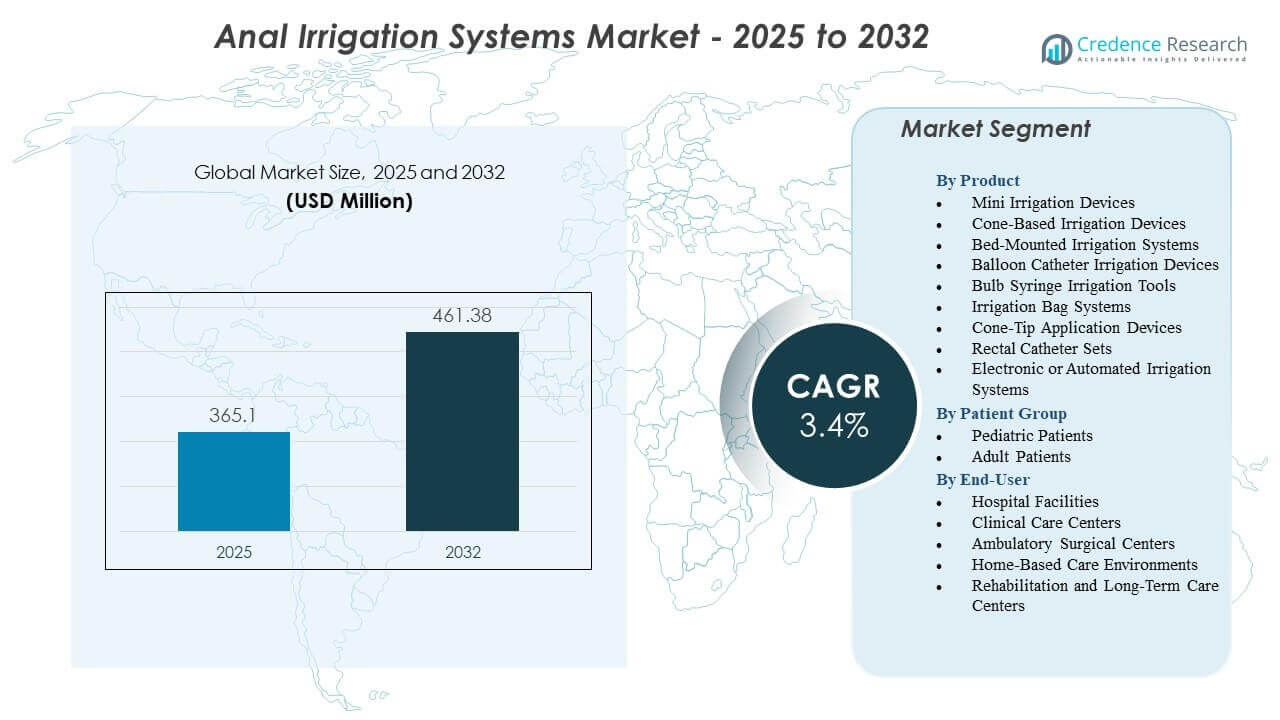
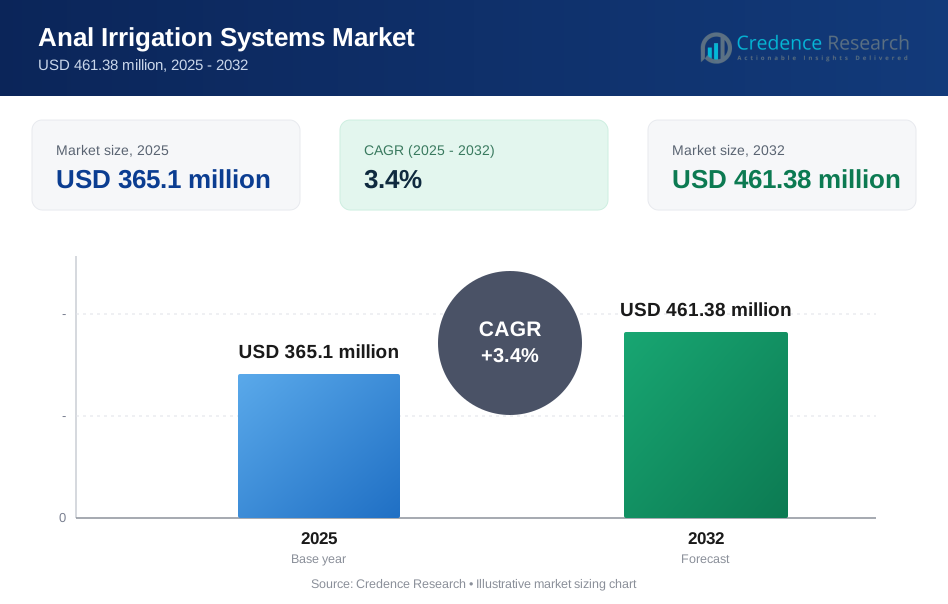
The Anal Irrigation Systems Market is projected to grow from USD 365.1 million in 2025 to an estimated USD 461.38 million by 2032, with a compound annual growth rate (CAGR) of 3.4% from 2025 to 2032.
| REPORT ATTRIBUTE | DETAILS |
|---|---|
| Historical Period | 2020-2023 |
| Base Year | 2024 |
| Forecast Period | 2025-2032 |
| Anal Irrigation Systems Market Size 2025 | USD 365.1 million |
| Anal Irrigation Systems Market , CAGR | 3.4% |
| Anal Irrigation Systems Market Size 2032 | USD 461.38 million |
Market growth is driven by rising diagnosis rates of bowel dysfunction across aging populations and individuals with neurological conditions. Healthcare providers recommend irrigation therapy to improve continence, reduce reliance on laxatives, and lower emergency care needs. Device improvements enhance patient comfort through controlled flow and intuitive operation, which helps new users build confidence in routine management. Training programs supported by hospitals and rehabilitation centers increase adherence and strengthen long-term outcomes. Home-care expansion also supports broader acceptance among adults seeking independence in daily care.
Regionally, North America leads the Anal Irrigation Systems Market due to strong clinical awareness, established bowel care programs, and greater access to trained specialists. Europe follows with high adoption across countries that maintain structured rehabilitation pathways and clear clinical guidelines for bowel management. Asia Pacific emerges as a growing region as healthcare access improves and diagnosis of chronic bowel disorders rises. Growth also spreads across Latin America and the Middle East, where specialty care services expand and patient education efforts strengthen awareness of non-surgical bowel management options.
Anal Irrigation Systems Market Insights:
- The Anal Irrigation Systems Market is projected to grow from USD 365.1 million in 2025 to USD 461.38 million by 2032, supported by a steady 3.4% CAGR.
- Demand increases as patients with constipation, fecal incontinence, and neurogenic bowel dysfunction seek predictable, non-surgical bowel management solutions.
- Market expansion is limited by low awareness, variable reimbursement, and the need for structured patient training to ensure consistent therapy outcomes.
- North America leads the market due to strong clinical adoption and established bowel care programs, while Europe maintains high usage supported by rehabilitation pathways.
- Asia Pacific shows rising momentum as healthcare access improves and diagnosis rates increase, with further adoption expected across Latin America and the Middle East.
Anal Irrigation Systems Market Drivers
Rising Prevalence of Bowel Dysfunction and Growing Need for Non-Surgical Care
The Anal Irrigation Systems Market gains momentum due to rising cases of chronic constipation, fecal incontinence, and neurogenic bowel disorders. Clinicians recommend irrigation systems to reduce dependence on laxatives and manual evacuation. Demand grows in patients seeking predictable bowel routines and fewer emergency visits. Device makers refine catheter comfort and irrigation control to support safer home use. Greater disease awareness helps more patients consider structured bowel programs. Training initiatives by hospitals improve user confidence. Reimbursement improvements strengthen accessibility. The method supports long-term bowel management without invasive procedures.
Expansion of Home Healthcare and Preference for Self-Administered Bowel Care
Home-based care adoption accelerates interest because patients prefer simple and predictable routines. The Anal Irrigation Systems Market benefits from rising demand for independent bowel management. Users value systems that reduce caregiver burden. Device design improvements make training easier for first-time users. Remote coaching services support adherence and reduce complications. Hospitals encourage early transition to home care for stable patients. Product kits with intuitive controls improve daily outcomes. Strong patient satisfaction rates encourage more physicians to recommend irrigation therapy.
Improved Clinical Evidence Supporting Structured Bowel Programs
Clinical studies validate irrigation therapy for improving continence, reducing soiling episodes, and preventing complications. Physicians trust systems with proven clinical outcomes. The Anal Irrigation Systems Market grows due to steady endorsement from colorectal specialists. Clear protocols help users achieve consistent outcomes. Long-term use lowers emergency visits and reduces dependence on surgical interventions. Hospitals integrate irrigation programs into bowel care pathways. Standardized training modules improve adoption. Clinical trials guide product refinements that boost safety and comfort.
- For instance, multiple clinical evaluations published in peer-reviewed journals have shown that transanal irrigation leads to meaningful reductions in constipation severity scores and improved bowel management outcomes compared with standard conservative therapy, especially in patients with neurogenic bowel dysfunction.
Technological Advancements Enhancing Usability and Patient Comfort
New designs include controlled pump systems, softer catheter materials, and adaptive pressure mechanisms. These features enhance comfort and reduce injury risk. The Anal Irrigation Systems Market benefits from digital features that guide users step-by-step. Device feedback signals help prevent over-irrigation. Compact kits improve portability for travel. Manufacturers emphasize ergonomic design to simplify routine use. Strong product reliability increases confidence among clinicians. User-friendly upgrades support wider adoption across diverse patient groups.
- For instance, B. Braun’s IryPump® S is an electronically controlled system designed specifically for colostomy irrigation, offering automated water delivery and standardized routines that help patients achieve predictable bowel emptying. Its programmable settings and safety features support consistent home-based irrigation and are widely adopted in European stoma-care programs.
Anal Irrigation Systems Market Trends
Growing Integration of Digital Tools and Assisted Training Platforms
Digital interfaces support real-time guidance and user reminders during irrigation routines. The Anal Irrigation Systems Market sees higher adoption of mobile training resources that improve adherence. Virtual coaching programs support new users. Clinics offer remote monitoring for complex cases. Data tracking helps patients understand routine effectiveness. Device makers explore app-linked pressure control systems. Patients value digital support in managing daily habits. Training videos enhance confidence in self-care routines.
Shift Toward Personalized Bowel Management Solutions
Manufacturers design systems based on patient anatomy, comfort needs, and condition severity. The Anal Irrigation Systems Market supports customization through varied catheter sizes and pressure settings. Tailored kits improve acceptance in children and older adults. Hospitals guide patients toward personalized therapy plans. Custom solutions improve long-term compliance. Product flexibility reduces discomfort during use. Training pathways adapt to patient mobility levels. Personalization strengthens therapy outcomes.
- For instance, Wellspect HealthCare’s Navina Smart system uses an electronic control unit that automates water flow and balloon inflation with clinician-preset safety limits, improving repeatability and consistency compared with manual irrigation systems.
Expansion of Reimbursement Policies and Structured Coverage Pathways
Reimbursement changes support wider uptake across developed healthcare systems. The Anal Irrigation Systems Market benefits from clear eligibility rules for chronic bowel conditions. Coverage expansion increases patient willingness to adopt therapy. Hospitals train users early to meet documentation needs. Clinics support insurance submissions to streamline access. Manufacturers work with policymakers to widen coverage categories. Consistent reimbursement guidance encourages long-term therapy use. Strong coverage models influence purchasing decisions.
- For instance, the Centers for Medicare & Medicaid Services (CMS) in the United States recognizes manual pump-operated bowel irrigation systems under HCPCS code A4459, enabling reimbursement pathways for eligible patients, including those diagnosed with neurogenic bowel dysfunction.
Increasing Adoption in Pediatric and Neurological Disorder Management
Clinicians use irrigation therapy for children with spina bifida and congenital bowel dysfunction. The Anal Irrigation Systems Market sees rising demand in pediatric rehabilitation programs. Families prefer predictable routines that reduce accidents. Pediatric clinics build structured bowel training modules. Device designs now include child-friendly kits. Neurology units integrate irrigation into broader care protocols. Predictable outcomes help improve quality of life. Adoption grows steadily in specialized care settings.
Anal Irrigation Systems Market Challenges Analysis
Limited Awareness and Training Barriers Affecting Adoption Rates
Awareness gaps limit use, especially in regions with fewer colorectal specialists. The Anal Irrigation Systems Market faces challenges when patients lack guidance on correct technique. Many clinicians hesitate to recommend irrigation due to training burden. Users may struggle during early learning stages without structured support. Cultural sensitivity issues reduce acceptance in some populations. Hospitals lack standardized training programs in several regions. Poor awareness delays diagnosis and treatment. Limited patient education weakens therapy consistency.
Regulatory Variation, Product Costs, and Infrastructure Constraints
Different regulatory rules slow product approvals and delay launch cycles. The Anal Irrigation Systems Market must address concerns around device sterility and safety standards. High product costs restrict access in low-income regions. Limited reimbursement in emerging markets weakens adoption. Rural areas face shortages of specialists who guide therapy. Logistics barriers disrupt supply continuity. Patient follow-up becomes difficult where home healthcare systems remain underdeveloped. These factors slow market expansion.
Anal Irrigation Systems Market Opportunities
Rising Adoption Potential in Emerging Markets with Growing Healthcare Access
Emerging economies show strong potential due to rising diagnosis rates and expanding gastroenterology services. The Anal Irrigation Systems Market can gain traction where hospitals modernize bowel care programs. Training across regional clinics will support safe adoption. Local distributors can increase access in underserved areas. Growing preference for home-based care strengthens long-term use. Awareness campaigns can improve acceptance among new patients. Partnerships with rehabilitation centers expand the user base. Education programs help integrate irrigation therapy into routine care.
Innovation in Device Design, Clinical Integration, and Patient Support Networks
Manufacturers can introduce advanced pump technology, safer catheters, and digital guidance systems. The Anal Irrigation Systems Market benefits from hospitals integrating structured bowel programs. User support lines and virtual coaching create strong engagement. Opportunities grow through personalized kits for pediatric and geriatric groups. Device upgrades will elevate comfort and precision. Clinics can bundle irrigation training into recovery pathways. Stronger peer-support networks encourage long-term adherence. These innovations can open new revenue streams for suppliers.
Anal Irrigation Systems Market Segmentation Analysis:
By Product
Mini irrigation devices gain steady adoption in the Anal Irrigation Systems Market because users prefer compact tools that support simple routines. Cone-based irrigation devices remain widely used due to predictable water flow and low training needs. Bed-mounted irrigation systems serve patients with limited mobility who require caregiver assistance and stable setup support. Balloon catheter irrigation devices maintain strong clinical use due to secure placement and reduced leakage. Bulb syringe tools retain demand in basic care environments that rely on manual control. Irrigation bag systems help users manage larger volumes with minimal handling steps. Cone-tip applicators continue to support entry-level home setups. Rectal catheter sets remain central in hospital protocols that require sterile and controlled irrigation. Electronic systems gain momentum due to pressure control, safety prompts, and digital guidance.
- For instance, ProSys irrigation bags support up to 1 liter capacity with controlled gravity flow validated for clinical consistency.
By Patient Group
Pediatric patients in the Anal Irrigation Systems Market use tailored devices that support gentle pressure control and predictable routines. Clinicians select child-friendly kits to improve comfort and reduce caregiver stress. Adult patients represent the largest user group because bowel dysfunction rises with age and chronic conditions. Manufacturers design advanced systems to support home-based independence. Hospitals guide adults toward structured routines that reduce complications. Adult-focused devices offer stronger durability. Training modules for adults enhance adherence. Stable demand supports ongoing product innovation.
- For instance, Wellspect’s Navina adult system demonstrated a 50% reduction in time spent on bowel management routines during long-term follow-ups.
By End-User
Hospital facilities drive consistent demand in the Anal Irrigation Systems Market due to structured bowel programs and high patient turnover. Clinical care centers adopt devices that support routine management for chronic bowel disorders. Ambulatory surgical centers use irrigation systems during recovery pathways that require predictable bowel evacuation. Home-based care environments show rising adoption because users prefer independent routines supported by training kits. Rehabilitation centers rely on structured irrigation for patients with neurological conditions. Each setting values reliable devices that improve outcomes.
Anal Irrigation Systems Market Segmentation:
By Product
- Mini Irrigation Devices
- Cone-Based Irrigation Devices
- Bed-Mounted Irrigation Systems
- Balloon Catheter Irrigation Devices
- Bulb Syringe Irrigation Tools
- Irrigation Bag Systems
- Cone-Tip Application Devices
- Rectal Catheter Sets
- Electronic or Automated Irrigation Systems
By Patient Group
- Pediatric Patients
- Adult Patients
By End-User
- Hospital Facilities
- Clinical Care Centers
- Ambulatory Surgical Centers
- Home-Based Care Environments
- Rehabilitation and Long-Term Care Centers
By Region
- North America
- U.S.
- Canada
- Mexico
- Europe
- Germany
- France
- U.K.
- Italy
- Spain
- Rest of Europe
- Asia Pacific
- China
- Japan
- India
- South Korea
- South-east Asia
- Rest of Asia Pacific
- Latin America
- Brazil
- Argentina
- Rest of Latin America
- Middle East & Africa
- GCC Countries
- South Africa
- Rest of the Middle East and Africa
Regional Analysis:
North America secures the largest share of the Anal Irrigation Systems Market with strong clinical adoption and structured bowel care pathways. The region holds about 38% share, driven by high awareness and supportive reimbursement. Users benefit from advanced home-care programs across the United States and Canada. Hospitals integrate irrigation therapy into chronic care protocols and encourage home-based routines. Demand rises in patients managing neurogenic bowel conditions. The market gains support from established suppliers and training resources that improve routine adherence. Clinical validation encourages physicians to recommend irrigation early in treatment planning.
Europe follows with around 33% share supported by long-standing colorectal care guidelines and structured patient education frameworks. Countries such as Germany, United Kingdom, and the Nordic region lead due to high bowel dysfunction diagnosis rates. The Anal Irrigation Systems Market benefits from early adoption of standardized irrigation programs in rehabilitation centers. Patients gain access through well-developed reimbursement schemes. Hospitals rely on evidence-backed protocols for chronic conditions. Manufacturers introduce products tailored to regional comfort and usability expectations. Europe maintains stable growth through strong clinical governance.
Asia Pacific holds about 20% share and continues to expand due to rising awareness and increasing access to specialty care. Countries such as China, Japan, and India show steady improvements in bowel disorder diagnosis and treatment pathways. The Anal Irrigation Systems Market gains traction within home-care channels where aging populations require predictable routines. Hospitals build structured training programs for patients with neurological disorders. Growing supply chains help distributors expand device availability. Regional growth strengthens through demand for less invasive bowel management options.
Key Player Analysis:
- Coloplast A/S
- Braun Melsungen AG
- Becton, Dickinson and Company (BD)
- ConvaTec Group PLC
- Consure Medical Pvt. Ltd.
- MBH-International A/S
- Aquaflush Medical Limited
- HTKD Medical
- ProSys International Ltd.
- Wellspect HealthCare (Dentsply Sirona)
- UroMed Kurt Drews KG
- Ostomed
- ABC Medical, Inc.
- Renew Medical
- Qufora A/S
Competitive Analysis:
The competitive landscape in the Anal Irrigation Systems Market features global manufacturers and specialized medical device firms offering varied irrigation solutions. Leading companies focus on comfort-driven designs, digital support tools, and safer catheter technologies. The Anal Irrigation Systems Market gains momentum through strong portfolios from Coloplast A/S, B. Braun, Qufora, and Wellspect HealthCare, each supporting clinical adoption with proven devices. Competitors invest in training programs that help users achieve consistent outcomes. It encourages wider acceptance across home-care and rehabilitation settings. Smaller companies drive innovation in portable kits and low-cost solutions for resource-limited regions. Market competition intensifies through product differentiation, regulatory approvals, and expanded reimbursement strategies. Firms strengthen market presence by partnering with hospitals and developing patient education platforms that improve adherence.
Recent Developments:
- In February 2024, Coloplast launched Peristeen Light 175mL, a new transanal irrigation device designed for people with bowel disorders, expected to contribute to growth in the bowel care segment and solidify the company's leadership in transanal irrigation.
- In February 2025, Coloplast expanded its Peristeen Light portfolio with the launch of the 250mL version, featuring larger water capacity, optional extension tube, and easy assembly to enhance comfort for constipation and fecal incontinence management, rolling out in select European markets.
Report Coverage:
The research report offers an in-depth analysis based on Product, Patient Group, and End-User. It details leading market players, providing an overview of their business, product offerings, investments, revenue streams, and key applications. Additionally, the report includes insights into the competitive environment, SWOT analysis, current market trends, as well as the primary drivers and constraints. Furthermore, it discusses various factors that have driven market expansion in recent years. The report also explores market dynamics, regulatory scenarios, and technological advancements that are shaping the industry. It assesses the impact of external factors and global economic changes on market growth. Lastly, it provides strategic recommendations for new entrants and established companies to navigate the complexities of the market.
Future Outlook:
- Rising demand for structured bowel routines will strengthen adoption across home-care environments and rehabilitation programs.
- Advancements in catheter comfort and pressure control will support wider clinical recommendations in neurological and chronic bowel disorder care.
- Digital guidance tools and remote training modules will enhance patient adherence and reduce early-stage challenges during routine setup.
- Growing awareness among pediatric and adult patients will expand treatment pathways across primary care and specialty clinics.
- Integration of automated irrigation systems will create new opportunities for manufacturers focused on safety and usability features.
- Hospitals will expand bowel management protocols to include standardized irrigation programs for chronic conditions.
- Distributors will strengthen supply chains in emerging markets where diagnosis and treatment rates are improving.
- Training partnerships with rehabilitation centers will increase therapy confidence and improve long-term user outcomes.
- Reimbursement improvements across developed regions will boost adoption among patients seeking predictable non-surgical solutions.
- Product innovation will remain strong as manufacturers refine ergonomic designs and compatibility with digital health platforms.
Request a Free Sample
Fill in your details and we'll send you a free sample report.
- Sample data tables & charts
- Research methodology
Need a Custom Version of This Report?
Tailor the scope, geography, or segments to your exact requirements.
- Custom geography or segment scope
- Direct access to our analyst team
Frequently Asked Questions
What is the current market size for the Anal Irrigation Systems Market, and what is its projected size in 2032?
At what Compound Annual Growth Rate is the Anal Irrigation Systems Market projected to grow between 2025 and 2032?
Which Anal Irrigation Systems Market segment held the largest share in 2025?
What are the primary factors fueling the growth of the Anal Irrigation Systems Market?
Who are the leading companies in the Anal Irrigation Systems Market?
Which region commanded the largest share of the Anal Irrigation Systems Market in 2025?
Table of Content
Chapter 1 Market Segmentation
- 1.1 Segmentation Framework
- 1.1.1 Product and Service Classification
- 1.1.2 Application and End-Use Classification
- 1.1.3 Technology and Solution Classification
- 1.1.4 Customer and Distribution Channel Classification
- 1.1.5 Geographic Segmentation
- 1.1.6 Market Segment Definitions and Boundaries
Chapter 2 Introduction
- 2.1 Report Objectives and Scope
- 2.2 Product Definition and Industry Terminology
- 2.3 Market Inclusions and Exclusions
- 2.4 Research Process
- 2.4.1 Primary Research and Expert Interviews
- 2.4.2 Secondary Research and Source Review
- 2.4.3 Top-Down and Bottom-Up Estimation
- 2.4.4 Data Triangulation and Verification
- 2.5 Market Size Measurement Basis
- 2.5.1 2025: USD 365.1 million → 2032: USD 461.38 million
- 2.6 Historical and Forecast Reference Periods
- 2.6.1 Base Year: 2025
- 2.6.2 Forecast Period: 2025-2032
- 2.7 Research Assumptions and Limitations
Chapter 3 Executive Summary
- 3.1 Market Snapshot and Key Findings
- 3.2 Base-Year Market Size, 2025
- 3.3 Forecast Market Size, 2032
- 3.4 Revenue and Volume Growth Outlook
- 3.5 Key Demand and Supply Indicators
- 3.6 Leading Market Segments
- 3.7 Fastest-Growing Market Opportunities
- 3.8 Regional Performance Highlights
- 3.9 Technology and Industry Transformation
- 3.10 Competitive Landscape Summary
- 3.11 Analyst View and Strategic Implications
Chapter 4 Global Anal Irrigation Systems Market Trends and Developments
- 4.1 Historical Industry Development
- 4.2 Recent Market Trends and Developments
- 4.3 Demand and Customer Behavior Trends
- 4.4 Technology and Product Innovation
- 4.5 Artificial Intelligence, Automation and Digitalization
- 4.6 Local Manufacturing and Supply Chain Realignment
- 4.7 Industry Partnerships, Mergers and Acquisitions
- 4.8 Sustainability and Circular Economy Developments
- 4.9 Government and Private Sector Investment Trends
- 4.10 Emerging Business Models and Commercialization
- 4.11 Industry Developments and Announcements
Chapter 5 Global Anal Irrigation Systems Market Production, Supply and Demand Analysis
- 5.1 Demand Trend and Consumption Analysis
- 5.2 Demand Forecast, 2025-2032
- 5.3 Production and Output Trend
- 5.4 Production and Output Forecast, 2025-2032
- 5.5 Installed Capacity and Capacity Utilization
- 5.6 Company-Wise Production Plants and Statistics
- 5.6.1 Installed Production Capacity
- 5.6.2 Actual Production
- 5.6.3 Planned Capacity and Expansion Targets
- 5.7 Supply Chain Structure and Procurement Trends
- 5.8 Supply-Demand Gap and Bottlenecks
- 5.9 Import Dependence and Sourcing Structure
- 5.10 Contract Manufacturing and Outsourcing
- 5.11 Regional Supply and Demand Concentration
Chapter 6 Global Anal Irrigation Systems Market Pricing Analysis
- 6.1 Pricing Structure and Measurement
- 6.2 Historical Pricing Trends
- 6.3 Pricing Outlook, 2025-2032
- 6.4 Average Selling Price and Unit Economics
- 6.5 Pricing by Product and Market Segment
- 6.6 Geographic Pricing Differences
- 6.7 Key Input, Energy, Labor and Logistics Costs
- 6.8 Contract Pricing and Purchasing Models
- 6.9 Pricing Sensitivity and Competitive Positioning
- 6.10 Price, Margin and Profitability Implications
Chapter 7 Global Anal Irrigation Systems Market Dynamics
- 7.1 Market Growth Drivers
- 7.1.1 Demand-Side Drivers
- 7.1.2 Technology and Innovation Drivers
- 7.1.3 Infrastructure and Investment Drivers
- 7.1.4 Regulatory and Policy Drivers
- 7.2 Market Restraints
- 7.2.1 Cost and Affordability Constraints
- 7.2.2 Technology and Adoption Barriers
- 7.2.3 Supply Chain and Operational Constraints
- 7.3 Market Challenges
- 7.3.1 Competitive Pressure and Margin Erosion
- 7.3.2 Skills, Infrastructure and Implementation Gaps
- 7.4 Emerging Market Opportunities
- 7.5 Market Dynamics Impact and Time-Horizon Assessment
Chapter 8 Global Anal Irrigation Systems Value Chain Analysis
- 8.1 Industry Value Chain Overview
- 8.2 Upstream Suppliers and Critical Inputs
- 8.3 Technology and Component Providers
- 8.4 Manufacturing or Service Delivery
- 8.5 Distribution, Channel Partners and Integrators
- 8.6 Downstream Applications and End Users
- 8.7 Value Addition and Profit Pools
- 8.8 Vertical Integration and Outsourcing
- 8.9 Supplier Concentration and Risk
- 8.10 Supply Chain Localization and Resilience
Chapter 9 Global Anal Irrigation Systems Market Regulations and Policies
- 9.1 Relevant Laws, Standards and Compliance Frameworks
- 9.2 Product, Service, Safety and Quality Requirements
- 9.3 Government Policies, Incentives and Subsidies
- 9.4 Imports, Exports and Trade Barriers
- 9.5 Public Procurement and Local Content Requirements
- 9.6 Environmental and Sustainability Compliance
- 9.7 Upcoming Policy Changes and Market Implications
Chapter 10 Global Anal Irrigation Systems Market Hotspots and Opportunities
- 10.1 Market Opportunity Mapping and Growth Hotspots
- 10.2 High-Growth Applications and Customer Groups
- 10.3 Underserved Markets and White-Space Opportunities
- 10.4 Emerging Technology and Product Opportunities
- 10.5 New Capacity and Investment Hotspots
- 10.6 Market Entry and Expansion Opportunities
- 10.7 Distribution and Partnership Opportunities
- 10.8 Near-Term and Long-Term Commercial Potential
- 10.9 Opportunity Attractiveness and Execution Risks
Chapter 11 Global Anal Irrigation Systems Market Outlook, 2025-2032
- 11.1 Market Size and Analysis
- 11.1.1 Revenue (Market Measurement: 2025: USD 365.1 million → 2032: USD 461.38 million)
- 11.1.2 Market Volume and Quantity Sold
- 11.1.3 Historical Market Size
- 11.1.4 Base-Year Market Size, 2025
- 11.2 Market Forecast, 2025-2032
- 11.2.1 Revenue Forecast to 2032
- 11.2.2 Volume Forecast to 2032
- 11.2.3 CAGR and Year-on-Year Growth
- 11.2.4 Incremental Revenue Opportunity
- 11.3 Forecast Assumptions and Scenario Analysis
- 11.3.1 Base-Case Forecast
- 11.3.2 Optimistic and Conservative Scenarios
- 11.3.3 Technology, Pricing and Policy Sensitivities
- 11.4 Market Attractiveness and Growth Outlook
Chapter 12 Global Anal Irrigation Systems Market Segmentation and Outlook
- 12.1 Segmentation Summary and Market Shares, 2025
- 12.2 Largest and Fastest-Growing Segments
- 12.3 Segment Growth Comparison
- 12.4 Segment Attractiveness and Priority Matrix
Chapter 13 Global Anal Irrigation Systems Geographic Market Outlook, 2025-2032
- 13.1 Regional Market Size and Share, 2025
- 13.2 Regional Market Forecast, 2025-2032
- 13.3 Regional Pricing, Production and Demand Differences
- 13.4 North America
- 13.4.1 United States
- 13.4.2 Canada
- 13.4.3 Mexico
- 13.5 Europe
- 13.5.1 Germany
- 13.5.2 France
- 13.5.3 Italy
- 13.5.4 United Kingdom
- 13.5.5 Spain
- 13.5.6 Poland
- 13.5.7 Russia
- 13.5.8 Netherlands
- 13.5.9 Belgium
- 13.5.10 Sweden
- 13.5.11 Denmark
- 13.5.12 Norway
- 13.5.13 Rest of Europe
- 13.6 Asia Pacific
- 13.6.1 China
- 13.6.2 India
- 13.6.3 Japan
- 13.6.4 South Korea
- 13.6.5 Thailand
- 13.6.6 Indonesia
- 13.6.7 Vietnam
- 13.6.8 Malaysia
- 13.6.9 Australia
- 13.6.10 Rest of Asia Pacific
- 13.7 Latin America
- 13.7.1 Brazil
- 13.7.2 Argentina
- 13.7.3 Colombia
- 13.7.4 Chile
- 13.7.5 Rest of Latin America
- 13.8 Middle East
- 13.8.1 Saudi Arabia
- 13.8.2 United Arab Emirates
- 13.8.3 Turkey
- 13.8.4 Israel
- 13.8.5 Iran
- 13.8.6 Rest of the Middle East
- 13.9 Africa
- 13.9.1 South Africa
- 13.9.2 Egypt
- 13.9.3 Nigeria
- 13.9.4 Morocco
- 13.9.5 Rest of Africa
- 13.10 Regional Investment, Policy and Supply Chain Differences
- 13.11 Regional Competitive Landscape
- 13.12 Geographic Growth Hotspots
Chapter 14 Global Anal Irrigation Systems Technology, Innovation and Sustainability Outlook
- 14.1 Technology Landscape and Maturity
- 14.2 Product, Process and Service Innovation
- 14.3 AI, Automation and Digital Tools in the Industry
- 14.4 Technology Adoption and Performance Benchmarking
- 14.5 Innovation Pipeline and R&D Investment
- 14.6 Patent and Intellectual Property Trends
- 14.7 Energy Efficiency and Resource Management
- 14.8 Sustainability, Recycling and Circularity
- 14.9 Technology Roadmap, 2025-2032
- 14.10 Risks of Obsolescence and Technology Substitution
Chapter 15 Global Anal Irrigation Systems Market Key Strategic Imperatives
- 15.1 Growth and Market Entry Priorities
- 15.2 High-Return Products and Segments
- 15.3 Pricing, Profitability and Cost Optimization
- 15.4 Technology Investment and Product Differentiation
- 15.5 Supply Chain Localization and Resilience
- 15.6 Distribution and Customer Acquisition
- 15.7 Partnership, Acquisition and Capacity Strategy
- 15.8 Regional Expansion Priorities
- 15.9 Short-, Medium- and Long-Term Actions
Chapter 16 Competition Outlook
- 16.1 Industry Competition Characteristics
- 16.2 Market Structure and Concentration
- 16.3 Market Share and Competitive Positioning, 2025
- 16.4 Company-Wise Revenue and Product Benchmarking
- 16.5 Production and Service Capacity Benchmarking
- 16.6 Technology, Pricing and Differentiation
- 16.7 Regional Footprint and Distribution Strength
- 16.8 Mergers, Acquisitions and Strategic Alliances
- 16.9 New Entrants and Competitive Threats
- 16.10 Porter's Five Forces and Industry Attractiveness
- 16.11 Competitive Outlook, 2025-2032
Chapter 17 Company Profiles
- 17.1 Company Coverage and Selection Criteria
- 17.2 Leading Market Participants – Standard Profile Structure
- 17.2.1 Business Description
- 17.2.2 Company Ownership and Geographic Presence
- 17.2.3 Product and Service Portfolio
- 17.2.4 Manufacturing and Operating Footprint
- 17.2.5 Production Capacity and Expansion Plans
- 17.2.6 Financial Performance and Investment
- 17.2.7 Market Share and Competitive Position
- 17.2.8 Technology and Innovation Capabilities
- 17.2.9 Strategic Alliances or Partnerships
- 17.2.10 Recent Developments
- 17.2.11 Growth Strategy and Outlook
- 17.3 Other Relevant Market Participants
Note: Every listed company is profiled on the structure shown under the first company. The company list is preliminary and may change based on research findings, market developments, data availability and client requirements.
Chapter 18 Disclaimer
- 18.1 Research and Forecast Disclaimer
- 18.2 Data Source and Estimation Limitations
Note: The depth of individual sections depends on data availability for this market. Volume, capacity, trade and other unit-based metrics are included where applicable.