
| REPORT ATTRIBUTE | DETAILS |
|---|---|
| Historical Period | 2020-2023 |
| Base Year | 2024 |
| Forecast Period | 2025-2032 |
| Anime Figure Blind Box Market Size 2024 | USD 1,566.34 million |
| Anime Figure Blind Box Market, CAGR | 9.38% |
| Anime Figure Blind Box Market Size 2032 | USD 3,375.29 million |
Market Overview:
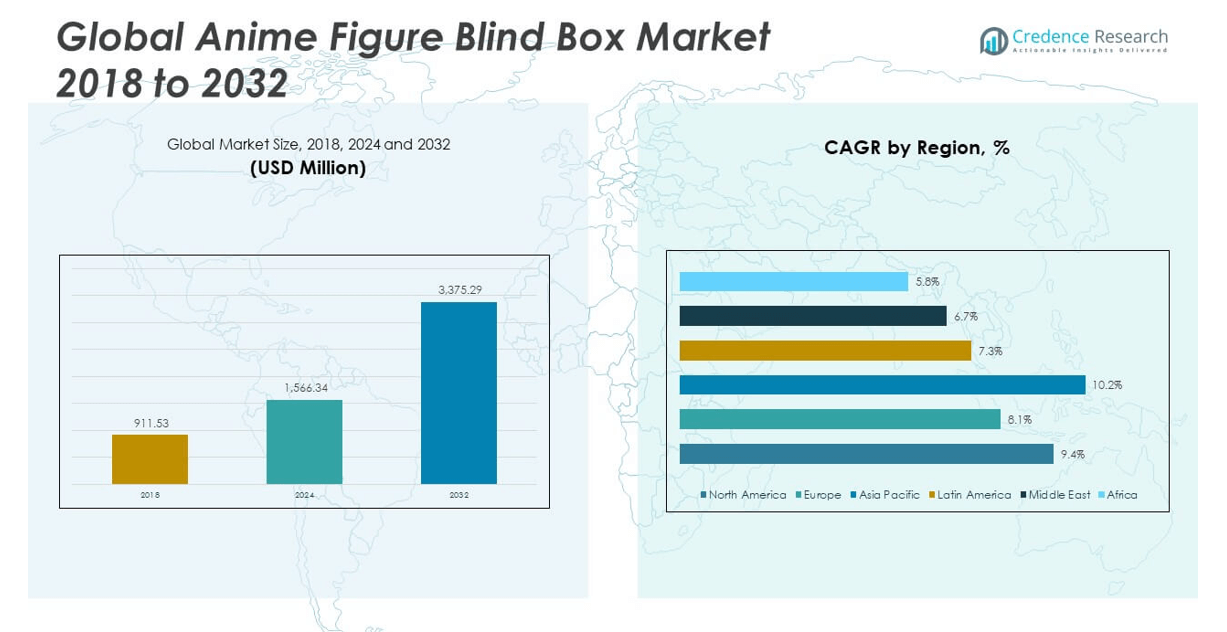
The Global Anime Figure Blind Box Market size was valued at USD 911.53 million in 2018 to USD 1,566.34 million in 2024 and is anticipated to reach USD 3,375.29 million by 2032, at a CAGR of 9.38% during the forecast period.
One of the primary factors fueling market growth is the globalization of anime culture, which has evolved into a significant force in the entertainment industry. The proliferation of streaming platforms such as Netflix, Crunchyroll, and Amazon Prime Video has introduced anime content to vast international audiences, creating new generations of fans. This expanded exposure has increased demand for licensed merchandise, especially character miniatures that connect fans emotionally to their favorite franchises. The psychological appeal of the blind box format offering surprise, rarity, and collectability intensifies consumer engagement, encouraging repeat purchases in pursuit of rare figures. Social media platforms have further amplified consumer interest through unboxing videos, fan reviews, and community-driven content. Additionally, the rise of e-commerce platforms and specialized collectibles retailers has made these products more accessible, while physical retail innovations like vending machines and pop-up shops continue to expand distribution touchpoints.
Regionally, the Asia-Pacific region dominates the anime figure blind box market, Japan remains the core market due to its long-standing tradition of gashapon (capsule toys) and strong cultural attachment to anime merchandise. China is a rapidly growing hub, driven by rising disposable incomes, youth-driven consumer trends, and the phenomenal success of companies such as Pop Mart. South Korea and Southeast Asia are also witnessing growing demand, with expanding retail footprints and increased exposure to Japanese pop culture. North America is the second-largest region, supported by a robust anime fan community, the region is seeing increased adoption among adult collectors, often referred to as "kidults," who drive demand through nostalgia and collector behavior. Europe holds a steady share, with countries like France, Germany, and the UK leading in market adoption. Latin America and the Middle East & Africa are emerging markets with untapped potential, gradually expanding through e-commerce channels, localized fan communities, and increasing internet penetration.
Market Insights:
- The Global Anime Figure Blind Box Market grew from USD 911.53 million in 2018 to USD 1,566.34 million in 2024 and is projected to reach USD 3,375.29 million by 2032, registering a strong CAGR of 9.38%.
- Streaming platforms like Netflix, Crunchyroll, and Amazon Prime have broadened anime’s global reach, significantly driving demand for character-based blind box collectibles.
- The blind box model appeals to consumer psychology through surprise and scarcity, encouraging repeated purchases and strong collector engagement.
- E-commerce and social commerce platforms have expanded access to blind box figures, especially among tech-savvy Gen Z and millennial buyers.
- Strategic licensing deals and collaborations with anime studios have led to exclusive figure series, boosting brand trust and enabling premium pricing.
- Regulatory scrutiny in markets like China and South Korea has intensified over blind box mechanics, pushing companies to improve transparency and responsible marketing.
- Asia Pacific dominates the market with Japan and China leading growth, while North America follows with rising demand among adult collectors and expanding fan culture.
Market Drivers:
Rising Globalization of Anime Culture Across Demographics and Regions
The increasing global reach of anime content is a major driver for the Global Anime Figure Blind Box Market. With platforms such as Netflix, Crunchyroll, and Amazon Prime expanding their anime libraries, audiences worldwide are gaining access to diverse anime series. These platforms have introduced Japanese characters and storylines to non-traditional markets, expanding the fan base across different age groups and geographies. As more consumers engage with anime, their interest in related merchandise grows, creating demand for collectibles like blind box figures. It benefits from this trend by catering to both long-time enthusiasts and new fans seeking tangible connections to their favorite characters. Retailers and producers are leveraging this expansion by launching region-specific products and exclusive character lines to appeal to local audiences.
Consumer Engagement Driven by Psychological Appeal of Surprise and Scarcity
The unique format of blind box collectibles taps into consumer psychology, specifically the appeal of randomness and rarity. Buyers often make multiple purchases to collect an entire series or find limited-edition figures, creating a loop of anticipation and reward. This strategy builds engagement, strengthens brand loyalty, and stimulates repeated buying behavior. The element of surprise increases the perceived value of each purchase, even when the monetary value remains static. It leverages this mechanism to enhance customer retention and create community-driven discussions around unboxings and rare finds. These dynamics make the blind box model more effective than traditional static product formats.
- For instance, companies like Pop Mart have engineered product releases that combine designer toys, limited editions, and “drop culture,” resulting in releases that can sell out within seconds.
Proliferation of Online Retail Platforms and Specialized Collectibles Channels
The expansion of digital sales channels has significantly boosted product accessibility and visibility across global markets. E-commerce platforms, including niche collectible marketplaces, offer a wide selection of anime figure blind boxes to international consumers. Social commerce via platforms like Instagram and TikTok further promotes product discovery, often through influencer content and viral trends. It benefits from direct-to-consumer models, which allow companies to control branding and inventory while capturing customer data. The convenience of home delivery and the ability to preorder exclusive editions drive higher sales volumes and reduce dependence on physical stores. These platforms play a key role in reaching tech-savvy, younger demographics who dominate the anime fan base.
Collaborations, Licensing Agreements, and Limited-Edition Drops Fuel Product Innovation
Brands are increasingly entering licensing agreements with anime studios to launch exclusive blind box series, ensuring authenticity and fan trust. These collaborations result in higher-quality designs and stronger emotional resonance with consumers. Timed releases and seasonal collections further create urgency, prompting immediate purchases and long-term collecting behavior. It uses such partnerships to stay aligned with popular series and evolving fan preferences. Limited-edition drops often coincide with anime events, movie releases, or character anniversaries, creating cultural relevance. This strategy not only increases product desirability but also drives higher margins due to premium pricing.
- For example, Bandai Namco Holdings, Good Smile Company, and Pop Mart are among the leading firms securing exclusive agreements with top anime studios, resulting in high-quality, authentic figures.
Market Trends:
Emergence of Premium and Customizable Blind Box Collections in Collectible Lines
The growing interest in personalized experiences has led to the rise of premium and customizable blind box offerings. Consumers now seek higher-quality materials, detailed craftsmanship, and themed packaging that reflect specific character arcs or storylines. Some manufacturers offer semi-customized blind boxes where buyers can select a character family or series while retaining the surprise element in design variations. This hybrid format appeals to mature collectors who value exclusivity without fully eliminating the blind box thrill. The Global Anime Figure Blind Box Market is gradually shifting toward premiumization, offering enhanced aesthetics, limited print runs, and collectible documentation. It supports brand elevation and attracts a more discerning customer segment.
- For example, the premiumization of blind box collectibles is exemplified by POP MART’s 2024 'MEGA Collection,' which features large-format figures crafted from high-grade vinyl and ABS plastic, finished with multi-layered hand-painted detailing.
Integration of Augmented Reality and QR Code Technology in Packaging
Manufacturers are incorporating augmented reality (AR) and scannable QR codes into packaging to elevate user interaction beyond the physical product. AR features allow buyers to project characters into their environment, unlock digital scenes, or engage in mini-games through mobile apps. These digital enhancements boost post-purchase engagement and encourage sharing on social platforms, driving organic visibility. QR codes often link to character lore, exclusive trailers, or fan communities, building deeper connections between the product and the content universe. The Global Anime Figure Blind Box Market is evolving by embracing tech-enabled value additions, which differentiate brands in a saturated space. It also provides a gateway for companies to merge physical merchandise with digital ecosystems.
Cross-Category Collaborations with Fashion, Gaming, and Lifestyle Brands
Cross-industry collaborations are becoming more prevalent, allowing anime figure blind boxes to reach new consumer segments. Partnerships with fashion labels, mobile games, and lifestyle brands create themed merchandise that reflects broader pop culture trends. These collaborations result in co-branded blind boxes featuring stylized character renditions or seasonal crossovers that appeal to trend-conscious audiences. The Global Anime Figure Blind Box Market leverages these partnerships to diversify product appeal and remain relevant across entertainment and fashion landscapes. It helps expand shelf presence in non-traditional outlets such as sneaker boutiques and pop-up concept stores. These multi-category synergies enhance brand prestige and consumer reach.
Growing Popularity of Subscription-Based Blind Box Services Among Young Consumers
Subscription models are gaining traction, offering curated monthly blind box deliveries to loyal fans. These services build anticipation and convenience while promoting long-term customer retention. Subscribers receive exclusive figures, early access drops, or themed sets unavailable through retail channels. The Global Anime Figure Blind Box Market is seeing increased participation in this model, particularly among Gen Z and millennial consumers who value regular engagement and novelty. It allows brands to forecast demand more accurately and maintain consistent cash flows. This recurring model strengthens brand-customer relationships and fuels product storytelling throughout the subscription lifecycle.
- For example, Otaku Crateoffers a monthly anime and manga subscription box, delivering 10–15 premium items (including figures and memorabilia) per shipment. Subscribers receive a curated mix of official and exclusive items from top franchises like Dragon Ball, Naruto, and My Hero Academia, with options for collector’s and premium edition.
Market Challenges Analysis:
Rising Regulatory Scrutiny and Ethical Concerns Over Blind Box Mechanism
The blind box format has attracted criticism in several regions due to its resemblance to gambling-like mechanics, especially among younger consumers. Regulatory bodies in countries like China and South Korea have issued guidelines to ensure transparency in probability disclosures and limit marketing tactics that encourage compulsive buying. Parents and advocacy groups argue that the randomized nature of blind boxes can promote addictive behavior and overspending. The Global Anime Figure Blind Box Market faces reputational risks if it fails to adapt to these emerging consumer protection norms. It must address growing ethical concerns by incorporating clearer labeling, voluntary caps on purchases, or more balanced odds across product lines. Brands that ignore this shift may face regulatory penalties or lose consumer trust in key markets.
Supply Chain Complexities and Counterfeit Risk Impacting Brand Integrity
Production delays, rising logistics costs, and inconsistent material availability have disrupted the timely release of new blind box series. These challenges affect product launches aligned with anime releases or seasonal events, leading to missed sales opportunities and customer dissatisfaction. The Global Anime Figure Blind Box Market is also vulnerable to counterfeit products, particularly in regions with weak intellectual property enforcement. It damages brand credibility and erodes consumer confidence in the authenticity and quality of purchases. Smaller manufacturers with limited supply chain control face greater risks in scaling operations without compromising delivery timelines or product integrity. Strengthening vendor partnerships and investing in traceability tools are essential for long-term resilience.
Market Opportunities:
Expansion into Untapped Emerging Markets with Rising Disposable Incomes
Emerging economies in Southeast Asia, Latin America, and parts of the Middle East present strong growth potential for anime-themed collectibles. These regions are witnessing a surge in anime viewership, driven by increased internet penetration and access to global streaming platforms. The Global Anime Figure Blind Box Market can capitalize on this demand by launching region-specific characters, affordable pricing models, and localized distribution networks. It can build strong brand loyalty by engaging directly with local fan communities and influencers. Retailers that enter early can establish a dominant market position and shape regional preferences. These markets offer lower competition and growing youth demographics favorable to long-term sales growth.
Leveraging Pop Culture Events and Experiential Retail to Drive Consumer Loyalty
Pop culture conventions, anime festivals, and themed retail pop-ups create ideal environments to engage target audiences. Limited-edition blind box drops at events generate buzz, drive foot traffic, and deepen fan engagement. The Global Anime Figure Blind Box Market benefits from aligning its launches with cultural milestones, anniversaries, or new anime seasons. It can create immersive retail experiences that blend digital interaction with physical product trials. These activations allow brands to gather real-time feedback and test new concepts before mass production. Event-driven marketing enhances brand memorability and cultivates repeat purchase behavior.
Market Segmentation Analysis:
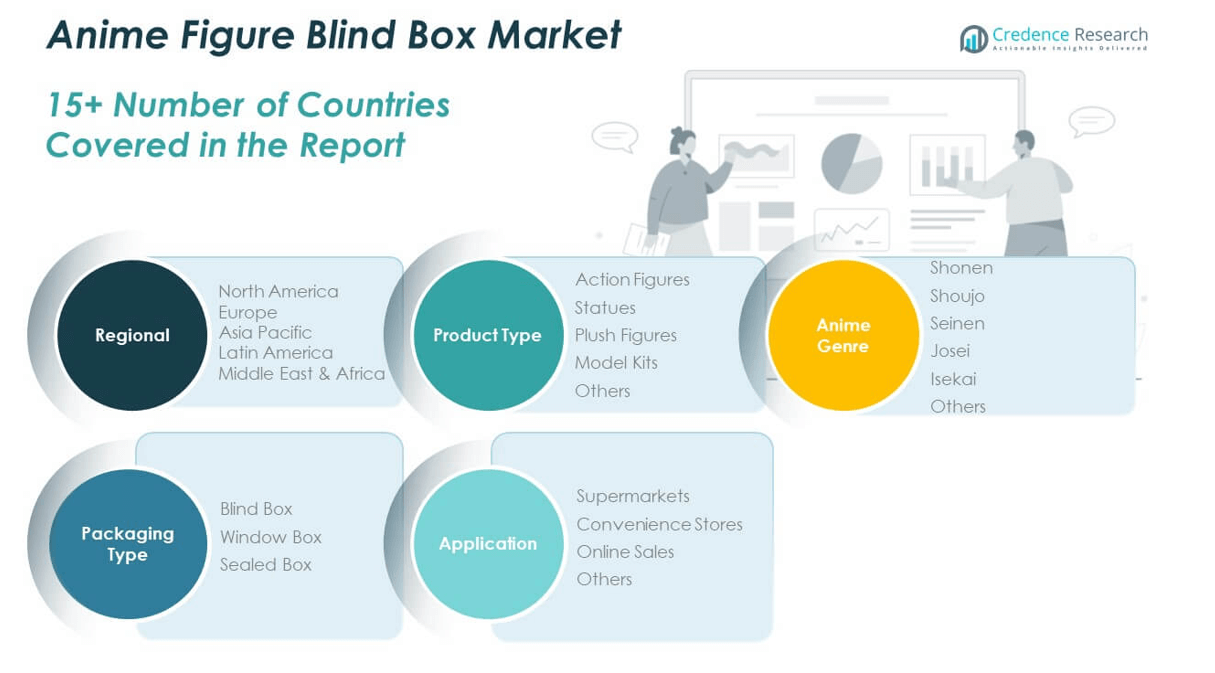
By product type, action figures dominate the Global Anime Figure Blind Box Market due to their strong connection with popular anime characters and widespread collector demand. Statues and model kits follow, appealing to hobbyists and premium collectors, while plush figures attract younger demographics. The “Others” category includes novelty miniatures and experimental designs that cater to niche segments.
By anime genre, shonen leads due to its broad fan base and iconic franchises with high merchandising value. Seinen and isekai genres are gaining traction, supported by adult collectors and expanding global fan engagement. Shoujo, josei, and other genres hold a stable share, especially among female consumers and genre-specific collectors. The Global Anime Figure Blind Box Market benefits from the diverse content offered across these genres.
By packaging type, blind boxes remain the core format, driving sales through their surprise element. Window boxes are popular among casual buyers, while sealed boxes cater to collectors seeking rarity.
- For instance, Funko’s windowed packaging for select limited-edition releases is a common example, balancing surprise with visibility.
By application, online sales account for the largest share due to convenience and global accessibility. Supermarkets and convenience stores provide impulse purchase channels, while “Others” include pop-up stores and specialty outlets.
- For example, in China, blind boxes are now ubiquitous in shopping malls and toy shops.
Segmentation:
By Product Type
- Action Figures
- Statues
- Plush Figures
- Model Kits
- Others
By Anime Genre
- Shonen
- Shoujo
- Seinen
- Josei
- Isekai
- Others
By Packaging Type
- Blind Box
- Window Box
- Sealed Box
By Application
- Supermarkets
- Convenience Stores
- Online Sales
- Others
By Region
- North America
- U.S.
- Canada
- Mexico
- Europe
- Germany
- France
- U.K.
- Italy
- Spain
- Rest of Europe
- Asia Pacific
- China
- Japan
- India
- South Korea
- South-east Asia
- Rest of Asia Pacific
- Latin America
- Brazil
- Argentina
- Rest of Latin America
- Middle East & Africa
- GCC Countries
- South Africa
- Rest of the Middle East and Africa
Regional Analysis:
The North America Anime Figure Blind Box Market size was valued at USD 293.82 million in 2018 to USD 497.79 million in 2024 and is anticipated to reach USD 1,076.74 million by 2032, at a CAGR of 9.4% during the forecast period. North America holds 22% of the global market share, with strong consumer engagement driven by anime streaming platforms, comic conventions, and adult collector culture. The United States leads regional growth, supported by the rising popularity of Japanese media and established distribution networks through e-commerce and specialty stores. Retailers are leveraging licensing partnerships with anime studios to localize products and tap into specific fandoms. The Global Anime Figure Blind Box Market benefits from high spending power and growing interest among millennials and Gen Z collectors. It continues to gain traction through collaborations with mainstream retailers and presence at pop culture events like Anime Expo and Comic-Con. The expanding footprint of Asian brands in U.S. malls and digital storefronts supports sustained growth in this region.
The Europe Anime Figure Blind Box Market size was valued at USD 170.87 million in 2018 to USD 277.59 million in 2024 and is anticipated to reach USD 544.17 million by 2032, at a CAGR of 8.1% during the forecast period. Europe accounts for 12% of the global market, with major contributions from Germany, France, and the United Kingdom. European anime fans show increasing demand for collectible merchandise, especially during fan conventions and limited-time retail events. The Global Anime Figure Blind Box Market is gaining visibility in Europe through online platforms and specialty import retailers. It sees rising engagement from “kidult” consumers who collect figures for display or hobby purposes. Regulatory standards on product safety and transparent pricing influence market entry strategies. Regional growth is supported by growing fandom communities and integration of blind box products into licensed European pop culture merchandise lines.
The Asia Pacific Anime Figure Blind Box Market size was valued at USD 375.86 million in 2018 to USD 671.14 million in 2024 and is anticipated to reach USD 1,539.52 million by 2032, at a CAGR of 10.2% during the forecast period. Asia Pacific holds the largest share of the global market at 49%. Japan and China dominate regional sales, driven by entrenched anime culture, gashapon vending machines, and youth-driven consumption patterns. The Global Anime Figure Blind Box Market thrives in Asia Pacific due to its proximity to content creators, widespread fandom culture, and high demand for licensed goods. Brands like Pop Mart in China and Bandai in Japan lead innovation and distribution scale. It benefits from strong offline presence in urban retail hubs and online popularity through influencer-driven campaigns. Southeast Asian markets such as Indonesia and Thailand are also gaining momentum through cross-border e-commerce and localized product offerings.
The Latin America Anime Figure Blind Box Market size was valued at USD 35.86 million in 2018 to USD 60.70 million in 2024 and is anticipated to reach USD 112.71 million by 2032, at a CAGR of 7.3% during the forecast period. Latin America represents 4% of the global market, with Brazil and Mexico driving most of the demand. Anime content has a long-standing presence in the region through dubbed TV series and online platforms. The Global Anime Figure Blind Box Market is gradually expanding in Latin America as fan communities grow more organized and engaged through conventions and social media. It benefits from rising youth demographics and increasing interest in Japanese pop culture. Price-sensitive consumers seek affordable yet authentic merchandise, prompting companies to introduce region-specific price strategies. Local distributors and online retailers play a key role in improving product accessibility.
The Middle East Anime Figure Blind Box Market size was valued at USD 22.97 million in 2018 to USD 35.70 million in 2024 and is anticipated to reach USD 63.43 million by 2032, at a CAGR of 6.7% during the forecast period. The Middle East contributes 2% to the global market share, with growing adoption in countries like the UAE and Saudi Arabia. Anime fandom is gaining visibility among younger audiences who consume Japanese media via global streaming platforms. The Global Anime Figure Blind Box Market in the region is developing through niche collectibles stores, international shipping, and fan-driven events. It faces challenges due to limited local licensing but compensates through digital retail channels and regional pop culture expos. Consumers prefer high-quality figures and limited editions, often ordered from global platforms. Retail partnerships with mall chains and toy retailers are slowly expanding physical availability.
The Africa Anime Figure Blind Box Market size was valued at USD 12.15 million in 2018 to USD 23.42 million in 2024 and is anticipated to reach USD 38.72 million by 2032, at a CAGR of 5.8% during the forecast period. Africa holds just 1% of the global market but offers long-term potential due to a young population and increasing internet penetration. Nigeria, South Africa, and Kenya are emerging markets where anime viewership is growing through mobile content platforms. The Global Anime Figure Blind Box Market in Africa is still in a nascent stage but benefits from rising awareness of Japanese culture and global retail access. It relies heavily on imports and informal e-commerce, which affects product consistency and availability. Local fan clubs and anime forums are key drivers of demand and engagement. Improved digital payment infrastructure and localized shipping solutions can enhance market expansion in the coming years.
Key Player Analysis:
- Sonny Angel
- Pop Mart
- LEGO
- Miniso
- Tokidoki
- Kidrobot
- DisneyFunko
- Shopkins
- Dreams Inc
- 52Toys
Competitive Analysis:
The Global Anime Figure Blind Box Market features a mix of established toy manufacturers, niche collectible brands, and regional players focused on anime merchandise. Key companies include Pop Mart, Bandai, Good Smile Company, Kotobukiya, Medicom Toy, Funko, and MegaHouse. It is characterized by intense competition in design innovation, licensing agreements, and limited-edition releases. Leading brands invest in exclusive anime partnerships to secure character rights and maintain relevance among collectors. Product quality, packaging aesthetics, and distribution scale are major differentiators. E-commerce platforms and pop-up retail events provide visibility and consumer access, giving agile brands an edge. Companies are expanding into overseas markets through localized marketing and strategic collaborations to capture growing international demand. The Global Anime Figure Blind Box Market remains fragmented, with significant opportunities for both mass-market expansion and niche specialization. Competitive advantage hinges on speed to market, cultural alignment, and community engagement.
Recent Developments:
- In June 2025, Alliance Entertainment’s Handmade by Robots brand expanded into anime collectibles with a new vinyl figure line featuring My Hero Academia characters Izuku Midoriya and Shoto Todoroki. This launch targets collector communities and complements the brand’s broader entertainment franchise strategy
- In April 2025, Pop Mart launched a blind box series based on “Arcane: League of Legends” Season Two. The collection features stylized figures of key characters like Jinx, Vi, Ekko, and Jayce, including two secret rare figures with a 1/72 probability, offered through both online and physical channels.
Market Concentration & Characteristics:
The Global Anime Figure Blind Box Market is moderately fragmented, with a few dominant players and a wide base of emerging brands competing across regions. It reflects a high degree of product differentiation based on character licensing, figure design, packaging, and rarity distribution. The market favors companies that can secure exclusive anime IPs and deliver high-quality, collectible-grade figures. Consumer behavior centers on emotional attachment to characters, the thrill of randomness, and brand loyalty. It shows strong seasonality around anime premieres, cultural events, and product drops. The market exhibits rapid innovation cycles, with new themes and limited editions released frequently to sustain interest. Entry barriers remain moderate due to relatively low manufacturing complexity, but sustained growth depends on branding, licensing access, and fan engagement strategies.
Report Coverage:
The research report offers an in-depth analysis based on Product Type, Anime Genre, Packaging Type and Application. It details leading market players, providing an overview of their business, product offerings, investments, revenue streams, and key applications. Additionally, the report includes insights into the competitive environment, SWOT analysis, current market trends, as well as the primary drivers and constraints. Furthermore, it discusses various factors that have driven market expansion in recent years. The report also explores market dynamics, regulatory scenarios, and technological advancements that are shaping the industry. It assesses the impact of external factors and global economic changes on market growth. Lastly, it provides strategic recommendations for new entrants and established companies to navigate the complexities of the market.
Future Outlook:
- Rising global anime viewership will continue to fuel demand for licensed collectible merchandise.
- Subscription-based blind box models are expected to gain more traction among younger consumers.
- Integration of augmented reality and mobile-based interactivity will enhance product appeal.
- Emerging markets in Southeast Asia, Latin America, and the Middle East will contribute to regional expansion.
- Companies will focus on premiumization through higher-quality materials and limited-edition releases.
- E-commerce platforms and social media influencers will drive direct-to-consumer growth.
- Collaborations with fashion, gaming, and lifestyle brands will broaden the customer base.
- Regulatory scrutiny may shape future product disclosures and ethical marketing practices.
- Pop culture events and experiential retail strategies will strengthen brand loyalty.
- Supply chain investments and counterfeit control will be critical to maintain consumer trust.

Request a Free Sample
Fill in your details and we'll send you a free sample report.
- Sample data tables & charts
- Research methodology
Market Dynamics
Globalization of Anime Culture
The widespread availability of anime on streaming platforms like Netflix and Crunchyroll has introduced anime to new international audiences, expanding the fan base and driving demand for related merchandise such as blind box figures.
Psychological Appeal of Surprise and Collectability
The blind box format leverages consumer psychology by offering surprise and rarity, encouraging repeat purchases as collectors seek to complete sets or obtain rare figures, thus boosting sales and engagement.
Expansion of E-commerce and Social Commerce
Online retail platforms and social media-driven sales have made anime figure blind boxes more accessible globally, especially to tech-savvy Gen Z and millennial consumers who prefer digital shopping and discover products through influencers.
Strategic Licensing and Limited-Edition Drops
Collaborations with anime studios and exclusive licensing agreements enable brands to release authentic, limited-edition figure series, increasing desirability, enabling premium pricing, and fostering brand loyalty among collectors.
Cross-Category Collaborations and Experiential Retail
Partnerships with fashion, gaming, and lifestyle brands, along with pop-up shops and event-driven launches, broaden the appeal of blind box figures and create immersive experiences that attract new consumer segments.
Need a Custom Version of This Report?
Tailor the scope, geography, or segments to your exact requirements.
- Custom geography or segment scope
- Direct access to our analyst team
Frequently Asked Questions
What is the current size of the Global Anime Figure Blind Box Market?
What are the key segments within the Global Anime Figure Blind Box Market?
What are some challenges faced by the Global Anime Figure Blind Box Market?
Who are the major players in the Global Anime Figure Blind Box Market?
Table of Content
Chapter 1 Market Segmentation
- 1.1 Segmentation Framework
- 1.1.1 Product and Service Classification
- 1.1.2 Application and End-Use Classification
- 1.1.3 Technology and Solution Classification
- 1.1.4 Customer and Distribution Channel Classification
- 1.1.5 Geographic Segmentation
- 1.1.6 Market Segment Definitions and Boundaries
- 1.2 By Anime Genre
- 1.2.1 Shonen
- 1.2.2 Shoujo
- 1.2.3 Seinen
- 1.2.4 Josei
- 1.2.5 Isekai
- 1.2.6 Others
- 1.3 By Application
- 1.3.1 Supermarkets
- 1.3.2 Convenience Stores
- 1.3.3 Online Sales
- 1.3.4 Others
- 1.4 By Product Type
- 1.4.1 Action Figures
- 1.4.2 Statues
- 1.4.3 Plush Figures
- 1.4.4 Model Kits
- 1.4.5 Others
- 1.5 By Packaging Type
- 1.5.1 Blind Box
- 1.5.2 Window Box
- 1.5.3 Sealed Box
Chapter 2 Introduction
- 2.1 Report Objectives and Scope
- 2.2 Product Definition and Industry Terminology
- 2.3 Market Inclusions and Exclusions
- 2.4 Research Process
- 2.4.1 Primary Research and Expert Interviews
- 2.4.2 Secondary Research and Source Review
- 2.4.3 Top-Down and Bottom-Up Estimation
- 2.4.4 Data Triangulation and Verification
- 2.5 Market Size Measurement Basis
- 2.5.1 2024: USD 1,566.34 million → 2032: USD 3,375.29 million
- 2.6 Historical and Forecast Reference Periods
- 2.6.1 Base Year: 2024
- 2.6.2 Forecast Period: 2024-2032
- 2.7 Research Assumptions and Limitations
Chapter 3 Executive Summary
- 3.1 Market Snapshot and Key Findings
- 3.2 Base-Year Market Size, 2024
- 3.3 Forecast Market Size, 2032
- 3.4 Revenue and Volume Growth Outlook
- 3.5 Key Demand and Supply Indicators
- 3.6 Leading Market Segments
- 3.7 Fastest-Growing Market Opportunities
- 3.8 Regional Performance Highlights
- 3.9 Technology and Industry Transformation
- 3.10 Competitive Landscape Summary
- 3.11 Analyst View and Strategic Implications
Chapter 4 Global Anime Figure Blind Box Market Trends and Developments
- 4.1 Historical Industry Development
- 4.2 Recent Market Trends and Developments
- 4.3 Demand and Customer Behavior Trends
- 4.4 Technology and Product Innovation
- 4.5 Artificial Intelligence, Automation and Digitalization
- 4.6 Local Manufacturing and Supply Chain Realignment
- 4.7 Industry Partnerships, Mergers and Acquisitions
- 4.8 Sustainability and Circular Economy Developments
- 4.9 Government and Private Sector Investment Trends
- 4.10 Emerging Business Models and Commercialization
- 4.11 Industry Developments and Announcements
Chapter 5 Global Anime Figure Blind Box Market Production, Supply and Demand Analysis
- 5.1 Demand Trend and Consumption Analysis
- 5.2 Demand Forecast, 2024-2032
- 5.3 Production and Output Trend
- 5.4 Production and Output Forecast, 2024-2032
- 5.5 Installed Capacity and Capacity Utilization
- 5.6 Company-Wise Production Plants and Statistics
- 5.6.1 Installed Production Capacity
- 5.6.2 Actual Production
- 5.6.3 Planned Capacity and Expansion Targets
- 5.7 Supply Chain Structure and Procurement Trends
- 5.8 Supply-Demand Gap and Bottlenecks
- 5.9 Import Dependence and Sourcing Structure
- 5.10 Contract Manufacturing and Outsourcing
- 5.11 Regional Supply and Demand Concentration
Chapter 6 Global Anime Figure Blind Box Market Pricing Analysis
- 6.1 Pricing Structure and Measurement
- 6.2 Historical Pricing Trends
- 6.3 Pricing Outlook, 2024-2032
- 6.4 Average Selling Price and Unit Economics
- 6.5 Pricing by Product and Market Segment
- 6.6 Geographic Pricing Differences
- 6.7 Key Input, Energy, Labor and Logistics Costs
- 6.8 Contract Pricing and Purchasing Models
- 6.9 Pricing Sensitivity and Competitive Positioning
- 6.10 Price, Margin and Profitability Implications
Chapter 7 Global Anime Figure Blind Box Market Dynamics
- 7.1 Market Growth Drivers
- 7.1.1 Demand-Side Drivers
- 7.1.2 Technology and Innovation Drivers
- 7.1.3 Infrastructure and Investment Drivers
- 7.1.4 Regulatory and Policy Drivers
- 7.2 Market Restraints
- 7.2.1 Cost and Affordability Constraints
- 7.2.2 Technology and Adoption Barriers
- 7.2.3 Supply Chain and Operational Constraints
- 7.3 Market Challenges
- 7.3.1 Competitive Pressure and Margin Erosion
- 7.3.2 Skills, Infrastructure and Implementation Gaps
- 7.4 Emerging Market Opportunities
- 7.5 Market Dynamics Impact and Time-Horizon Assessment
Chapter 8 Global Anime Figure Blind Box Value Chain Analysis
- 8.1 Industry Value Chain Overview
- 8.2 Upstream Suppliers and Critical Inputs
- 8.3 Technology and Component Providers
- 8.4 Manufacturing or Service Delivery
- 8.5 Distribution, Channel Partners and Integrators
- 8.6 Downstream Applications and End Users
- 8.7 Value Addition and Profit Pools
- 8.8 Vertical Integration and Outsourcing
- 8.9 Supplier Concentration and Risk
- 8.10 Supply Chain Localization and Resilience
Chapter 9 Global Anime Figure Blind Box Market Regulations and Policies
- 9.1 Relevant Laws, Standards and Compliance Frameworks
- 9.2 Product, Service, Safety and Quality Requirements
- 9.3 Government Policies, Incentives and Subsidies
- 9.4 Imports, Exports and Trade Barriers
- 9.5 Public Procurement and Local Content Requirements
- 9.6 Environmental and Sustainability Compliance
- 9.7 Upcoming Policy Changes and Market Implications
Chapter 10 Global Anime Figure Blind Box Market Hotspots and Opportunities
- 10.1 Market Opportunity Mapping and Growth Hotspots
- 10.2 High-Growth Applications and Customer Groups
- 10.3 Underserved Markets and White-Space Opportunities
- 10.4 Emerging Technology and Product Opportunities
- 10.5 New Capacity and Investment Hotspots
- 10.6 Market Entry and Expansion Opportunities
- 10.7 Distribution and Partnership Opportunities
- 10.8 Near-Term and Long-Term Commercial Potential
- 10.9 Opportunity Attractiveness and Execution Risks
Chapter 11 Global Anime Figure Blind Box Market Outlook, 2024-2032
- 11.1 Market Size and Analysis
- 11.1.1 Revenue (Market Measurement: 2024: USD 1,566.34 million → 2032: USD 3,375.29 million)
- 11.1.2 Market Volume and Quantity Sold
- 11.1.3 Historical Market Size
- 11.1.4 Base-Year Market Size, 2024
- 11.2 Market Forecast, 2024-2032
- 11.2.1 Revenue Forecast to 2032
- 11.2.2 Volume Forecast to 2032
- 11.2.3 CAGR and Year-on-Year Growth
- 11.2.4 Incremental Revenue Opportunity
- 11.3 Forecast Assumptions and Scenario Analysis
- 11.3.1 Base-Case Forecast
- 11.3.2 Optimistic and Conservative Scenarios
- 11.3.3 Technology, Pricing and Policy Sensitivities
- 11.4 Market Attractiveness and Growth Outlook
Chapter 12 Global Anime Figure Blind Box Market Segmentation and Outlook
- 12.1 Segmentation Summary and Market Shares, 2024
- 12.2 Largest and Fastest-Growing Segments
- 12.3 By Anime Genre - Market Size and Forecast, 2024-2032
- 12.3.1 Segment Definition and Scope
- 12.3.2 Historical Market Size
- 12.3.3 Revenue Forecast, 2024-2032
- 12.3.4 Volume Forecast, 2024-2032
- 12.3.5 Base-Year Market Share, 2024
- 12.3.6 Segment CAGR and Growth Drivers
- 12.3.7 Subsegment Market Size and Forecast
- 12.3.7.1 Shonen
- 12.3.7.2 Shoujo
- 12.3.7.3 Seinen
- 12.3.7.4 Josei
- 12.3.7.5 Isekai
- 12.3.7.6 Others
- 12.3.8 Subsegment Pricing and Adoption Trends
- 12.3.9 Leading Suppliers and Competition
- 12.3.10 Regional Demand and Opportunities
- 12.4 By Application - Market Size and Forecast, 2024-2032
- 12.4.1 Segment Definition and Scope
- 12.4.2 Historical Market Size
- 12.4.3 Revenue Forecast, 2024-2032
- 12.4.4 Volume Forecast, 2024-2032
- 12.4.5 Base-Year Market Share, 2024
- 12.4.6 Segment CAGR and Growth Drivers
- 12.4.7 Subsegment Market Size and Forecast
- 12.4.7.1 Supermarkets
- 12.4.7.2 Convenience Stores
- 12.4.7.3 Online Sales
- 12.4.7.4 Others
- 12.4.8 Subsegment Pricing and Adoption Trends
- 12.4.9 Leading Suppliers and Competition
- 12.4.10 Regional Demand and Opportunities
- 12.5 By Product Type - Market Size and Forecast, 2024-2032
- 12.5.1 Segment Definition and Scope
- 12.5.2 Historical Market Size
- 12.5.3 Revenue Forecast, 2024-2032
- 12.5.4 Volume Forecast, 2024-2032
- 12.5.5 Base-Year Market Share, 2024
- 12.5.6 Segment CAGR and Growth Drivers
- 12.5.7 Subsegment Market Size and Forecast
- 12.5.7.1 Action Figures
- 12.5.7.2 Statues
- 12.5.7.3 Plush Figures
- 12.5.7.4 Model Kits
- 12.5.7.5 Others
- 12.5.8 Subsegment Pricing and Adoption Trends
- 12.5.9 Leading Suppliers and Competition
- 12.5.10 Regional Demand and Opportunities
- 12.6 By Packaging Type - Market Size and Forecast, 2024-2032
- 12.6.1 Segment Definition and Scope
- 12.6.2 Historical Market Size
- 12.6.3 Revenue Forecast, 2024-2032
- 12.6.4 Volume Forecast, 2024-2032
- 12.6.5 Base-Year Market Share, 2024
- 12.6.6 Segment CAGR and Growth Drivers
- 12.6.7 Subsegment Market Size and Forecast
- 12.6.7.1 Blind Box
- 12.6.7.2 Window Box
- 12.6.7.3 Sealed Box
- 12.6.8 Subsegment Pricing and Adoption Trends
- 12.6.9 Leading Suppliers and Competition
- 12.6.10 Regional Demand and Opportunities
- 12.7 Segment Growth Comparison
- 12.8 Segment Attractiveness and Priority Matrix
Chapter 13 Global Anime Figure Blind Box End-Use and Application Market Outlook
- 13.1 End-Use Industry and Customer Demand Structure
- 13.2 Leading Applications and Customer Groups
- 13.3 End-Use Market Size, Share and Forecast
- 13.4 Major End-Use Industry Deep Dives
- 13.4.1 Customer Requirements and Use Cases
- 13.4.2 Demand and Replacement Cycles
- 13.4.3 Technical and Regulatory Considerations
- 13.4.4 Purchasing and Procurement Models
- 13.4.5 Leading Vendors and Distribution Channels
- 13.4.6 Forecast and Commercial Opportunities
- 13.5 Emerging Applications and Cross-Segment Demand
- 13.6 End-Use Industry Investment Priorities
Chapter 14 Global Anime Figure Blind Box Geographic Market Outlook, 2024-2032
- 14.1 Regional Market Size and Share, 2024
- 14.2 Regional Market Forecast, 2024-2032
- 14.3 Regional Pricing, Production and Demand Differences
- 14.4 North America
- 14.4.1 United States
- 14.4.2 Canada
- 14.4.3 Mexico
- 14.5 Europe
- 14.5.1 Germany
- 14.5.2 France
- 14.5.3 Italy
- 14.5.4 United Kingdom
- 14.5.5 Spain
- 14.5.6 Poland
- 14.5.7 Russia
- 14.5.8 Netherlands
- 14.5.9 Belgium
- 14.5.10 Sweden
- 14.5.11 Denmark
- 14.5.12 Norway
- 14.5.13 Rest of Europe
- 14.6 Asia Pacific
- 14.6.1 China
- 14.6.2 India
- 14.6.3 Japan
- 14.6.4 South Korea
- 14.6.5 Thailand
- 14.6.6 Indonesia
- 14.6.7 Vietnam
- 14.6.8 Malaysia
- 14.6.9 Australia
- 14.6.10 Rest of Asia Pacific
- 14.7 Latin America
- 14.7.1 Brazil
- 14.7.2 Argentina
- 14.7.3 Colombia
- 14.7.4 Chile
- 14.7.5 Rest of Latin America
- 14.8 Middle East
- 14.8.1 Saudi Arabia
- 14.8.2 United Arab Emirates
- 14.8.3 Turkey
- 14.8.4 Israel
- 14.8.5 Iran
- 14.8.6 Rest of the Middle East
- 14.9 Africa
- 14.9.1 South Africa
- 14.9.2 Egypt
- 14.9.3 Nigeria
- 14.9.4 Morocco
- 14.9.5 Rest of Africa
- 14.10 Regional Investment, Policy and Supply Chain Differences
- 14.11 Regional Competitive Landscape
- 14.12 Geographic Growth Hotspots
Chapter 15 Global Anime Figure Blind Box Technology, Innovation and Sustainability Outlook
- 15.1 Technology Landscape and Maturity
- 15.2 Product, Process and Service Innovation
- 15.3 AI, Automation and Digital Tools in the Industry
- 15.4 Technology Adoption and Performance Benchmarking
- 15.5 Innovation Pipeline and R&D Investment
- 15.6 Patent and Intellectual Property Trends
- 15.7 Energy Efficiency and Resource Management
- 15.8 Sustainability, Recycling and Circularity
- 15.9 Technology Roadmap, 2024-2032
- 15.10 Risks of Obsolescence and Technology Substitution
Chapter 16 Global Anime Figure Blind Box Market Key Strategic Imperatives
- 16.1 Growth and Market Entry Priorities
- 16.2 High-Return Products and Segments
- 16.3 Pricing, Profitability and Cost Optimization
- 16.4 Technology Investment and Product Differentiation
- 16.5 Supply Chain Localization and Resilience
- 16.6 Distribution and Customer Acquisition
- 16.7 Partnership, Acquisition and Capacity Strategy
- 16.8 Regional Expansion Priorities
- 16.9 Short-, Medium- and Long-Term Actions
Chapter 17 Competition Outlook
- 17.1 Industry Competition Characteristics
- 17.2 Market Structure and Concentration
- 17.3 Market Share and Competitive Positioning, 2024
- 17.4 Company-Wise Revenue and Product Benchmarking
- 17.5 Production and Service Capacity Benchmarking
- 17.6 Technology, Pricing and Differentiation
- 17.7 Regional Footprint and Distribution Strength
- 17.8 Mergers, Acquisitions and Strategic Alliances
- 17.9 New Entrants and Competitive Threats
- 17.10 Porter's Five Forces and Industry Attractiveness
- 17.11 Competitive Outlook, 2024-2032
Chapter 18 Company Profiles
- 18.1 Company Coverage and Selection Criteria
- 18.2 Pop Mart
- 18.2.1 Business Description
- 18.2.2 Company Ownership and Geographic Presence
- 18.2.3 Product and Service Portfolio
- 18.2.4 Manufacturing and Operating Footprint
- 18.2.5 Production Capacity and Expansion Plans
- 18.2.6 Financial Performance and Investment
- 18.2.7 Market Share and Competitive Position
- 18.2.8 Technology and Innovation Capabilities
- 18.2.9 Strategic Alliances or Partnerships
- 18.2.10 Recent Developments
- 18.2.11 Growth Strategy and Outlook
- 18.3 Bandai Namco Holdings
- 18.4 Good Smile Company
- 18.5 Kotobukiya
- 18.6 Funko
- 18.7 MegaHouse
- 18.8 Tokidoki
- 18.9 Kidrobot
- 18.10 Sonny Angel
- 18.11 Miniso
- 18.12 Other Relevant Market Participants
Note: Every listed company is profiled on the structure shown under the first company. The company list is preliminary and may change based on research findings, market developments, data availability and client requirements.
Chapter 19 Disclaimer
- 19.1 Research and Forecast Disclaimer
- 19.2 Data Source and Estimation Limitations
Note: The depth of individual sections depends on data availability for this market. Volume, capacity, trade and other unit-based metrics are included where applicable.

