
Franchise brands turn dog day care into a suburban staple
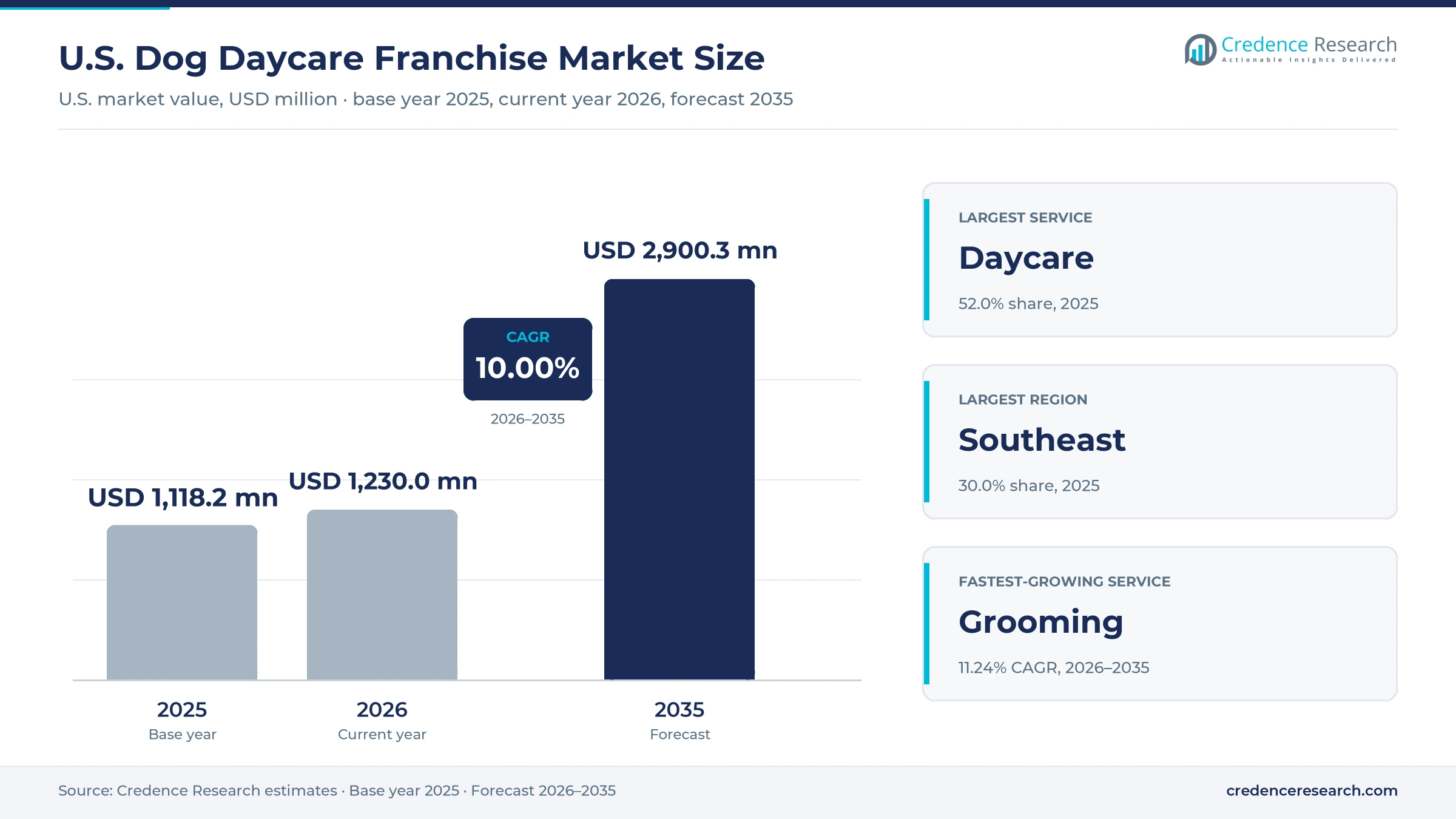
The U.S. dog daycare franchise market was valued at USD 1.12 billion in 2025 and is projected to increase from USD 1.23 billion in 2026 to USD 2.90 billion by 2035, registering a CAGR of 10.00% during 2026–2035. Demand comes from dog owners who pay for supervised group play, overnight boarding, baths and training at branded and independent facilities. The Southeast held the largest regional share, 30.0% in 2025, while the South Central region grows fastest at 10.64% a year as franchisors sell multi-unit territories in Texas suburbs. The American Pet Products Association counted 71 million dog-owning households in 2025, which gives operators a deep client base. At the same time, national brands are scaling quickly, as Hounds Town USA opened 21 locations in 2025 and Camp Bow Wow introduced a lower-cost storefront prototype in March 2026. As a result, franchise systems with add-on menus and multi-unit owners are gaining share from single-site facilities.
What does facility-based dog care spending in the U.S. include?
The market counts owner spending at dog daycare facilities in the United States, including daily and half-day play, overnight boarding, baths and grooming, and training classes sold by the same facility. Value covers franchise locations of national brands and independent facilities that run dedicated group-play daycare, whether owners pay per visit, by package or by membership.
The estimate excludes in-home pet sitting and dog walking booked through apps, standalone grooming salons without daycare, veterinary boarding and the sale of pet food or supplies. Canadian locations of U.S. franchise brands are also excluded, so the scope covers facilities inside the United States only.
U.S. Dog Daycare Franchise Market Insights
- The market grows from USD 1.12 billion in 2025 to USD 2.90 billion by 2035, a 10.00% CAGR, as franchise systems add suburban facilities and sell grooming and boarding to daycare clients.
- The Southeast led with 30.0% of 2025 value, as the Census Bureau found the South was the only region with a growing under-18 population.
- Daycare held 52.0% of 2025 value, because owners book several visits a week at facility rates that Rover puts at $35 to $50 a day.
- Pet Resort Hospitality Group bought five independent resort brands with 12 locations in March 2024, showing how private equity is consolidating independent facilities.
- Camp Bow Wow launched a lower-cost storefront prototype in March 2026 to speed franchise openings, after signing 14 new agreements during 2025.
Daycare leads while grooming add-ons grow fastest
Why does daily group play still anchor facility revenue?
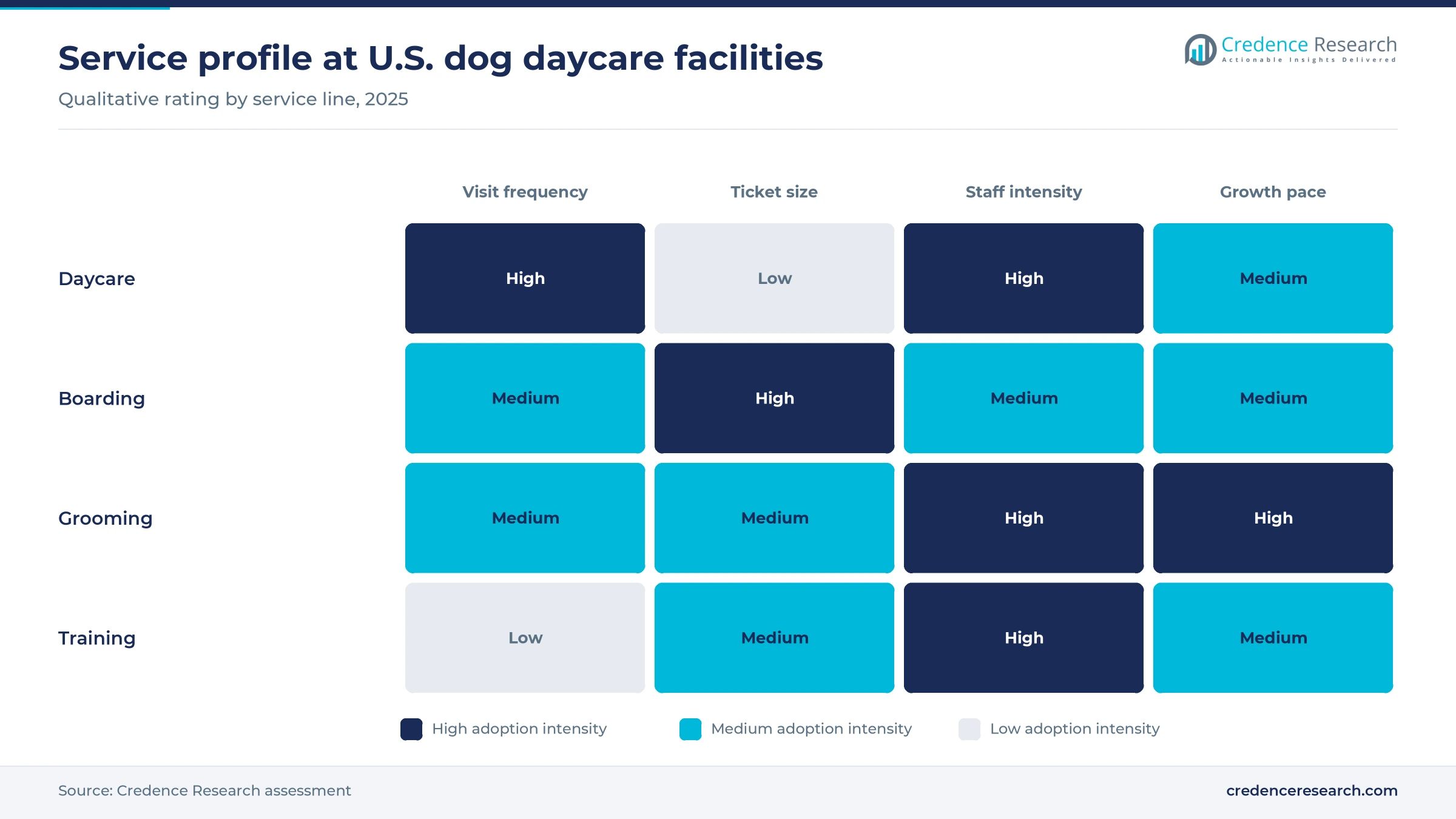
Based on service, the market is categorized into daycare, boarding, grooming and training. Daycare led with 52.0% of 2025 value because most enrolled dogs visit several days a week, and Rover puts the national average at about $40 a day. Boarding follows, since overnight stays at K9 Resorts and Hounds Town USA sites carry higher tickets than a single play day. Grooming grows fastest at 11.24% a year as Hounds Town USA lists affordable spa services beside daycare and boarding in its Feb. 2, 2026, release, and Dogtopia launched a 12-product spa line on Feb. 8, 2024.
How far do franchise systems lead independent facilities?
Based on model, the market is categorized into franchise and independent facilities. Franchise facilities led with 56.0% of 2025 value because national brands now run hundreds of sites, with Camp Bow Wow at 225 locations and Hounds Town USA above 95 in early 2026. Independent facilities remain important in smaller towns, although private equity is consolidating them, as Pet Resort Hospitality Group bought resort brands in Texas, Pennsylvania, Florida, Missouri and Washington, D.C., on March 13, 2024. Franchise facilities grow fastest at 10.47% a year as Dogtopia signed 27 new agreements in 2025 and targets 500 locations by 2030.
Are multi-site operators taking over new openings?
Based on operator scale, the market is categorized into single-site operators and multi-site operators. Single-Site Operator businesses held 55.0% of 2025 value because most independent facilities and many early franchisees run one building, and Central Bark still operated just 44 locations across 16 states in January 2026, according to BizTimes. Multi-Site Operator businesses grow fastest at 10.75% a year as franchisors sell territories in bundles, with K9 Resorts signing a 13-unit Florida agreement on April 23, 2025, and Camp Bow Wow awarding a three-unit North Texas deal on Aug. 25, 2026.
| Segment Group | Leading Sub-segment | Share, 2025 | Fastest-growing Sub-segment | CAGR, 2026–2035 |
|---|---|---|---|---|
| By Service | Daycare | 52.0% | Grooming | 11.24% |
| By Model | Franchise | 56.0% | Franchise | 10.47% |
| By Operator Scale | Single-Site Operator | 55.0% | Multi-Site Operator | 10.75% |
Request a Free Sample
Fill in your details and we'll send you a free sample report.
- Sample data tables & charts
- Research methodology
Dog ownership, franchise build-outs and add-ons lift demand
Rising dog ownership lifts structured day care demand
More dog-owning homes create a larger pool of pets that need supervised care during working hours. The American Pet Products Association reported on March 26, 2026, that 71 million U.S. households owned dogs in 2025, or 53% of households, up from 51% in 2024. The same release put total pet industry spending at $158 billion in 2025, with $165 billion projected for 2026. Facility pricing stays within reach of many owners, because Rover puts dog daycare facility rates at $35 to $50 a day. In the Credence Research model this ownership driver adds about 3.7 percentage points to annual growth to 2035, and Daycare keeps 52.0% of 2025 value.
Franchise systems expand standardized suburban facilities
Dog daycare franchise systems are adding standardized facilities in suburban trade areas, which brings consistent safety rules and booking tools to new markets. Hounds Town USA opened 21 locations in 2025 and planned 10 more openings and 15 new franchise agreements in 2026, according to its Feb. 2, 2026, release. Camp Bow Wow reported 225 open locations and 14 new agreements for 2025 on March 3, 2026, and it set a target of 25 agreements for 2026. Dogtopia added almost 80 net units over three years and expects to pass 300 stores in 2026. The Census Bureau reported in June 2026 that southern growth was fueled mainly by outlying metro counties, where these brands site new buildings. In the Credence Research model this adds about 2.7 percentage points to annual growth.
Grooming and boarding add-ons raise revenue per dog
Add-on services lift spending per dog because owners who already trust a facility for day play book baths, nail trims and overnight stays at the same counter. K9 Resorts opened its first Illinois resort in Deerfield on June 21, 2025, with luxury boarding suites, bathing salons and indoor playrooms. Hounds Town USA adds Pet Taxi transport at select locations, while Central Bark sells grooming, training and a dog marketplace at its Paradise Valley, Arizona, site. Prices are also rising, as pet services prices rose 5% in 2025 against 1% for pet supplies, according to GlobalPETS in January 2026. In the Credence Research model this adds about 2.0 percentage points to annual growth to 2035, mostly through higher spending per enrolled dog.
Puppy and training programs build lifelong clients
Early socialization and training programs draw puppies into facilities before habits form, which turns a first booking into years of daycare visits. Camp Bow Wow offers its Pawsitive Start Jr. puppy education program and a rewards-based training program, according to its August 2026 franchise release. Hounds Town USA is preparing its Tiny Townies puppy socialization program for systemwide rollout, according to its February 2026 release. The Bureau of Labor Statistics counted 47,800 animal trainers in 2025 at a median pay of $39,990, so trained staff remain scarce and valuable to facilities. Central Bark also listed training beside daycare and boarding when it announced its first Arizona site on Feb. 13, 2025. These programs keep training revenue growing alongside core daycare through 2035.
Activity tracking and roll-ups reshape facility care
Shift toward activity tracking and live playroom webcams
Operators are adding monitoring tools that show owners what their dogs did during the day, which supports premium pricing and repeat visits. Dogtopia launched its DASH daycare activity monitor in 2025, according to a Feb. 4, 2026, release on its record year. Dogtopia also assigns playrooms by size and play style and streams webcams for owners, according to its February 2024 announcement. Tools like these extend the pet wearables category into facility care, because activity data comes from staff and cameras rather than collars alone. Dogtopia also reports 10 consecutive years of positive same-store sales growth, which suggests that tech-enabled service keeps clients loyal. As a result, branded systems widen their lead, and Franchise facilities hold 56.0% of 2025 value.
Rise of private equity roll-ups among independent resorts
Private equity buyers are rolling up independent resorts, which moves the independent side of the market toward multi-site ownership and shared booking systems. Pet Resort Hospitality Group, backed by Trivest Partners and Queens Court Capital, closed five acquisitions covering 12 locations on March 13, 2024, according to PE Professional. Propelled Brands, which also owns FASTSIGNS, now owns Camp Bow Wow and is pushing a reduced-investment model to accelerate openings. K9 Resorts opened its 50th resort in Turnersville, New Jersey, on June 19, 2026, and counts more than 170 resorts open or in development. Because these owners fund new sites in groups, Multi-Site Operator businesses grow at 10.75% a year in the Credence Research model.
Opening in sun belt suburbs with growing young families
Fast-growing southern suburbs offer the clearest opening, because new households there need daycare close to home rather than near offices. The Census Bureau found that the South was the only region whose population under 18 grew from 2020 to 2025, by 1.1%, while the Northeast fell 4.1% and the Midwest fell 3.9%. Hounds Town USA opened its first Alabama site in Huntsville on June 21, 2025. Dogtopia opened its 250th location in Fort Myers, Florida, in November 2023, with a local veterinarian as franchisee. Camp Bow Wow also chose the Fort Worth suburbs of Weatherford, Burleson and Granbury for its newest Texas territory. As a result, new dog daycare franchise territories cluster in southern metro suburbs.
Opening in wellness bundles for insured dog owners
Wellness bundles offer a second opening because owners who insure their dogs already budget for preventive care every month. Facilities can partner with providers in the pet insurance field to reward vaccinated, regularly assessed dogs, which also supports the health screening that group play requires. Dogtopia already sells its spa products online and on Amazon, according to its Feb. 4, 2026, release, which turns in-store grooming into a retail line. Veterinary service prices rose 7.1% in 2025, according to GlobalPETS, so owners look for lower-cost preventive routines between vet visits. Central Bark offers membership or single-day care at its Paradise Valley site, which gives operators a base for bundled monthly plans.
Handler pay, outbreaks and build-out costs weigh on growth
Can operators hire and keep enough dog handlers?
Handler labor is the main operating cost, and pay near the low end of the wage scale drives frequent turnover. The Bureau of Labor Statistics reported a median pay of $35,360 for animal caretakers in May 2025 and expects about 69,400 openings a year in animal care and service jobs. Each opening means training a new handler in dog body language and group play. Facilities that cannot fill shifts must cap enrollment or raise prices, which slows growth at single-site operators.
How do respiratory outbreaks disrupt group play?
Respiratory outbreaks hit group-play facilities first because dogs share air, water and toys for hours. Cornell University's Animal Health Diagnostic Center issued an advisory on Dec. 1, 2023, after veterinarians across the country reported severe, long-lasting cases among dogs that had visited daycare centers, boarding facilities and dog parks. Such alerts can lead owners to pause bookings, and operators face extra cleaning and vaccination checks. Facilities therefore need written health policies, ventilation upgrades and fast owner updates to limit cancellations.
Do build-out costs slow new franchise openings?
Facility build-outs need large spaces, drainage, fencing and noise control, which raises the capital a new franchisee must find. A SharpSheets summary of the Dogtopia franchise disclosure document lists an initial investment of about $608,000 to $1.27 million and a 7% royalty. Camp Bow Wow responded on March 3, 2026, with an optimized storefront prototype meant to lower build-out and startup costs. Until lower-cost formats spread, financing remains a hurdle for first-time owners, who carry the full lease and build-out risk alone.
Will state licensing rules add compliance costs?
State licensing rules add inspections and paperwork, and they differ from one state to the next. A Colorado Legislative Council Staff brief dated Oct. 9, 2025, notes that any place that boards or grooms pet animals must be licensed and inspected by the Colorado Department of Agriculture under the Pet Animal Care and Facilities Act. Multi-state franchise systems must therefore adapt records, procedures and facility designs for each market. These compliance costs fall hardest on independents that lack a franchisor support team.
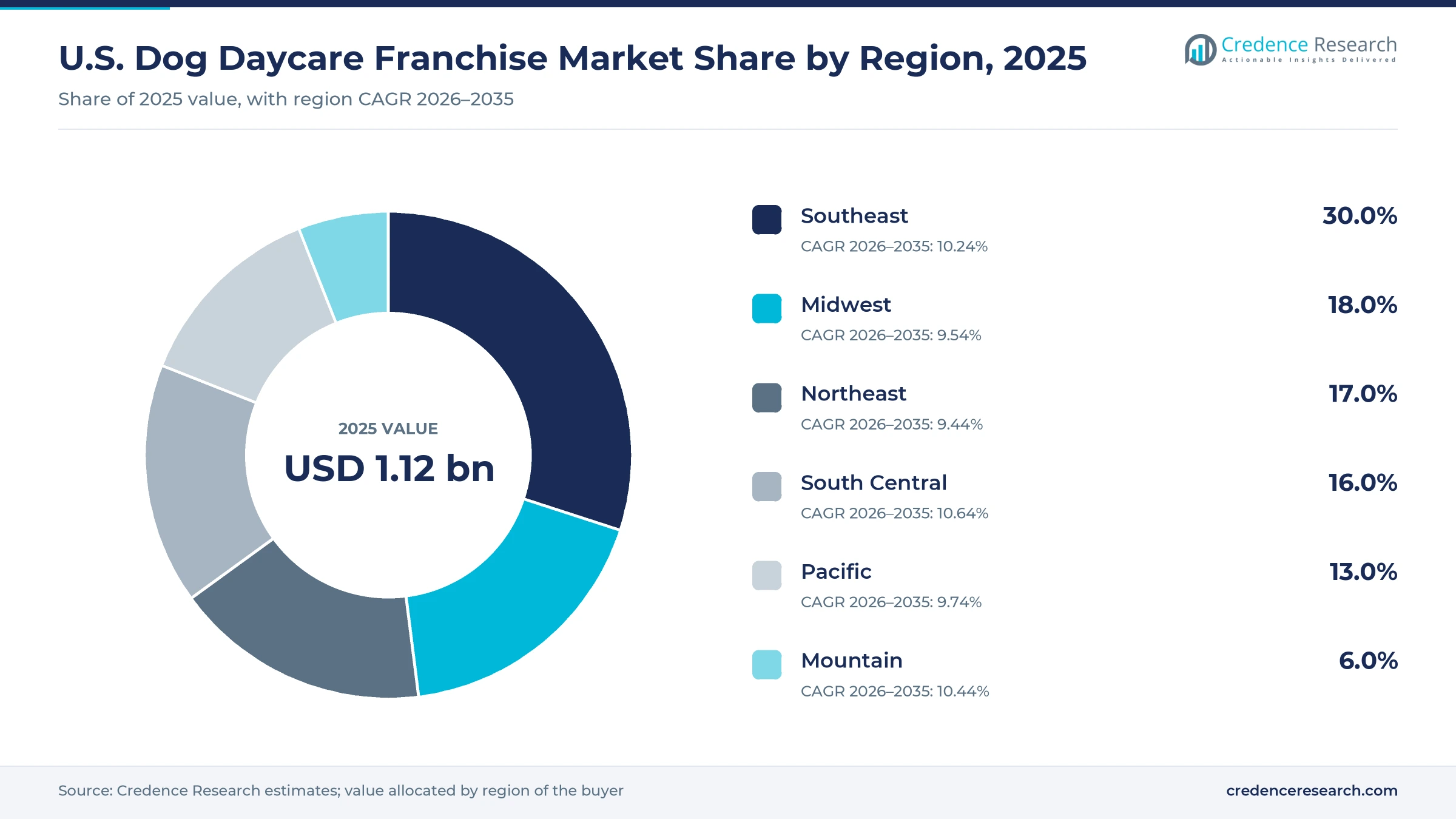
The Southeast holds the largest share of facility spend
| Region | Value, 2025 (USD billion) | Share, 2025 | CAGR, 2026–2035 |
|---|---|---|---|
| Southeast | 0.34 | 30.0% | 10.24% |
| Midwest | 0.20 | 18.0% | 9.54% |
| Northeast | 0.19 | 17.0% | 9.44% |
| South Central | 0.18 | 16.0% | 10.64% |
| Pacific | 0.15 | 13.0% | 9.74% |
| Mountain | 0.07 | 6.0% | 10.44% |
The Southeast leads on suburban growth and franchise density
The Southeast held 30.0% of 2025 value and grows at 10.24% a year, the largest regional share in the market. Census Bureau Vintage 2025 estimates show that the South grew by 6.0% between April 2020 and July 2025, nearly double the national rate of 3.1%. K9 Resorts widened its Florida pipeline through an agreement with its largest franchisee group, which franchising.com reported on April 23, 2025. Hounds Town USA also entered Alabama with its Huntsville site in June 2025.
The Midwest grows from lower daily prices
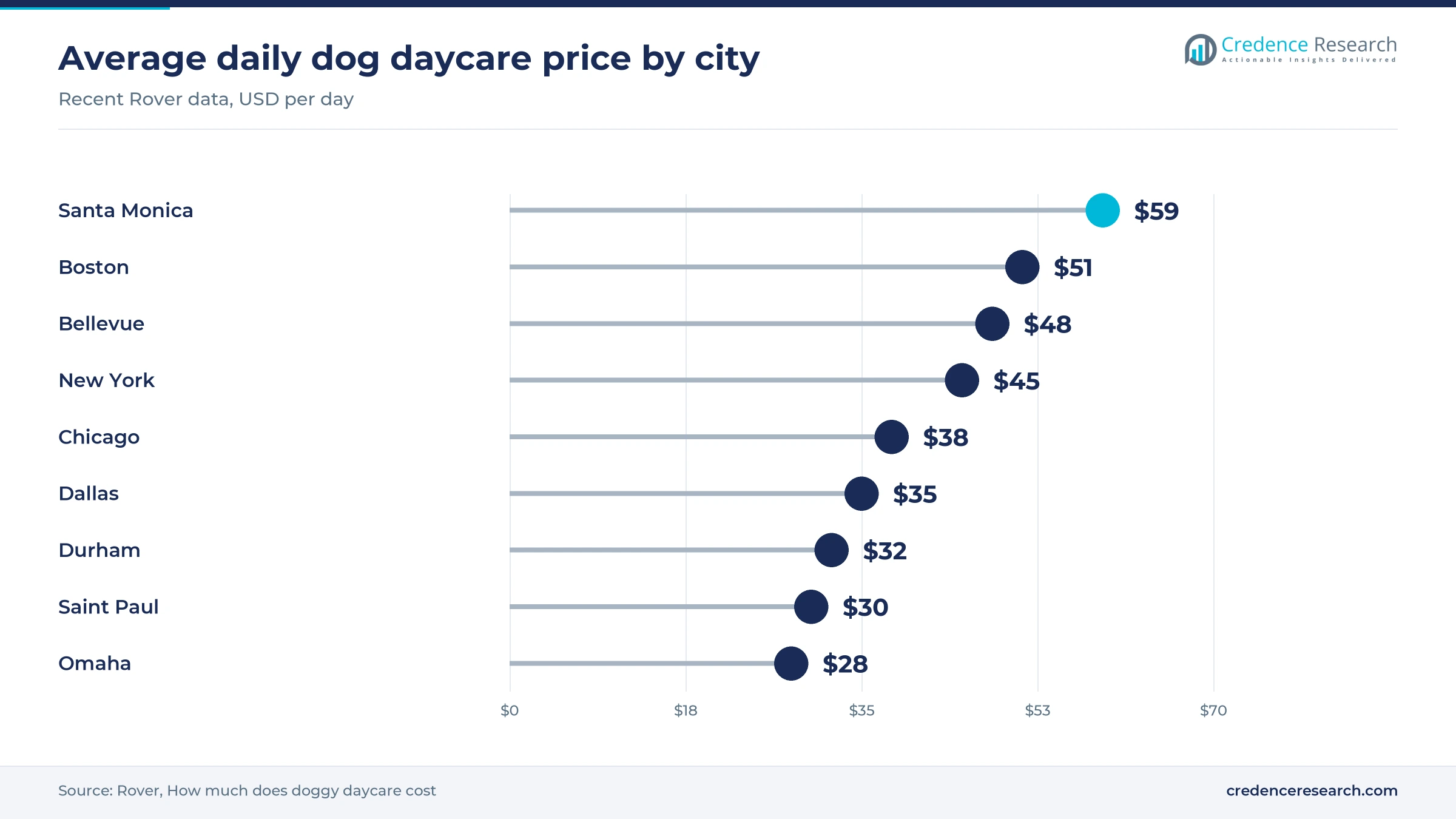
The Midwest held 18.0% of 2025 value and grows at 9.54% a year, slightly below the national rate. Rover puts the average daycare day at $38 in Chicago, $30 in Saint Paul and $28 in Omaha, which limits revenue per visit compared with coastal metros. New brands still enter the region, as K9 Resorts opened its first Illinois resort in Deerfield in June 2025. K9 Resorts also planned a second Michigan franchise in the Detroit metro area, according to Pet Age in July 2026.
The Northeast pairs premium prices with slower household growth
The Northeast held 17.0% of 2025 value and grows at 9.44% a year, the slowest pace among the six zones. Census Bureau estimates show that the region lost 4.1% of its under-18 population from 2020 to 2025, which limits new family households. Dense metros still support premium sites, as Rover puts average daycare at $51 a day in Boston and $45 in New York. Hounds Town USA, based in Ronkonkoma, New York, opened a Long Island location on Jan. 8, 2025, and a Brooklyn location on Jan. 28, 2025.
South Central grows fastest on Texas franchise deals
The South Central region held 16.0% of 2025 value and grows at 10.64% a year, the fastest pace among the six zones. Texas suburbs draw new franchise territories, as Camp Bow Wow awarded a three-unit agreement for Weatherford, Burleson and Granbury in August 2026. The Dog Stop signed two new franchise agreements in Dallas in June 2026, according to Pet Age, and Hounds Town USA added a Texas location on Feb. 6, 2025. Rover puts the average Dallas daycare day at $35, so operators compete on add-ons rather than base price.
The Pacific region carries the highest daily rates
The Pacific region held 13.0% of 2025 value and grows at 9.74% a year, close to the national rate. Prices are highest here, as Rover puts the average daycare day at $59 in Santa Monica, California and $48 in Bellevue, Washington. Dogtopia opened in Hillsboro, Oregon, on Sept. 29, 2025, as the first of five planned facilities in the Portland metro area, according to Newsworthy. High lease costs in coastal cities favor operators that can fill large buildings every weekday.
The mountain region adds Denver and Phoenix franchise sites
The Mountain region held 6.0% of 2025 value and grows at 10.44% a year, above the national pace from a small base. Skiptown signed a five-unit franchise agreement on June 23, 2026, to expand across Colorado, starting in the Denver area, according to Pet Age. Central Bark announced its first Arizona location in Paradise Valley in February 2025, and K9 Resorts lists Phoenix and Denver among its expansion priorities. Colorado also requires boarding and grooming facilities to hold a state license under its Pet Animal Care and Facilities Act.
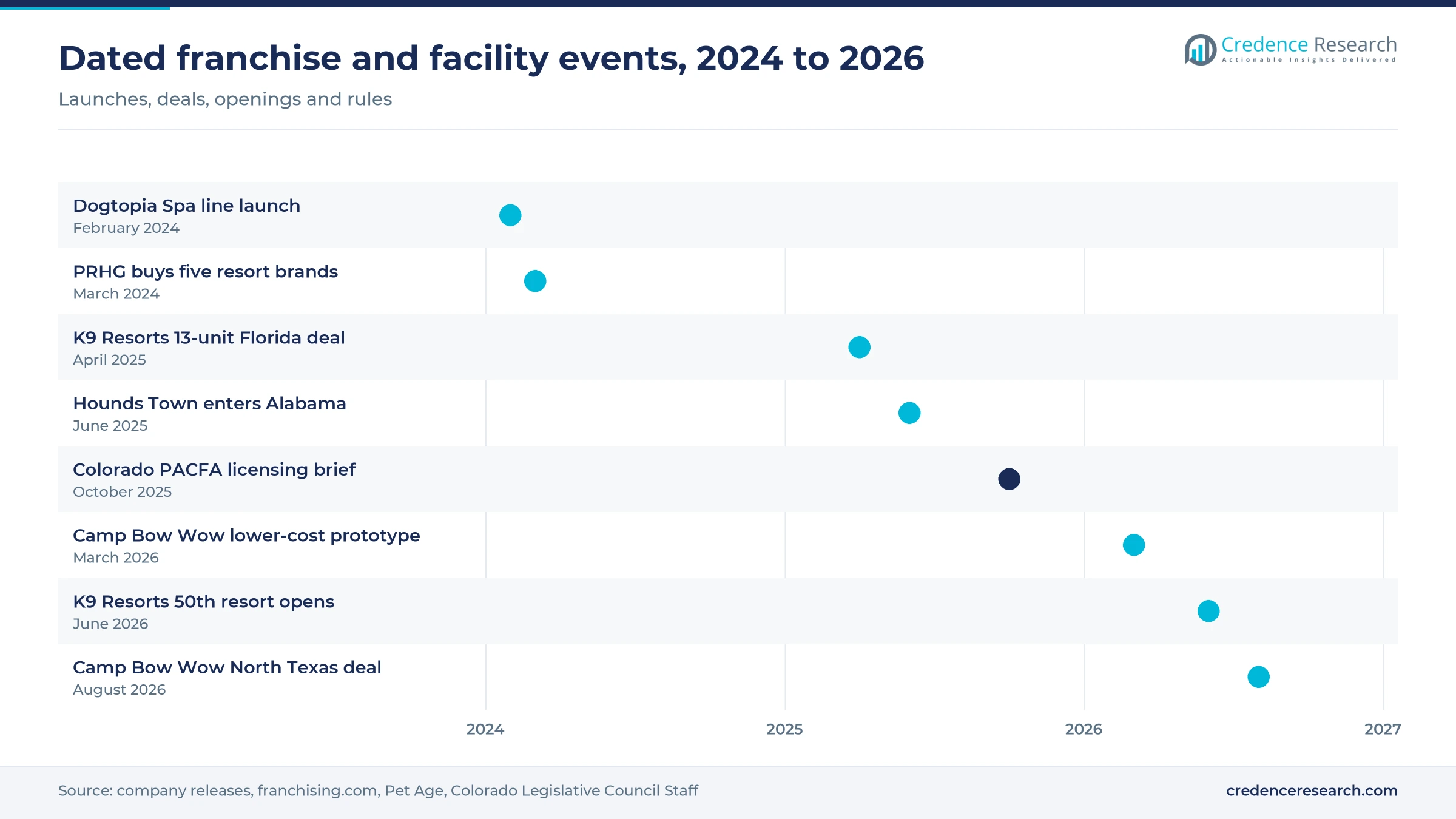
Franchise deals and openings mark 2024 to 2026
| Development | Status and market relevance |
|---|---|
| In March 2024, Pet Resort Hospitality Group closed five acquisitions covering 12 pet resorts in four states and Washington, D.C. | Completed; consolidates independent boarding and daycare resorts |
| In April 2025, K9 Resorts signed a 13-unit franchise agreement in Florida with its largest franchisee group. | Signed; expands luxury boarding capacity in the Southeast region |
| In September 2025, Dogtopia opened in Hillsboro, Oregon, the first of five planned facilities in the Portland metro area. | Open; adds Pacific Northwest capacity |
| In March 2026, Camp Bow Wow introduced an optimized storefront prototype to lower build-out and startup costs. | Launched; aims to speed openings by new franchisees |
| In June 2026, K9 Resorts opened its 50th resort in Turnersville, New Jersey. | Open; more than 170 resorts open or in development |
Monitors, webcams and curricula change the visit
- Activity monitors such as the Dogtopia DASH system, launched in 2025, record play and rest during each visit and share summaries with owners.
- Live webcams let owners watch playrooms that Dogtopia assigns by size and play style, which builds trust with first-time clients.
- Spa product lines such as the Dogtopia Spa range of shampoos, ear care and paw balms carry in-facility grooming into retail pet products sold online.
- Structured training curricula such as Camp Bow Wow Pawsitive Start Jr. give puppies set lessons that owners continue at home with leashes, clickers and other training equipment.
Need a Custom Version of This Report?
Tailor the scope, geography, or segments to your exact requirements.
- Custom geography or segment scope
- Direct access to our analyst team
National franchisors compete for multi-unit owners
In the dog daycare franchise field, competition centers on site quality, staff training and the depth of add-on services rather than on base daycare price. Dogtopia, Camp Bow Wow and Hounds Town USA run the largest national franchise systems, each selling daycare, boarding and spa services from standardized buildings. K9 Resorts competes at the premium end with luxury boarding suites, while Central Bark positions itself as a whole dog care brand with training and a retail marketplace. Independent resorts remain numerous, but private equity platforms such as Pet Resort Hospitality Group are buying them in groups. Franchisors now compete for multi-unit owners, as shown by K9 Resorts and its largest Florida franchisee group and by Camp Bow Wow and its lower-cost prototype. Brands also differentiate on technology, from activity monitors to webcams and app booking. Newer systems such as Skiptown and The Dog Stop are signing territories in Colorado and Texas, which keeps pressure on established brands in fast-growing suburbs.
Companies profiled and their roles in this market
| Company | Type | Role in the market |
|---|---|---|
| Dogtopia | Franchisor | Daycare-led system with boarding and spa services; signed 27 new agreements in 2025 and launched the DASH activity monitor |
| Camp Bow Wow | Franchisor | Owned by Propelled Brands; 225 locations with daycare, boarding, grooming and puppy programs |
| Hounds Town USA | Franchisor | Daycare, boarding, spa and Pet Taxi services; opened 21 locations in 2025 |
| K9 Resorts | Franchisor | Luxury boarding and daycare resorts; opened its 50th resort in Turnersville, New Jersey, in June 2026 |
| Central Bark | Franchisor | Whole dog care brand with daycare, boarding, training and grooming across 16 states |
Staffing and site economics decide which operators scale
Credence Research's view is that dog daycare franchise growth to 2035 depends more on staffing and site economics than on demand, because a majority of U.S. households now own dogs. Franchise systems with multi-unit owners, lower-cost prototypes and add-on menus are best placed, and Franchise facilities grow at 10.47% a year in the model. Single-site independents face the hardest choice, since handler pay, licensing and outbreak protocols weigh on small teams. The Southeast and South Central regions offer the strongest new-site pipeline, while dense northeastern and Pacific metros reward premium pricing over unit count.
How dog daycare facility spending was modeled
The report uses 2025 as the base year and forecasts the market to 2035 with the Credence Research market model. Market values come from that model, built from facility counts in franchise disclosures and company releases, published daycare prices, U.S. pet ownership data from the American Pet Products Association, and labor and population statistics from the Bureau of Labor Statistics and the Census Bureau. Segment and regional shares are Credence Research estimates built from these same inputs. The model was cross-checked against a bottom-up count of franchise units and independent facilities multiplied by typical sales per site. No interviews or surveys were conducted for this edition of the dog daycare franchise study.
Suburban units and add-ons carry growth to 2035
The market is expected to grow from USD 1.23 billion in 2026 to USD 2.90 billion by 2035, a 10.00% CAGR over 2026–2035. Growth through 2030 comes mainly from new dog daycare franchise units in southern and mountain suburbs, as Dogtopia aims for 500 locations by 2030 and Hounds Town USA plans new openings and agreements through 2026. After 2030, add-on services and memberships carry more of the gain, because Grooming grows at 11.24% a year. Operators that solve handler retention and meet state licensing rules will capture most of the value, while weaker single-site facilities are likely to sell to larger platforms.
Frequently Asked Questions
How big is the U.S. dog daycare franchise market?
Which service leads the market?
Which service grows fastest?
Which region leads the market?
Which region grows fastest?
Who are the key companies in the market?
What are the main challenges for operators?
How do franchise and independent facilities compare?
Table of Content
Chapter 1 Market Segmentation
- 1.1 Segmentation Framework
- 1.1.1 Product and Service Classification
- 1.1.2 Application and End-Use Classification
- 1.1.3 Technology and Solution Classification
- 1.1.4 Customer and Distribution Channel Classification
- 1.1.5 Geographic Segmentation
- 1.1.6 Market Segment Definitions and Boundaries
- 1.2 By Service
- 1.2.1 Daycare
- 1.2.2 Boarding
- 1.2.3 Grooming
- 1.2.4 Training
- 1.3 By Model
- 1.3.1 Franchise
- 1.3.2 Independent
- 1.4 By Operator Scale
- 1.4.1 Single-Site Operator
- 1.4.2 Multi-Site Operator
Chapter 2 Introduction
- 2.1 Report Objectives and Scope
- 2.2 Product Definition and Industry Terminology
- 2.3 Market Inclusions and Exclusions
- 2.4 Research Process
- 2.4.1 Primary Research and Expert Interviews
- 2.4.2 Secondary Research and Source Review
- 2.4.3 Top-Down and Bottom-Up Estimation
- 2.4.4 Data Triangulation and Verification
- 2.5 Market Size Measurement Basis
- 2.5.1 2025: USD 1.12 billion → 2035: USD 2.90 billion
- 2.6 Historical and Forecast Reference Periods
- 2.6.1 Historical Period: 2018-2025
- 2.6.2 Base Year: 2025
- 2.6.3 Forecast Period: 2025-2035
- 2.7 Research Assumptions and Limitations
Chapter 3 Executive Summary
- 3.1 Market Snapshot and Key Findings
- 3.2 Base-Year Market Size, 2025
- 3.3 Forecast Market Size, 2035
- 3.4 Revenue and Volume Growth Outlook
- 3.5 Key Demand and Supply Indicators
- 3.6 Leading Market Segments
- 3.7 Fastest-Growing Market Opportunities
- 3.8 Regional Performance Highlights
- 3.9 Technology and Industry Transformation
- 3.10 Competitive Landscape Summary
- 3.11 Analyst View and Strategic Implications
Chapter 4 U.S. Dog Daycare Franchise Market Trends and Developments
- 4.1 Historical Industry Development, 2018-2025
- 4.2 Recent Market Trends and Developments
- 4.3 Demand and Customer Behavior Trends
- 4.4 Technology and Product Innovation
- 4.5 Artificial Intelligence, Automation and Digitalization
- 4.6 Local Manufacturing and Supply Chain Realignment
- 4.7 Industry Partnerships, Mergers and Acquisitions
- 4.8 Sustainability and Circular Economy Developments
- 4.9 Government and Private Sector Investment Trends
- 4.10 Emerging Business Models and Commercialization
- 4.11 Industry Developments and Announcements
Chapter 5 U.S. Dog Daycare Franchise Market Production, Supply and Demand Analysis
- 5.1 Demand Trend and Consumption Analysis, 2018-2025
- 5.2 Demand Forecast, 2025-2035
- 5.3 Production and Output Trend, 2018-2025
- 5.4 Production and Output Forecast, 2025-2035
- 5.5 Installed Capacity and Capacity Utilization
- 5.6 Company-Wise Production Plants and Statistics
- 5.6.1 Installed Production Capacity
- 5.6.2 Actual Production
- 5.6.3 Planned Capacity and Expansion Targets
- 5.7 Supply Chain Structure and Procurement Trends
- 5.8 Supply-Demand Gap and Bottlenecks
- 5.9 Import Dependence and Sourcing Structure
- 5.10 Contract Manufacturing and Outsourcing
- 5.11 Regional Supply and Demand Concentration
Chapter 6 U.S. Dog Daycare Franchise Market Pricing Analysis
- 6.1 Pricing Structure and Measurement
- 6.2 Historical Pricing Trends, 2018-2025
- 6.3 Pricing Outlook, 2025-2035
- 6.4 Average Selling Price and Unit Economics
- 6.5 Pricing by Product and Market Segment
- 6.6 Geographic Pricing Differences
- 6.7 Key Input, Energy, Labor and Logistics Costs
- 6.8 Contract Pricing and Purchasing Models
- 6.9 Pricing Sensitivity and Competitive Positioning
- 6.10 Price, Margin and Profitability Implications
Chapter 7 U.S. Dog Daycare Franchise Market Dynamics
- 7.1 Market Growth Drivers
- 7.1.1 Demand-Side Drivers
- 7.1.2 Technology and Innovation Drivers
- 7.1.3 Infrastructure and Investment Drivers
- 7.1.4 Regulatory and Policy Drivers
- 7.2 Market Restraints
- 7.2.1 Cost and Affordability Constraints
- 7.2.2 Technology and Adoption Barriers
- 7.2.3 Supply Chain and Operational Constraints
- 7.3 Market Challenges
- 7.3.1 Competitive Pressure and Margin Erosion
- 7.3.2 Skills, Infrastructure and Implementation Gaps
- 7.4 Emerging Market Opportunities
- 7.5 Market Dynamics Impact and Time-Horizon Assessment
Chapter 8 U.S. Dog Daycare Franchise Value Chain Analysis
- 8.1 Industry Value Chain Overview
- 8.2 Upstream Suppliers and Critical Inputs
- 8.3 Technology and Component Providers
- 8.4 Manufacturing or Service Delivery
- 8.5 Distribution, Channel Partners and Integrators
- 8.6 Downstream Applications and End Users
- 8.7 Value Addition and Profit Pools
- 8.8 Vertical Integration and Outsourcing
- 8.9 Supplier Concentration and Risk
- 8.10 Supply Chain Localization and Resilience
Chapter 9 U.S. Dog Daycare Franchise Market Regulations and Policies
- 9.1 Relevant Laws, Standards and Compliance Frameworks
- 9.2 Product, Service, Safety and Quality Requirements
- 9.3 Government Policies, Incentives and Subsidies
- 9.4 Imports, Exports and Trade Barriers
- 9.5 Public Procurement and Local Content Requirements
- 9.6 Environmental and Sustainability Compliance
- 9.7 Upcoming Policy Changes and Market Implications
Chapter 10 U.S. Dog Daycare Franchise Market Hotspots and Opportunities
- 10.1 Market Opportunity Mapping and Growth Hotspots
- 10.2 High-Growth Applications and Customer Groups
- 10.3 Underserved Markets and White-Space Opportunities
- 10.4 Emerging Technology and Product Opportunities
- 10.5 New Capacity and Investment Hotspots
- 10.6 Market Entry and Expansion Opportunities
- 10.7 Distribution and Partnership Opportunities
- 10.8 Near-Term and Long-Term Commercial Potential
- 10.9 Opportunity Attractiveness and Execution Risks
Chapter 11 U.S. Dog Daycare Franchise Market Outlook, 2025-2035
- 11.1 Market Size and Analysis
- 11.1.1 Revenue (Market Measurement: 2025: USD 1.12 billion → 2035: USD 2.90 billion)
- 11.1.2 Market Volume and Quantity Sold
- 11.1.3 Historical Market Size, 2018-2025
- 11.1.4 Base-Year Market Size, 2025
- 11.2 Market Forecast, 2025-2035
- 11.2.1 Revenue Forecast to 2035
- 11.2.2 Volume Forecast to 2035
- 11.2.3 CAGR and Year-on-Year Growth
- 11.2.4 Incremental Revenue Opportunity
- 11.3 Forecast Assumptions and Scenario Analysis
- 11.3.1 Base-Case Forecast
- 11.3.2 Optimistic and Conservative Scenarios
- 11.3.3 Technology, Pricing and Policy Sensitivities
- 11.4 Market Attractiveness and Growth Outlook
Chapter 12 U.S. Dog Daycare Franchise Market Segmentation and Outlook
- 12.1 Segmentation Summary and Market Shares, 2025
- 12.2 Largest and Fastest-Growing Segments
- 12.3 By Service - Market Size and Forecast, 2025-2035
- 12.3.1 Segment Definition and Scope
- 12.3.2 Historical Market Size, 2018-2025
- 12.3.3 Revenue Forecast, 2025-2035
- 12.3.4 Volume Forecast, 2025-2035
- 12.3.5 Base-Year Market Share, 2025
- 12.3.6 Segment CAGR and Growth Drivers
- 12.3.7 Subsegment Market Size and Forecast
- 12.3.7.1 Daycare
- 12.3.7.2 Boarding
- 12.3.7.3 Grooming
- 12.3.7.4 Training
- 12.3.8 Subsegment Pricing and Adoption Trends
- 12.3.9 Leading Suppliers and Competition
- 12.3.10 Regional Demand and Opportunities
- 12.4 By Model - Market Size and Forecast, 2025-2035
- 12.4.1 Segment Definition and Scope
- 12.4.2 Historical Market Size, 2018-2025
- 12.4.3 Revenue Forecast, 2025-2035
- 12.4.4 Volume Forecast, 2025-2035
- 12.4.5 Base-Year Market Share, 2025
- 12.4.6 Segment CAGR and Growth Drivers
- 12.4.7 Subsegment Market Size and Forecast
- 12.4.7.1 Franchise
- 12.4.7.2 Independent
- 12.4.8 Subsegment Pricing and Adoption Trends
- 12.4.9 Leading Suppliers and Competition
- 12.4.10 Regional Demand and Opportunities
- 12.5 By Operator Scale - Market Size and Forecast, 2025-2035
- 12.5.1 Segment Definition and Scope
- 12.5.2 Historical Market Size, 2018-2025
- 12.5.3 Revenue Forecast, 2025-2035
- 12.5.4 Volume Forecast, 2025-2035
- 12.5.5 Base-Year Market Share, 2025
- 12.5.6 Segment CAGR and Growth Drivers
- 12.5.7 Subsegment Market Size and Forecast
- 12.5.7.1 Single-Site Operator
- 12.5.7.2 Multi-Site Operator
- 12.5.8 Subsegment Pricing and Adoption Trends
- 12.5.9 Leading Suppliers and Competition
- 12.5.10 Regional Demand and Opportunities
- 12.6 Segment Growth Comparison
- 12.7 Segment Attractiveness and Priority Matrix
Chapter 13 U.S. Dog Daycare Franchise Geographic Market Outlook, 2025-2035
- 13.1 Domestic Market Distribution and Demand Clusters
- 13.2 State- or Province-Wise Market Size and Forecast, 2025-2035
- 13.3 City and Metropolitan Market Outlook
- 13.4 Industrial, Manufacturing and Commercial Clusters
- 13.5 Geographic Concentration of Key End Users
- 13.6 Local Pricing and Purchasing Differences
- 13.7 Domestic Production Facilities and Capacity Map
- 13.8 Local Infrastructure and Project Pipeline
- 13.9 State-Level Policy and Incentive Differences
- 13.10 Subnational Investment Hotspots and Opportunities
- 13.11 Distribution and Logistics Networks
- 13.12 Domestic Competitive Footprint
Chapter 14 U.S. Dog Daycare Franchise Technology, Innovation and Sustainability Outlook
- 14.1 Technology Landscape and Maturity
- 14.2 Product, Process and Service Innovation
- 14.3 AI, Automation and Digital Tools in the Industry
- 14.4 Technology Adoption and Performance Benchmarking
- 14.5 Innovation Pipeline and R&D Investment
- 14.6 Patent and Intellectual Property Trends
- 14.7 Energy Efficiency and Resource Management
- 14.8 Sustainability, Recycling and Circularity
- 14.9 Technology Roadmap, 2025-2035
- 14.10 Risks of Obsolescence and Technology Substitution
Chapter 15 U.S. Dog Daycare Franchise Market Key Strategic Imperatives
- 15.1 Growth and Market Entry Priorities
- 15.2 High-Return Products and Segments
- 15.3 Pricing, Profitability and Cost Optimization
- 15.4 Technology Investment and Product Differentiation
- 15.5 Supply Chain Localization and Resilience
- 15.6 Distribution and Customer Acquisition
- 15.7 Partnership, Acquisition and Capacity Strategy
- 15.8 Regional Expansion Priorities
- 15.9 Short-, Medium- and Long-Term Actions
Chapter 16 Competition Outlook
- 16.1 Industry Competition Characteristics
- 16.2 Market Structure and Concentration
- 16.3 Market Share and Competitive Positioning, 2025
- 16.4 Company-Wise Revenue and Product Benchmarking
- 16.5 Production and Service Capacity Benchmarking
- 16.6 Technology, Pricing and Differentiation
- 16.7 Regional Footprint and Distribution Strength
- 16.8 Mergers, Acquisitions and Strategic Alliances
- 16.9 New Entrants and Competitive Threats
- 16.10 Porter's Five Forces and Industry Attractiveness
- 16.11 Competitive Outlook, 2025-2035
Chapter 17 Company Profiles
- 17.1 Company Coverage and Selection Criteria
- 17.2 Dogtopia
- 17.2.1 Business Description
- 17.2.2 Company Ownership and Geographic Presence
- 17.2.3 Product and Service Portfolio
- 17.2.4 Manufacturing and Operating Footprint
- 17.2.5 Production Capacity and Expansion Plans
- 17.2.6 Financial Performance and Investment
- 17.2.7 Market Share and Competitive Position
- 17.2.8 Technology and Innovation Capabilities
- 17.2.9 Strategic Alliances or Partnerships
- 17.2.10 Recent Developments
- 17.2.11 Growth Strategy and Outlook
- 17.3 Camp Bow Wow
- 17.4 Hounds Town USA
- 17.5 K9 Resorts
- 17.6 Central Bark
- 17.7 Other Relevant Market Participants
Note: Every listed company is profiled on the structure shown under the first company. The company list is preliminary and may change based on research findings, market developments, data availability and client requirements.
Chapter 18 Disclaimer
- 18.1 Research and Forecast Disclaimer
- 18.2 Data Source and Estimation Limitations
Note: The depth of individual sections depends on data availability for this market. Volume, capacity, trade and other unit-based metrics are included where applicable.

