
| REPORT ATTRIBUTE | DETAILS |
|---|---|
| Historical Period | 2020-2023 |
| Base Year | 2024 |
| Forecast Period | 2025-2032 |
| Action Figures Market Size 2024 | USD 9,659.12 million |
| Action Figures Market, CAGR | 9.02% |
| Action Figures Market Size 2032 | USD 19,274.02 million |
Market Overview
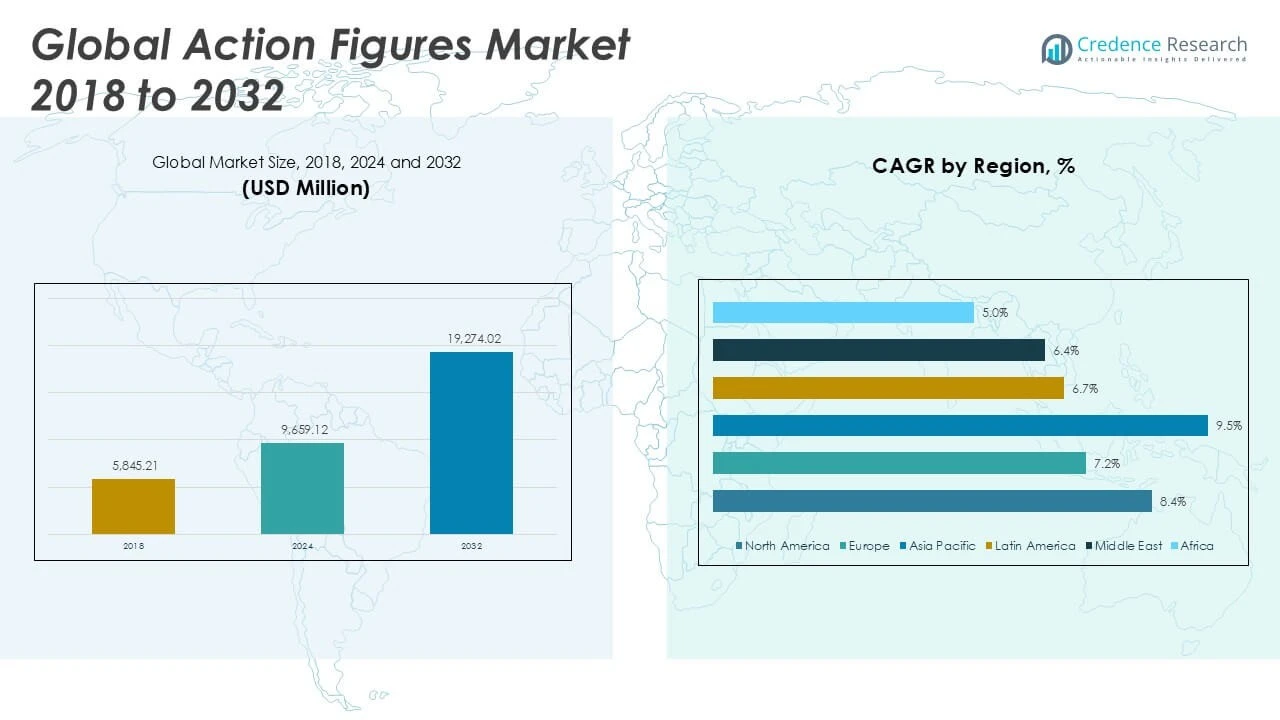
Action Figures Market size was valued at USD 5,845.21 million in 2018 to USD 9,659.12 million in 2024 and is anticipated to reach USD 19,274.02 million by 2032, at a CAGR of 9.02% during the forecast period.
The Action Figures Market benefits from surging demand driven by the growing popularity of licensed characters from movies, TV series, comics, and video games. Rising consumer interest in collectibles and nostalgia among adult fans expands the target demographic beyond children, fueling continuous product innovation and premium offerings. Manufacturers leverage advanced materials and enhanced articulation to deliver high-quality, detailed action figures, while strategic collaborations with entertainment studios and global events create limited-edition and exclusive releases that drive Market excitement. E-commerce platforms and digital Marketing campaigns increase accessibility and engagement, enabling brands to reach wider audiences and capitalize on emerging trends quickly. The Market also sees a shift toward eco-friendly packaging and sustainable materials in response to evolving consumer preferences and environmental regulations. These factors, coupled with the influence of social media and collector communities, reinforce sustained growth and diversification in the Action Figures Market.
The Action Figures Market demonstrates strong growth across global regions, with North America, Europe, and Asia Pacific leading in both sales and cultural influence. North America benefits from a vibrant collector community and frequent releases tied to blockbuster movies and comic franchises, while Europe’s demand is fueled by established pop culture trends and widespread retailer support. Asia Pacific, especially in countries like Japan, China, and South Korea, is driven by the popularity of anime, gaming, and local entertainment brands. Latin America, the Middle East, and Africa are emerging Market with expanding retail infrastructure and rising interest in international franchises. Key players shaping the industry include Hasbro, Mattel, Bandai Namco Holdings Inc., and The LEGO Group. These companies maintain their leadership through constant innovation, licensing partnerships, and global distribution, ensuring the Action Figures Market remains dynamic and responsive to shifting consumer trends.
Market Insights
- The Action Figures Market was valued at USD 5,845.21 million in 2018 to USD 9,659.12 million in 2024 and is anticipated to reach USD 19,274.02 million by 2032, at a CAGR of 9.02% during the forecast period.
- Rising demand for collectible merchandise and character-based toys, fueled by blockbuster movies, streaming series, and comic franchises, drives market growth worldwide.
- The market is witnessing trends such as limited-edition releases, increased collaboration with entertainment brands, and the integration of digital and augmented reality features in action figures.
- Leading players like Hasbro, Mattel, Bandai Namco Holdings Inc., and The LEGO Group maintain their positions through product innovation, global licensing agreements, and expanding collector-focused lines.
- Key restraints include intense competition, rising production costs, and the need for continuous licensing renewals to secure popular character rights.
- North America and Asia Pacific lead in sales due to a strong pop culture ecosystem, while Europe shows robust demand driven by established toy traditions and collector communities.
- The market’s competitive landscape features both global giants and niche manufacturers, with companies adapting to regional preferences, digital engagement, and evolving consumer expectations.
Market Drivers
Rising Popularity of Licensed Characters and Franchises
The Action Figures Market gains significant momentum from the enduring appeal of licensed characters associated with blockbuster movies, TV shows, comic books, and video games. Major entertainment franchises consistently introduce new storylines and characters, creating a steady stream of inspiration for innovative product launches. Collaboration between manufacturers and entertainment studios drives the release of action figures tied to highly anticipated events, sequels, and anniversaries, sparking excitement among both children and adult collectors. The popularity of superhero universes, science fiction sagas, and anime properties attracts a diverse customer base, boosting global demand. Retailers and online platforms actively feature themed collections, seasonal exclusives, and promotional tie-ins to maximize Market exposure. This synergy between entertainment and toy industries ensures a dynamic product landscape that captures consumer attention and drives repeat purchases.
- For instance, the success of major franchises like Marvel, DC, and Star Wars has driven demand for action figures, with collectors and fans seeking merchandise tied to their favorite characters.
Expansion of Collectible Culture Among Adults
The Action Figures Market benefits from a growing adult collector segment that seeks nostalgia, investment opportunities, and unique additions to personal collections. Adults engage in communities, conventions, and online forums dedicated to trading, showcasing, and discussing limited-edition figures. Manufacturers recognize this trend by developing premium product lines featuring advanced articulation, lifelike details, and authentic accessories. Collectible figures linked to pop culture moments, retro themes, or influential characters command higher price points and foster brand loyalty. The willingness of adult consumers to invest in high-value items encourages brands to explore exclusive collaborations and limited production runs. These dynamics broaden the Market’s scope beyond traditional child-oriented toys.
- For instance, adult collectors now account for a significant portion of the market, with premium and limited-edition figures commanding higher price points.
Technological Advancements and Product Innovation
Innovation in design and manufacturing techniques shapes the evolution of the Action Figures Market. Companies adopt cutting-edge materials and digital sculpting technologies to create figures with enhanced durability, realistic finishes, and intricate details. Interactive features such as voice activation, motion sensors, and augmented reality apps introduce new play experiences and appeal to tech-savvy buyers. Licensing agreements allow integration of iconic costumes, weapons, and digital codes, bridging the gap between physical toys and digital entertainment. Manufacturers focus on quality control and safety, adhering to international standards while responding to consumer demand for authentic, high-value collectibles. The integration of advanced technology strengthens brand differentiation and Market competitiveness.
Growth of E-Commerce and Digital Marketing Channels
E-commerce expansion and targeted digital Marketing strategies accelerate growth in the Action Figures Market. Online Marketplaces and brand websites offer broad product selections, detailed descriptions, and exclusive releases, attracting a global audience. Social media platforms and influencer partnerships play a crucial role in building brand awareness, sharing product reviews, and launching interactive campaigns. Real-time engagement with fans and collector communities enables brands to gauge consumer preferences, gather feedback, and tailor future offerings. Subscription boxes, pre-orders, and crowdfunding initiatives introduce new revenue streams and foster a sense of exclusivity. These developments ensure sustained demand and position the Market for continued global expansion.
Market Trends
Emergence of Premium and Limited-Edition Figures
The Action Figures Market witnesses a marked trend toward premium and limited-edition releases that cater to discerning collectors and enthusiasts. Manufacturers partner with major entertainment brands to unveil exclusive figures tied to special events, anniversaries, and global launches. These figures often feature superior craftsmanship, detailed sculpting, and unique packaging, appealing to adult collectors who value authenticity and rarity. Limited production runs and certificate of authenticity boost perceived value, driving higher demand and secondary Market activity. Collectors actively seek out these rare editions both online and through specialty retail channels, fueling a vibrant resale ecosystem. This trend reinforces the premiumization of the Market and encourages brands to invest in creative collaborations.
- For instance, the action figure market in the United States is experiencing a resurgence in popularity, with collectors driving up demand for rare and limited-edition figures.
Sustainable Practices and Eco-Friendly Materials
Sustainability emerges as a defining trend in the Action Figures Market, with manufacturers prioritizing eco-friendly materials and responsible production practices. Brands introduce action figures made from recycled plastics, bioplastics, and other sustainable resources to address growing environmental concerns. Packaging solutions shift toward minimalism and recyclability, while companies pledge to reduce their carbon footprint throughout the supply chain. Consumers, especially younger demographics, demonstrate strong preferences for products that align with their values, influencing purchasing decisions. Industry leaders adopt transparent sourcing and green manufacturing certifications, setting new benchmarks for the sector. These practices not only enhance brand reputation but also align the Market with global sustainability goals.
- For instance, manufacturers are introducing action figures made from recycled plastics, bioplastics, and other sustainable resources to align with consumer preferences for sustainability.
Integration of Technology and Interactive Features
Technological integration transforms the Action Figures Market, introducing interactive and digital features that elevate the play experience. Brands equip figures with sound, light, motion sensors, and connectivity to companion apps, expanding functionality beyond traditional play. Augmented reality applications allow users to unlock digital content or participate in interactive storytelling, bridging physical and virtual worlds. Manufacturers use 3D printing and advanced modeling software to rapidly prototype and customize new designs, ensuring quicker response to Market trends. Smart packaging solutions provide QR codes or NFC chips that enhance consumer engagement through digital rewards and exclusive content. These advancements redefine product value and capture the interest of tech-savvy buyers.
Expansion of Global Collector Communities and Digital Marketplaces
The rise of global collector communities and digital Marketplaces significantly shapes the Action Figures Market. Social media platforms, online forums, and dedicated collector websites foster active fan engagement and knowledge sharing. Digital Marketplaces facilitate seamless buying, selling, and trading of action figures, expanding access to rare and international products. Brands leverage influencer partnerships and live-streamed product launches to create buzz and reach new audiences worldwide. Crowdfunding platforms and pre-order campaigns give consumers a direct role in product development, further strengthening brand loyalty. This interconnected ecosystem drives Market visibility, supports secondary trading activity, and cultivates a thriving culture of collecting on a global scale.
Market Challenges Analysis
Rising Production Costs and Supply Chain Disruptions
The Action Figures Market faces escalating production costs driven by fluctuations in raw material prices, increased labor expenses, and global supply chain disruptions. Manufacturers contend with sourcing challenges for plastics, metals, and packaging materials, while transportation delays and geopolitical uncertainties impact delivery timelines. Stringent regulatory requirements for safety and quality standards in different regions further increase compliance costs. Companies must adapt to these pressures by optimizing inventory management and seeking alternative suppliers to maintain steady output. Smaller brands encounter higher barriers to entry due to limited economies of scale and higher per-unit costs. These factors create an environment where only well-capitalized players sustain long-term growth and Market presence.
- For instance, supply chain disruptions have incurred substantial financial costs, averaging 6-10% of annual revenues for affected businesses.
Counterfeit Products and Market Saturation
Counterfeit products and Market saturation present persistent challenges for the Action Figures Market. The proliferation of imitation figures undermines brand reputation and erodes consumer trust, impacting the profitability of legitimate manufacturers. Unauthorized replicas often fail to meet safety and quality standards, raising concerns for end-users, especially parents and collectors. Market saturation results from frequent product launches and an abundance of similar offerings, making differentiation more difficult for brands. Intense competition leads to price wars and margin compression, forcing companies to invest in innovation and Marketing to stand out. These dynamics compel Market players to prioritize intellectual property protection and develop strategies that ensure sustained consumer loyalty.
Market Opportunities
Expansion into Emerging Market and New Demographics
The Action Figures Market holds significant opportunities for expansion into emerging Market across Asia Pacific, Latin America, and the Middle East. Rapid urbanization, rising disposable incomes, and a growing middle class support increased spending on toys and collectibles. Brands can leverage local partnerships and tailored Marketing campaigns to reach diverse cultural audiences and introduce region-specific characters. Youth populations in these regions display strong interest in global entertainment franchises, creating fertile ground for product launches and brand loyalty. E-commerce growth in these Market offers wider distribution channels, enabling manufacturers to bypass traditional retail constraints. Companies that invest in understanding local preferences and building robust distribution networks are well-positioned to capture new Market share.
Innovation in Product Design and Interactive Experiences
Opportunities in the Action Figures Market also arise from ongoing innovation in product design and the integration of interactive experiences. Advances in technology allow brands to introduce smart features, augmented reality applications, and customizable action figures that engage tech-savvy consumers. Collaborations with digital content creators and gaming platforms create new licensing avenues and unique play scenarios. Limited-edition releases, personalized figures, and co-branded collections appeal to collectors and fans seeking exclusivity. Companies that focus on sustainable materials and eco-friendly packaging align with evolving consumer values and regulatory expectations. These initiatives not only enhance product appeal but also foster deeper consumer engagement and long-term brand loyalty.
Market Segmentation Analysis:
By Type:
The Action Figures Market exhibits a dynamic segmentation landscape, reflecting diverse consumer preferences and purchasing behaviors. By type, superheroes lead the Market, driven by enduring popularity of comic book and movie franchises. Anime characters secure substantial demand, supported by the global rise of Japanese pop culture and streaming content. Movie characters maintain strong traction, with each major film release boosting new product introductions, while the “others” category captures niche figures and emerging trends.
By End- User:
Based on end-user, the 9–15 years segment represents the core consumer base, though the 15 years & above group gains momentum as adult collectors invest in premium and limited-edition items. The up to 8 years segment remains important for entry-level and educational action figures.
By Distribution Channel:
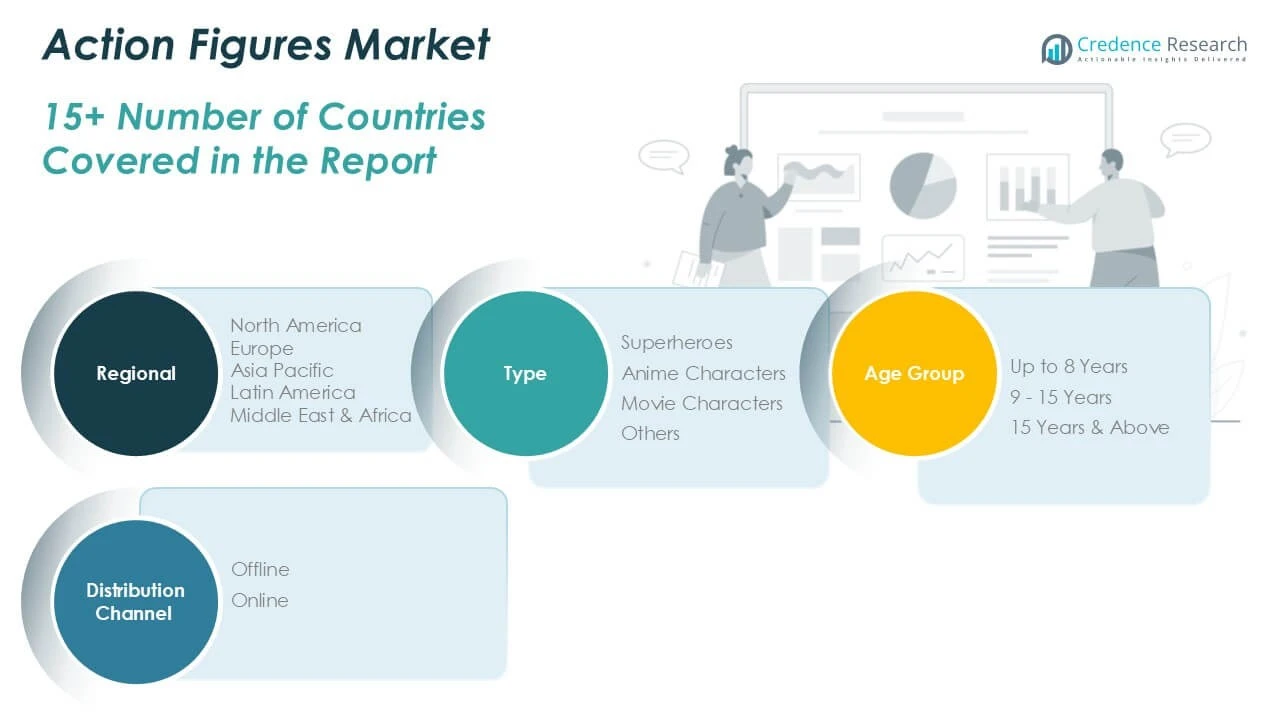
In terms of distribution channel, offline retail stores provide immediate access and product visibility, especially for impulse purchases and gift buying. Online platforms rapidly expand their presence, offering extensive product variety, exclusive releases, and convenience to both casual buyers and dedicated collectors. This multi-faceted segmentation enables the Market to serve a broad audience and adapt to evolving industry trends.
Segments:
Based on Type:
- Superheroes
- Anime Characters
- Movie Characters
- Others
Based on End- User:
- Up to 8 Years
- 9 - 15 Years
- 15 Years & Above
Based on Distribution Channel
- Offline
- Online
Based on the Geography:
- North America
- U.S.
- Canada
- Mexico
- Europe
- UK
- France
- Germany
- Italy
- Spain
- Russia
- Belgium
- Netherlands
- Austria
- Sweden
- Poland
- Denmark
- Switzerland
- Rest of Europe
- Asia Pacific
- China
- Japan
- South Korea
- India
- Australia
- Thailand
- Indonesia
- Vietnam
- Malaysia
- Philippines
- Taiwan
- Rest of Asia Pacific
- Latin America
- Brazil
- Argentina
- Peru
- Chile
- Colombia
- Rest of Latin America
- Middle East
- UAE
- KSA
- Israel
- Turkey
- Iran
- Rest of Middle East
- Africa
- Egypt
- Nigeria
- Algeria
- Morocco
- Rest of Africa
Regional Analysis
North America Action Figures Market
North America Action Figures Market grew from USD 2,367.02 million in 2018 to USD 3,867.65 million in 2024 and is projected to reach USD 7,740.73 million by 2032, reflecting a CAGR of 8.4%. North America holds approximately 35% of the global Market share in 2024. The United States leads the region, supported by Canada and Mexico, driven by strong licensing partnerships, collector culture, and consistent movie and comic franchise releases. A mature retail infrastructure and extensive e-commerce networks enable wide product availability. Demand for limited-edition and collectible figures continues to grow, especially among adult collectors. Brands invest heavily in innovation and packaging to enhance appeal and retention across both child and adult demographics.
Europe Action Figures Market
Europe Action Figures Market grew from USD 1,131.49 million in 2018 to USD 1,770.97 million in 2024 and is forecast to reach USD 3,225.46 million by 2032, registering a CAGR of 7.2%. Europe accounts for nearly 16% Market share in 2024. The region’s demand is concentrated in the UK, Germany, France, Italy, and Spain, where strong pop culture trends and interest in global franchises drive growth. Retailers expand online offerings and exclusive collaborations to attract collectors and children alike. Stringent regulations encourage product safety and quality. Established toy fairs and events also boost brand exposure and sales.
Asia Pacific Action Figures Market
Asia Pacific Action Figures Market grew from USD 1,806.12 million in 2018 to USD 3,140.44 million in 2024 and is anticipated to reach USD 6,799.23 million by 2032, posting a CAGR of 9.5%. Asia Pacific commands about 28% Market share in 2024. China, Japan, South Korea, and India are key Market, driven by large youth populations, rising disposable incomes, and a vibrant anime and gaming culture. Regional and international brands expand through partnerships and character licensing. The rapid expansion of e-commerce enables greater accessibility and product diversity. Innovative designs and collaborations with digital entertainment further fuel demand.
Latin America Action Figures Market
Latin America Action Figures Market grew from USD 274.79 million in 2018 to USD 448.41 million in 2024 and is projected to reach USD 791.46 million by 2032, at a CAGR of 6.7%. Latin America represents about 4% of the global Market in 2024. Brazil, Argentina, Chile, and Colombia drive demand, with increasing interest in action figures linked to global entertainment brands. Expansion of specialty retail outlets and promotional activities during festive seasons support Market growth. Price-sensitive consumers favor mid-range and mass-Market offerings. Local adaptations and language-specific packaging enhance regional appeal.
Middle East Action Figures Market
Middle East Action Figures Market grew from USD 183.42 million in 2018 to USD 279.85 million in 2024 and is expected to reach USD 481.33 million by 2032, reflecting a CAGR of 6.4%. The Middle East holds nearly 3% of the global Market in 2024. The UAE, Saudi Arabia, and Israel are the leading countries, supported by rising urbanization and family entertainment spending. Brands focus on premium product lines and licensed characters to capture consumer interest. Retailers invest in mall-based stores and e-commerce to boost product accessibility. Cultural events and partnerships with entertainment venues further strengthen Market growth.
Africa Action Figures Market
Africa Action Figures Market grew from USD 82.38 million in 2018 to USD 151.79 million in 2024 and is forecast to reach USD 235.81 million by 2032, with a CAGR of 5.0%. Africa comprises just over 1% of the global Market in 2024. Nigeria, South Africa, and Egypt lead demand, driven by youthful demographics and growing exposure to international media. International brands partner with local distributors to increase affordability and reach. Retail infrastructure improvements and increased internet access enable Market expansion. Action figures gain traction as aspirational and educational toys, supporting steady growth prospects.
Key Player Analysis
- Hasbro
- The LEGO Group
- Playmates Toys Ltd.
- JAKKS Pacific, Inc.
- Mattel
- Bandai Namco Holdings Inc.
- Diamond Select Toys
- Good Smile Company, Inc.
- Spin Master
- McFarlane Toys
Competitive Analysis
The competitive landscape of the Action Figures Market is shaped by a combination of global leaders and specialized manufacturers, with top players including Hasbro, The LEGO Group, Playmates Toys Ltd., JAKKS Pacific, Inc., Mattel, Bandai Namco Holdings Inc., Diamond Select Toys, Good Smile Company, Inc., Spin Master, and McFarlane Toys. Companies consistently invest in product development to capture emerging trends, such as collectible editions, tie-ins with movies and streaming series, and interactive features like augmented reality integration. Brand collaborations with major entertainment franchises ensure a steady pipeline of high-demand character releases, attracting both children and adult collectors. The market experiences ongoing pressure to differentiate through unique packaging, exclusive launches, and quality craftsmanship. Regional players contribute by offering culturally relevant figures and leveraging digital platforms to reach wider audiences. The sector remains highly dynamic, with players continually adapting to shifting consumer preferences, evolving media trends, and increased competition from both established brands and agile new entrants, ensuring that product innovation and brand engagement remain central to market success.
Recent Developments
- In May 2025, JAKKS Pacific announced a major DC x Sonic the Hedgehog crossover toy line, featuring articulated action figures, vehicles, and plushes of characters like Sonic, Batman, and Wonder Woman, launching Fall 2025.
- In April 2025, Mattel renewed its global licensing partnership with WWE, continuing to produce WWE action figures and playsets.
- In March 2025, McFarlane Toys announced the Mortal Kombat Klassic series, featuring highly detailed 7-inch action figures of classic characters (Sub-Zero, Scorpion, Liu Kang, Kitana, Mileena, and more), launching Summer 2025.
Market Concentration & Characteristics
The Action Figures Market displays a moderately high market concentration, with a small group of global brands holding significant influence over product trends, licensing partnerships, and distribution. It is characterized by strong reliance on entertainment franchises, frequent new launches, and a vibrant collector community spanning multiple age groups. The market demonstrates rapid responsiveness to pop culture trends and consumer demand for both mass-market and limited-edition figures. Companies emphasize product innovation, quality, and unique packaging to attract diverse consumer segments. The Action Figures Market benefits from expanding e-commerce channels, global fan bases, and active social media engagement, all of which boost brand visibility and consumer loyalty. Licensing agreements, cross-promotions with movies and games, and regional adaptations further define its dynamic and competitive environment, ensuring ongoing evolution and sustained growth.
Report Coverage
The research report offers an in-depth analysis based on Type, End-User, Distribution Channel and Geography. It details leading Market players, providing an overview of their business, product offerings, investments, revenue streams, and key applications. Additionally, the report includes insights into the competitive environment, SWOT analysis, current Market trends, as well as the primary drivers and constraints. Furthermore, it discusses various factors that have driven Market expansion in recent years. The report also explores Market dynamics, regulatory scenarios, and technological advancements that are shaping the industry. It assesses the impact of external factors and global economic changes on Market growth. Lastly, it provides strategic recommendations for new entrants and established companies to navigate the complexities of the Market.
Future Outlook
- Demand for customizable and limited-edition action figures will continue to increase, catering to both collectors and enthusiasts.
- Integration of digital storytelling and augmented reality features will create immersive experiences, expanding the appeal of action figures beyond traditional play.
- Manufacturers will invest in character diversity and inclusive representation to attract broader demographic groups.
- Collaborations with social media influencers and online communities will enhance brand engagement and promote new launches.
- Expansion into emerging Market, particularly in Latin America, the Middle East, and Africa, will unlock new growth opportunities as consumer awareness and disposable incomes rise.
- Subscription-based models and direct-to-consumer platforms will gain traction, providing exclusive releases and building long-term brand loyalty.
- Advances in 3D printing and rapid prototyping will shorten product development cycles, enabling faster response to pop culture trends.
- Strategic licensing agreements with gaming companies will bring new digital characters into the action figure category.
- Retailers will adopt omnichannel strategies, blending physical displays with digital experiences to drive sales and enhance customer interaction.
- The rise of fan conventions and global events will strengthen the connection between brands and collectors, generating demand for event-exclusive products and merchandise.

Request a Free Sample
Fill in your details and we'll send you a free sample report.
- Sample data tables & charts
- Research methodology
Market Dynamics
Popularity of Licensed Characters and Franchises
The enduring appeal of characters from blockbuster movies, TV shows, comics, and video games drives continuous demand for action figures, as new releases and collaborations with entertainment studios keep the product pipeline fresh and relevant.
Expansion of Adult Collector Segment
A growing adult collector base, motivated by nostalgia and investment value, is fueling demand for premium, limited-edition, and highly detailed action figures, expanding the market beyond traditional child consumers.
Technological Advancements and Product Innovation
Manufacturers are leveraging advanced materials, digital sculpting, and interactive features such as augmented reality and app integration to create more engaging and high-quality action figures, attracting tech-savvy consumers.
Growth of E-Commerce and Digital Marketing
The rise of online marketplaces and targeted digital campaigns has made action figures more accessible to a global audience, enabling brands to quickly capitalize on emerging trends and reach both casual buyers and dedicated collectors.
Sustainability and Eco-Friendly Materials
Increasing consumer preference for sustainable products is prompting manufacturers to adopt recycled plastics, bioplastics, and eco-friendly packaging, aligning with environmental regulations and enhancing brand reputation.
Need a Custom Version of This Report?
Tailor the scope, geography, or segments to your exact requirements.
- Custom geography or segment scope
- Direct access to our analyst team
Frequently Asked Questions
What is the current size of the Action Figures Market?
What factors are driving the growth of the Action Figures Market?
What are some challenges faced by the Action Figures Market?
Who are the major players in the Action Figures Market?
Table of Content
Chapter 1 Market Segmentation
- 1.1 Segmentation Framework
- 1.1.1 Product and Service Classification
- 1.1.2 Application and End-Use Classification
- 1.1.3 Technology and Solution Classification
- 1.1.4 Customer and Distribution Channel Classification
- 1.1.5 Geographic Segmentation
- 1.1.6 Market Segment Definitions and Boundaries
- 1.2 By Type
- 1.2.1 Superheroes
- 1.2.2 Anime Characters
- 1.2.3 Movie Characters
- 1.2.4 Others
- 1.3 By End-User
- 1.3.1 Up to 8 Years
- 1.3.2 9 - 15 Years
- 1.3.3 15 Years & Above
Chapter 2 Introduction
- 2.1 Report Objectives and Scope
- 2.2 Product Definition and Industry Terminology
- 2.3 Market Inclusions and Exclusions
- 2.4 Research Process
- 2.4.1 Primary Research and Expert Interviews
- 2.4.2 Secondary Research and Source Review
- 2.4.3 Top-Down and Bottom-Up Estimation
- 2.4.4 Data Triangulation and Verification
- 2.5 Market Size Measurement Basis
- 2.5.1 2024: USD 9,659.12 million → 2032: USD 19,274.02 million
- 2.6 Historical and Forecast Reference Periods
- 2.6.1 Base Year: 2024
- 2.6.2 Forecast Period: 2024-2032
- 2.7 Research Assumptions and Limitations
Chapter 3 Executive Summary
- 3.1 Market Snapshot and Key Findings
- 3.2 Base-Year Market Size, 2024
- 3.3 Forecast Market Size, 2032
- 3.4 Revenue and Volume Growth Outlook
- 3.5 Key Demand and Supply Indicators
- 3.6 Leading Market Segments
- 3.7 Fastest-Growing Market Opportunities
- 3.8 Regional Performance Highlights
- 3.9 Technology and Industry Transformation
- 3.10 Competitive Landscape Summary
- 3.11 Analyst View and Strategic Implications
Chapter 4 Global Action Figures Market Trends and Developments
- 4.1 Historical Industry Development
- 4.2 Recent Market Trends and Developments
- 4.3 Demand and Customer Behavior Trends
- 4.4 Technology and Product Innovation
- 4.5 Artificial Intelligence, Automation and Digitalization
- 4.6 Local Manufacturing and Supply Chain Realignment
- 4.7 Industry Partnerships, Mergers and Acquisitions
- 4.8 Sustainability and Circular Economy Developments
- 4.9 Government and Private Sector Investment Trends
- 4.10 Emerging Business Models and Commercialization
- 4.11 Industry Developments and Announcements
Chapter 5 Global Action Figures Market Production, Supply and Demand Analysis
- 5.1 Demand Trend and Consumption Analysis
- 5.2 Demand Forecast, 2024-2032
- 5.3 Production and Output Trend
- 5.4 Production and Output Forecast, 2024-2032
- 5.5 Installed Capacity and Capacity Utilization
- 5.6 Company-Wise Production Plants and Statistics
- 5.6.1 Installed Production Capacity
- 5.6.2 Actual Production
- 5.6.3 Planned Capacity and Expansion Targets
- 5.7 Supply Chain Structure and Procurement Trends
- 5.8 Supply-Demand Gap and Bottlenecks
- 5.9 Import Dependence and Sourcing Structure
- 5.10 Contract Manufacturing and Outsourcing
- 5.11 Regional Supply and Demand Concentration
Chapter 6 Global Action Figures Market Pricing Analysis
- 6.1 Pricing Structure and Measurement
- 6.2 Historical Pricing Trends
- 6.3 Pricing Outlook, 2024-2032
- 6.4 Average Selling Price and Unit Economics
- 6.5 Pricing by Product and Market Segment
- 6.6 Geographic Pricing Differences
- 6.7 Key Input, Energy, Labor and Logistics Costs
- 6.8 Contract Pricing and Purchasing Models
- 6.9 Pricing Sensitivity and Competitive Positioning
- 6.10 Price, Margin and Profitability Implications
Chapter 7 Global Action Figures Market Dynamics
- 7.1 Market Growth Drivers
- 7.1.1 Demand-Side Drivers
- 7.1.2 Technology and Innovation Drivers
- 7.1.3 Infrastructure and Investment Drivers
- 7.1.4 Regulatory and Policy Drivers
- 7.2 Market Restraints
- 7.2.1 Cost and Affordability Constraints
- 7.2.2 Technology and Adoption Barriers
- 7.2.3 Supply Chain and Operational Constraints
- 7.3 Market Challenges
- 7.3.1 Competitive Pressure and Margin Erosion
- 7.3.2 Skills, Infrastructure and Implementation Gaps
- 7.4 Emerging Market Opportunities
- 7.5 Market Dynamics Impact and Time-Horizon Assessment
Chapter 8 Global Action Figures Value Chain Analysis
- 8.1 Industry Value Chain Overview
- 8.2 Upstream Suppliers and Critical Inputs
- 8.3 Technology and Component Providers
- 8.4 Manufacturing or Service Delivery
- 8.5 Distribution, Channel Partners and Integrators
- 8.6 Downstream Applications and End Users
- 8.7 Value Addition and Profit Pools
- 8.8 Vertical Integration and Outsourcing
- 8.9 Supplier Concentration and Risk
- 8.10 Supply Chain Localization and Resilience
Chapter 9 Global Action Figures Market Regulations and Policies
- 9.1 Relevant Laws, Standards and Compliance Frameworks
- 9.2 Product, Service, Safety and Quality Requirements
- 9.3 Government Policies, Incentives and Subsidies
- 9.4 Imports, Exports and Trade Barriers
- 9.5 Public Procurement and Local Content Requirements
- 9.6 Environmental and Sustainability Compliance
- 9.7 Upcoming Policy Changes and Market Implications
Chapter 10 Global Action Figures Market Hotspots and Opportunities
- 10.1 Market Opportunity Mapping and Growth Hotspots
- 10.2 High-Growth Applications and Customer Groups
- 10.3 Underserved Markets and White-Space Opportunities
- 10.4 Emerging Technology and Product Opportunities
- 10.5 New Capacity and Investment Hotspots
- 10.6 Market Entry and Expansion Opportunities
- 10.7 Distribution and Partnership Opportunities
- 10.8 Near-Term and Long-Term Commercial Potential
- 10.9 Opportunity Attractiveness and Execution Risks
Chapter 11 Global Action Figures Market Outlook, 2024-2032
- 11.1 Market Size and Analysis
- 11.1.1 Revenue (Market Measurement: 2024: USD 9,659.12 million → 2032: USD 19,274.02 million)
- 11.1.2 Market Volume and Quantity Sold
- 11.1.3 Historical Market Size
- 11.1.4 Base-Year Market Size, 2024
- 11.2 Market Forecast, 2024-2032
- 11.2.1 Revenue Forecast to 2032
- 11.2.2 Volume Forecast to 2032
- 11.2.3 CAGR and Year-on-Year Growth
- 11.2.4 Incremental Revenue Opportunity
- 11.3 Forecast Assumptions and Scenario Analysis
- 11.3.1 Base-Case Forecast
- 11.3.2 Optimistic and Conservative Scenarios
- 11.3.3 Technology, Pricing and Policy Sensitivities
- 11.4 Market Attractiveness and Growth Outlook
Chapter 12 Global Action Figures Market Segmentation and Outlook
- 12.1 Segmentation Summary and Market Shares, 2024
- 12.2 Largest and Fastest-Growing Segments
- 12.3 By Type - Market Size and Forecast, 2024-2032
- 12.3.1 Segment Definition and Scope
- 12.3.2 Historical Market Size
- 12.3.3 Revenue Forecast, 2024-2032
- 12.3.4 Volume Forecast, 2024-2032
- 12.3.5 Base-Year Market Share, 2024
- 12.3.6 Segment CAGR and Growth Drivers
- 12.3.7 Subsegment Market Size and Forecast
- 12.3.7.1 Superheroes
- 12.3.7.2 Anime Characters
- 12.3.7.3 Movie Characters
- 12.3.7.4 Others
- 12.3.8 Subsegment Pricing and Adoption Trends
- 12.3.9 Leading Suppliers and Competition
- 12.3.10 Regional Demand and Opportunities
- 12.4 By End-User - Market Size and Forecast, 2024-2032
- 12.4.1 Segment Definition and Scope
- 12.4.2 Historical Market Size
- 12.4.3 Revenue Forecast, 2024-2032
- 12.4.4 Volume Forecast, 2024-2032
- 12.4.5 Base-Year Market Share, 2024
- 12.4.6 Segment CAGR and Growth Drivers
- 12.4.7 Subsegment Market Size and Forecast
- 12.4.7.1 Up to 8 Years
- 12.4.7.2 9 - 15 Years
- 12.4.7.3 15 Years & Above
- 12.4.8 Subsegment Pricing and Adoption Trends
- 12.4.9 Leading Suppliers and Competition
- 12.4.10 Regional Demand and Opportunities
- 12.5 Segment Growth Comparison
- 12.6 Segment Attractiveness and Priority Matrix
Chapter 13 Global Action Figures End-Use and Application Market Outlook
- 13.1 End-Use Industry and Customer Demand Structure
- 13.2 Leading Applications and Customer Groups
- 13.3 End-Use Market Size, Share and Forecast
- 13.4 Major End-Use Industry Deep Dives
- 13.4.1 Customer Requirements and Use Cases
- 13.4.2 Demand and Replacement Cycles
- 13.4.3 Technical and Regulatory Considerations
- 13.4.4 Purchasing and Procurement Models
- 13.4.5 Leading Vendors and Distribution Channels
- 13.4.6 Forecast and Commercial Opportunities
- 13.5 Emerging Applications and Cross-Segment Demand
- 13.6 End-Use Industry Investment Priorities
Chapter 14 Global Action Figures Geographic Market Outlook, 2024-2032
- 14.1 Regional Market Size and Share, 2024
- 14.2 Regional Market Forecast, 2024-2032
- 14.3 Regional Pricing, Production and Demand Differences
- 14.4 North America
- 14.4.1 United States
- 14.4.2 Canada
- 14.4.3 Mexico
- 14.5 Europe
- 14.5.1 Germany
- 14.5.2 France
- 14.5.3 Italy
- 14.5.4 United Kingdom
- 14.5.5 Spain
- 14.5.6 Poland
- 14.5.7 Russia
- 14.5.8 Netherlands
- 14.5.9 Belgium
- 14.5.10 Sweden
- 14.5.11 Denmark
- 14.5.12 Norway
- 14.5.13 Rest of Europe
- 14.6 Asia Pacific
- 14.6.1 China
- 14.6.2 India
- 14.6.3 Japan
- 14.6.4 South Korea
- 14.6.5 Thailand
- 14.6.6 Indonesia
- 14.6.7 Vietnam
- 14.6.8 Malaysia
- 14.6.9 Australia
- 14.6.10 Rest of Asia Pacific
- 14.7 Latin America
- 14.7.1 Brazil
- 14.7.2 Argentina
- 14.7.3 Colombia
- 14.7.4 Chile
- 14.7.5 Rest of Latin America
- 14.8 Middle East
- 14.8.1 Saudi Arabia
- 14.8.2 United Arab Emirates
- 14.8.3 Turkey
- 14.8.4 Israel
- 14.8.5 Iran
- 14.8.6 Rest of the Middle East
- 14.9 Africa
- 14.9.1 South Africa
- 14.9.2 Egypt
- 14.9.3 Nigeria
- 14.9.4 Morocco
- 14.9.5 Rest of Africa
- 14.10 Regional Investment, Policy and Supply Chain Differences
- 14.11 Regional Competitive Landscape
- 14.12 Geographic Growth Hotspots
Chapter 15 Global Action Figures Technology, Innovation and Sustainability Outlook
- 15.1 Technology Landscape and Maturity
- 15.2 Product, Process and Service Innovation
- 15.3 AI, Automation and Digital Tools in the Industry
- 15.4 Technology Adoption and Performance Benchmarking
- 15.5 Innovation Pipeline and R&D Investment
- 15.6 Patent and Intellectual Property Trends
- 15.7 Energy Efficiency and Resource Management
- 15.8 Sustainability, Recycling and Circularity
- 15.9 Technology Roadmap, 2024-2032
- 15.10 Risks of Obsolescence and Technology Substitution
Chapter 16 Global Action Figures Market Key Strategic Imperatives
- 16.1 Growth and Market Entry Priorities
- 16.2 High-Return Products and Segments
- 16.3 Pricing, Profitability and Cost Optimization
- 16.4 Technology Investment and Product Differentiation
- 16.5 Supply Chain Localization and Resilience
- 16.6 Distribution and Customer Acquisition
- 16.7 Partnership, Acquisition and Capacity Strategy
- 16.8 Regional Expansion Priorities
- 16.9 Short-, Medium- and Long-Term Actions
Chapter 17 Competition Outlook
- 17.1 Industry Competition Characteristics
- 17.2 Market Structure and Concentration
- 17.3 Market Share and Competitive Positioning, 2024
- 17.4 Company-Wise Revenue and Product Benchmarking
- 17.5 Production and Service Capacity Benchmarking
- 17.6 Technology, Pricing and Differentiation
- 17.7 Regional Footprint and Distribution Strength
- 17.8 Mergers, Acquisitions and Strategic Alliances
- 17.9 New Entrants and Competitive Threats
- 17.10 Porter's Five Forces and Industry Attractiveness
- 17.11 Competitive Outlook, 2024-2032
Chapter 18 Company Profiles
- 18.1 Company Coverage and Selection Criteria
- 18.2 Hasbro
- 18.2.1 Business Description
- 18.2.2 Company Ownership and Geographic Presence
- 18.2.3 Product and Service Portfolio
- 18.2.4 Manufacturing and Operating Footprint
- 18.2.5 Production Capacity and Expansion Plans
- 18.2.6 Financial Performance and Investment
- 18.2.7 Market Share and Competitive Position
- 18.2.8 Technology and Innovation Capabilities
- 18.2.9 Strategic Alliances or Partnerships
- 18.2.10 Recent Developments
- 18.2.11 Growth Strategy and Outlook
- 18.3 Mattel
- 18.4 Bandai Namco Holdings Inc.
- 18.5 The LEGO Group
- 18.6 Playmates Toys Ltd.
- 18.7 JAKKS Pacific, Inc.
- 18.8 Diamond Select Toys
- 18.9 Good Smile Company, Inc.
- 18.10 Spin Master
- 18.11 McFarlane Toys
- 18.12 Other Relevant Market Participants
Note: Every listed company is profiled on the structure shown under the first company. The company list is preliminary and may change based on research findings, market developments, data availability and client requirements.
Chapter 19 Disclaimer
- 19.1 Research and Forecast Disclaimer
- 19.2 Data Source and Estimation Limitations
Note: The depth of individual sections depends on data availability for this market. Volume, capacity, trade and other unit-based metrics are included where applicable.

