
Market Overview
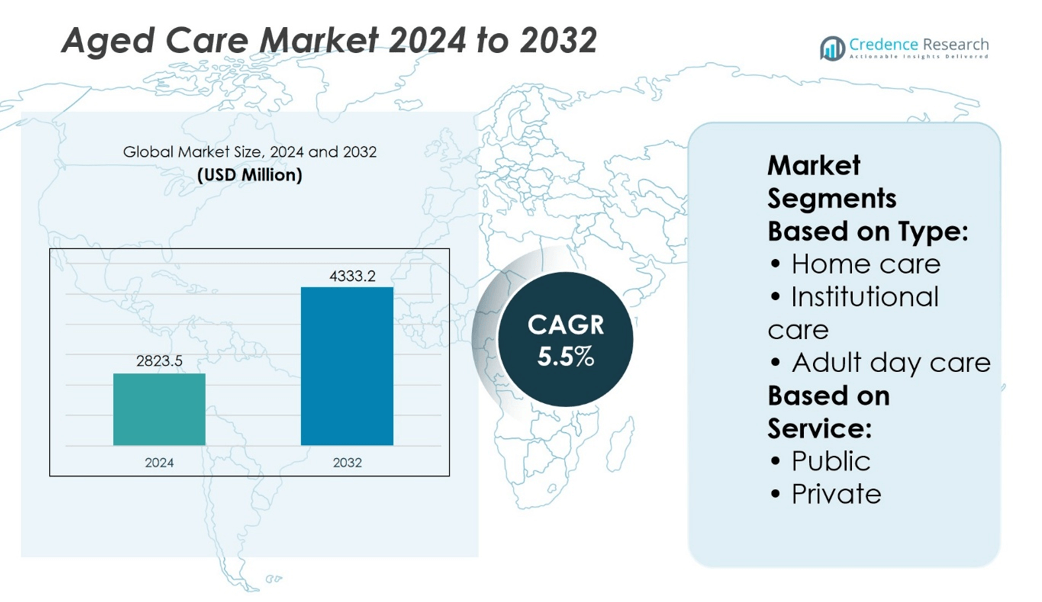
Aged Care Market size was valued at USD 2823.5 million in 2024 and is anticipated to reach USD 4333.2 million by 2032, at a CAGR of 5.5% during the forecast period.
| REPORT ATTRIBUTE | DETAILS |
|---|---|
| Historical Period | 2020-2023 |
| Base Year | 2024 |
| Forecast Period | 2025-2032 |
| Aged Care Market Size 2024 | USD 2823.5 million |
| Aged Care Market, CAGR | 5.5% |
| Aged Care Market Size 2032 | USD 4333.2 million |
The Aged Care Market grows on the back of rising elderly populations, increasing life expectancy, and shifting family structures that reduce informal caregiving capacity. It benefits from expanding public and private investment in facilities, workforce training, and specialized geriatric services. Demand for home-based care and community programs strengthens as consumers seek independence and personalized solutions. Technology adoption, including telehealth, wearable monitoring, and AI-assisted care planning, drives efficiency and accessibility. Providers focus on person-centered models, preventive health programs, and integrated service delivery, positioning the sector to meet evolving demographic needs while enhancing quality and scope of aged care services worldwide.
The Aged Care Market shows strong presence in North America and Europe, supported by advanced infrastructure and regulatory frameworks, while Asia-Pacific experiences rapid growth from demographic shifts and rising investments. Latin America and the Middle East & Africa are emerging with gradual adoption of formal care models. Key players drive competition through service diversification, technology integration, and regional expansion, including Brookdale Senior Living Inc., Econ Healthcare Group, Benesse Style Care Co. Ltd., Amedisys, Inc., and Rosewood Care Group Inc.
Market Insights
- The Aged Care Market was valued at USD 2823.5 million in 2024 and is projected to reach USD 4333.2 million by 2032, at a CAGR of 5.5%.
- Rising elderly populations, longer life expectancy, and reduced informal caregiving capacity drive sustained market growth.
- Technology adoption, including telehealth, wearable monitoring, and AI-assisted care planning, enhances efficiency and service reach.
- Competition intensifies as key players expand through service diversification, innovation, and regional penetration.
- High operational costs, workforce shortages, and regulatory compliance requirements limit growth potential.
- North America and Europe lead with advanced infrastructure, while Asia-Pacific grows rapidly through demographic and investment shifts.
- Latin America and the Middle East & Africa gradually adopt formal care models, creating emerging market opportunities.
Market Drivers
Growing Demand from Aging Population and Increasing Life Expectancy
The Aged Care Market is driven by the sharp rise in the global elderly population and improvements in healthcare that extend life expectancy. It faces sustained demand from individuals requiring long-term support for daily living, medical assistance, and social engagement. Urbanization and smaller family units limit traditional caregiving capacity, increasing reliance on formal aged care services. Governments and private providers expand facilities and home-based programs to address this demographic shift. Rising awareness of specialized geriatric care encourages early adoption of aged care solutions. This structural demand ensures steady growth opportunities for both public and private sector providers.
- For instance, Pfizer reported in 2023 that more than 524 million individuals aged 65 or older are living globally.
Advancements in Healthcare Infrastructure and Specialized Services
Improved healthcare infrastructure and the expansion of specialized geriatric services support the growth of the Aged Care Market. It benefits from innovations in disease management, rehabilitation, and preventive care tailored to older adults. Providers integrate multidisciplinary teams, combining medical, nursing, and allied health expertise to deliver comprehensive care. Technology adoption, such as telehealth and remote monitoring, enhances service accessibility for those in remote areas. The availability of specialized dementia care units and palliative services meets the complex needs of aging populations. These developments increase the quality and range of services available across aged care settings.
- For instance, Ramsay Health Care invested AUD 45 million to expand its Joondalup Health Campus in Western Australia, adding a dedicated geriatric ward.
Rising Public and Private Investment in Aged Care Facilities
The Aged Care Market experiences significant expansion through increased public and private sector investment in infrastructure and workforce capacity. It gains from government funding programs aimed at modernizing facilities and expanding residential capacity. Private investors contribute to new purpose-built centers with enhanced amenities and medical capabilities. Capital is directed toward workforce training to improve care quality and retention rates. Investments also target the development of integrated communities that combine independent living with access to medical support. This capital inflow strengthens service delivery and enhances competitiveness across the market.
Shifting Consumer Preferences Toward Home and Community-Based Care
Changing consumer expectations are reshaping the Aged Care Market, with a growing preference for home and community-based care solutions. It sees demand for personalized care plans that support independence while ensuring safety and health monitoring. Home care providers expand service offerings, including daily living assistance, nursing care, and allied health services. Community programs provide social interaction and wellness activities that reduce isolation. Flexible service packages allow older adults to adjust care levels according to changing needs. This shift encourages innovation in service delivery models and technology-enabled care solutions that align with individual lifestyle choices.
Market Trends
Increasing Integration of Technology and Digital Health Solutions
The Aged Care Market adopts advanced technologies to improve service efficiency and patient outcomes. It incorporates telehealth platforms, remote monitoring devices, and electronic health records to streamline care delivery. Providers use wearable sensors to track vital signs and detect early health deterioration. Artificial intelligence supports predictive care models that anticipate medical needs and optimize staff allocation. Virtual reality applications enhance rehabilitation and cognitive therapy for older adults. The integration of these solutions strengthens care quality and expands access to services beyond traditional facility settings.
- For instance, Philips Healthcare deployed its remote patient monitoring platform to support over 7.5 million connected medical devices globally, enabling continuous tracking of seniors’ health indicators and reducing hospital readmissions.
Growing Emphasis on Person-Centered and Customized Care Models
The Aged Care Market shifts toward care models that prioritize individual needs, preferences, and lifestyle choices. It offers personalized care plans based on health conditions, mobility levels, and social requirements. Facilities redesign spaces to create homelike environments that promote comfort and dignity. Providers implement flexible service packages, enabling residents to adjust support levels over time. Nutritional programs, wellness activities, and therapy options are tailored to specific demographic groups within the elderly population. This trend drives higher satisfaction rates and strengthens the reputation of service providers.
- For instance, Brookdale Senior Living delivers tailored wellness programs to residents across its network of 86,000 accommodation units in the United States.
Expansion of Home and Community-Based Care Services
The Aged Care Market experiences growing demand for home-based and community-focused care options. It responds with expanded services such as in-home nursing, daily living assistance, and allied health visits. Community hubs offer social interaction, rehabilitation programs, and preventive health initiatives. Providers adopt mobile healthcare units to reach rural and underserved areas. Service models focus on enabling independence while ensuring safety through regular monitoring and rapid response systems. This expansion diversifies care delivery and aligns with changing consumer preferences.
Rising Focus on Workforce Development and Training Standards
The Aged Care Market places greater emphasis on workforce capacity and professional training. It invests in upskilling programs for nurses, carers, and allied health professionals to address complex geriatric needs. Certification requirements are strengthened to ensure consistent care quality. Providers develop leadership pathways to retain experienced staff and reduce turnover rates. Workforce planning incorporates flexible scheduling and mental health support to improve employee well-being. These measures enhance service reliability and maintain high operational standards across aged care facilities and home care services.
Market Challenges Analysis
Workforce Shortages and Rising Operational Pressures
The Aged Care Market faces persistent workforce shortages that strain service delivery and impact care quality. It struggles to recruit and retain qualified nurses, carers, and allied health professionals due to demanding workloads and competitive labor markets. Limited staffing levels increase operational pressure, particularly in residential facilities with high dependency residents. Providers must balance compliance with stringent care standards while managing workforce gaps. Training and upskilling programs require significant investment, adding to operational costs. High turnover disrupts continuity of care and undermines patient trust, creating further challenges in meeting the needs of an aging population.
Escalating Costs and Funding Constraints
The Aged Care Market encounters escalating costs related to staffing, infrastructure, and advanced medical technologies. It must address these financial pressures while operating under limited public funding and constrained reimbursement rates. Providers face difficulty maintaining profitability without compromising service standards. Rising expenses in equipment procurement, facility upgrades, and compliance audits place additional burdens on budgets. Smaller operators risk financial instability, limiting their ability to expand or innovate. These funding and cost challenges restrict the sector’s capacity to meet increasing demand and invest in long-term service improvements.
Market Opportunities
Expansion of Home-Based and Technology-Enabled Care Models
The Aged Care Market holds significant opportunity in the expansion of home-based care supported by advanced technologies. It can leverage telehealth, remote monitoring devices, and mobile healthcare units to deliver services beyond traditional facility boundaries. Demand for personalized home care packages creates potential for providers to design flexible, scalable solutions. Integration of wearable devices and AI-driven health alerts enhances patient safety and supports proactive intervention. Growth in smart home adaptations, such as automated fall detection systems, aligns with the goal of enabling independent living. These advancements open avenues for providers to reach new customer segments and strengthen market presence.
Rising Demand for Specialized and Preventive Geriatric Services
The Aged Care Market benefits from increasing demand for specialized services that address chronic conditions, cognitive decline, and rehabilitation needs. It can expand offerings in areas such as dementia care, palliative support, and geriatric physiotherapy. Preventive care programs targeting nutrition, mobility, and mental well-being attract both public and private investment. Collaboration with healthcare providers and research institutions fosters the development of innovative treatment approaches. Expansion into wellness-focused services creates opportunities to diversify revenue streams. This focus on specialized and preventive solutions enhances care quality while meeting the evolving expectations of aging populations.
Market Segmentation Analysis:
By Type
Public aged care services receive funding and oversight from government agencies, ensuring affordability and accessibility for a wide population segment. It often focuses on meeting essential health and social care needs, particularly for lower-income groups or those with limited support networks. Public programs maintain standardized care protocols and invest in workforce development to meet regulatory requirements. Expansion plans frequently target rural and underserved regions.Private aged care services operate under independent ownership and rely on direct payments or insurance coverage. It emphasizes higher service customization, premium amenities, and advanced healthcare facilities. Private operators compete on quality, innovation, and speed of service delivery. They invest in technology-enabled solutions and luxury living arrangements to attract higher-income clients. The private sector plays a critical role in expanding overall capacity and introducing new care models to meet evolving consumer expectations.
- For instance, the Australian Government allocates resources to over 1.3 million people annually through its My Aged Care program, providing subsidized residential care, home support packages, and specialized dementia services nationwide.
By Service
Home care holds a strong position in the Aged Care Market due to growing demand for personalized, in-home support that maintains independence and comfort. It covers a wide range of services, including medical supervision, personal care, and assistance with daily activities. Providers adopt technology such as remote monitoring and telehealth consultations to enhance care delivery and safety in home settings. It appeals to families seeking flexible solutions that adapt to changing health conditions. Residential aged care facilities, nursing homes, and assisted living centers deliver structured environments with access to skilled healthcare teams. It addresses complex conditions such as dementia, post-surgical recovery, and chronic illness management. Investments focus on facility modernization, infection control measures, and integrated healthcare services. Institutional care also incorporates wellness programs and rehabilitation services to improve quality of life for residents.
- For instance, Home Instead Senior Care delivers tailored in-home support to over 1.2 million clients globally each year, utilizing a network of trained caregivers to provide medical check-ins, mobility assistance, and companionship services.
Segments:
Based on Type:
- Home care
- Institutional care
- Adult day care
Based on Service:
- Public
- Private
Based on the Geography:
- North America
- U.S.
- Canada
- Mexico
- Europe
- UK
- France
- Germany
- Italy
- Spain
- Russia
- Belgium
- Netherlands
- Austria
- Sweden
- Poland
- Denmark
- Switzerland
- Rest of Europe
- Asia Pacific
- China
- Japan
- South Korea
- India
- Australia
- Thailand
- Indonesia
- Vietnam
- Malaysia
- Philippines
- Taiwan
- Rest of Asia Pacific
- Latin America
- Brazil
- Argentina
- Peru
- Chile
- Colombia
- Rest of Latin America
- Middle East
- UAE
- KSA
- Israel
- Turkey
- Iran
- Rest of Middle East
- Africa
- Egypt
- Nigeria
- Algeria
- Morocco
- Rest of Africa
Regional Analysis
North America
North America holds a market share of 38% in the Aged Care Market, supported by advanced healthcare infrastructure, strong government programs, and high awareness of aged care services. The region benefits from established public funding mechanisms such as Medicare and Medicaid in the United States and comprehensive senior care systems in Canada. It has a mature network of residential care facilities, home care agencies, and adult day care centers equipped with advanced technology for monitoring and treatment. Demand is further driven by the large proportion of the population aged 65 and above, along with increasing life expectancy. Private sector participation is strong, with operators investing in premium assisted living and specialized memory care units. North America’s focus on integrating digital health solutions into aged care delivery enhances service efficiency and patient outcomes.
Europe
Europe accounts for 32% of the Aged Care Market, with a well-developed framework of public and private aged care services. Countries such as Germany, France, and the United Kingdom maintain extensive long-term care systems supported by government funding and regulated quality standards. The region faces rising demand due to aging populations, particularly in Western and Northern Europe, where life expectancy is among the highest globally. It is witnessing growth in home-based care models, supported by policies encouraging aging in place. Investments in workforce development and facility modernization aim to address staffing shortages and improve service quality. The presence of specialized geriatric hospitals and rehabilitation centers strengthens the region’s aged care capabilities.
Asia-Pacific
Asia-Pacific holds a 20% share of the Aged Care Market, with rapid expansion driven by demographic shifts and changing family structures. Countries such as Japan, China, and Australia lead in aged care development, while emerging markets in Southeast Asia are increasing their investments. It faces unique challenges from a fast-growing elderly population and limited existing infrastructure in some areas. Government initiatives in countries like Japan promote technology adoption, including robotics and AI for elderly assistance. Private sector engagement is growing, particularly in urban centers, with an emphasis on building modern facilities and community-based care programs. The rising middle class in many Asia-Pacific nations is fueling demand for higher-quality, personalized aged care services.
Latin America
Latin America represents 6% of the Aged Care Market, with demand growing steadily in countries such as Brazil, Mexico, and Argentina. It is transitioning from informal family-based elder care toward more structured services. Urbanization and increased female workforce participation are reducing traditional caregiving availability, creating opportunities for professional care providers. Governments are beginning to develop policies to expand access to aged care services, though private operators remain a key growth driver. Investment in home care and small-scale residential facilities is increasing in metropolitan areas.
Middle East & Africa
The Middle East & Africa holds a 4% market share, with the sector still in its early development stage in many countries. Wealthier Gulf nations, including the UAE and Saudi Arabia, are investing in premium residential aged care facilities and home care services. In Africa, aged care services are limited but expanding through non-profit organizations and community-based initiatives. Cultural preferences for family care remain strong, but urbanization is creating a gradual shift toward formal service adoption. Governments and private investors are exploring partnerships to build infrastructure and train a skilled aged care workforce.
Key Player Analysis
- Brookdale Senior Living Inc.
- Econ Healthcare Group
- Rosewood Care Group Inc.
- Benesse Style Care Co. Ltd.
- Epoch Elder Care
- Samvedna Senior Care
- Amedisys, Inc.
- Cascade Healthcare
- Latin America Home Health Care
- St Luke's ElderCare Ltd
Competitive Analysis
The Aged Care Market features include Brookdale Senior Living Inc., Econ Healthcare Group, Rosewood Care Group Inc., Benesse Style Care Co. Ltd., Epoch Elder Care, Samvedna Senior Care, Amedisys, Inc., Cascade Healthcare, Latin America Home Health Care, and St Luke's ElderCare Ltd. The Aged Care Market operates in a competitive environment shaped by diverse service offerings, technology adoption, and expanding care models. Providers differentiate through specialized services such as dementia care, palliative support, and rehabilitation programs, while others focus on scaling home-based and community-oriented solutions. Investment in digital health tools, including telehealth, remote monitoring, and predictive analytics, is enhancing operational efficiency and patient outcomes. Market participants seek to strengthen brand reputation by improving care quality, expanding facility networks, and developing integrated living arrangements that combine healthcare with lifestyle amenities. Strategic collaborations with healthcare institutions, technology firms, and government agencies support innovation and regulatory compliance. Competition remains driven by the ability to adapt services to changing demographic needs and consumer expectations while maintaining sustainable operational models.
Recent Developments
- In November 2024, Bangalore-based listed hospital chain Aster DM Healthcare and US-based private equity major Blackstone-owned Quality Care India reached the final steps of completing a merger, with Blackstone expected to hold a majority stake in the merged entity.
- In August 2024, The Australian Department of Health and Aged Care expanded two more contracts to Accenture to aid with delivering IT abilities in the aged care sector for upcoming two years.
- In March 2024, Kites Senior Care, a geriatric care service provider, announced that it has secured in a series A funding round, which was led by Ranjan Pai, chairman of Manipal Education and Medical Group (MEMG).
- In January 2023, Genesis Healthcare Inc. revealed plans to add 34 nursing homes in Pennsylvania as part of its expansion strategy. This move is expected to significantly enhance the company’s market share and boost overall revenue through broader regional coverage.
Market Concentration & Characteristics
The Aged Care Market demonstrates a moderately fragmented structure with a mix of large multinational providers and numerous regional operators catering to local demands. It is characterized by a broad spectrum of services, including home care, residential facilities, and community-based programs, tailored to varying levels of dependency. Public and private sectors both play critical roles, with public services focusing on accessibility and private operators emphasizing premium and specialized offerings. It reflects strong regulatory oversight in developed regions, ensuring compliance with quality and safety standards, while emerging markets are gradually formalizing frameworks to support industry growth. Technological integration, such as telehealth, remote monitoring, and AI-driven care planning, is becoming a defining feature across providers. The market maintains high barriers to entry due to capital-intensive infrastructure, workforce training requirements, and complex compliance obligations. Competition centers on service quality, innovation, and the ability to adapt to evolving demographic needs, with consumer expectations driving continuous improvements in care delivery models.
Report Coverage
The research report offers an in-depth analysis based on Type, Service and Geography. It details leading market players, providing an overview of their business, product offerings, investments, revenue streams, and key applications. Additionally, the report includes insights into the competitive environment, SWOT analysis, current market trends, as well as the primary drivers and constraints. Furthermore, it discusses various factors that have driven market expansion in recent years. The report also explores market dynamics, regulatory scenarios, and technological advancements that are shaping the industry. It assesses the impact of external factors and global economic changes on market growth. Lastly, it provides strategic recommendations for new entrants and established companies to navigate the complexities of the market.
Future Outlook
- The market will expand due to the rising elderly population and longer life expectancy.
- Demand for home-based care will grow as more seniors choose to age in place.
- Technology adoption will increase through telehealth, wearable devices, and remote monitoring tools.
- Personalized care models will become standard, focusing on individual health and lifestyle needs.
- Workforce development programs will strengthen to address skill gaps and staffing shortages.
- Private investment will rise in premium residential facilities with advanced medical capabilities.
- Public sector funding will focus on expanding access and improving service quality.
- Preventive health and wellness programs will gain importance in reducing long-term care needs.
- Partnerships between healthcare providers and technology firms will enhance service innovation.
- Sustainability initiatives will influence facility design and operational practices across the sector.

Request a Free Sample
Fill in your details and we'll send you a free sample report.
- Sample data tables & charts
- Research methodology
Market Dynamics
Growing Demand from Aging Population and Increasing Life Expectancy
The global rise in the elderly population, coupled with longer life expectancy, is driving sustained demand for aged care services as more individuals require long-term support, medical assistance, and social engagement.
Advancements in Healthcare Infrastructure and Specialized Services
Improvements in healthcare infrastructure and the expansion of specialized geriatric services, such as dementia and palliative care, are enhancing the quality and range of aged care offerings, attracting both public and private investment.
Rising Public and Private Investment in Aged Care Facilities
Significant capital inflows from government funding and private investors are expanding residential capacity, modernizing facilities, and supporting workforce training, which strengthens service delivery and market competitiveness.
Shifting Consumer Preferences Toward Home and Community-Based Care
There is a growing preference for home and community-based care solutions that support independence and personalized care, prompting providers to innovate with flexible service packages and technology-enabled care models.
Increasing Integration of Technology and Digital Health Solutions
The adoption of telehealth, wearable monitoring, and AI-assisted care planning is improving efficiency, expanding access, and enabling proactive health management for seniors, making aged care services more effective and scalable.
Need a Custom Version of This Report?
Tailor the scope, geography, or segments to your exact requirements.
- Custom geography or segment scope
- Direct access to our analyst team
Frequently Asked Questions
What is the current market size for Aged Care Market, and what is its projected size in 2032?
At what Compound Annual Growth Rate is the Aged Care Market projected to grow between 2025 and 2032?
What are the primary factors fueling the growth of the Aged Care Market?
Who are the leading companies in the Aged Care Market?
Table of Content
Chapter 1 Market Segmentation
- 1.1 Segmentation Framework
- 1.1.1 Product and Service Classification
- 1.1.2 Application and End-Use Classification
- 1.1.3 Technology and Solution Classification
- 1.1.4 Customer and Distribution Channel Classification
- 1.1.5 Geographic Segmentation
- 1.1.6 Market Segment Definitions and Boundaries
- 1.2 By Type
- 1.2.1 Home care
- 1.2.2 Institutional care
- 1.2.3 Adult day care
- 1.3 By Service
- 1.3.1 Public
- 1.3.2 Private
Chapter 2 Introduction
- 2.1 Report Objectives and Scope
- 2.2 Product Definition and Industry Terminology
- 2.3 Market Inclusions and Exclusions
- 2.4 Research Process
- 2.4.1 Primary Research and Expert Interviews
- 2.4.2 Secondary Research and Source Review
- 2.4.3 Top-Down and Bottom-Up Estimation
- 2.4.4 Data Triangulation and Verification
- 2.5 Market Size Measurement Basis
- 2.5.1 2024: USD 2823.5 million → 2032: USD 4333.2 million
- 2.6 Historical and Forecast Reference Periods
- 2.6.1 Base Year: 2024
- 2.6.2 Forecast Period: 2024-2032
- 2.7 Research Assumptions and Limitations
Chapter 3 Executive Summary
- 3.1 Market Snapshot and Key Findings
- 3.2 Base-Year Market Size, 2024
- 3.3 Forecast Market Size, 2032
- 3.4 Revenue and Volume Growth Outlook
- 3.5 Key Demand and Supply Indicators
- 3.6 Leading Market Segments
- 3.7 Fastest-Growing Market Opportunities
- 3.8 Regional Performance Highlights
- 3.9 Technology and Industry Transformation
- 3.10 Competitive Landscape Summary
- 3.11 Analyst View and Strategic Implications
Chapter 4 Global Aged Care Market Trends and Developments
- 4.1 Historical Industry Development
- 4.2 Recent Market Trends and Developments
- 4.3 Demand and Customer Behavior Trends
- 4.4 Technology and Product Innovation
- 4.5 Artificial Intelligence, Automation and Digitalization
- 4.6 Local Manufacturing and Supply Chain Realignment
- 4.7 Industry Partnerships, Mergers and Acquisitions
- 4.8 Sustainability and Circular Economy Developments
- 4.9 Government and Private Sector Investment Trends
- 4.10 Emerging Business Models and Commercialization
- 4.11 Industry Developments and Announcements
Chapter 5 Global Aged Care Market Production, Supply and Demand Analysis
- 5.1 Demand Trend and Consumption Analysis
- 5.2 Demand Forecast, 2024-2032
- 5.3 Production and Output Trend
- 5.4 Production and Output Forecast, 2024-2032
- 5.5 Installed Capacity and Capacity Utilization
- 5.6 Company-Wise Production Plants and Statistics
- 5.6.1 Installed Production Capacity
- 5.6.2 Actual Production
- 5.6.3 Planned Capacity and Expansion Targets
- 5.7 Supply Chain Structure and Procurement Trends
- 5.8 Supply-Demand Gap and Bottlenecks
- 5.9 Import Dependence and Sourcing Structure
- 5.10 Contract Manufacturing and Outsourcing
- 5.11 Regional Supply and Demand Concentration
Chapter 6 Global Aged Care Market Pricing Analysis
- 6.1 Pricing Structure and Measurement
- 6.2 Historical Pricing Trends
- 6.3 Pricing Outlook, 2024-2032
- 6.4 Average Selling Price and Unit Economics
- 6.5 Pricing by Product and Market Segment
- 6.6 Geographic Pricing Differences
- 6.7 Key Input, Energy, Labor and Logistics Costs
- 6.8 Contract Pricing and Purchasing Models
- 6.9 Pricing Sensitivity and Competitive Positioning
- 6.10 Price, Margin and Profitability Implications
Chapter 7 Global Aged Care Market Dynamics
- 7.1 Market Growth Drivers
- 7.1.1 Demand-Side Drivers
- 7.1.2 Technology and Innovation Drivers
- 7.1.3 Infrastructure and Investment Drivers
- 7.1.4 Regulatory and Policy Drivers
- 7.2 Market Restraints
- 7.2.1 Cost and Affordability Constraints
- 7.2.2 Technology and Adoption Barriers
- 7.2.3 Supply Chain and Operational Constraints
- 7.3 Market Challenges
- 7.3.1 Competitive Pressure and Margin Erosion
- 7.3.2 Skills, Infrastructure and Implementation Gaps
- 7.4 Emerging Market Opportunities
- 7.5 Market Dynamics Impact and Time-Horizon Assessment
Chapter 8 Global Aged Care Value Chain Analysis
- 8.1 Industry Value Chain Overview
- 8.2 Upstream Suppliers and Critical Inputs
- 8.3 Technology and Component Providers
- 8.4 Manufacturing or Service Delivery
- 8.5 Distribution, Channel Partners and Integrators
- 8.6 Downstream Applications and End Users
- 8.7 Value Addition and Profit Pools
- 8.8 Vertical Integration and Outsourcing
- 8.9 Supplier Concentration and Risk
- 8.10 Supply Chain Localization and Resilience
Chapter 9 Global Aged Care Market Regulations and Policies
- 9.1 Relevant Laws, Standards and Compliance Frameworks
- 9.2 Product, Service, Safety and Quality Requirements
- 9.3 Government Policies, Incentives and Subsidies
- 9.4 Imports, Exports and Trade Barriers
- 9.5 Public Procurement and Local Content Requirements
- 9.6 Environmental and Sustainability Compliance
- 9.7 Upcoming Policy Changes and Market Implications
Chapter 10 Global Aged Care Market Hotspots and Opportunities
- 10.1 Market Opportunity Mapping and Growth Hotspots
- 10.2 High-Growth Applications and Customer Groups
- 10.3 Underserved Markets and White-Space Opportunities
- 10.4 Emerging Technology and Product Opportunities
- 10.5 New Capacity and Investment Hotspots
- 10.6 Market Entry and Expansion Opportunities
- 10.7 Distribution and Partnership Opportunities
- 10.8 Near-Term and Long-Term Commercial Potential
- 10.9 Opportunity Attractiveness and Execution Risks
Chapter 11 Global Aged Care Market Outlook, 2024-2032
- 11.1 Market Size and Analysis
- 11.1.1 Revenue (Market Measurement: 2024: USD 2823.5 million → 2032: USD 4333.2 million)
- 11.1.2 Market Volume and Quantity Sold
- 11.1.3 Historical Market Size
- 11.1.4 Base-Year Market Size, 2024
- 11.2 Market Forecast, 2024-2032
- 11.2.1 Revenue Forecast to 2032
- 11.2.2 Volume Forecast to 2032
- 11.2.3 CAGR and Year-on-Year Growth
- 11.2.4 Incremental Revenue Opportunity
- 11.3 Forecast Assumptions and Scenario Analysis
- 11.3.1 Base-Case Forecast
- 11.3.2 Optimistic and Conservative Scenarios
- 11.3.3 Technology, Pricing and Policy Sensitivities
- 11.4 Market Attractiveness and Growth Outlook
Chapter 12 Global Aged Care Market Segmentation and Outlook
- 12.1 Segmentation Summary and Market Shares, 2024
- 12.2 Largest and Fastest-Growing Segments
- 12.3 By Type - Market Size and Forecast, 2024-2032
- 12.3.1 Segment Definition and Scope
- 12.3.2 Historical Market Size
- 12.3.3 Revenue Forecast, 2024-2032
- 12.3.4 Volume Forecast, 2024-2032
- 12.3.5 Base-Year Market Share, 2024
- 12.3.6 Segment CAGR and Growth Drivers
- 12.3.7 Subsegment Market Size and Forecast
- 12.3.7.1 Home care
- 12.3.7.2 Institutional care
- 12.3.7.3 Adult day care
- 12.3.8 Subsegment Pricing and Adoption Trends
- 12.3.9 Leading Suppliers and Competition
- 12.3.10 Regional Demand and Opportunities
- 12.4 By Service - Market Size and Forecast, 2024-2032
- 12.4.1 Segment Definition and Scope
- 12.4.2 Historical Market Size
- 12.4.3 Revenue Forecast, 2024-2032
- 12.4.4 Volume Forecast, 2024-2032
- 12.4.5 Base-Year Market Share, 2024
- 12.4.6 Segment CAGR and Growth Drivers
- 12.4.7 Subsegment Market Size and Forecast
- 12.4.7.1 Public
- 12.4.7.2 Private
- 12.4.8 Subsegment Pricing and Adoption Trends
- 12.4.9 Leading Suppliers and Competition
- 12.4.10 Regional Demand and Opportunities
- 12.5 Segment Growth Comparison
- 12.6 Segment Attractiveness and Priority Matrix
Chapter 13 Global Aged Care Geographic Market Outlook, 2024-2032
- 13.1 Regional Market Size and Share, 2024
- 13.2 Regional Market Forecast, 2024-2032
- 13.3 Regional Pricing, Production and Demand Differences
- 13.4 North America
- 13.4.1 United States
- 13.4.2 Canada
- 13.4.3 Mexico
- 13.5 Europe
- 13.5.1 Germany
- 13.5.2 France
- 13.5.3 Italy
- 13.5.4 United Kingdom
- 13.5.5 Spain
- 13.5.6 Poland
- 13.5.7 Russia
- 13.5.8 Netherlands
- 13.5.9 Belgium
- 13.5.10 Sweden
- 13.5.11 Denmark
- 13.5.12 Norway
- 13.5.13 Rest of Europe
- 13.6 Asia Pacific
- 13.6.1 China
- 13.6.2 India
- 13.6.3 Japan
- 13.6.4 South Korea
- 13.6.5 Thailand
- 13.6.6 Indonesia
- 13.6.7 Vietnam
- 13.6.8 Malaysia
- 13.6.9 Australia
- 13.6.10 Rest of Asia Pacific
- 13.7 Latin America
- 13.7.1 Brazil
- 13.7.2 Argentina
- 13.7.3 Colombia
- 13.7.4 Chile
- 13.7.5 Rest of Latin America
- 13.8 Middle East
- 13.8.1 Saudi Arabia
- 13.8.2 United Arab Emirates
- 13.8.3 Turkey
- 13.8.4 Israel
- 13.8.5 Iran
- 13.8.6 Rest of the Middle East
- 13.9 Africa
- 13.9.1 South Africa
- 13.9.2 Egypt
- 13.9.3 Nigeria
- 13.9.4 Morocco
- 13.9.5 Rest of Africa
- 13.10 Regional Investment, Policy and Supply Chain Differences
- 13.11 Regional Competitive Landscape
- 13.12 Geographic Growth Hotspots
Chapter 14 Global Aged Care Technology, Innovation and Sustainability Outlook
- 14.1 Technology Landscape and Maturity
- 14.2 Product, Process and Service Innovation
- 14.3 AI, Automation and Digital Tools in the Industry
- 14.4 Technology Adoption and Performance Benchmarking
- 14.5 Innovation Pipeline and R&D Investment
- 14.6 Patent and Intellectual Property Trends
- 14.7 Energy Efficiency and Resource Management
- 14.8 Sustainability, Recycling and Circularity
- 14.9 Technology Roadmap, 2024-2032
- 14.10 Risks of Obsolescence and Technology Substitution
Chapter 15 Global Aged Care Market Key Strategic Imperatives
- 15.1 Growth and Market Entry Priorities
- 15.2 High-Return Products and Segments
- 15.3 Pricing, Profitability and Cost Optimization
- 15.4 Technology Investment and Product Differentiation
- 15.5 Supply Chain Localization and Resilience
- 15.6 Distribution and Customer Acquisition
- 15.7 Partnership, Acquisition and Capacity Strategy
- 15.8 Regional Expansion Priorities
- 15.9 Short-, Medium- and Long-Term Actions
Chapter 16 Competition Outlook
- 16.1 Industry Competition Characteristics
- 16.2 Market Structure and Concentration
- 16.3 Market Share and Competitive Positioning, 2024
- 16.4 Company-Wise Revenue and Product Benchmarking
- 16.5 Production and Service Capacity Benchmarking
- 16.6 Technology, Pricing and Differentiation
- 16.7 Regional Footprint and Distribution Strength
- 16.8 Mergers, Acquisitions and Strategic Alliances
- 16.9 New Entrants and Competitive Threats
- 16.10 Porter's Five Forces and Industry Attractiveness
- 16.11 Competitive Outlook, 2024-2032
Chapter 17 Company Profiles
- 17.1 Company Coverage and Selection Criteria
- 17.2 Brookdale Senior Living Inc.
- 17.2.1 Business Description
- 17.2.2 Company Ownership and Geographic Presence
- 17.2.3 Product and Service Portfolio
- 17.2.4 Manufacturing and Operating Footprint
- 17.2.5 Production Capacity and Expansion Plans
- 17.2.6 Financial Performance and Investment
- 17.2.7 Market Share and Competitive Position
- 17.2.8 Technology and Innovation Capabilities
- 17.2.9 Strategic Alliances or Partnerships
- 17.2.10 Recent Developments
- 17.2.11 Growth Strategy and Outlook
- 17.3 Econ Healthcare Group
- 17.4 Rosewood Care Group Inc.
- 17.5 Benesse Style Care Co. Ltd.
- 17.6 Amedisys, Inc.
- 17.7 Epoch Elder Care
- 17.8 Samvedna Senior Care
- 17.9 Cascade Healthcare
- 17.10 Latin America Home Health Care
- 17.11 St Luke's ElderCare Ltd
- 17.12 Other Relevant Market Participants
Note: Every listed company is profiled on the structure shown under the first company. The company list is preliminary and may change based on research findings, market developments, data availability and client requirements.
Chapter 18 Disclaimer
- 18.1 Research and Forecast Disclaimer
- 18.2 Data Source and Estimation Limitations
Note: The depth of individual sections depends on data availability for this market. Volume, capacity, trade and other unit-based metrics are included where applicable.

