
Connected homes and employer training lift digital study
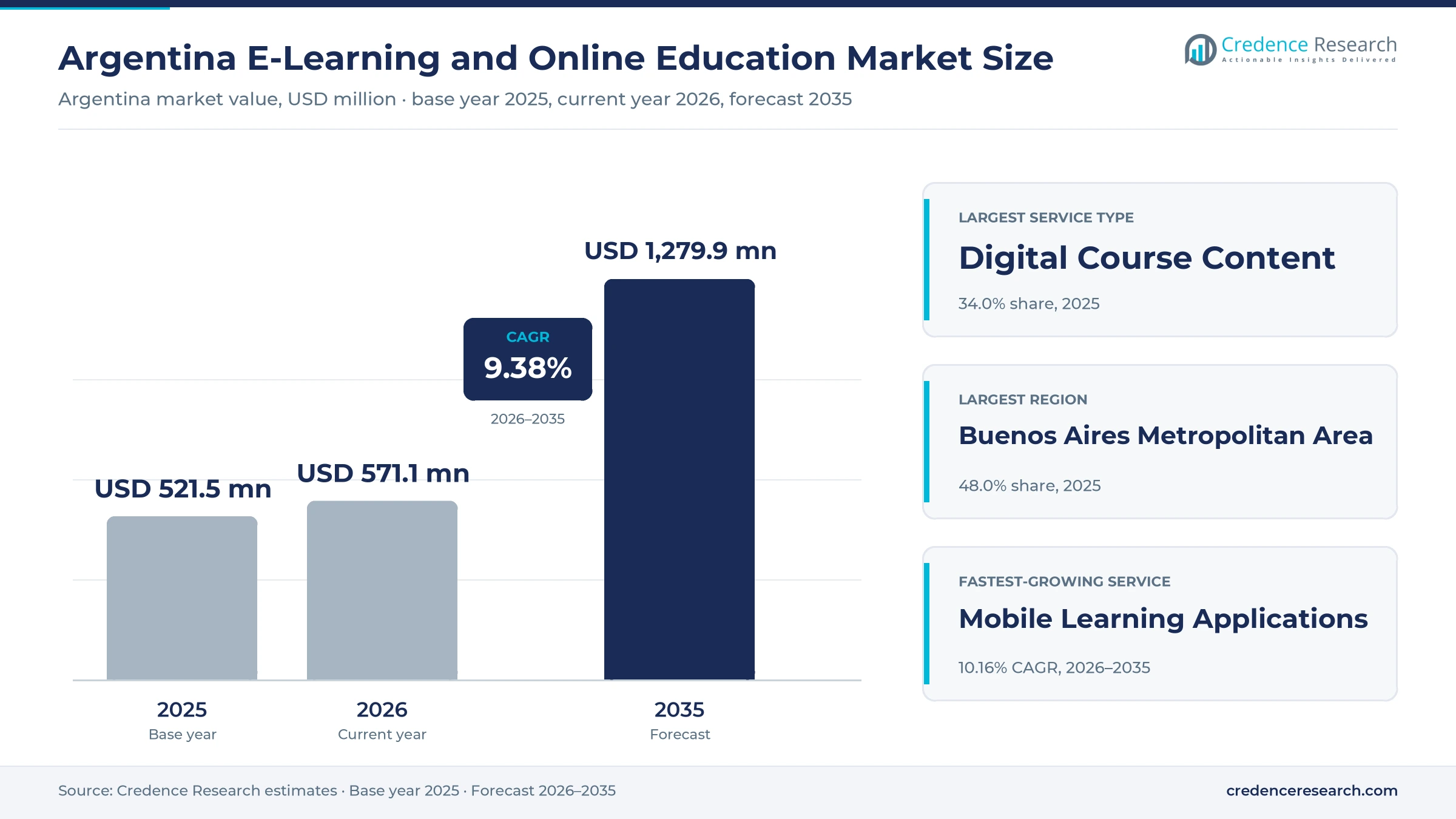
The Argentina e-learning and online education market was valued at USD 521.5 million in 2025 and is projected to increase from USD 571.1 million in 2026 to USD 1.28 billion by 2035, registering a CAGR of 9.38% during 2026–2035. Demand comes from employers that buy structured digital skills courses, from university students who study through validated distance systems and from adults who pay for coding, data and AI programs to change careers. The Buenos Aires Metropolitan Area held the largest regional share, 48.0% in 2025, because the capital region concentrates corporate head offices, universities and fixed broadband accesses. Mendoza, Tucumán and Patagonia form the fastest-growing zone at 9.73% a year, as high household connectivity meets long distances to campuses. International platforms, Argentine coding schools and universities with validated distance systems all compete for paid online learners. The end of the PAIS tax in December 2024 also lowered the surcharge on courses and subscriptions billed in foreign currency.
Which digital courses and learners does the estimate cover?
The estimate measures spending on digitally delivered study by learners located in Argentina. It covers learning management platforms, digital course content, instructor-led online services and mobile learning applications, sold to companies, schools, universities and individual adults. Values include subscriptions, course and program fees and contracted services paid by employers and institutions.
The estimate excludes on-campus teaching without a digital component, printed textbooks and general video platforms that do not sell structured courses. The value chain runs from content creators, universities and coding schools through platform vendors and app stores to employers, public programs and individual learners who pay for courses.
Argentina E-Learning and Online Education Market Insights
- The Argentina e-learning and online education market was valued at USD 521.5 million in 2025 and is projected to reach USD 1.28 billion by 2035, registering a CAGR of 9.38% during 2026–2035.
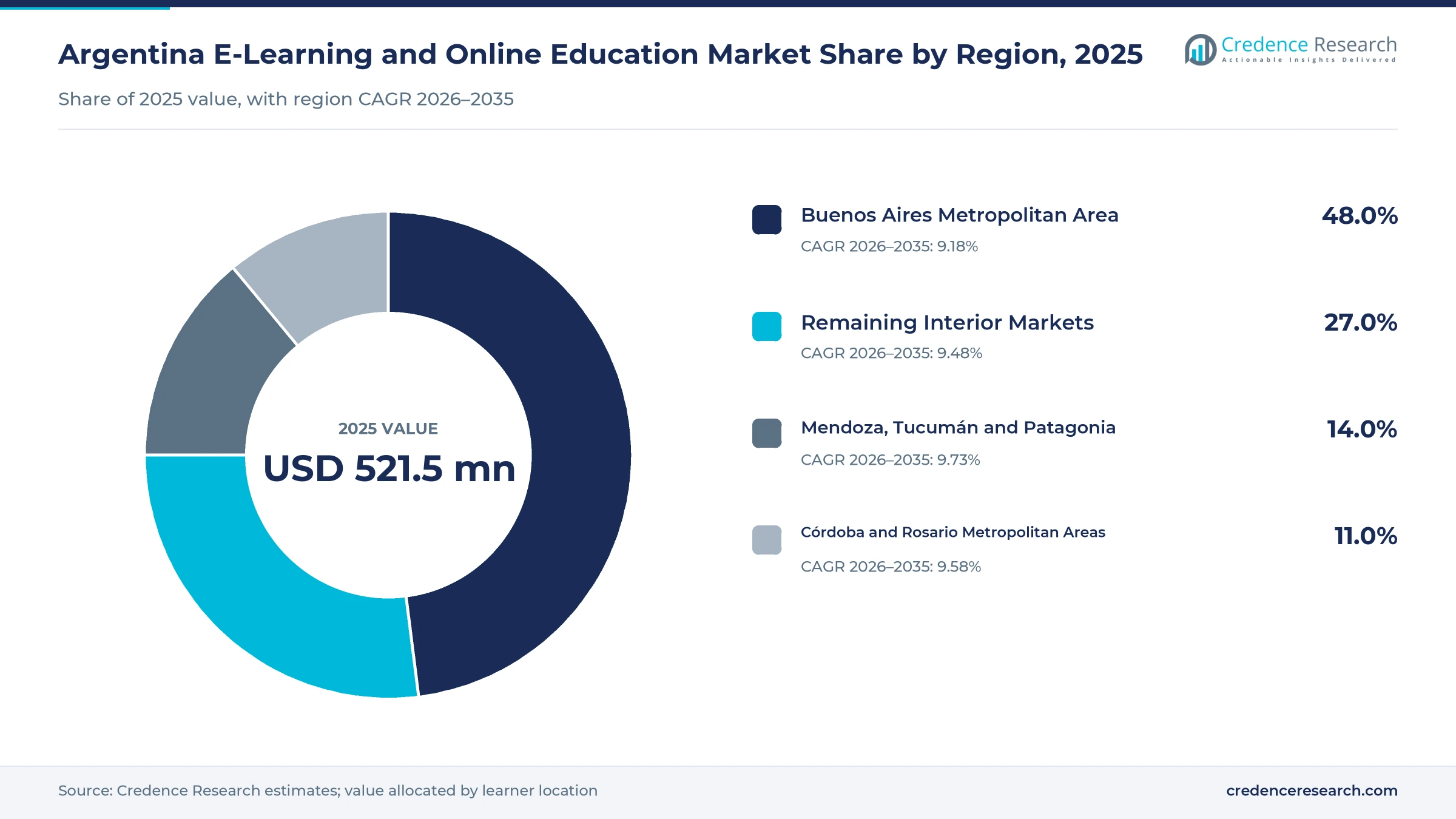
- The Buenos Aires Metropolitan Area held a 48.0% share of 2025 value, because the capital region concentrates employers and broadband accesses.
- Digital Course Content led with a 34.0% share of 2025 value, because buyers pay for coding, data and business courses one program at a time.
- About 93.7% of urban households had internet access in the fourth quarter of 2024, while only 60.3% owned a computer, which favors mobile study.
- Coursera completed its combination with Udemy on May 11, 2026, creating a platform that serves 290 million learners and 18,000 enterprise customers.
Course content leads while mobile study apps grow fastest
Why does digital course content lead spending?
Based on service type, the market is categorized into learning management platforms, digital course content, instructor-led online services and mobile learning applications. Digital Course Content led with a 34.0% share of 2025 value, because learners and employers buy coding, data and business courses program by program. Mobile Learning Applications grow fastest at 10.16% a year, as more Argentines study on phones than on computers.
How do corporate learners shape demand?
Based on learner segment, the market is categorized into corporate learners, school learners, higher education learners and independent adult learners. Corporate Learners led with a 36.0% share of 2025 value, because knowledge-economy employers pay for structured skills programs. Corporate Learners also grow fastest at 9.71% a year, as firms retrain staff in AI and cloud tools.
Why are live online cohorts growing fastest?
Based on delivery model, the market is categorized into self-paced online, live online cohorts and mixed online delivery. Self-Paced Online led with a 44.0% share of 2025 value, because large course libraries let learners study around work. Live Online Cohorts grow fastest at 9.76% a year, as Argentine coding schools sell scheduled classes with tutors and job support.
How do subscriptions change who pays?
Based on revenue model, the market is categorized into recurring subscriptions, course and program fees and contracted learning services. Course and Program Fees led with a 46.0% share of 2025 value, because bootcamps and universities charge per program. Recurring Subscriptions grow fastest at 9.84% a year, as employers and individuals move to monthly access across broad course catalogs.
| Segment Group | Leading Sub-segment | Share, 2025 | Fastest-growing Sub-segment | CAGR, 2026–2035 |
|---|---|---|---|---|
| By Service Type | Digital Course Content | 34.0% | Mobile Learning Applications | 10.16% |
| By Learner Segment | Corporate Learners | 36.0% | Corporate Learners | 9.71% |
| By Delivery Model | Self-Paced Online | 44.0% | Live Online Cohorts | 9.76% |
| By Revenue Model | Course and Program Fees | 46.0% | Recurring Subscriptions | 9.84% |
Request a Free Sample
Fill in your details and we'll send you a free sample report.
- Sample data tables & charts
- Research methodology
Connectivity, employer budgets and university rules
How do connected households support repeat study?
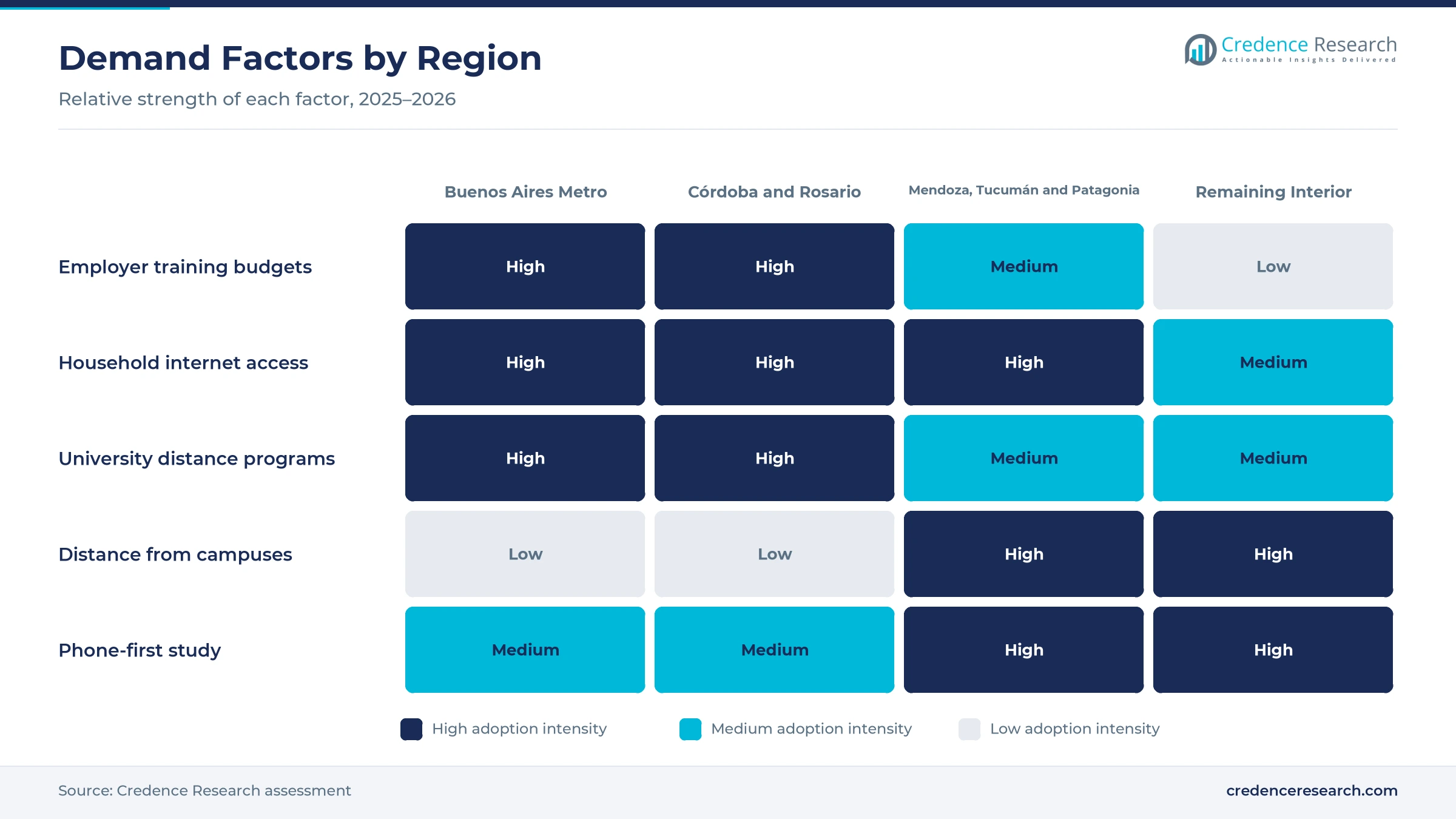
Near-universal home connectivity lets Argentine learners enroll in one course after another without buying new equipment, which drives steady demand. About 93.7% of urban households had internet access in the fourth quarter of 2024, according to the INDEC household ICT survey, and 89.7% of people aged four and over used the internet. Fixed internet accesses reached 8.52 million in the fourth quarter of 2025, up 4.1% on a year earlier, according to INDEC. Mobile use is even wider, as 90.5% of people used a mobile phone while only 60.3% of households owned a computer. As a result, mobile learning applications grow at 10.16% a year, the fastest service rate in the forecast.
Why do employers buy structured skills programs?
Technology and services exporters need a steady flow of trained staff, so they fund training that fuels demand for paid programs. Knowledge-economy service exports reached a record USD 9.6 billion in 2025, up 8.1%, according to the Ministry of Economy as reported by Diario Conclusión. The same sector passed 285,000 formal jobs in 2025, adding 9,000 positions over 2024. Argencon and Digital House launched IA Argentina on April 30, 2025, with 35,000 free online scholarships backed by Bagó, EY, AWS and VML, according to DPL News. These budgets sit alongside wider corporate training spending, and corporate learners hold a 36.0% share of 2025 value.
How does validated university distance study lift platform use?
Each Argentine university that teaches at a distance must operate a recognized institutional system, which drives steady adoption of digital tools. Ministerial Resolution 2641 of June 13, 2017, requires each university to set up a SIED that CONEAU evaluates before the Secretariat of University Policies validates it. Argentine universities offered 318 distance undergraduate programs and 125 distance postgraduate programs, according to the inter-university network CINDA. Those offers rose 35% and 95% over five years, while tertiary gross enrollment reached 107.8% in 2023, according to World Bank data. In turn, universities invest in LMS platforms that support blended and fully remote degree programs.
Why did the end of the PAIS tax help foreign courses?
Courses priced in dollars became cheaper for Argentine buyers after Dec. 23, 2024, when the PAIS tax stopped applying, which boosts demand for international platforms. The total surcharge on card purchases abroad fell from 60% to 30%, according to Chequeado. Digital services still carry a 30% income tax advance and 21% value-added tax, so dollar pricing remains a cost hurdle. Annual inflation also slowed to 31.5% in 2025 from 117.8% in 2024, according to INDEC data reported by Forbes Argentina. As a result, recurring subscriptions grow at 9.84% a year, the fastest revenue model rate.
AI courses and platform mergers reshape Argentine study
How is the rise of AI courses changing study?
Generative AI has become a core job skill for Argentine employers and workers, and course catalogs are shifting toward it. Google announced 15,000 new scholarships in Argentina on June 3, 2025, including a prompting course of under 10 hours, through the Potrero Digital program of Fundación Compromiso, according to Los Andes. IA Argentina adds online specializations in finance, legal services, programming, content creation, UX design, customer service and marketing. Coursera reported in June 2025 that Latin America had a 425% increase in GenAI enrollments, the highest anywhere. In turn, live online cohorts grow at 9.76% a year, as learners seek guided AI practice.
Why is the shift to platform consolidation gaining ground?
Scale now matters more in digital study, because large catalogs and enterprise contracts favor the biggest platforms. Coursera completed its combination with Udemy on May 11, 2026, according to a Coursera filing. The combined company serves 290 million learners and 18,000 enterprise customers worldwide. Coursera already had over 710,000 Argentine learners in 2020, through a partnership with Universidad Austral, according to Universidad de Palermo. Crehana also bought Argentine training company Wormhole in July 2022, which served more than 100 companies, according to Bloomberg Línea. In turn, enterprise buyers in Argentina get broader catalogs under single contracts, which suits firms that train whole teams at once.
Can live job-focused cohorts win career changers?
Career changers in Argentina increasingly pick programs with tutors, deadlines and employer links over recorded videos. Coderhouse, founded in Argentina in 2014, teaches through live online classes and reports a community of more than 300,000 students, according to Mercado. Its free CoderCamp ran from July 14 to 17, 2025, with speakers from Globant and Randstad, and over 35,000 people joined its three earlier editions. Digital House bought Acámica in June 2021, when Acámica had trained more than 150,000 students in the region, according to Enter.co. These schools compete with coding bootcamps worldwide, and they win learners who want scheduled classes with job support.
Is there room to reach phone-first learners?
Many Argentines now study on phones, because computer ownership is falling while mobile use stays near universal. In Gran Mendoza, households with at least one computer fell to 54.7% in late 2024 from 58.5% a year earlier, while household internet access rose to 96.3% from 95.8%, according to El Sol. People using a mobile phone reached 90.5% nationally in the same INDEC survey, ahead of the 37.1% who used a computer. Providers that design short lessons for mobile apps can therefore reach learners without laptops. This opening is largest in provinces where campuses are far apart and household budgets are tight, so phone-first courses offer a low-cost path into paid study.
Inflation, device gaps and dollar pricing limit demand
How does inflation weaken course budgets?
Prices rose 117.8% in 2024 and 31.5% in 2025, according to INDEC, which squeezes household spending on paid courses. Fast price changes cut income in real terms and make program fees hard to plan for both families and small firms. As a result, independent adult learners delay paid programs or choose free scholarships instead. Providers respond with installment plans, peso pricing and shorter courses that lower the cost of each purchase and keep learners enrolled.
Why do device gaps limit longer programs?
Only 60.3% of urban households owned a computer in late 2024, so many learners have no suitable device for long projects. These learners therefore study on phones, which suit short lessons but not demanding coding or design work. In turn, completion rates in longer programs can fall among lower-income students who lack a laptop at home. Providers respond with mobile-first content, lighter browser tools and partnerships that lend equipment to scholarship learners.
How do dollar-priced subscriptions raise costs?
Foreign digital services still carry an income tax advance and value-added tax on top of the list price, which raises what Argentine learners pay international platforms. Learners who pay by card therefore face a final bill well above the advertised price. As a result, local schools that bill in pesos keep a clear price edge over global rivals. International platforms respond with regional pricing, enterprise contracts and local partners that sell bundled access to companies.
Why does uneven regional connectivity slow growth?
Household internet access reached only 89.1% in the Northeast in late 2024, compared with 94.9% in Patagonia, so some provinces still lag. Learners in poorer provinces also have fewer local employers that fund training for their staff. In turn, paid enrollment spreads more slowly outside large cities and provincial capitals. Providers respond with mobile delivery, free introductory courses and public programs that cover fees for first courses in these areas.
Buenos Aires leads while western and southern zones gain
| Region | Value, 2025 (USD million) | Share, 2025 | CAGR, 2026–2035 |
|---|---|---|---|
| Buenos Aires Metropolitan Area | 250.3 | 48.0% | 9.18% |
| Remaining Interior Markets | 140.8 | 27.0% | 9.48% |
| Mendoza, Tucumán and Patagonia | 73.0 | 14.0% | 9.73% |
| Córdoba and Rosario Metropolitan Areas | 57.4 | 11.0% | 9.58% |
What keeps the capital region ahead in spending?
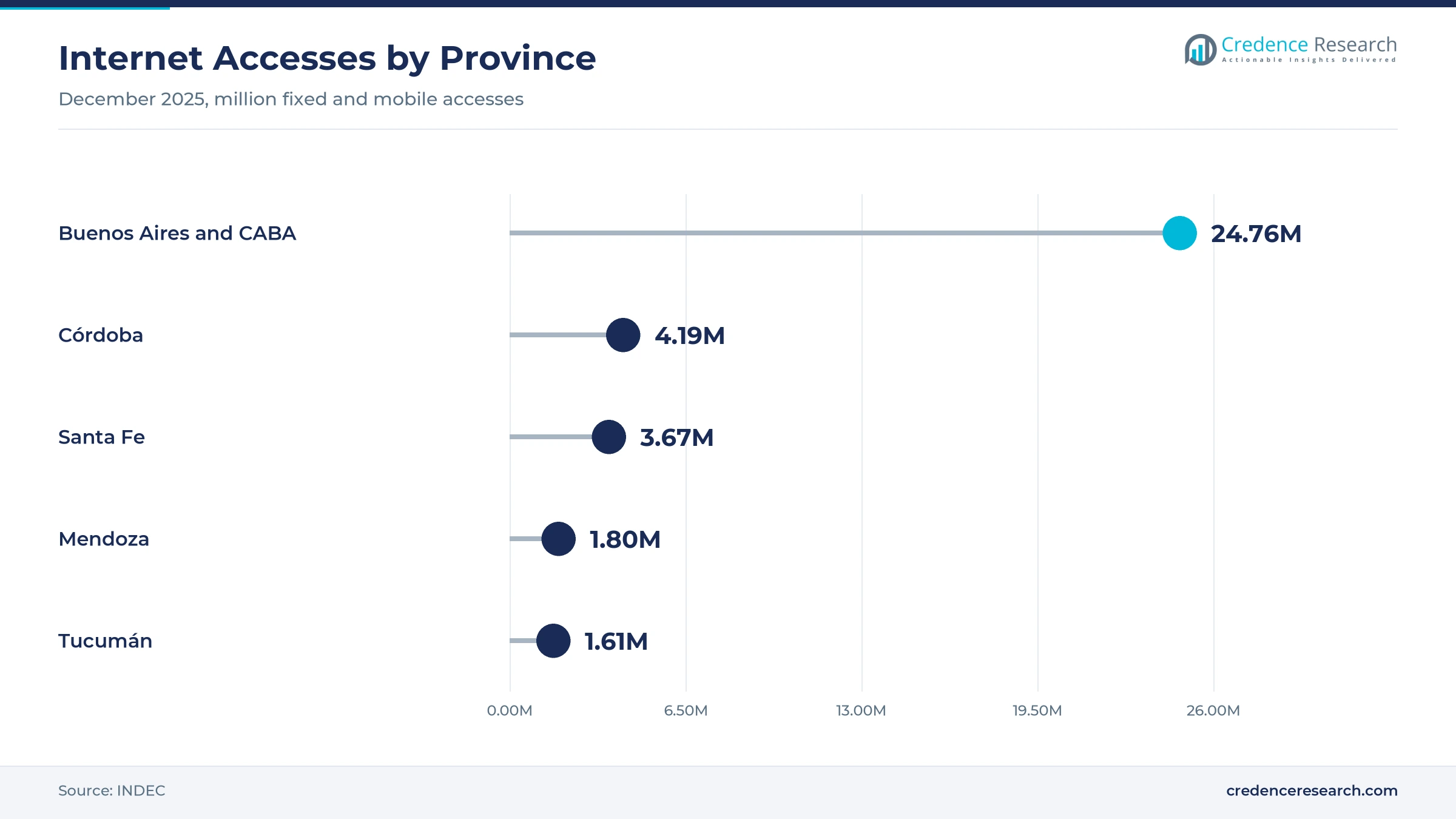
The Buenos Aires Metropolitan Area held a 48.0% share of 2025 value and grows at 9.18% a year, because the capital region hosts most corporate head offices and private universities. Buenos Aires province and the city together had 24.76 million internet accesses in December 2025, according to INDEC. The city also runs Talento Tech, a free program whose adult track is fully virtual. However, growth trails other zones, because the capital already has the deepest provider base.
How do Córdoba and Rosario add technology learners?
The Córdoba and Rosario Metropolitan Areas accounted for 11.0% of 2025 value and grow at 9.58% a year, because both cities host universities and technology employers. Córdoba province had 4.19 million internet accesses in December 2025, and Santa Fe had 3.67 million, according to INDEC. Household internet access in the Pampas region reached 93.7% in late 2024. As a result, corporate and higher education study gain learners across both metros.
How does distance from campuses speed western and southern study?
Mendoza, Tucumán and Patagonia held a 14.0% share of 2025 value and grow fastest at 9.73% a year, because connectivity is high while campuses are far apart. Patagonia had the highest household internet access at 94.9% in late 2024, ahead of Cuyo at 94.7%. Mendoza had 1.80 million internet accesses and Tucumán had 1.61 million in December 2025. As a result, online programs reach learners who would otherwise travel to study.
What brings first-time paying learners in smaller provinces?
The Remaining Interior Markets held a 27.0% share of 2025 value and grow at 9.48% a year, because many provinces have fewer universities and employers that fund training. The Northeast had the lowest household internet access at 89.1% in late 2024, while the Northwest reached 94.5%. However, mobile phones reach most residents, which gives short courses a path into smaller cities. Free scholarship programs also bring first-time learners onto paid platforms.
Tax relief, AI scholarships and a merger marked 2024 to 2026
| Development | Status and market relevance |
|---|---|
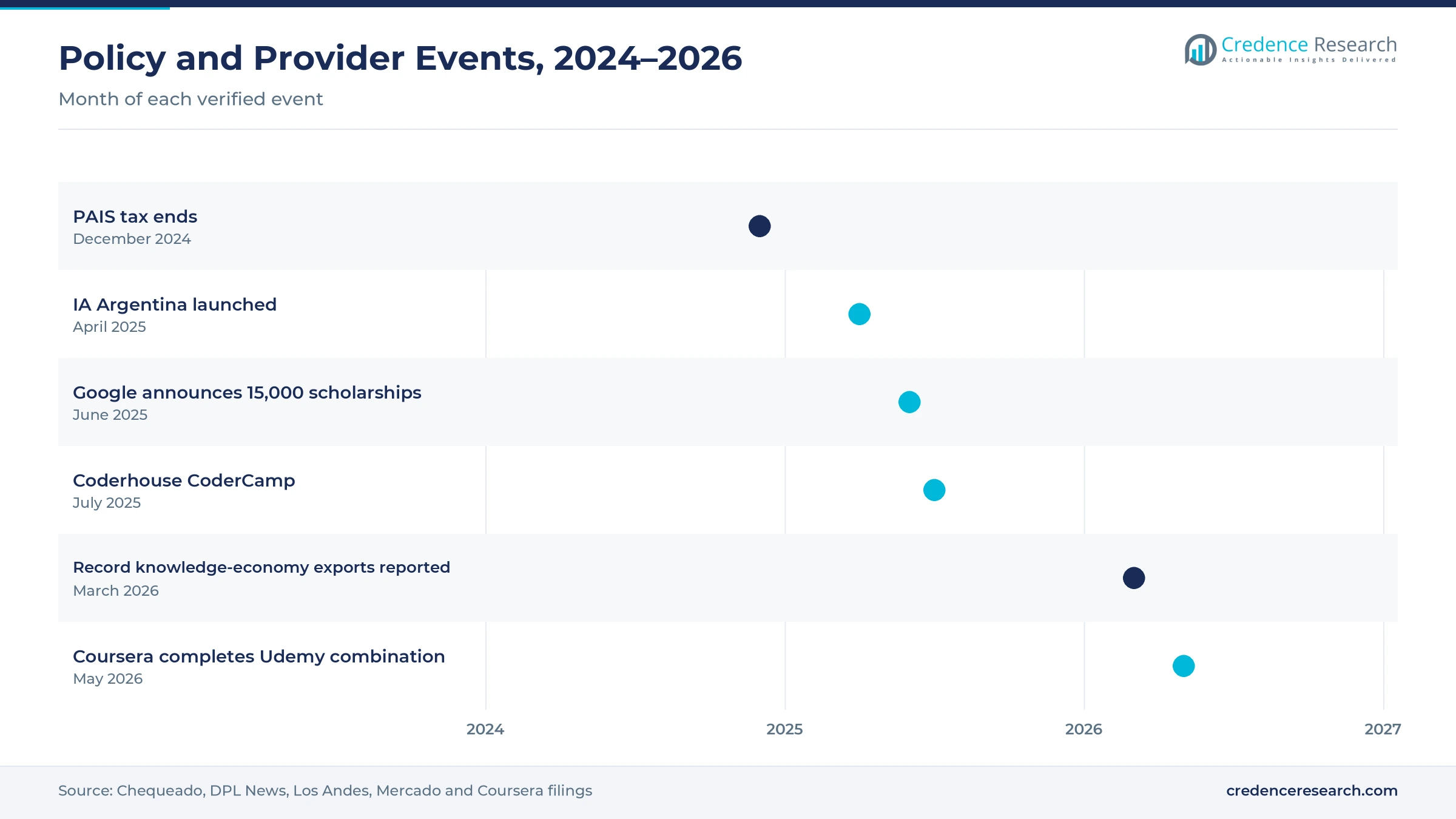
| In December 2024, the PAIS tax stopped applying, cutting the total surcharge on card purchases abroad from 60% to 30%. | Lowered the cost of courses billed in foreign currency |
| In April 2025, Argencon and Digital House launched IA Argentina with 35,000 free online scholarships. | Expanded employer-backed AI training across sectors |
| In June 2025, Google announced 15,000 new scholarships in Argentina, including a generative AI prompting course. | Widened free entry points to digital skills study |
| In July 2025, Coderhouse ran its free CoderCamp with speakers from Globant and Randstad. | Linked live online study to employment support |
| In May 2026, Coursera completed its combination with Udemy, serving 290 million learners and 18,000 enterprise customers. | Created a larger catalog for Argentine employers and learners |
Platforms, live classrooms and AI tutors shape delivery
- Learning management systems host courses, assessments and records for universities and employers, which lets validated distance systems track student progress.
- Live virtual classrooms run scheduled sessions with teachers and tutors, which supports the cohort model that Argentine coding schools sell.
- Mobile learning apps deliver short lessons on phones, which suits households that have internet access but no computer.
- AI tutoring and course tools suggest content and give feedback on exercises, which helps learners practice generative AI skills at their own pace.
Need a Custom Version of This Report?
Tailor the scope, geography, or segments to your exact requirements.
- Custom geography or segment scope
- Direct access to our analyst team
Global platforms and Argentine schools compete on jobs
Competition combines international platforms with large catalogs and Argentine schools that sell live, job-focused programs. Coursera completed its combination with Udemy in May 2026, which joins an open instructor marketplace to a university-partner catalog that already reached Argentine learners. Coderhouse, founded in Argentina in 2014, teaches through live online classes and runs free employability events with Globant and Randstad. Digital House runs the IA Argentina scholarship program with Argencon and corporate backers. Crehana sells business training across Latin America and bought the Argentine company Wormhole in 2022. Universities also compete through validated distance systems that CONEAU evaluates before approval. Rivals compete on price in pesos, credential value, tutor support, employer links and AI content. Local schools hold an edge on live teaching and local pricing, while global platforms win on catalog breadth and enterprise reporting.
Companies profiled and their roles in this market
| Company | Type | Role in the market |
|---|---|---|
| Coursera | International platform | Completed its combination with Udemy in May 2026 and partners with Argentine universities |
| Udemy | International marketplace | Open instructor marketplace now part of the combined Coursera group |
| Coderhouse | Argentine coding school | Live online classes and free CoderCamp events with Globant and Randstad |
| Digital House | Argentine digital school | Runs the IA Argentina scholarship program with Argencon |
| Crehana | Regional business training platform | Bought Argentine training company Wormhole in July 2022 |
Employer budgets and AI skills will set the growth pace
Credence Research's view is that Argentine spending on digital study will grow quickly because employers need AI and technology skills and most households are already online. Digital course content remains the base of the market, while mobile apps and subscriptions gain share. Live online cohorts grow fastest as career changers want tutors and job links. However, inflation, device gaps and dollar pricing will limit self-funded demand. Providers that combine peso pricing, recognized credentials and employer partnerships should gain share fastest.
Household ICT surveys and policy records shaped estimates
The report uses 2025 as the base year on a calendar basis, and market values come from the Credence Research model. That model combines INDEC household ICT surveys, internet access statistics by province, World Bank enrollment data, university regulation records and provider and company announcements. Segment splits, regional shares and regional growth rates are Credence Research estimates. Sources used are public reports, official statistics, company filings, company websites and news releases, and no interviews or surveys were used.
Subscriptions and live cohorts carry growth to 2035
Spending on digital study in Argentina is expected to reach USD 1.28 billion by 2035, a 9.38% CAGR during 2026–2035, as employer AI training, university distance programs and phone-based study keep demand rising. Growth should be strongest in the early years as inflation eases and AI scholarships turn into paid enrollments. After that, subscriptions and contracted services will carry more growth as platforms consolidate. A new inflation spike would lower this outlook, while faster employer adoption of AI would raise it. Providers with peso pricing and strong employer links are expected to gain most.
Frequently Asked Questions
How big is the Argentina e-learning and online education market?
Which service type leads digital study in Argentina?
Which region leads the Argentina e-learning and online education market?
How connected are Argentine households?
What drives employer spending on digital training?
Which delivery model is growing fastest?
Who are the leading providers in Argentina?
What are the main challenges for providers?
Table of Content
Chapter 1 Market Segmentation
- 1.1 Segmentation Framework
- 1.1.1 Product and Service Classification
- 1.1.2 Application and End-Use Classification
- 1.1.3 Technology and Solution Classification
- 1.1.4 Customer and Distribution Channel Classification
- 1.1.5 Geographic Segmentation
- 1.1.6 Market Segment Definitions and Boundaries
- 1.2 By Service Type
- 1.2.1 Learning Management Platforms
- 1.2.2 Digital Course Content
- 1.2.3 Instructor-Led Online Services
- 1.2.4 Mobile Learning Applications
- 1.3 By Learner Segment
- 1.3.1 Corporate Learners
- 1.3.2 School Learners
- 1.3.3 Higher Education Learners
- 1.3.4 Independent Adult Learners
- 1.4 By Delivery Model
- 1.4.1 Self-Paced Online
- 1.4.2 Live Online Cohorts
- 1.4.3 Mixed Online Delivery
- 1.5 By Revenue Model
- 1.5.1 Recurring Subscriptions
- 1.5.2 Course and Program Fees
- 1.5.3 Contracted Learning Services
Chapter 2 Introduction
- 2.1 Report Objectives and Scope
- 2.2 Product Definition and Industry Terminology
- 2.3 Market Inclusions and Exclusions
- 2.4 Research Process
- 2.4.1 Primary Research and Expert Interviews
- 2.4.2 Secondary Research and Source Review
- 2.4.3 Top-Down and Bottom-Up Estimation
- 2.4.4 Data Triangulation and Verification
- 2.5 Market Size Measurement Basis
- 2.5.1 2025: USD 521.5 million → 2035: USD 1.28 billion
- 2.6 Historical and Forecast Reference Periods
- 2.6.1 Historical Period: 2018-2025
- 2.6.2 Base Year: 2025
- 2.6.3 Forecast Period: 2025-2035
- 2.7 Research Assumptions and Limitations
Chapter 3 Executive Summary
- 3.1 Market Snapshot and Key Findings
- 3.2 Base-Year Market Size, 2025
- 3.3 Forecast Market Size, 2035
- 3.4 Revenue and Volume Growth Outlook
- 3.5 Key Demand and Supply Indicators
- 3.6 Leading Market Segments
- 3.7 Fastest-Growing Market Opportunities
- 3.8 Regional Performance Highlights
- 3.9 Technology and Industry Transformation
- 3.10 Competitive Landscape Summary
- 3.11 Analyst View and Strategic Implications
Chapter 4 Argentina E-Learning and Online Education Market Trends and Developments
- 4.1 Historical Industry Development, 2018-2025
- 4.2 Recent Market Trends and Developments
- 4.3 Demand and Customer Behavior Trends
- 4.4 Technology and Product Innovation
- 4.5 Artificial Intelligence, Automation and Digitalization
- 4.6 Local Manufacturing and Supply Chain Realignment
- 4.7 Industry Partnerships, Mergers and Acquisitions
- 4.8 Sustainability and Circular Economy Developments
- 4.9 Government and Private Sector Investment Trends
- 4.10 Emerging Business Models and Commercialization
- 4.11 Industry Developments and Announcements
Chapter 5 Argentina E-Learning and Online Education Market Production, Supply and Demand Analysis
- 5.1 Demand Trend and Consumption Analysis, 2018-2025
- 5.2 Demand Forecast, 2025-2035
- 5.3 Production and Output Trend, 2018-2025
- 5.4 Production and Output Forecast, 2025-2035
- 5.5 Installed Capacity and Capacity Utilization
- 5.6 Company-Wise Production Plants and Statistics
- 5.6.1 Installed Production Capacity
- 5.6.2 Actual Production
- 5.6.3 Planned Capacity and Expansion Targets
- 5.7 Supply Chain Structure and Procurement Trends
- 5.8 Supply-Demand Gap and Bottlenecks
- 5.9 Import Dependence and Sourcing Structure
- 5.10 Contract Manufacturing and Outsourcing
- 5.11 Regional Supply and Demand Concentration
Chapter 6 Argentina E-Learning and Online Education Market Pricing Analysis
- 6.1 Pricing Structure and Measurement
- 6.2 Historical Pricing Trends, 2018-2025
- 6.3 Pricing Outlook, 2025-2035
- 6.4 Average Selling Price and Unit Economics
- 6.5 Pricing by Product and Market Segment
- 6.6 Geographic Pricing Differences
- 6.7 Key Input, Energy, Labor and Logistics Costs
- 6.8 Contract Pricing and Purchasing Models
- 6.9 Pricing Sensitivity and Competitive Positioning
- 6.10 Price, Margin and Profitability Implications
Chapter 7 Argentina E-Learning and Online Education Market Dynamics
- 7.1 Market Growth Drivers
- 7.1.1 Demand-Side Drivers
- 7.1.2 Technology and Innovation Drivers
- 7.1.3 Infrastructure and Investment Drivers
- 7.1.4 Regulatory and Policy Drivers
- 7.2 Market Restraints
- 7.2.1 Cost and Affordability Constraints
- 7.2.2 Technology and Adoption Barriers
- 7.2.3 Supply Chain and Operational Constraints
- 7.3 Market Challenges
- 7.3.1 Competitive Pressure and Margin Erosion
- 7.3.2 Skills, Infrastructure and Implementation Gaps
- 7.4 Emerging Market Opportunities
- 7.5 Market Dynamics Impact and Time-Horizon Assessment
Chapter 8 Argentina E-Learning and Online Education Value Chain Analysis
- 8.1 Industry Value Chain Overview
- 8.2 Upstream Suppliers and Critical Inputs
- 8.3 Technology and Component Providers
- 8.4 Manufacturing or Service Delivery
- 8.5 Distribution, Channel Partners and Integrators
- 8.6 Downstream Applications and End Users
- 8.7 Value Addition and Profit Pools
- 8.8 Vertical Integration and Outsourcing
- 8.9 Supplier Concentration and Risk
- 8.10 Supply Chain Localization and Resilience
Chapter 9 Argentina E-Learning and Online Education Market Regulations and Policies
- 9.1 Relevant Laws, Standards and Compliance Frameworks
- 9.2 Product, Service, Safety and Quality Requirements
- 9.3 Government Policies, Incentives and Subsidies
- 9.4 Imports, Exports and Trade Barriers
- 9.5 Public Procurement and Local Content Requirements
- 9.6 Environmental and Sustainability Compliance
- 9.7 Data Protection, AI and Cybersecurity Compliance
- 9.8 Upcoming Policy Changes and Market Implications
Chapter 10 Argentina E-Learning and Online Education Market Hotspots and Opportunities
- 10.1 Market Opportunity Mapping and Growth Hotspots
- 10.2 High-Growth Applications and Customer Groups
- 10.3 Underserved Markets and White-Space Opportunities
- 10.4 Emerging Technology and Product Opportunities
- 10.5 New Capacity and Investment Hotspots
- 10.6 Market Entry and Expansion Opportunities
- 10.7 Distribution and Partnership Opportunities
- 10.8 Near-Term and Long-Term Commercial Potential
- 10.9 Opportunity Attractiveness and Execution Risks
Chapter 11 Argentina E-Learning and Online Education Market Outlook, 2025-2035
- 11.1 Market Size and Analysis
- 11.1.1 Revenue (Market Measurement: 2025: USD 521.5 million → 2035: USD 1.28 billion)
- 11.1.2 Market Volume and Quantity Sold
- 11.1.3 Historical Market Size, 2018-2025
- 11.1.4 Base-Year Market Size, 2025
- 11.2 Market Forecast, 2025-2035
- 11.2.1 Revenue Forecast to 2035
- 11.2.2 Volume Forecast to 2035
- 11.2.3 CAGR and Year-on-Year Growth
- 11.2.4 Incremental Revenue Opportunity
- 11.3 Forecast Assumptions and Scenario Analysis
- 11.3.1 Base-Case Forecast
- 11.3.2 Optimistic and Conservative Scenarios
- 11.3.3 Technology, Pricing and Policy Sensitivities
- 11.4 Market Attractiveness and Growth Outlook
Chapter 12 Argentina E-Learning and Online Education Market Segmentation and Outlook
- 12.1 Segmentation Summary and Market Shares, 2025
- 12.2 Largest and Fastest-Growing Segments
- 12.3 By Service Type - Market Size and Forecast, 2025-2035
- 12.3.1 Segment Definition and Scope
- 12.3.2 Historical Market Size, 2018-2025
- 12.3.3 Revenue Forecast, 2025-2035
- 12.3.4 Volume Forecast, 2025-2035
- 12.3.5 Base-Year Market Share, 2025
- 12.3.6 Segment CAGR and Growth Drivers
- 12.3.7 Subsegment Market Size and Forecast
- 12.3.7.1 Learning Management Platforms
- 12.3.7.2 Digital Course Content
- 12.3.7.3 Instructor-Led Online Services
- 12.3.7.4 Mobile Learning Applications
- 12.3.8 Subsegment Pricing and Adoption Trends
- 12.3.9 Leading Suppliers and Competition
- 12.3.10 Regional Demand and Opportunities
- 12.4 By Learner Segment - Market Size and Forecast, 2025-2035
- 12.4.1 Segment Definition and Scope
- 12.4.2 Historical Market Size, 2018-2025
- 12.4.3 Revenue Forecast, 2025-2035
- 12.4.4 Volume Forecast, 2025-2035
- 12.4.5 Base-Year Market Share, 2025
- 12.4.6 Segment CAGR and Growth Drivers
- 12.4.7 Subsegment Market Size and Forecast
- 12.4.7.1 Corporate Learners
- 12.4.7.2 School Learners
- 12.4.7.3 Higher Education Learners
- 12.4.7.4 Independent Adult Learners
- 12.4.8 Subsegment Pricing and Adoption Trends
- 12.4.9 Leading Suppliers and Competition
- 12.4.10 Regional Demand and Opportunities
- 12.5 By Delivery Model - Market Size and Forecast, 2025-2035
- 12.5.1 Segment Definition and Scope
- 12.5.2 Historical Market Size, 2018-2025
- 12.5.3 Revenue Forecast, 2025-2035
- 12.5.4 Volume Forecast, 2025-2035
- 12.5.5 Base-Year Market Share, 2025
- 12.5.6 Segment CAGR and Growth Drivers
- 12.5.7 Subsegment Market Size and Forecast
- 12.5.7.1 Self-Paced Online
- 12.5.7.2 Live Online Cohorts
- 12.5.7.3 Mixed Online Delivery
- 12.5.8 Subsegment Pricing and Adoption Trends
- 12.5.9 Leading Suppliers and Competition
- 12.5.10 Regional Demand and Opportunities
- 12.6 By Revenue Model - Market Size and Forecast, 2025-2035
- 12.6.1 Segment Definition and Scope
- 12.6.2 Historical Market Size, 2018-2025
- 12.6.3 Revenue Forecast, 2025-2035
- 12.6.4 Volume Forecast, 2025-2035
- 12.6.5 Base-Year Market Share, 2025
- 12.6.6 Segment CAGR and Growth Drivers
- 12.6.7 Subsegment Market Size and Forecast
- 12.6.7.1 Recurring Subscriptions
- 12.6.7.2 Course and Program Fees
- 12.6.7.3 Contracted Learning Services
- 12.6.8 Subsegment Pricing and Adoption Trends
- 12.6.9 Leading Suppliers and Competition
- 12.6.10 Regional Demand and Opportunities
- 12.7 Segment Growth Comparison
- 12.8 Segment Attractiveness and Priority Matrix
Chapter 13 Argentina E-Learning and Online Education Geographic Market Outlook, 2025-2035
- 13.1 Domestic Market Distribution and Demand Clusters
- 13.2 State- or Province-Wise Market Size and Forecast, 2025-2035
- 13.3 City and Metropolitan Market Outlook
- 13.4 Industrial, Manufacturing and Commercial Clusters
- 13.5 Geographic Concentration of Key End Users
- 13.6 Local Pricing and Purchasing Differences
- 13.7 Domestic Production Facilities and Capacity Map
- 13.8 Local Infrastructure and Project Pipeline
- 13.9 State-Level Policy and Incentive Differences
- 13.10 Subnational Investment Hotspots and Opportunities
- 13.11 Distribution and Logistics Networks
- 13.12 Domestic Competitive Footprint
Chapter 14 Argentina E-Learning and Online Education Technology, Innovation and Sustainability Outlook
- 14.1 Technology Landscape and Maturity
- 14.2 Product, Process and Service Innovation
- 14.3 AI, Automation and Digital Tools in the Industry
- 14.4 Technology Adoption and Performance Benchmarking
- 14.5 Innovation Pipeline and R&D Investment
- 14.6 Patent and Intellectual Property Trends
- 14.7 Energy Efficiency and Resource Management
- 14.8 Sustainability, Recycling and Circularity
- 14.9 Technology Roadmap, 2025-2035
- 14.10 Risks of Obsolescence and Technology Substitution
Chapter 15 Argentina E-Learning and Online Education Market Key Strategic Imperatives
- 15.1 Growth and Market Entry Priorities
- 15.2 High-Return Products and Segments
- 15.3 Pricing, Profitability and Cost Optimization
- 15.4 Technology Investment and Product Differentiation
- 15.5 Supply Chain Localization and Resilience
- 15.6 Distribution and Customer Acquisition
- 15.7 Partnership, Acquisition and Capacity Strategy
- 15.8 Regional Expansion Priorities
- 15.9 Short-, Medium- and Long-Term Actions
Chapter 16 Competition Outlook
- 16.1 Industry Competition Characteristics
- 16.2 Market Structure and Concentration
- 16.3 Market Share and Competitive Positioning, 2025
- 16.4 Company-Wise Revenue and Product Benchmarking
- 16.5 Production and Service Capacity Benchmarking
- 16.6 Technology, Pricing and Differentiation
- 16.7 Regional Footprint and Distribution Strength
- 16.8 Mergers, Acquisitions and Strategic Alliances
- 16.9 New Entrants and Competitive Threats
- 16.10 Porter's Five Forces and Industry Attractiveness
- 16.11 Competitive Outlook, 2025-2035
Chapter 17 Company Profiles
- 17.1 Company Coverage and Selection Criteria
- 17.2 Udemy
- 17.2.1 Business Description
- 17.2.2 Company Ownership and Geographic Presence
- 17.2.3 Product and Service Portfolio
- 17.2.4 Manufacturing and Operating Footprint
- 17.2.5 Production Capacity and Expansion Plans
- 17.2.6 Financial Performance and Investment
- 17.2.7 Market Share and Competitive Position
- 17.2.8 Technology and Innovation Capabilities
- 17.2.9 Strategic Alliances or Partnerships
- 17.2.10 Recent Developments
- 17.2.11 Growth Strategy and Outlook
- 17.3 Coursera
- 17.4 Coderhouse
- 17.5 Crehana
- 17.6 Digital House
- 17.7 Other Relevant Market Participants
Note: Every listed company is profiled on the structure shown under the first company. The company list is preliminary and may change based on research findings, market developments, data availability and client requirements.
Chapter 18 Disclaimer
- 18.1 Research and Forecast Disclaimer
- 18.2 Data Source and Estimation Limitations
Note: The depth of individual sections depends on data availability for this market. Volume, capacity, trade and other unit-based metrics are included where applicable.

