
| REPORT ATTRIBUTE | DETAILS |
|---|---|
| Historical Period | 2019-2022 |
| Base Year | 2023 |
| Forecast Period | 2024-2032 |
| Aromatic Solvents Market Size 2023 | USD 8,151.2 Million |
| Aromatic Solvents Market, CAGR | 3.00% |
| Aromatic Solvents Market Size 2032 | USD 10,635.46 Million |
Market Insights
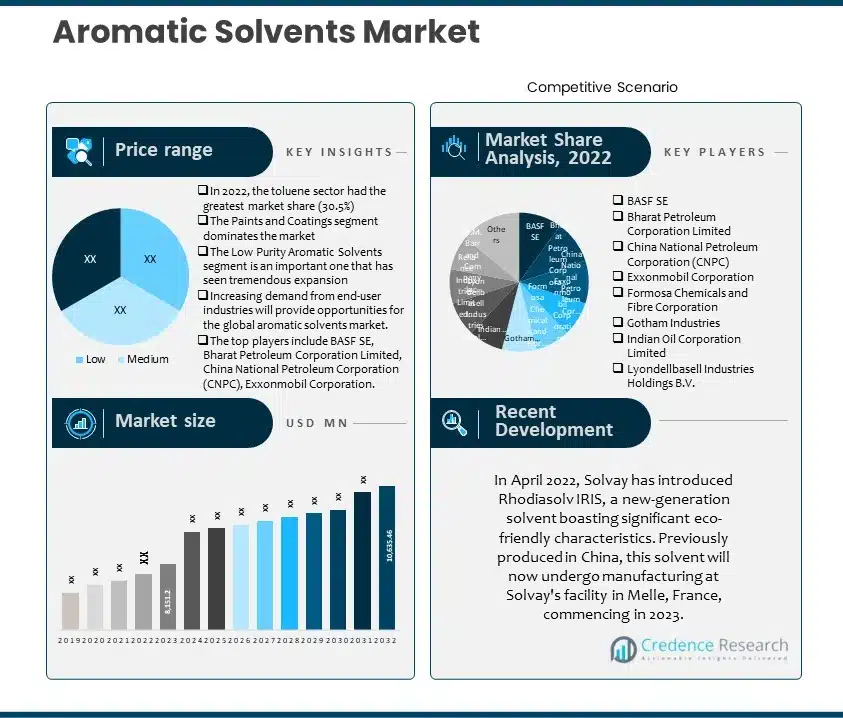
- The global demand for Aromatic Solvents was valued at USD 8,151.2 Million in 2023 and is expected to reach USD 10,635.46 Million in 2032, growing at a CAGR of 3.00% between 2024 and 2032.
- The toluene sector is the market leader by type, accounting for more than 31% of total value in 2023, while the xylene segment is expected to grow rapidly throughout the forecast period.
- The Paints and Coatings application dominates the global need for Aromatic Solvents, accounting for more than 20% in 2023 and is predicted to expand at a high CAGR.
- The Low Purity Aromatic Solvents sector is predicted to grow fastest over the projection period, while the High Purity Aromatic Solvents segment will have a market share of more than 55% in 2023.
- Over the projection period, the hydrogenation category is expected to expand at the highest rate, while the Reformulating category will dominate the market in 2023 with a 25% share.
- The vapor aromatic solvents category is expected to expand quickly over the forecast period, while the liquid aromatic solvents segment will have the greatest market share in 2023.
- North America is fueling the growth of the Aromatic Solvents industry with over one-third share in 2023, while Asia Pacific and Europe collectively account for just under 55% share in 2023. Europe held over 20% share in 2023.
- The market for Aromatic Solvents is driven by the increasing demand from end-user industries such as paints and coatings, adhesives, pharmaceuticals, and chemical manufacturing.
- The market's primary possibilities include the significant growth potential in North America, expansion of the automotive industry.
Executive Summary
Market Definition
Aromatic solvents are a type of organic solvent primarily composed of aromatic hydrocarbons such as benzene, toluene, and xylene. These solvents are characterized by their strong solvency power, low volatility, and ability to dissolve a wide range of substances including resins, polymers, oils, and fats. Aromatic solvents find extensive use in various industrial applications such as paints and coatings, adhesives, pharmaceuticals, chemical manufacturing, and printing inks due to their ability to enhance product performance, facilitate formulation processes, and achieve desired material properties. Additionally, aromatic solvents are favored for their relatively low toxicity and favorable environmental profile compared to some other types of solvents, contributing to their widespread adoption across different sectors.
Market Overview
The global Aromatic Solvents market has witnessed steady growth in recent years and is expected to grow at a CAGR of 3.00% between 2024 and 2032. The market was valued at USD 8,151.2 million in 2023 and is expected to reach USD 10,635.46 million in 2032.
The key driver boosting the growth rate of the Aromatic Solvents market is the increasing demand from end-user industries such as paints and coatings, adhesives, pharmaceuticals, and chemical manufacturing. The growth in the construction sector globally, driving demand for aromatic solvents in paints, coatings, and sealants positively impacts the target market's expansion. The market for Aromatic Solvents is expanding due to expansion of the automotive industry.
Furthermore, the expansion of the Aromatic Solvents market is actively driven by the increasing investments in infrastructure development projects, particularly in developing regions. The market is expected to grow significantly during the forecast above period due to the expansion of the pharmaceutical industry, particularly in the production of active pharmaceutical ingredients (APIs), resulting in higher demand for aromatic solvents as reaction solvents.
Segmentation by Type
- Toluene is the leading segment by type and held over 31% share in value in 2023, attributable to the rising disposable income levels and changing lifestyles.
- The xylene segment will likely exhibit a significant CAGR during the forecast period. Increasing investments in infrastructure development projects, particularly in developing regions.
- Ethylbenzene, benzene, and others is another segment but contributes very little to the global aromatic solvents market compared to the toluene, and xylene segments.
Segmentation by Application
- The paints and coatings segment governs the demand for aromatic solvents in the world, holding a massive share of over 20% in 2023, and is also expected to grow at a rapid CAGR due to the expansion of the automotive industry, particularly in emerging economies, leading to higher demand for aromatic solvents in automotive paints and coatings.
- The adhesives and sealants sectors segment contributes to the demand for Aromatic Solvents.
Segmentation by Purity Level
- The high purity aromatic solvents segment is expected to post the highest CAGR during the forecast period. This is primarily due to the growing preference for low-VOC (volatile organic compound) solvents in various applications, propelling the high purity aromatic solvents market.
- The low purity aromatic solvents segment is leading the market share with over 55% share in 2023.
Segmentation by Process Type
- The hydrogenation segment is anticipated to register the highest CAGR during the projection period.
- With a market share of nearly 25% in 2023, the reformulating category is currently in the lead.
- The extractive distillation, and others segments are also contributing significantly in growth of the market.
Segmentation by Product Form
- The liquid aromatic solvents dominate the global need for aromatic solvents, accounting for more than 50% in 2023 and are predicted to expand at a high CAGR.
- The rest of the demand for Aromatic Solvents comes from the vapor aromatic solvents market.
Segmentation by Region
- North America is fueling the growth of the Aromatic Solvents industry with over one-third share in 2023 due to the region's expanding automotive and construction industries and increased disposable income.
- Asia Pacific and Europe collectively account for just under 55% share in 2023, with Europe holding over 20% share in the same year.
- The rest of the world, including Latin America, the Middle East, and Africa, supplies the remaining demand for Aromatic Solvents.
North America is a dominant region in the aromatic solvent market, the market in the region is driven by a robust industrial base, stringent regulatory standards, and significant consumption across various end-user industries. The region's strong presence in sectors such as paints and coatings, automotive, pharmaceuticals, and electronics contributes to a steady demand for aromatic solvents. Additionally, technological advancements and a focus on sustainable practices further bolster the market in North America, with initiatives aimed at reducing VOC emissions and promoting the use of eco-friendly solvents.
The Asia Pacific emerges as the fastest-growing region in the aromatic solvents market, propelled by rapid industrialization, urbanization, and economic growth. Countries like China, India, and Japan are witnessing substantial investments in infrastructure development, automotive manufacturing, construction, and consumer goods industries, all of which fuel demand for aromatic solvents. Furthermore, the increasing adoption of low-VOC solvents, rising disposable incomes, and expanding middle-class population in the region contribute to the market's growth trajectory.
The primary factor driving the Aromatic Solvents market's growth rate is the growth in construction sector globally, driving demand for aromatic solvents in paints, coatings, and sealants. The rising adoption of printing inks in packaging and publication industries, boosting the demand for aromatic solvents as ink solvents.
Key Highlights of the Report
The global Aromatic Solvents market is segmented by type, application, purity level, process type, product form, and region. Toluene-based Aromatic Solvents are the most popular, while paints and coatings, and adhesives and sealants are the primary segments. In addition, high purity aromatic solvents, and reformulating cables are the most commonly used categories. However, liquid aromatic solvents dominate the market, with North America leading the market growth.
One of the main factors propelling the global market for Aromatic Solvents is increasing demand from end-user industries. The growth in the construction sector globally, driving demand for aromatic solvents in paints, coatings, and sealants drives up demand for Aromatic Solvents components. The expansion of the automotive industry, particularly in emerging economies is another factor boosting the size of the global market.
Nonetheless, North America is anticipated to have the greatest share of the worldwide Aromatic Solvents market because of the advancements in extraction and processing technologies, leading to cost-effective production of aromatic solvents. Furthermore, the market is anticipated to expand at the highest rate in the Asia-Pacific (APAC) region due to the Increasing investments in infrastructure development projects, particularly in developing regions, driving the demand for construction-related products and, consequently, aromatic solvents.
What Are The Main Drivers Of The Global Aromatic Solvents Market?
The main drivers of the global aromatic solvents market include increasing demand from end-user industries such as paints and coatings, adhesives, pharmaceuticals, and chemical manufacturing, along with growth in the construction and automotive sectors, advancements in extraction and processing technologies, and rising preference for low-VOC solvents.
What Are The Major Challenges Faced By The Global Aromatic Solvents Market?
The major challenges faced by the global aromatic solvents market include stringent regulatory standards regarding VOC emissions, fluctuating prices of raw materials such as crude oil, environmental concerns related to solvent disposal and emissions, and competition from alternative solvents or technologies.
What Are The Growth Opportunities In The Global Aromatic Solvents Market?
The growth opportunities in the global aromatic solvents market include expanding applications in emerging sectors like electronics and agriculture, advancements in eco-friendly solvent formulations to meet regulatory requirements, penetration into untapped markets in developing regions, development of novel applications and formulations to cater to evolving consumer preferences, and strategic collaborations or mergers and acquisitions to strengthen market presence and enhance product offerings.
Market Drivers
The global Aromatic Solvents market is driven by several factors. The following are the key drivers of the global Aromatic Solvents market:
Increasing demand for low-VOC solvents
The increasing demand for low-VOC solvents in various industries is a significant driver for the global aromatic solvents market. With growing environmental concerns and stringent regulations imposed by governments worldwide to reduce volatile organic compound (VOC) emissions, there is a shift towards the adoption of aromatic solvents due to their relatively lower VOC content compared to other solvent types. This demand is particularly evident in sectors such as paints and coatings, adhesives, and printing inks, where manufacturers are actively seeking eco-friendly alternatives to comply with regulations while maintaining product performance. According to the Environmental Protection Agency (EPA), VOC emissions from industrial solvent use account for approximately 30% of total VOC emissions in the United States. As a response to this environmental concern, the EPA has implemented regulations such as the National Emission Standards for Hazardous Air Pollutants (NESHAP) to limit VOC emissions from solvent-based processes, thereby driving the demand for low-VOC aromatic solvents in the country.
Market Restraints
The global Aromatic Solvents market faces some challenges that may hinder its growth. These include the following:
Fluctuating prices of crude oil
Fluctuating prices of crude oil, a key raw material in the production of aromatic solvents, pose a significant restraint to the global aromatic solvents market. As crude oil prices are subject to various geopolitical factors, market volatility can impact the production costs of aromatic solvents, thereby affecting profit margins for manufacturers. This uncertainty in raw material costs can hinder investment decisions, expansion plans, and overall market growth, as companies may struggle to maintain competitive pricing amidst fluctuating input costs.
Opportunities
The global Aromatic Solvents market offers significant growth opportunities. These include the following:
Government initiatives and incentives promoting sustainable practices
Government initiatives and incentives promoting sustainable practices and green technologies present a significant opportunity for the global aromatic solvents market. Many governments are implementing policies to encourage the use of eco-friendly solvents and reduce reliance on traditional, more harmful alternatives. For instance, subsidies, tax breaks, and grants are often offered to companies investing in research and development of low-VOC formulations or transitioning to greener manufacturing processes. By capitalizing on these incentives and aligning with governmental sustainability goals, aromatic solvent manufacturers can not only enhance their market position but also contribute to positive environmental outcomes.
Competitive Landscape
Key Players
The global Aromatic Solvents market is highly competitive, with several key players. Some of the major players in the market and their market share are as follows:
- BASF SE
- Bharat Petroleum Corporation Limited
- China National Petroleum Corporation (CNPC)
- Exxonmobil Corporation
- Formosa Chemicals and Fibre Corporation
- Gotham Industries
- Indian Oil Corporation Limited
- Lyondellbasell Industries Holdings B.V.
- Reliance Industries Limited (RIL)
- W.M. Barr and Company Inc.
- Others
These organizations prioritize product innovation, distribution channel expansion, and mergers and acquisitions to stay competitive.
The global Aromatic Solvents market's key players continually seek to stay ahead by offering new products and developments.
In April 2022, Solvay has introduced Rhodiasolv IRIS, a new-generation solvent boasting significant eco-friendly characteristics. Previously produced in China, this solvent will now undergo manufacturing at Solvay's facility in Melle, France, commencing in 2023.
In February 2021, Honeywell International Inc. reports that Hengyi Industries has implemented state-of-the-art aromatics technology from Honeywell UOP at its petrochemical complex located in Pulau Muara Besar, Brunei. With a production capacity of approximately 200,000 barrels per day, the facility caters to the escalating demand for paraxylene in Asia, compelling companies to invest substantially in innovative technologies for converting crude oil into petrochemicals.
Summary of Key Findings
- The demand for aromatic solvents is rising due to the expansion of the automotive industry, particularly in emerging economies, leading to higher demand for aromatic solvents in automotive paints and coatings, which is boosting the growth of the Aromatic Solvents market.
- Market segmented by type, application, purity level, process type, product form, and region.
- Toluene-based Aromatic Solvents are the most popular, while paints and coatings, and adhesives and sealants are the primary segments.
- High purity aromatic solvents, and reformulating cables are the most commonly used categories. However, liquid aromatic solvents dominate the market.
- North America is leading market growth; the market is highly competitive with key players including BASF SE, Bharat Petroleum Corporation Limited, China National Petroleum Corporation (CNPC), Exxonmobil Corporation, Formosa Chemicals and Fibre Corporation, Gotham Industries, Indian Oil Corporation Limited, Lyondellbasell Industries Holdings B.V., Reliance Industries Limited (RIL), W.M. Barr and Company Inc., and Others.
Future Outlook
- Positive outlook for the global Aromatic Solvents market with significant growth potential in the North American region
- One of the main factors promoting the market's expansion is the government and business sectors' current reliance on Aromatic Solvents.
- During the forecast period, fluctuation in raw material prices is a significant factor projected to restrain the growth of the Aromatic Solvents market.
- Key firms must focus on product innovation, growing market reach, and maintaining competitive pricing to keep ahead of the competition.
How CXOs Can Benefit from the Credence Research Aromatic Solvents Market Report
The Credence Research Aromatic Solvents Market Report provides CXOs with a comprehensive overview of the market, including:
- Market size and growth forecast: The report provides detailed estimates of the global Aromatic Solvents market size, segmented by type, application, purity level, process type, product form, and region. It also includes forecasts for the market through 2032, based on key trends and drivers.
- Market segmentation: The report segments the Aromatic Solvents market by type, application, purity level, process type, product form, and region. This segmentation provides CXOs with a granular understanding of the market and the opportunities in each segment.
- Competitive landscape: The report profiles the key players in the Aromatic Solvents market and provides insights into their strategies, product offerings, and financial performance. This information can help CXOs to identify and assess their competition.
- Key trends and drivers: The report identifies and analyzes the key trends and drivers that are shaping the Aromatic Solvents This information can help CXOs to make informed decisions about their investments and strategies.
CXOs can use the insights from the Credence Research Aromatic Solvents Market Report to:
- Identify growth opportunities: The report can help CXOs to identify new growth opportunities in the Aromatic Solvents For example, the report identifies the growing demand for Aromatic Solvents from automotive OEMs and construction companies as a key opportunity.
- Make informed investment decisions: The report can help CXOs to make informed investment decisions about Aromatic Solvents. For example, the report provides insights into the key factors to consider when evaluating Aromatic Solvents providers and selecting Aromatic Solvents
- Develop competitive strategies: The report can help CXOs to develop competitive strategies for their Aromatic Solvents For example, the report identifies the key strategies that Aromatic Solvents providers are using to differentiate themselves from their competitors.
- Track market developments: The report can help CXOs to track market developments and stay ahead of the curve. For example, the report provides insights into the latest trends and innovations in the Aromatic Solvents
Overall, the Credence Research Aromatic Solvents Market Report is a valuable resource for CXOs who are looking to gain a deeper understanding of the market and identify opportunities for growth.
Segmentation
- By Type
- Toluene
- Xylene (Ortho, Meta, Para)
- Ethylbenzene
- Benzene
- Others
- By Application
- Paints and Coatings
- Adhesives and Sealants
- Printing Inks
- Pharmaceuticals
- Chemical Intermediates
- Automotive
- Others
- By Purity Level
- High Purity Aromatic Solvents
- Low Purity Aromatic Solvents
- By Process Type
- Reformulating
- Hydrogenation
- Extractive Distillation
- Others
- By Product Form
- Liquid Aromatic Solvents
- Vapor Aromatic Solvents
- By Region
- North America
- The U.S.
- Canada
- Mexico
- Europe
- Germany
- France
- The U.K.
- Italy
- Spain
- Rest of Europe
- Asia Pacific
- China
- Japan
- India
- South Korea
- South-east Asia
- Rest of Asia Pacific
- Latin America
- Brazil
- Argentina
- Rest of Latin America
- Middle East & Africa
- GCC Countries
- South Africa
- Rest of Middle East and Africa
- North America

Request a Free Sample
Fill in your details and we'll send you a free sample report.
- Sample data tables & charts
- Research methodology
Market Dynamics
Expansion of Construction and Infrastructure Sectors
Rapid growth in construction and infrastructure projects, especially in emerging economies, is driving demand for paints, coatings, and sealants, which are major end-users of aromatic solvents.
Growth in Automotive Manufacturing
The automotive industry's expansion, particularly in Asia Pacific and North America, increases the need for high-performance paints and coatings, directly boosting aromatic solvent consumption.
Rising Demand for Low-VOC and High Purity Solvents
Stricter environmental regulations and a shift toward sustainable manufacturing are increasing the adoption of low-VOC and high purity aromatic solvents in industries such as paints, adhesives, and pharmaceuticals.
Technological Advancements in Extraction and Processing
Innovations in extraction and processing technologies are making aromatic solvent production more cost-effective and environmentally friendly, encouraging broader adoption across end-user industries.
Expansion of Pharmaceutical and Chemical Manufacturing
The growing pharmaceutical sector, especially in the production of active pharmaceutical ingredients (APIs), is increasing the use of aromatic solvents as reaction media and intermediates.
Need a Custom Version of This Report?
Tailor the scope, geography, or segments to your exact requirements.
- Custom geography or segment scope
- Direct access to our analyst team
Frequently Asked Questions
What is the current size of the global Aromatic Solvents market?
What is the expected growth rate of the Aromatic Solvents market between 2024 and 2032?
Which segment is leading the market share in terms of type?
Which application segment governs the demand for Aromatic Solvents in the world?
What are the major market drivers of the Aromatic Solvents industry?
Who are the major players in the global Aromatic Solvents market?
Table of Content
Chapter 1 Market Segmentation
- 1.1 Segmentation Framework
- 1.1.1 Product and Service Classification
- 1.1.2 Application and End-Use Classification
- 1.1.3 Technology and Solution Classification
- 1.1.4 Customer and Distribution Channel Classification
- 1.1.5 Geographic Segmentation
- 1.1.6 Market Segment Definitions and Boundaries
- 1.2 By Type
- 1.2.1 Toluene
- 1.2.2 Xylene (Ortho, Meta, Para)
- 1.2.3 Ethylbenzene
- 1.2.4 Benzene
- 1.2.5 Others
- 1.3 By Application
- 1.3.1 Paints and Coatings
- 1.3.2 Adhesives and Sealants
- 1.3.3 Printing Inks
- 1.3.4 Pharmaceuticals
- 1.3.5 Chemical Intermediates
- 1.3.6 Automotive
- 1.3.7 Others
- 1.4 By Process Type
- 1.4.1 Reformulating
- 1.4.2 Hydrogenation
- 1.4.3 Extractive Distillation
- 1.4.4 Others
- 1.5 By Purity Level
- 1.5.1 High Purity Aromatic Solvents
- 1.5.2 Low Purity Aromatic Solvents
Chapter 2 Introduction
- 2.1 Report Objectives and Scope
- 2.2 Product Definition and Industry Terminology
- 2.3 Market Inclusions and Exclusions
- 2.4 Research Process
- 2.4.1 Primary Research and Expert Interviews
- 2.4.2 Secondary Research and Source Review
- 2.4.3 Top-Down and Bottom-Up Estimation
- 2.4.4 Data Triangulation and Verification
- 2.5 Market Size Measurement Basis
- 2.5.1 2023: USD 8,151.2 Million → 2032: USD 10,635.46 Million
- 2.6 Historical and Forecast Reference Periods
- 2.6.1 Base Year: 2023
- 2.6.2 Forecast Period: 2023-2032
- 2.7 Research Assumptions and Limitations
Chapter 3 Executive Summary
- 3.1 Market Snapshot and Key Findings
- 3.2 Base-Year Market Size, 2023
- 3.3 Forecast Market Size, 2032
- 3.4 Revenue and Volume Growth Outlook
- 3.5 Key Demand and Supply Indicators
- 3.6 Leading Market Segments
- 3.7 Fastest-Growing Market Opportunities
- 3.8 Regional Performance Highlights
- 3.9 Technology and Industry Transformation
- 3.10 Competitive Landscape Summary
- 3.11 Analyst View and Strategic Implications
Chapter 4 Global Aromatic Solvents Market Trends and Developments
- 4.1 Historical Industry Development
- 4.2 Recent Market Trends and Developments
- 4.3 Demand and Customer Behavior Trends
- 4.4 Technology and Product Innovation
- 4.5 Artificial Intelligence, Automation and Digitalization
- 4.6 Local Manufacturing and Supply Chain Realignment
- 4.7 Industry Partnerships, Mergers and Acquisitions
- 4.8 Sustainability and Circular Economy Developments
- 4.9 Government and Private Sector Investment Trends
- 4.10 Emerging Business Models and Commercialization
- 4.11 Industry Developments and Announcements
Chapter 5 Global Aromatic Solvents Market Production, Supply and Demand Analysis
- 5.1 Demand Trend and Consumption Analysis
- 5.2 Demand Forecast, 2023-2032
- 5.3 Production and Output Trend
- 5.4 Production and Output Forecast, 2023-2032
- 5.5 Installed Capacity and Capacity Utilization
- 5.6 Company-Wise Production Plants and Statistics
- 5.6.1 Installed Production Capacity
- 5.6.2 Actual Production
- 5.6.3 Planned Capacity and Expansion Targets
- 5.7 Supply Chain Structure and Procurement Trends
- 5.8 Supply-Demand Gap and Bottlenecks
- 5.9 Import Dependence and Sourcing Structure
- 5.10 Contract Manufacturing and Outsourcing
- 5.11 Regional Supply and Demand Concentration
Chapter 6 Global Aromatic Solvents Market Pricing Analysis
- 6.1 Pricing Structure and Measurement
- 6.2 Historical Pricing Trends
- 6.3 Pricing Outlook, 2023-2032
- 6.4 Average Selling Price and Unit Economics
- 6.5 Pricing by Product and Market Segment
- 6.6 Geographic Pricing Differences
- 6.7 Key Input, Energy, Labor and Logistics Costs
- 6.8 Contract Pricing and Purchasing Models
- 6.9 Pricing Sensitivity and Competitive Positioning
- 6.10 Price, Margin and Profitability Implications
Chapter 7 Global Aromatic Solvents Market Dynamics
- 7.1 Market Growth Drivers
- 7.1.1 Demand-Side Drivers
- 7.1.2 Technology and Innovation Drivers
- 7.1.3 Infrastructure and Investment Drivers
- 7.1.4 Regulatory and Policy Drivers
- 7.2 Market Restraints
- 7.2.1 Cost and Affordability Constraints
- 7.2.2 Technology and Adoption Barriers
- 7.2.3 Supply Chain and Operational Constraints
- 7.3 Market Challenges
- 7.3.1 Competitive Pressure and Margin Erosion
- 7.3.2 Skills, Infrastructure and Implementation Gaps
- 7.4 Emerging Market Opportunities
- 7.5 Market Dynamics Impact and Time-Horizon Assessment
Chapter 8 Global Aromatic Solvents Value Chain Analysis
- 8.1 Industry Value Chain Overview
- 8.2 Upstream Suppliers and Critical Inputs
- 8.3 Technology and Component Providers
- 8.4 Manufacturing or Service Delivery
- 8.5 Distribution, Channel Partners and Integrators
- 8.6 Downstream Applications and End Users
- 8.7 Value Addition and Profit Pools
- 8.8 Vertical Integration and Outsourcing
- 8.9 Supplier Concentration and Risk
- 8.10 Supply Chain Localization and Resilience
Chapter 9 Global Aromatic Solvents Market Regulations and Policies
- 9.1 Relevant Laws, Standards and Compliance Frameworks
- 9.2 Product, Service, Safety and Quality Requirements
- 9.3 Government Policies, Incentives and Subsidies
- 9.4 Imports, Exports and Trade Barriers
- 9.5 Public Procurement and Local Content Requirements
- 9.6 Environmental and Sustainability Compliance
- 9.7 Upcoming Policy Changes and Market Implications
Chapter 10 Global Aromatic Solvents Market Hotspots and Opportunities
- 10.1 Market Opportunity Mapping and Growth Hotspots
- 10.2 High-Growth Applications and Customer Groups
- 10.3 Underserved Markets and White-Space Opportunities
- 10.4 Emerging Technology and Product Opportunities
- 10.5 New Capacity and Investment Hotspots
- 10.6 Market Entry and Expansion Opportunities
- 10.7 Distribution and Partnership Opportunities
- 10.8 Near-Term and Long-Term Commercial Potential
- 10.9 Opportunity Attractiveness and Execution Risks
Chapter 11 Global Aromatic Solvents Market Outlook, 2023-2032
- 11.1 Market Size and Analysis
- 11.1.1 Revenue (Market Measurement: 2023: USD 8,151.2 Million → 2032: USD 10,635.46 Million)
- 11.1.2 Market Volume and Quantity Sold
- 11.1.3 Historical Market Size
- 11.1.4 Base-Year Market Size, 2023
- 11.2 Market Forecast, 2023-2032
- 11.2.1 Revenue Forecast to 2032
- 11.2.2 Volume Forecast to 2032
- 11.2.3 CAGR and Year-on-Year Growth
- 11.2.4 Incremental Revenue Opportunity
- 11.3 Forecast Assumptions and Scenario Analysis
- 11.3.1 Base-Case Forecast
- 11.3.2 Optimistic and Conservative Scenarios
- 11.3.3 Technology, Pricing and Policy Sensitivities
- 11.4 Market Attractiveness and Growth Outlook
Chapter 12 Global Aromatic Solvents Market Segmentation and Outlook
- 12.1 Segmentation Summary and Market Shares, 2023
- 12.2 Largest and Fastest-Growing Segments
- 12.3 By Type - Market Size and Forecast, 2023-2032
- 12.3.1 Segment Definition and Scope
- 12.3.2 Historical Market Size
- 12.3.3 Revenue Forecast, 2023-2032
- 12.3.4 Volume Forecast, 2023-2032
- 12.3.5 Base-Year Market Share, 2023
- 12.3.6 Segment CAGR and Growth Drivers
- 12.3.7 Subsegment Market Size and Forecast
- 12.3.7.1 Toluene
- 12.3.7.2 Xylene (Ortho, Meta, Para)
- 12.3.7.3 Ethylbenzene
- 12.3.7.4 Benzene
- 12.3.7.5 Others
- 12.3.8 Subsegment Pricing and Adoption Trends
- 12.3.9 Leading Suppliers and Competition
- 12.3.10 Regional Demand and Opportunities
- 12.4 By Application - Market Size and Forecast, 2023-2032
- 12.4.1 Segment Definition and Scope
- 12.4.2 Historical Market Size
- 12.4.3 Revenue Forecast, 2023-2032
- 12.4.4 Volume Forecast, 2023-2032
- 12.4.5 Base-Year Market Share, 2023
- 12.4.6 Segment CAGR and Growth Drivers
- 12.4.7 Subsegment Market Size and Forecast
- 12.4.7.1 Paints and Coatings
- 12.4.7.2 Adhesives and Sealants
- 12.4.7.3 Printing Inks
- 12.4.7.4 Pharmaceuticals
- 12.4.7.5 Chemical Intermediates
- 12.4.7.6 Automotive
- 12.4.7.7 Others
- 12.4.8 Subsegment Pricing and Adoption Trends
- 12.4.9 Leading Suppliers and Competition
- 12.4.10 Regional Demand and Opportunities
- 12.5 By Process Type - Market Size and Forecast, 2023-2032
- 12.5.1 Segment Definition and Scope
- 12.5.2 Historical Market Size
- 12.5.3 Revenue Forecast, 2023-2032
- 12.5.4 Volume Forecast, 2023-2032
- 12.5.5 Base-Year Market Share, 2023
- 12.5.6 Segment CAGR and Growth Drivers
- 12.5.7 Subsegment Market Size and Forecast
- 12.5.7.1 Reformulating
- 12.5.7.2 Hydrogenation
- 12.5.7.3 Extractive Distillation
- 12.5.7.4 Others
- 12.5.8 Subsegment Pricing and Adoption Trends
- 12.5.9 Leading Suppliers and Competition
- 12.5.10 Regional Demand and Opportunities
- 12.6 By Purity Level - Market Size and Forecast, 2023-2032
- 12.6.1 Segment Definition and Scope
- 12.6.2 Historical Market Size
- 12.6.3 Revenue Forecast, 2023-2032
- 12.6.4 Volume Forecast, 2023-2032
- 12.6.5 Base-Year Market Share, 2023
- 12.6.6 Segment CAGR and Growth Drivers
- 12.6.7 Subsegment Market Size and Forecast
- 12.6.7.1 High Purity Aromatic Solvents
- 12.6.7.2 Low Purity Aromatic Solvents
- 12.6.8 Subsegment Pricing and Adoption Trends
- 12.6.9 Leading Suppliers and Competition
- 12.6.10 Regional Demand and Opportunities
- 12.7 Segment Growth Comparison
- 12.8 Segment Attractiveness and Priority Matrix
Chapter 13 Global Aromatic Solvents End-Use and Application Market Outlook
- 13.1 End-Use Industry and Customer Demand Structure
- 13.2 Leading Applications and Customer Groups
- 13.3 End-Use Market Size, Share and Forecast
- 13.4 Major End-Use Industry Deep Dives
- 13.4.1 Customer Requirements and Use Cases
- 13.4.2 Demand and Replacement Cycles
- 13.4.3 Technical and Regulatory Considerations
- 13.4.4 Purchasing and Procurement Models
- 13.4.5 Leading Vendors and Distribution Channels
- 13.4.6 Forecast and Commercial Opportunities
- 13.5 Emerging Applications and Cross-Segment Demand
- 13.6 End-Use Industry Investment Priorities
Chapter 14 Global Aromatic Solvents Geographic Market Outlook, 2023-2032
- 14.1 Regional Market Size and Share, 2023
- 14.2 Regional Market Forecast, 2023-2032
- 14.3 Regional Pricing, Production and Demand Differences
- 14.4 North America
- 14.4.1 United States
- 14.4.2 Canada
- 14.4.3 Mexico
- 14.5 Europe
- 14.5.1 Germany
- 14.5.2 France
- 14.5.3 Italy
- 14.5.4 United Kingdom
- 14.5.5 Spain
- 14.5.6 Poland
- 14.5.7 Russia
- 14.5.8 Netherlands
- 14.5.9 Belgium
- 14.5.10 Sweden
- 14.5.11 Denmark
- 14.5.12 Norway
- 14.5.13 Rest of Europe
- 14.6 Asia Pacific
- 14.6.1 China
- 14.6.2 India
- 14.6.3 Japan
- 14.6.4 South Korea
- 14.6.5 Thailand
- 14.6.6 Indonesia
- 14.6.7 Vietnam
- 14.6.8 Malaysia
- 14.6.9 Australia
- 14.6.10 Rest of Asia Pacific
- 14.7 Latin America
- 14.7.1 Brazil
- 14.7.2 Argentina
- 14.7.3 Colombia
- 14.7.4 Chile
- 14.7.5 Rest of Latin America
- 14.8 Middle East
- 14.8.1 Saudi Arabia
- 14.8.2 United Arab Emirates
- 14.8.3 Turkey
- 14.8.4 Israel
- 14.8.5 Iran
- 14.8.6 Rest of the Middle East
- 14.9 Africa
- 14.9.1 South Africa
- 14.9.2 Egypt
- 14.9.3 Nigeria
- 14.9.4 Morocco
- 14.9.5 Rest of Africa
- 14.10 Regional Investment, Policy and Supply Chain Differences
- 14.11 Regional Competitive Landscape
- 14.12 Geographic Growth Hotspots
Chapter 15 Global Aromatic Solvents Technology, Innovation and Sustainability Outlook
- 15.1 Technology Landscape and Maturity
- 15.2 Product, Process and Service Innovation
- 15.3 AI, Automation and Digital Tools in the Industry
- 15.4 Technology Adoption and Performance Benchmarking
- 15.5 Innovation Pipeline and R&D Investment
- 15.6 Patent and Intellectual Property Trends
- 15.7 Energy Efficiency and Resource Management
- 15.8 Sustainability, Recycling and Circularity
- 15.9 Technology Roadmap, 2023-2032
- 15.10 Risks of Obsolescence and Technology Substitution
Chapter 16 Global Aromatic Solvents Market Key Strategic Imperatives
- 16.1 Growth and Market Entry Priorities
- 16.2 High-Return Products and Segments
- 16.3 Pricing, Profitability and Cost Optimization
- 16.4 Technology Investment and Product Differentiation
- 16.5 Supply Chain Localization and Resilience
- 16.6 Distribution and Customer Acquisition
- 16.7 Partnership, Acquisition and Capacity Strategy
- 16.8 Regional Expansion Priorities
- 16.9 Short-, Medium- and Long-Term Actions
Chapter 17 Competition Outlook
- 17.1 Industry Competition Characteristics
- 17.2 Market Structure and Concentration
- 17.3 Market Share and Competitive Positioning, 2023
- 17.4 Company-Wise Revenue and Product Benchmarking
- 17.5 Production and Service Capacity Benchmarking
- 17.6 Technology, Pricing and Differentiation
- 17.7 Regional Footprint and Distribution Strength
- 17.8 Mergers, Acquisitions and Strategic Alliances
- 17.9 New Entrants and Competitive Threats
- 17.10 Porter's Five Forces and Industry Attractiveness
- 17.11 Competitive Outlook, 2023-2032
Chapter 18 Company Profiles
- 18.1 Company Coverage and Selection Criteria
- 18.2 BASF SE
- 18.2.1 Business Description
- 18.2.2 Company Ownership and Geographic Presence
- 18.2.3 Product and Service Portfolio
- 18.2.4 Manufacturing and Operating Footprint
- 18.2.5 Production Capacity and Expansion Plans
- 18.2.6 Financial Performance and Investment
- 18.2.7 Market Share and Competitive Position
- 18.2.8 Technology and Innovation Capabilities
- 18.2.9 Strategic Alliances or Partnerships
- 18.2.10 Recent Developments
- 18.2.11 Growth Strategy and Outlook
- 18.3 Bharat Petroleum Corporation Limited
- 18.4 China National Petroleum Corporation (CNPC)
- 18.5 ExxonMobil Corporation
- 18.6 Formosa Chemicals and Fibre Corporation
- 18.7 Indian Oil Corporation Limited
- 18.8 LyondellBasell Industries Holdings B.V.
- 18.9 Reliance Industries Limited (RIL)
- 18.10 W.M. Barr and Company Inc.
- 18.11 Gotham Industries
- 18.12 Other Relevant Market Participants
Note: Every listed company is profiled on the structure shown under the first company. The company list is preliminary and may change based on research findings, market developments, data availability and client requirements.
Chapter 19 Disclaimer
- 19.1 Research and Forecast Disclaimer
- 19.2 Data Source and Estimation Limitations
Note: The depth of individual sections depends on data availability for this market. Volume, capacity, trade and other unit-based metrics are included where applicable.

