
Imports still supply most of what Indian plants buy
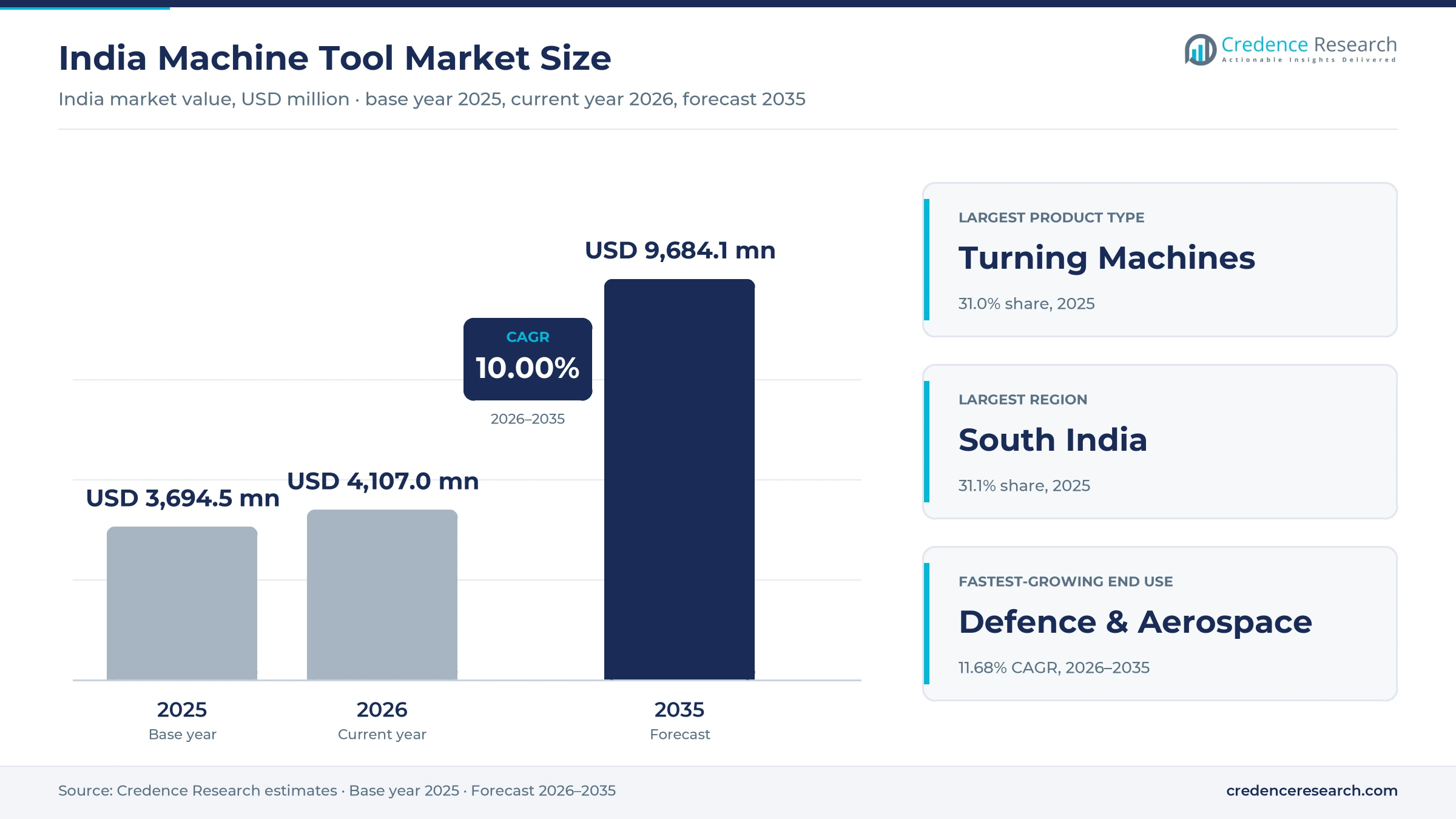
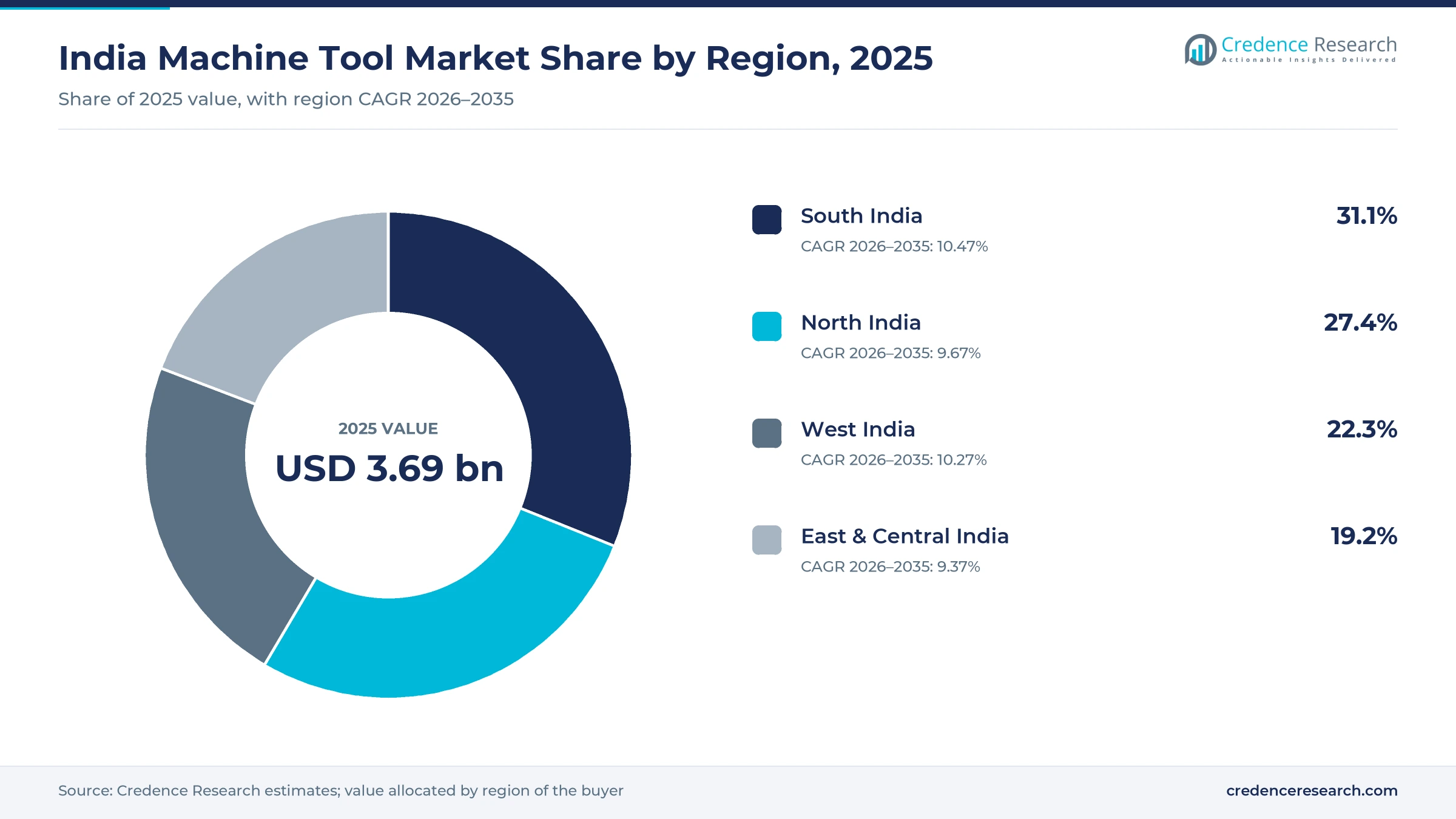
The India machine tool market was valued at USD 3.69 billion in 2025 and is projected to increase from USD 4.11 billion in 2026 to USD 9.68 billion by 2035, registering a CAGR of 10.00% during 2026–2035. Demand comes from automotive plants, component suppliers, defense factories and tool rooms replacing conventional lathes with CNC equipment. South India held the largest regional share, 31.1% in 2025, as plants around Bengaluru and Hosur buy close to a Karnataka cluster that makes more than half of national output. South India is also the fastest-growing region at 10.47% a year among the four zones. Imports exceeded domestic production by about Rs 4,400 crore in fiscal 2024-25, according to the Ministry of Heavy Industries, so localization is the main commercial story. Defense production reached a record Rs 1.78 lakh crore in fiscal 2025-26, which has pulled builders toward multi-axis and high-precision machines, and Jyoti CNC Automation reported about 41% of its order book from aerospace and defense in February 2026.
What does the India machine tool market count, and how do plants buy?
The market counts the value of new metal-cutting and metal-forming machines bought by Indian plants, whether built domestically or imported. Buyers range from vehicle makers ordering dedicated lines through direct sales teams to small job shops buying a single vertical machining center through a dealer. Public buyers such as ordnance factories and naval procurement offices usually purchase through tenders.
The market excludes cutting tools, tool holders, standalone robots, used machines and service income. The value chain runs from imported controllers, servo motors and ball screws through Indian machine builders to dealers, system integrators and end plants, and exports are excluded because they do not represent Indian demand.
India Machine Tool Market Insights
- The India machine tool market moves from USD 3.69 billion in 2025 to USD 9.68 billion by 2035, a 10.00% CAGR over 2026–2035 as plants replace imports and older conventional machines.
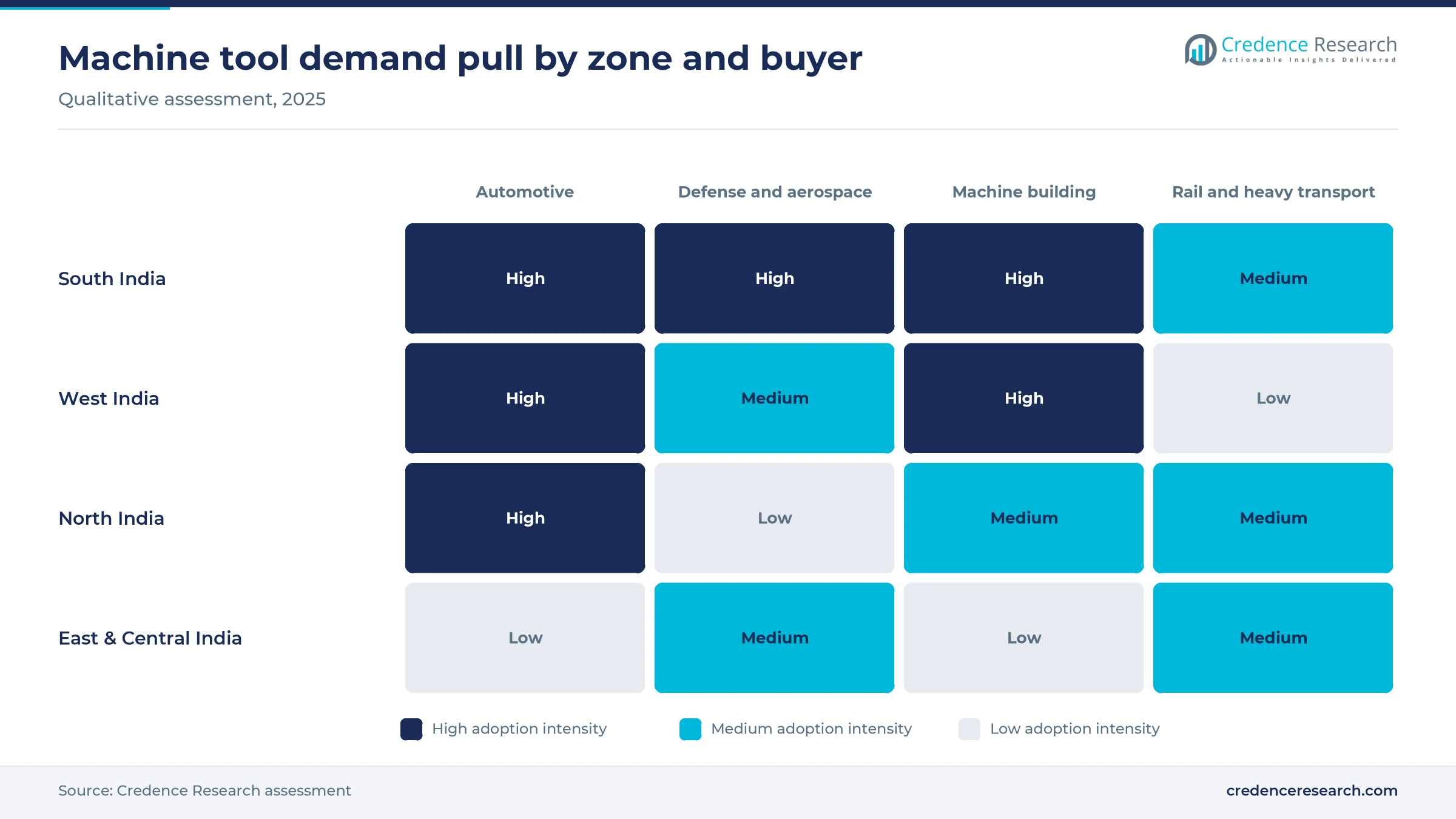
- South India held 31.1% of 2025 value, supported by the Bengaluru and Hosur builders and by Karnataka hosting 52% of national machine tool production in January 2025.
- Automotive & Auto Components led end use with 38.0% in 2025, while Defence & Aerospace grows fastest at 11.68% a year on record defense output.
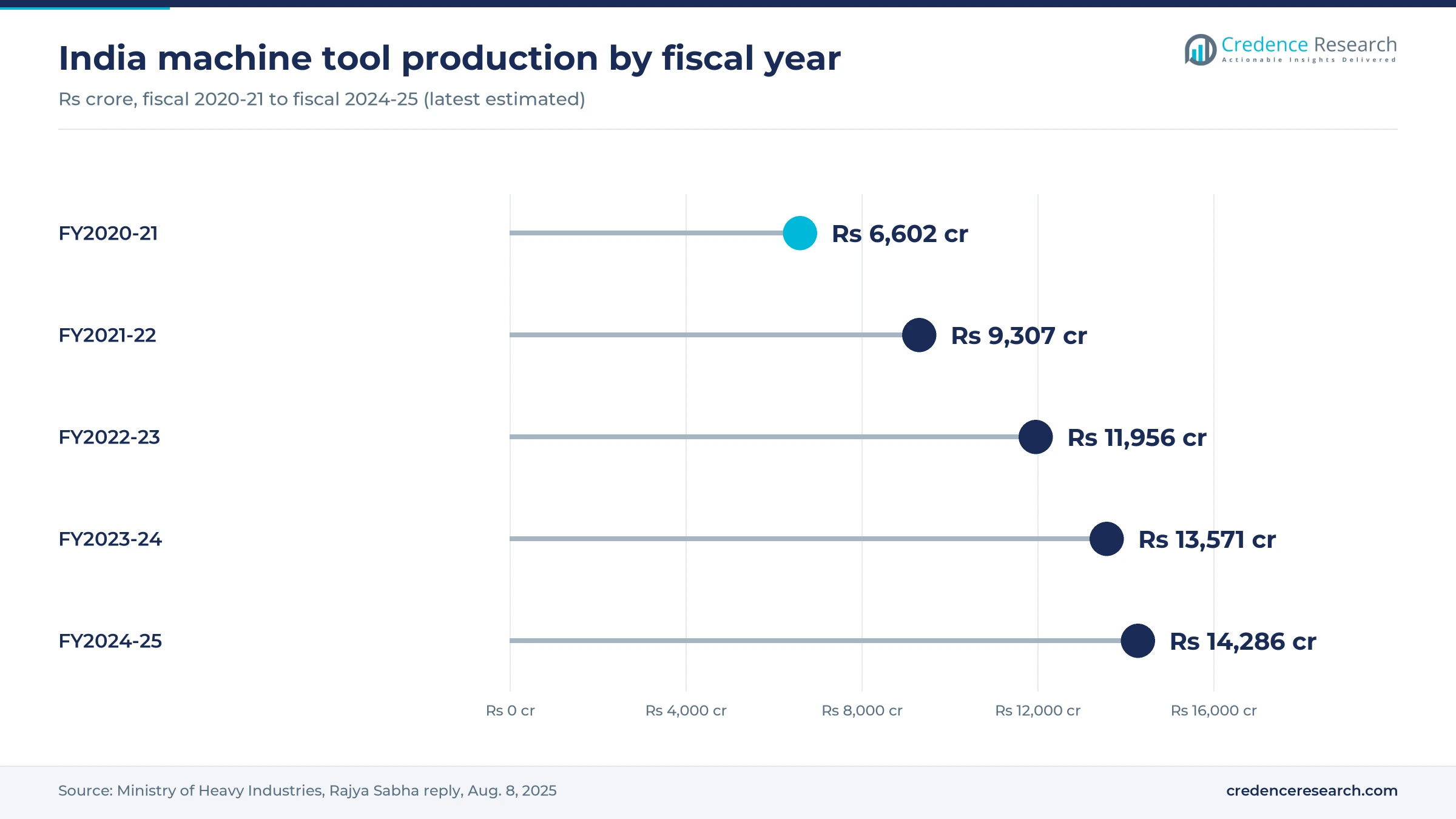
- Imports of Rs 18,686 crore exceeded production of Rs 14,286 crore in fiscal 2024-25, which makes localization the central change in how this market is supplied.
- Jyoti CNC Automation targeted 16,000 machines of Indian capacity by September 2026 and Bharat Fritz Werner built for over 10,000 a year at Hosur, so domestic supply is expanding quickly.
Turning leads value while multi-axis work gains share
Why turning machines lead and machining centers grow fastest
Based on product type, the market is categorized into turning machines, machining centers, grinding and finishing machines, metal forming machines and EDM and non-traditional machines. Turning Machines led with 31.0% of 2025 value because high-volume component shops buy them in the largest numbers, and Ace Designers reported capacity for 8,000 turning centers against 3,400 machining centers, according to MTDCNC in May 2026. Machining Centres rise fastest at 10.84% a year as aerospace and defense supplied 46% of Jyoti CNC Automation's order intake in the first nine months of fiscal 2025-26, according to Machinist.
Vehicle plants still lead while defense orders climb quickest
Based on end-use industry, the market is categorized into automotive and auto components, general engineering, defense and aerospace, railways and heavy transport, and electrical and electronics. Automotive & Auto Components led with 38.0% of 2025 value because automotive and EV work still made up about 60% of Makino India's order book in December 2025, according to Domain-b. Defence & Aerospace grows fastest at 11.68% a year as Jyoti CNC Automation drew about 41% of its order book from that sector, according to Machinist in February 2026, when electronics manufacturing services supplied a further 14%.
Standard CNC holds the base while connected machines rise
Based on technology, the market is categorized into conventional machine tools, 2-axis and 3-axis CNC, multi-axis CNC, automated CNC cells and connected smart machine tools. 2-Axis & 3-Axis CNC led with 46.0% of 2025 value because CNC equipment already exceeds 60% of domestic production, according to Engmag in December 2025, and simple turning centers and vertical machining centers fill most job shops. Connected Smart Machine Tools rise fastest at 11.95% a year as Ace Designers directed part of its INR 12 billion Kotak funding of May 2025 toward remote machine monitoring, according to Machinist. Four SAMARTH Industry 4.0 centers also demonstrate such systems to smaller factories.
OEM plants buy the most, and public-sector buyers rise fastest
Based on customer type, the market is categorized into OEM manufacturing plants, component suppliers, tool rooms and job shops, defense and public-sector manufacturing, and contract manufacturers. OEM Manufacturing Plants led with 36.0% of 2025 value because vehicle lines need dedicated machining, as Maruti Suzuki showed by adding 250,000 units of Kharkhoda capacity in May 2026, according to Autocar Professional. Defence & Public-Sector Manufacturing grows fastest at 11.58% a year as Macpower CNC reported more than 200 machines supplied to 35 defense factories in its July 2026 investor presentation, and HMT Machine Tools supplied six machines to Ordnance Factory Ambajhari.
| Segment Group | Leading Sub-segment | Share, 2025 | Fastest-growing Sub-segment | CAGR, 2026–2035 |
|---|---|---|---|---|
| By Product Type | Turning Machines | 31.0% | Machining Centres | 10.84% |
| By End-Use Industry | Automotive & Auto Components | 38.0% | Defence & Aerospace | 11.68% |
| By Technology | 2-Axis & 3-Axis CNC | 46.0% | Connected Smart Machine Tools | 11.95% |
| By Customer Type | OEM Manufacturing Plants | 36.0% | Defence & Public-Sector Manufacturing | 11.58% |
Request a Free Sample
Fill in your details and we'll send you a free sample report.
- Sample data tables & charts
- Research methodology
Vehicle, defense and localization capex lift orders
Automotive and advanced mobility capital expenditure
Vehicle programs remain the largest source of machine orders because every new engine, transmission and EV line needs dedicated machining capacity. Indian plants produced 53.8 lakh passenger vehicles and 255 lakh two-wheelers in calendar 2025, according to a Ministry of Heavy Industries reply to the Lok Sabha on Feb. 10, 2026. The ministry's explainer of February 2026 put investment under the PLI-Auto scheme at Rs 35,657 crore through September 2025, which shows how much supplier tooling is already committed. Maruti Suzuki then started its second Kharkhoda plant in May 2026, adding 250,000 units of annual capacity, according to Autocar Professional. As a result, Automotive & Auto Components held 38.0% of 2025 value, even as other sectors gained orders.
Defense, aerospace and precision manufacturing expansion
Defense budgets now pull the market toward tighter tolerances and larger five-axis work envelopes. India's defense production reached a record Rs 1.78 lakh crore in fiscal 2025-26, up 15.6% from Rs 1.54 lakh crore, according to the defense minister's office in June 2026. Jyoti CNC Automation reported that aerospace and defense supplied 46% of its order intake in the first nine months of fiscal 2025-26, according to Machinist. HMT Machine Tools also listed machines supplied to Ordnance Factory Ambajhari and the Directorate General of Naval Procurement in its fiscal 2024-25 accounts. INDEX Machine Tools India opened a technology center in Bengaluru's Aerospace Park on Feb. 27, 2026, placing test machining beside these buyers.
Capital-goods technology and localization support
Public programs lower the cost of developing machines that India currently imports. The second phase of the capital goods competitiveness scheme had 29 approved projects by November 2025 with a total cost of Rs 891.37 crore, according to a Press Information Bureau explainer dated Feb. 3, 2026. The Union Budget for fiscal 2026-27 added Hi-Tech Tool Rooms at two locations, to be run by central public enterprises. Domestic output has responded, since a Rajya Sabha reply of Aug. 8, 2025 showed machine tool production rising from Rs 6,602 crore in fiscal 2020-21 to an estimated Rs 14,286 crore in fiscal 2024-25. In turn, proposed public capital expenditure of about Rs 12.2 lakh crore for fiscal 2026-27, according to the same explainer, supports the plants that buy this equipment.
Electronics and rail programs widen the buyer base
Electronics and rail factories reduce the market's reliance on vehicle cycles because they buy different machine classes in meaningful volumes. Electronics production rose 15.8% to Rs 13.11 lakh crore in fiscal 2025-26, according to Minister of State Jitin Prasada in the Lok Sabha in July 2026, while 75 component projects were approved under the ECMS. Rail plants are also busy, since Integral Coach Factory built 3,405 coaches in fiscal 2025-26, according to The Hindu Business Line, and Modern Coach Factory in Rae Bareli built 2,126, according to The Free Press Journal. This broader demand helps Defence & Aerospace and other non-automotive buyers, and the World Bank recorded investment growth of 11.9% in the first quarter of fiscal 2026-27 in its October 2026 outlook.
Five-axis, automation and exports reshape the buying brief
Shift from standard CNC to five-axis and turn-mill machines
Buyers increasingly specify machines that finish a part in one setup, which cuts handling and suits aerospace alloys. LMW showed a JU 40 five-axis machining center and three turn-mill centers at IMTEX 2025, according to Motor India in February 2025. Macpower CNC now lists 5-axis and double-column models among 383 variants in its July 2026 presentation. Makino India also described its five-axis and wire EDM systems as central to its December 2025 pivot toward aerospace and semiconductor work, according to Domain-b. Buyers can see this shift at trade shows, because IMTEX 2025 drew 133,166 business visitors and about Rs 3,500 crore of orders. Show orders remain small against annual imports, so builders still rely on direct follow-up sales after each exhibition.
Rise of automated cells and connected shop floors
Automation is moving from large vehicle plants toward mid-size suppliers because labor shortages make unattended shifts valuable. Macpower CNC offered gantry, pallet changer and robot-based automation systems in its July 2026 presentation, and LMW fitted automatic pallet changers on the JG50 R and JHF 400 machines shown at IMTEX 2025. Makino India added engineering labs for factory automation layouts at Whitefield and Coimbatore, according to Domain-b in December 2025. Installations of industrial robots in India also reached 8,500 in 2023, up from 5,000 in 2021, according to Germany Trade & Invest in June 2025. The Ministry of Heavy Industries supports the same direction through SAMARTH centers at Pune, Delhi and Bengaluru, and Connected Smart Machine Tools rise fastest at 11.95% a year.
Import substitution opens a large domestic opening
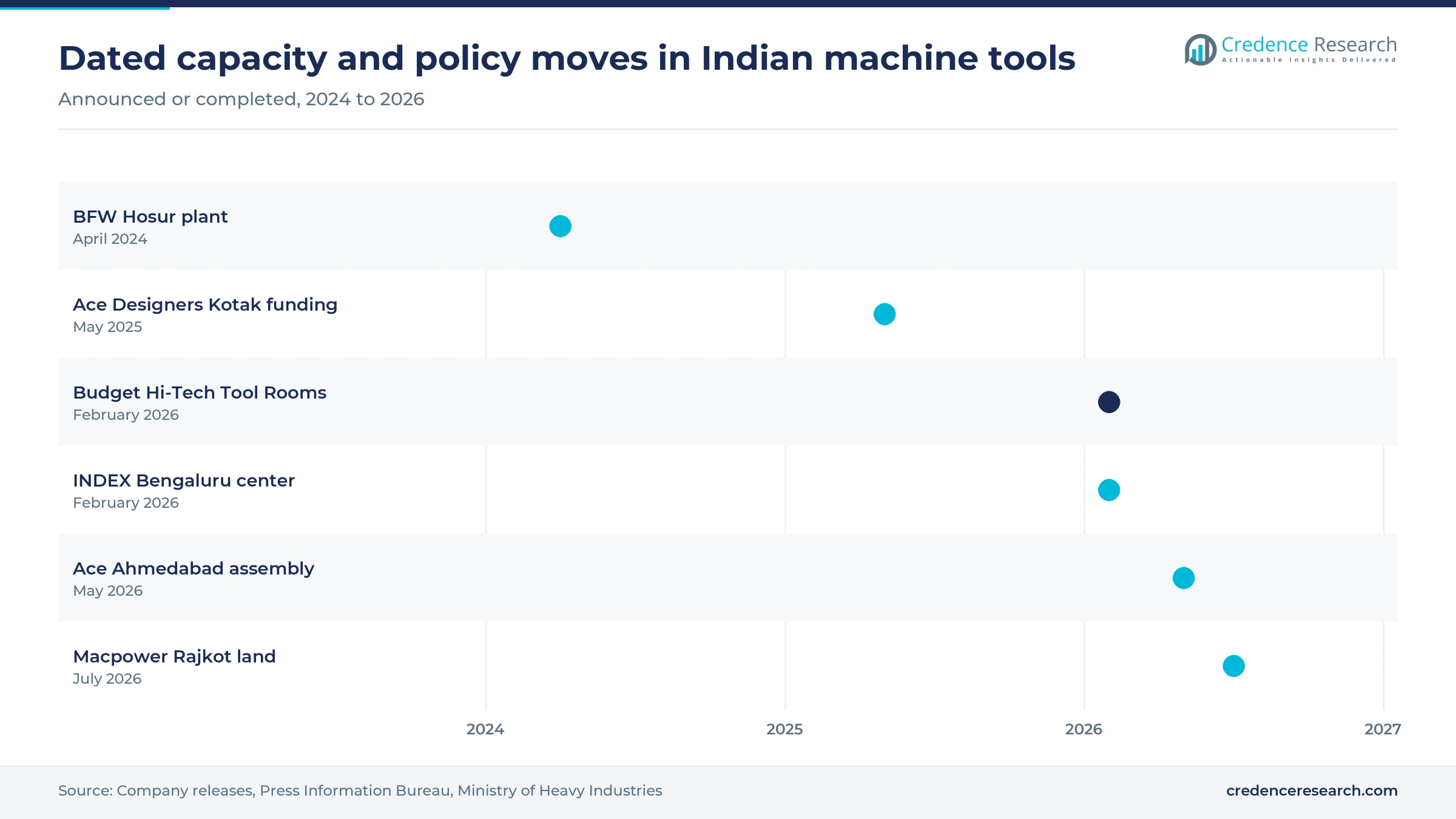
The clearest opportunity for Indian builders lies in the machines that plants still import. The Ministry of Heavy Industries put imports at Rs 18,686 crore in fiscal 2024-25, or about 59% of an apparent consumption of Rs 31,500 crore. Bharat Fritz Werner prepared for this demand with a Hosur plant announced on April 22, 2024, built for over 10,000 CNC machines a year. Macpower CNC plans a greenfield site targeting 10,000 machines a year within five years, according to its July 2026 presentation. HMT Machine Tools is also developing what it calls India's first roll grinding machine with IIT BHU under the capital goods scheme, which targets a low-volume category now served from abroad.
Export markets offer an opening for Indian CNC builders
Exports give Indian builders a second growth path because they are still small relative to domestic production. Machine tool exports were only Rs 1,472 crore in fiscal 2024-25, roughly a tenth of production, according to the Lok Sabha reply of February 2026. Jyoti CNC Automation targets 35% to 40% of its revenue from exports, and it nearly doubled capacity at its Huron plant in France in November 2025, according to Machinist. Ace Designers already sells into Europe, Asia, North America and the Middle East, according to the same publication in May 2025. Swarajya also reported in September 2025 that Ethereal Machines earned about 70% of revenue abroad, which shows that even young builders can compete internationally.
Controllers, skills and long sales cycles limit growth
Imports still set the technology ceiling
Domestic builders still lose the highest-value orders because imports outran production by about Rs 4,400 crore in fiscal 2024-25, according to the Ministry of Heavy Industries. HMT Machine Tools notes that India continues to import low-volume, high-technology and large machines. This gap affects aerospace and heavy engineering buyers most, since they face longer lead times and foreign-exchange exposure. Builders are responding with local large-format and five-axis models, as Macpower CNC now lists double-column machines, although those models must still win over established import preferences.
Controllers and servo motors remain imported
Machine builders carry supply risk because servo motors and CNC controllers are still imported even by Jyoti CNC and Bharat Fritz Werner, according to Swarajya in September 2025. HMT Machine Tools also lists ball screws among its imported parts in its fiscal 2024-25 accounts. Currency swings and export controls therefore reach Indian builders directly. In response, Jyoti is developing its own controllers, drives and motors, and Macpower CNC now sells a Macatrol controller on its machines.
CNC skills lag behind machine installations
Plant owners cannot fully use new equipment when operators are scarce, and Mojo4Industry reported in February 2025 that India needs about 150,000 new CNC operators each year. HMT Machine Tools also names skilled operator shortages among the key industry constraints. Smaller job shops suffer most, since they cannot afford long training periods before machines earn money. Makino India has trained over 1,000 rural youth at its training center, and Ace Micromatic runs similar programs, although supply remains short.
Long buying cycles and uneven capacity use delay orders
Sales conversion stays slow because IMTEX 2025 generated Rs 37,700 crore of enquiries but only about Rs 3,500 crore of orders at the show. Manufacturing capacity utilization also stood near 74.8% in the second quarter of fiscal 2025-26, according to a Press Information Bureau explainer. Germany Trade & Invest also warned in June 2025 that battery-electric production needs fewer precision machines. As a result, builders face uneven order timing, and they increasingly lean on defense and electronics orders.
South India anchors both production and demand
| Region | Value, 2025 (USD billion) | Share, 2025 | CAGR, 2026–2035 |
|---|---|---|---|
| South India | 1.15 | 31.1% | 10.47% |
| North India | 1.01 | 27.4% | 9.67% |
| West India | 0.82 | 22.3% | 10.27% |
| East & Central India | 0.71 | 19.2% | 9.37% |
South India leads on Bengaluru and Hosur clusters
South India held 31.1% of 2025 value and grows at 10.47% a year, the fastest pace among the four zones. Karnataka accounted for 52% of national machine tool production, according to Deccan Herald in January 2025, while Tamil Nadu held 15.43% of the country's factories in the Annual Survey of Industries 2023-24, according to The South First. Bharat Fritz Werner's Hosur plant and the Bengaluru research base of Ace Designers serve nearby buyers, and Rail Wheel Factory in Yelahanka made 210,026 wheels in fiscal 2025-26.
North India buys for vehicle plants and metalworking towns
North India held 27.4% of 2025 value and grows at 9.67% a year, because demand comes mostly from vehicle and component plants instead of local machine building. Maruti Suzuki added 250,000 units of capacity at Kharkhoda, Haryana in May 2026, according to Autocar Professional, which draws suppliers around it. Taiwan's Economic Division in New Delhi lists Ludhiana, Jalandhar and Batala as metal-processing centers in July 2026. Modern Coach Factory in Rae Bareli also raised output from 2,025 to 2,126 coaches in fiscal 2025-26.
West India combines Rajkot builders with Pune plants
West India held 22.3% of 2025 value and grows at 10.27% a year, helped by builders in Gujarat and vehicle plants in Maharashtra. Macpower CNC secured about 13 acres near Metoda GIDC in Rajkot in July 2026, according to Sahi, and Ace Designers opened an assembly facility in Ahmedabad, according to MTDCNC in May 2026. Yamazaki Mazak India runs its plant and technology center at Ranjangaon near Pune, which places Japanese application support close to automotive customers.
East and Central India grow from a heavy-industry base
East & Central India held 19.2% of 2025 value and grows at 9.37% a year, the slowest pace among the zones because local machine building is thin. Demand centers on industrial belts such as Pithampur, where Madhya Pradesh's chief minister inaugurated new units on July 8, 2026, including a railway bogie and fabrication maker, according to The Free Press Journal. LiuGong India added Rs 272 crore of investment at the same event, which shows heavy equipment plants choosing this belt for new capacity. In Eastern India, Jupiter Tatravagonka planned an INR 25 billion plant in Odisha's Khordha district for 100,000 forged wheelsets a year, according to Machinist in April 2025.
Builders add plants and technology centers since 2024
| Development | Status and market relevance |
|---|---|
| In April 2024, Bharat Fritz Werner announced the inauguration of a 54-acre plant at Hosur, Tamil Nadu, built for over 10,000 CNC machines a year. | Operating; it triples the company's output and adds a spindle technology center. |
| In May 2025, Ace Designers secured INR 12 billion from Kotak Alternate Asset Managers to expand CNC capacity and digital tools. | Funding secured; it supports a new production unit and remote monitoring. |
| In February 2026, INDEX Machine Tools India opened a technology center in Aerospace Park, Bengaluru. | Operating; it offers test machining and faster service for aerospace and vehicle buyers. |
| In May 2026, Ace Designers inaugurated an assembly facility at Panchratna Industrial Park, Ahmedabad. | Ramping up; the workforce is planned to rise from about 100 to about 350. |
| In July 2026, Macpower CNC secured about 13 acres near Metoda GIDC in Rajkot for assembly expansion. | Planned; the land should ease assembly limits at its 2,500-machine site. |
CNC already dominates, so the next step is connected cells
- Multi-axis machining reduces setups on aerospace and defense parts, and LMW, Macpower CNC and Makino India all now sell five-axis models in India.
- Automated cells combine pallet changers, gantries and robots, which lets suppliers run longer shifts with fewer operators on repeat components.
- Domestic controls address the largest import gap, since Jyoti CNC Automation is developing controllers, drives and motors under the electronics component scheme.
- Connected monitoring gives builders and plants remote views of machine condition, and Ace Designers has earmarked funding for these remote systems.
Need a Custom Version of This Report?
Tailor the scope, geography, or segments to your exact requirements.
- Custom geography or segment scope
- Direct access to our analyst team
Indian builders scale up against Japanese and German peers
Competition splits between large Indian CNC builders and Japanese and German specialists serving high-precision work. Ace Designers, Bharat Fritz Werner, LMW and Macpower CNC compete on price, delivery and service for turning centers and vertical machining centers across automotive and engineering shops. Jyoti CNC Automation has moved toward aerospace and defense work, while Makino India and Yamazaki Mazak India defend the upper end through local technology centers and application support. Scale is rising quickly, since Jyoti targeted 16,000 machines of Indian capacity by September 2026 and Macpower CNC reports more than 13,875 installations. Public-sector supplier HMT Machine Tools relies on defense, nuclear and rail tenders, and Lokesh Machines pairs machine building with defense component contracts, including an Indian Army kit order disclosed on July 15, 2026. Service reach now decides many orders, as Macpower CNC operates 10 branch offices and eight technology centers, and buyers of metal-cutting equipment compare uptime support as closely as price.
Companies profiled and their roles in this market
| Company | Type | Role in the market |
|---|---|---|
| Ace Designers Limited | Indian builder | Makes turning and machining centers, with an assembly facility added in Ahmedabad in May 2026. |
| Jyoti CNC Automation Limited | Indian builder | Indian builder with aerospace and defense as its largest order-book sector. |
| Bharat Fritz Werner Limited | Indian builder | Runs the 54-acre Hosur plant and a spindle technology center. |
| LMW Limited, Machine Tool Division | Indian builder | Sells turning, vertical, horizontal and five-axis machining centers, shown at IMTEX 2025. |
| Macpower CNC Machines Limited | Indian builder | Rajkot-based builder with 13,875 installations and a planned greenfield expansion. |
| Lokesh Machines Limited | Indian builder and defense supplier | Combines machine tool activity with Indian Army kit supply, as disclosed in July 2026. |
| HMT Machine Tools Limited | Public-sector builder | Supplies ordnance factories and naval procurement, and is developing a roll grinder with IIT BHU. |
| INDEX Machine Tools India | German-owned builder | Opened a technology center in Aerospace Park, Bengaluru, on Feb. 27, 2026. |
| Makino India Pvt. Ltd. | Japanese-owned builder | Serves automotive, aerospace and semiconductor work from Whitefield and Coimbatore. |
| Yamazaki Mazak India Pvt. Ltd. | Japanese-owned builder | Runs its plant and technology center at Ranjangaon near Pune. |
Capacity matters less than control and precision know-how
Credence Research's view is that India's machine tool constraint has moved from capacity to control and precision know-how. Announced plants at Hosur and Rajkot suggest that standard turning and milling supply will be ample by 2028, so price pressure may rise there. The better margins should sit with builders who master five-axis work, their own controllers and aerospace qualification, because imports hold a large part of the market. Demand for Indian-built machines should rise, since imports still supply about 59% of apparent consumption. Suppliers of touch probes and similar accuracy add-ons should benefit from that same move, and the main risk is a slower vehicle investment cycle.
How the estimates and supporting facts were built
The report uses 2025 as the base year and forecasts values to 2035 through the Credence Research market model. The market value was checked against apparent consumption derived from official production, import and export figures of the Ministry of Heavy Industries. Segment and regional splits are Credence Research estimates informed by company presentations, plant announcements, industry-association figures quoted by government and company documents, and press reports. No interviews or surveys were conducted for this edition, so the splits should be treated as modeled estimates and not as measured sales.
Import substitution sets the pace through 2035
Through 2035, the India machine tool market should reach USD 9.68 billion as vehicle programs, defense output and electronics factories continue adding machining lines. Import substitution will set the pace, because every point of share won from imports adds orders for Indian builders without any increase in end demand. Comparison with worldwide metalworking equipment demand suggests that India will keep outgrowing mature markets, while local industrial fasteners producers show the kind of high-volume machining customer base that keeps buying. Controllers, skills and export qualification remain the conditions to watch. Regional demand should stay led by South India, helped by the 10,000-machine Hosur plant.
Frequently Asked Questions
How big is the India machine tool market?
Why does India import so many machine tools?
Which region leads the India machine tool market?
Which product type holds the largest share?
Which end-use industry leads demand?
What government programs support machine tools in India?
What are the main challenges for Indian builders?
Who are the main companies in this market?
Table of Content
Chapter 1 Market Segmentation
- 1.1 Segmentation Framework
- 1.1.1 Product and Service Classification
- 1.1.2 Application and End-Use Classification
- 1.1.3 Technology and Solution Classification
- 1.1.4 Customer and Distribution Channel Classification
- 1.1.5 Geographic Segmentation
- 1.1.6 Market Segment Definitions and Boundaries
- 1.2 By Product Type
- 1.2.1 Turning Machines
- 1.2.2 Machining Centres
- 1.2.3 Metal Forming Machines
- 1.2.4 Grinding & Finishing Machines
- 1.2.5 EDM & Non-Traditional Machines
- 1.3 By End-Use Industry
- 1.3.1 Automotive & Auto Components
- 1.3.2 General Engineering
- 1.3.3 Defence & Aerospace
- 1.3.4 Electrical & Electronics
- 1.3.5 Railways & Heavy Transport
- 1.4 By Technology
- 1.4.1 2-Axis & 3-Axis CNC
- 1.4.2 Multi-Axis CNC
- 1.4.3 Conventional Machine Tools
- 1.4.4 Automated CNC Cells
- 1.4.5 Connected Smart Machine Tools
- 1.5 By Customer Type
- 1.5.1 OEM Manufacturing Plants
- 1.5.2 Component Suppliers
- 1.5.3 Tool Rooms & Job Shops
- 1.5.4 Defence & Public-Sector Manufacturing
- 1.5.5 Contract Manufacturers
Chapter 2 Introduction
- 2.1 Report Objectives and Scope
- 2.2 Product Definition and Industry Terminology
- 2.3 Market Inclusions and Exclusions
- 2.4 Research Process
- 2.4.1 Primary Research and Expert Interviews
- 2.4.2 Secondary Research and Source Review
- 2.4.3 Top-Down and Bottom-Up Estimation
- 2.4.4 Data Triangulation and Verification
- 2.5 Market Size Measurement Basis
- 2.5.1 2025: USD 3.69 billion → 2035: USD 9.68 billion
- 2.6 Historical and Forecast Reference Periods
- 2.6.1 Historical Period: 2018-2025
- 2.6.2 Base Year: 2025
- 2.6.3 Forecast Period: 2025-2035
- 2.7 Research Assumptions and Limitations
Chapter 3 Executive Summary
- 3.1 Market Snapshot and Key Findings
- 3.2 Base-Year Market Size, 2025
- 3.3 Forecast Market Size, 2035
- 3.4 Revenue and Volume Growth Outlook
- 3.5 Key Demand and Supply Indicators
- 3.6 Leading Market Segments
- 3.7 Fastest-Growing Market Opportunities
- 3.8 Regional Performance Highlights
- 3.9 Technology and Industry Transformation
- 3.10 Competitive Landscape Summary
- 3.11 Analyst View and Strategic Implications
Chapter 4 India Machine Tool Market Trends and Developments
- 4.1 Historical Industry Development, 2018-2025
- 4.2 Recent Market Trends and Developments
- 4.3 Demand and Customer Behavior Trends
- 4.4 Technology and Product Innovation
- 4.5 Artificial Intelligence, Automation and Digitalization
- 4.6 Local Manufacturing and Supply Chain Realignment
- 4.7 Industry Partnerships, Mergers and Acquisitions
- 4.8 Sustainability and Circular Economy Developments
- 4.9 Government and Private Sector Investment Trends
- 4.10 Emerging Business Models and Commercialization
- 4.11 Industry Developments and Announcements
Chapter 5 India Machine Tool Market Production, Supply and Demand Analysis
- 5.1 Demand Trend and Consumption Analysis, 2018-2025
- 5.2 Demand Forecast, 2025-2035
- 5.3 Production and Output Trend, 2018-2025
- 5.4 Production and Output Forecast, 2025-2035
- 5.5 Installed Capacity and Capacity Utilization
- 5.6 Company-Wise Production Plants and Statistics
- 5.6.1 Installed Production Capacity
- 5.6.2 Actual Production
- 5.6.3 Planned Capacity and Expansion Targets
- 5.7 Supply Chain Structure and Procurement Trends
- 5.8 Supply-Demand Gap and Bottlenecks
- 5.9 Import Dependence and Sourcing Structure
- 5.10 Contract Manufacturing and Outsourcing
- 5.11 Regional Supply and Demand Concentration
Chapter 6 India Machine Tool Market Pricing Analysis
- 6.1 Pricing Structure and Measurement
- 6.2 Historical Pricing Trends, 2018-2025
- 6.3 Pricing Outlook, 2025-2035
- 6.4 Average Selling Price and Unit Economics
- 6.5 Pricing by Product and Market Segment
- 6.6 Geographic Pricing Differences
- 6.7 Key Input, Energy, Labor and Logistics Costs
- 6.8 Contract Pricing and Purchasing Models
- 6.9 Pricing Sensitivity and Competitive Positioning
- 6.10 Price, Margin and Profitability Implications
Chapter 7 India Machine Tool Market Dynamics
- 7.1 Market Growth Drivers
- 7.1.1 Demand-Side Drivers
- 7.1.2 Technology and Innovation Drivers
- 7.1.3 Infrastructure and Investment Drivers
- 7.1.4 Regulatory and Policy Drivers
- 7.2 Market Restraints
- 7.2.1 Cost and Affordability Constraints
- 7.2.2 Technology and Adoption Barriers
- 7.2.3 Supply Chain and Operational Constraints
- 7.3 Market Challenges
- 7.3.1 Competitive Pressure and Margin Erosion
- 7.3.2 Skills, Infrastructure and Implementation Gaps
- 7.4 Emerging Market Opportunities
- 7.5 Market Dynamics Impact and Time-Horizon Assessment
Chapter 8 India Machine Tool Value Chain Analysis
- 8.1 Industry Value Chain Overview
- 8.2 Upstream Suppliers and Critical Inputs
- 8.3 Technology and Component Providers
- 8.4 Manufacturing or Service Delivery
- 8.5 Distribution, Channel Partners and Integrators
- 8.6 Downstream Applications and End Users
- 8.7 Value Addition and Profit Pools
- 8.8 Vertical Integration and Outsourcing
- 8.9 Supplier Concentration and Risk
- 8.10 Supply Chain Localization and Resilience
Chapter 9 India Machine Tool Market Regulations and Policies
- 9.1 Relevant Laws, Standards and Compliance Frameworks
- 9.2 Product, Service, Safety and Quality Requirements
- 9.3 Government Policies, Incentives and Subsidies
- 9.4 Imports, Exports and Trade Barriers
- 9.5 Public Procurement and Local Content Requirements
- 9.6 Environmental and Sustainability Compliance
- 9.7 Upcoming Policy Changes and Market Implications
Chapter 10 India Machine Tool Market Hotspots and Opportunities
- 10.1 Market Opportunity Mapping and Growth Hotspots
- 10.2 High-Growth Applications and Customer Groups
- 10.3 Underserved Markets and White-Space Opportunities
- 10.4 Emerging Technology and Product Opportunities
- 10.5 New Capacity and Investment Hotspots
- 10.6 Market Entry and Expansion Opportunities
- 10.7 Distribution and Partnership Opportunities
- 10.8 Near-Term and Long-Term Commercial Potential
- 10.9 Opportunity Attractiveness and Execution Risks
Chapter 11 India Machine Tool Market Outlook, 2025-2035
- 11.1 Market Size and Analysis
- 11.1.1 Revenue (Market Measurement: 2025: USD 3.69 billion → 2035: USD 9.68 billion)
- 11.1.2 Market Volume and Quantity Sold
- 11.1.3 Historical Market Size, 2018-2025
- 11.1.4 Base-Year Market Size, 2025
- 11.2 Market Forecast, 2025-2035
- 11.2.1 Revenue Forecast to 2035
- 11.2.2 Volume Forecast to 2035
- 11.2.3 CAGR and Year-on-Year Growth
- 11.2.4 Incremental Revenue Opportunity
- 11.3 Forecast Assumptions and Scenario Analysis
- 11.3.1 Base-Case Forecast
- 11.3.2 Optimistic and Conservative Scenarios
- 11.3.3 Technology, Pricing and Policy Sensitivities
- 11.4 Market Attractiveness and Growth Outlook
Chapter 12 India Machine Tool Market Segmentation and Outlook
- 12.1 Segmentation Summary and Market Shares, 2025
- 12.2 Largest and Fastest-Growing Segments
- 12.3 By Product Type - Market Size and Forecast, 2025-2035
- 12.3.1 Segment Definition and Scope
- 12.3.2 Historical Market Size, 2018-2025
- 12.3.3 Revenue Forecast, 2025-2035
- 12.3.4 Volume Forecast, 2025-2035
- 12.3.5 Base-Year Market Share, 2025
- 12.3.6 Segment CAGR and Growth Drivers
- 12.3.7 Subsegment Market Size and Forecast
- 12.3.7.1 Turning Machines
- 12.3.7.2 Machining Centres
- 12.3.7.3 Metal Forming Machines
- 12.3.7.4 Grinding & Finishing Machines
- 12.3.7.5 EDM & Non-Traditional Machines
- 12.3.8 Subsegment Pricing and Adoption Trends
- 12.3.9 Leading Suppliers and Competition
- 12.3.10 Regional Demand and Opportunities
- 12.4 By End-Use Industry - Market Size and Forecast, 2025-2035
- 12.4.1 Segment Definition and Scope
- 12.4.2 Historical Market Size, 2018-2025
- 12.4.3 Revenue Forecast, 2025-2035
- 12.4.4 Volume Forecast, 2025-2035
- 12.4.5 Base-Year Market Share, 2025
- 12.4.6 Segment CAGR and Growth Drivers
- 12.4.7 Subsegment Market Size and Forecast
- 12.4.7.1 Automotive & Auto Components
- 12.4.7.2 General Engineering
- 12.4.7.3 Defence & Aerospace
- 12.4.7.4 Electrical & Electronics
- 12.4.7.5 Railways & Heavy Transport
- 12.4.8 Subsegment Pricing and Adoption Trends
- 12.4.9 Leading Suppliers and Competition
- 12.4.10 Regional Demand and Opportunities
- 12.5 By Technology - Market Size and Forecast, 2025-2035
- 12.5.1 Segment Definition and Scope
- 12.5.2 Historical Market Size, 2018-2025
- 12.5.3 Revenue Forecast, 2025-2035
- 12.5.4 Volume Forecast, 2025-2035
- 12.5.5 Base-Year Market Share, 2025
- 12.5.6 Segment CAGR and Growth Drivers
- 12.5.7 Subsegment Market Size and Forecast
- 12.5.7.1 2-Axis & 3-Axis CNC
- 12.5.7.2 Multi-Axis CNC
- 12.5.7.3 Conventional Machine Tools
- 12.5.7.4 Automated CNC Cells
- 12.5.7.5 Connected Smart Machine Tools
- 12.5.8 Subsegment Pricing and Adoption Trends
- 12.5.9 Leading Suppliers and Competition
- 12.5.10 Regional Demand and Opportunities
- 12.6 By Customer Type - Market Size and Forecast, 2025-2035
- 12.6.1 Segment Definition and Scope
- 12.6.2 Historical Market Size, 2018-2025
- 12.6.3 Revenue Forecast, 2025-2035
- 12.6.4 Volume Forecast, 2025-2035
- 12.6.5 Base-Year Market Share, 2025
- 12.6.6 Segment CAGR and Growth Drivers
- 12.6.7 Subsegment Market Size and Forecast
- 12.6.7.1 OEM Manufacturing Plants
- 12.6.7.2 Component Suppliers
- 12.6.7.3 Tool Rooms & Job Shops
- 12.6.7.4 Defence & Public-Sector Manufacturing
- 12.6.7.5 Contract Manufacturers
- 12.6.8 Subsegment Pricing and Adoption Trends
- 12.6.9 Leading Suppliers and Competition
- 12.6.10 Regional Demand and Opportunities
- 12.7 Segment Growth Comparison
- 12.8 Segment Attractiveness and Priority Matrix
Chapter 13 India Machine Tool End-Use and Application Market Outlook
- 13.1 End-Use Industry and Customer Demand Structure
- 13.2 Leading Applications and Customer Groups
- 13.3 End-Use Market Size, Share and Forecast
- 13.4 Major End-Use Industry Deep Dives
- 13.4.1 Customer Requirements and Use Cases
- 13.4.2 Demand and Replacement Cycles
- 13.4.3 Technical and Regulatory Considerations
- 13.4.4 Purchasing and Procurement Models
- 13.4.5 Leading Vendors and Distribution Channels
- 13.4.6 Forecast and Commercial Opportunities
- 13.5 Emerging Applications and Cross-Segment Demand
- 13.6 End-Use Industry Investment Priorities
Chapter 14 India Machine Tool Geographic Market Outlook, 2025-2035
- 14.1 Domestic Market Distribution and Demand Clusters
- 14.2 State- or Province-Wise Market Size and Forecast, 2025-2035
- 14.3 City and Metropolitan Market Outlook
- 14.4 Industrial, Manufacturing and Commercial Clusters
- 14.5 Geographic Concentration of Key End Users
- 14.6 Local Pricing and Purchasing Differences
- 14.7 Domestic Production Facilities and Capacity Map
- 14.8 Local Infrastructure and Project Pipeline
- 14.9 State-Level Policy and Incentive Differences
- 14.10 Subnational Investment Hotspots and Opportunities
- 14.11 Distribution and Logistics Networks
- 14.12 Domestic Competitive Footprint
Chapter 15 India Machine Tool Technology, Innovation and Sustainability Outlook
- 15.1 Technology Landscape and Maturity
- 15.2 Product, Process and Service Innovation
- 15.3 AI, Automation and Digital Tools in the Industry
- 15.4 Technology Adoption and Performance Benchmarking
- 15.5 Innovation Pipeline and R&D Investment
- 15.6 Patent and Intellectual Property Trends
- 15.7 Energy Efficiency and Resource Management
- 15.8 Sustainability, Recycling and Circularity
- 15.9 Technology Roadmap, 2025-2035
- 15.10 Risks of Obsolescence and Technology Substitution
Chapter 16 India Machine Tool Market Key Strategic Imperatives
- 16.1 Growth and Market Entry Priorities
- 16.2 High-Return Products and Segments
- 16.3 Pricing, Profitability and Cost Optimization
- 16.4 Technology Investment and Product Differentiation
- 16.5 Supply Chain Localization and Resilience
- 16.6 Distribution and Customer Acquisition
- 16.7 Partnership, Acquisition and Capacity Strategy
- 16.8 Regional Expansion Priorities
- 16.9 Short-, Medium- and Long-Term Actions
Chapter 17 Competition Outlook
- 17.1 Industry Competition Characteristics
- 17.2 Market Structure and Concentration
- 17.3 Market Share and Competitive Positioning, 2025
- 17.4 Company-Wise Revenue and Product Benchmarking
- 17.5 Production and Service Capacity Benchmarking
- 17.6 Technology, Pricing and Differentiation
- 17.7 Regional Footprint and Distribution Strength
- 17.8 Mergers, Acquisitions and Strategic Alliances
- 17.9 New Entrants and Competitive Threats
- 17.10 Porter's Five Forces and Industry Attractiveness
- 17.11 Competitive Outlook, 2025-2035
Chapter 18 Company Profiles
- 18.1 Company Coverage and Selection Criteria
- 18.2 Ace Designers Limited
- 18.2.1 Business Description
- 18.2.2 Company Ownership and Geographic Presence
- 18.2.3 Product and Service Portfolio
- 18.2.4 Manufacturing and Operating Footprint
- 18.2.5 Production Capacity and Expansion Plans
- 18.2.6 Financial Performance and Investment
- 18.2.7 Market Share and Competitive Position
- 18.2.8 Technology and Innovation Capabilities
- 18.2.9 Strategic Alliances or Partnerships
- 18.2.10 Recent Developments
- 18.2.11 Growth Strategy and Outlook
- 18.3 Jyoti CNC Automation Limited
- 18.4 Bharat Fritz Werner Limited
- 18.5 LMW Limited, Machine Tool Division
- 18.6 Macpower CNC Machines Limited
- 18.7 Lokesh Machines Limited
- 18.8 HMT Machine Tools Limited
- 18.9 DMG MORI India Pvt. Ltd.
- 18.10 Makino India Pvt. Ltd.
- 18.11 Yamazaki Mazak India Pvt. Ltd.
- 18.12 Other Relevant Market Participants
Note: Every listed company is profiled on the structure shown under the first company. The company list is preliminary and may change based on research findings, market developments, data availability and client requirements.
Chapter 19 Disclaimer
- 19.1 Research and Forecast Disclaimer
- 19.2 Data Source and Estimation Limitations
Note: The depth of individual sections depends on data availability for this market. Volume, capacity, trade and other unit-based metrics are included where applicable.

