
Transplant matching and drug safety tests anchor demand
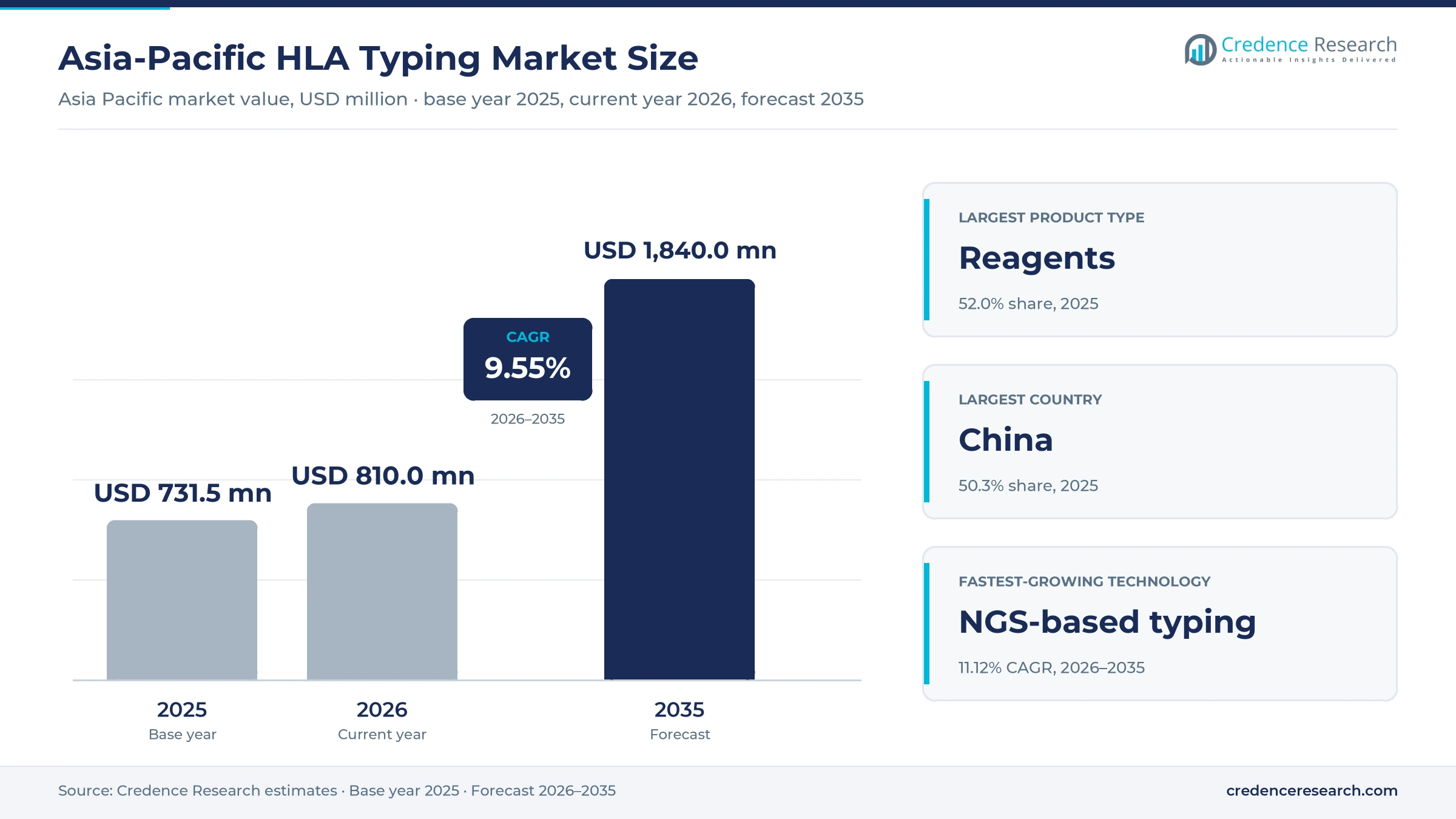
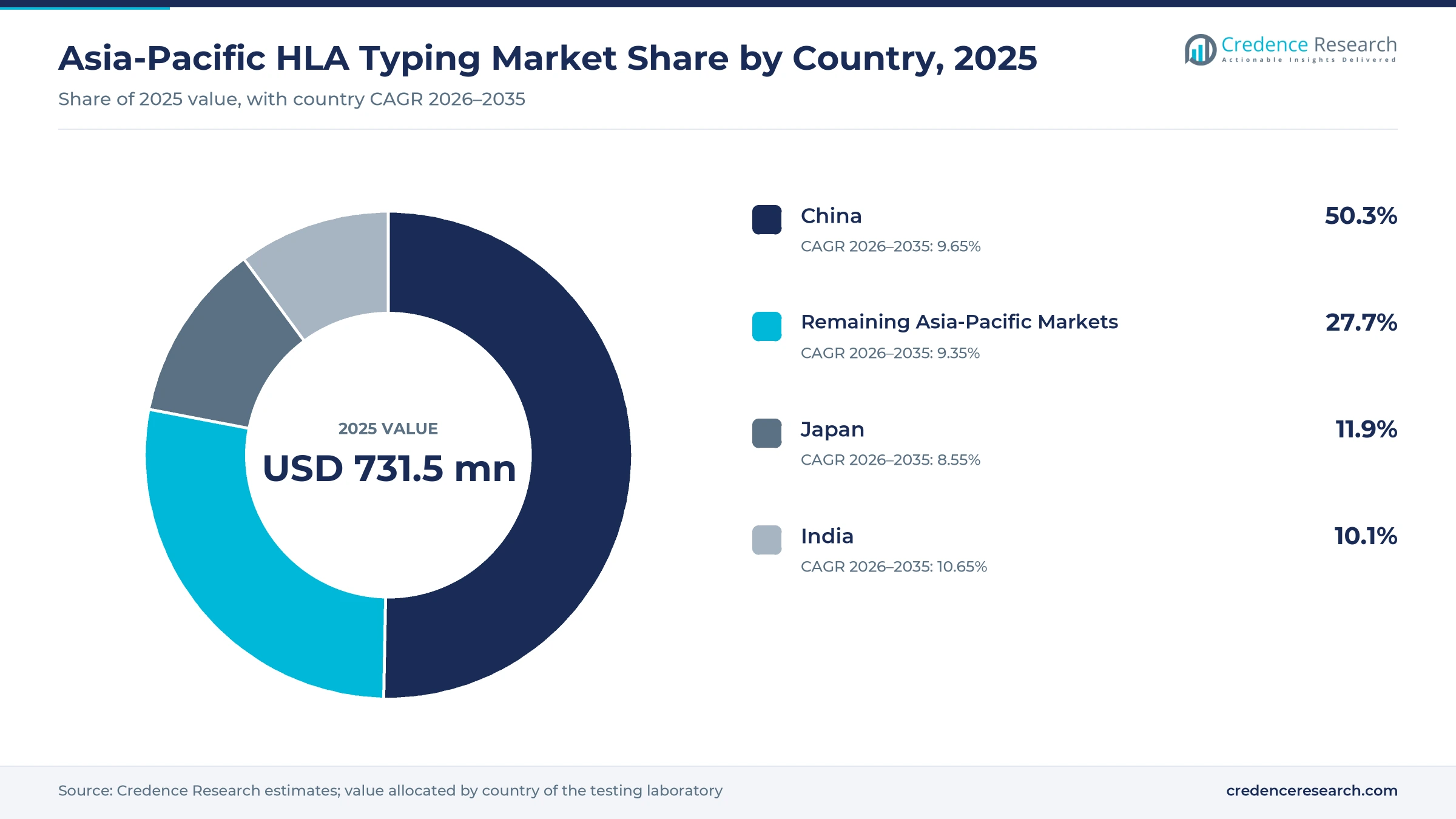
The Asia-Pacific HLA typing market was valued at USD 731.5 million in 2025 and is projected to increase from USD 810.0 million in 2026 to USD 1.84 billion by 2035, registering a CAGR of 9.55% during 2026–2035. Demand comes from transplant centers that match kidney, liver and stem cell donors, donor registries that type volunteers, and hospitals that screen patients before prescribing drugs with genetic risk markers. China held the largest country share, 50.3% in 2025, because it runs the largest donor registry and transplant program in the region. India is the fastest-growing country at 10.65% a year, as transplant numbers reach new records and registries recruit more donors. Japan and the remaining markets add steady demand from stem cell transplant programs and long waiting lists for organs. Laboratories are also moving from older probe and Sanger methods to sequencing kits that return high-resolution results in a single working day.
Which products and services does the regional estimate cover?
The estimate measures the value of reagents and consumables, instruments and systems, software and bioinformatics, and outsourced typing services sold to laboratories in the Asia-Pacific region. It covers testing for solid organ transplants, stem cell transplants, disease and drug safety screening, and research work. Values are measured at the first point of sale to the hospital, laboratory, registry or institute.
The estimate excludes antibody screening and crossmatch tests that do not type tissue genes, as well as general sequencing instruments bought for other uses. The value chain runs from kit, primer and probe makers through instrument suppliers and software developers to transplant centers, reference laboratories, blood services and donor registries across China, Japan, India and the rest of the region.
Asia-Pacific HLA Typing Market Insights
- The Asia-Pacific HLA typing market was valued at USD 731.5 million in 2025 and is projected to reach USD 1.84 billion by 2035, registering a CAGR of 9.55% during 2026–2035.
- China held a 50.3% share of 2025 value, because its national marrow donor program had more than 3.45 million volunteers in September 2024.
- Reagents and consumables led product demand with a 52.0% share of 2025 value, because every donor and patient sample uses a new kit.
- India performed a record 18,900 organ transplants in 2024, which raises demand for donor and recipient matching tests across its hospitals.
- Thermo Fisher Scientific launched a sequencing typing kit in March 2025 with a full workflow time of under 5.5 hours.
Reagents lead while sequencing-based typing grows fastest
Why do reagents and consumables lead the product mix?
Based on product type, the market is categorized into reagents and consumables, instruments and systems, software and bioinformatics, and HLA typing services. Reagents and Consumables led with a 52.0% share of 2025 value, because every patient and donor sample needs new primers, probes and library kits. Software and Bioinformatics grows fastest at 10.75% a year, as sequencing data needs automated allele calling and reporting.
How do transplant programs shape application demand?
Based on application, the market is categorized into solid organ transplantation, hematopoietic transplantation, disease diagnostics and pharmacogenomics, and research and companion diagnostic development. Solid Organ Transplantation led with a 38.0% share of 2025 value, because kidney and liver programs type every donor and recipient. Disease Diagnostics and Pharmacogenomics grows fastest at 10.50% a year, as hospitals screen more patients before prescribing high-risk drugs.
Why do hospitals and transplant centers lead end-user demand?
Based on end user, the market is categorized into hospitals and transplant centres, independent reference laboratories, academic and research institutes, and donor registries and blood services. Hospitals and Transplant Centres led with a 46.0% share of 2025 value, because most recipient typing happens inside transplant hospitals. Independent Reference Laboratories grow fastest at 10.33% a year, as smaller hospitals send complex sequencing work to central laboratories.
How fast is sequencing replacing older typing methods?
Based on technology, the market is categorized into PCR-based typing, NGS-based typing and Sanger sequence-based typing. PCR-Based Typing led with a 55.0% share of 2025 value, because probe and primer tests are fast, cheap and suited to deceased donor work. NGS-Based Typing grows fastest at 11.12% a year, as labs adopt kits that resolve more genes and alleles in one run.
| Segment Group | Leading Sub-segment | Share, 2025 | Fastest-growing Sub-segment | CAGR, 2026–2035 |
|---|---|---|---|---|
| By Product Type | Reagents and Consumables | 52.0% | Software and Bioinformatics | 10.75% |
| By Application | Solid Organ Transplantation | 38.0% | Disease Diagnostics and Pharmacogenomics | 10.50% |
| By End User | Hospitals and Transplant Centres | 46.0% | Independent Reference Laboratories | 10.33% |
| By Technology | PCR-Based Typing | 55.0% | NGS-Based Typing | 11.12% |
Request a Free Sample
Fill in your details and we'll send you a free sample report.
- Sample data tables & charts
- Research methodology
Transplants, sequencing and drug safety screening lift use
How do transplant and registry volumes lift testing demand?
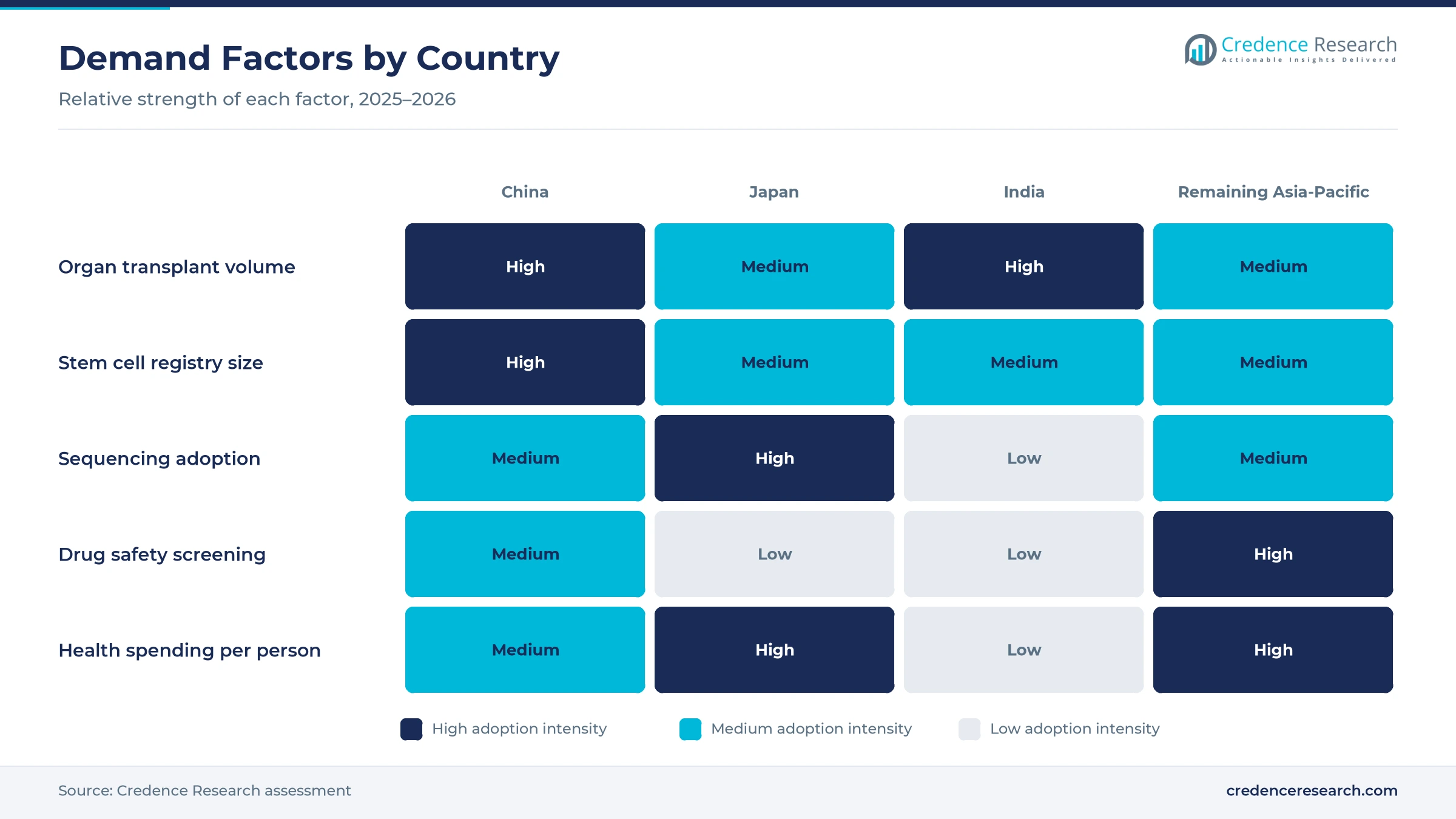
Transplant and registry testing demand lifts the market, because every donor and recipient must be typed before a match is confirmed. China recorded 18,474 marrow donations and more than 3.45 million registered volunteers by Sept. 23, 2024, according to a China Marrow Donor Program report. The same program had run typing tests for more than 120,000 patients with blood diseases. China also performed more than 24,000 organ transplant operations in 2024, with 6,744 deceased organ donors, up 4.5% from the year before. Japan adds more than 5,500 stem cell transplants a year, according to its national survey. As a result, solid organ transplantation holds a 38.0% share of 2025 value.
Why is the migration to sequencing workflows raising spend?
The migration to sequencing workflows raises spending per test, because sequencing kits resolve more genes at higher resolution than older probe methods. Thermo Fisher Scientific launched its One Lambda HybriType HLA Plus Typing Flex kit, a hybrid capture sequencing assay, according to a trade press report dated March 24, 2025. The full workflow takes under 5.5 hours with under 2.5 hours of hands-on time. The supplier also reports at least 99.8% concordance with reference results. GenDx earlier won South Korean clearance for its sequencing workflow, which types five genes on benchtop next-generation sequencing instruments. In turn, NGS-based typing grows at 11.12% a year, the fastest technology rate.
How do pharmacogenomic screening pathways widen testing?
Pharmacogenomic screening pathways widen testing beyond transplant centers, because certain gene variants predict severe skin reactions to common drugs. Hong Kong has run universal screening for the HLA-B*58:01 variant in its public hospitals since March 2023, before patients start allopurinol for gout. South Korea and Thailand support universal testing for the same variant through public insurance. The variant is carried by 12% to 22% of Chinese people in Malaysia, Singapore and Hong Kong, which makes screening relevant across the region. As a result, disease diagnostics and pharmacogenomics grow at 10.50% a year, the fastest application rate, while hospitals add pharmacogenomic testing to electronic prescribing systems.
Why does rising health spending support wider access?
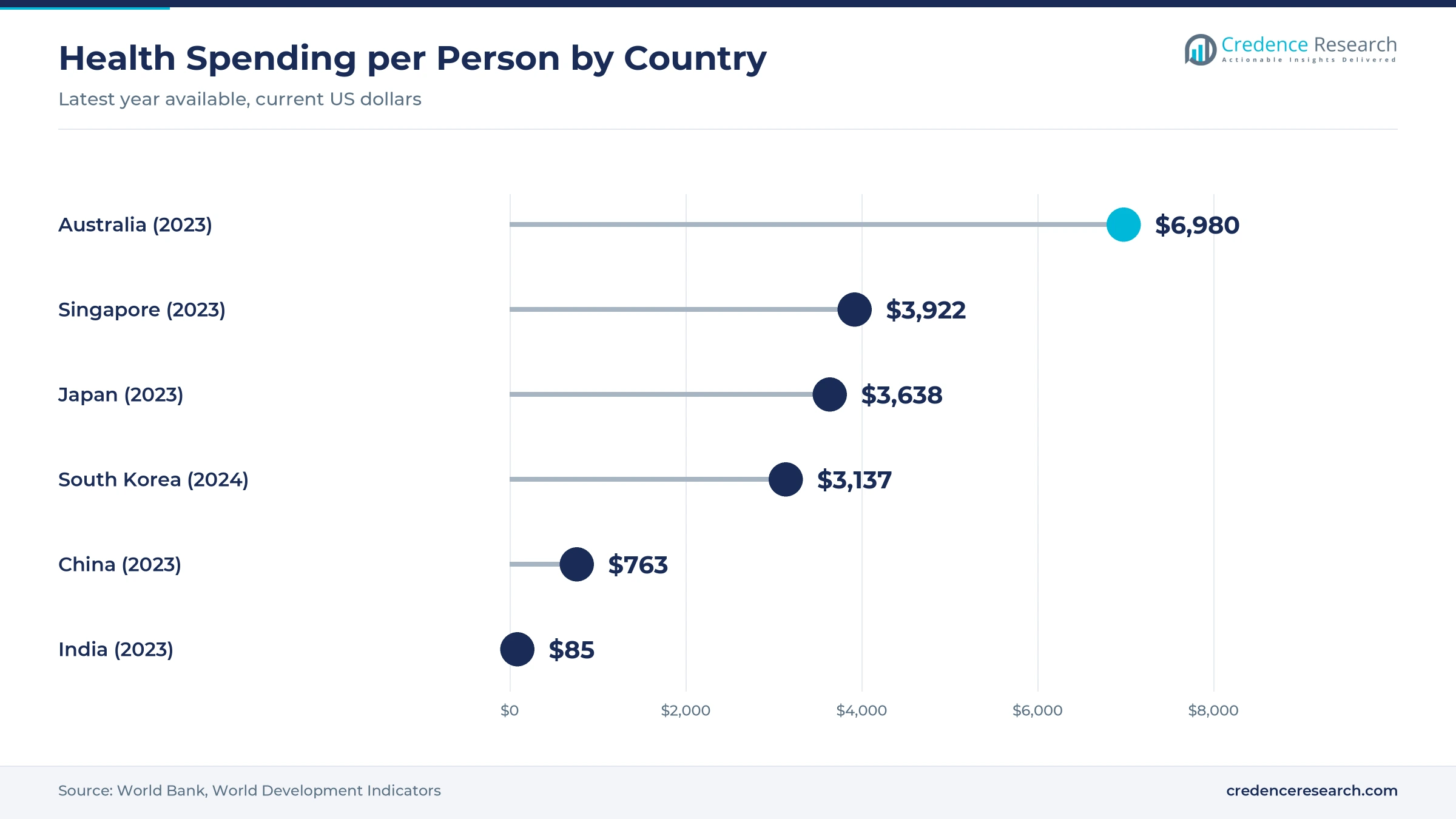
Rising health spending supports wider access to typing, because transplants and screening need public funding and insurance coverage. Health spending per person reached $6,980 in Australia and $3,638 in Japan in 2023, according to World Bank data. China spent $763 per person in 2023, while India spent $85, which shows how much room lower-income markets still have. South Korea spent $3,137 per person in 2024, which supports broad insurance coverage of screening tests. In turn, lower-income markets such as India have the most room for new public transplant and screening programs, while richer markets already fund high-resolution typing for most planned transplants and add pharmacogenomic screening when insurers approve coverage.
Faster workflows and wider marker panels reshape testing
How is the shift to same-day typing changing labs?
The shift to same-day typing is changing lab workflows, because deceased donor organs must be matched within hours. CareDx launched its AlloSeq Tx11 sequencing solution and new QTYPE software on Oct. 6, 2025, according to a company release. QTYPE is a real-time PCR method for rapid low-to-intermediate resolution typing. CareDx also opened an early access program for same-day long-read genotyping with a new probe design. Thermo Fisher Scientific reports a sequencing workflow of under 5.5 hours, which brings high resolution close to deceased donor timelines. As a result, PCR-based typing keeps a 55.0% share of 2025 value, while sequencing tools gain share in planned transplants.
Why is the rise of wider marker panels gaining weight?
The rise of wider marker panels is gaining weight, because transplant teams want more risk information from a single sample. The CareDx AlloSeq Tx11 panel adds ABO, CCR5, LIMS1 and APOL1 markers to tissue typing genes. A poster at the same 2025 meeting showed a combined ABO and tissue typing assay with 100% concordance across 3 clinical sites. European rules also set December 2027 as the deadline for certified typing devices, which pushes suppliers to update kits sold worldwide. In turn, software and bioinformatics grow at 10.75% a year, the fastest product rate, because labs need tools that read and report larger panels.
Can Indian registry and transplant growth open new demand?
Indian registry and transplant growth opens new demand, because the country still has a large gap between patients and donors. India performed a record 18,900 organ transplants in 2024, according to a government statement reported in August 2025. The health minister also pointed to a significant gap between patients who need transplants and available donors. DATRI, a stem cell donor registry founded in 2009, uses HistoGenetics as its high-resolution typing laboratory, which received an interest-free loan to cover donor typing costs. As a result, India becomes the fastest-growing country in the region, and closer links with Indian marrow transplant programs widen volumes.
Is there room for growth in Korean transplant testing?
Korean transplant testing creates room for growth, because the waiting list for organs has more than doubled in a decade. About 52,000 people were waiting for an organ transplant in South Korea in June 2024, up from 24,607 in 2014. Of these, 34,254 people, or 65%, were waiting for a kidney transplant. The country also had 1.78 million registered organ donors at the end of 2023, equal to 3.44% of the population. In turn, demand for transplant diagnostics such as antibody screening and tissue typing should rise, which supports the remaining markets with a 27.7% share of 2025 value and steady sequencing demand.
Costs, skills gaps and uneven funding weigh on labs
How do test costs limit access in lower-income markets?
Test costs limit access in lower-income markets, because high-resolution sequencing kits and instruments cost far more than older probe tests. Patients in many countries pay part of transplant testing out of pocket. As a result, some hospitals type only a few genes at low resolution or delay testing. Suppliers respond with flexible kit configurations, shared reference laboratory services and lower-cost real-time PCR options for first-line work. Registries and public hospitals also negotiate volume contracts that lower the price of each kit over several years.
Why do skills gaps slow sequencing adoption?
Skills gaps slow sequencing adoption, because library preparation, data review and allele reporting need trained staff. Many regional hospitals do not have histocompatibility specialists or bioinformatics teams on site. In turn, labs that buy sequencers may run them below capacity for months. Suppliers and registries respond with training programs, automated analysis software and remote support from central laboratories. Over time, regional training centers and online courses should widen the pool of staff who can review sequencing data with confidence.
How does uneven funding for drug safety screening slow demand?
Uneven funding for drug safety screening slows demand, because some health systems pay for tests while others leave the cost to patients. Singapore does not fund routine screening for the allopurinol risk variant in primary care. As a result, testing stays limited to tertiary centers and high-risk patients. Hospitals respond by targeting older patients and those with kidney disease, while advocates press for public coverage. Wider evidence on avoided hospital stays could help persuade more insurers to pay for screening.
Why do regulatory differences raise launch costs?
Regulatory differences raise launch costs, because each country requires its own registration for diagnostic kits. Suppliers must run local studies, translate labels and maintain separate files for China, Japan, South Korea and other markets. In turn, new kits can reach some countries years after launch elsewhere. Companies respond by working with local distributors that manage registration, training and service. Some suppliers also run local studies with leading transplant centers, which helps them meet national rules faster.
China leads while India grows fastest
| Country | Value, 2025 (USD million) | Share, 2025 | CAGR, 2026–2035 |
|---|---|---|---|
| China | 367.9 | 50.3% | 9.65% |
| Remaining Asia-Pacific Markets | 202.6 | 27.7% | 9.35% |
| Japan | 87.0 | 11.9% | 8.55% |
| India | 73.9 | 10.1% | 10.65% |
Why does China hold the largest share?
China held a 50.3% share of 2025 value and grows at 9.65% a year, because it runs the largest donor registry and transplant program in the region. The national marrow donor program had more than 3.45 million volunteers in September 2024, and China performed more than 24,000 organ transplant operations in 2024. TBG Biotechnology won approval from Chinese regulators for its sequence-based typing kits, while local makers supply probe and primer tests.
How does Japan support steady demand?
Japan held an 11.9% share of 2025 value and grows at 8.55% a year, because its stem cell transplant programs are large and mature. The country performs more than 5,500 stem cell transplants a year, and the Japan Marrow Donor Program works with 258 transplant centers. Health spending reached $3,638 per person in 2023, which supports high-resolution typing for most planned transplants.
Why is India the fastest-growing country?
India held a 10.1% share of 2025 value and grows fastest at 10.65% a year, because transplant numbers and donor registries are expanding together. The country performed a record 18,900 organ transplants in 2024, and DATRI uses high-resolution typing for new stem cell donors. Health spending is still low at $85 per person in 2023, which leaves large room for public coverage to grow.
What shapes demand in the remaining markets?
The remaining Asia-Pacific markets held a 27.7% share of 2025 value and grow at 9.35% a year. South Korea adds demand from a waiting list of about 52,000 people, while Hong Kong, Thailand and Taiwan add drug safety screening. Australia adds research and transplant demand supported by health spending of $6,980 per person in 2023.
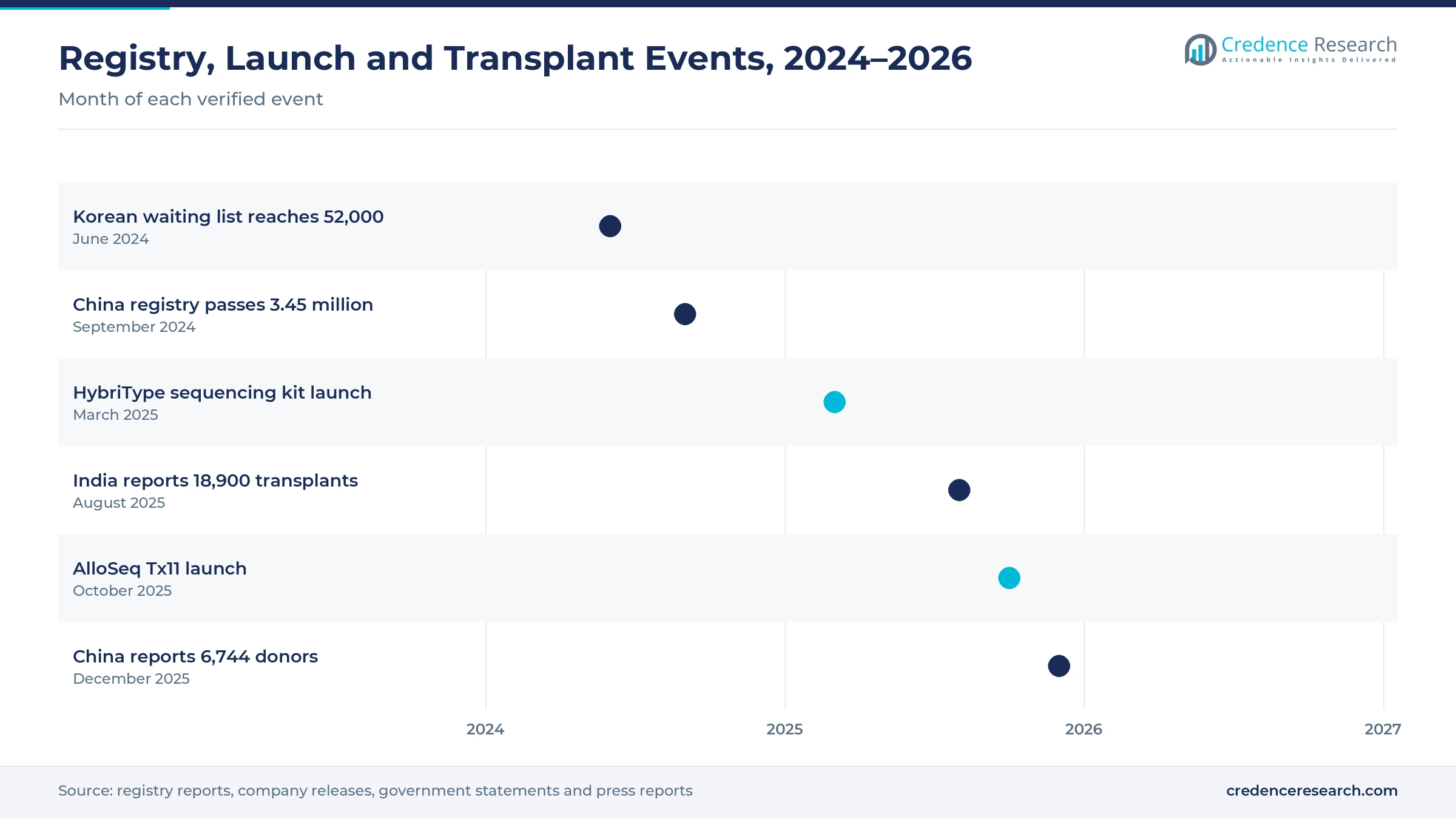
Registry, launch and transplant milestones from 2024 to 2026
| Development | Status and market relevance |
|---|---|
| In June 2024, about 52,000 people were waiting for organ transplants in South Korea, up from 24,607 in 2014. | Signals rising demand for donor and recipient matching |
| In September 2024, the China Marrow Donor Program reported more than 3.45 million registered volunteers. | Sustains registry typing volumes in China |
| In March 2025, Thermo Fisher Scientific launched the One Lambda HybriType HLA Plus Typing Flex kit. | Brings sequencing results within a single working day |
| In August 2025, the Indian government said the country performed a record 18,900 organ transplants in 2024. | Raises matching demand in the fastest-growing country |
| In October 2025, CareDx launched AlloSeq Tx11 with added ABO, CCR5, LIMS1 and APOL1 markers. | Widens the information labs report from one sample |
Sequencing, real-time PCR and long-read typing tools
- Hybrid capture sequencing pulls target genes from the sample with probes, which improves read balance and coverage. One kit launched in March 2025 completes the full workflow in under 5.5 hours.
- Real-time PCR typing gives low-to-intermediate resolution results in hours, which suits deceased donor work where organs must be matched quickly.
- Long-read sequencing reads whole genes in one pass, which reduces ambiguous results and allele dropout. Suppliers now offer same-day long-read genotyping through early access programs.
- Automated analysis software calls alleles from sequencing data, which cuts manual review time for lab staff and supports reports for wider marker panels.
Need a Custom Version of This Report?
Tailor the scope, geography, or segments to your exact requirements.
- Custom geography or segment scope
- Direct access to our analyst team
Suppliers compete on resolution, speed and local approval
Competition combines global diagnostics suppliers with regional kit makers and specialist laboratories. Thermo Fisher Scientific sells One Lambda typing kits and analysis software, including a hybrid capture sequencing kit launched in March 2025. Illumina promotes its TruSight HLA sequencing assay through its South Asia Pacific business. TBG Biotechnology, based in Taiwan, holds Chinese approval for sequence-based typing kits and has distributed sequencing software in China, Hong Kong, Taiwan and Australia. GenDx holds South Korean clearance for its sequencing workflow, while HistoGenetics types donors for the Indian registry DATRI. Companies compete on resolution, turnaround time, software quality and local registration rather than on price alone. Suppliers that pair kits with training and service win long contracts with transplant centers and registries.
Companies profiled and their roles in this market
| Company | Type | Role in the market |
|---|---|---|
| Thermo Fisher Scientific | Global supplier | Launched a hybrid capture sequencing typing kit in March 2025 |
| Illumina | Sequencing supplier | Promotes TruSight HLA through its South Asia Pacific business |
| TBG Biotechnology | Regional kit maker | Holds Chinese approval for sequence-based typing kits |
| GenDx | Specialist supplier | Holds South Korean clearance for its sequencing workflow |
| HistoGenetics | Typing laboratory | Provides high-resolution typing for the Indian registry DATRI |
Credence Research view on regional tissue matching demand
Credence Research's view is that Asia-Pacific demand for tissue typing will grow steadily because transplant numbers, donor registries and drug safety screening are all expanding. Reagents and consumables remain the base of the market, while software grows fastest as sequencing spreads. China keeps the largest share, and India grows fastest among the major countries. However, test costs, skills gaps and uneven funding will slow adoption in lower-income markets. Suppliers that combine fast workflows, local approval and training support should gain share fastest.
How the regional tissue matching estimate was built
The report uses 2025 as the base year on a calendar basis, and market values come from the Credence Research model. That model combines transplant statistics, registry data, health spending statistics, screening policies and company information on products and approvals. Segment splits and country growth rates are Credence Research estimates, while country shares follow the client-defined split. Sources used are official statistics, registry reports, company releases, trade press and peer-reviewed articles, and no interviews or surveys were used.
Transplant access and screening carry demand to 2035
Regional HLA typing value is expected to reach USD 1.84 billion by 2035, a 9.55% CAGR during 2026–2035, as transplants and screening keep demand rising. Growth should stay steady through 2028 while labs move planned transplant work to sequencing. After that, drug safety screening and wider marker panels will carry more growth as insurers add coverage. Faster public funding for transplants would raise this outlook, while tight hospital budgets would lower it. Suppliers with local approval and strong service networks are expected to gain the most.
Frequently Asked Questions
How big is the Asia-Pacific HLA typing market?
Which product type leads regional demand?
Which country leads the regional market?
Why does solid organ transplantation hold the largest application share?
How does drug safety screening affect regional demand?
How is sequencing changing tissue typing?
Who are the leading companies in the region?
What are the main challenges for laboratories?
Table of Content
Chapter 1 Market Segmentation
- 1.1 Segmentation Framework
- 1.1.1 Product and Service Classification
- 1.1.2 Application and End-Use Classification
- 1.1.3 Technology and Solution Classification
- 1.1.4 Customer and Distribution Channel Classification
- 1.1.5 Geographic Segmentation
- 1.1.6 Market Segment Definitions and Boundaries
- 1.2 By Product Type
- 1.2.1 Reagents and Consumables
- 1.2.2 Instruments and Systems
- 1.2.3 Software and Bioinformatics
- 1.2.4 HLA Typing Services
- 1.3 By Application
- 1.3.1 Solid Organ Transplantation
- 1.3.2 Hematopoietic Transplantation
- 1.3.3 Disease Diagnostics and Pharmacogenomics
- 1.3.4 Research and Companion Diagnostic Development
- 1.4 By End User
- 1.4.1 Hospitals and Transplant Centres
- 1.4.2 Independent Reference Laboratories
- 1.4.3 Academic and Research Institutes
- 1.4.4 Donor Registries and Blood Services
- 1.5 By Technology
- 1.5.1 PCR-Based Typing
- 1.5.2 NGS-Based Typing
- 1.5.3 Sanger Sequence-Based Typing
- 1.6 By Country
- 1.6.1 China
- 1.6.2 Japan
- 1.6.3 India
- 1.6.4 Remaining Asia-Pacific Markets
Chapter 2 Introduction
- 2.1 Report Objectives and Scope
- 2.2 Product Definition and Industry Terminology
- 2.3 Market Inclusions and Exclusions
- 2.4 Research Process
- 2.4.1 Primary Research and Expert Interviews
- 2.4.2 Secondary Research and Source Review
- 2.4.3 Top-Down and Bottom-Up Estimation
- 2.4.4 Data Triangulation and Verification
- 2.5 Market Size Measurement Basis
- 2.5.1 2025: USD 731.5 million → 2035: USD 1.84 billion
- 2.6 Historical and Forecast Reference Periods
- 2.6.1 Historical Period: 2018-2025
- 2.6.2 Base Year: 2025
- 2.6.3 Forecast Period: 2025-2035
- 2.7 Research Assumptions and Limitations
Chapter 3 Executive Summary
- 3.1 Market Snapshot and Key Findings
- 3.2 Base-Year Market Size, 2025
- 3.3 Forecast Market Size, 2035
- 3.4 Revenue and Volume Growth Outlook
- 3.5 Key Demand and Supply Indicators
- 3.6 Leading Market Segments
- 3.7 Fastest-Growing Market Opportunities
- 3.8 Regional Performance Highlights
- 3.9 Technology and Industry Transformation
- 3.10 Competitive Landscape Summary
- 3.11 Analyst View and Strategic Implications
Chapter 4 Asia-Pacific HLA Typing Market Trends and Developments
- 4.1 Historical Industry Development, 2018-2025
- 4.2 Recent Market Trends and Developments
- 4.3 Demand and Customer Behavior Trends
- 4.4 Technology and Product Innovation
- 4.5 Artificial Intelligence, Automation and Digitalization
- 4.6 Local Manufacturing and Supply Chain Realignment
- 4.7 Industry Partnerships, Mergers and Acquisitions
- 4.8 Sustainability and Circular Economy Developments
- 4.9 Government and Private Sector Investment Trends
- 4.10 Emerging Business Models and Commercialization
- 4.11 Industry Developments and Announcements
Chapter 5 Asia-Pacific HLA Typing Market Production, Supply and Demand Analysis
- 5.1 Demand Trend and Consumption Analysis, 2018-2025
- 5.2 Demand Forecast, 2025-2035
- 5.3 Production and Output Trend, 2018-2025
- 5.4 Production and Output Forecast, 2025-2035
- 5.5 Installed Capacity and Capacity Utilization
- 5.6 Company-Wise Production Plants and Statistics
- 5.6.1 Installed Production Capacity
- 5.6.2 Actual Production
- 5.6.3 Planned Capacity and Expansion Targets
- 5.7 Supply Chain Structure and Procurement Trends
- 5.8 Supply-Demand Gap and Bottlenecks
- 5.9 Import Dependence and Sourcing Structure
- 5.10 Contract Manufacturing and Outsourcing
- 5.11 Regional Supply and Demand Concentration
Chapter 6 Asia-Pacific HLA Typing Market Pricing Analysis
- 6.1 Pricing Structure and Measurement
- 6.2 Historical Pricing Trends, 2018-2025
- 6.3 Pricing Outlook, 2025-2035
- 6.4 Average Selling Price and Unit Economics
- 6.5 Pricing by Product and Market Segment
- 6.6 Geographic Pricing Differences
- 6.7 Key Input, Energy, Labor and Logistics Costs
- 6.8 Contract Pricing and Purchasing Models
- 6.9 Pricing Sensitivity and Competitive Positioning
- 6.10 Price, Margin and Profitability Implications
Chapter 7 Asia-Pacific HLA Typing Market Dynamics
- 7.1 Market Growth Drivers
- 7.1.1 Demand-Side Drivers
- 7.1.2 Technology and Innovation Drivers
- 7.1.3 Infrastructure and Investment Drivers
- 7.1.4 Regulatory and Policy Drivers
- 7.2 Market Restraints
- 7.2.1 Cost and Affordability Constraints
- 7.2.2 Technology and Adoption Barriers
- 7.2.3 Supply Chain and Operational Constraints
- 7.3 Market Challenges
- 7.3.1 Competitive Pressure and Margin Erosion
- 7.3.2 Skills, Infrastructure and Implementation Gaps
- 7.4 Emerging Market Opportunities
- 7.5 Market Dynamics Impact and Time-Horizon Assessment
Chapter 8 Asia-Pacific HLA Typing Value Chain Analysis
- 8.1 Industry Value Chain Overview
- 8.2 Upstream Suppliers and Critical Inputs
- 8.3 Technology and Component Providers
- 8.4 Manufacturing or Service Delivery
- 8.5 Distribution, Channel Partners and Integrators
- 8.6 Downstream Applications and End Users
- 8.7 Value Addition and Profit Pools
- 8.8 Vertical Integration and Outsourcing
- 8.9 Supplier Concentration and Risk
- 8.10 Supply Chain Localization and Resilience
Chapter 9 Asia-Pacific HLA Typing Market Regulations and Policies
- 9.1 Relevant Laws, Standards and Compliance Frameworks
- 9.2 Product, Service, Safety and Quality Requirements
- 9.3 Government Policies, Incentives and Subsidies
- 9.4 Imports, Exports and Trade Barriers
- 9.5 Public Procurement and Local Content Requirements
- 9.6 Environmental and Sustainability Compliance
- 9.7 Upcoming Policy Changes and Market Implications
Chapter 10 Asia-Pacific HLA Typing Market Hotspots and Opportunities
- 10.1 Market Opportunity Mapping and Growth Hotspots
- 10.2 High-Growth Applications and Customer Groups
- 10.3 Underserved Markets and White-Space Opportunities
- 10.4 Emerging Technology and Product Opportunities
- 10.5 New Capacity and Investment Hotspots
- 10.6 Market Entry and Expansion Opportunities
- 10.7 Distribution and Partnership Opportunities
- 10.8 Near-Term and Long-Term Commercial Potential
- 10.9 Opportunity Attractiveness and Execution Risks
Chapter 11 Asia-Pacific HLA Typing Market Outlook, 2025-2035
- 11.1 Market Size and Analysis
- 11.1.1 Revenue (Market Measurement: 2025: USD 731.5 million → 2035: USD 1.84 billion)
- 11.1.2 Market Volume and Quantity Sold
- 11.1.3 Historical Market Size, 2018-2025
- 11.1.4 Base-Year Market Size, 2025
- 11.2 Market Forecast, 2025-2035
- 11.2.1 Revenue Forecast to 2035
- 11.2.2 Volume Forecast to 2035
- 11.2.3 CAGR and Year-on-Year Growth
- 11.2.4 Incremental Revenue Opportunity
- 11.3 Forecast Assumptions and Scenario Analysis
- 11.3.1 Base-Case Forecast
- 11.3.2 Optimistic and Conservative Scenarios
- 11.3.3 Technology, Pricing and Policy Sensitivities
- 11.4 Market Attractiveness and Growth Outlook
Chapter 12 Asia-Pacific HLA Typing Market Segmentation and Outlook
- 12.1 Segmentation Summary and Market Shares, 2025
- 12.2 Largest and Fastest-Growing Segments
- 12.3 By Product Type - Market Size and Forecast, 2025-2035
- 12.3.1 Segment Definition and Scope
- 12.3.2 Historical Market Size, 2018-2025
- 12.3.3 Revenue Forecast, 2025-2035
- 12.3.4 Volume Forecast, 2025-2035
- 12.3.5 Base-Year Market Share, 2025
- 12.3.6 Segment CAGR and Growth Drivers
- 12.3.7 Subsegment Market Size and Forecast
- 12.3.7.1 Reagents and Consumables
- 12.3.7.2 Instruments and Systems
- 12.3.7.3 Software and Bioinformatics
- 12.3.7.4 HLA Typing Services
- 12.3.8 Subsegment Pricing and Adoption Trends
- 12.3.9 Leading Suppliers and Competition
- 12.3.10 Regional Demand and Opportunities
- 12.4 By Application - Market Size and Forecast, 2025-2035
- 12.4.1 Segment Definition and Scope
- 12.4.2 Historical Market Size, 2018-2025
- 12.4.3 Revenue Forecast, 2025-2035
- 12.4.4 Volume Forecast, 2025-2035
- 12.4.5 Base-Year Market Share, 2025
- 12.4.6 Segment CAGR and Growth Drivers
- 12.4.7 Subsegment Market Size and Forecast
- 12.4.7.1 Solid Organ Transplantation
- 12.4.7.2 Hematopoietic Transplantation
- 12.4.7.3 Disease Diagnostics and Pharmacogenomics
- 12.4.7.4 Research and Companion Diagnostic Development
- 12.4.8 Subsegment Pricing and Adoption Trends
- 12.4.9 Leading Suppliers and Competition
- 12.4.10 Regional Demand and Opportunities
- 12.5 By End User - Market Size and Forecast, 2025-2035
- 12.5.1 Segment Definition and Scope
- 12.5.2 Historical Market Size, 2018-2025
- 12.5.3 Revenue Forecast, 2025-2035
- 12.5.4 Volume Forecast, 2025-2035
- 12.5.5 Base-Year Market Share, 2025
- 12.5.6 Segment CAGR and Growth Drivers
- 12.5.7 Subsegment Market Size and Forecast
- 12.5.7.1 Hospitals and Transplant Centres
- 12.5.7.2 Independent Reference Laboratories
- 12.5.7.3 Academic and Research Institutes
- 12.5.7.4 Donor Registries and Blood Services
- 12.5.8 Subsegment Pricing and Adoption Trends
- 12.5.9 Leading Suppliers and Competition
- 12.5.10 Regional Demand and Opportunities
- 12.6 By Technology - Market Size and Forecast, 2025-2035
- 12.6.1 Segment Definition and Scope
- 12.6.2 Historical Market Size, 2018-2025
- 12.6.3 Revenue Forecast, 2025-2035
- 12.6.4 Volume Forecast, 2025-2035
- 12.6.5 Base-Year Market Share, 2025
- 12.6.6 Segment CAGR and Growth Drivers
- 12.6.7 Subsegment Market Size and Forecast
- 12.6.7.1 PCR-Based Typing
- 12.6.7.2 NGS-Based Typing
- 12.6.7.3 Sanger Sequence-Based Typing
- 12.6.8 Subsegment Pricing and Adoption Trends
- 12.6.9 Leading Suppliers and Competition
- 12.6.10 Regional Demand and Opportunities
- 12.7 By Country - Market Size and Forecast, 2025-2035
- 12.7.1 Segment Definition and Scope
- 12.7.2 Historical Market Size, 2018-2025
- 12.7.3 Revenue Forecast, 2025-2035
- 12.7.4 Volume Forecast, 2025-2035
- 12.7.5 Base-Year Market Share, 2025
- 12.7.6 Segment CAGR and Growth Drivers
- 12.7.7 Subsegment Market Size and Forecast
- 12.7.7.1 China
- 12.7.7.2 Japan
- 12.7.7.3 India
- 12.7.7.4 Remaining Asia-Pacific Markets
- 12.7.8 Subsegment Pricing and Adoption Trends
- 12.7.9 Leading Suppliers and Competition
- 12.7.10 Regional Demand and Opportunities
- 12.8 Segment Growth Comparison
- 12.9 Segment Attractiveness and Priority Matrix
Chapter 13 Asia-Pacific HLA Typing End-Use and Application Market Outlook
- 13.1 End-Use Industry and Customer Demand Structure
- 13.2 Leading Applications and Customer Groups
- 13.3 End-Use Market Size, Share and Forecast
- 13.4 Major End-Use Industry Deep Dives
- 13.4.1 Customer Requirements and Use Cases
- 13.4.2 Demand and Replacement Cycles
- 13.4.3 Technical and Regulatory Considerations
- 13.4.4 Purchasing and Procurement Models
- 13.4.5 Leading Vendors and Distribution Channels
- 13.4.6 Forecast and Commercial Opportunities
- 13.5 Emerging Applications and Cross-Segment Demand
- 13.6 End-Use Industry Investment Priorities
Chapter 14 Asia-Pacific HLA Typing Geographic Market Outlook, 2025-2035
- 14.1 Regional Market Size and Country-Level Shares, 2025
- 14.2 Country Market Size Comparison, 2025
- 14.3 Country Market Forecasts, 2025-2035
- 14.4 Subregional Industrial and Demand Clusters
- 14.5 Intra-Regional Pricing and Cost Differences
- 14.6 Cross-Border Trade and Supply Networks
- 14.7 Regional Supply and Demand Balances
- 14.8 Country Opportunity Comparison and Prioritization
Note: Every listed country is covered on the structure shown under the first country.
Chapter 15 Asia-Pacific HLA Typing Technology, Innovation and Sustainability Outlook
- 15.1 Technology Landscape and Maturity
- 15.2 Product, Process and Service Innovation
- 15.3 AI, Automation and Digital Tools in the Industry
- 15.4 Technology Adoption and Performance Benchmarking
- 15.5 Innovation Pipeline and R&D Investment
- 15.6 Patent and Intellectual Property Trends
- 15.7 Energy Efficiency and Resource Management
- 15.8 Sustainability, Recycling and Circularity
- 15.9 Technology Roadmap, 2025-2035
- 15.10 Risks of Obsolescence and Technology Substitution
Chapter 16 Asia-Pacific HLA Typing Market Key Strategic Imperatives
- 16.1 Growth and Market Entry Priorities
- 16.2 High-Return Products and Segments
- 16.3 Pricing, Profitability and Cost Optimization
- 16.4 Technology Investment and Product Differentiation
- 16.5 Supply Chain Localization and Resilience
- 16.6 Distribution and Customer Acquisition
- 16.7 Partnership, Acquisition and Capacity Strategy
- 16.8 Regional Expansion Priorities
- 16.9 Short-, Medium- and Long-Term Actions
Chapter 17 Competition Outlook
- 17.1 Industry Competition Characteristics
- 17.2 Market Structure and Concentration
- 17.3 Market Share and Competitive Positioning, 2025
- 17.4 Company-Wise Revenue and Product Benchmarking
- 17.5 Production and Service Capacity Benchmarking
- 17.6 Technology, Pricing and Differentiation
- 17.7 Regional Footprint and Distribution Strength
- 17.8 Mergers, Acquisitions and Strategic Alliances
- 17.9 New Entrants and Competitive Threats
- 17.10 Porter's Five Forces and Industry Attractiveness
- 17.11 Competitive Outlook, 2025-2035
Chapter 18 Company Profiles
- 18.1 Company Coverage and Selection Criteria
- 18.2 Thermo Fisher Scientific
- 18.2.1 Business Description
- 18.2.2 Company Ownership and Geographic Presence
- 18.2.3 Product and Service Portfolio
- 18.2.4 Manufacturing and Operating Footprint
- 18.2.5 Production Capacity and Expansion Plans
- 18.2.6 Financial Performance and Investment
- 18.2.7 Market Share and Competitive Position
- 18.2.8 Technology and Innovation Capabilities
- 18.2.9 Strategic Alliances or Partnerships
- 18.2.10 Recent Developments
- 18.2.11 Growth Strategy and Outlook
- 18.3 Illumina
- 18.4 CareDx
- 18.5 Werfen
- 18.6 GenDx
- 18.7 TBG Biotechnology
- 18.8 BAG Diagnostics
- 18.9 inno-train Diagnostik
- 18.10 HistoGenetics
- 18.11 Beijing Bofurui Gene Diagnostics
- 18.12 Other Relevant Market Participants
Note: Every listed company is profiled on the structure shown under the first company. The company list is preliminary and may change based on research findings, market developments, data availability and client requirements.
Chapter 19 Disclaimer
- 19.1 Research and Forecast Disclaimer
- 19.2 Data Source and Estimation Limitations
Note: The depth of individual sections depends on data availability for this market. Volume, capacity, trade and other unit-based metrics are included where applicable.

