
| REPORT ATTRIBUTE | DETAILS |
|---|---|
| Historical Period | 2019-2022 |
| Base Year | 2023 |
| Forecast Period | 2024-2032 |
| Pharmacogenomics Market Size 2023 | USD 3481.20 million |
| Pharmacogenomics Market, CAGR | 11.50% |
| Pharmacogenomics Market Size 2032 | USD 9272.63 million |
Market Insights
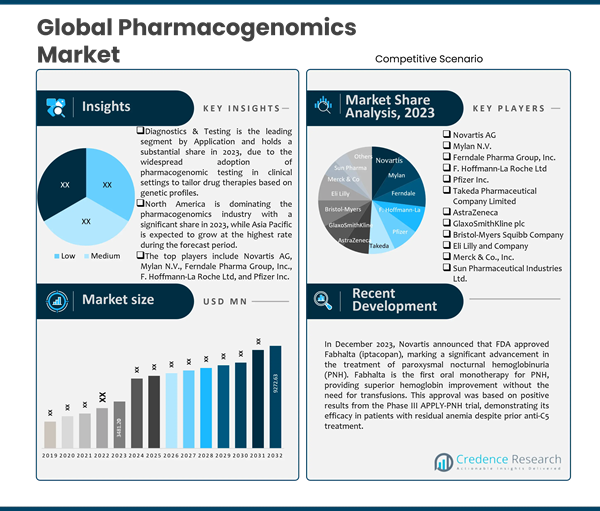
- The global demand for pharmacogenomics products was valued at USD 3481.20 million in 2023 and is expected to reach USD 9272.63 million in 2032, growing at a CAGR of 11.50% between 2024 and 2032.
- The diagnostics & testing segment was the market leader by application, accounting for the highest share in value in 2023, and the personalized medicine segment is expected to grow rapidly throughout the forecast period.
- The next-generation sequencing (NGS) segment is predicted to grow fastest over the projection period, while polymerase chain reaction (PCR) had the largest share by technology in 2023.
- Over the projection period, the pharmaceutical companies segment is expected to expand at the fastest rate, and the hospitals & clinics segment dominated the market share by end-user in 2023.
- North America is dominating the pharmacogenomics industry, with over one-third of the market in 2023.
- The market's primary possibilities include significant growth potential driven by several factors, such as advancements in genetic research and sequencing technologies, increasing awareness and adoption of personalized medicine, rising prevalence of chronic diseases and genetic disorders, and supportive government initiatives and funding.
Executive Summary
Market Definition
Pharmacogenomics is the study of how an individual's genetic makeup influences their response to drugs. It combines pharmacology and genomics to develop effective, safe medications and doses tailored to a person's genetic profile.
Pharmacogenomics analyzes genes that affect drug metabolism and response. This information helps predict how a patient will respond to specific medications, allowing healthcare providers to select and dose drugs more precisely.
The primary advantages of pharmacogenomics include improved drug efficacy, reduced adverse drug reactions, and the ability to tailor treatments to individual patients.
Market Overview
The global pharmacogenomics market has witnessed steady growth in recent years and is expected to grow at a CAGR of 11.50% between 2024 and 2032. The market was valued at USD 3481.20 million in 2023 and is expected to reach USD 9272.63 million in 2032.
The pharmacogenomics market is driven by the growing prevalence of chronic and genetic diseases and the increasing use of genomics in specialized and personalized medicine. Chronic conditions such as cancer, cardiovascular diseases, and diabetes are becoming more common worldwide, necessitating more effective and personalized treatment strategies.
Pharmacogenomics offers the ability to tailor therapies based on individual genetic profiles, enhancing treatment efficacy and safety for these chronic diseases. Additionally, the rise in awareness and diagnosis of genetic disorders requires targeted therapeutic approaches that pharmacogenomics can provide.
However, the integration of genomics into personalized medicine, which customizes healthcare based on individual genetic, environmental, and lifestyle factors, further propels market growth. Advances in genomic technologies have made it easier and more cost-effective to obtain and analyze genetic information, facilitating the incorporation of pharmacogenomics into routine clinical practice and allowing for more precise treatment decisions. This shift towards personalized medicine is driving the demand for pharmacogenomic solutions, thereby expanding the market.
The integration of artificial intelligence (AI) in pharmacogenomics presents a significant opportunity in the forecasted period. AI technologies enhance the analysis of complex genomic data, improving the accuracy of predicting individual drug responses by considering genetic, environmental, and lifestyle factors. AI also streamlines drug discovery and development processes, potentially reducing time and costs while advancing personalized medicine through more precise treatment plans.
Segmentation by Application
- Diagnostics & Testing is the leading segment by application and held the dominant share in value in 2023. This dominance is primarily due to the widespread adoption of pharmacogenomic testing in clinical settings to tailor drug therapies based on genetic profiles. The ability to predict patient responses to drugs and avoid adverse reactions has made pharmacogenomic testing an essential tool in personalized medicine, driving its substantial market share.
- The personalized medicine segment is expected to exhibit the highest CAGR during the forecast period. The growth of personalized medicine is driven by advancements in genomic technologies and the increasing demand for tailored treatments. As healthcare moves towards more individualized approaches, the adoption and development of personalized medicine solutions are accelerating rapidly, including the implementation of targeted therapies and precision diagnostics.
- The drug development & discovery and companion diagnostics segment is anticipated to grow moderately compared to the personalized medicine segment during the forecasted period.
Segmentation by Technology
- The polymerase chain reaction (PCR) held the largest market share by technology in terms of value in 2023. PCR is a well-established technology widely used in pharmacogenomics due to its precision, speed, and cost-effectiveness. Its ability to amplify specific DNA sequences makes it indispensable for detecting genetic variations that influence drug response, thus driving its substantial market share.
- The next-generation sequencing (NGS) segment is expected to be the fastest-growing segment during the forecasted period. NGS's rapid growth is fueled by its capability to provide comprehensive genetic information at a lower cost and higher throughput compared to traditional methods. NGS enables the simultaneous analysis of multiple genes, offering deeper insights into genetic variations and their implications in drug response. As the demand for more detailed and personalized genetic information increases, the adoption of NGS in pharmacogenomics is accelerating rapidly.
- The microarrays, mass spectrometry, and other technologies are projected to grow at a moderate CAGR and hold a lower share than the polymerase chain reaction (PCR) segment.
Segmentation by End-User
- The Hospitals & Clinics segment held the largest market share in terms of value in 2023. This is due to the increasing integration of pharmacogenomic testing into routine clinical practice. Hospitals and clinics are the primary points of patient care where personalized treatment plans are developed, making them central to the application of pharmacogenomic insights. The need to improve drug efficacy and reduce adverse drug reactions in a clinical setting drives the substantial market share of hospitals and clinics in this market.
- Pharmaceutical companies are anticipated to be the fastest-growing segment in terms of end-users. The rapid growth of this subsegment is driven by the pharmaceutical industry's increasing focus on precision medicine. Pharmaceutical companies are investing heavily in pharmacogenomics to develop drugs that are tailored to the genetic profiles of patients, enhancing the effectiveness and safety of their products. The push towards more personalized therapeutic solutions, along with regulatory support for personalized medicine, is propelling the growth of pharmacogenomics within pharmaceutical companies at an accelerated pace.
- The diagnostic laboratories, research institutes & academic centers, and other segments are anticipated to contribute significantly to the market growth during the forecasted period.
Segmentation by Region
- North America drove the growth of the pharmacogenomics industry in 2023, fueled by the increasing prevalence of chronic diseases and the presence of leading market players in the region.
- Asia Pacific is anticipated to showcase the highest growth rate during the forecasted period, propelled by heightened investments in healthcare infrastructure, greater adoption of precision medicine, and expanded research and development efforts in genomics.
- The rest of the world, including Latin America, the Middle East, and Africa, supplies the remaining demand for retail inventory management software.
North America commands a significant share of the pharmacogenomics market and is expected to retain its leadership position in the coming years. This dominance is driven by the rising prevalence of chronic diseases, such as cardiovascular diseases, across the region, which fuels a growing demand for personalized treatment solutions tailored to individual genetic profiles. According to the U.S. Department of Health & Human Services, the percentage of adults aged 18 and over with coronary heart disease in the United States was 4.9% of the total population in 2022.
Moreover, the increasing adoption of pharmacogenomics in specialized and personalized medicine in countries such as the United States and Canada further drives the market. This is attributed to advancements in genomic technologies and a robust healthcare infrastructure that facilitates its seamless integration into clinical practice.
In Addition, the presence of leading market players such as Ferndale Pharma Group, Inc., Pfizer Inc., Eli Lilly and Company, and Merck & Co., Inc. further drives the market's growth. For instance, in April 2024, In April 2024, Pfizer announced that the company received FDA approval for BEQVEZ™, a one-time gene therapy for adults with hemophilia B. BEQVEZ is designed to enable people with hemophilia B to produce FIX themselves, eliminating the need for regular intravenous infusions of FIX. This is a significant development for the hemophilia B community, as the current standard of care is disruptive and can lead to painful joint damage. Such developments are driving the growth of the market in this region.
On the other hand, the Asia-Pacific region is anticipated to experience the highest growth rate in the pharmacogenomics market due to several factors. These include increasing investments in healthcare infrastructure, rising adoption of precision medicine approaches, and a growing awareness among healthcare professionals about the benefits of pharmacogenomics in optimizing treatment outcomes. Additionally, expanding research and development activities in genomics and personalized medicine across countries such as China, Japan, and India are expected to contribute significantly to market expansion in the region.
Key Highlights of the Report
The global Pharmacogenomics Market is segmented by application, technology, end-user, and region. The Diagnostics and testing segment dominated the market in 2023, holding the largest value share. However, next-generation sequencing (NGS) is expected to see the fastest growth, and hospitals and clinics remain the primary end-users, with North America leading the market growth.
The pharmacogenomics market is driven by the growing prevalence of chronic and genetic diseases, which creates a significant need for more effective and personalized treatment. Chronic conditions such as cancer and cardiovascular diseases, as well as genetic disorders, require tailored therapeutic approaches that pharmacogenomics can provide by understanding genetic variations and their impact on drug response. Additionally, the use of genomics in specialized and personalized medicine is gaining traction, enabling the development of customized therapeutic regimens that maximize efficacy and minimize adverse effects. Advances in genomic technologies have made genetic information more accessible and cost-effective, facilitating its integration into clinical practice and driving market growth.
Nonetheless, While North America is expected to hold the largest market share due to the increasing prevalence of chronic diseases and the presence of leading market players, Asia Pacific is anticipated to see the fastest growth, driven by increasing investments in healthcare infrastructure, rising adoption of precision medicine, and expanding research and development activities in genomics.
What Are The Main Drivers Of The Global Pharmacogenomics Market?
The pharmacogenomics market is driven by the growing prevalence of chronic and genetic diseases, which necessitates more effective and personalized treatment. Additionally, the increasing use of genomics in specialized and personalized medicine enables the development of customized therapeutic regimens based on individual genetic profiles, enhancing treatment efficacy and patient outcomes. Advances in genomic technologies have facilitated the integration of pharmacogenomics into clinical practice, further driving market growth.
What are The Major Challenges Faced By The Global Pharmacogenomics Market?
Challenges in data integration and interpretation pose significant restraints on the pharmacogenomics market. Integrating vast amounts of genetic data from diverse sources, such as electronic health records and genomic sequencing results, requires sophisticated bioinformatics tools and expertise. Ensuring data accuracy, consistency, and security is crucial but challenging, potentially hindering the adoption of pharmacogenomics in clinical practice and limiting market growth.
What Are The Growth Opportunities In The Global Pharmacogenomics Market?
One significant growth opportunity in the global pharmacogenomics market lies in the integration of artificial intelligence (AI). AI technologies have the potential to revolutionize pharmacogenomics by improving the analysis and interpretation of complex genomic data. By leveraging machine learning algorithms, AI can enhance the accuracy of predicting individual drug responses based on genetic, environmental, and lifestyle factors.
This capability facilitates the development of more personalized treatment plans and streamlines drug discovery and development processes, potentially reducing costs and timelines. As AI continues to advance, its application in pharmacogenomics is expected to drive innovation, improve patient outcomes, and expand market opportunities.
Market Drivers
Growing Prevalence of Chronic and Genetic Diseases
The increasing prevalence of chronic and genetic diseases is a major driver for the pharmacogenomics market. Chronic conditions such as cancer, cardiovascular diseases, and diabetes are on the rise globally, creating a significant need for more effective and personalized treatment. Pharmacogenomics offers the ability to tailor treatments based on individual genetic profiles, improving the efficacy and safety of therapies for these chronic diseases.
Moreover, the rising awareness and diagnosis of genetic disorders necessitate targeted therapeutic approaches that pharmacogenomics can provide. By understanding genetic variations and their impact on drug response, healthcare providers can offer more precise treatments, leading to better management of these diseases and enhancing patient outcomes. This growing demand for tailored healthcare solutions propels the expansion of the pharmacogenomics market.
Use of Genomics in Specialized/Personalized Medicine
The use of genomics in specialized and personalized medicine is another significant driver for the pharmacogenomics market. Personalized medicine, which customizes healthcare based on individual genetic, environmental, and lifestyle factors, is gaining traction as it promises more accurate and effective treatments. Pharmacogenomics is at the forefront of this movement, enabling the development of personalized therapeutic regimens that maximize efficacy and minimize adverse effects.
Advances in genomic technologies, such as next-generation sequencing, have made it easier and more cost-effective to obtain and analyze genetic information. This has facilitated the incorporation of pharmacogenomics into routine clinical practice, allowing healthcare providers to make more informed treatment decisions. As the healthcare industry continues to shift towards personalized medicine, the demand for pharmacogenomic solutions is expected to increase, driving market growth.
Market Restraints
Challenges in Data Integration and Interpretation and Drug Response Variabilities
One of the primary restraints on the pharmacogenomics market is the complexity involved in integrating and interpreting vast amounts of genetic data. Pharmacogenomics relies heavily on the analysis of extensive genomic datasets to understand how genetic variations affect drug responses. However, the integration of this data from various sources-such as electronic health records, genomic sequencing results, and patient histories-into a cohesive and actionable format poses significant challenges.
The need for advanced bioinformatics tools and skilled professionals to accurately interpret these complex datasets adds to the difficulty. Additionally, ensuring data accuracy, consistency, and security is paramount but challenging, as any errors or breaches can lead to incorrect treatment decisions and privacy concerns. These challenges can slow down the adoption of pharmacogenomics in clinical practice, limiting its market growth.
Another significant restraint in the pharmacogenomics market is the issue of drug response variabilities among individuals. Even with genetic information, predicting drug responses can be complicated due to the multifactorial nature of drug efficacy and safety. Factors such as environmental influences, lifestyle choices, and interactions with other medications can all impact drug responses, making it difficult to rely solely on genetic data for treatment decisions.
This variability poses a challenge in developing standardized pharmacogenomic guidelines and protocols that can be universally applied. Moreover, the limited understanding of the complete genetic basis for many drug responses further complicates the situation, as all genetic variations influencing drug metabolism and efficacy are not known or well-characterized. This uncertainty can hinder the confidence of healthcare providers and patients in pharmacogenomic-based treatments, thereby restraining market growth.
Opportunities
Use of AI in Enhancing Pharmacogenomics
The integration of artificial intelligence (AI) in pharmacogenomics presents a significant opportunity for market growth. AI technologies can greatly enhance the analysis and interpretation of complex genomic data by identifying patterns and correlations that might be overlooked by human analysis. Machine learning algorithms can predict individual drug responses more accurately by considering a broader range of genetic, environmental, and lifestyle factors.
Furthermore, AI can streamline the drug discovery and development process by simulating how different genetic profiles respond to various compounds, potentially reducing time and costs. The use of AI in pharmacogenomics also facilitates the development of more personalized treatment plans, improving patient outcomes and advancing precision medicine. As AI technology continues to evolve, its application in pharmacogenomics is expected to unlock new possibilities, creating ample opportunities in the market.
Competitive Landscape
Key Players
The global pharmacogenomics market is highly competitive, with several key players. Some of the major players in the market:
- Novartis AG
- Mylan N.V.
- Ferndale Pharma Group, Inc.
- F. Hoffmann-La Roche Ltd
- Pfizer Inc.
- Takeda Pharmaceutical Company Limited
- AstraZeneca
- GlaxoSmithKline plc
- Bristol-Myers Squibb Company
- Eli Lilly and Company
- Merck & Co., Inc.
- Sun Pharmaceutical Industries Ltd.
- NATCO Pharma Limited
- LUPIN Limited
- Teva Pharmaceutical Industries Ltd.
- Boehringer Ingelheim International GmbH
- AbbVie Inc.
- Allergan plc
- Abbott Laboratories
- Bayer AG
These organizations prioritize product innovation, distribution channel expansion, collaborations, and mergers & acquisitions to stay competitive.
The global pharmacogenomics market's key players continually seek to stay ahead by launching new products.
In December 2023, the U.S. Food and Drug Administration approved Novartis' Fabhalta (iptacopan), marking a significant advancement in the treatment of paroxysmal nocturnal hemoglobinuria (PNH). Fabhalta is the first oral monotherapy for PNH, providing superior hemoglobin improvement without the need for transfusions. This approval was based on positive results from the Phase III APPLY-PNH trial, demonstrating its efficacy in patients with residual anemia despite prior anti-C5 treatment.
In December 2022, Roche received FDA approval for Lunsumio (mosunetuzumab-axgb), a first-in-class bispecific antibody for the treatment of relapsed or refractory follicular lymphoma. This drug targets CD20 on B-cells and CD3 on T-cells, enabling the patient’s T-cells to attack the B-cells. This approval marks a significant advancement in Roche's hematology portfolio, aiming to provide innovative treatments for blood cancer patients.
How are Companies Performing in the Pharmacogenomics Market?
Startups in the Pharmacogenomics Market:
In the rapidly advancing field of pharmacogenomics, startups such as Singapore-based NalaGenetics are playing a pivotal role in transforming healthcare by offering tailored treatment solutions. Pharmacogenomics identifies specific drug-gene interactions, allowing physicians to prescribe optimal doses that enhance therapeutic outcomes and reduce adverse effects. NalaGenetics stands out with its personalized dosing and prescription solutions facilitated by a comprehensive pharmacogenomics kit. This kit provides actionable insights for different drugs across various medical conditions, such as cardiac disorders, chronic pain, and gastric ailments. Beyond diagnostics, NalaGenetics supports healthcare decisions through post-test counseling and a user-friendly mobile app, ensuring ongoing patient support and informed prescribing practices.
Moreover, Dalcor Pharmaceuticals, a Canadian startup, focuses on precision medicine solutions for cardiovascular disease (CVD). Dalcor's flagship drug candidate, dalcetrapib, targets patients with a specific genetic profile (AA polymorphism), which is present in approximately 20% of CVD patients. This genetic specificity enhances efficacy by reducing the risk of major adverse cardiovascular events (MACE), showcasing the potential of pharmacogenomics in optimizing treatment outcomes.
In addition, bioTech startups are leveraging cutting-edge technologies such as genetic sequencing and machine learning to revolutionize drug development and clinical trials. By analyzing vast biological datasets and predicting individual phenotypes, these startups illuminate complex drug-gene interactions through sophisticated 3D and 4D network analyses. This approach not only aids in identifying new medications but also supports the repurposing of existing drugs for different indications. Such innovations highlight the role of pharmacogenomics in advancing precision medicine and shaping the future of healthcare.
Summary of Key Findings
- The growing prevalence of chronic and genetic diseases is a key driver for the pharmacogenomics market, necessitating more personalized treatment strategies tailored to individual genetic profiles. This trend is supported by the increasing use of genomics in specialized and personalized medicine, which enhances treatment efficacy and safety based on genetic information.
- Market segmented by application, technology, end-user, and region.
- Diagnostics & Testing are the most popular, with hospitals & clinics remaining the primary end-user segment.
- North America is leading market growth; the market is highly competitive, with key players including Novartis AG, Mylan N.V., Ferndale Pharma Group, Inc., F. Hoffmann-La Roche Ltd, Pfizer Inc., Takeda Pharmaceutical Company Limited, AstraZeneca, GlaxoSmithKline plc, Bristol-Myers Squibb Company, Eli Lilly and Company, Merck & Co., Inc., Sun Pharmaceutical Industries Ltd., NATCO Pharma Limited, LUPIN Limited, Teva Pharmaceutical Industries Ltd., Boehringer Ingelheim International GmbH, AbbVie Inc., Allergan plc, Abbott Laboratories, and Bayer AG.
Future Outlook
- Positive outlook for the global pharmacogenomics market with significant growth potential in the North American region.
- The key drivers accelerating the growth of the Pharmacogenomics Market include the increasing prevalence of chronic and genetic diseases that require more personalized treatment. Additionally, the use of genomics in specialized medicine is propelling market growth by enabling precise therapeutic regimens based on individual genetic profiles.
- During the forecast period, data integration challenges and drug response variabilities limit the adoption and standardization of pharmacogenomics in clinical practice, restraining market growth.
- Key firms must focus on product innovation, growing market reach, and maintaining competitive pricing to keep ahead of the competition.
How CXOs Can Benefit from the Credence Research Pharmacogenomics Market Report
The Credence Research Pharmacogenomics Market Report provides CXOs with a comprehensive overview of the market, including:
- Market size and growth forecast:The report provides detailed estimates of the global pharmacogenomics market size, segmented by application, technology, end-user, and region. It also includes forecasts for the market through 2032 based on key trends and drivers.
- Market segmentation:The report segments the pharmacogenomics market by application, technology, end-user, and region. This segmentation provides CXOs with a granular understanding of the market and the opportunities in each segment.
- Competitive Landscape:The report profiles the key players in the pharmacogenomics market and provides insights into their strategies, product offerings, and financial performance. This information can help CXOs to identify and assess their competition.
- Key trends and drivers:The report identifies and analyzes the key trends and drivers shaping the pharmacogenomics market. This information can help CXOs make informed decisions about their investments and strategies.
CXOs can use the insights from the Credence Research Pharmacogenomics Market Report to:
- Identify growth opportunities:The report can help CXOs identify new growth opportunities in the pharmacogenomics market. For example, it identifies the growing demand for pharmacogenomics in personalized medicine, oncology, psychiatry, and cardiology, enabling executives to strategize investments and partnerships accordingly.
- Make informed investment decisions:The report can help CXOs make informed investment decisions about pharmacogenomics. For example, it provides insights into the key factors to consider when evaluating pharmacogenomics providers.
- Develop competitive strategies:The report can help CXOs develop competitive strategies for their pharmacogenomics businesses. For example, it identifies the key strategies that pharmacogenomics providers are using to differentiate themselves from their competitors.
- Track market developments:The report can help CXOs monitor market developments and stay ahead of the curve. For example, it provides insights into the latest trends and innovations in the Pharmacogenomics Market.
Overall, the Credence Research Pharmacogenomics Report is a valuable resource for CXOs who are looking to gain a deeper understanding of the market and identify opportunities for growth.
Segmentation
-
By Application
- Drug Development & Discovery
- Diagnostics & Testing
- Personalized Medicine
- Companion Diagnostics
-
By Technology
- Polymerase Chain Reaction (PCR)
- Microarrays
- Next-Generation Sequencing (NGS)
- Mass Spectrometry
- Other Technologies
-
By End-User
- Hospitals & Clinics
- Diagnostic Laboratories
- Pharmaceutical Companies
- Research Institutes & Academic Centers
- Others
-
By Region
- North America
- US
- Canada
- Mexico
- Europe
- Germany
- France
- UK.
- Italy
- Spain
- Rest of Europe
- Asia Pacific
- China
- Japan
- India
- South Korea
- South-east Asia
- Rest of Asia Pacific
- Latin America
- Brazil
- Argentina
- Rest of Latin America
- Middle East & Africa
- GCC Countries
- South Africa
- Rest of the Middle East and Africa
- North America
Adjacent Markets
In the Pharmacogenomics Market, several adjacent markets have high revenue growth opportunities. The key adjacent markets for pharmacogenomics market-
Adjacent Markets |
||
| Precision Medicine Market | Biomarker Testing Market | Genetic Testing Market |
| Bioinformatics Market | Companion Diagnostics Market | Personalized Medicine Market |
| Genetic Disorders Market | Molecular Diagnostics Market | Oncology Diagnostics Market |

Request a Free Sample
Fill in your details and we'll send you a free sample report.
- Sample data tables & charts
- Research methodology
Market Dynamics
Growing Prevalence of Chronic and Genetic Diseases
The increasing incidence of chronic conditions such as cancer, cardiovascular diseases, and diabetes, as well as genetic disorders, is driving demand for pharmacogenomics solutions that enable more effective and personalized treatment strategies.
Advancements in Genomic Technologies
Innovations such as next-generation sequencing (NGS) and improved PCR techniques have made genetic testing more accessible, accurate, and cost-effective, facilitating the integration of pharmacogenomics into routine clinical practice.
Rising Adoption of Personalized Medicine
Healthcare systems are increasingly shifting toward personalized medicine, leveraging pharmacogenomics to tailor drug therapies to individual genetic profiles, which improves treatment efficacy and reduces adverse drug reactions.
Supportive Government Initiatives and Funding
Government programs and funding for genomics research and personalized healthcare are accelerating the adoption of pharmacogenomics, particularly in developed markets with robust healthcare infrastructures.
Integration of Artificial Intelligence in Genomic Analysis
The use of AI and machine learning is enhancing the analysis of complex genomic data, improving the prediction of drug responses and streamlining drug discovery, which further propels market growth.
Need a Custom Version of This Report?
Tailor the scope, geography, or segments to your exact requirements.
- Custom geography or segment scope
- Direct access to our analyst team
Frequently Asked Questions
What is the current size of the global pharmacogenomics market?
What is the expected growth rate of the pharmacogenomics market between 2024 and 2032?
Which segment is leading the market share in terms of application?
Which technology governs the demand for pharmacogenomics globally?
Which end-user is expected to post the highest CAGR during the forecast period?
Which region is fueling the growth of the pharmacogenomics industry?
Who are the major players in the global pharmacogenomics market?
What are the major market drivers of the pharmacogenomics industry?
What are the major market restraints of the pharmacogenomics industry?
What are the major market opportunities of the pharmacogenomics industry?
Table of Content
Chapter 1 Market Segmentation
- 1.1 Segmentation Framework
- 1.1.1 Product and Service Classification
- 1.1.2 Application and End-Use Classification
- 1.1.3 Technology and Solution Classification
- 1.1.4 Customer and Distribution Channel Classification
- 1.1.5 Geographic Segmentation
- 1.1.6 Market Segment Definitions and Boundaries
- 1.2 By End-User
- 1.2.1 Hospitals & Clinics
- 1.2.2 Diagnostic Laboratories
- 1.2.3 Pharmaceutical Companies
- 1.2.4 Research Institutes & Academic Centers
- 1.2.5 Others
- 1.3 By Technology
- 1.3.1 Polymerase Chain Reaction (PCR)
- 1.3.2 Microarrays
- 1.3.3 Next-Generation Sequencing (NGS)
- 1.3.4 Mass Spectrometry
- 1.3.5 Other Technologies
- 1.4 By Application
- 1.4.1 Drug Development & Discovery
- 1.4.2 Diagnostics & Testing
- 1.4.3 Personalized Medicine
- 1.4.4 Companion Diagnostics
Chapter 2 Introduction
- 2.1 Report Objectives and Scope
- 2.2 Product Definition and Industry Terminology
- 2.3 Market Inclusions and Exclusions
- 2.4 Research Process
- 2.4.1 Primary Research and Expert Interviews
- 2.4.2 Secondary Research and Source Review
- 2.4.3 Top-Down and Bottom-Up Estimation
- 2.4.4 Data Triangulation and Verification
- 2.5 Market Size Measurement Basis
- 2.5.1 2023: USD 3481.20 million → 2032: USD 9,272.63 million
- 2.6 Historical and Forecast Reference Periods
- 2.6.1 Base Year: 2023
- 2.6.2 Forecast Period: 2023-2032
- 2.7 Research Assumptions and Limitations
Chapter 3 Executive Summary
- 3.1 Market Snapshot and Key Findings
- 3.2 Base-Year Market Size, 2023
- 3.3 Forecast Market Size, 2032
- 3.4 Revenue and Volume Growth Outlook
- 3.5 Key Demand and Supply Indicators
- 3.6 Leading Market Segments
- 3.7 Fastest-Growing Market Opportunities
- 3.8 Regional Performance Highlights
- 3.9 Technology and Industry Transformation
- 3.10 Competitive Landscape Summary
- 3.11 Analyst View and Strategic Implications
Chapter 4 Global Pharmacogenomics Market Trends and Developments
- 4.1 Historical Industry Development
- 4.2 Recent Market Trends and Developments
- 4.3 Demand and Customer Behavior Trends
- 4.4 Technology and Product Innovation
- 4.5 Artificial Intelligence, Automation and Digitalization
- 4.6 Local Manufacturing and Supply Chain Realignment
- 4.7 Industry Partnerships, Mergers and Acquisitions
- 4.8 Sustainability and Circular Economy Developments
- 4.9 Government and Private Sector Investment Trends
- 4.10 Emerging Business Models and Commercialization
- 4.11 Industry Developments and Announcements
Chapter 5 Global Pharmacogenomics Market Production, Supply and Demand Analysis
- 5.1 Demand Trend and Consumption Analysis
- 5.2 Demand Forecast, 2023-2032
- 5.3 Production and Output Trend
- 5.4 Production and Output Forecast, 2023-2032
- 5.5 Installed Capacity and Capacity Utilization
- 5.6 Company-Wise Production Plants and Statistics
- 5.6.1 Installed Production Capacity
- 5.6.2 Actual Production
- 5.6.3 Planned Capacity and Expansion Targets
- 5.7 Supply Chain Structure and Procurement Trends
- 5.8 Supply-Demand Gap and Bottlenecks
- 5.9 Import Dependence and Sourcing Structure
- 5.10 Contract Manufacturing and Outsourcing
- 5.11 Regional Supply and Demand Concentration
Chapter 6 Global Pharmacogenomics Market Pricing Analysis
- 6.1 Pricing Structure and Measurement
- 6.2 Historical Pricing Trends
- 6.3 Pricing Outlook, 2023-2032
- 6.4 Average Selling Price and Unit Economics
- 6.5 Pricing by Product and Market Segment
- 6.6 Geographic Pricing Differences
- 6.7 Key Input, Energy, Labor and Logistics Costs
- 6.8 Contract Pricing and Purchasing Models
- 6.9 Pricing Sensitivity and Competitive Positioning
- 6.10 Price, Margin and Profitability Implications
Chapter 7 Global Pharmacogenomics Market Dynamics
- 7.1 Market Growth Drivers
- 7.1.1 Demand-Side Drivers
- 7.1.2 Technology and Innovation Drivers
- 7.1.3 Infrastructure and Investment Drivers
- 7.1.4 Regulatory and Policy Drivers
- 7.2 Market Restraints
- 7.2.1 Cost and Affordability Constraints
- 7.2.2 Technology and Adoption Barriers
- 7.2.3 Supply Chain and Operational Constraints
- 7.3 Market Challenges
- 7.3.1 Competitive Pressure and Margin Erosion
- 7.3.2 Skills, Infrastructure and Implementation Gaps
- 7.4 Emerging Market Opportunities
- 7.5 Market Dynamics Impact and Time-Horizon Assessment
Chapter 8 Global Pharmacogenomics Value Chain Analysis
- 8.1 Industry Value Chain Overview
- 8.2 Upstream Suppliers and Critical Inputs
- 8.3 Technology and Component Providers
- 8.4 Manufacturing or Service Delivery
- 8.5 Distribution, Channel Partners and Integrators
- 8.6 Downstream Applications and End Users
- 8.7 Value Addition and Profit Pools
- 8.8 Vertical Integration and Outsourcing
- 8.9 Supplier Concentration and Risk
- 8.10 Supply Chain Localization and Resilience
Chapter 9 Global Pharmacogenomics Market Regulations and Policies
- 9.1 Relevant Laws, Standards and Compliance Frameworks
- 9.2 Product, Service, Safety and Quality Requirements
- 9.3 Government Policies, Incentives and Subsidies
- 9.4 Imports, Exports and Trade Barriers
- 9.5 Public Procurement and Local Content Requirements
- 9.6 Environmental and Sustainability Compliance
- 9.7 Upcoming Policy Changes and Market Implications
Chapter 10 Global Pharmacogenomics Market Hotspots and Opportunities
- 10.1 Market Opportunity Mapping and Growth Hotspots
- 10.2 High-Growth Applications and Customer Groups
- 10.3 Underserved Markets and White-Space Opportunities
- 10.4 Emerging Technology and Product Opportunities
- 10.5 New Capacity and Investment Hotspots
- 10.6 Market Entry and Expansion Opportunities
- 10.7 Distribution and Partnership Opportunities
- 10.8 Near-Term and Long-Term Commercial Potential
- 10.9 Opportunity Attractiveness and Execution Risks
Chapter 11 Global Pharmacogenomics Market Outlook, 2023-2032
- 11.1 Market Size and Analysis
- 11.1.1 Revenue (Market Measurement: 2023: USD 3481.20 million → 2032: USD 9,272.63 million)
- 11.1.2 Market Volume and Quantity Sold
- 11.1.3 Historical Market Size
- 11.1.4 Base-Year Market Size, 2023
- 11.2 Market Forecast, 2023-2032
- 11.2.1 Revenue Forecast to 2032
- 11.2.2 Volume Forecast to 2032
- 11.2.3 CAGR and Year-on-Year Growth
- 11.2.4 Incremental Revenue Opportunity
- 11.3 Forecast Assumptions and Scenario Analysis
- 11.3.1 Base-Case Forecast
- 11.3.2 Optimistic and Conservative Scenarios
- 11.3.3 Technology, Pricing and Policy Sensitivities
- 11.4 Market Attractiveness and Growth Outlook
Chapter 12 Global Pharmacogenomics Market Segmentation and Outlook
- 12.1 Segmentation Summary and Market Shares, 2023
- 12.2 Largest and Fastest-Growing Segments
- 12.3 By End-User - Market Size and Forecast, 2023-2032
- 12.3.1 Segment Definition and Scope
- 12.3.2 Historical Market Size
- 12.3.3 Revenue Forecast, 2023-2032
- 12.3.4 Volume Forecast, 2023-2032
- 12.3.5 Base-Year Market Share, 2023
- 12.3.6 Segment CAGR and Growth Drivers
- 12.3.7 Subsegment Market Size and Forecast
- 12.3.7.1 Hospitals & Clinics
- 12.3.7.2 Diagnostic Laboratories
- 12.3.7.3 Pharmaceutical Companies
- 12.3.7.4 Research Institutes & Academic Centers
- 12.3.7.5 Others
- 12.3.8 Subsegment Pricing and Adoption Trends
- 12.3.9 Leading Suppliers and Competition
- 12.3.10 Regional Demand and Opportunities
- 12.4 By Technology - Market Size and Forecast, 2023-2032
- 12.4.1 Segment Definition and Scope
- 12.4.2 Historical Market Size
- 12.4.3 Revenue Forecast, 2023-2032
- 12.4.4 Volume Forecast, 2023-2032
- 12.4.5 Base-Year Market Share, 2023
- 12.4.6 Segment CAGR and Growth Drivers
- 12.4.7 Subsegment Market Size and Forecast
- 12.4.7.1 Polymerase Chain Reaction (PCR)
- 12.4.7.2 Microarrays
- 12.4.7.3 Next-Generation Sequencing (NGS)
- 12.4.7.4 Mass Spectrometry
- 12.4.7.5 Other Technologies
- 12.4.8 Subsegment Pricing and Adoption Trends
- 12.4.9 Leading Suppliers and Competition
- 12.4.10 Regional Demand and Opportunities
- 12.5 By Application - Market Size and Forecast, 2023-2032
- 12.5.1 Segment Definition and Scope
- 12.5.2 Historical Market Size
- 12.5.3 Revenue Forecast, 2023-2032
- 12.5.4 Volume Forecast, 2023-2032
- 12.5.5 Base-Year Market Share, 2023
- 12.5.6 Segment CAGR and Growth Drivers
- 12.5.7 Subsegment Market Size and Forecast
- 12.5.7.1 Drug Development & Discovery
- 12.5.7.2 Diagnostics & Testing
- 12.5.7.3 Personalized Medicine
- 12.5.7.4 Companion Diagnostics
- 12.5.8 Subsegment Pricing and Adoption Trends
- 12.5.9 Leading Suppliers and Competition
- 12.5.10 Regional Demand and Opportunities
- 12.6 Segment Growth Comparison
- 12.7 Segment Attractiveness and Priority Matrix
Chapter 13 Global Pharmacogenomics End-Use and Application Market Outlook
- 13.1 End-Use Industry and Customer Demand Structure
- 13.2 Leading Applications and Customer Groups
- 13.3 End-Use Market Size, Share and Forecast
- 13.4 Major End-Use Industry Deep Dives
- 13.4.1 Customer Requirements and Use Cases
- 13.4.2 Demand and Replacement Cycles
- 13.4.3 Technical and Regulatory Considerations
- 13.4.4 Purchasing and Procurement Models
- 13.4.5 Leading Vendors and Distribution Channels
- 13.4.6 Forecast and Commercial Opportunities
- 13.5 Emerging Applications and Cross-Segment Demand
- 13.6 End-Use Industry Investment Priorities
Chapter 14 Global Pharmacogenomics Geographic Market Outlook, 2023-2032
- 14.1 Regional Market Size and Share, 2023
- 14.2 Regional Market Forecast, 2023-2032
- 14.3 Regional Pricing, Production and Demand Differences
- 14.4 North America
- 14.4.1 United States
- 14.4.2 Canada
- 14.4.3 Mexico
- 14.5 Europe
- 14.5.1 Germany
- 14.5.2 France
- 14.5.3 Italy
- 14.5.4 United Kingdom
- 14.5.5 Spain
- 14.5.6 Poland
- 14.5.7 Russia
- 14.5.8 Netherlands
- 14.5.9 Belgium
- 14.5.10 Sweden
- 14.5.11 Denmark
- 14.5.12 Norway
- 14.5.13 Rest of Europe
- 14.6 Asia Pacific
- 14.6.1 China
- 14.6.2 India
- 14.6.3 Japan
- 14.6.4 South Korea
- 14.6.5 Thailand
- 14.6.6 Indonesia
- 14.6.7 Vietnam
- 14.6.8 Malaysia
- 14.6.9 Australia
- 14.6.10 Rest of Asia Pacific
- 14.7 Latin America
- 14.7.1 Brazil
- 14.7.2 Argentina
- 14.7.3 Colombia
- 14.7.4 Chile
- 14.7.5 Rest of Latin America
- 14.8 Middle East
- 14.8.1 Saudi Arabia
- 14.8.2 United Arab Emirates
- 14.8.3 Turkey
- 14.8.4 Israel
- 14.8.5 Iran
- 14.8.6 Rest of the Middle East
- 14.9 Africa
- 14.9.1 South Africa
- 14.9.2 Egypt
- 14.9.3 Nigeria
- 14.9.4 Morocco
- 14.9.5 Rest of Africa
- 14.10 Regional Investment, Policy and Supply Chain Differences
- 14.11 Regional Competitive Landscape
- 14.12 Geographic Growth Hotspots
Chapter 15 Global Pharmacogenomics Technology, Innovation and Sustainability Outlook
- 15.1 Technology Landscape and Maturity
- 15.2 Product, Process and Service Innovation
- 15.3 AI, Automation and Digital Tools in the Industry
- 15.4 Technology Adoption and Performance Benchmarking
- 15.5 Innovation Pipeline and R&D Investment
- 15.6 Patent and Intellectual Property Trends
- 15.7 Energy Efficiency and Resource Management
- 15.8 Sustainability, Recycling and Circularity
- 15.9 Technology Roadmap, 2023-2032
- 15.10 Risks of Obsolescence and Technology Substitution
Chapter 16 Global Pharmacogenomics Market Key Strategic Imperatives
- 16.1 Growth and Market Entry Priorities
- 16.2 High-Return Products and Segments
- 16.3 Pricing, Profitability and Cost Optimization
- 16.4 Technology Investment and Product Differentiation
- 16.5 Supply Chain Localization and Resilience
- 16.6 Distribution and Customer Acquisition
- 16.7 Partnership, Acquisition and Capacity Strategy
- 16.8 Regional Expansion Priorities
- 16.9 Short-, Medium- and Long-Term Actions
Chapter 17 Competition Outlook
- 17.1 Industry Competition Characteristics
- 17.2 Market Structure and Concentration
- 17.3 Market Share and Competitive Positioning, 2023
- 17.4 Company-Wise Revenue and Product Benchmarking
- 17.5 Production and Service Capacity Benchmarking
- 17.6 Technology, Pricing and Differentiation
- 17.7 Regional Footprint and Distribution Strength
- 17.8 Mergers, Acquisitions and Strategic Alliances
- 17.9 New Entrants and Competitive Threats
- 17.10 Porter's Five Forces and Industry Attractiveness
- 17.11 Competitive Outlook, 2023-2032
Chapter 18 Company Profiles
- 18.1 Company Coverage and Selection Criteria
- 18.2 Novartis AG
- 18.2.1 Business Description
- 18.2.2 Company Ownership and Geographic Presence
- 18.2.3 Product and Service Portfolio
- 18.2.4 Manufacturing and Operating Footprint
- 18.2.5 Production Capacity and Expansion Plans
- 18.2.6 Financial Performance and Investment
- 18.2.7 Market Share and Competitive Position
- 18.2.8 Technology and Innovation Capabilities
- 18.2.9 Strategic Alliances or Partnerships
- 18.2.10 Recent Developments
- 18.2.11 Growth Strategy and Outlook
- 18.3 Pfizer Inc.
- 18.4 F. Hoffmann-La Roche Ltd
- 18.5 Eli Lilly and Company
- 18.6 Merck & Co., Inc.
- 18.7 AstraZeneca
- 18.8 GlaxoSmithKline plc
- 18.9 AbbVie Inc.
- 18.10 Takeda Pharmaceutical Company Limited
- 18.11 Bristol-Myers Squibb Company
- 18.12 Other Relevant Market Participants
Note: Every listed company is profiled on the structure shown under the first company. The company list is preliminary and may change based on research findings, market developments, data availability and client requirements.
Chapter 19 Disclaimer
- 19.1 Research and Forecast Disclaimer
- 19.2 Data Source and Estimation Limitations
Note: The depth of individual sections depends on data availability for this market. Volume, capacity, trade and other unit-based metrics are included where applicable.

