
Cloud moves and labor law reform reshape HR spending
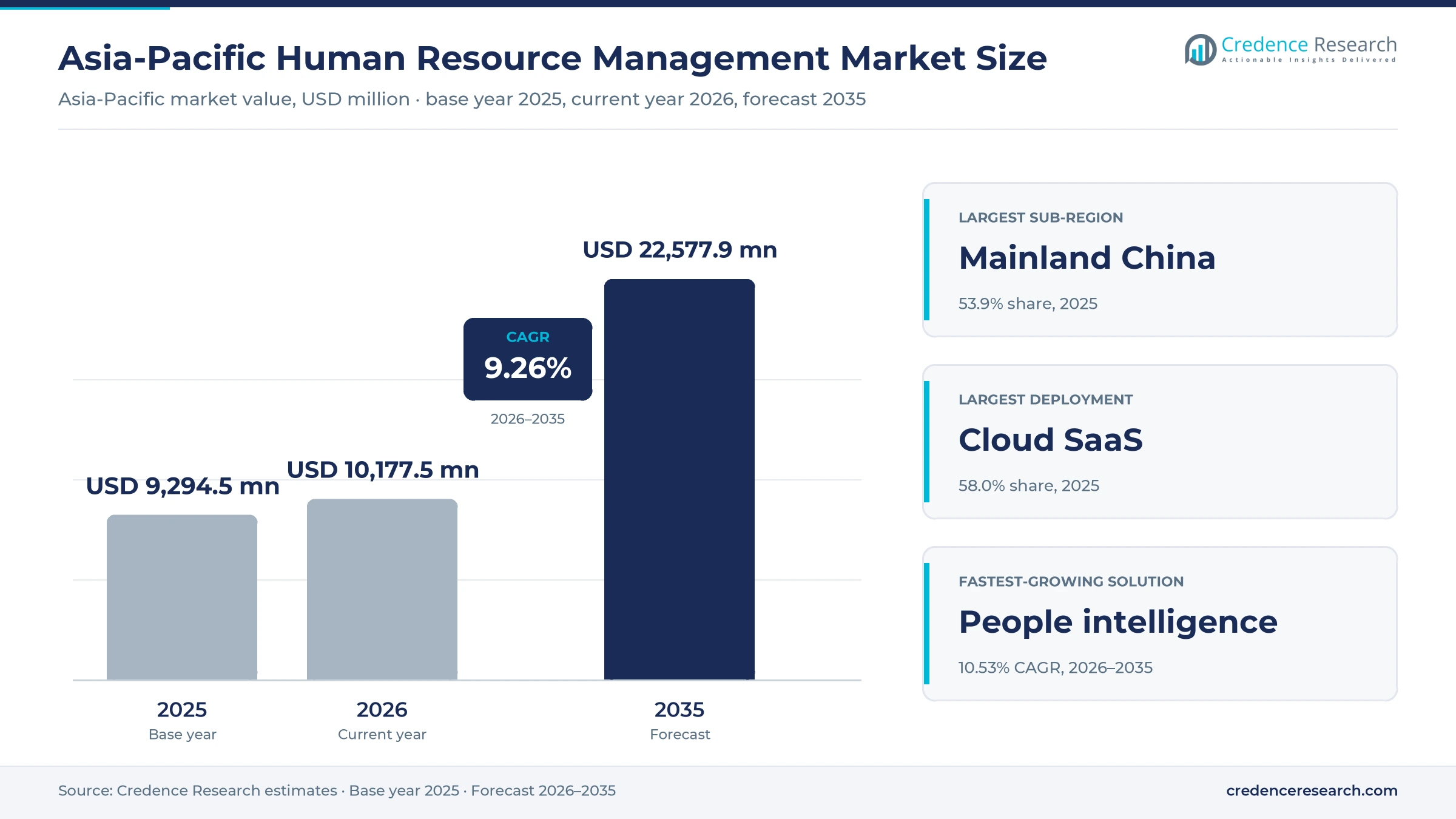
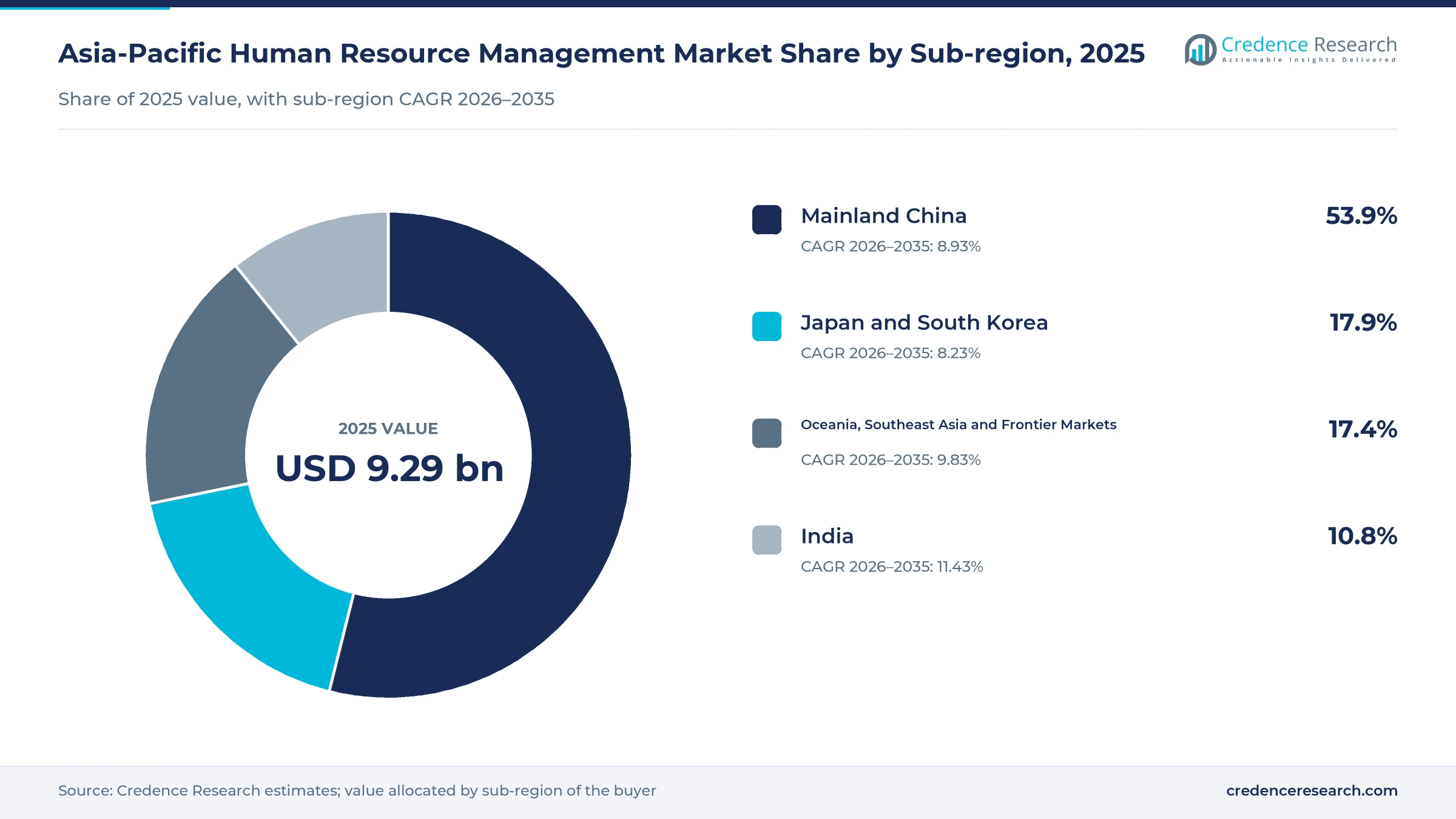
The Asia-Pacific human resource management market was valued at USD 9.29 billion in 2025 and is projected to increase from USD 10.18 billion in 2026 to USD 22.58 billion by 2035, registering a CAGR of 9.26% during 2026–2035. Demand comes from employers that must retire aging on-premise payroll and HR suites, absorb new labor and payroll rules in India, China and Australia, and manage very large workforces with fewer manual steps. Mainland China held the largest sub-regional share, 53.9% in 2025, because its employers counted 475.35 million urban workers at the end of that year. India is the fastest-growing sub-region at 11.43% a year, as four new labor codes took effect on Nov. 21, 2025, and global suites open local data centers. Japan and South Korea add steady demand from overtime rules and wage changes. In July 2025, Workday said it would host its HR software in an Indian data center for the first time.
Which HR software and services does the regional estimate cover?
The estimate measures spending on software and related services that employers use to hire, pay, schedule, train and analyze their workforce across the Asia-Pacific region. It covers core employee records and payroll engines, talent and time tools, people analytics and learning systems, and the platform services that connect them. Values are measured as subscription, license, maintenance, implementation and managed service fees received by vendors and their partners.
The estimate excludes staffing agency fees, wages paid through outsourced payroll bureaus, general office software and internal HR staff costs. The value chain runs from cloud and data center operators through HR suite vendors, local payroll specialists and system integrators to employers in Mainland China, Japan and South Korea, India and Oceania, Southeast Asia and frontier markets.
Asia-Pacific Human Resource Management Market Insights
- The Asia-Pacific human resource management market was valued at USD 9.29 billion in 2025 and is projected to reach USD 22.58 billion by 2035, registering a CAGR of 9.26% during 2026–2035.
- Mainland China held a 53.9% share of 2025 value, because the country had 725.04 million employed persons and added 12.67 million urban jobs in 2025.
- Cloud software as a service led deployment with a 58.0% share of 2025 value, because employers prefer subscription suites that update payroll rules automatically.
- SAP launched a sovereign cloud for India in September 2025, which keeps customer data inside the country for employers that need local hosting.
- ADP launched Lyric HCM in Australia and New Zealand in December 2025 with more than 350 local payroll professionals.
Employee administration leads while analytics grows fastest
Why does employee administration hold the largest share?
Based on solution type, the market is categorized into employee administration, talent and workforce operations, people intelligence and learning and platform services. Employee Administration led with a 38.0% share of 2025 value, because every employer must keep records and run payroll before buying other tools. People Intelligence and Learning grows fastest at 10.53% a year, as buyers add analytics and skills data to existing suites.
How does cloud subscription shape deployment choices?
Based on deployment model, the market is categorized into cloud software as a service, customer-managed on-premise and private hosted platforms. Cloud Software as a Service led with a 58.0% share of 2025 value, because vendors push regular rule updates through shared cloud tenants. Cloud Software as a Service also grows fastest at 10.16% a year, as banks and public bodies retire licensed systems.
Why do enterprise customers lead buyer demand?
Based on enterprise size, the market is categorized into enterprise customers, mid-market customers and small business customers. Enterprise Customers led with a 52.0% share of 2025 value, because large employers run payroll across several countries and pay for complex integration. Small Business Customers grow fastest at 10.11% a year, as simple cloud payroll plans reach firms with only a few dozen workers.
How do knowledge services lead industry demand?
Based on end-use industry, the market is categorized into knowledge services, manufacturing and logistics, consumer services and healthcare and public services and education. Knowledge Services led with a 34.0% share of 2025 value, because banks, software firms and consultancies compete hard for skilled staff. Consumer Services and Healthcare grows fastest at 9.84% a year, as hospitals and retailers schedule large shift workforces.
| Segment Group | Leading Sub-segment | Share, 2025 | Fastest-growing Sub-segment | CAGR, 2026–2035 |
|---|---|---|---|---|
| By Solution Type | Employee Administration | 38.0% | People Intelligence and Learning | 10.53% |
| By Deployment Model | Cloud Software as a Service | 58.0% | Cloud Software as a Service | 10.16% |
| By Enterprise Size | Enterprise Customers | 52.0% | Small Business Customers | 10.11% |
| By End-Use Industry | Knowledge Services | 34.0% | Consumer Services and Healthcare | 9.84% |
Request a Free Sample
Fill in your details and we'll send you a free sample report.
- Sample data tables & charts
- Research methodology
Legacy exits, vendor ecosystems and labor rules lift spend
How does legacy platform migration release new budgets?
Many large employers in the region still run payroll on licensed systems installed two decades ago, and vendor support deadlines now force a decision. SAP ends mainstream maintenance for ECC 6.0 in 2027, with extended support to 2030, The Register reported in June 2025. SAP had earlier said its on-premise HR option would receive maintenance at least through 2030, Diginomica reported in January 2018. Fujifilm Business Innovation, which operates in Japan, China and wider Asia, replaced a setup of 256 interfaces across 53 systems with one Oracle cloud HR platform. As a result, customer-managed on-premise systems lose share, while cloud software as a service holds a 58.0% share of 2025 value.
Why do expanding enterprise platform ecosystems widen reach?
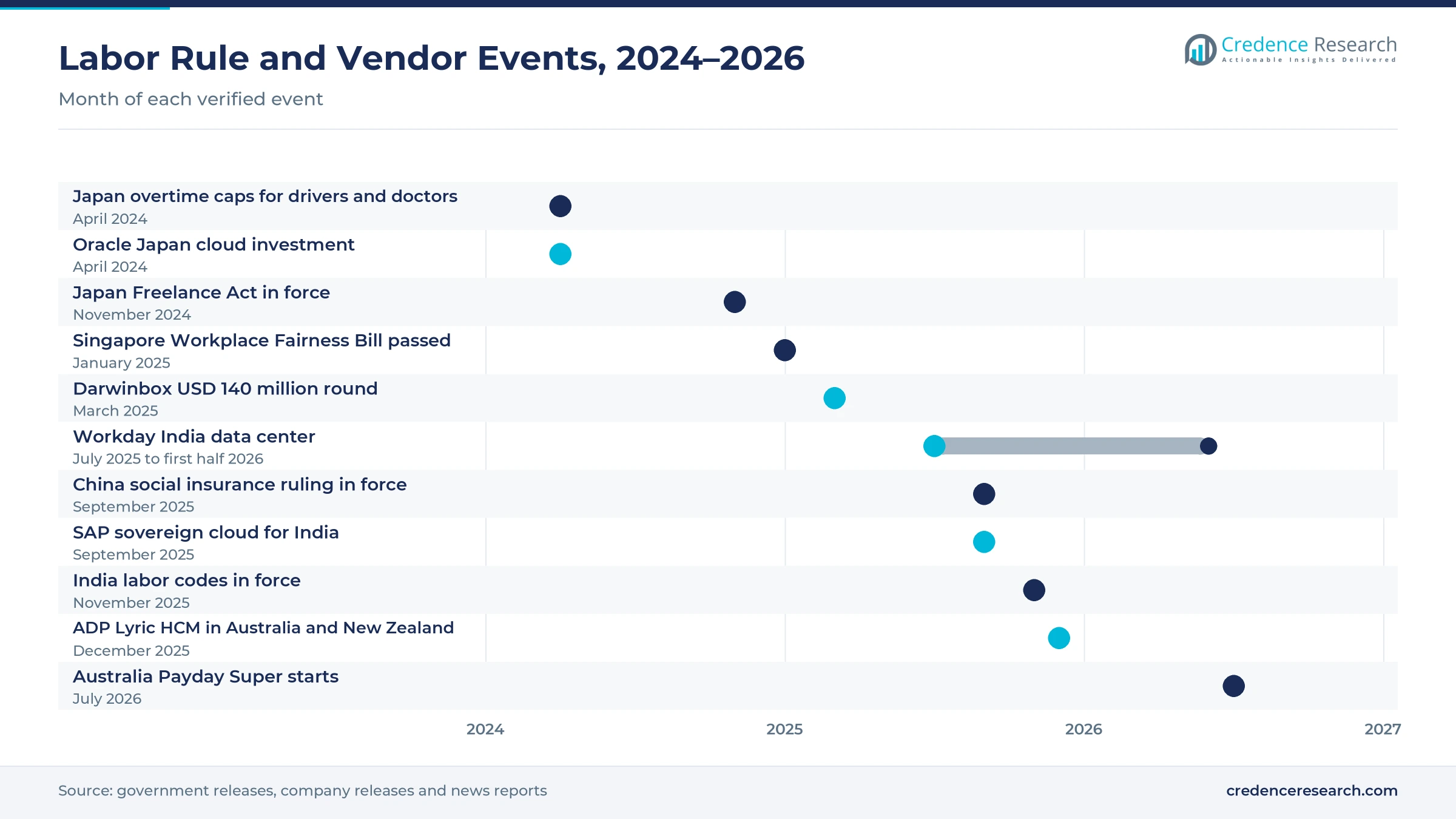
Global suites and regional challengers are adding local hosting, partners and staff, which lowers the cost of switching for employers. Workday said on July 3, 2025, that it would host HR software on AWS in India from the first half of 2026, according to a Workday release, and that 1,800 of its customers already operate in India with about 3.8 million monthly users. Darwinbox raised USD 140 million in March 2025 and serves more than 1,000 enterprises and over 3 million employees. ADP also launched Lyric HCM in Australia and New Zealand in December 2025, backed by more than 350 local payroll professionals. In turn, cloud software as a service grows fastest among deployment models at 10.16% a year.
How does compliance automation demand lift payroll spending?
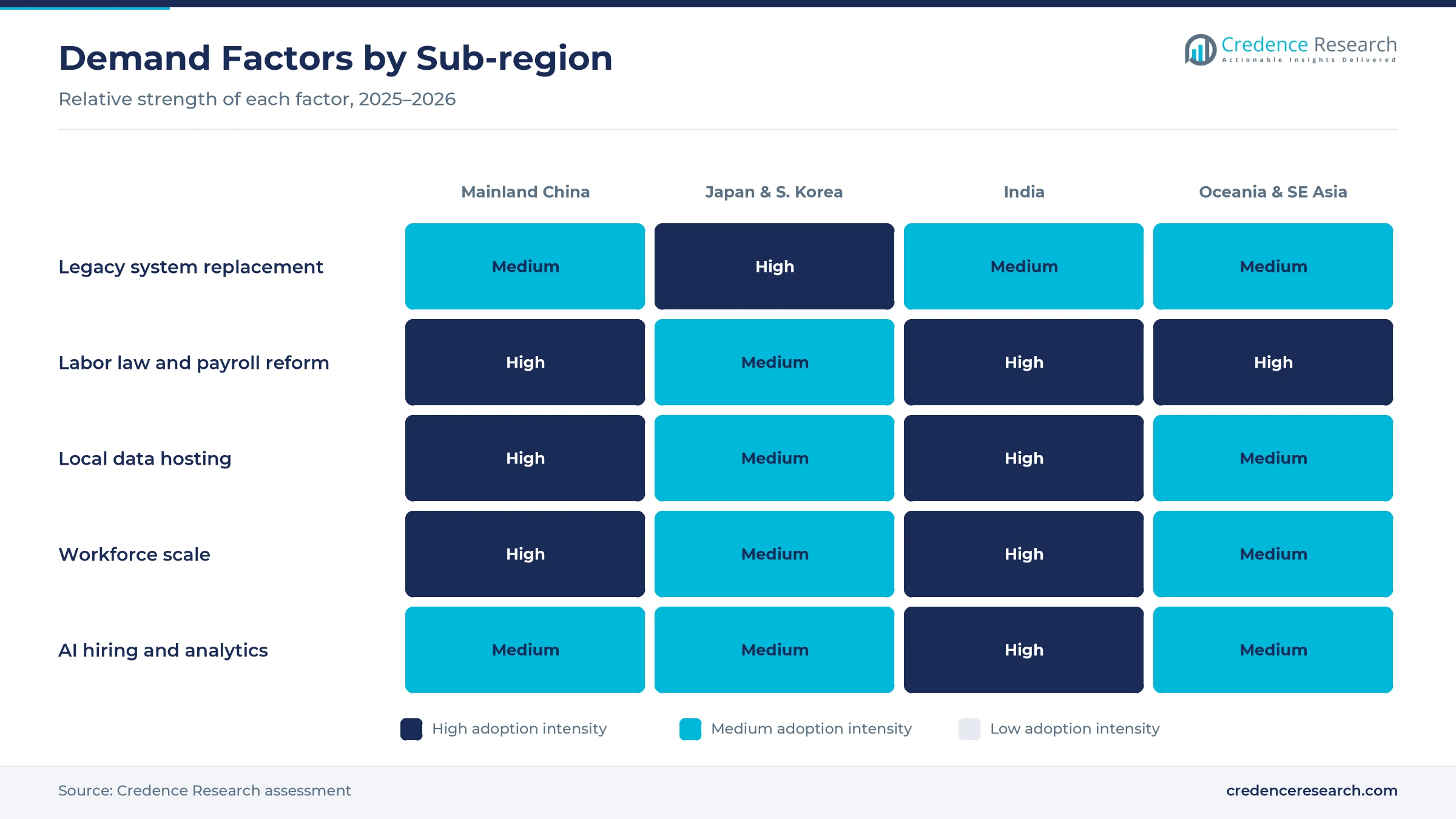
Labor rules across the region changed quickly in 2025, and manual payroll teams struggle to apply them without errors. India brought four labor codes into force on Nov. 21, 2025, replacing 29 laws and requiring appointment letters for all workers, India's labor ministry said. China's Supreme People's Court made agreements to waive social insurance invalid from Sept. 1, 2025, which raises the cost of contribution errors. Singapore passed its Workplace Fairness Bill on Jan. 8, 2025, requiring firms to run grievance handling processes, according to the Ministry of Manpower. As a result, employee administration keeps a 38.0% share of 2025 value.
Why do very large workforces need digital HR records?
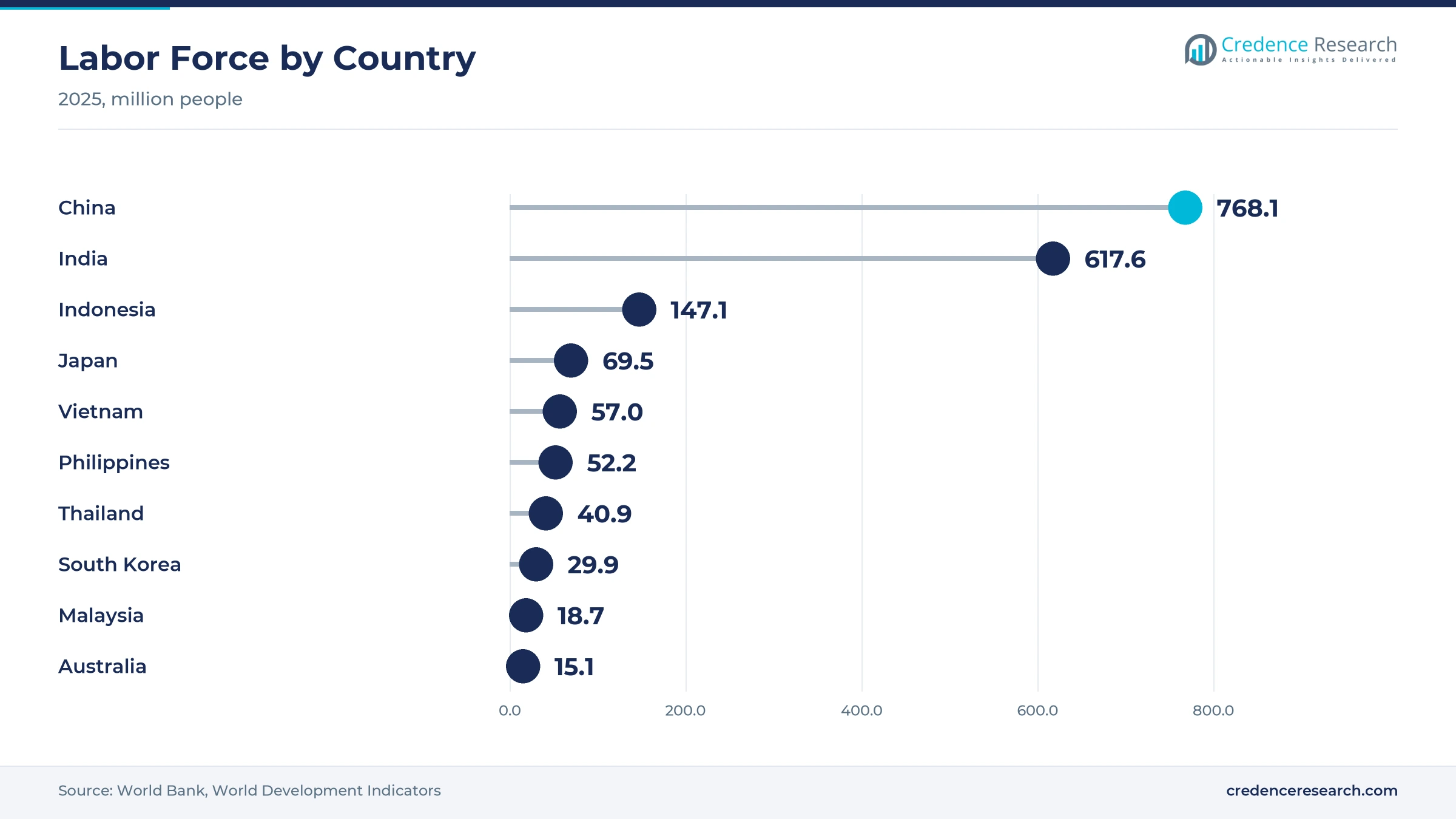
The region employs more people than any other, and even a small share of formal employers moving to software adds large seat counts. China had 725.04 million employed persons and 301.15 million migrant workers at the end of 2025, according to the National Bureau of Statistics of China. The same release counted 12.67 million new urban jobs in 2025, each needing contracts, payroll and social insurance records. India's labor force reached about 617.6 million in 2025, World Bank data show, while Japan capped annual overtime for drivers and doctors at 960 hours from April 2024. In turn, enterprise customers keep a 52.0% share of 2025 value, because large employers hold most formal jobs.
AI hiring agents, local hosting and payroll rules open space
How is the shift to AI agents changing recruiting tools?
HR suites now add software agents that answer candidates, book interviews and screen applications, which cuts recruiter workload for high-volume hiring. Workday completed its acquisition of Paradox on Oct. 1, 2025, adding a conversational candidate agent built for frontline hiring to a suite used by more than 11,000 organizations. Partners Group said its March 2025 investment in Darwinbox would support product innovation and generative AI. ADP's Lyric HCM, launched in Australia and New Zealand in December 2025, uses intelligent search and in-app analytics to automate workflows. As a result, people intelligence and learning grows fastest among solution types at 10.53% a year, as employers replace stand-alone recruiting software with suite modules.
Why is the rise of local data hosting reshaping deployment?
Data protection laws push employers to keep employee records inside the country, so vendors are building local and sovereign hosting options. SAP launched a sovereign cloud for India on Sept. 19, 2025, with an operations facility in Bengaluru and alignment with the Digital Personal Data Protection Act, 2023. Oracle said on April 17, 2024, that it would invest more than USD 8 billion in Japan over 10 years and add local operations staff, according to an Oracle release. Workday's Indian data center, due in the first half of 2026, also runs on AWS to meet local sovereignty rules. In turn, private hosted platforms grow at a steady pace while shared cloud remains the larger deployment model for most employers.
Can payroll rule changes in Oceania open new demand?
Frequent payroll reforms in Australia and Southeast Asia create an opening for vendors that update rules for customers automatically, which matters most to employers with lean payroll teams. From July 1, 2026, Australian employers must pay superannuation with wages, and funds must receive it within seven business days, according to the Fair Work Ombudsman. Malaysia made pension contributions of 2% of wages mandatory for foreign workers from October 2025 salaries, Bernama reported in June 2025. ADP said its Lyric HCM covers Single Touch Payroll, superannuation, KiwiSaver and New Zealand Holidays Act rules. As a result, Oceania, Southeast Asia and frontier markets grow at 9.83% a year.
Is there room for growth in contingent workforce tools?
Freelance, gig and migrant labor now sits under formal rules in several large markets, which creates demand for tools beyond the payroll of permanent staff. Japan's Freelance Act took effect on Nov. 1, 2024, requiring written terms and 30 days' notice before ending a contract, and the country had about 2.09 million main-job freelancers, Nippon.com reported. India's Code on Social Security requires platform aggregators to contribute 1% to 2% of annual turnover for gig workers. China also counted 301.15 million migrant workers in 2025, many of them on short contracts. In turn, small business customers grow fastest by enterprise size at 10.11% a year, and many first move from outsourced payroll services to cloud payroll plans.
Data rules, skills gaps and price pressure slow adoption
How do data localization rules raise vendor costs?
India, China, Japan and other markets set different rules for where employee data may be stored and who may access it. Vendors must therefore build or rent local data centers and run separate operations teams for each country. As a result, smaller vendors struggle to serve multinational employers across the whole region. Larger vendors respond with partnerships with cloud providers and sovereign hosting offers, which spread the fixed cost across many customers.
Why do implementation skill gaps delay projects?
Moving payroll and HR records from a licensed system to a cloud suite requires consultants who know both local labor law and the target product. Employers in the region often compete for the same small pool of certified consultants. In turn, projects slip and budgets rise when parallel payroll runs must continue for extra months. Vendors respond with prebuilt country packs, migration tools and partner training programs that shorten implementation work.
How does price pressure limit small business uptake?
Small employers in India, Indonesia and Vietnam compare HR software prices with spreadsheet and local payroll bureau costs. Many of these firms have few staff and thin margins, so a per-employee subscription can look expensive. As a result, vendors earn less per seat in emerging markets than in Japan or Australia. Providers respond with simple payroll plans, mobile apps and bundles sold through accountants and banks.
Why do frequent rule changes strain payroll accuracy?
Minimum wages, social insurance rates and leave rules change every year across dozens of jurisdictions in the region. South Korea, for example, set its 2026 minimum hourly wage at KRW 10,320 on July 10, 2025, up 2.9%. In turn, payroll teams must test and apply each change before the next pay cycle. Vendors respond with rule engines and regulatory content teams, although errors still expose employers to penalties.
Mainland China leads while India grows fastest
| Sub-region | Value, 2025 (USD billion) | Share, 2025 | CAGR, 2026–2035 |
|---|---|---|---|
| Mainland China | 5.01 | 53.9% | 8.93% |
| Japan and South Korea | 1.66 | 17.9% | 8.23% |
| Oceania, Southeast Asia and Frontier Markets | 1.62 | 17.4% | 9.83% |
| India | 1.00 | 10.8% | 11.43% |
Why does Mainland China hold the largest share?
Employers in Mainland China manage the largest formal workforce in the region, with 475.35 million urban employed persons at the end of 2025. As a result, the sub-region held a 53.9% share of 2025 value and grows at 8.93% a year. In addition, court rules from Sept. 1, 2025, made social insurance waivers invalid, which pushes employers toward accurate payroll records.
What keeps Japan and South Korea a steady buyer base?
Large employers in Japan and South Korea run mature HR systems that now need replacement, which keeps project budgets steady. The sub-region held a 17.9% share of 2025 value and grows at 8.23% a year. Japan capped annual overtime for drivers and doctors at 960 hours from April 2024, which raised demand for workforce scheduling software in logistics and hospitals. South Korea also lifted its minimum hourly wage to KRW 10,320 for 2026, so payroll teams must update pay tables every year.
How do Oceania and Southeast Asia add mixed demand?
Payroll rules in Australia, New Zealand and Southeast Asia change often, which keeps employers buying software that applies updates automatically. The sub-region held a 17.4% share of 2025 value and grows at 9.83% a year. Australia requires superannuation with each pay run from July 1, 2026, and Malaysia added mandatory pension contributions for foreign workers from October 2025. Singapore also passed its Workplace Fairness Bill in January 2025, which adds grievance handling duties for employers.
Why is India the fastest-growing sub-region?
India held a 10.8% share of 2025 value and grows fastest at 11.43% a year, because new labor codes and local hosting both arrived within a few months. The four codes took effect in November 2025 and require single registration, appointment letters and gig worker contributions. Workday and SAP also added local data hosting, which lets employers replace older core HR software with cloud suites.
Data centers, funding and launches, 2024 to 2025
| Development | Status and market relevance |
|---|---|
| In April 2024, Oracle said it would invest more than USD 8 billion in cloud computing and AI in Japan over 10 years. | Adds local operations staff for sovereignty needs |
| In March 2025, Darwinbox raised USD 140 million in a round co-led by Partners Group and KKR. | Funds product work and international expansion |
| In July 2025, Workday said it would host its HR software in an Indian data center on AWS. | Operations due in the first half of 2026 |
| In September 2025, SAP launched a sovereign cloud for India with an operations facility in Bengaluru. | Keeps customer data inside India |
| In October 2025, Workday completed its acquisition of Paradox, a conversational hiring agent. | Adds frontline recruiting automation |
Unified data models, AI agents and rule engines shape tools
- Unified employee data models hold one record for each worker across payroll, time and talent, which removes the interfaces that older systems needed.
- Conversational AI agents answer candidates and employees in chat, which lets small HR teams handle large hiring and service volumes.
- Payroll rule engines apply new wage, tax and pension rules through central updates, which reduces errors when laws change.
- Sovereign hosting options keep employee data inside one country under local operators, which helps banks and public bodies move to cloud suites.
Need a Custom Version of This Report?
Tailor the scope, geography, or segments to your exact requirements.
- Custom geography or segment scope
- Direct access to our analyst team
Vendors compete on local payroll depth and hosted data
Competition in human resource management software combines global suite vendors, payroll specialists and regional challengers. SAP serves large employers that run its licensed HR and payroll systems, and it launched a sovereign cloud for India in September 2025. Workday is adding an Indian data center and bought Paradox in October 2025 to automate frontline hiring. Oracle sells its cloud HR suite to firms such as Fujifilm Business Innovation and is expanding its hosting in Japan. ADP focuses on payroll depth and brought Lyric HCM to Australia and New Zealand in December 2025, while Darwinbox targets Asian enterprises from India and raised fresh funding in March 2025. Companies compete on local payroll coverage, data hosting, partner networks and AI features rather than price alone.
Companies profiled and their roles in this market
| Company | Type | Role in the market |
|---|---|---|
| SAP | HR suite vendor | Launched a sovereign cloud for India in September 2025 |
| Workday | Cloud HR suite vendor | Plans Indian data center hosting from the first half of 2026 |
| Oracle | Cloud HR suite vendor | Supports Fujifilm Business Innovation and expands hosting in Japan |
| ADP | Payroll and HR vendor | Launched Lyric HCM in Australia and New Zealand in December 2025 |
| Darwinbox | Regional HR platform | Serves more than 1,000 enterprises and raised new funding in March 2025 |
Credence Research view on regional HR platform demand
Credence Research's view is that human resource management software demand in the Asia-Pacific region will grow steadily because employers must replace aging systems while labor rules change faster than manual teams can follow. Employee administration keeps the largest share, while people intelligence and learning grows fastest as buyers add analytics and AI agents. Mainland China stays the largest buyer, and India grows fastest after its labor codes took effect. However, data rules and consultant shortages will slow some projects. Vendors that pair local payroll depth with local hosting should gain share fastest.
How the regional HR software estimate was built
The report uses 2025 as the base year on a calendar basis, and market values come from the Credence Research model. That model combines employment statistics, labor force data, cloud hosting announcements, labor law changes and company information on product launches, funding and customer counts. Segment splits, sub-regional shares and growth rates are Credence Research estimates. Sources used are official statistics, government releases, company releases and news reports, and no interviews or surveys were used.
Payroll reform and cloud migration carry growth to 2035
Regional value for human resource management software is expected to reach USD 22.58 billion by 2035, a 9.26% CAGR during 2026–2035, as payroll reform and cloud migration keep budgets open. Growth should be strongest through 2030, while employers leave licensed systems before vendor support ends and Indian firms adjust to the new labor codes. After that, analytics, AI agents and contingent workforce tools will carry more growth as core payroll moves fully to the cloud. Faster rule changes would raise this outlook, while tighter data rules would lower it.
Frequently Asked Questions
How big is the Asia-Pacific human resource management market?
Which solution type leads regional demand?
Which sub-region leads the regional market?
Why does cloud software lead deployment?
How do labor law changes affect HR software demand?
Which enterprise size grows fastest?
Who are the leading companies in the region?
What are the main challenges for buyers?
Table of Content
Chapter 1 Market Segmentation
- 1.1 Segmentation Framework
- 1.1.1 Product and Service Classification
- 1.1.2 Application and End-Use Classification
- 1.1.3 Technology and Solution Classification
- 1.1.4 Customer and Distribution Channel Classification
- 1.1.5 Geographic Segmentation
- 1.1.6 Market Segment Definitions and Boundaries
- 1.2 By Solution Type
- 1.2.1 Employee Administration
- 1.2.2 Talent and Workforce Operations
- 1.2.3 People Intelligence and Learning
- 1.2.4 Platform Services
- 1.3 By Deployment Model
- 1.3.1 Cloud Software as a Service
- 1.3.2 Customer-Managed On-Premise
- 1.3.3 Private Hosted Platforms
- 1.4 By Enterprise Size
- 1.4.1 Enterprise Customers
- 1.4.2 Mid-Market Customers
- 1.4.3 Small Business Customers
- 1.5 By End-Use Industry
- 1.5.1 Knowledge Services
- 1.5.2 Manufacturing and Logistics
- 1.5.3 Consumer Services and Healthcare
- 1.5.4 Public Services and Education
- 1.6 By Sub-region
- 1.6.1 Mainland China
- 1.6.2 Japan and South Korea
- 1.6.3 India
- 1.6.4 Oceania, Southeast Asia and Frontier Markets
Chapter 2 Introduction
- 2.1 Report Objectives and Scope
- 2.2 Product Definition and Industry Terminology
- 2.3 Market Inclusions and Exclusions
- 2.4 Research Process
- 2.4.1 Primary Research and Expert Interviews
- 2.4.2 Secondary Research and Source Review
- 2.4.3 Top-Down and Bottom-Up Estimation
- 2.4.4 Data Triangulation and Verification
- 2.5 Market Size Measurement Basis
- 2.5.1 2025: USD 9.29 billion → 2035: USD 22.58 billion
- 2.6 Historical and Forecast Reference Periods
- 2.6.1 Historical Period: 2018-2025
- 2.6.2 Base Year: 2025
- 2.6.3 Forecast Period: 2025-2035
- 2.7 Research Assumptions and Limitations
Chapter 3 Executive Summary
- 3.1 Market Snapshot and Key Findings
- 3.2 Base-Year Market Size, 2025
- 3.3 Forecast Market Size, 2035
- 3.4 Revenue and Volume Growth Outlook
- 3.5 Key Demand and Supply Indicators
- 3.6 Leading Market Segments
- 3.7 Fastest-Growing Market Opportunities
- 3.8 Regional Performance Highlights
- 3.9 Technology and Industry Transformation
- 3.10 Competitive Landscape Summary
- 3.11 Analyst View and Strategic Implications
Chapter 4 Asia-Pacific Human Resource Management Market Trends and Developments
- 4.1 Historical Industry Development, 2018-2025
- 4.2 Recent Market Trends and Developments
- 4.3 Demand and Customer Behavior Trends
- 4.4 Technology and Product Innovation
- 4.5 Artificial Intelligence, Automation and Digitalization
- 4.6 Local Manufacturing and Supply Chain Realignment
- 4.7 Industry Partnerships, Mergers and Acquisitions
- 4.8 Sustainability and Circular Economy Developments
- 4.9 Government and Private Sector Investment Trends
- 4.10 Emerging Business Models and Commercialization
- 4.11 Industry Developments and Announcements
Chapter 5 Asia-Pacific Human Resource Management Market Supply and Demand Analysis
- 5.1 Demand Trend and Consumption Analysis, 2018-2025
- 5.2 Demand Forecast, 2025-2035
- 5.3 Supply Chain Structure and Procurement Trends
- 5.4 Supply-Demand Gap and Bottlenecks
- 5.5 Import Dependence and Sourcing Structure
- 5.6 Regional Supply and Demand Concentration
Chapter 6 Asia-Pacific Human Resource Management Market Pricing Analysis
- 6.1 Pricing Structure and Measurement
- 6.2 Historical Pricing Trends, 2018-2025
- 6.3 Pricing Outlook, 2025-2035
- 6.4 Pricing by Product and Market Segment
- 6.5 Geographic Pricing Differences
- 6.6 Key Input, Energy, Labor and Logistics Costs
- 6.7 Contract Pricing and Purchasing Models
- 6.8 Pricing Sensitivity and Competitive Positioning
- 6.9 Price, Margin and Profitability Implications
Chapter 7 Asia-Pacific Human Resource Management Market Dynamics
- 7.1 Market Growth Drivers
- 7.1.1 Demand-Side Drivers
- 7.1.2 Technology and Innovation Drivers
- 7.1.3 Infrastructure and Investment Drivers
- 7.1.4 Regulatory and Policy Drivers
- 7.2 Market Restraints
- 7.2.1 Cost and Affordability Constraints
- 7.2.2 Technology and Adoption Barriers
- 7.2.3 Supply Chain and Operational Constraints
- 7.3 Market Challenges
- 7.3.1 Competitive Pressure and Margin Erosion
- 7.3.2 Skills, Infrastructure and Implementation Gaps
- 7.4 Emerging Market Opportunities
- 7.5 Market Dynamics Impact and Time-Horizon Assessment
Chapter 8 Asia-Pacific Human Resource Management Value Chain Analysis
- 8.1 Industry Value Chain Overview
- 8.2 Upstream Suppliers and Critical Inputs
- 8.3 Technology and Component Providers
- 8.4 Manufacturing or Service Delivery
- 8.5 Distribution, Channel Partners and Integrators
- 8.6 Downstream Applications and End Users
- 8.7 Value Addition and Profit Pools
- 8.8 Vertical Integration and Outsourcing
- 8.9 Supplier Concentration and Risk
- 8.10 Supply Chain Localization and Resilience
Chapter 9 Asia-Pacific Human Resource Management Market Regulations and Policies
- 9.1 Relevant Laws, Standards and Compliance Frameworks
- 9.2 Product, Service, Safety and Quality Requirements
- 9.3 Government Policies, Incentives and Subsidies
- 9.4 Imports, Exports and Trade Barriers
- 9.5 Public Procurement and Local Content Requirements
- 9.6 Data Protection, AI and Cybersecurity Compliance
- 9.7 Upcoming Policy Changes and Market Implications
Chapter 10 Asia-Pacific Human Resource Management Market Hotspots and Opportunities
- 10.1 Market Opportunity Mapping and Growth Hotspots
- 10.2 High-Growth Applications and Customer Groups
- 10.3 Underserved Markets and White-Space Opportunities
- 10.4 Emerging Technology and Product Opportunities
- 10.5 New Capacity and Investment Hotspots
- 10.6 Market Entry and Expansion Opportunities
- 10.7 Distribution and Partnership Opportunities
- 10.8 Near-Term and Long-Term Commercial Potential
- 10.9 Opportunity Attractiveness and Execution Risks
Chapter 11 Asia-Pacific Human Resource Management Market Outlook, 2025-2035
- 11.1 Market Size and Analysis
- 11.1.1 Revenue (Market Measurement: 2025: USD 9.29 billion → 2035: USD 22.58 billion)
- 11.1.2 Historical Market Size, 2018-2025
- 11.1.3 Base-Year Market Size, 2025
- 11.2 Market Forecast, 2025-2035
- 11.2.1 Revenue Forecast to 2035
- 11.2.2 CAGR and Year-on-Year Growth
- 11.2.3 Incremental Revenue Opportunity
- 11.3 Forecast Assumptions and Scenario Analysis
- 11.3.1 Base-Case Forecast
- 11.3.2 Optimistic and Conservative Scenarios
- 11.3.3 Technology, Pricing and Policy Sensitivities
- 11.4 Market Attractiveness and Growth Outlook
Chapter 12 Asia-Pacific Human Resource Management Market Segmentation and Outlook
- 12.1 Segmentation Summary and Market Shares, 2025
- 12.2 Largest and Fastest-Growing Segments
- 12.3 By Solution Type - Market Size and Forecast, 2025-2035
- 12.3.1 Segment Definition and Scope
- 12.3.2 Historical Market Size, 2018-2025
- 12.3.3 Revenue Forecast, 2025-2035
- 12.3.4 Base-Year Market Share, 2025
- 12.3.5 Segment CAGR and Growth Drivers
- 12.3.6 Subsegment Market Size and Forecast
- 12.3.6.1 Employee Administration
- 12.3.6.2 Talent and Workforce Operations
- 12.3.6.3 People Intelligence and Learning
- 12.3.6.4 Platform Services
- 12.3.7 Subsegment Pricing and Adoption Trends
- 12.3.8 Leading Suppliers and Competition
- 12.3.9 Regional Demand and Opportunities
- 12.4 By Deployment Model - Market Size and Forecast, 2025-2035
- 12.4.1 Segment Definition and Scope
- 12.4.2 Historical Market Size, 2018-2025
- 12.4.3 Revenue Forecast, 2025-2035
- 12.4.4 Base-Year Market Share, 2025
- 12.4.5 Segment CAGR and Growth Drivers
- 12.4.6 Subsegment Market Size and Forecast
- 12.4.6.1 Cloud Software as a Service
- 12.4.6.2 Customer-Managed On-Premise
- 12.4.6.3 Private Hosted Platforms
- 12.4.7 Subsegment Pricing and Adoption Trends
- 12.4.8 Leading Suppliers and Competition
- 12.4.9 Regional Demand and Opportunities
- 12.5 By Enterprise Size - Market Size and Forecast, 2025-2035
- 12.5.1 Segment Definition and Scope
- 12.5.2 Historical Market Size, 2018-2025
- 12.5.3 Revenue Forecast, 2025-2035
- 12.5.4 Base-Year Market Share, 2025
- 12.5.5 Segment CAGR and Growth Drivers
- 12.5.6 Subsegment Market Size and Forecast
- 12.5.6.1 Enterprise Customers
- 12.5.6.2 Mid-Market Customers
- 12.5.6.3 Small Business Customers
- 12.5.7 Subsegment Pricing and Adoption Trends
- 12.5.8 Leading Suppliers and Competition
- 12.5.9 Regional Demand and Opportunities
- 12.6 By End-Use Industry - Market Size and Forecast, 2025-2035
- 12.6.1 Segment Definition and Scope
- 12.6.2 Historical Market Size, 2018-2025
- 12.6.3 Revenue Forecast, 2025-2035
- 12.6.4 Base-Year Market Share, 2025
- 12.6.5 Segment CAGR and Growth Drivers
- 12.6.6 Subsegment Market Size and Forecast
- 12.6.6.1 Knowledge Services
- 12.6.6.2 Manufacturing and Logistics
- 12.6.6.3 Consumer Services and Healthcare
- 12.6.6.4 Public Services and Education
- 12.6.7 Subsegment Pricing and Adoption Trends
- 12.6.8 Leading Suppliers and Competition
- 12.6.9 Regional Demand and Opportunities
- 12.7 By Sub-region - Market Size and Forecast, 2025-2035
- 12.7.1 Segment Definition and Scope
- 12.7.2 Historical Market Size, 2018-2025
- 12.7.3 Revenue Forecast, 2025-2035
- 12.7.4 Base-Year Market Share, 2025
- 12.7.5 Segment CAGR and Growth Drivers
- 12.7.6 Subsegment Market Size and Forecast
- 12.7.6.1 Mainland China
- 12.7.6.2 Japan and South Korea
- 12.7.6.3 India
- 12.7.6.4 Oceania, Southeast Asia and Frontier Markets
- 12.7.7 Subsegment Pricing and Adoption Trends
- 12.7.8 Leading Suppliers and Competition
- 12.7.9 Regional Demand and Opportunities
- 12.8 Segment Growth Comparison
- 12.9 Segment Attractiveness and Priority Matrix
Chapter 13 Asia-Pacific Human Resource Management End-Use and Application Market Outlook
- 13.1 End-Use Industry and Customer Demand Structure
- 13.2 Leading Applications and Customer Groups
- 13.3 End-Use Market Size, Share and Forecast
- 13.4 Major End-Use Industry Deep Dives
- 13.4.1 Customer Requirements and Use Cases
- 13.4.2 Demand and Replacement Cycles
- 13.4.3 Technical and Regulatory Considerations
- 13.4.4 Purchasing and Procurement Models
- 13.4.5 Leading Vendors and Distribution Channels
- 13.4.6 Forecast and Commercial Opportunities
- 13.5 Emerging Applications and Cross-Segment Demand
- 13.6 End-Use Industry Investment Priorities
Chapter 14 Asia-Pacific Human Resource Management Geographic Market Outlook, 2025-2035
- 14.1 Regional Market Size and Country-Level Shares, 2025
- 14.2 Country Market Size Comparison, 2025
- 14.3 Country Market Forecasts, 2025-2035
- 14.4 Subregional Industrial and Demand Clusters
- 14.5 Intra-Regional Pricing and Cost Differences
- 14.6 Cross-Border Trade and Supply Networks
- 14.7 Regional Supply and Demand Balances
- 14.8 Country Opportunity Comparison and Prioritization
Note: Every listed country is covered on the structure shown under the first country.
Chapter 15 Asia-Pacific Human Resource Management Technology, Innovation and Sustainability Outlook
- 15.1 Technology Landscape and Maturity
- 15.2 Product, Process and Service Innovation
- 15.3 AI, Automation and Digital Tools in the Industry
- 15.4 Technology Adoption and Performance Benchmarking
- 15.5 Innovation Pipeline and R&D Investment
- 15.6 Patent and Intellectual Property Trends
- 15.7 Energy Efficiency and Resource Management
- 15.8 Sustainability, Recycling and Circularity
- 15.9 Technology Roadmap, 2025-2035
- 15.10 Risks of Obsolescence and Technology Substitution
Chapter 16 Asia-Pacific Human Resource Management Market Key Strategic Imperatives
- 16.1 Growth and Market Entry Priorities
- 16.2 High-Return Products and Segments
- 16.3 Pricing, Profitability and Cost Optimization
- 16.4 Technology Investment and Product Differentiation
- 16.5 Supply Chain Localization and Resilience
- 16.6 Distribution and Customer Acquisition
- 16.7 Partnership, Acquisition and Capacity Strategy
- 16.8 Regional Expansion Priorities
- 16.9 Short-, Medium- and Long-Term Actions
Chapter 17 Competition Outlook
- 17.1 Industry Competition Characteristics
- 17.2 Market Structure and Concentration
- 17.3 Market Share and Competitive Positioning, 2025
- 17.4 Company-Wise Revenue and Product Benchmarking
- 17.5 Production and Service Capacity Benchmarking
- 17.6 Technology, Pricing and Differentiation
- 17.7 Regional Footprint and Distribution Strength
- 17.8 Mergers, Acquisitions and Strategic Alliances
- 17.9 New Entrants and Competitive Threats
- 17.10 Porter's Five Forces and Industry Attractiveness
- 17.11 Competitive Outlook, 2025-2035
Chapter 18 Company Profiles
- 18.1 Company Coverage and Selection Criteria
- 18.2 SAP
- 18.2.1 Business Description
- 18.2.2 Company Ownership and Geographic Presence
- 18.2.3 Product and Service Portfolio
- 18.2.4 Manufacturing and Operating Footprint
- 18.2.5 Financial Performance and Investment
- 18.2.6 Market Share and Competitive Position
- 18.2.7 Technology and Innovation Capabilities
- 18.2.8 Strategic Alliances or Partnerships
- 18.2.9 Recent Developments
- 18.2.10 Growth Strategy and Outlook
- 18.3 Workday
- 18.4 Oracle
- 18.5 ADP
- 18.6 Darwinbox
- 18.7 Other Relevant Market Participants
Note: Every listed company is profiled on the structure shown under the first company. The company list is preliminary and may change based on research findings, market developments, data availability and client requirements.
Chapter 19 Disclaimer
- 19.1 Research and Forecast Disclaimer
- 19.2 Data Source and Estimation Limitations
Note: The depth of individual sections depends on data availability for this market. Volume, capacity, trade and other unit-based metrics are included where applicable.

