
Digital titles and tokenization rules open a ledger niche
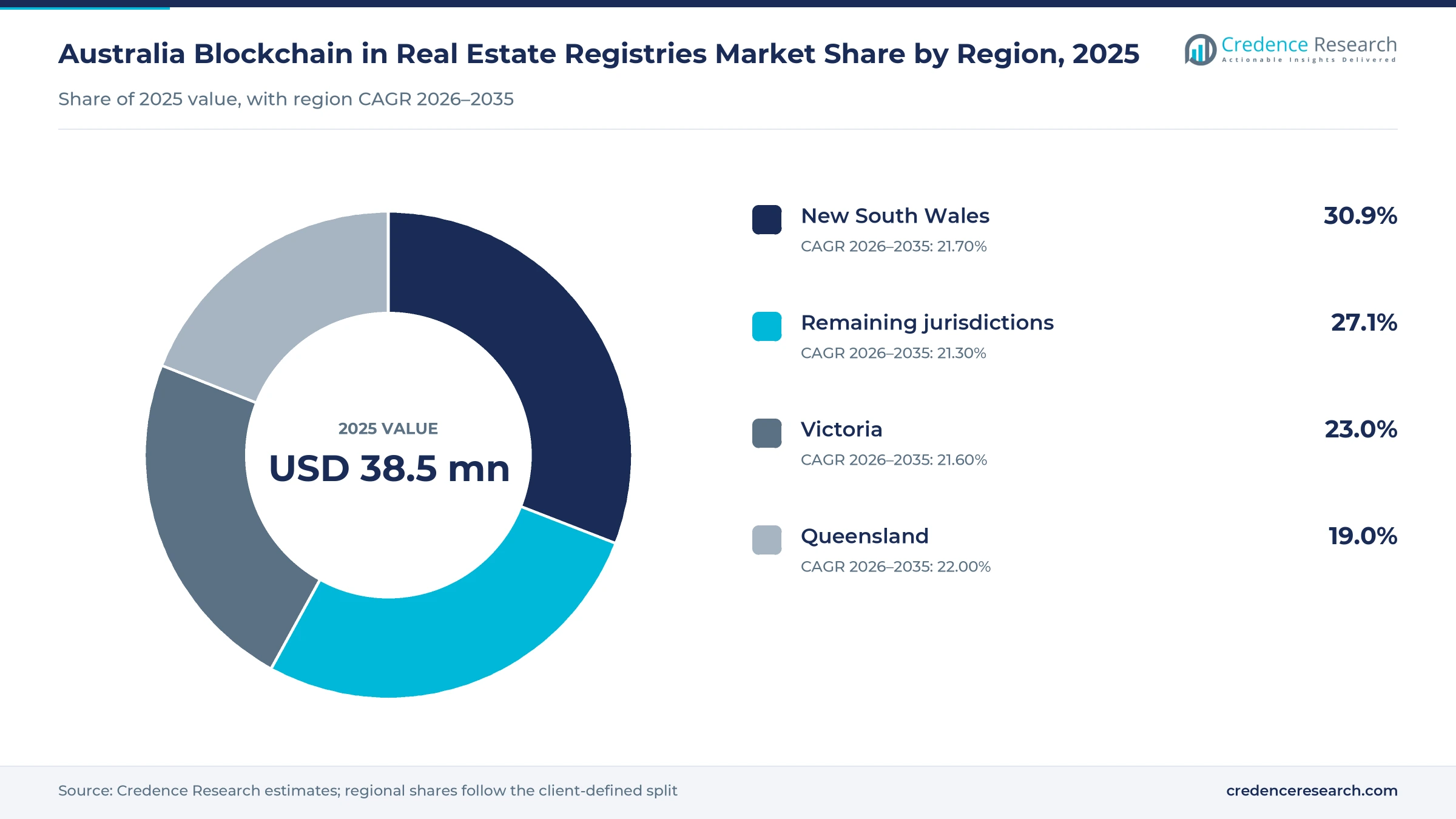
The Australia blockchain in real estate registries market was valued at USD 38.5 million in 2025 and is projected to increase from USD 54.0 million in 2026 to USD 314.6 million by 2035, registering a CAGR of 21.63% during 2026–2035. Demand comes from registry operators, lenders, settlement providers, conveyancers and investment platforms that are testing distributed ledgers, smart contracts and tokenized ownership records around a title system that is already fully electronic. No Australian land titles office runs its official register on a blockchain, so spending centers on pilots, ledger-based audit layers, integration work and registry-linked tokenization. New South Wales held the largest regional share, 30.9% in 2025, because it hosted the 2018 land registry proof of concept and has the highest mean dwelling price. Queensland is the fastest-growing region at 22.00% a year, helped by high dwelling values. In turn, the digital assets framework that received Royal Assent on April 8, 2026, and starts on April 9, 2027, gives tokenized property platforms a licensing path.
What does the Australian estimate count as ledger spending?
The estimate measures spending in Australia on distributed ledger software and services that record, verify or mirror interests in land, including registry platforms, smart contract tools, tokenization platforms linked to registered titles, and the integration and assurance work that connects them to land registries and settlement systems. It counts subscription, usage, project and license fees paid by registry operators, lenders, conveyancing practices and investment platforms, including funded pilots and proofs of concept.
The estimate excludes the core electronic conveyancing exchanges and land registry systems that run on conventional databases, cryptocurrency trading and general property listing software. The value chain runs from ledger developers and cloud hosts through integrators to registry operators, lenders, conveyancers and fund managers, which decide whether a ledger adds trust, speed or audit value beyond the state-guaranteed Torrens title register.
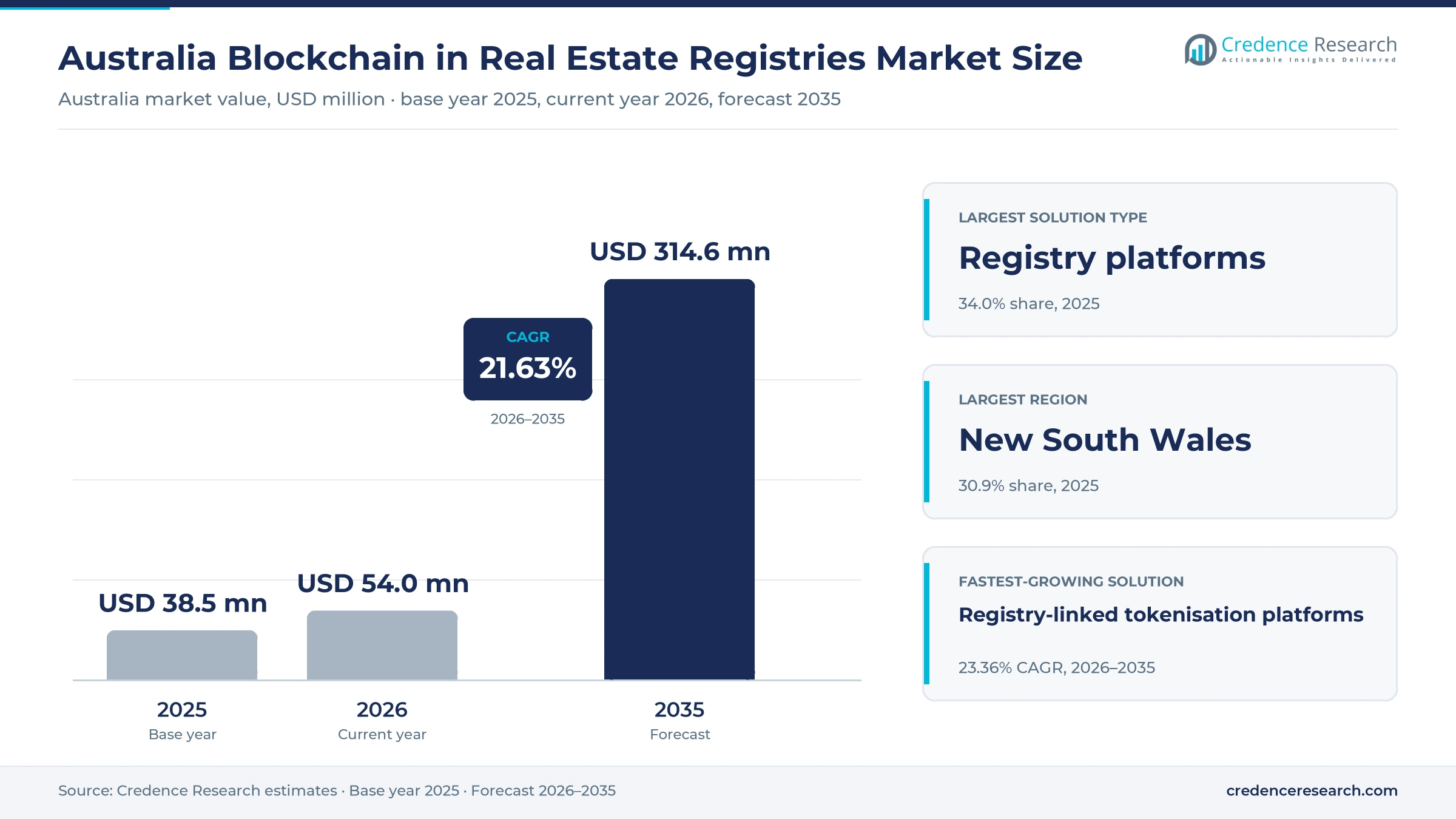
Australia Blockchain in Real Estate Registries Market Insights
- The Australia blockchain in real estate registries market was valued at USD 38.5 million in 2025 and is projected to reach USD 314.6 million by 2035, registering a CAGR of 21.63% during 2026–2035.
- New South Wales held a 30.9% share of 2025 value, because Sydney concentrates registry, lending and settlement activity.
- Registry platforms led with a 34.0% share of 2025 value, as registry operators and lenders fund ledger pilots and audit layers first.
- The Corporations Amendment (Digital Assets Framework) Bill 2025 received Royal Assent on April 8, 2026, and its platform rules start on April 9, 2027.
- Registry-linked tokenisation platforms grow fastest at 23.36% a year during 2026–2035, as licensed custody rules make tokenized property products viable.
Registry platforms lead while tokenization tools surge
Why do registry platforms hold the largest share?
Based on solution type, the market is categorized into Registry platforms, Smart contract platforms, Registry-linked tokenisation platforms and Integration and assurance services. Registry platforms led with a 34.0% share of 2025 value, because registry operators and lenders test ledgers as audit and record layers before anything else. Registry-linked tokenisation platforms grow fastest at 23.36% a year, as licensed custody rules let fund managers apply asset tokenization to property interests.
How do private and hybrid networks split spending?
Based on deployment model, the market is categorized into Customer-hosted networks, Vendor-managed private networks and Hybrid networks. Vendor-managed private networks led with a 46.0% share of 2025 value, because registry operators and banks prefer permissioned networks run by a trusted provider under contract. Hybrid networks grow fastest at 22.62% a year, as buyers keep title data on private nodes while anchoring proofs or tokens on wider networks.
Which buyers fund most ledger projects?
Based on customer type, the market is categorized into Registry authorities and operators, Lenders and settlement providers, Legal and conveyancing practices, and Registry-linked investment platforms. Registry authorities and operators led with a 38.0% share of 2025 value, because the privatized operators in New South Wales, Victoria and South Australia fund their own technology programs. Registry-linked investment platforms grow fastest at 23.46% a year, as licensed platforms build tokenized property funds.
Which registry applications carry the most value?
Based on application, the market is categorized into Title transfer recording, Mortgage recording, Settlement workflow verification and Registry provenance assurance. Title transfer recording led with a 33.0% share of 2025 value, because transfers were the main use case in early ledger trials. Registry provenance assurance grows fastest at 22.52% a year, as operators add tamper-evident logs to strengthen digital identity and cyber governance controls.
| Segment Group | Leading Sub-segment | Share, 2025 | Fastest-growing Sub-segment | CAGR, 2026–2035 |
|---|---|---|---|---|
| By Solution Type | Registry platforms | 34.0% | Registry-linked tokenisation platforms | 23.36% |
| By Deployment Model | Vendor-managed private networks | 46.0% | Hybrid networks | 22.62% |
| By Customer Type | Registry authorities and operators | 38.0% | Registry-linked investment platforms | 23.46% |
| By Application | Title transfer recording | 33.0% | Registry provenance assurance | 22.52% |
Request a Free Sample
Fill in your details and we'll send you a free sample report.
- Sample data tables & charts
- Research methodology
Digital titles, registry upgrades and token law lift demand
How does fully digital conveyancing prepare the ground?
Australia already settles and lodges most property deals online, which gives ledger vendors clean digital records to anchor, verify and tokenize. Australia has eight land registries, and all of them now support electronic conveyancing, according to an ARNECC functional requirements review submitted on Nov. 30, 2025. PEXA states that 90% of all property transfer settlements in Australia are processed on its exchange, which added the Northern Territory in August 2025. New South Wales abolished paper certificates of title on Oct. 11, 2021, and made electronic lodgement mandatory for all land dealings. As a result, Title transfer recording holds 33.0% of 2025 ledger value.
Why do privatized registry operators fund ledger upgrades?
The privatized registry operators must modernize systems over long concessions, which gives them reasons to test ledgers for audit trails and data products. NSW Land Registry Services worked with ChromaWay on a blockchain proof of concept for electronic conveyancing that was due for completion in early 2019, according to IDM. Victoria awarded a 40-year concession over parts of its titles and registry business in August 2018, and Secure Electronic Registries Victoria launched its first property data API in June 2022, according to GovTech Review. Land Services SA reports that average registration times fell from 12 days in 2017 to five days in 2025. In turn, registry authorities and operators hold 38.0% of 2025 ledger value.
How do new token laws open registry-linked ownership models?
Federal law now gives tokenized custody platforms a licensing route, which lets fund managers design property products whose tokens mirror registered interests. The Corporations Amendment (Digital Assets Framework) Bill 2025 was introduced on Nov. 26, 2025, and created digital asset platforms and tokenized custody platforms as financial products, according to Treasury. The law received Royal Assent on April 8, 2026, and starts on April 9, 2027, according to Gilbert + Tobin. ASIC also added a tokenized real estate example to its updated INFO 225 guidance on Oct. 29, 2025, according to Norton Rose Fulbright. As a result, Registry-linked tokenisation platforms grow at 23.36% a year.
Why does wholesale tokenization research lift lender interest?
Central bank research on tokenized asset settlement gives lenders a tested model for linking ledgers to payments, which strengthens the case for settlement verification tools. The Reserve Bank of Australia conditionally selected 24 Project Acacia use cases with 14 lead participants, including ANZ, Commonwealth Bank and Westpac, according to an RBA media release of July 10, 2025. The RBA and DFCRC released findings on May 18, 2026, after testing 20 use cases, and estimated annual gains of up to AUD 24 billion from digital finance. In turn, Lenders and settlement providers fund settlement verification pilots, building on earlier trade finance ledger pilots.
Hybrid ledgers, tokenized assets and digital ID emerge
How is the shift to electronic titles reshaping record design?
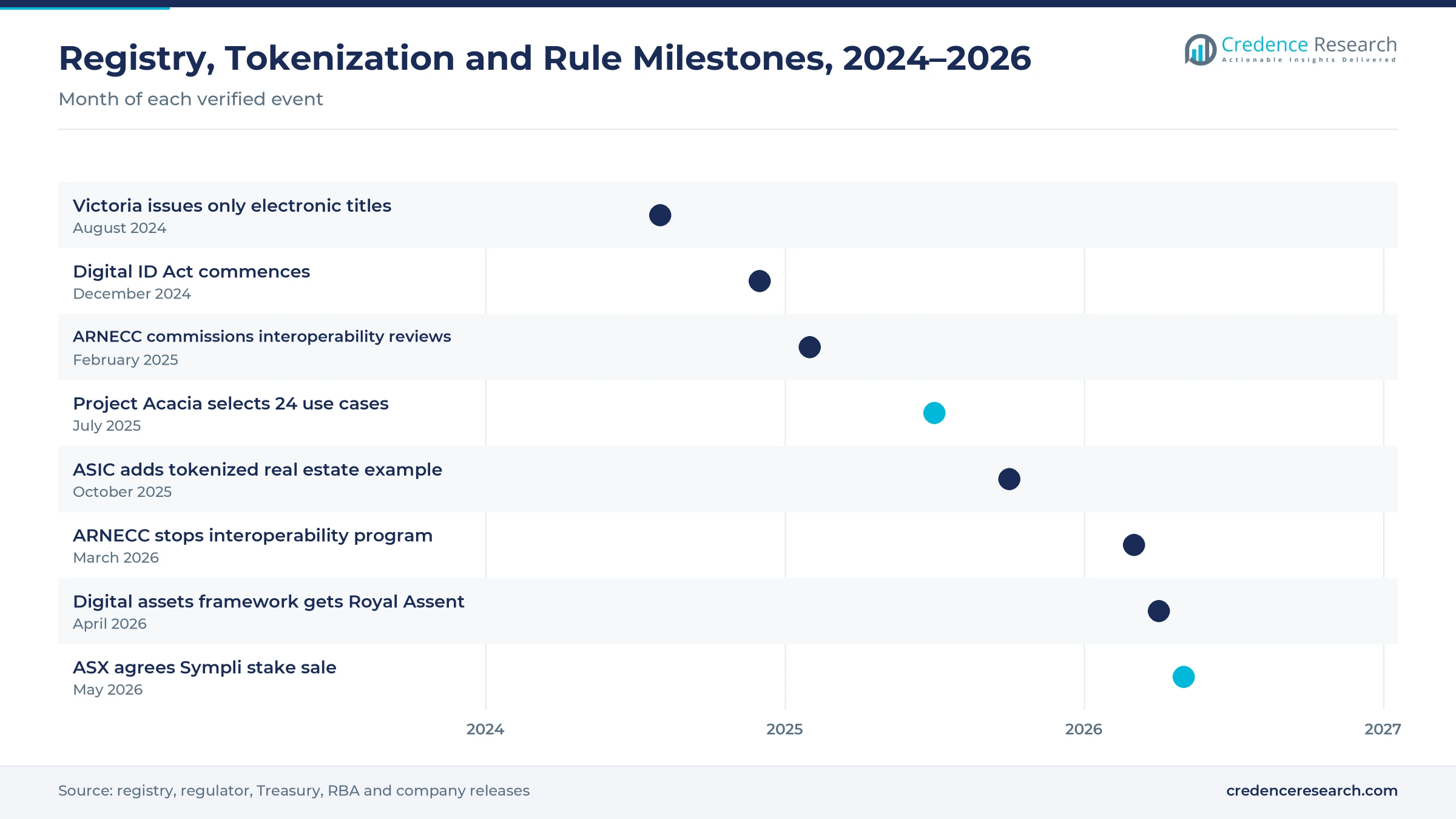
States are moving from paper certificates to electronic titles, which shifts the trust anchor from a paper document to a digital record that can be hashed and verified. From Aug. 3, 2024, all new certificates of title issued from the Victorian Register of land are electronic, according to Land Use Victoria. More than 65% of Victorian titles were already electronic, and the state had issued about 150,000 new paper titles a year on average. Queensland made electronic lodgement mandatory for transfers and mortgages from Feb. 20, 2023, according to the Queensland Law Society. As a result, Registry provenance assurance grows at 22.52% a year.
Why are hybrid ledger designs emerging in registry pilots?
Registry pilots are shifting toward hybrid designs that keep title data on private nodes while publishing proofs or tokens more widely, which balances privacy with transparency. ChromaWay told the NSW Registrar General in a February 2018 submission that ledgers can stop the same electronic mortgage being assigned twice and can time-stamp records that cannot be altered. The RBA also issued a pilot wholesale digital currency onto both public and private ledgers, according to findings released on May 18, 2026. NSW Land Registry Services tested a ledger proof of concept due in early 2019, which shows how such pilots of distributed ledger technology start beside the register rather than inside it. In turn, Hybrid networks grow fastest at 22.62% a year.
Can digital identity reform open verification services?
Stronger national digital identity rules create an opening for ledger tools that bind verified identities to property transactions and audit logs. The Digital ID Act commenced on Dec. 1, 2024, making the ACCC the Digital ID Regulator and allowing state and territory services to apply to join the national system, according to the Digital ID System. Private sector entities can apply to participate by December 2026. Registry operators also handle large volumes, with Secure Electronic Registries Victoria administering more than 1 million property transactions a year, so each identity check must scale. PEXA also processes 90% of property transfer settlements, so verification tools built into its workflow reach most deals. As a result, Integration and assurance services gain work linking identity checks to registry and settlement systems.
Is there room for tokenized property funds built on titles?
Housing is Australia's largest asset class, which gives licensed platforms a deep base for fractional, registry-linked investment products. Residential dwellings were worth AUD 12.7 trillion in the June quarter 2026, with a mean price of AUD 1.1 million, according to the Australian Bureau of Statistics. The International Monetary Fund highlighted the need for a holistic strategy to address housing supply constraints in February 2026, which keeps housing finance and new ownership models on the policy agenda. ASIC's tokenized real estate example clarifies when such products count as financial products. In turn, Registry-linked investment platforms grow fastest at 23.46% a year.
Incumbent platforms and DLT setbacks slow adoption
How does a dominant electronic exchange limit ledger demand?
One electronic exchange already processes most property settlements, which reduces the gap a ledger could fill. ARNECC paused its interoperability program in June 2024 and decided on March 31, 2026, not to proceed without Commonwealth support. ASX then sold its 49% stake in Sympli to ATI Group in May 2026. As a result, buyers see little short-term pressure to replace central systems, so vendors target audit layers instead.
Why does the CHESS experience make buyers cautious?
The ASX chose distributed ledger technology to replace its CHESS settlement system in December 2017 but paused the project on Nov. 17, 2022, according to a parliamentary committee. The write-down and redesign made boards and regulators wary of ledger-based core infrastructure. In turn, registry operators keep conventional databases for the official register. Vendors respond with smaller, contained pilots that run beside core systems.
How does the Torrens guarantee reduce the ledger value case?
Australian titles are registered and guaranteed by the state, which already gives buyers and lenders certainty of ownership. A ledger therefore cannot add legal finality unless land titles law changes in each state. As a result, the value case rests on audit, speed and data products rather than title security. Vendors respond by selling provenance logs and verification services that sit alongside the register.
Why does fragmented state law slow national rollouts?
Land titles law sits with each state and territory, so a ledger design approved in one registry does not carry over automatically. The Senate economics committee noted that only New South Wales has enforcement provisions for interoperability, while other jurisdictions issue annual waivers. In turn, vendors face eight separate approval paths and longer sales cycles. Suppliers respond by starting with one registry operator and reusing integration work.
New South Wales leads as Queensland grows fastest
| Region | Value, 2025 (USD million) | Share, 2025 | CAGR, 2026–2035 |
|---|---|---|---|
| New South Wales | 11.9 | 30.9% | 21.70% |
| Remaining jurisdictions | 10.4 | 27.1% | 21.30% |
| Victoria | 8.9 | 23.0% | 21.60% |
| Queensland | 7.3 | 19.0% | 22.00% |
New South Wales leads on registry pilots and settlements
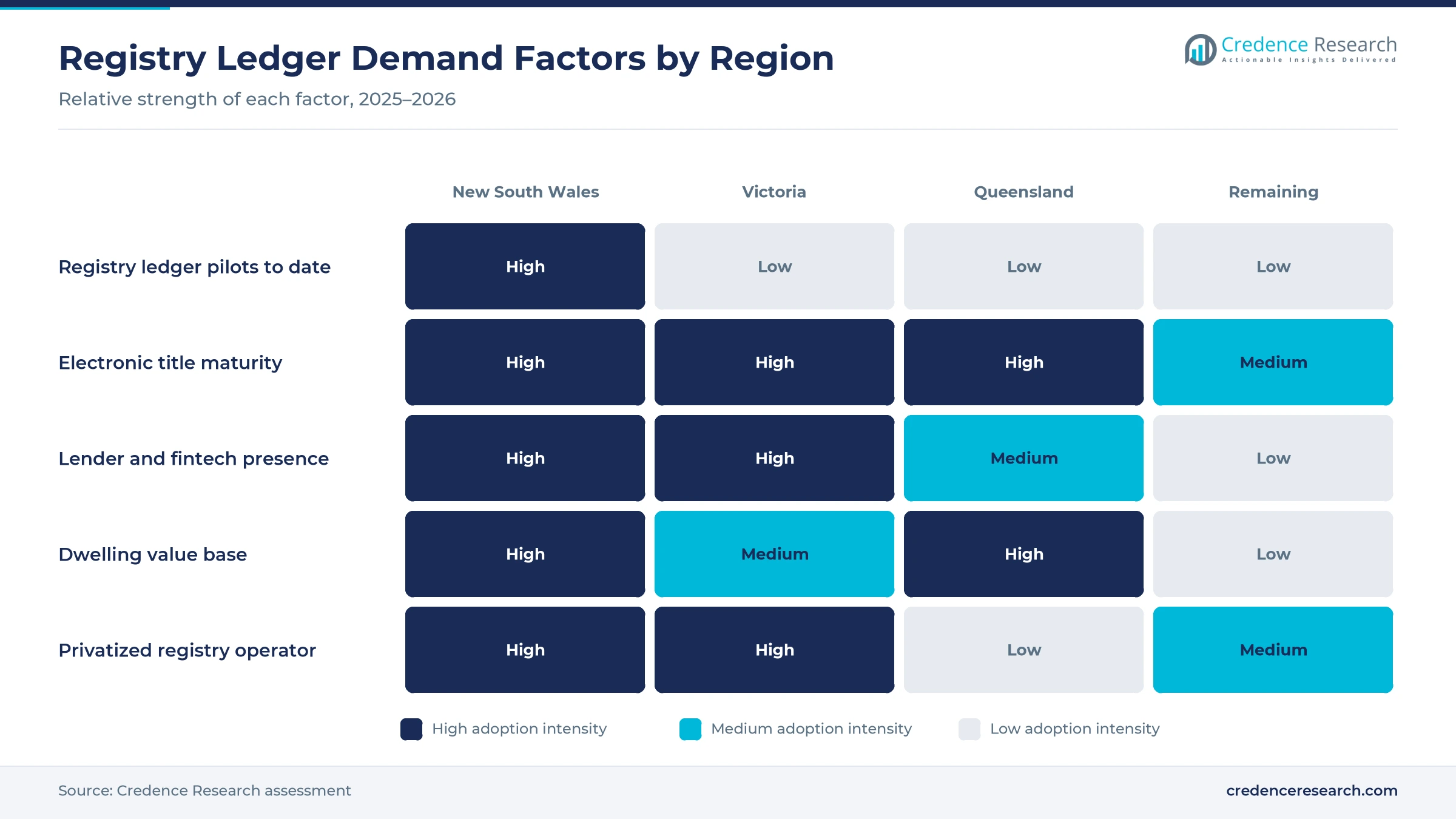
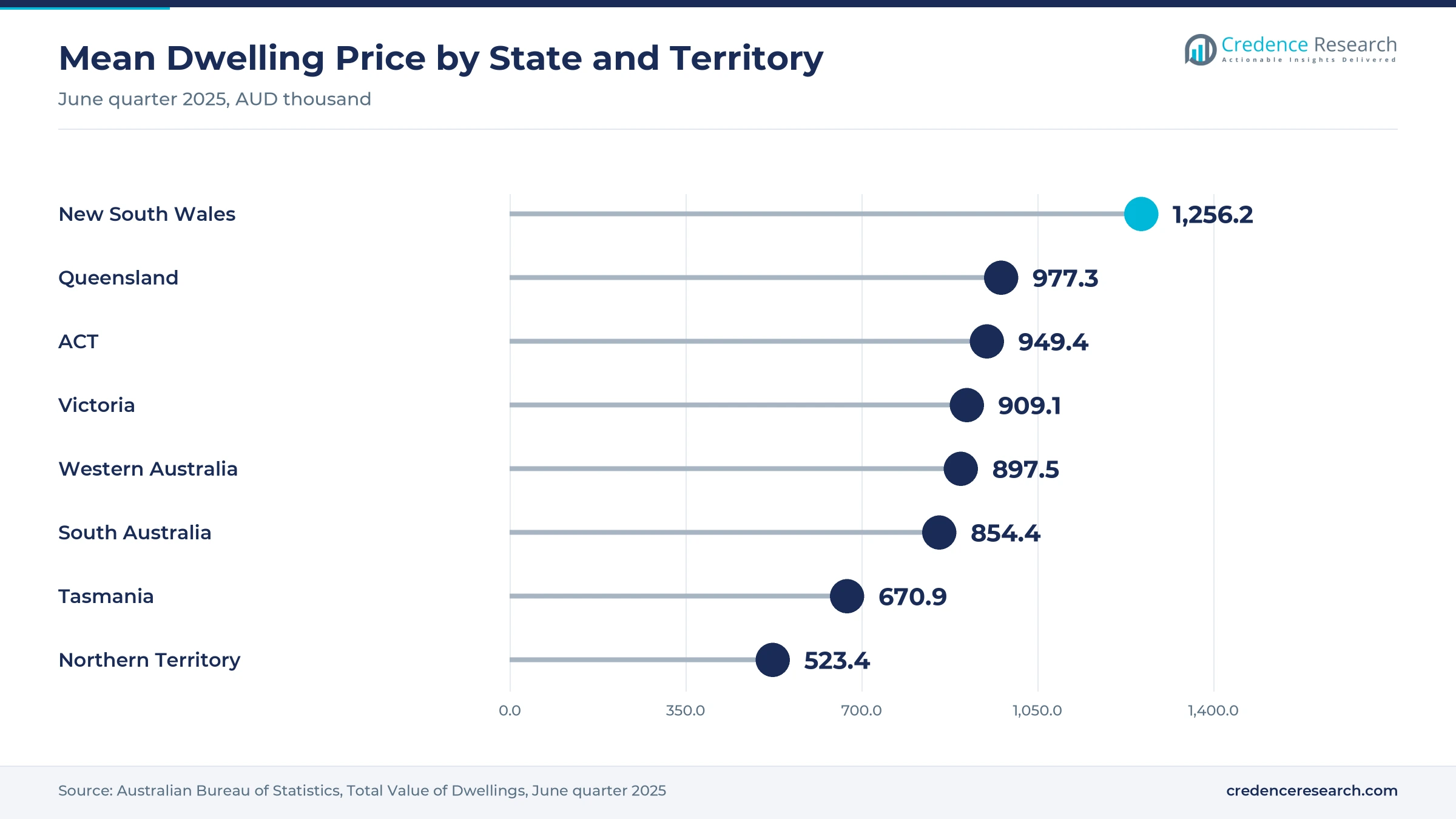
New South Wales held a 30.9% share of 2025 value and grows at 21.70% a year, because Sydney concentrates lenders, conveyancing firms and fintech developers. NSW Land Registry Services ran the state's blockchain proof of concept with ChromaWay, and the state abolished paper titles in October 2021. The mean dwelling price reached AUD 1,256,200 in the June quarter 2025, the highest of any state, according to the Australian Bureau of Statistics. As a result, the state leads registry and settlement work.
How do electronic titles shape demand in Victoria?
Victoria held a 23.0% share of 2025 value and grows at 21.60% a year, supported by Melbourne lenders and its privatized registry operator. All new Victorian titles have been electronic since Aug. 3, 2024, and Secure Electronic Registries Victoria handles more than one million property transactions a year, according to GovTech Review. The mean dwelling price was AUD 909,100 in the June quarter 2025. In turn, provenance and data integration projects carry most new spending.
Why does Queensland grow fastest among the regions?
Queensland held a 19.0% share of 2025 value and grows fastest at 22.00% a year. The state mandated electronic lodgement for transfers and mortgages from Feb. 20, 2023, and Titles Queensland led the targeted review that shaped ARNECC's 2025 work program. The mean dwelling price reached AUD 977,300 in the June quarter 2025, above Victoria. As a result, lenders and investment platforms see room to grow verification and tokenized products in the state.
How do South Australia and the other jurisdictions contribute?
Remaining jurisdictions held a 27.1% share of 2025 value and grow at 21.30% a year. Land Services SA, appointed in August 2017 to run South Australian transaction services, reports that more than 94% of property dealings are lodged electronically. Western Australia, Tasmania and the two territories each run their own registries. In turn, smaller budgets and separate laws keep ledger projects in this group small and slower to scale.
Interoperability, tokenization and title moves, 2024–2026
| Development | Status and market relevance |
|---|---|
| In August 2024, Victoria began issuing all new certificates of title from its land register in electronic form. | Completes the move to digital title records in the state |
| In February 2025, ARNECC commissioned functional requirements and cost benefit reviews of electronic conveyancing interoperability. | Sets the technical scope for future registry connections |
| In July 2025, the Reserve Bank of Australia selected 24 Project Acacia use cases for tokenized asset settlement. | Tests ledger settlement models used by lenders |
| In April 2026, the Corporations Amendment (Digital Assets Framework) Bill 2025 received Royal Assent. | Creates licensing for tokenized custody platforms from April 2027 |
| In May 2026, ASX agreed to sell its 49% stake in Sympli to ATI Group after the interoperability program stalled. | Leaves PEXA as the dominant settlement exchange |
Permissioned ledgers, hashes and smart contracts compete
- Permissioned ledgers let registry operators, lenders and conveyancers share a tamper-evident record of dealings without exposing title data publicly.
- Cryptographic hashes and time stamps anchor electronic titles and mortgage documents so that any later change can be detected during audits and disputes.
- Smart contracts automate checks and token transfers in settlement or fund workflows, although complex contract terms remain hard to translate into code.
- Tokenization engines issue digital units linked to registered property interests, which licensed custody platforms can offer to investors once the new federal framework starts in April 2027.
Need a Custom Version of This Report?
Tailor the scope, geography, or segments to your exact requirements.
- Custom geography or segment scope
- Direct access to our analyst team
Registry operators and one dominant exchange set the pace
Competition is shaped by registry operators that control access to title data and by one dominant electronic settlement exchange. NSW Land Registry Services, which runs the New South Wales registry under a long concession, tested a blockchain proof of concept with ChromaWay starting in 2018 but has not moved its register onto a ledger. ChromaWay AB, a Stockholm developer that built a pilot for the Swedish land registry, opened an Australian office in 2018. PEXA Group Limited runs the main electronic exchange on conventional infrastructure and is the gateway that any ledger tool must connect to. Secure Electronic Registries Victoria and Land Services SA operate state registries and sell data through APIs and digital products. Rivals compete on registry access, security credentials and integration with lenders, and ledger vendors usually win work as partners rather than as replacements.
Which companies shape registry ledger activity in Australia?
| Company | Type | Role in the market |
|---|---|---|
| ChromaWay AB | Blockchain developer | Ran 2018 NSW land registry proof of concept |
| NSW Land Registry Services | Registry operator | Tested ledger use cases for eConveyancing |
| PEXA Group Limited | Electronic settlement exchange | Processes 90% of property transfer settlements |
| Land Services SA | Registry services operator | Over 94% of dealings lodged electronically |
| Secure Electronic Registries Victoria | Registry operator | Runs Victorian title data APIs and services |
Tokenization law matters more than title register change
Credence Research's view is that the Australia blockchain in real estate registries market will grow from a small base, but mainly around the register rather than inside it. The official Torrens registers are fully electronic and state guaranteed, so the strongest demand comes from audit layers, settlement verification and tokenized property products that use registered titles as their reference. The digital assets framework is the main catalyst, while the stalled interoperability program and earlier ledger setbacks will keep registry operators cautious about core replacement.
Model built from registry, regulator and housing data
The report uses 2025 as the base year on a calendar basis, and market values come from the Credence Research model. That model draws on land registry and regulator publications, housing value statistics, central bank and Treasury releases, parliamentary reports and company announcements on pilots, concessions and platform changes. Segment splits and regional growth rates are Credence Research estimates, while regional shares follow the client-defined split. Sources used are official statistics, regulator releases, government documents, trade press and company releases, and no interviews or surveys were used.
Pilots turn into niche production systems by 2035
The Australia blockchain in real estate registries market is expected to reach USD 314.6 million by 2035, a 21.63% CAGR during 2026–2035, as pilots turn into niche production systems. Growth should pick up after April 2027, when licensed tokenized custody platforms can launch property products under the new law. Registry operators are likely to add ledger-based audit and provenance tools before any change to the official register. Slow national coordination would hold back settlement uses, while a clear federal push on tokenization would lift spending.
Frequently Asked Questions
How big is the Australia blockchain in real estate registries market?
Does any Australian land registry run on a blockchain?
Which solution type leads the Australian market?
Which region leads the Australian market?
How does the new digital assets law affect property tokens?
What role does PEXA play in registry ledger projects?
Who are the leading companies in this market?
What are the main challenges for ledger adoption?
Table of Content
Chapter 1 Market Segmentation
- 1.1 Segmentation Framework
- 1.1.1 Product and Service Classification
- 1.1.2 Application and End-Use Classification
- 1.1.3 Technology and Solution Classification
- 1.1.4 Customer and Distribution Channel Classification
- 1.1.5 Geographic Segmentation
- 1.1.6 Market Segment Definitions and Boundaries
- 1.2 By Solution Type
- 1.2.1 Registry platforms
- 1.2.2 Smart contract platforms
- 1.2.3 Registry-linked tokenisation platforms
- 1.2.4 Integration and assurance services
- 1.3 By Deployment Model
- 1.3.1 Customer-hosted networks
- 1.3.2 Vendor-managed private networks
- 1.3.3 Hybrid networks
- 1.4 By Customer Type
- 1.4.1 Registry authorities and operators
- 1.4.2 Lenders and settlement providers
- 1.4.3 Legal and conveyancing practices
- 1.4.4 Registry-linked investment platforms
- 1.5 By Application
- 1.5.1 Title transfer recording
- 1.5.2 Mortgage recording
- 1.5.3 Settlement workflow verification
- 1.5.4 Registry provenance assurance
Chapter 2 Introduction
- 2.1 Report Objectives and Scope
- 2.2 Product Definition and Industry Terminology
- 2.3 Market Inclusions and Exclusions
- 2.4 Research Process
- 2.4.1 Primary Research and Expert Interviews
- 2.4.2 Secondary Research and Source Review
- 2.4.3 Top-Down and Bottom-Up Estimation
- 2.4.4 Data Triangulation and Verification
- 2.5 Market Size Measurement Basis
- 2.5.1 2025: USD 38.5 million → 2035: USD 314.6 million
- 2.6 Historical and Forecast Reference Periods
- 2.6.1 Historical Period: 2018-2025
- 2.6.2 Base Year: 2025
- 2.6.3 Forecast Period: 2025-2035
- 2.7 Research Assumptions and Limitations
Chapter 3 Executive Summary
- 3.1 Market Snapshot and Key Findings
- 3.2 Base-Year Market Size, 2025
- 3.3 Forecast Market Size, 2035
- 3.4 Revenue and Volume Growth Outlook
- 3.5 Key Demand and Supply Indicators
- 3.6 Leading Market Segments
- 3.7 Fastest-Growing Market Opportunities
- 3.8 Regional Performance Highlights
- 3.9 Technology and Industry Transformation
- 3.10 Competitive Landscape Summary
- 3.11 Analyst View and Strategic Implications
Chapter 4 Australia Blockchain in Real Estate Registries Market Trends and Developments
- 4.1 Historical Industry Development, 2018-2025
- 4.2 Recent Market Trends and Developments
- 4.3 Demand and Customer Behavior Trends
- 4.4 Technology and Product Innovation
- 4.5 Artificial Intelligence, Automation and Digitalization
- 4.6 Local Manufacturing and Supply Chain Realignment
- 4.7 Industry Partnerships, Mergers and Acquisitions
- 4.8 Sustainability and Circular Economy Developments
- 4.9 Government and Private Sector Investment Trends
- 4.10 Emerging Business Models and Commercialization
- 4.11 Industry Developments and Announcements
Chapter 5 Australia Blockchain in Real Estate Registries Market Supply and Demand Analysis
- 5.1 Demand Trend and Consumption Analysis, 2018-2025
- 5.2 Demand Forecast, 2025-2035
- 5.3 Supply Chain Structure and Procurement Trends
- 5.4 Supply-Demand Gap and Bottlenecks
- 5.5 Import Dependence and Sourcing Structure
- 5.6 Regional Supply and Demand Concentration
Chapter 6 Australia Blockchain in Real Estate Registries Market Pricing Analysis
- 6.1 Pricing Structure and Measurement
- 6.2 Historical Pricing Trends, 2018-2025
- 6.3 Pricing Outlook, 2025-2035
- 6.4 Pricing by Product and Market Segment
- 6.5 Geographic Pricing Differences
- 6.6 Key Input, Energy, Labor and Logistics Costs
- 6.7 Contract Pricing and Purchasing Models
- 6.8 Pricing Sensitivity and Competitive Positioning
- 6.9 Price, Margin and Profitability Implications
Chapter 7 Australia Blockchain in Real Estate Registries Market Dynamics
- 7.1 Market Growth Drivers
- 7.1.1 Demand-Side Drivers
- 7.1.2 Technology and Innovation Drivers
- 7.1.3 Infrastructure and Investment Drivers
- 7.1.4 Regulatory and Policy Drivers
- 7.2 Market Restraints
- 7.2.1 Cost and Affordability Constraints
- 7.2.2 Technology and Adoption Barriers
- 7.2.3 Supply Chain and Operational Constraints
- 7.3 Market Challenges
- 7.3.1 Competitive Pressure and Margin Erosion
- 7.3.2 Skills, Infrastructure and Implementation Gaps
- 7.4 Emerging Market Opportunities
- 7.5 Market Dynamics Impact and Time-Horizon Assessment
Chapter 8 Australia Blockchain in Real Estate Registries Value Chain Analysis
- 8.1 Industry Value Chain Overview
- 8.2 Upstream Suppliers and Critical Inputs
- 8.3 Technology and Component Providers
- 8.4 Manufacturing or Service Delivery
- 8.5 Distribution, Channel Partners and Integrators
- 8.6 Downstream Applications and End Users
- 8.7 Value Addition and Profit Pools
- 8.8 Vertical Integration and Outsourcing
- 8.9 Supplier Concentration and Risk
- 8.10 Supply Chain Localization and Resilience
Chapter 9 Australia Blockchain in Real Estate Registries Market Regulations and Policies
- 9.1 Relevant Laws, Standards and Compliance Frameworks
- 9.2 Product, Service, Safety and Quality Requirements
- 9.3 Government Policies, Incentives and Subsidies
- 9.4 Imports, Exports and Trade Barriers
- 9.5 Public Procurement and Local Content Requirements
- 9.6 Data Protection, AI and Cybersecurity Compliance
- 9.7 Upcoming Policy Changes and Market Implications
Chapter 10 Australia Blockchain in Real Estate Registries Market Hotspots and Opportunities
- 10.1 Market Opportunity Mapping and Growth Hotspots
- 10.2 High-Growth Applications and Customer Groups
- 10.3 Underserved Markets and White-Space Opportunities
- 10.4 Emerging Technology and Product Opportunities
- 10.5 New Capacity and Investment Hotspots
- 10.6 Market Entry and Expansion Opportunities
- 10.7 Distribution and Partnership Opportunities
- 10.8 Near-Term and Long-Term Commercial Potential
- 10.9 Opportunity Attractiveness and Execution Risks
Chapter 11 Australia Blockchain in Real Estate Registries Market Outlook, 2025-2035
- 11.1 Market Size and Analysis
- 11.1.1 Revenue (Market Measurement: 2025: USD 38.5 million → 2035: USD 314.6 million)
- 11.1.2 Historical Market Size, 2018-2025
- 11.1.3 Base-Year Market Size, 2025
- 11.2 Market Forecast, 2025-2035
- 11.2.1 Revenue Forecast to 2035
- 11.2.2 CAGR and Year-on-Year Growth
- 11.2.3 Incremental Revenue Opportunity
- 11.3 Forecast Assumptions and Scenario Analysis
- 11.3.1 Base-Case Forecast
- 11.3.2 Optimistic and Conservative Scenarios
- 11.3.3 Technology, Pricing and Policy Sensitivities
- 11.4 Market Attractiveness and Growth Outlook
Chapter 12 Australia Blockchain in Real Estate Registries Market Segmentation and Outlook
- 12.1 Segmentation Summary and Market Shares, 2025
- 12.2 Largest and Fastest-Growing Segments
- 12.3 By Solution Type - Market Size and Forecast, 2025-2035
- 12.3.1 Segment Definition and Scope
- 12.3.2 Historical Market Size, 2018-2025
- 12.3.3 Revenue Forecast, 2025-2035
- 12.3.4 Base-Year Market Share, 2025
- 12.3.5 Segment CAGR and Growth Drivers
- 12.3.6 Subsegment Market Size and Forecast
- 12.3.6.1 Registry platforms
- 12.3.6.2 Smart contract platforms
- 12.3.6.3 Registry-linked tokenisation platforms
- 12.3.6.4 Integration and assurance services
- 12.3.7 Subsegment Pricing and Adoption Trends
- 12.3.8 Leading Suppliers and Competition
- 12.3.9 Regional Demand and Opportunities
- 12.4 By Deployment Model - Market Size and Forecast, 2025-2035
- 12.4.1 Segment Definition and Scope
- 12.4.2 Historical Market Size, 2018-2025
- 12.4.3 Revenue Forecast, 2025-2035
- 12.4.4 Base-Year Market Share, 2025
- 12.4.5 Segment CAGR and Growth Drivers
- 12.4.6 Subsegment Market Size and Forecast
- 12.4.6.1 Customer-hosted networks
- 12.4.6.2 Vendor-managed private networks
- 12.4.6.3 Hybrid networks
- 12.4.7 Subsegment Pricing and Adoption Trends
- 12.4.8 Leading Suppliers and Competition
- 12.4.9 Regional Demand and Opportunities
- 12.5 By Customer Type - Market Size and Forecast, 2025-2035
- 12.5.1 Segment Definition and Scope
- 12.5.2 Historical Market Size, 2018-2025
- 12.5.3 Revenue Forecast, 2025-2035
- 12.5.4 Base-Year Market Share, 2025
- 12.5.5 Segment CAGR and Growth Drivers
- 12.5.6 Subsegment Market Size and Forecast
- 12.5.6.1 Registry authorities and operators
- 12.5.6.2 Lenders and settlement providers
- 12.5.6.3 Legal and conveyancing practices
- 12.5.6.4 Registry-linked investment platforms
- 12.5.7 Subsegment Pricing and Adoption Trends
- 12.5.8 Leading Suppliers and Competition
- 12.5.9 Regional Demand and Opportunities
- 12.6 By Application - Market Size and Forecast, 2025-2035
- 12.6.1 Segment Definition and Scope
- 12.6.2 Historical Market Size, 2018-2025
- 12.6.3 Revenue Forecast, 2025-2035
- 12.6.4 Base-Year Market Share, 2025
- 12.6.5 Segment CAGR and Growth Drivers
- 12.6.6 Subsegment Market Size and Forecast
- 12.6.6.1 Title transfer recording
- 12.6.6.2 Mortgage recording
- 12.6.6.3 Settlement workflow verification
- 12.6.6.4 Registry provenance assurance
- 12.6.7 Subsegment Pricing and Adoption Trends
- 12.6.8 Leading Suppliers and Competition
- 12.6.9 Regional Demand and Opportunities
- 12.7 Segment Growth Comparison
- 12.8 Segment Attractiveness and Priority Matrix
Chapter 13 Australia Blockchain in Real Estate Registries End-Use and Application Market Outlook
- 13.1 End-Use Industry and Customer Demand Structure
- 13.2 Leading Applications and Customer Groups
- 13.3 End-Use Market Size, Share and Forecast
- 13.4 Major End-Use Industry Deep Dives
- 13.4.1 Customer Requirements and Use Cases
- 13.4.2 Demand and Replacement Cycles
- 13.4.3 Technical and Regulatory Considerations
- 13.4.4 Purchasing and Procurement Models
- 13.4.5 Leading Vendors and Distribution Channels
- 13.4.6 Forecast and Commercial Opportunities
- 13.5 Emerging Applications and Cross-Segment Demand
- 13.6 End-Use Industry Investment Priorities
Chapter 14 Australia Blockchain in Real Estate Registries Geographic Market Outlook, 2025-2035
- 14.1 Domestic Market Distribution and Demand Clusters
- 14.2 State- or Province-Wise Market Size and Forecast, 2025-2035
- 14.3 City and Metropolitan Market Outlook
- 14.4 Industrial, Manufacturing and Commercial Clusters
- 14.5 Geographic Concentration of Key End Users
- 14.6 Local Pricing and Purchasing Differences
- 14.7 Domestic Production Facilities and Capacity Map
- 14.8 Local Infrastructure and Project Pipeline
- 14.9 State-Level Policy and Incentive Differences
- 14.10 Subnational Investment Hotspots and Opportunities
- 14.11 Distribution and Logistics Networks
- 14.12 Domestic Competitive Footprint
Chapter 15 Australia Blockchain in Real Estate Registries Technology, Innovation and Sustainability Outlook
- 15.1 Technology Landscape and Maturity
- 15.2 Product, Process and Service Innovation
- 15.3 AI, Automation and Digital Tools in the Industry
- 15.4 Technology Adoption and Performance Benchmarking
- 15.5 Innovation Pipeline and R&D Investment
- 15.6 Patent and Intellectual Property Trends
- 15.7 Energy Efficiency and Resource Management
- 15.8 Sustainability, Recycling and Circularity
- 15.9 Technology Roadmap, 2025-2035
- 15.10 Risks of Obsolescence and Technology Substitution
Chapter 16 Australia Blockchain in Real Estate Registries Market Key Strategic Imperatives
- 16.1 Growth and Market Entry Priorities
- 16.2 High-Return Products and Segments
- 16.3 Pricing, Profitability and Cost Optimization
- 16.4 Technology Investment and Product Differentiation
- 16.5 Supply Chain Localization and Resilience
- 16.6 Distribution and Customer Acquisition
- 16.7 Partnership, Acquisition and Capacity Strategy
- 16.8 Regional Expansion Priorities
- 16.9 Short-, Medium- and Long-Term Actions
Chapter 17 Competition Outlook
- 17.1 Industry Competition Characteristics
- 17.2 Market Structure and Concentration
- 17.3 Market Share and Competitive Positioning, 2025
- 17.4 Company-Wise Revenue and Product Benchmarking
- 17.5 Production and Service Capacity Benchmarking
- 17.6 Technology, Pricing and Differentiation
- 17.7 Regional Footprint and Distribution Strength
- 17.8 Mergers, Acquisitions and Strategic Alliances
- 17.9 New Entrants and Competitive Threats
- 17.10 Porter's Five Forces and Industry Attractiveness
- 17.11 Competitive Outlook, 2025-2035
Chapter 18 Company Profiles
- 18.1 Company Coverage and Selection Criteria
- 18.2 ChromaWay AB
- 18.2.1 Business Description
- 18.2.2 Company Ownership and Geographic Presence
- 18.2.3 Product and Service Portfolio
- 18.2.4 Manufacturing and Operating Footprint
- 18.2.5 Financial Performance and Investment
- 18.2.6 Market Share and Competitive Position
- 18.2.7 Technology and Innovation Capabilities
- 18.2.8 Strategic Alliances or Partnerships
- 18.2.9 Recent Developments
- 18.2.10 Growth Strategy and Outlook
- 18.3 NSW Land Registry Services
- 18.4 PEXA Group Limited
- 18.5 Land Services SA
- 18.6 Secure Electronic Registries Victoria
- 18.7 Other Relevant Market Participants
Note: Every listed company is profiled on the structure shown under the first company. The company list is preliminary and may change based on research findings, market developments, data availability and client requirements.
Chapter 19 Disclaimer
- 19.1 Research and Forecast Disclaimer
- 19.2 Data Source and Estimation Limitations
Note: The depth of individual sections depends on data availability for this market. Volume, capacity, trade and other unit-based metrics are included where applicable.

