
| REPORT ATTRIBUTE | DETAILS |
|---|---|
| Historical Period | 2019-2022 |
| Base Year | 2023 |
| Forecast Period | 2024-2032 |
| Dental Implants Market Size 2023 | USD 5,068.66 Million |
| Dental Implants Market, CAGR | 9.50% |
| Dental Implants Market Size 2032 | USD 11,471.50 Million |
Market Overview
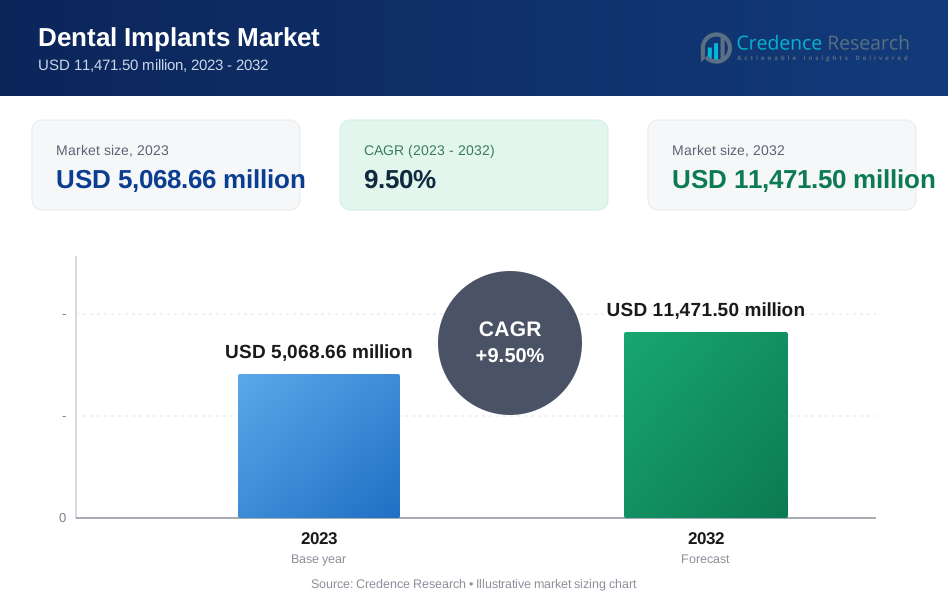
The Dental Implants Market is projected to grow from USD 5,068.66 million in 2023 to an estimated USD 11,471.50 million by 2032, with a compound annual growth rate (CAGR) of 9.50% from 2024 to 2032. This robust growth is driven by the increasing prevalence of dental disorders, rising awareness about oral health, and the growing adoption of advanced dental technologies.
Key market drivers include technological advancements in dental implantology, such as the development of mini dental implants and 3D printing technology. Additionally, the increasing preference for minimally invasive procedures and the rising disposable income levels in emerging economies are fueling market growth. Trends such as the growing popularity of cosmetic dentistry and the shift toward dental tourism in developing regions are also contributing to the market's positive trajectory.
Geographically, North America is expected to dominate the Dental Implants Market due to the high adoption of advanced dental procedures and the presence of key market players. Europe follows closely, driven by the increasing geriatric population and high healthcare expenditure. The Asia-Pacific region is anticipated to witness the highest growth rate, attributed to the rising awareness of dental care, expanding healthcare infrastructure, and increasing disposable incomes. Major players in the market include Straumann Group, Dentsply Sirona, Nobel Biocare, Zimmer Biomet, and Osstem Implant.
Market Drivers
Increasing Prevalence of Dental Disorders
The rising prevalence of dental disorders worldwide is a key driver of growth in the dental implants market. Conditions like tooth decay, periodontal diseases, and tooth loss are becoming increasingly common due to factors such as poor oral hygiene, unhealthy diets, and aging populations. For instance, data from global health organizations indicates that dental caries affects a significant portion of the world's population, making it an extremely widespread health condition. As these dental issues become more prevalent, the demand for effective long-term solutions like dental implants is growing. Implants offer a more permanent and natural-looking option compared to traditional dentures or bridges, driving their popularity among patients and dental professionals. The aging global population is also contributing substantially to increased dental disorder prevalence. Older adults are more prone to tooth loss due to weakened bones and gums, chronic diseases, and long-term medication use. With rapidly growing elderly populations, especially in developed regions, the demand for dental implants is expected to rise as older adults seek to maintain their oral health and quality of life through durable dental restoration options.
Technological Advancements in Implantology
Innovations in dental implant technology have significantly enhanced the quality, efficiency and outcomes of implant procedures, expanding their accessibility and appeal. Advanced imaging technologies now allow for precise 3D visualization of patients' oral structures, enabling more accurate implant planning and placement. Computer-aided design and manufacturing systems have streamlined the production of custom implants and prosthetics that fit seamlessly. The advent of 3D printing has also enabled rapid, cost-effective production of implant components. For instance, some dental clinics now offer same-day implants and crowns using in-house milling machines. Mini dental implants and immediate load implants have expanded options for patients with limited bone density or those seeking faster treatment. Implant surfaces and materials have also been optimized to promote better integration with bone tissue. Robotic-assisted implant surgery systems are enhancing precision and reducing invasiveness. Digital smile design software allows patients to preview expected aesthetic outcomes. Overall, these technological advancements have made dental implants a more viable, convenient and attractive option for a broader patient population.
Rising Awareness and Acceptance of Dental Implants
Growing awareness and acceptance of dental implants as a superior alternative to traditional prosthetics is significantly driving market expansion. Implants offer key advantages like improved durability, functionality and aesthetics compared to conventional dentures and bridges. They provide a more natural look and feel by anchoring directly into the jawbone, which helps preserve bone structure. Public education initiatives by dental associations and implant manufacturers have been crucial in informing people about implant benefits and dispelling misconceptions. For instance, some dental practices now offer free educational seminars on implant options. Positive word-of-mouth from satisfied implant patients is also boosting adoption. The increasing focus on aesthetic dentistry is another factor, as more people seek to enhance their smile and appearance. Social media influence and demand for a youthful, confident look are expected to further drive implant acceptance, especially among younger adults. Some clinics report rising requests for implants from patients in their 30s and 40s wanting to replace missing teeth. Overall, as awareness grows, dental implants are becoming viewed as an ideal solution for achieving both oral health and an attractive smile.
Growing Demand in Emerging Markets The dental implants market is experiencing robust growth in emerging markets, driven by several factors, including rising disposable incomes, expanding healthcare infrastructure, and increasing awareness of oral health. Countries in the Asia-Pacific region, Latin America, and the Middle East are witnessing significant economic development, which has led to an increase in the purchasing power of their populations. As a result, more people in these regions can afford advanced dental treatments, including dental implants, which were previously considered a luxury. In addition to economic factors, the expansion of healthcare infrastructure in emerging markets has made dental care more accessible to a larger portion of the population. Governments in these regions are investing in healthcare facilities, training programs for dental professionals, and public health campaigns to promote oral hygiene. These efforts have not only improved access to dental care but have also raised awareness of the importance of maintaining good oral health, leading to a higher demand for dental implants.
Market Trends
Adoption of Digital Dentistry and 3D Printing
The dental implants market is experiencing a significant shift towards digital dentistry, driven by advancements in 3D printing and imaging technologies. For instance, a recent survey by a leading dental association found that a majority of dental practices have already adopted or plan to adopt digital workflows in the near future. This trend is reshaping implant procedures, from planning to fabrication. 3D printing, in particular, is enabling the production of highly precise and customized dental implants and prosthetics more efficiently. Government reports indicate that the use of CAD/CAM technologies in dental offices has grown substantially over the past five years. Dental professionals report that digital workflows enhance practice efficiency by streamlining processes and reducing patient visits. Additionally, there is a marked increase in patient satisfaction scores for implant procedures utilizing digital technologies. As these technologies continue to evolve, their integration into dental implantology is becoming more widespread, with several major implant manufacturers investing heavily in digital solutions.
Increasing Focus on Immediate Load Implants and Minimally Invasive Procedures
Another key trend in the dental implants market is the growing preference for immediate load implants and minimally invasive procedures. For instance, a recent industry report highlighted that demand for same-day implants has risen significantly in the past year. This approach not only enhances patient convenience but also improves their quality of life by providing faster aesthetic and functional results. Government health data indicates a notable reduction in recovery times and post-operative complications associated with these advanced techniques. Additionally, surveys of dental practitioners reveal a growing adoption of minimally invasive procedures, driven by patient demand for quicker recovery and less discomfort. Industry analysts report that sales of mini dental implants and related tools have seen substantial growth, reflecting the shift towards less invasive options. Furthermore, educational institutions are increasingly incorporating training on immediate load implants and minimally invasive techniques into their curricula, preparing the next generation of dental professionals for these evolving practices.
Market Restraints and Challenges
High Cost of Dental Implants and Limited Insurance Coverage
One of the major challenges facing the dental implants market is the high cost of procedures, which can be prohibitive for many patients. According to surveys by dental associations, the price of a single dental implant can range from several hundred to several thousand dollars. This financial burden is compounded by limited insurance coverage, as many dental plans consider implants to be elective procedures and provide minimal reimbursement. Government data indicates that out-of-pocket costs for dental care, including implants, represent a significant portion of healthcare spending for many households. The affordability issue is particularly acute in lower-income populations and emerging markets. Industry reports suggest that the high cost of implants restricts market penetration in many regions, despite growing demand. Some dental practices have begun offering financing options or discount plans to help offset costs, but affordability remains a key barrier to wider adoption. The challenge of cost and limited coverage continues to impact market growth potential, especially in areas where dental care access is already constrained by economic factors.
Complexity of Surgical Procedures and Need for Skilled Professionals
Another significant challenge in the dental implants market is the complexity of implant procedures and the requirement for highly skilled professionals. Dental association surveys indicate that implant surgery demands precision and expertise to ensure proper placement and long-term success. The intricate nature of these procedures necessitates extensive training and experience, typically requiring specialists such as oral surgeons or prosthodontists. However, industry data shows a shortage of such specialized professionals, particularly in rural or underserved areas. This scarcity of qualified practitioners limits the availability and accessibility of implant procedures in many regions. Additionally, the need for ongoing education and training in evolving implant technologies can be a deterrent for some dental professionals. Government health workforce statistics reveal disparities in the distribution of specialized dental care providers across different geographical areas. The complexity of implant procedures and the limited availability of skilled professionals create barriers to widespread adoption, especially in areas with less developed healthcare infrastructure.
Market Segmentation Analysis
By Type
The dental implants market is segmented into several types, with endosteal implants being the most commonly used. Endosteal implants are placed directly into the jawbone, offering high stability and durability. They are the preferred choice for patients with sufficient bone density. For instance, a survey by the American Academy of Implant Dentistry found that over 3 million Americans have dental implants, with endosteal implants being the most popular type. Subperiosteal implants, placed under the gum but above the jawbone, are typically used for patients with insufficient bone height or those unable to undergo bone augmentation. The National Institute of Dental and Craniofacial Research reports that about 5% of adults aged 20 to 64 have no remaining teeth, making them potential candidates for subperiosteal implants. Transosteal implants, less commonly used, involve placement through the jawbone and are typically reserved for cases where the jawbone structure is severely compromised. Intramucosal implants, which are less invasive and placed into the mucous membrane, are used for patients who cannot tolerate more invasive procedures, although their application is more limited.
By Product
The dental implants market is also segmented by product type, with tapered implants and parallel-walled implants being the primary categories. Tapered implants, with their conical shape resembling a natural tooth root, are preferred for providing immediate stability, particularly in soft bone and challenging conditions. According to a study published in the Journal of Clinical Medicine, tapered implants showed a higher success rate in immediate loading protocols compared to parallel-walled implants. The American Dental Association reports that immediate implant placement is becoming increasingly popular, with over 500,000 dental implants placed annually in the United States. Parallel-walled implants, which have a cylindrical design, are typically used in straightforward cases where bone density is sufficient, offering versatility across various clinical scenarios. A survey conducted by the International Team for Implantology found that parallel-walled implants remain a popular choice among dentists for their predictable outcomes in standard implant cases. The choice between tapered and parallel-walled implants often depends on the specific clinical situation and the dentist's preference.
Segments
Based on Type
- Endosteal Implants
- Subperiosteal Implants
- Transosteal Implants
- Intramucosal Implants
Based on Product
- Tapered Implants
- Parallel-Walled Implants
Based on End User
- Hospitals
- Dental Clinics
- Dental Service Organizations (DSOs)
- Others
Based on Material
- Titanium
- Zirconium
Based on Price
- Premium Implants
- Value Implants
- Discounted Implants
Based on Region
- North America
- The U.S
- Canada
- Mexico
- Europe
- Germany
- France
- The U.K.
- Italy
- Spain
- Rest of Europe
- Asia Pacific
- China
- Japan
- India
- South Korea
- South-east Asia
- Rest of Asia Pacific
- Latin America
- Brazil
- Argentina
- Rest of Latin America
- Middle East & Africa
- GCC Countries
- South Africa
- Rest of Middle East and Africa
Regional Analysis
North America (35%):
North America holds the largest market share, accounting for approximately 35% of the global dental implants market. This dominance is attributed to the region's advanced healthcare infrastructure, high adoption of cutting-edge dental technologies, and the presence of leading dental implant manufacturers. For instance, according to the American College of Prosthodontists, more than 36 million Americans do not have any teeth, and 120 million people in the U.S. are missing at least one tooth. The United States drives much of this growth, supported by a well-established dental care system and strong demand for cosmetic dentistry. The growing awareness of oral health and the rising prevalence of dental disorders further boost the market in this region.
Europe (30%):
Europe follows closely, with a market share of around 30%. The region's market growth is fueled by an aging population, especially in countries like Germany, France, and the United Kingdom, where the demand for dental implants is on the rise. For instance, according to Eurostat, the percentage of the population aged 65 and over in the EU is projected to increase from 20.3% in 2019 to 29.4% by 2050. High healthcare expenditure and the strong presence of key market players also contribute to the region's robust market position. Additionally, Europe benefits from favorable reimbursement policies and a high level of dental tourism, particularly in countries such as Hungary and Poland, which are known for offering high-quality dental care at competitive prices.
Key players
- B. Dental Devices Ltd.
- Adin Dental Implant Systems Ltd.
- AVINENT Implant System, S.L.U.
- Bicon
- Cortex Dental Implants Industries Ltd.
- Dentsply Sirona
- Envista Holdings Corporation
- Glidewell
- Henry Schein, Inc.
- Mega’gen Implant Co., Ltd.
- MIS Implants Technologies Ltd.
- Nucle OSS
- Osstem Implant Co., Ltd.
- Straumann Holding AG
Competitive Analysis
The dental implants market is highly competitive, with a mix of well-established companies and emerging players driving innovation and growth. Major players like Straumann Holding AG, Dentsply Sirona, and Envista Holdings Corporation dominate the market through their extensive product portfolios, strong global presence, and continuous investment in research and development. These companies lead the market in terms of technology advancements and comprehensive customer support services. Meanwhile, companies like Osstem Implant Co., Ltd. and Mega’gen Implant Co., Ltd. are expanding rapidly, particularly in emerging markets, by offering cost-effective solutions without compromising quality. The market is also seeing increased competition from niche players like A.B. Dental Devices Ltd. and Adin Dental Implant Systems Ltd., which focus on specialized implant technologies. This competitive landscape encourages innovation, driving the market forward while also increasing the accessibility and affordability of dental implant procedures globally.
Recent Developments
- In September 2023, Dentsply Sirona launched the new DS PrimeTaper EV implant system, featuring a unique thread design for enhanced primary stability.
- In August 2023, Straumann Holding AG introduced the TLX implant system, designed for immediate protocols and optimized for all bone types.
- In May 2023, Envista Holdings Corporation acquired Osteogenics Biomedical, a leader in regenerative dental products, to expand their portfolio.
- In March 2023, Henry Schein, Inc. launched the Medentika ProCone implant system, offering a comprehensive solution for various clinical situations.
- In February 2023, Osstem Implant Co., Ltd. released the TS VI implant, featuring an advanced surface treatment for improved osseointegration.
- In January 2023, MIS Implants Technologies Ltd. introduced the MSOFT implant, designed specifically for soft bone conditions.
- In November 2022, Glidewell launched the Hahn Tapered Pro implant system, offering enhanced primary stability and ease of use.
- In October 2022, AVINENT Implant System, S.L.U. released the AVINENT Ocean implant, featuring a new connection design for improved prosthetic flexibility.
Market Concentration and Characteristics
The dental implants market is characterized by moderate to high market concentration, with a few leading players, such as Straumann Holding AG, Dentsply Sirona, and Envista Holdings Corporation, holding significant market shares. These companies dominate the market through their extensive product offerings, strong global distribution networks, and continuous investment in technological advancements. The market also features a range of smaller, specialized companies that contribute to innovation, particularly in niche segments such as mini implants and zirconiumInbased implants. Despite the dominance of a few large players, the market remains competitive, driven by ongoing advancements in implant technology, increasing demand for aesthetic dental solutions, and the growing adoption of digital dentistry. This competitive environment fosters both innovation and collaboration, enabling the market to meet the diverse needs of a global patient population.
Report Coverage
The research report offers an inIndepth analysis based on Type, Product, End User, Material, Price and Region. It details leading market players, providing an overview of their business, product offerings, investments, revenue streams, and key applications. Additionally, the report includes insights into the competitive environment, SWOT analysis, current market trends, as well as the primary drivers and constraints. Furthermore, it discusses various factors that have driven market expansion in recent years. The report also explores market dynamics, regulatory scenarios, and technological advancements that are shaping the industry. It assesses the impact of external factors and global economic changes on market growth. Lastly, it provides strategic recommendations for new entrants and established companies to navigate the complexities of the market.
Future Outlook
- The dental implants market will continue to benefit from advancements in digital dentistry, such as 3D printing and CAD/CAM technologies, enabling more precise and customized implant solutions.
- Immediate load implants, which allow for faster treatment times, will see growing adoption as patients seek quicker and more convenient dental restoration options.
- Emerging markets in AsiaInPacific and Latin America are expected to experience significant growth due to rising disposable incomes, expanding healthcare infrastructure, and increasing awareness of dental care.
- The demand for aesthetic dental solutions, including implants that offer a natural appearance, will drive market growth as consumers prioritize cosmetic outcomes alongside functionality.
- The global aging population will continue to fuel demand for dental implants, as older adults seek reliable solutions for tooth loss and improved quality of life.
- There will be a growing preference for minimally invasive implant procedures, supported by advancements in implant design and surgical techniques that reduce recovery times and discomfort.
- AI and machine learning will play an increasing role in treatment planning and implant design, improving accuracy and outcomes while enhancing patient satisfaction.
- The market will see a shift towards ecoInfriendly and sustainable materials, with manufacturers exploring biodegradable and bioactive implants to meet environmental concerns.
- Dental tourism will continue to expand, particularly in regions offering highInquality yet affordable dental care, further driving the global market for dental implants.
- Future growth will be influenced by changes in regulatory frameworks and improvements in insurance coverage, which could make dental implants more accessible to a broader population.
Request a Free Sample
Fill in your details and we'll send you a free sample report.
- Sample data tables & charts
- Research methodology
Need a Custom Version of This Report?
Tailor the scope, geography, or segments to your exact requirements.
- Custom geography or segment scope
- Direct access to our analyst team
Frequently Asked Questions
What is the market size of the dental implants market in 2023, and what are the projected figures for 2032?
What are the key drivers of growth in the dental implants market?
Which regions are leading the dental implants market?
How are technological advancements influencing the dental implants market?
What challenges are affecting the adoption of dental implants?
Table of Content
Chapter 1. Report Introduction
- 1.1 Report Description & Purpose
- 1.1.1 Report Title & Market Definition
- 1.1.2 Unique Selling Propositions (USP) & Key Differentiators
- 1.1.3 Value Proposition for Stakeholders
- 1.2 Research Objectives
- 1.2.1 Market Sizing Objectives (Volume & Revenue)
- 1.2.2 Segmentation Objectives
- 1.2.3 Competitive Intelligence Objectives
- 1.2.4 Forecast & Scenario Objectives
- 1.3 Report Scope
- 1.3.1 Dental Implants Scope – Types & Subtypes Covered
- 1.3.2 Geographic Scope – Regions & Countries Covered
- 1.3.3 Historical Period, Base Year & Forecast Period (2023; forecast to 2032)
- 1.3.4 Inclusions & Exclusions
- 1.4 HS Code & Classification Framework
- 1.5 Currency, Units & Pricing Basis
- 1.6 Target Stakeholders
- 1.7 Limitations & Assumptions
Chapter 2. Executive Summary
- 2.1 Global Dental Implants Market Snapshot
- 2.1.1 Market Size – Historical (2023) & Forecast (2023-2032) (2023: USD 5,068.66 million → 2032: USD 11,471.50 million)
- 2.1.2 Volume & Revenue – Global Totals
- 2.1.3 Key Market Highlights – Top Five Facts
- 2.2 Dental Implants Market Segmentation Snapshot
- 2.2.1 Market Split by Region – 2023 vs. 2032
- 2.3 Competitive Snapshot
- 2.3.1 Top 10 Players by Revenue Share – 2023
- 2.3.2 Top 10 Players by Volume Share – 2023
- 2.3.3 Recent Strategic Developments (18-Month Summary)
- 2.4 Key Investment Highlights & Strategic Conclusions
Chapter 3. Dental Implants Market Dynamics & Industry Analysis
- 3.1 Market Overview & Context
- 3.1.1 Dental Implants Market Position in the Broader Automotive Value Chain
- 3.1.2 OEM vs. Replacement Market Dynamics
- 3.1.3 Market Maturity & Development Stage by Region
- 3.2 Dental Implants Market Drivers
- 3.3 Dental Implants Market Restraints & Challenges
- 3.4 Dental Implants Market Opportunities
- 3.5 Porter's Five Forces Analysis
- 3.5.1 Threat of New Entrants
- 3.5.2 Bargaining Power of Suppliers
- 3.5.3 Bargaining Power of Buyers
- 3.5.4 Threat of Substitutes
- 3.5.5 Competitive Rivalry – Intensity Assessment
- 3.6 Dental Implants Value Chain Analysis
- 3.6.1 Upstream – Raw Material/Input Suppliers
- 3.6.1.1 Raw Material/Input 1
- 3.6.1.2 Raw Material/Input 2
- 3.6.1.3 Raw Material/Input 3
- 3.6.2 Midstream – Production/Manufacturing/Service Delivery
- 3.6.2.1 Production/Process Overview
- 3.6.2.2 Key Facility Locations & Capacity by Manufacturer
- 3.6.3 Downstream – Distribution & End Consumer
- 3.6.3.1 Primary Channel – B2B/OEM
- 3.6.3.2 Secondary Channels – Dealer, Retail, Online, Direct
- 3.6.4 Value Chain Profitability Analysis
- 3.6.1 Upstream – Raw Material/Input Suppliers
- 3.7 PESTEL Analysis
- 3.7.1 Political Factors
- 3.7.2 Economic Factors
- 3.7.3 Social Factors
- 3.7.4 Technological Factors
- 3.7.5 Environmental Factors
- 3.7.6 Legal Factors
- 3.8 Dental Implants Supply Chain Analysis
- 3.8.1 Raw Material/Input Supply Risk Assessment
- 3.8.2 Manufacturing Concentration Risk (Geographic Exposure)
- 3.8.3 Trade Disruption Impact Analysis
- 3.9 Regulatory & Policy Landscape
Note: The regulatory and policy landscape section covers regulations based on their applicability to the market, Dental Implants category, geography, and scope of the study. Only regulatory frameworks with a material impact on operations, compliance, trade, sustainability, or market access are analyzed in detail.
Chapter 4. Key Investment Pockets & Opportunity Analysis
- 4.1 Dental Implants Market Attractiveness Analysis
- 4.1.1 By Region – Investment Attractiveness Matrix (Volume × CAGR)
- 4.2 Absolute Revenue Growth Opportunity
- 4.2.1 By Region – Absolute USD Growth Through 2032
- 4.3 Incremental Volume Opportunity
- 4.3.1 By Region – Incremental Volume Through 2032
- 4.3.2 Segment – Incremental Volume
- 4.4 Emerging Submarket Opportunity Deep Dive (Subject to Applicability)
- 4.5 Emerging Market Opportunity Scorecards
- 4.5.1 United States
- 4.5.2 Europe
- 4.5.3 Asia
- 4.5.4 Middle East & Africa
Note: Emerging Market Opportunity Scorecards will be included based on relevance and strategic importance. Regions listed are indicative and may vary depending on data availability and market dynamics.
Chapter 5. Dental Implants Import-Export Analysis & Trade Flows
- 5.1 Global Trade Overview
- 5.1.1 Global Export Value by Country (2023)
- 5.1.2 Global Export Volume by Country (2023)
- 5.1.3 Global Import Value by Country (2023)
- 5.1.4 Global Import Volume by Country (2023)
- 5.1.5 Net Trade Balance by Country (2023)
- 5.2 Export Analysis – Segment
- 5.2.1 Type 1 (HS Code)
- 5.2.2 Type 2 (HS Code)
- 5.2.3 Type 3 (HS Code)
- 5.2.4 Type 4 (HS Code)
- 5.2.5 Type 5 (HS Code)
- 5.3 Import Analysis – Segment
- 5.3.1 Type 1 (HS Code)
- 5.3.2 Type 2 (HS Code)
- 5.3.3 Type 3 (HS Code)
- 5.3.4 Type 4 (HS Code)
- 5.3.5 Type 5 (HS Code)
- 5.4 Average Unit Trade Prices
- 5.4.1 Average Export Price – Segment & Country
- 5.4.2 Average Import Price – Segment & Source Country
- 5.4.3 Price Trends (2023)
- 5.5 Key Trade Route Analysis
- 5.5.1 Trade Route 1
- 5.5.2 Trade Route 2
- 5.5.3 Trade Route 3
- 5.5.4 Trade Route 4
- 5.5.5 Trade Route 5
- 5.6 Trade Policy Impact Assessment
- 5.6.1 US Anti-Dumping & Section 301 Tariffs
- 5.6.2 EU Customs Union Impact
- 5.6.3 Major Free Trade Agreements
- 5.6.4 USMCA Rules of Origin
Note: Trade policy analysis will be included only where relevant to the Dental Implants market.
Chapter 6. Competitive Landscape & Company Benchmarking
- 6.1 Dental Implants Market Concentration & Structure
- 6.1.1 Herfindahl-Hirschman Index (HHI) – vs. 2023
- 6.1.2 Tier 1, Tier 2 & Tier 3 Market Structure
- 6.1.3 Global, Regional & Local Player Dynamics
- 6.2 Dental Implants Market Share Analysis – 2023
- 6.2.1 Global Revenue Share by Company
- 6.2.2 Global Volume Share by Company
- 6.2.3 Regional Revenue Share
- 6.2.4 Market Share Evolution ( vs. 2023)
- 6.2.5 OEM Segment Share by Company
- 6.2.6 Replacement Segment Share by Company
- 6.3 Production/Delivery Capacity & Facility Analysis
- 6.3.1 Global Installed Capacity
- 6.3.2 Capacity Utilization Rates
- 6.3.3 Production/Output Volume
- 6.3.4 Facility Locations & Capacity Map
- 6.3.5 Planned Capacity Additions
- 6.4 Dental Implants Competitive Benchmarking Matrix
- 6.4.1 Revenue, Volume, CAGR & Profitability Comparison
- 6.4.2 Channel Revenue Mix
- 6.4.3 Geographic Revenue Exposure
- 6.4.4 R&D Intensity
- 6.4.5 Sustainability Maturity
- 6.5 Strategic Developments in Dental Implants (Last 24 Months)
- 6.5.1 Mergers, Acquisitions & Divestments
- 6.5.2 New Dental Implants Launches
- 6.5.3 Facility Expansions
- 6.5.4 Strategic Alliances, Joint Ventures & Partnerships
- 6.5.5 Distribution Expansion & Market Entry
- 6.5.6 Sustainability & ESG Initiatives
- 6.6 Competitive Strategy Mapping
- 6.6.1 Leader, Challenger, Follower & Niche Classification
- 6.6.2 Pricing Strategy Comparison
- 6.6.3 Channel Strategy Matrix
Note: Strategic developments are included based on their materiality and the availability of reliable information.
Chapter 7. Global Dental Implants Market – By Distribution Channel
- 7.1 Segment Overview
- 7.1.1 Volume & Revenue Split by Channel (2023 & 2032)
- 7.1.2 Channel Mix Evolution (2023-2032)
Chapter 8. Regional Market Analysis – Global Overview
- 8.1 Global Regional Overview
- 8.1.1 Regional Volume Share
- 8.1.2 Regional Revenue Share
- 8.1.3 Regional Volume by Region
- 8.1.4 Regional Revenue by Region
- 8.1.5 Regional Forecast Through 2032
- 8.2 Cross-Regional Segment Analysis
- 8.2.1 By Distribution Channel
- 8.2.2 By Brand/Price Tier
Chapter 9. North America Dental Implants Market
- 9.1 United States
- 9.2 Canada
- 9.3 Mexico
Chapter 10. Europe Dental Implants Market
- 10.1 Germany
- 10.2 France
- 10.3 Italy
- 10.4 United Kingdom
- 10.5 Spain
- 10.6 Poland
- 10.7 Russia
- 10.8 Netherlands
- 10.9 Belgium
- 10.10 Sweden
- 10.11 Denmark
- 10.12 Norway
- 10.13 Rest of Europe
Chapter 11. Asia Pacific Dental Implants Market
- 11.1 China
- 11.2 India
- 11.3 Japan
- 11.4 South Korea
- 11.5 Thailand
- 11.6 Indonesia
- 11.7 Vietnam
- 11.8 Malaysia
- 11.9 Australia
- 11.10 Rest of Asia Pacific
Chapter 12. Latin America Dental Implants Market
- 12.1 Brazil
- 12.2 Argentina
- 12.3 Colombia
- 12.4 Chile
- 12.5 Rest of Latin America
Chapter 13. Middle East Dental Implants Market
- 13.1 Saudi Arabia
- 13.2 United Arab Emirates
- 13.3 Turkey
- 13.4 Israel
- 13.5 Iran
- 13.6 Rest of the Middle East
Chapter 14. Africa Dental Implants Market
- 14.1 South Africa
- 14.2 Egypt
- 14.3 Nigeria
- 14.4 Morocco
- 14.5 Rest of Africa
Chapter 15. Dental Implants Company Profiles
- 15.1 [Company 01]
- 15.1.1 Company Overview
- 15.1.2 Key Management Personnel
- 15.1.3 Products & Services Portfolio
- 15.1.4 Financial Performance
- 15.1.5 Key Market Focus & Geographic Presence
- 15.1.6 Recent Developments & Strategic Initiatives
Note: The company profile list is preliminary and may change based on research findings, market developments, data availability, and client requirements.
Chapter 16. Appendices
- Appendix A – List of Abbreviations & Acronyms
- Appendix B – Industry Classification Code Reference – Full Series
- Appendix C – Production & Capacity Data Tables
- Appendix D – End-Use & Demand Base Tables
- Appendix E – Consumption & Replacement Rate Assumptions
- Appendix F – ASP Reference Tables
- Appendix G – Manufacturing & Facility Database
- Appendix H – Import-Export Data Tables
- Appendix I – Regulatory Summary Tables
- Appendix J – Primary Research Participant List (Anonymized)
- Appendix K – Primary Research Questionnaire Framework
- Appendix L – Data Sources & Bibliography
- Appendix M – Market Size Divergence & Source Comparison
Chapter 17. Research Methodology
- 17.1 Research Framework & Philosophy
- 17.2 Secondary Research – Sources, Hierarchy & Data Extraction
- 17.3 Data Modeling – Bottom-Up & Top-Down Market Sizing
- 17.4 Primary Research – Stakeholder Framework, LOI & Sample Sizes
- 17.5 Forecast Methodology – Regression, Scenario & Sensitivity Analysis
- 17.6 Quality Control – Four-Layer Validation Framework
- 17.7 Limitations & Standard Assumptions
- 17.8 Disclaimer
