
Companion-animal surgery anchors regional demand
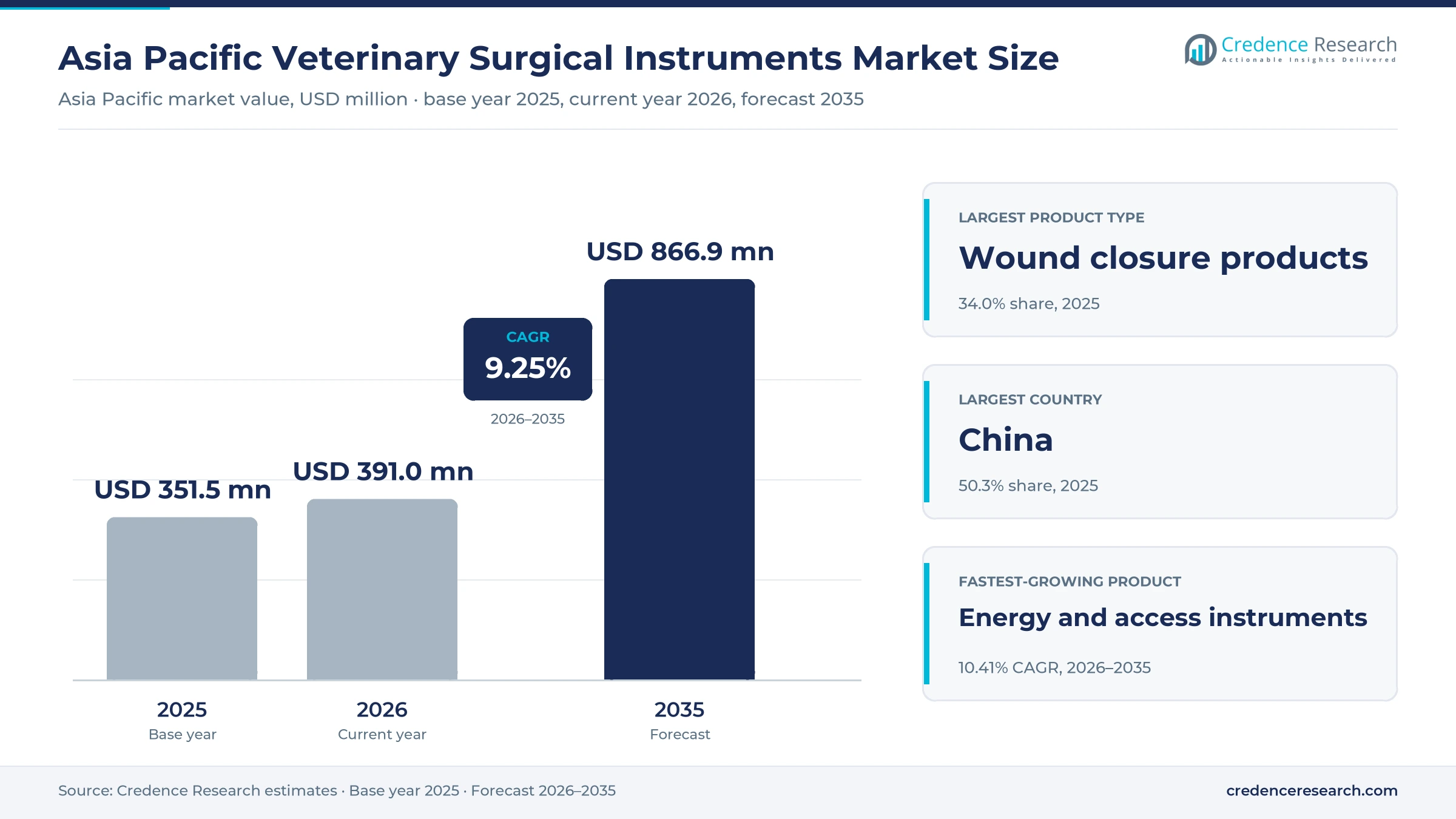
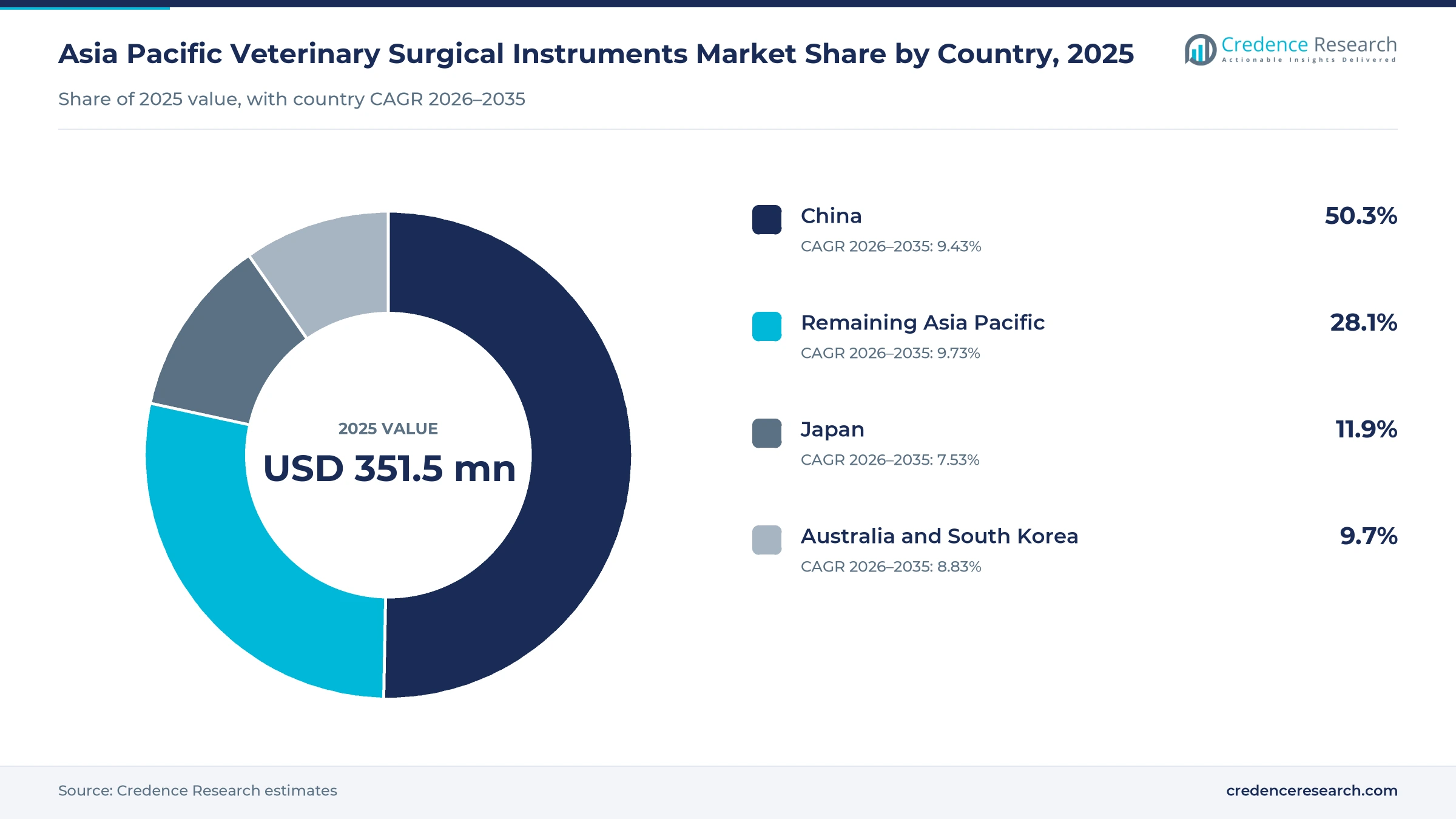
The Asia Pacific veterinary surgical instruments market was valued at USD 351.5 million in 2025 and is projected to increase from USD 391.0 million in 2026 to USD 866.9 million by 2035, registering a CAGR of 9.25% during 2026–2035. Demand comes from companion-animal clinics that perform desexing, wound repair and mass removals every week, and from hospitals that add orthopaedic, dental and laparoscopic work. China held the largest share, 50.3% in 2025, because its urban pet population reached about 120 million in 2024 and clinic rules now require dedicated operating rooms. Remaining Asia Pacific is the fastest-growing group at 9.73% a year, as companion-animal care spreads beyond the largest markets into Southeast Asia and South Asia. The main regulatory change is China's revised animal clinic measures, in force since October 2022, which reserve cranial, thoracic and abdominal surgery for licensed hospitals. Suppliers are also pairing implants with hands-on training, as shown by the first official hip replacement course in East Asia, scheduled for Seoul in April 2026.
Which surgical tools, from sutures to sealers, are counted?
The estimate measures the value of instruments and closure products used in animal surgery across Asia Pacific. It covers sutures, staples and other wound closure products, electrosurgical and vessel sealing devices with access ports, forceps, retractors and other grasping and exposure tools, and scalpels, scissors, saws and bone instruments.
The estimate excludes orthopedic implants, anesthesia machines, imaging systems and surgical drugs, which are sold as separate product lines. The value chain runs from instrument makers through manufacturer sales teams, specialist distributors, online catalogs and public tenders to clinics, hospitals, universities and livestock producers.
Asia Pacific Veterinary Surgical Instruments Market Insights
- The Asia Pacific veterinary surgical instruments market was valued at USD 351.5 million in 2025 and is projected to reach USD 866.9 million by 2035, registering a CAGR of 9.25% during 2026–2035.
- China held a 50.3% share of 2025 value, because about 120 million urban pets and stricter clinic rules support steady surgical purchasing.
- Wound Closure Products led with a 34.0% share of 2025 value, because every spay, castration and wound repair consumes sutures and staples.
- China's revised animal clinic measures took effect in October 2022 and reserve cranial, thoracic and abdominal surgery for hospitals with three licensed veterinarians.
- Energy and Access Instruments grow fastest at 10.41% a year during 2026–2035, as vessel sealing spreads from human surgery into veterinary hospitals.
Wound closure leads as energy tools grow fastest
Why do wound closure products hold the largest value?
Based on product type, the market is categorized into Wound Closure Products, Energy and Access Instruments, Grasping and Exposure Instruments, and Cutting and Bone Instruments. Wound Closure Products led with a 34.0% share of 2025 value, because sutures and staples are consumed in every procedure. Energy and Access Instruments grow fastest at 10.41% a year, as hospitals adopt vessel sealing for spays and laparoscopic work.
Which procedures account for the most spending?
Based on application, the market is categorized into Soft Tissue and Reproductive Surgery, Orthopaedic Surgery, Dental Surgery and Specialty Surgery. Soft Tissue and Reproductive Surgery led with a 48.0% share of 2025 value, because desexing and wound repair dominate clinic caseloads. Orthopaedic Surgery grows fastest at 10.03% a year, as referral hospitals add cruciate and joint replacement procedures.
Where are surgical instruments used most?
Based on end user, the market is categorized into Veterinary Clinics, Veterinary Hospitals, Research Institutions and Livestock Enterprises. Veterinary Clinics led with a 46.0% share of 2025 value, because most routine surgery, such as desexing and wound repair, happens in small practices with one or two veterinarians. Veterinary Hospitals grow fastest at 9.83% a year, as complex orthopaedic, thoracic and abdominal procedures move into licensed surgical suites with imaging and dedicated surgical teams.
How do clinics buy their surgical instruments?
Based on sales channel, the market is categorized into Manufacturer Direct Sales, Specialist Distributor Sales, Digital Direct Sales and Public Tender Sales. Specialist Distributor Sales led with a 47.0% share of 2025 value, because distributors carry broad catalogs and local stock. Digital Direct Sales grow fastest at 10.89% a year, as clinics reorder consumables through online accounts.
| Segment Group | Leading Sub-segment | Share, 2025 | Fastest-growing Sub-segment | CAGR, 2026–2035 |
|---|---|---|---|---|
| By Product Type | Wound Closure Products | 34.0% | Energy and Access Instruments | 10.41% |
| By Application | Soft Tissue and Reproductive Surgery | 48.0% | Orthopaedic Surgery | 10.03% |
| By End User | Veterinary Clinics | 46.0% | Veterinary Hospitals | 9.83% |
| By Sales Channel | Specialist Distributor Sales | 47.0% | Digital Direct Sales | 10.89% |
Request a Free Sample
Fill in your details and we'll send you a free sample report.
- Sample data tables & charts
- Research methodology
Pet care, specialist surgery and clinic rules lift sales
How does companion-animal care sustain repeat purchasing?
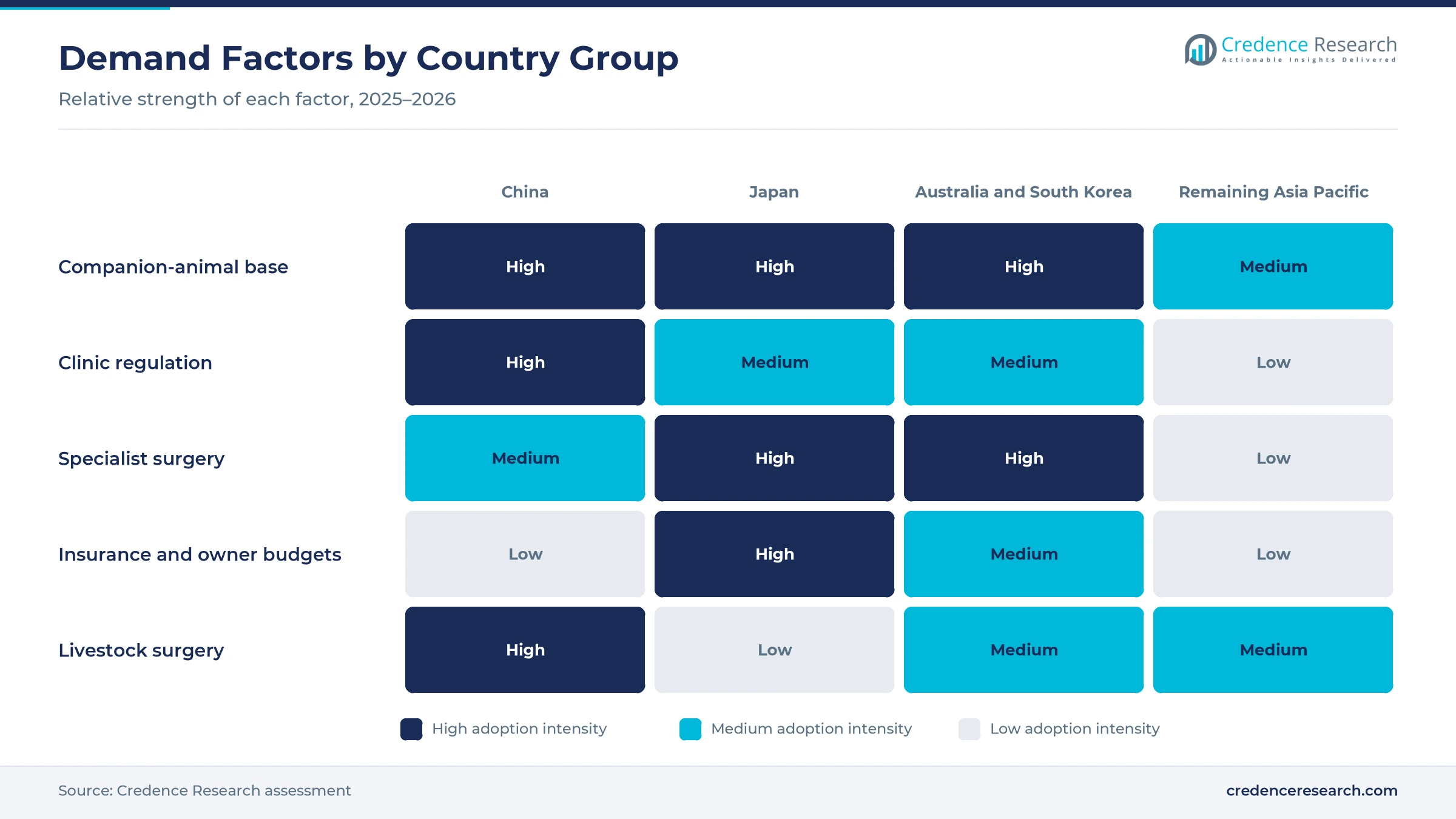
Companion animals generate most of the routine surgical work in the region, because desexing, wound repair and mass removals recur in every clinic that treats dogs and cats. Australia had 31.6 million pets and pets in 73% of households in 2025, with owners spending about A$1.9 billion a year on veterinary care, according to Animal Medicines Australia. Japan counted 6.82 million dogs and 8.847 million cats in the 2025 national survey by the Japan Pet Food Association, which PetfoodIndustry reported in February 2026. China Daily reported that urban China held about 120 million pets in 2024, citing the 2025 China Pet Industry White Paper. As a result, Soft Tissue and Reproductive Surgery holds 48.0% of 2025 value, because spays, castrations and wound repairs consume blades, sutures and hemostats every day.
Why do specialist surgical portfolios widen the procedure mix?
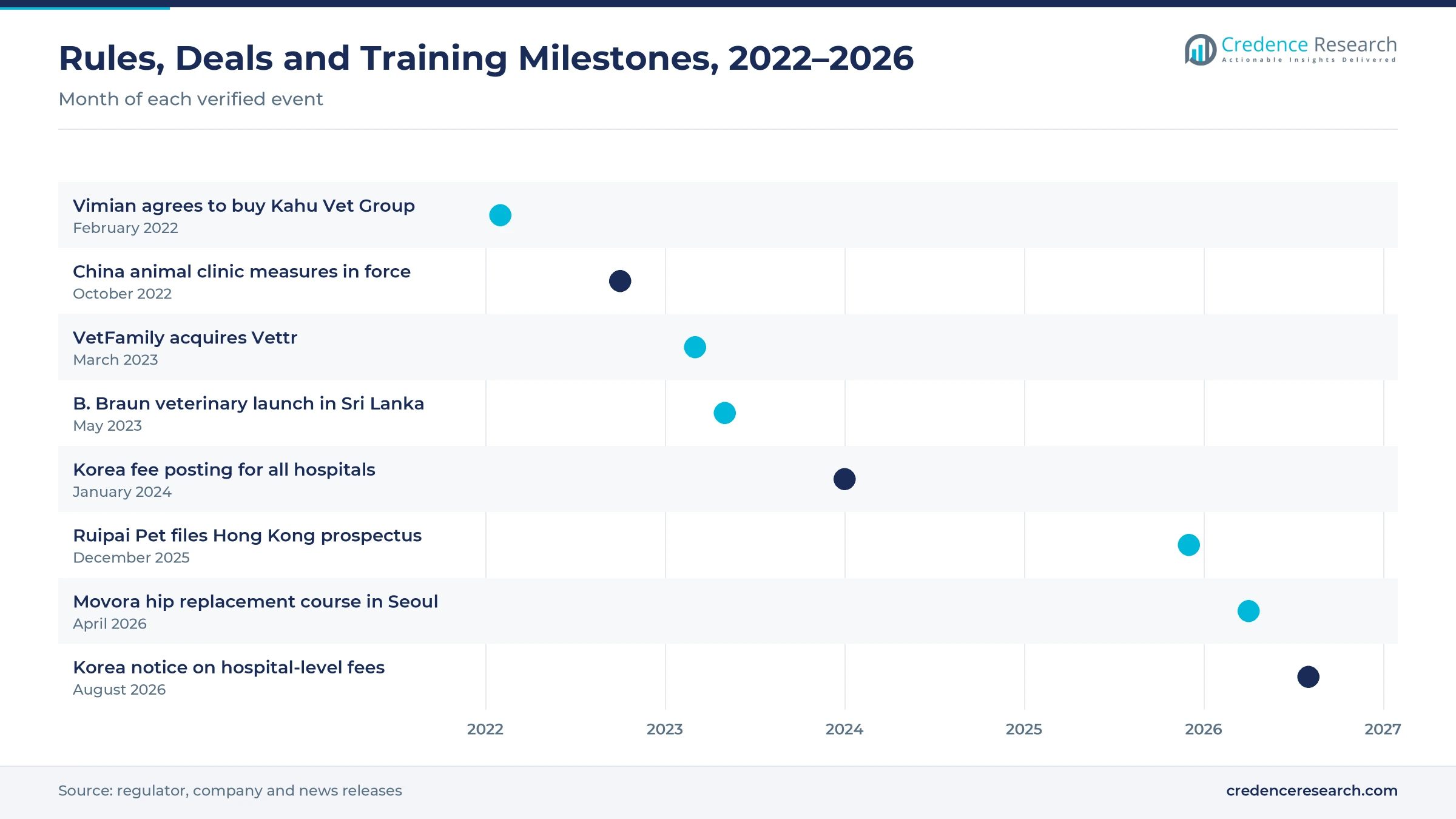
Suppliers now bundle orthopedic, joint replacement and advanced soft tissue tools with training, which moves clinics beyond spays toward higher-value referral procedures. Vimian Group agreed on Feb. 3, 2022, to buy Kahu Vet Group, a New Zealand supplier of implants and surgical instruments that served more than 700 clinics in New Zealand and Australia and ran its own surgical training center. Movora, the medtech arm of Vimian, set the first official KYON total hip replacement course in East Asia at Seoul National University for April 19–24, 2026, according to DailyVet. Medtronic Animal Health lists eight LigaSure vessel sealing products for open and laparoscopic veterinary procedures. In turn, Orthopaedic Surgery grows fastest at 10.03% a year, as clinics add orthopedic implants and the bone tools that place them.
How does clinical formalization tighten procurement?
Regulators are setting minimum standards for staff, rooms and equipment, which pushes clinics to buy complete, traceable instrument sets rather than improvised tools. China's agriculture ministry put revised animal clinic measures into force on Oct. 1, 2022, requiring an operating room and surgical equipment in every clinic, according to China Briefing. The same measures reserve cranial, thoracic and abdominal surgery for hospitals with at least three licensed veterinarians and X-ray or ultrasound equipment. In Japan, 16,717 veterinarians worked in small animal practice in 2024, up from 16,541 in 2022, based on notifications compiled by the Ministry of Agriculture, Forestry and Fisheries. As a result, Veterinary Hospitals grow fastest at 9.83% a year, as referral caseloads move into licensed surgical suites.
Why does pet insurance make owners accept surgery?
Insurance and rising care budgets let owners approve operations that they once declined on cost, which lifts demand for both routine and specialist instruments. Anicom Holdings reported 1,392,772 pet insurance policies in force in Japan in March 2026, up from 1,287,923 a year earlier, according to its monthly disclosure. A survey by South Korea's agriculture ministry, reported by The Korea Times in January 2025, found that owners spent an average of 142,300 won a month on their pets. 36Kr reported that Chinese owners spent 270 yuan on medical care per dog or cat in 2024, out of 2,212 yuan in total. In turn, Japan holds 11.9% of 2025 value even though its dog and cat numbers are flat, because insured owners accept surgery more readily.
Energy sealing and clinic chains reshape buying
How is the shift to energy-based sealing changing soft tissue work?
Hospitals are replacing some ligatures and clamps with vessel sealing devices, because sealing shortens operating time and reduces bleeding in vessel-rich procedures. Mediray became the Korean animal hospital distributor for the Medtronic energy range in October 2019 and promoted the Valleylab LS10 for ovariohysterectomy and trap-neuter-return clinics, according to DailyVet. The same promotion covered the Valleylab FT10 generator, which combines vessel sealing, monopolar cutting and bipolar hemostasis in one system. Medtronic Animal Health now lists open, laparoscopic and small-jaw sealers, two of them with nano-coating, for veterinary use. As a result, Energy and Access Instruments grow fastest at 10.41% a year during 2026–2035, while closure products such as sutures remain the largest category.
How do clinic chains and buying groups change procurement?
Hospital chains and member platforms now negotiate instrument catalogs for hundreds of sites, which shifts purchasing from single clinics to central procurement teams. Ruipai Pet operated 548 hospitals in China in the first half of 2025 and filed a Hong Kong prospectus on Dec. 22, 2025, according to 36Kr. The same report said New Ruipeng peaked at about 1,900 affiliated hospitals in 2022. VetFamily, part of Vimian Group, bought the Brisbane member platform Vettr on March 22, 2023, adding about 200 independent Australian clinics. In turn, Specialist Distributor Sales still hold 47.0% of 2025 value, because chains and buying groups negotiate catalog terms through distributors with local stock.
Can fee transparency open demand for standard procedure kits?
Price disclosure rules push clinics to standardize procedures and costs, which opens room for fixed instrument kits sold at predictable prices. South Korea required all animal hospitals to post fees for 11 common services from Jan. 5, 2024, and planned to raise the list to 20 items, according to Korea JoongAng Daily. The agriculture ministry gave notice on Aug. 6, 2026, of a rule to publish major fees for individual hospitals rather than regional averages. In a separate report dated Sept. 2, 2026, Korea JoongAng Daily said households averaged more than 1 million won on pet treatment over the past two years, nearly double the 2023 figure. As a result, standard procedure kits can help clinics in Australia and South Korea quote surgery prices more clearly to owners.
Is the gap in smaller markets an opening for value-tier suppliers?
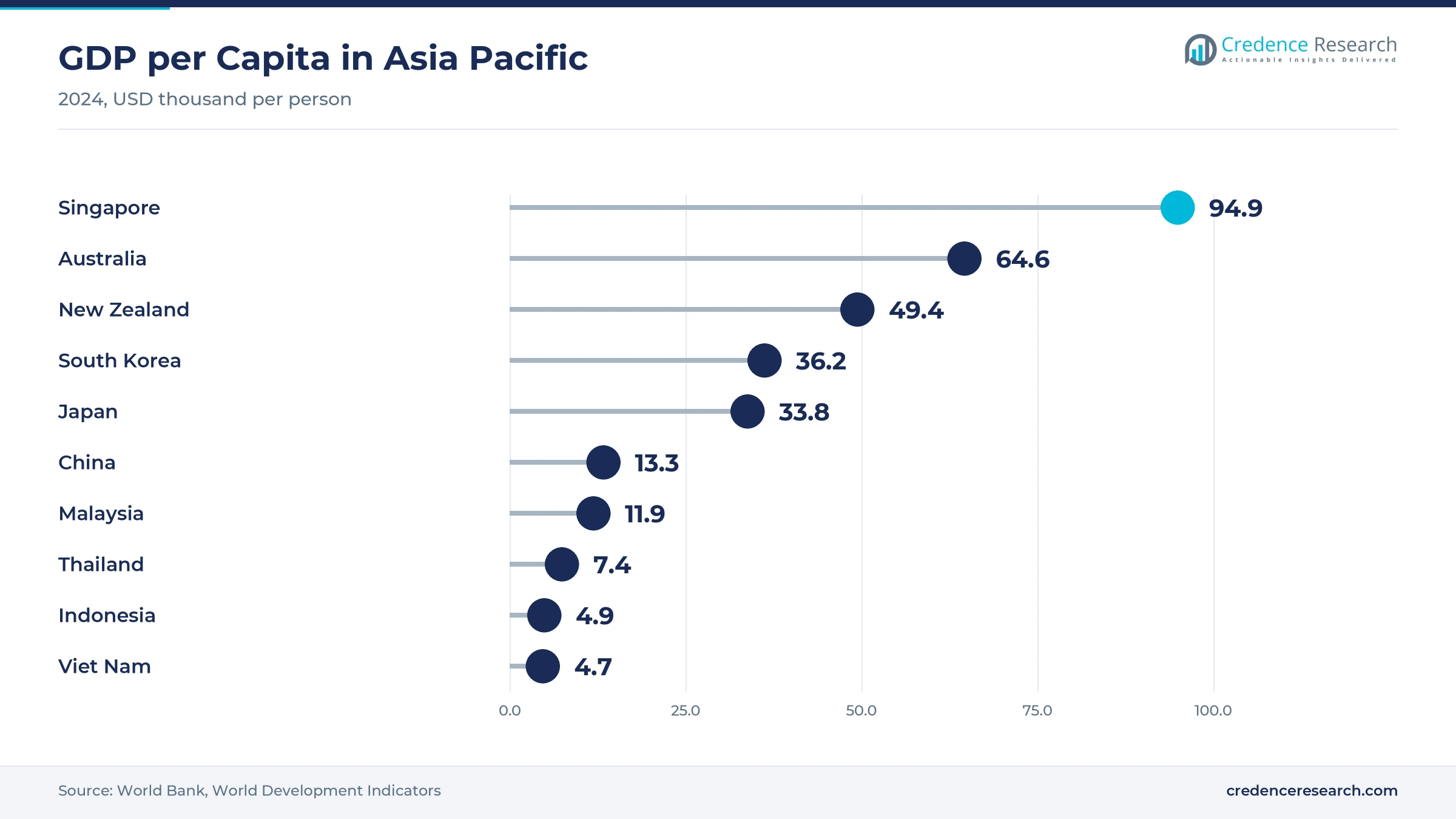
Clinic networks in Southeast Asia and South Asia are still small, which leaves room for value-tier instrument sets and distributor training as pet ownership spreads. GDP per capita stood at USD 11,874 in Malaysia, USD 7,387 in Thailand and USD 4,717 in Viet Nam in 2024, against USD 33,797 in Japan, according to the World Bank. The Sunday Observer in Colombo reported in May 2023 that B. Braun had expanded its veterinary offering in Sri Lanka with a launch event. China also held 427.43 million pigs at the end of 2024, based on National Bureau of Statistics data reported by 3tres3, which sustains livestock castration and field surgery. In turn, Remaining Asia Pacific forms the fastest-growing group, as clinic networks there expand from a small base.
Vet shortages and owner costs slow surgical volume
Why do veterinary workforce shortages limit surgical volume?
Clinics cannot add surgical sessions without surgeons and nurses, so staff shortages cap how many instruments they use. The Australian Veterinary Association's 2023/24 workforce survey found that 36.8% of vacancies took 12 months or longer to fill, and 44% of regional positions stayed open for extended periods. As a result, rural clinics refer complex cases to city hospitals or delay elective surgery. Suppliers respond with training programs and simpler instrument sets that general practitioners can use with confidence.
How do owner costs delay elective procedures?
Surgery is often the largest bill a pet owner faces, so cost pressure leads some owners to postpone or decline operations. The Australian Veterinary Association reported in September 2025 that 12% of pet owners needed financial help for vet care in the past year. Among owners who cut back on vet visits, 30% of dog owners and 22% of cat owners cited affordability. In turn, clinics favor reusable instruments and value-tier consumables to keep procedure prices within reach.
Why does chain restructuring in China slow purchasing?
Several Chinese hospital chains expanded quickly through acquisitions and are now closing weaker sites, which delays new equipment orders. Ruipai Pet closed 38 community hospitals in 2024 and another 26 hospitals in the first half of 2025, according to 36Kr. New Ruipeng withdrew its planned U.S. listing in 2024 after filing in 2023. As a result, chains focus spending on regional center hospitals, while smaller community sites reuse older instrument sets for longer periods.
How does fee scrutiny squeeze clinic budgets in Korea?
Public fee comparison makes clinics wary of raising prices, which limits the budget available for premium instruments and energy devices. The Korean Veterinary Medical Association called the August 2026 plan to publish hospital-level fees unilateral regulation and demanded its withdrawal, according to Korea JoongAng Daily in September 2026. In turn, Korean clinics compare instrument costs closely before buying. Suppliers respond with leasing, bundled consumables and training that help clinics justify premium devices.
China leads while smaller markets grow fastest
| Country | Value, 2025 (USD million) | Share, 2025 | CAGR, 2026–2035 |
|---|---|---|---|
| China | 176.8 | 50.3% | 9.43% |
| Remaining Asia Pacific | 98.8 | 28.1% | 9.73% |
| Japan | 41.8 | 11.9% | 7.53% |
| Australia and South Korea | 34.1 | 9.7% | 8.83% |
Why does China hold half of regional value?
China held a 50.3% share of 2025 value and grows at 9.43% a year, because its large urban pet population and stricter clinic rules support steady instrument purchasing. Urban China held about 120 million pets in 2024, and owners spent more than 300 billion yuan on urban dog and cat care, according to China Daily. The animal clinic measures in force since October 2022 require an operating room and surgical equipment in every clinic. In turn, chains such as Ruipai Pet standardize instrument sets across hundreds of hospitals.
How does Japan rely on insured, experienced practice?
Japan held an 11.9% share of 2025 value and grows at 7.53% a year, the slowest pace in the region, because dog and cat numbers have stopped rising. Japan still has a deep base of 16,717 small animal veterinarians, and Anicom Holdings had nearly 1.4 million policies in force in March 2026. As a result, Japanese clinics spend more per procedure, and premium sealing and orthopaedic tools hold a larger part of local value than elsewhere.
What shapes demand in Australia and South Korea?
Australia and South Korea held 9.7% of 2025 value and grow at 8.83% a year, because both markets combine high incomes with dense clinic networks. Australia had 31.6 million pets in 2025, and buying groups such as Vettr bring independent clinics into shared supply terms for animal health services. South Korea now requires fee posting at every animal hospital. In turn, Movora chose Seoul for its first official hip replacement course in East Asia.
Why do the remaining countries grow fastest?
Remaining Asia Pacific held 28.1% of 2025 value and grows fastest at 9.73% a year, because companion-animal care is spreading from a small clinic base. New Zealand, Southeast Asia and South Asia fall in this group, with incomes ranging from USD 49,432 per person in New Zealand to USD 4,717 in Viet Nam in 2024. Kahu Vet Group serves clinics in New Zealand, while B. Braun expanded its veterinary range in Sri Lanka in 2023.
Acquisitions, courses and fee rules since 2022
| Development | Status and market relevance |
|---|---|
| In February 2022, Vimian Group agreed to buy Kahu Vet Group, a supplier of implants and surgical instruments to more than 700 clinics. | Extends Movora into New Zealand and Australia |
| In December 2025, Ruipai Pet filed a Hong Kong prospectus while operating 548 pet hospitals in China. | Signals consolidation of hospital purchasing |
| In March 2026, Anicom Holdings reported 1,392,772 pet insurance policies in force in Japan. | Supports owner acceptance of surgery |
| In April 2026, Movora set its first official KYON total hip replacement course in East Asia at Seoul National University. | Builds surgeon skills for joint replacement |
| In August 2026, South Korea's agriculture ministry gave notice of a rule to publish major fees for individual hospitals. | Raises price transparency for clinic care |
Manual, electrosurgical and endoscopic tools advance
- Manual mechanical technology covers scalpels, scissors, forceps, retractors and needle holders, which remain the core of every clinic surgical pack.
- Electrosurgical technology includes monopolar, bipolar and vessel sealing generators such as the Valleylab FT10, which cut and seal tissue in one step.
- Endoscopic mechanical technology supports laparoscopic spays and minimally invasive biopsies through small ports, which shortens recovery for dogs and cats.
- Ultrasonic technology uses high-frequency vibration to cut and coagulate tissue or remove dental calculus, which suits dental and soft tissue work.
Need a Custom Version of This Report?
Tailor the scope, geography, or segments to your exact requirements.
- Custom geography or segment scope
- Direct access to our analyst team
Implant specialists and distributors compete
Competition combines global medical technology groups, veterinary implant specialists and broad-line consumable makers. Vimian Group competes through its Movora implant and instrument brands, its Kahu Vet Group supply business in New Zealand and Australia, and VetFamily buying platforms for independent clinics. Medtronic Animal Health competes in vessel sealing with LigaSure devices, sold to Korean animal hospitals through the distributor Mediray. KRUUSE supplies surgery, wound care and postoperative products through Provet in Australia and has an operating presence in China. Among broad-line medical technology groups that also serve animal clinics, B. Braun competes with surgical equipment and expanded its veterinary offering in Sri Lanka in 2023. Rivals compete on training, catalog breadth, distributor reach and price, which keeps hands-on courses and local stock central to winning hospital accounts.
Which suppliers equip veterinary surgeons in the region?
| Company | Type | Role in the market |
|---|---|---|
| Vimian Group | Veterinary medtech group | Movora implants and instruments, Kahu Vet Group in New Zealand and Australia |
| Medtronic Animal Health | Medical technology maker | LigaSure vessel sealing, distributed in South Korea by Mediray |
| KRUUSE | Veterinary consumables maker | Surgery and wound care products sold through Provet in Australia |
| B. Braun Vet Care | Medical technology maker | Expanded veterinary offering in Sri Lanka in 2023 |
Credence Research view on regional vet surgery
Credence Research's view is that Asia Pacific veterinary surgery will grow steadily because pet numbers, clinic rules and specialist training keep enlarging the pool of procedures performed in licensed suites. Wound Closure Products remain the largest value pool, while energy devices, orthopaedic work and hospital caseloads add the fastest growth. Workforce shortages and owner costs will slow elective surgery in some markets, so suppliers that pair instruments with training and value-tier sets should gain the most. China will decide the regional pace, because it holds about half of value and is still consolidating its hospital chains.
Pet census, clinic rules and filings shape the estimate
The report uses 2025 as the base year on a calendar basis, and market values come from the Credence Research model. That model combines international agency statistics on income, national data on pet populations, veterinary workforce and livestock, regulatory texts and company releases and filings. Country growth rates, segment splits and segment growth rates are Credence Research estimates from public data. Sources used are international agency data, government releases, industry association surveys, news reports and company disclosures, and no interviews or surveys were conducted.
Hospital surgery and energy tools carry growth to 2035
The Asia Pacific veterinary surgical instruments market is expected to reach USD 866.9 million by 2035, a 9.25% CAGR during 2026–2035, as more pets, stricter clinic rules and specialist training bring more procedures into equipped surgical suites. Growth should be strongest in Remaining Asia Pacific, Energy and Access Instruments and Veterinary Hospitals, because these areas gain most from new clinics and referral surgery. Workforce shortages, owner costs and chain restructuring in China could slow purchasing in some years, while training programs should widen the use of advanced tools.
Frequently Asked Questions
How big is the Asia Pacific veterinary surgical instruments market?
Which product type leads the market?
Which country leads the market?
Which application grows fastest?
How did China change its clinic rules?
Why are veterinary hospitals growing faster than clinics?
Who are the leading companies in this market?
What are the main challenges for suppliers?
Table of Content
Chapter 1 Market Segmentation
- 1.1 Segmentation Framework
- 1.1.1 Product and Service Classification
- 1.1.2 Application and End-Use Classification
- 1.1.3 Technology and Solution Classification
- 1.1.4 Customer and Distribution Channel Classification
- 1.1.5 Geographic Segmentation
- 1.1.6 Market Segment Definitions and Boundaries
- 1.2 By Product Type
- 1.2.1 Wound Closure Products
- 1.2.2 Energy and Access Instruments
- 1.2.3 Grasping and Exposure Instruments
- 1.2.4 Cutting and Bone Instruments
- 1.3 By Application
- 1.3.1 Soft Tissue and Reproductive Surgery
- 1.3.2 Orthopaedic Surgery
- 1.3.3 Dental Surgery
- 1.3.4 Specialty Surgery
- 1.4 By End User
- 1.4.1 Veterinary Clinics
- 1.4.2 Veterinary Hospitals
- 1.4.3 Research Institutions
- 1.4.4 Livestock Enterprises
- 1.5 By Sales Channel
- 1.5.1 Manufacturer Direct Sales
- 1.5.2 Specialist Distributor Sales
- 1.5.3 Digital Direct Sales
- 1.5.4 Public Tender Sales
- 1.6 By Country
- 1.6.1 China
- 1.6.2 Japan
- 1.6.3 Australia and South Korea
- 1.6.4 Remaining Asia Pacific
Chapter 2 Introduction
- 2.1 Report Objectives and Scope
- 2.2 Product Definition and Industry Terminology
- 2.3 Market Inclusions and Exclusions
- 2.4 Research Process
- 2.4.1 Primary Research and Expert Interviews
- 2.4.2 Secondary Research and Source Review
- 2.4.3 Top-Down and Bottom-Up Estimation
- 2.4.4 Data Triangulation and Verification
- 2.5 Market Size Measurement Basis
- 2.5.1 2025: USD 351.5 million → 2035: USD 866.9 million
- 2.6 Historical and Forecast Reference Periods
- 2.6.1 Historical Period: 2018-2025
- 2.6.2 Base Year: 2025
- 2.6.3 Forecast Period: 2025-2035
- 2.7 Research Assumptions and Limitations
Chapter 3 Executive Summary
- 3.1 Market Snapshot and Key Findings
- 3.2 Base-Year Market Size, 2025
- 3.3 Forecast Market Size, 2035
- 3.4 Revenue and Volume Growth Outlook
- 3.5 Key Demand and Supply Indicators
- 3.6 Leading Market Segments
- 3.7 Fastest-Growing Market Opportunities
- 3.8 Regional Performance Highlights
- 3.9 Technology and Industry Transformation
- 3.10 Competitive Landscape Summary
- 3.11 Analyst View and Strategic Implications
Chapter 4 Asia Pacific Veterinary Surgical Instruments Market Trends and Developments
- 4.1 Historical Industry Development, 2018-2025
- 4.2 Recent Market Trends and Developments
- 4.3 Demand and Customer Behavior Trends
- 4.4 Technology and Product Innovation
- 4.5 Artificial Intelligence, Automation and Digitalization
- 4.6 Local Manufacturing and Supply Chain Realignment
- 4.7 Industry Partnerships, Mergers and Acquisitions
- 4.8 Sustainability and Circular Economy Developments
- 4.9 Government and Private Sector Investment Trends
- 4.10 Emerging Business Models and Commercialization
- 4.11 Industry Developments and Announcements
Chapter 5 Asia Pacific Veterinary Surgical Instruments Market Production, Supply and Demand Analysis
- 5.1 Demand Trend and Consumption Analysis, 2018-2025
- 5.2 Demand Forecast, 2025-2035
- 5.3 Production and Output Trend, 2018-2025
- 5.4 Production and Output Forecast, 2025-2035
- 5.5 Installed Capacity and Capacity Utilization
- 5.6 Company-Wise Production Plants and Statistics
- 5.6.1 Installed Production Capacity
- 5.6.2 Actual Production
- 5.6.3 Planned Capacity and Expansion Targets
- 5.7 Supply Chain Structure and Procurement Trends
- 5.8 Supply-Demand Gap and Bottlenecks
- 5.9 Import Dependence and Sourcing Structure
- 5.10 Contract Manufacturing and Outsourcing
- 5.11 Regional Supply and Demand Concentration
Chapter 6 Asia Pacific Veterinary Surgical Instruments Market Pricing Analysis
- 6.1 Pricing Structure and Measurement
- 6.2 Historical Pricing Trends, 2018-2025
- 6.3 Pricing Outlook, 2025-2035
- 6.4 Average Selling Price and Unit Economics
- 6.5 Pricing by Product and Market Segment
- 6.6 Geographic Pricing Differences
- 6.7 Key Input, Energy, Labor and Logistics Costs
- 6.8 Contract Pricing and Purchasing Models
- 6.9 Pricing Sensitivity and Competitive Positioning
- 6.10 Price, Margin and Profitability Implications
Chapter 7 Asia Pacific Veterinary Surgical Instruments Market Dynamics
- 7.1 Market Growth Drivers
- 7.1.1 Demand-Side Drivers
- 7.1.2 Technology and Innovation Drivers
- 7.1.3 Infrastructure and Investment Drivers
- 7.1.4 Regulatory and Policy Drivers
- 7.2 Market Restraints
- 7.2.1 Cost and Affordability Constraints
- 7.2.2 Technology and Adoption Barriers
- 7.2.3 Supply Chain and Operational Constraints
- 7.3 Market Challenges
- 7.3.1 Competitive Pressure and Margin Erosion
- 7.3.2 Skills, Infrastructure and Implementation Gaps
- 7.4 Emerging Market Opportunities
- 7.5 Market Dynamics Impact and Time-Horizon Assessment
Chapter 8 Asia Pacific Veterinary Surgical Instruments Value Chain Analysis
- 8.1 Industry Value Chain Overview
- 8.2 Upstream Suppliers and Critical Inputs
- 8.3 Technology and Component Providers
- 8.4 Manufacturing or Service Delivery
- 8.5 Distribution, Channel Partners and Integrators
- 8.6 Downstream Applications and End Users
- 8.7 Value Addition and Profit Pools
- 8.8 Vertical Integration and Outsourcing
- 8.9 Supplier Concentration and Risk
- 8.10 Supply Chain Localization and Resilience
Chapter 9 Asia Pacific Veterinary Surgical Instruments Market Regulations and Policies
- 9.1 Relevant Laws, Standards and Compliance Frameworks
- 9.2 Product, Service, Safety and Quality Requirements
- 9.3 Government Policies, Incentives and Subsidies
- 9.4 Imports, Exports and Trade Barriers
- 9.5 Public Procurement and Local Content Requirements
- 9.6 Environmental and Sustainability Compliance
- 9.7 Upcoming Policy Changes and Market Implications
Chapter 10 Asia Pacific Veterinary Surgical Instruments Market Hotspots and Opportunities
- 10.1 Market Opportunity Mapping and Growth Hotspots
- 10.2 High-Growth Applications and Customer Groups
- 10.3 Underserved Markets and White-Space Opportunities
- 10.4 Emerging Technology and Product Opportunities
- 10.5 New Capacity and Investment Hotspots
- 10.6 Market Entry and Expansion Opportunities
- 10.7 Distribution and Partnership Opportunities
- 10.8 Near-Term and Long-Term Commercial Potential
- 10.9 Opportunity Attractiveness and Execution Risks
Chapter 11 Asia Pacific Veterinary Surgical Instruments Market Outlook, 2025-2035
- 11.1 Market Size and Analysis
- 11.1.1 Revenue (Market Measurement: 2025: USD 351.5 million → 2035: USD 866.9 million)
- 11.1.2 Market Volume and Quantity Sold
- 11.1.3 Historical Market Size, 2018-2025
- 11.1.4 Base-Year Market Size, 2025
- 11.2 Market Forecast, 2025-2035
- 11.2.1 Revenue Forecast to 2035
- 11.2.2 Volume Forecast to 2035
- 11.2.3 CAGR and Year-on-Year Growth
- 11.2.4 Incremental Revenue Opportunity
- 11.3 Forecast Assumptions and Scenario Analysis
- 11.3.1 Base-Case Forecast
- 11.3.2 Optimistic and Conservative Scenarios
- 11.3.3 Technology, Pricing and Policy Sensitivities
- 11.4 Market Attractiveness and Growth Outlook
Chapter 12 Asia Pacific Veterinary Surgical Instruments Market Segmentation and Outlook
- 12.1 Segmentation Summary and Market Shares, 2025
- 12.2 Largest and Fastest-Growing Segments
- 12.3 By Product Type - Market Size and Forecast, 2025-2035
- 12.3.1 Segment Definition and Scope
- 12.3.2 Historical Market Size, 2018-2025
- 12.3.3 Revenue Forecast, 2025-2035
- 12.3.4 Volume Forecast, 2025-2035
- 12.3.5 Base-Year Market Share, 2025
- 12.3.6 Segment CAGR and Growth Drivers
- 12.3.7 Subsegment Market Size and Forecast
- 12.3.7.1 Wound Closure Products
- 12.3.7.2 Energy and Access Instruments
- 12.3.7.3 Grasping and Exposure Instruments
- 12.3.7.4 Cutting and Bone Instruments
- 12.3.8 Subsegment Pricing and Adoption Trends
- 12.3.9 Leading Suppliers and Competition
- 12.3.10 Regional Demand and Opportunities
- 12.4 By Application - Market Size and Forecast, 2025-2035
- 12.4.1 Segment Definition and Scope
- 12.4.2 Historical Market Size, 2018-2025
- 12.4.3 Revenue Forecast, 2025-2035
- 12.4.4 Volume Forecast, 2025-2035
- 12.4.5 Base-Year Market Share, 2025
- 12.4.6 Segment CAGR and Growth Drivers
- 12.4.7 Subsegment Market Size and Forecast
- 12.4.7.1 Soft Tissue and Reproductive Surgery
- 12.4.7.2 Orthopaedic Surgery
- 12.4.7.3 Dental Surgery
- 12.4.7.4 Specialty Surgery
- 12.4.8 Subsegment Pricing and Adoption Trends
- 12.4.9 Leading Suppliers and Competition
- 12.4.10 Regional Demand and Opportunities
- 12.5 By End User - Market Size and Forecast, 2025-2035
- 12.5.1 Segment Definition and Scope
- 12.5.2 Historical Market Size, 2018-2025
- 12.5.3 Revenue Forecast, 2025-2035
- 12.5.4 Volume Forecast, 2025-2035
- 12.5.5 Base-Year Market Share, 2025
- 12.5.6 Segment CAGR and Growth Drivers
- 12.5.7 Subsegment Market Size and Forecast
- 12.5.7.1 Veterinary Clinics
- 12.5.7.2 Veterinary Hospitals
- 12.5.7.3 Research Institutions
- 12.5.7.4 Livestock Enterprises
- 12.5.8 Subsegment Pricing and Adoption Trends
- 12.5.9 Leading Suppliers and Competition
- 12.5.10 Regional Demand and Opportunities
- 12.6 By Sales Channel - Market Size and Forecast, 2025-2035
- 12.6.1 Segment Definition and Scope
- 12.6.2 Historical Market Size, 2018-2025
- 12.6.3 Revenue Forecast, 2025-2035
- 12.6.4 Volume Forecast, 2025-2035
- 12.6.5 Base-Year Market Share, 2025
- 12.6.6 Segment CAGR and Growth Drivers
- 12.6.7 Subsegment Market Size and Forecast
- 12.6.7.1 Manufacturer Direct Sales
- 12.6.7.2 Specialist Distributor Sales
- 12.6.7.3 Digital Direct Sales
- 12.6.7.4 Public Tender Sales
- 12.6.8 Subsegment Pricing and Adoption Trends
- 12.6.9 Leading Suppliers and Competition
- 12.6.10 Regional Demand and Opportunities
- 12.7 By Country - Market Size and Forecast, 2025-2035
- 12.7.1 Segment Definition and Scope
- 12.7.2 Historical Market Size, 2018-2025
- 12.7.3 Revenue Forecast, 2025-2035
- 12.7.4 Volume Forecast, 2025-2035
- 12.7.5 Base-Year Market Share, 2025
- 12.7.6 Segment CAGR and Growth Drivers
- 12.7.7 Subsegment Market Size and Forecast
- 12.7.7.1 China
- 12.7.7.2 Japan
- 12.7.7.3 Australia and South Korea
- 12.7.7.4 Remaining Asia Pacific
- 12.7.8 Subsegment Pricing and Adoption Trends
- 12.7.9 Leading Suppliers and Competition
- 12.7.10 Regional Demand and Opportunities
- 12.8 Segment Growth Comparison
- 12.9 Segment Attractiveness and Priority Matrix
Chapter 13 Asia Pacific Veterinary Surgical Instruments End-Use and Application Market Outlook
- 13.1 End-Use Industry and Customer Demand Structure
- 13.2 Leading Applications and Customer Groups
- 13.3 End-Use Market Size, Share and Forecast
- 13.4 Major End-Use Industry Deep Dives
- 13.4.1 Customer Requirements and Use Cases
- 13.4.2 Demand and Replacement Cycles
- 13.4.3 Technical and Regulatory Considerations
- 13.4.4 Purchasing and Procurement Models
- 13.4.5 Leading Vendors and Distribution Channels
- 13.4.6 Forecast and Commercial Opportunities
- 13.5 Emerging Applications and Cross-Segment Demand
- 13.6 End-Use Industry Investment Priorities
Chapter 14 Asia Pacific Veterinary Surgical Instruments Geographic Market Outlook, 2025-2035
- 14.1 Regional Market Size and Country-Level Shares, 2025
- 14.2 Country Market Size Comparison, 2025
- 14.3 Country Market Forecasts, 2025-2035
- 14.4 Subregional Industrial and Demand Clusters
- 14.5 Intra-Regional Pricing and Cost Differences
- 14.6 Cross-Border Trade and Supply Networks
- 14.7 Regional Supply and Demand Balances
- 14.8 Country Opportunity Comparison and Prioritization
Note: Every listed country is covered on the structure shown under the first country.
Chapter 15 Asia Pacific Veterinary Surgical Instruments Technology, Innovation and Sustainability Outlook
- 15.1 Technology Landscape and Maturity
- 15.2 Product, Process and Service Innovation
- 15.3 AI, Automation and Digital Tools in the Industry
- 15.4 Technology Adoption and Performance Benchmarking
- 15.5 Innovation Pipeline and R&D Investment
- 15.6 Patent and Intellectual Property Trends
- 15.7 Energy Efficiency and Resource Management
- 15.8 Sustainability, Recycling and Circularity
- 15.9 Technology Roadmap, 2025-2035
- 15.10 Risks of Obsolescence and Technology Substitution
Chapter 16 Asia Pacific Veterinary Surgical Instruments Market Key Strategic Imperatives
- 16.1 Growth and Market Entry Priorities
- 16.2 High-Return Products and Segments
- 16.3 Pricing, Profitability and Cost Optimization
- 16.4 Technology Investment and Product Differentiation
- 16.5 Supply Chain Localization and Resilience
- 16.6 Distribution and Customer Acquisition
- 16.7 Partnership, Acquisition and Capacity Strategy
- 16.8 Regional Expansion Priorities
- 16.9 Short-, Medium- and Long-Term Actions
Chapter 17 Competition Outlook
- 17.1 Industry Competition Characteristics
- 17.2 Market Structure and Concentration
- 17.3 Market Share and Competitive Positioning, 2025
- 17.4 Company-Wise Revenue and Product Benchmarking
- 17.5 Production and Service Capacity Benchmarking
- 17.6 Technology, Pricing and Differentiation
- 17.7 Regional Footprint and Distribution Strength
- 17.8 Mergers, Acquisitions and Strategic Alliances
- 17.9 New Entrants and Competitive Threats
- 17.10 Porter's Five Forces and Industry Attractiveness
- 17.11 Competitive Outlook, 2025-2035
Chapter 18 Company Profiles
- 18.1 Company Coverage and Selection Criteria
- 18.2 B. Braun Vet Care
- 18.2.1 Business Description
- 18.2.2 Company Ownership and Geographic Presence
- 18.2.3 Product and Service Portfolio
- 18.2.4 Manufacturing and Operating Footprint
- 18.2.5 Production Capacity and Expansion Plans
- 18.2.6 Financial Performance and Investment
- 18.2.7 Market Share and Competitive Position
- 18.2.8 Technology and Innovation Capabilities
- 18.2.9 Strategic Alliances or Partnerships
- 18.2.10 Recent Developments
- 18.2.11 Growth Strategy and Outlook
- 18.3 Vimian Group
- 18.4 Medtronic Animal Health
- 18.5 KRUUSE
- 18.6 Ethicon
- 18.7 Other Relevant Market Participants
Note: Every listed company is profiled on the structure shown under the first company. The company list is preliminary and may change based on research findings, market developments, data availability and client requirements.
Chapter 19 Disclaimer
- 19.1 Research and Forecast Disclaimer
- 19.2 Data Source and Estimation Limitations
Note: The depth of individual sections depends on data availability for this market. Volume, capacity, trade and other unit-based metrics are included where applicable.

