
Older patients and outpatient shifts lift instrument demand
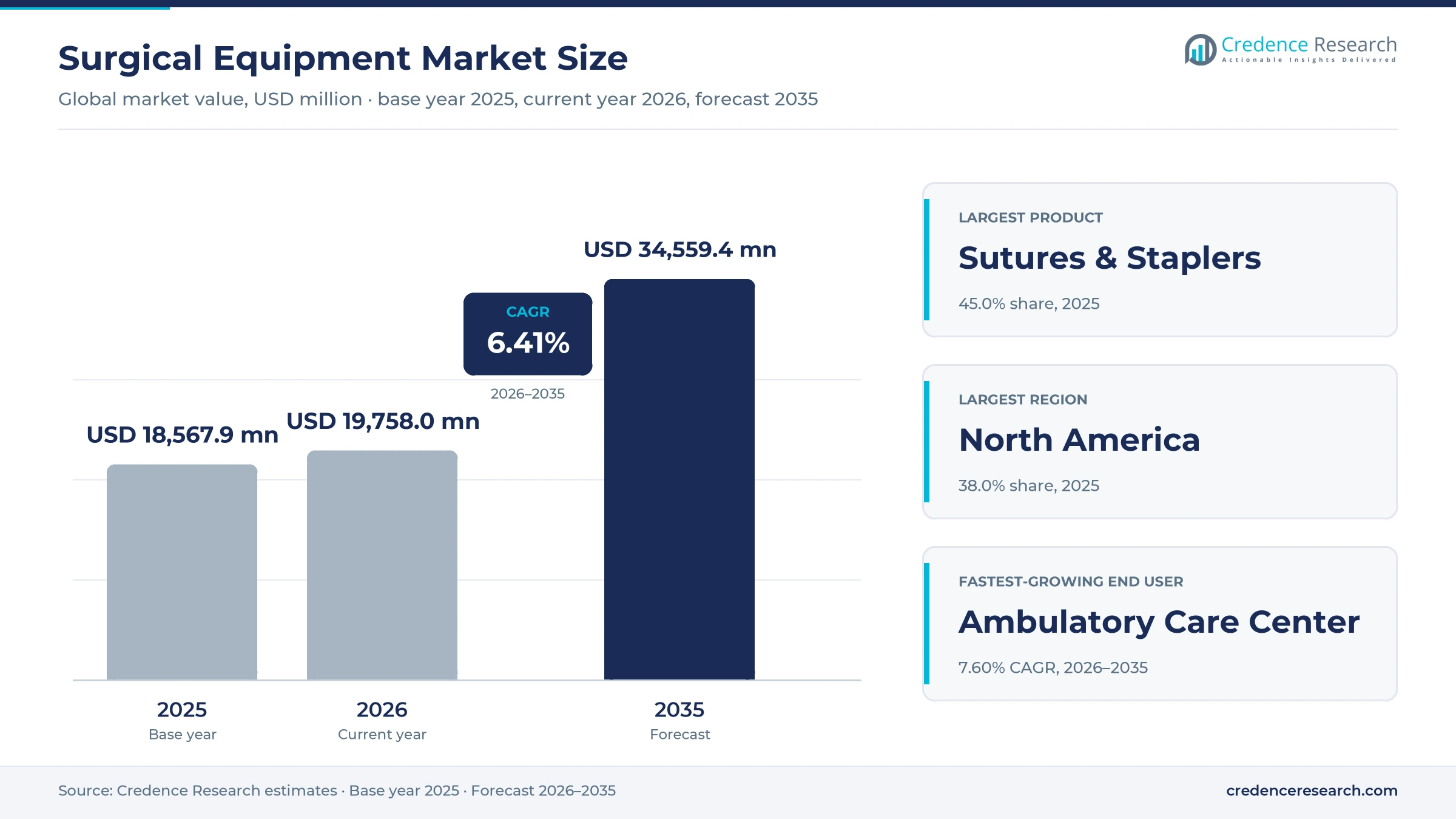
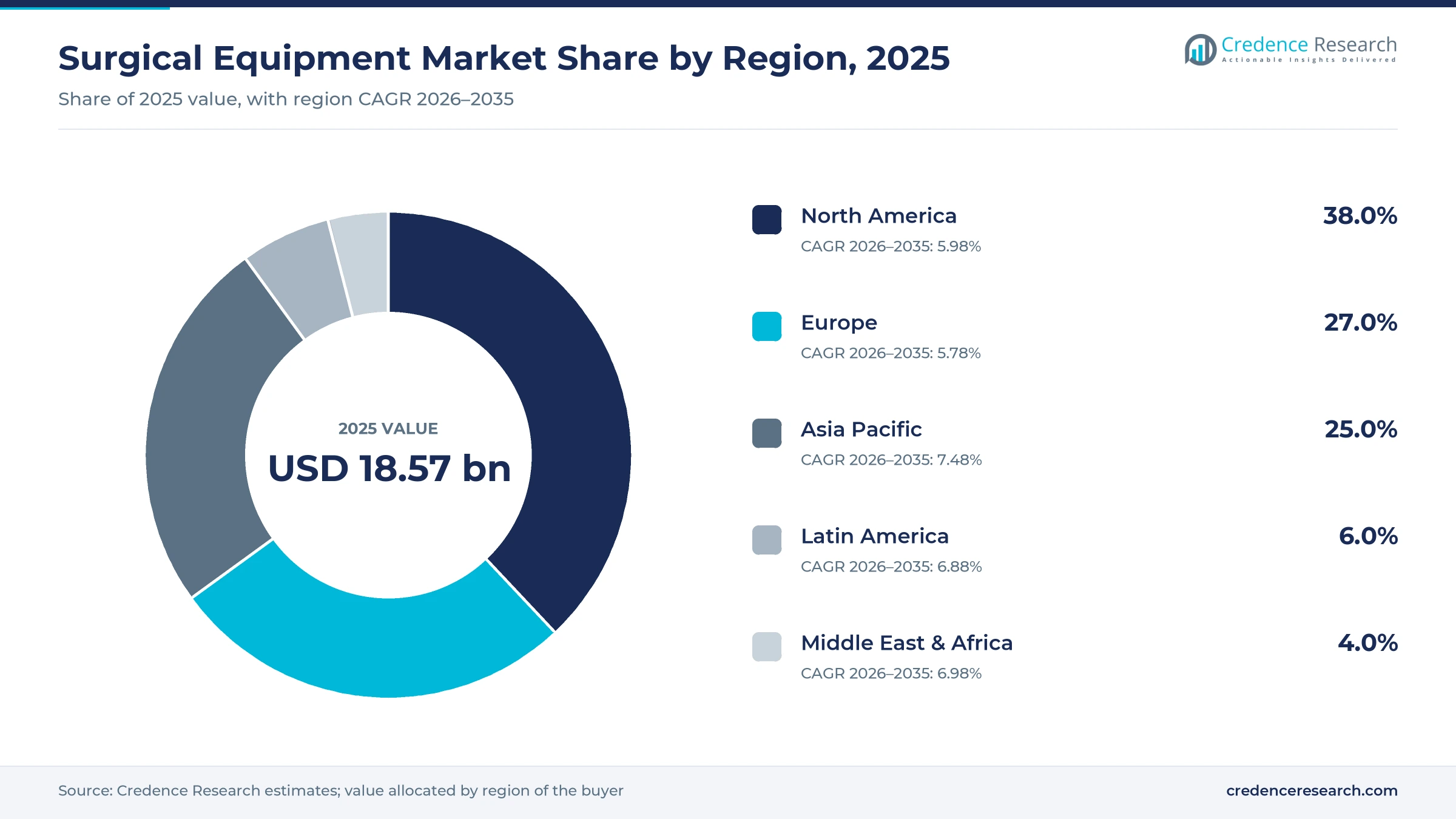
The global surgical equipment market was valued at USD 18.57 billion in 2025 and is projected to increase from USD 19.76 billion in 2026 to USD 34.56 billion by 2035, registering a CAGR of 6.41% during 2026–2035. Demand rises because an aging population needs more joint, heart, cancer and gynecologic operations, and each procedure uses sutures, staplers, handheld instruments and energy devices. North America held the largest regional share, 38.0% in 2025, because U.S. hospitals and outpatient centers perform high procedure volumes at premium device prices. Asia Pacific is the fastest-growing region at 7.48% a year, as China and India add hospital beds and local makers expand supply. Payment policy also changed in November 2025, when U.S. Medicare began phasing out its inpatient-only list and added hundreds of procedures to the outpatient surgery list. As a result, buyers are moving more instrument spending toward ambulatory care centers.
Which operating room products does this analysis count?
The analysis counts surgical sutures and staplers, handheld devices such as scalpels, forceps, retractors and clamps, and electrosurgical generators and instruments used to cut and seal tissue. Hospitals, ambulatory care centers and specialized clinics buy them through group contracts, distributors and direct supply agreements.
Implants, imaging systems and capital robotic platforms sit outside the value counted here, although their use shapes instrument demand. The value chain runs from steel, polymer and suture material supply through manufacturing, sterilization and regulatory clearance to distribution and hospital purchasing.
Surgical Equipment Market Insights
- The surgical equipment market grows from USD 18.57 billion in 2025 to USD 34.56 billion by 2035, a 6.41% CAGR as procedure volumes rise with population aging.
- North America held 38.0% of global value in 2025, because U.S. hospitals and outpatient centers pay premium prices for instruments.
- Surgical sutures and staplers led products with 45.0% of 2025 value, because nearly every open and laparoscopic operation needs closure.
- In November 2025, U.S. Medicare began a three-year phase-out of its inpatient-only list, which moves more surgery into outpatient settings.
- Ambulatory care centers grow fastest among end users at 7.60% a year through 2035, as payers favor lower-cost outpatient surgery.
Sutures, staplers and hospitals hold the largest shares
Which closure and energy products earn the most?
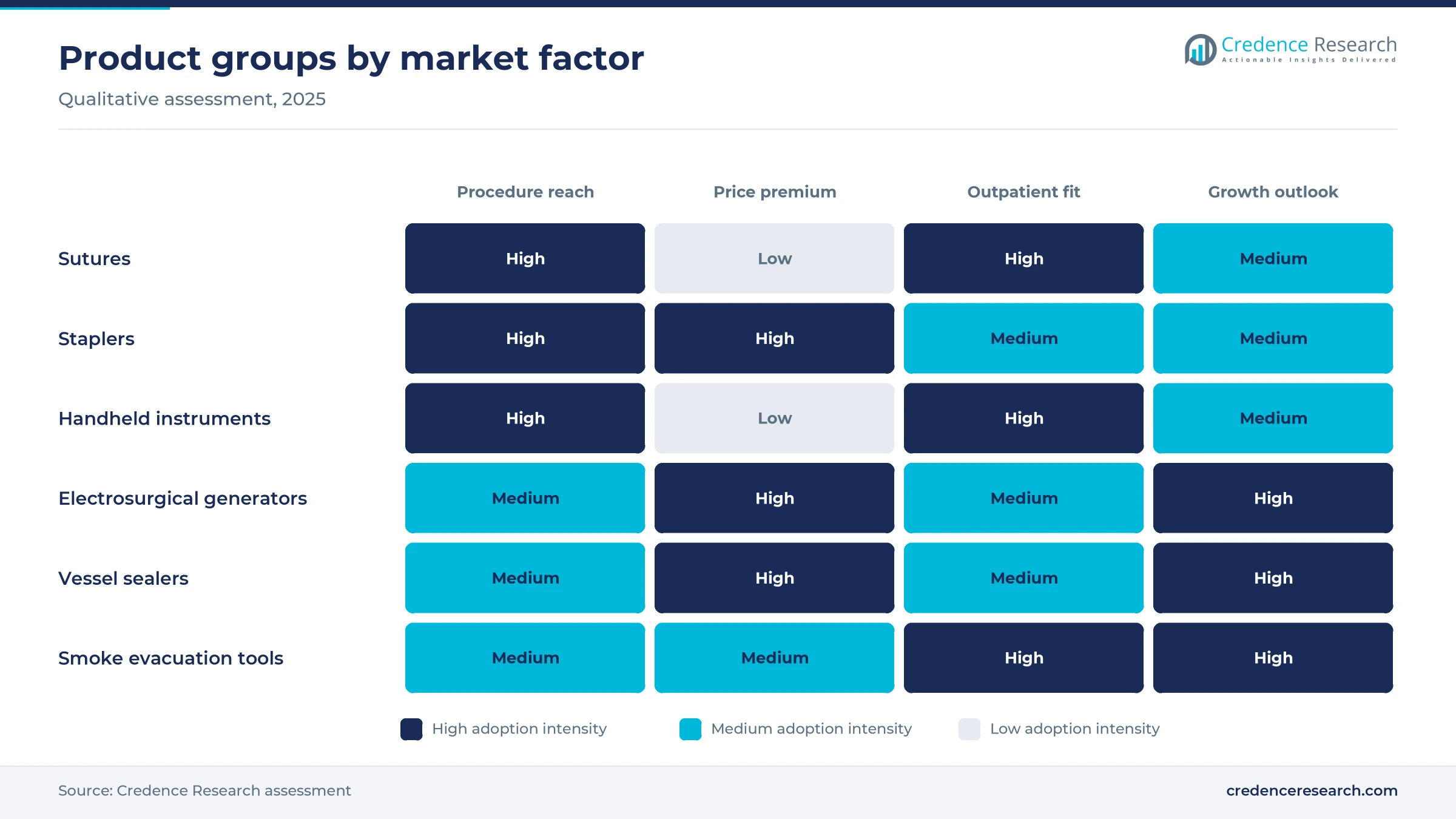
Based on product, the market is categorized into surgical sutures and staplers, handheld surgical devices and electrosurgical devices. Surgical Sutures & Staplers led with 45.0% of 2025 value, because closure is required in nearly every open and minimally invasive operation. Electrosurgical Devices grow fastest at 7.22% a year, as surgeons use energy to cut and seal tissue with less bleeding. Handheld devices remain a steady base for every operating room.
Which surgical specialties use the most products?
Based on application, the market is categorized into neurosurgery, plastic and reconstructive surgery, wound closure, obstetrics and gynecology, cardiovascular, orthopedic and others. Wound Closure led with 24.0% of 2025 value, because every incision needs sutures, staples or adhesives. Neurosurgery grows fastest at 6.96% a year, as digital microscopes and precise instruments widen access to brain and spine surgery.
Where are surgical products used most?
Based on end user, the market is categorized into hospitals, ambulatory care centers, specialized clinics and others. Hospitals led with 58.0% of 2025 value, because complex inpatient and emergency operations still take place there. Ambulatory Care Center grow fastest at 7.60% a year, as payers move joint, eye and general procedures to lower-cost outpatient settings with shorter stays.
| Segment Group | Leading Sub-segment | Share, 2025 | Fastest-growing Sub-segment | CAGR, 2026–2035 |
|---|---|---|---|---|
| By Product | Surgical Sutures & Staplers | 45.0% | Electrosurgical Devices | 7.22% |
| By Application | Wound Closure | 24.0% | Neurosurgery | 6.96% |
| By End User | Hospitals | 58.0% | Ambulatory Care Center | 7.60% |
Request a Free Sample
Fill in your details and we'll send you a free sample report.
- Sample data tables & charts
- Research methodology
Aging, outpatient policy and stapler launches drive demand
How does population aging raise procedure volumes?
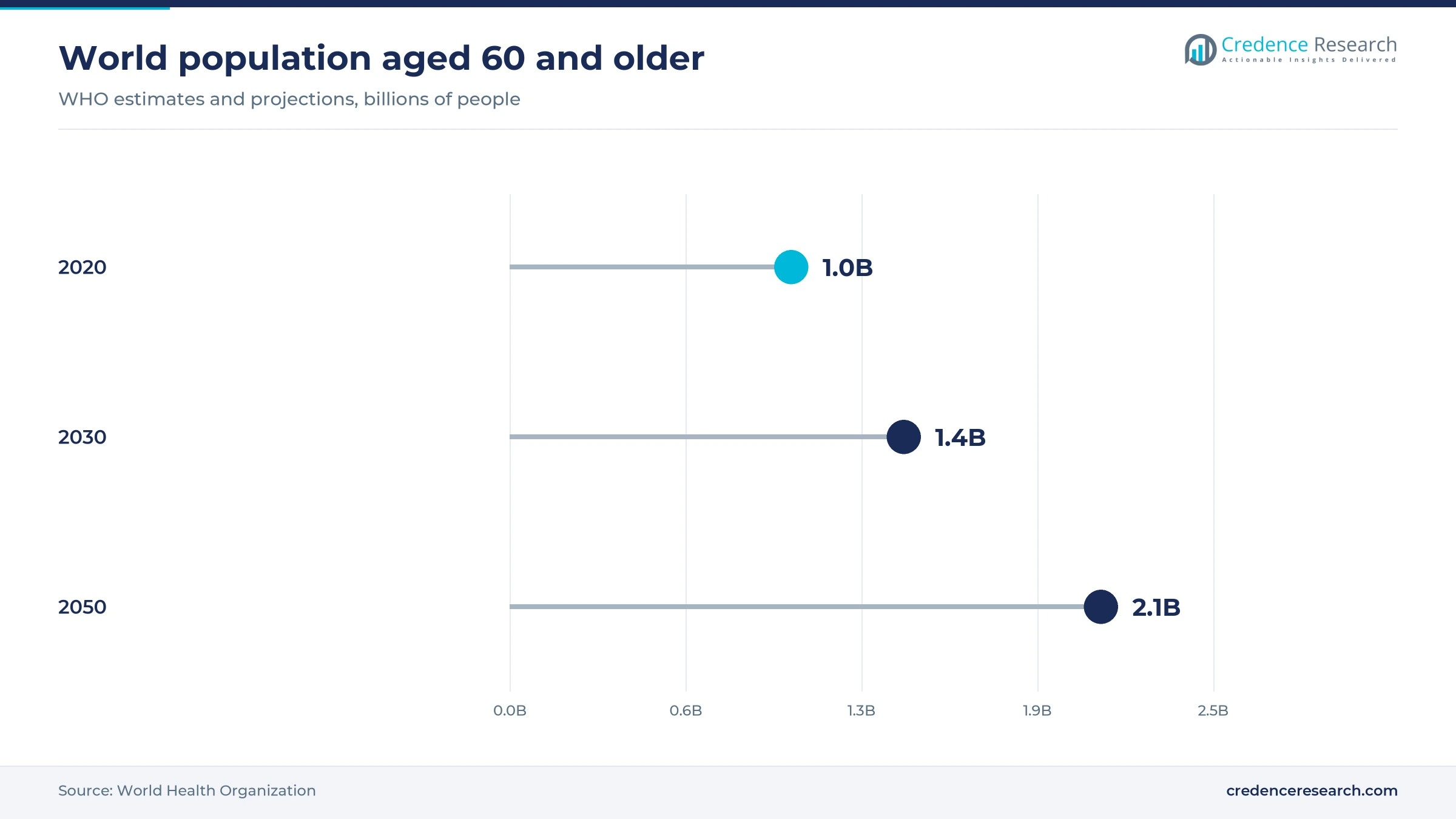
Older adults need more joint, heart, eye and cancer operations than younger groups, which makes demographic change the largest demand driver. The World Health Organization reports that the number of people aged 60 and older will rise from 1 billion in 2020 to 1.4 billion by 2030. By 2050, that group will double to 2.1 billion, while people aged 80 and older will triple to 426 million. Each added operation uses sutures, clamps, retractors and energy devices, so instrument demand follows procedure counts closely. As a result, orthopedic applications grow at a steady pace, and suppliers of orthopedic devices also add instrument sets for older patients.
Why does outpatient payment policy shift purchasing?
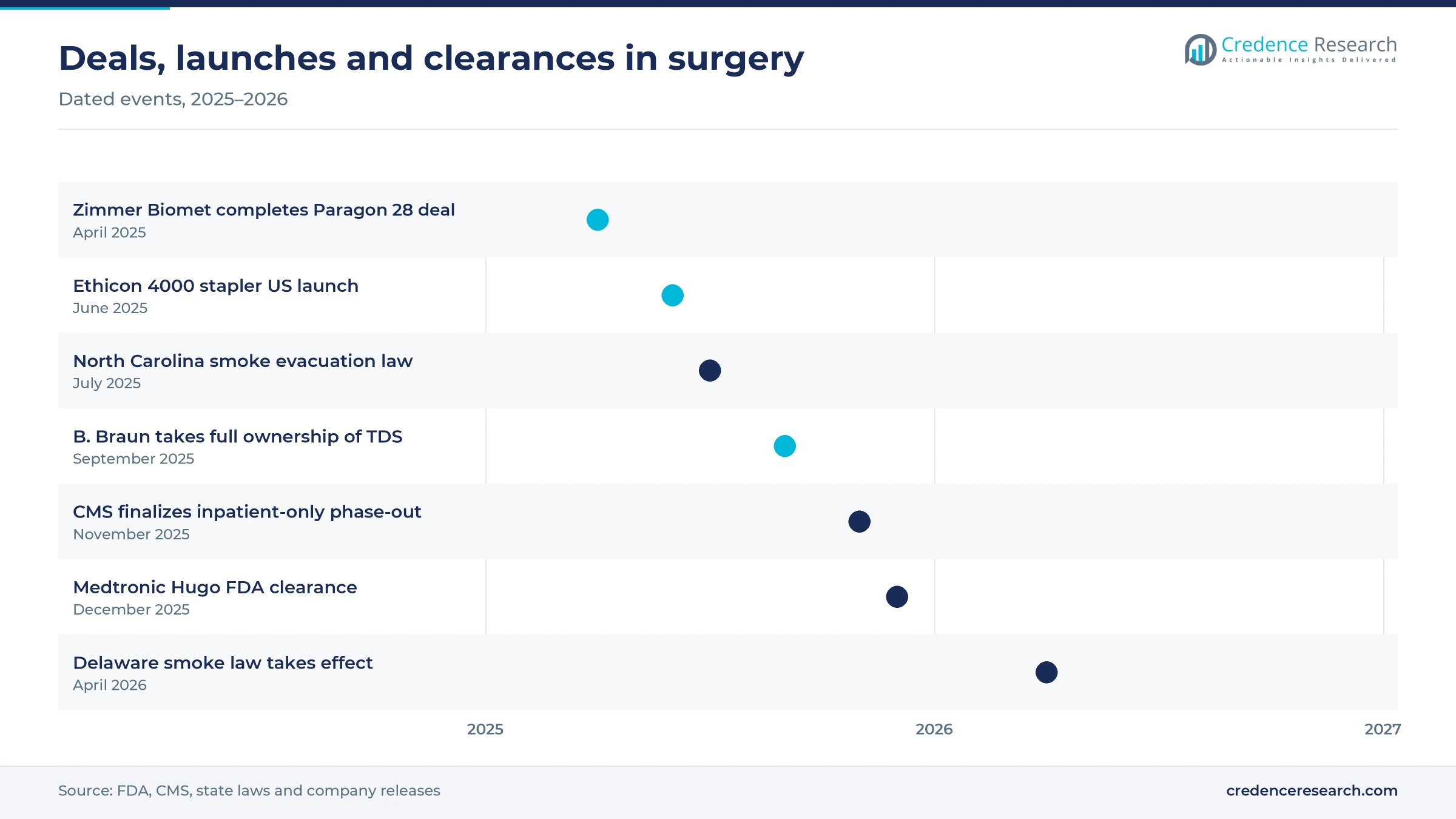
Medicare now pays for many more operations outside hospitals, so outpatient payment policy shifts where buyers spend. In November 2025, the Centers for Medicare & Medicaid Services finalized a three-year phase-out of its inpatient-only list, starting with 285 mostly musculoskeletal procedures in 2026. CMS also added 289 procedures to the ambulatory surgical center covered list for 2026. It raised outpatient surgery center payment rates by 2.6% for the same year. These centers buy compact instrument sets and single-use products for fast turnover between cases. In turn, ambulatory care centers grow at 7.60% a year, the fastest pace among end users.
How do new stapler launches lift closure spending?
Hospitals pay more for devices that cut leaks and bleeding after surgery, so new stapler launches lift closure spending. In June 2025, Johnson & Johnson MedTech launched the Ethicon 4000 stapler and 3D reloads for open and laparoscopic surgery in the United States. The company reported 23% fewer staple line interventions due to bleeding than traditional staples in a porcine study. Its 60mm reloads received FDA 510(k) clearance earlier in 2025, and the launch targets bariatric, thoracic and colorectal operations. As a result, sutures and staplers keep the largest product share, 45.0% of 2025 value, while premium reloads raise spending per case.
Why do acquisitions widen specialty instrument demand?
Large device groups buy focused firms to reach fast-growing procedures, and these acquisitions widen specialty demand. In April 2025, Zimmer Biomet completed its acquisition of Paragon 28, a company focused only on foot and ankle orthopedics. Zimmer Biomet said the deal creates a dedicated foot and ankle sales channel and opens opportunities in ambulatory surgery centers. In September 2025, Braun took full ownership of True Digital Surgery to advance its Aesculap AEOS digital microscope for brain, spine and ENT surgery. In turn, neurosurgery grows at 6.96% a year, the fastest pace among applications, as precise optics pull demand for fine instruments.
Energy devices, robotics and smoke rules reshape use
How is the rise of robotic surgery changing instrument use?
Each robotic case needs dedicated staplers, energy tools and handheld accessories, so the rise of robotic surgery changes instrument use. In December 2025, Medtronic announced FDA clearance of its Hugo robotic-assisted surgery system for urologic procedures in the United States. These procedures, including prostatectomy, nephrectomy and cystectomy, account for about 230,000 U.S. surgeries a year. Hugo has already been used in more than 30 countries, and Medtronic expects gynecologic and general indications to follow. Stryker also reported that its Mako robotic platform passed 2 million procedures in 2025. As a result, demand rises for instruments that work with robotic systems in hospitals and outpatient centers.
Is the shift to energy-based cutting replacing older tools?
Surgeons can cut and seal vessels in one step with less blood loss, so energy-based cutting is replacing some older tools. Electrosurgical devices grow at 7.22% a year, the fastest pace among product groups through 2035. Bipolar sealers, ultrasonic shears and advanced generators shorten operating time in gynecologic, colorectal and thoracic surgery. Hospitals also value fewer transfusions and shorter stays, which offset the higher price of each instrument. Medicare removed 285 procedures from its inpatient-only list in 2026, and many of these shorter cases rely on compact energy generators in outpatient centers. In turn, demand for electrosurgery generators and disposable handpieces grows in both hospitals and outpatient centers. Makers also bundle generators with reusable and single-use tips for each specialty.
Where can surgical smoke rules open new demand?
New state laws require facilities to capture plume from energy devices, so smoke rules offer a clear opening. By mid-September 2025, 20 U.S. states had passed laws requiring smoke evacuation for plume-generating procedures. North Carolina signed its law on July 1, 2025, and facilities there needed policies in place by Jan. 1, 2026. Delaware followed on Aug. 25, 2025, with a law that takes effect on April 1, 2026. These rules push hospitals and outpatient centers to buy evacuation pencils, filters and integrated generators. As a result, suppliers of electrosurgical products gain new upgrade sales across North America, which grows at 5.98% a year.
Can lower-cost makers open demand in growing markets?
Many hospitals in Asia, Africa and Latin America need basic instrument sets at affordable prices, which gives lower-cost makers an opening. The WHO expects that, by 2050, 80% of older people will live in low- and middle-income countries, which raises future surgical need there. Indian makers such as GPC Medical and IndoSurgicals export handheld instruments and closure products to many countries. Asia Pacific held 25.0% of 2025 value, and its hospitals keep adding operating rooms. In turn, international groups add local supply and lower-priced lines to compete for public tenders, and absorbable sutures gain wider use in these hospitals.
Pricing, reprocessing and sterility limits on growth
How does hospital price pressure squeeze suppliers?
Group purchasing organizations negotiate long contracts with strict price caps, which squeezes supplier margins across the industry. Many handheld instruments are treated as commodities, so buyers switch suppliers for small savings. Tariffs and higher steel and resin costs also raise production costs for makers. As a result, smaller suppliers face thin margins, while large groups rely on bundled contracts and premium products to protect returns. Clinical evidence of fewer complications helps premium products defend their prices.
Why do reprocessing rules raise costs?
Reusable instruments must be cleaned, inspected and sterilized after every case, so reprocessing rules raise costs. Sterile processing departments often lack staff, which delays instrument sets and can postpone operations. Regulators also expect makers to validate cleaning instructions for complex devices. In turn, some hospitals move to single-use products, which adds purchase costs and creates more medical waste. Clear cleaning guidance and modular trays help reduce delays in busy operating rooms.
How do sterility and quality failures affect trust?
A single packaging or manufacturing problem can lead to large recalls, so sterility and quality failures quickly affect trust. Hospitals then remove products from shelves and look for other suppliers at short notice. Recalls also add inspection costs and can delay new product clearances for the maker involved. As a result, buyers favor suppliers with strong quality records, even when their prices are higher than those of newer competitors. Makers invest in tracking systems that link every lot to its sterilization records.
Why do skills gaps slow uptake of advanced tools?
Surgeons and nurses need training before they use new staplers, energy devices or robotic accessories, so skills gaps slow uptake. Training takes time away from operating schedules in busy hospitals. In many emerging markets, there are too few surgeons to use advanced products widely. However, makers now offer simulation programs and on-site training that help hospitals adopt new tools faster and with fewer errors. Professional societies also run courses that spread best practices among younger surgeons.
U.S. leads value while Asia Pacific adds operating rooms
| Region | Value, 2025 (USD billion) | Share, 2025 | CAGR, 2026–2035 |
|---|---|---|---|
| North America | 7.06 | 38.0% | 5.98% |
| Europe | 5.01 | 27.0% | 5.78% |
| Asia Pacific | 4.64 | 25.0% | 7.48% |
| Latin America | 1.11 | 6.0% | 6.88% |
| Middle East & Africa | 0.74 | 4.0% | 6.98% |
What keeps U.S. hospitals ahead in spending?
North America held a 38.0% share of 2025 value and grows at 5.98% a year through 2035. U.S. hospitals and outpatient centers perform very large procedure volumes, and they pay premium prices for advanced staplers and energy devices. Medicare policy now moves more joint and general surgery to outpatient centers. Twenty U.S. states require smoke evacuation, which adds demand for upgraded electrosurgical products. Canada adds demand through public hospital tenders for instruments and closure products.
Which Asian health systems are building new operating rooms?
Asia Pacific held a 25.0% share of 2025 value and is the fastest-growing region at 7.48% a year. China and India are building hospitals and training more surgeons, which raises demand for basic instrument sets. Japan has one of the oldest populations, with 30% of people already over 60, according to the WHO. Indian makers such as GPC Medical and IndoSurgicals supply lower-cost instruments to the region and to export markets.
How do public tenders shape European hospital buying?
Europe held a 27.0% share of 2025 value and grows at 5.78% a year through 2035. Germany, France and the United Kingdom perform high volumes of joint, heart and cancer surgery in public hospitals. Germany-based Braun supplies Aesculap instruments, sutures and digital microscopes across the region. However, tight public budgets and tender pricing keep regional growth below the global pace. Strict medical device rules in the European Union also raise the cost of new product approvals.
Where are brazil and Mexico adding operating room demand?
Latin America held a 6.0% share of 2025 value and grows at 6.88% a year through 2035. Brazil and Mexico lead regional demand, with private hospitals buying advanced staplers and public systems buying basic sets.
Which Gulf and African factors shape demand?
The Middle East and Africa held a 4.0% share of 2025 value and grows at 6.98% a year through 2035. Gulf states fund new hospitals, while much of Africa still lacks surgeons and sterile processing capacity.
Clearances, launches and deals in surgery since 2025
| Development | Status and market relevance |
|---|---|
| In February 2025, Stryker completed its acquisition of Inari Medical about a month after announcing the deal. | Completed; widens vascular procedure portfolio |
| In April 2025, Zimmer Biomet completed its acquisition of Paragon 28, a foot and ankle orthopedics company. | Completed; adds ambulatory surgery channel |
| In June 2025, Johnson & Johnson MedTech launched the Ethicon 4000 stapler and 3D reloads in the United States. | Launched; open and laparoscopic surgery |
| In September 2025, B. Braun took full ownership of True Digital Surgery to advance its Aesculap AEOS microscope. | Completed; neurosurgery, spine and ENT use |
| In December 2025, Medtronic announced FDA clearance of its Hugo robotic-assisted surgery system for urology. | Cleared; gynecologic and general indications expected |
Staple designs, energy platforms and digital optics
- 3D staple designs distribute compression more evenly across tissue, which reduces leaks and bleeding along the staple line.
- Advanced bipolar and ultrasonic energy cuts and seals vessels in one step, which shortens operating time and lowers blood loss.
- Integrated smoke evacuation captures surgical plume at the tip of energy pencils, which helps facilities meet new state laws.
- Digital 3D microscopes give neurosurgeons and spine surgeons a magnified view on a screen, which improves comfort and precision.
- Robot-compatible instruments connect staplers and energy tools with robotic arms, which extends their use in minimally invasive surgery.
Need a Custom Version of This Report?
Tailor the scope, geography, or segments to your exact requirements.
- Custom geography or segment scope
- Direct access to our analyst team
Closure specialists and orthopedic groups compete widely
Competition in the market centers on closure specialists, orthopedic groups and broad device makers that sell complete instrument portfolios to hospitals and outpatient centers. Johnson & Johnson, through Ethicon and Medtronic compete on staplers, sutures and energy platforms, and both gained new launches or clearances in 2025. Zimmer Biomet, Stryker and Smith + Nephew pair orthopedic procedures with instrument sets and expanded their portfolios through acquisitions. Braun supplies Aesculap instruments, sutures and digital optics, while BD offers hernia and surgical products. Aspen Surgical focuses on single-use and handheld products for operating rooms. GPC Medical and IndoSurgicals compete on price in handheld instruments and export to many emerging markets. However, group purchasing contracts and clinical evidence still decide which suppliers win large hospital agreements.
Companies profiled and their roles in this market
| Company | Type | Role in the market |
|---|---|---|
| Johnson & Johnson (Ethicon Inc.) | Closure and energy | Ethicon 4000 stapler, sutures and energy devices |
| Medtronic | Surgical technologies | Staplers, energy devices and Hugo robotic system |
| Zimmer Biomet | Orthopedics | Joint and foot and ankle instruments, including Paragon 28 |
| Stryker | Orthopedics and instruments | Mako robotics and surgical instruments |
| Smith + Nephew | Orthopedics and wound care | Joint instruments and wound products |
| B. Braun SE | Surgical products | Aesculap instruments, sutures and AEOS digital microscope |
| BD | Surgical products | Hernia repair and surgical products |
| Aspen Surgical | Operating room products | Single-use and handheld surgical products |
| GPC Medical | Handheld instruments | Lower-cost instruments for export markets |
| IndoSurgicals Private Limited | Handheld instruments | Surgical instruments and closure products |
Outpatient surgery carries growth through 2035
Credence Research's view is that outpatient surgery, rather than hospital expansion alone, will carry most growth through 2035. The market grows at 6.41% a year as population aging raises procedure counts across joint, heart and cancer care. Medicare policy and new state smoke rules favor compact instrument sets, single-use products and integrated energy platforms. The strongest openings sit in electrosurgical devices, neurosurgery and ambulatory care centers, while hospital price pressure and sterile processing limits remain the main brakes on spending.
How Credence Research built the operating room model
The report uses 2025 as the base year and 2026 to 2035 as the forecast period. Market values come from the Credence Research model, which builds spending by product, application and end user. Regional and segment splits are Credence Research estimates informed by World Health Organization statistics, Medicare payment rules, FDA clearance information, company releases, securities filings and medical trade press. No primary interviews or surveys were used in preparing this edition of the report.
Operating room instrument outlook to 2035
By 2035, the surgical equipment market is projected to reach USD 34.56 billion, with growth led by Asia Pacific, ambulatory care centers and electrosurgical devices. Sutures and staplers will remain the core product group as procedure volumes rise with aging. Robotic platforms, digital microscopes and smoke-safe energy tools will add premium sales in hospitals each year. North America keeps the highest spending per procedure, while Asia Pacific adds the most new capacity over the decade. Makers that combine reliable quality, broad portfolios and outpatient-friendly pricing will gain the most share.
Frequently Asked Questions
How big is the global surgical equipment market?
Which region leads the surgical equipment market?
Which product group leads the market?
Which end user grows fastest?
Which application holds the largest share?
How do surgical smoke laws affect demand?
Who are the leading surgical equipment companies?
How does population aging affect surgery demand?
Table of Content
Chapter 1 Market Segmentation
- 1.1 Segmentation Framework
- 1.1.1 Product and Service Classification
- 1.1.2 Application and End-Use Classification
- 1.1.3 Technology and Solution Classification
- 1.1.4 Customer and Distribution Channel Classification
- 1.1.5 Geographic Segmentation
- 1.1.6 Market Segment Definitions and Boundaries
- 1.2 By Product
- 1.2.1 Surgical Sutures & Staplers
- 1.2.2 Handheld Surgical Devices
- 1.2.3 Electrosurgical Devices
- 1.3 By Application
- 1.3.1 Neurosurgery
- 1.3.2 Plastic & Reconstructive Surgery
- 1.3.3 Wound Closure
- 1.3.4 Obstetrics & Gynecology
- 1.3.5 Cardiovascular
- 1.3.6 Orthopedic
- 1.3.7 Others
- 1.4 By End User
- 1.4.1 Hospitals
- 1.4.2 Ambulatory Care Center
- 1.4.3 Specialized Clinics
- 1.4.4 Others
Chapter 2 Introduction
- 2.1 Report Objectives and Scope
- 2.2 Product Definition and Industry Terminology
- 2.3 Market Inclusions and Exclusions
- 2.4 Research Process
- 2.4.1 Primary Research and Expert Interviews
- 2.4.2 Secondary Research and Source Review
- 2.4.3 Top-Down and Bottom-Up Estimation
- 2.4.4 Data Triangulation and Verification
- 2.5 Market Size Measurement Basis
- 2.5.1 2025: USD 18.57 billion → 2035: USD 34.56 billion
- 2.6 Historical and Forecast Reference Periods
- 2.6.1 Historical Period: 2018-2025
- 2.6.2 Base Year: 2025
- 2.6.3 Forecast Period: 2025-2035
- 2.7 Research Assumptions and Limitations
Chapter 3 Executive Summary
- 3.1 Market Snapshot and Key Findings
- 3.2 Base-Year Market Size, 2025
- 3.3 Forecast Market Size, 2035
- 3.4 Revenue and Volume Growth Outlook
- 3.5 Key Demand and Supply Indicators
- 3.6 Leading Market Segments
- 3.7 Fastest-Growing Market Opportunities
- 3.8 Regional Performance Highlights
- 3.9 Technology and Industry Transformation
- 3.10 Competitive Landscape Summary
- 3.11 Analyst View and Strategic Implications
Chapter 4 Global Surgical Equipment Market Trends and Developments
- 4.1 Historical Industry Development, 2018-2025
- 4.2 Recent Market Trends and Developments
- 4.3 Demand and Customer Behavior Trends
- 4.4 Technology and Product Innovation
- 4.5 Artificial Intelligence, Automation and Digitalization
- 4.6 Local Manufacturing and Supply Chain Realignment
- 4.7 Industry Partnerships, Mergers and Acquisitions
- 4.8 Sustainability and Circular Economy Developments
- 4.9 Government and Private Sector Investment Trends
- 4.10 Emerging Business Models and Commercialization
- 4.11 Industry Developments and Announcements
Chapter 5 Global Surgical Equipment Market Production, Supply and Demand Analysis
- 5.1 Demand Trend and Consumption Analysis, 2018-2025
- 5.2 Demand Forecast, 2025-2035
- 5.3 Production and Output Trend, 2018-2025
- 5.4 Production and Output Forecast, 2025-2035
- 5.5 Installed Capacity and Capacity Utilization
- 5.6 Company-Wise Production Plants and Statistics
- 5.6.1 Installed Production Capacity
- 5.6.2 Actual Production
- 5.6.3 Planned Capacity and Expansion Targets
- 5.7 Supply Chain Structure and Procurement Trends
- 5.8 Supply-Demand Gap and Bottlenecks
- 5.9 Import Dependence and Sourcing Structure
- 5.10 Contract Manufacturing and Outsourcing
- 5.11 Regional Supply and Demand Concentration
Chapter 6 Global Surgical Equipment Market Pricing Analysis
- 6.1 Pricing Structure and Measurement
- 6.2 Historical Pricing Trends, 2018-2025
- 6.3 Pricing Outlook, 2025-2035
- 6.4 Average Selling Price and Unit Economics
- 6.5 Pricing by Product and Market Segment
- 6.6 Geographic Pricing Differences
- 6.7 Key Input, Energy, Labor and Logistics Costs
- 6.8 Contract Pricing and Purchasing Models
- 6.9 Pricing Sensitivity and Competitive Positioning
- 6.10 Price, Margin and Profitability Implications
Chapter 7 Global Surgical Equipment Market Dynamics
- 7.1 Market Growth Drivers
- 7.1.1 Demand-Side Drivers
- 7.1.2 Technology and Innovation Drivers
- 7.1.3 Infrastructure and Investment Drivers
- 7.1.4 Regulatory and Policy Drivers
- 7.2 Market Restraints
- 7.2.1 Cost and Affordability Constraints
- 7.2.2 Technology and Adoption Barriers
- 7.2.3 Supply Chain and Operational Constraints
- 7.3 Market Challenges
- 7.3.1 Competitive Pressure and Margin Erosion
- 7.3.2 Skills, Infrastructure and Implementation Gaps
- 7.4 Emerging Market Opportunities
- 7.5 Market Dynamics Impact and Time-Horizon Assessment
Chapter 8 Global Surgical Equipment Value Chain Analysis
- 8.1 Industry Value Chain Overview
- 8.2 Upstream Suppliers and Critical Inputs
- 8.3 Technology and Component Providers
- 8.4 Manufacturing or Service Delivery
- 8.5 Distribution, Channel Partners and Integrators
- 8.6 Downstream Applications and End Users
- 8.7 Value Addition and Profit Pools
- 8.8 Vertical Integration and Outsourcing
- 8.9 Supplier Concentration and Risk
- 8.10 Supply Chain Localization and Resilience
Chapter 9 Global Surgical Equipment Market Regulations and Policies
- 9.1 Relevant Laws, Standards and Compliance Frameworks
- 9.2 Product, Service, Safety and Quality Requirements
- 9.3 Government Policies, Incentives and Subsidies
- 9.4 Imports, Exports and Trade Barriers
- 9.5 Public Procurement and Local Content Requirements
- 9.6 Environmental and Sustainability Compliance
- 9.7 Upcoming Policy Changes and Market Implications
Chapter 10 Global Surgical Equipment Market Hotspots and Opportunities
- 10.1 Market Opportunity Mapping and Growth Hotspots
- 10.2 High-Growth Applications and Customer Groups
- 10.3 Underserved Markets and White-Space Opportunities
- 10.4 Emerging Technology and Product Opportunities
- 10.5 New Capacity and Investment Hotspots
- 10.6 Market Entry and Expansion Opportunities
- 10.7 Distribution and Partnership Opportunities
- 10.8 Near-Term and Long-Term Commercial Potential
- 10.9 Opportunity Attractiveness and Execution Risks
Chapter 11 Global Surgical Equipment Market Outlook, 2025-2035
- 11.1 Market Size and Analysis
- 11.1.1 Revenue (Market Measurement: 2025: USD 18.57 billion → 2035: USD 34.56 billion)
- 11.1.2 Market Volume and Quantity Sold
- 11.1.3 Historical Market Size, 2018-2025
- 11.1.4 Base-Year Market Size, 2025
- 11.2 Market Forecast, 2025-2035
- 11.2.1 Revenue Forecast to 2035
- 11.2.2 Volume Forecast to 2035
- 11.2.3 CAGR and Year-on-Year Growth
- 11.2.4 Incremental Revenue Opportunity
- 11.3 Forecast Assumptions and Scenario Analysis
- 11.3.1 Base-Case Forecast
- 11.3.2 Optimistic and Conservative Scenarios
- 11.3.3 Technology, Pricing and Policy Sensitivities
- 11.4 Market Attractiveness and Growth Outlook
Chapter 12 Global Surgical Equipment Market Segmentation and Outlook
- 12.1 Segmentation Summary and Market Shares, 2025
- 12.2 Largest and Fastest-Growing Segments
- 12.3 By Product - Market Size and Forecast, 2025-2035
- 12.3.1 Segment Definition and Scope
- 12.3.2 Historical Market Size, 2018-2025
- 12.3.3 Revenue Forecast, 2025-2035
- 12.3.4 Volume Forecast, 2025-2035
- 12.3.5 Base-Year Market Share, 2025
- 12.3.6 Segment CAGR and Growth Drivers
- 12.3.7 Subsegment Market Size and Forecast
- 12.3.7.1 Surgical Sutures & Staplers
- 12.3.7.2 Handheld Surgical Devices
- 12.3.7.3 Electrosurgical Devices
- 12.3.8 Subsegment Pricing and Adoption Trends
- 12.3.9 Leading Suppliers and Competition
- 12.3.10 Regional Demand and Opportunities
- 12.4 By Application - Market Size and Forecast, 2025-2035
- 12.4.1 Segment Definition and Scope
- 12.4.2 Historical Market Size, 2018-2025
- 12.4.3 Revenue Forecast, 2025-2035
- 12.4.4 Volume Forecast, 2025-2035
- 12.4.5 Base-Year Market Share, 2025
- 12.4.6 Segment CAGR and Growth Drivers
- 12.4.7 Subsegment Market Size and Forecast
- 12.4.7.1 Neurosurgery
- 12.4.7.2 Plastic & Reconstructive Surgery
- 12.4.7.3 Wound Closure
- 12.4.7.4 Obstetrics & Gynecology
- 12.4.7.5 Cardiovascular
- 12.4.7.6 Orthopedic
- 12.4.7.7 Others
- 12.4.8 Subsegment Pricing and Adoption Trends
- 12.4.9 Leading Suppliers and Competition
- 12.4.10 Regional Demand and Opportunities
- 12.5 By End User - Market Size and Forecast, 2025-2035
- 12.5.1 Segment Definition and Scope
- 12.5.2 Historical Market Size, 2018-2025
- 12.5.3 Revenue Forecast, 2025-2035
- 12.5.4 Volume Forecast, 2025-2035
- 12.5.5 Base-Year Market Share, 2025
- 12.5.6 Segment CAGR and Growth Drivers
- 12.5.7 Subsegment Market Size and Forecast
- 12.5.7.1 Hospitals
- 12.5.7.2 Ambulatory Care Center
- 12.5.7.3 Specialized Clinics
- 12.5.7.4 Others
- 12.5.8 Subsegment Pricing and Adoption Trends
- 12.5.9 Leading Suppliers and Competition
- 12.5.10 Regional Demand and Opportunities
- 12.6 Segment Growth Comparison
- 12.7 Segment Attractiveness and Priority Matrix
Chapter 13 Global Surgical Equipment End-Use and Application Market Outlook
- 13.1 End-Use Industry and Customer Demand Structure
- 13.2 Leading Applications and Customer Groups
- 13.3 End-Use Market Size, Share and Forecast
- 13.4 Major End-Use Industry Deep Dives
- 13.4.1 Customer Requirements and Use Cases
- 13.4.2 Demand and Replacement Cycles
- 13.4.3 Technical and Regulatory Considerations
- 13.4.4 Purchasing and Procurement Models
- 13.4.5 Leading Vendors and Distribution Channels
- 13.4.6 Forecast and Commercial Opportunities
- 13.5 Emerging Applications and Cross-Segment Demand
- 13.6 End-Use Industry Investment Priorities
Chapter 14 Global Surgical Equipment Geographic Market Outlook, 2025-2035
- 14.1 Regional Market Size and Share, 2025
- 14.2 Regional Market Forecast, 2025-2035
- 14.3 Regional Pricing, Production and Demand Differences
- 14.4 North America
- 14.4.1 United States
- 14.4.2 Canada
- 14.4.3 Mexico
- 14.5 Europe
- 14.5.1 Germany
- 14.5.2 France
- 14.5.3 Italy
- 14.5.4 United Kingdom
- 14.5.5 Spain
- 14.5.6 Poland
- 14.5.7 Russia
- 14.5.8 Netherlands
- 14.5.9 Belgium
- 14.5.10 Sweden
- 14.5.11 Denmark
- 14.5.12 Norway
- 14.5.13 Rest of Europe
- 14.6 Asia Pacific
- 14.6.1 China
- 14.6.2 India
- 14.6.3 Japan
- 14.6.4 South Korea
- 14.6.5 Thailand
- 14.6.6 Indonesia
- 14.6.7 Vietnam
- 14.6.8 Malaysia
- 14.6.9 Australia
- 14.6.10 Rest of Asia Pacific
- 14.7 Latin America
- 14.7.1 Brazil
- 14.7.2 Argentina
- 14.7.3 Colombia
- 14.7.4 Chile
- 14.7.5 Rest of Latin America
- 14.8 Middle East
- 14.8.1 Saudi Arabia
- 14.8.2 United Arab Emirates
- 14.8.3 Turkey
- 14.8.4 Israel
- 14.8.5 Iran
- 14.8.6 Rest of the Middle East
- 14.9 Africa
- 14.9.1 South Africa
- 14.9.2 Egypt
- 14.9.3 Nigeria
- 14.9.4 Morocco
- 14.9.5 Rest of Africa
- 14.10 Regional Investment, Policy and Supply Chain Differences
- 14.11 Regional Competitive Landscape
- 14.12 Geographic Growth Hotspots
Chapter 15 Global Surgical Equipment Technology, Innovation and Sustainability Outlook
- 15.1 Technology Landscape and Maturity
- 15.2 Product, Process and Service Innovation
- 15.3 AI, Automation and Digital Tools in the Industry
- 15.4 Technology Adoption and Performance Benchmarking
- 15.5 Innovation Pipeline and R&D Investment
- 15.6 Patent and Intellectual Property Trends
- 15.7 Energy Efficiency and Resource Management
- 15.8 Sustainability, Recycling and Circularity
- 15.9 Technology Roadmap, 2025-2035
- 15.10 Risks of Obsolescence and Technology Substitution
Chapter 16 Global Surgical Equipment Market Key Strategic Imperatives
- 16.1 Growth and Market Entry Priorities
- 16.2 High-Return Products and Segments
- 16.3 Pricing, Profitability and Cost Optimization
- 16.4 Technology Investment and Product Differentiation
- 16.5 Supply Chain Localization and Resilience
- 16.6 Distribution and Customer Acquisition
- 16.7 Partnership, Acquisition and Capacity Strategy
- 16.8 Regional Expansion Priorities
- 16.9 Short-, Medium- and Long-Term Actions
Chapter 17 Competition Outlook
- 17.1 Industry Competition Characteristics
- 17.2 Market Structure and Concentration
- 17.3 Market Share and Competitive Positioning, 2025
- 17.4 Company-Wise Revenue and Product Benchmarking
- 17.5 Production and Service Capacity Benchmarking
- 17.6 Technology, Pricing and Differentiation
- 17.7 Regional Footprint and Distribution Strength
- 17.8 Mergers, Acquisitions and Strategic Alliances
- 17.9 New Entrants and Competitive Threats
- 17.10 Porter's Five Forces and Industry Attractiveness
- 17.11 Competitive Outlook, 2025-2035
Chapter 18 Company Profiles
- 18.1 Company Coverage and Selection Criteria
- 18.2 Johnson & Johnson (Ethicon Inc.)
- 18.2.1 Business Description
- 18.2.2 Company Ownership and Geographic Presence
- 18.2.3 Product and Service Portfolio
- 18.2.4 Manufacturing and Operating Footprint
- 18.2.5 Production Capacity and Expansion Plans
- 18.2.6 Financial Performance and Investment
- 18.2.7 Market Share and Competitive Position
- 18.2.8 Technology and Innovation Capabilities
- 18.2.9 Strategic Alliances or Partnerships
- 18.2.10 Recent Developments
- 18.2.11 Growth Strategy and Outlook
- 18.3 Zimmer Biomet
- 18.4 B. Braun SE
- 18.5 GPC Medical
- 18.6 IndoSurgicals Private Limited
- 18.7 Smith + Nephew
- 18.8 Stryker
- 18.9 Aspen Surgical
- 18.10 Medtronic
- 18.11 BD
- 18.12 Other Relevant Market Participants
Note: Every listed company is profiled on the structure shown under the first company. The company list is preliminary and may change based on research findings, market developments, data availability and client requirements.
Chapter 19 Disclaimer
- 19.1 Research and Forecast Disclaimer
- 19.2 Data Source and Estimation Limitations
Note: The depth of individual sections depends on data availability for this market. Volume, capacity, trade and other unit-based metrics are included where applicable.

