
Optometrist fitting and daily lenses shape Australian demand
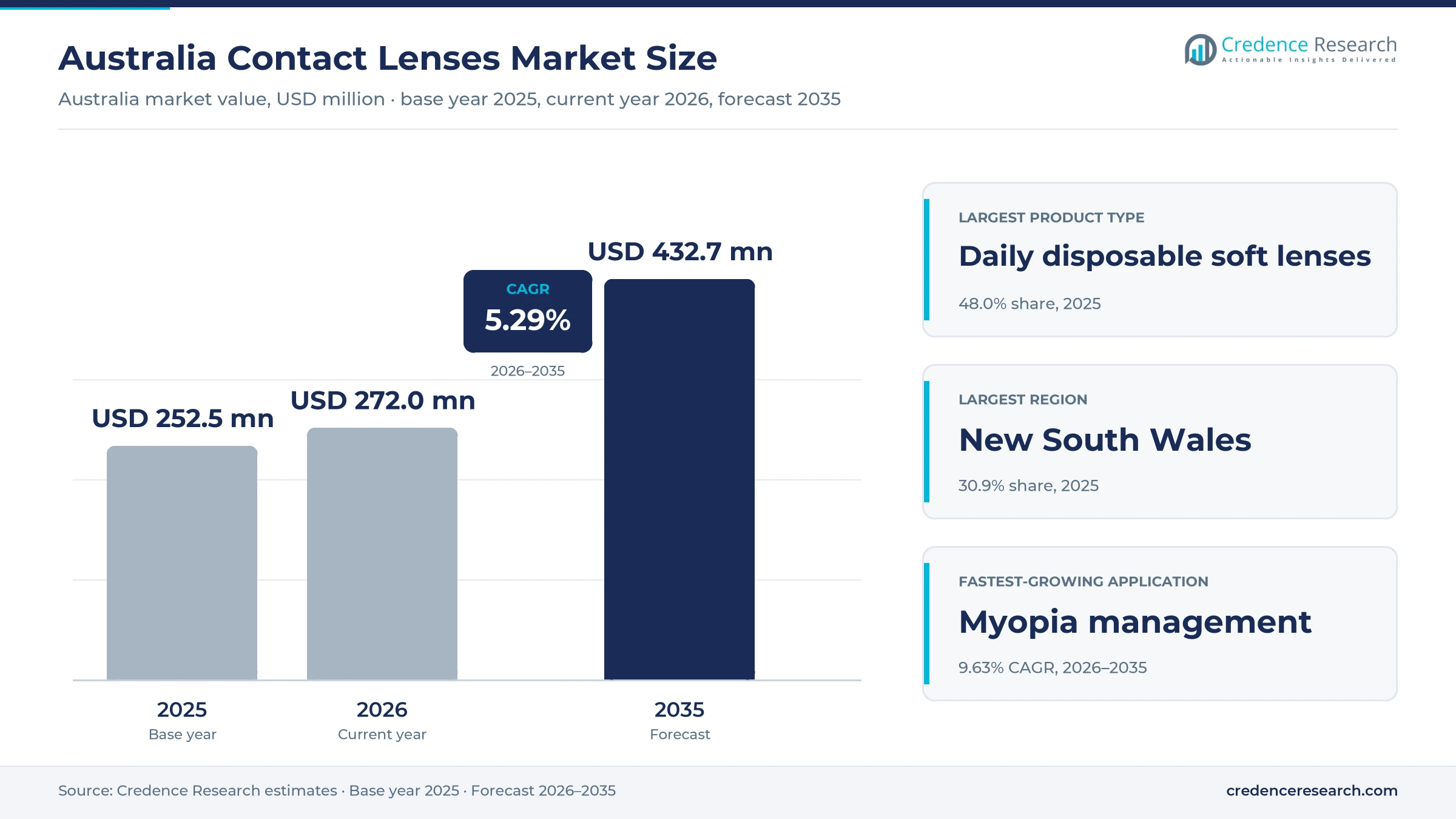
The Australia contact lenses market was valued at USD 252.5 million in 2025 and is projected to increase from USD 272.0 million in 2026 to USD 432.7 million by 2035, registering a CAGR of 5.29% during 2026–2035. Demand comes from about 7.2 million short-sighted Australians, a growing group of presbyopic adults and children whose myopia optometrists now treat with specialized daily and overnight lenses. New South Wales held the largest regional share, 30.9% in 2025, because Sydney has the largest population and the densest network of optometry practices and optical chains. Victoria is the fastest-growing region at 5.57% a year, as Melbourne adds residents quickly and hosts the Optometry Clinical Conference. At the same time, practitioners keep moving wearers from monthly hydrogels to silicone hydrogel daily disposables, which lifts the annual spend per wearer even when the number of wearers grows slowly.
Which lens products and buying channels are counted?
The estimate measures the value of soft and rigid contact lenses sold in Australia at the price paid by wearers, covering daily disposable, two-weekly and monthly soft lenses, rigid gas-permeable, orthokeratology and scleral designs. It includes corrective, myopia management, therapeutic and decorative lenses supplied through optometry practices, optical chains, online stores and pharmacies.
The estimate excludes spectacle lenses and frames, lens care solutions, eye drops and the professional fees that optometrists charge for eye examinations and fitting. The value chain runs from global manufacturers and local custom laboratories through national distributors to practices and retailers, which fit and resupply wearers under prescriptions issued by registered optometrists or ophthalmologists.
Australia Contact Lenses Market Insights
- The Australia contact lenses market was valued at USD 252.5 million in 2025 and is projected to reach USD 432.7 million by 2035, registering a CAGR of 5.29% during 2026–2035.
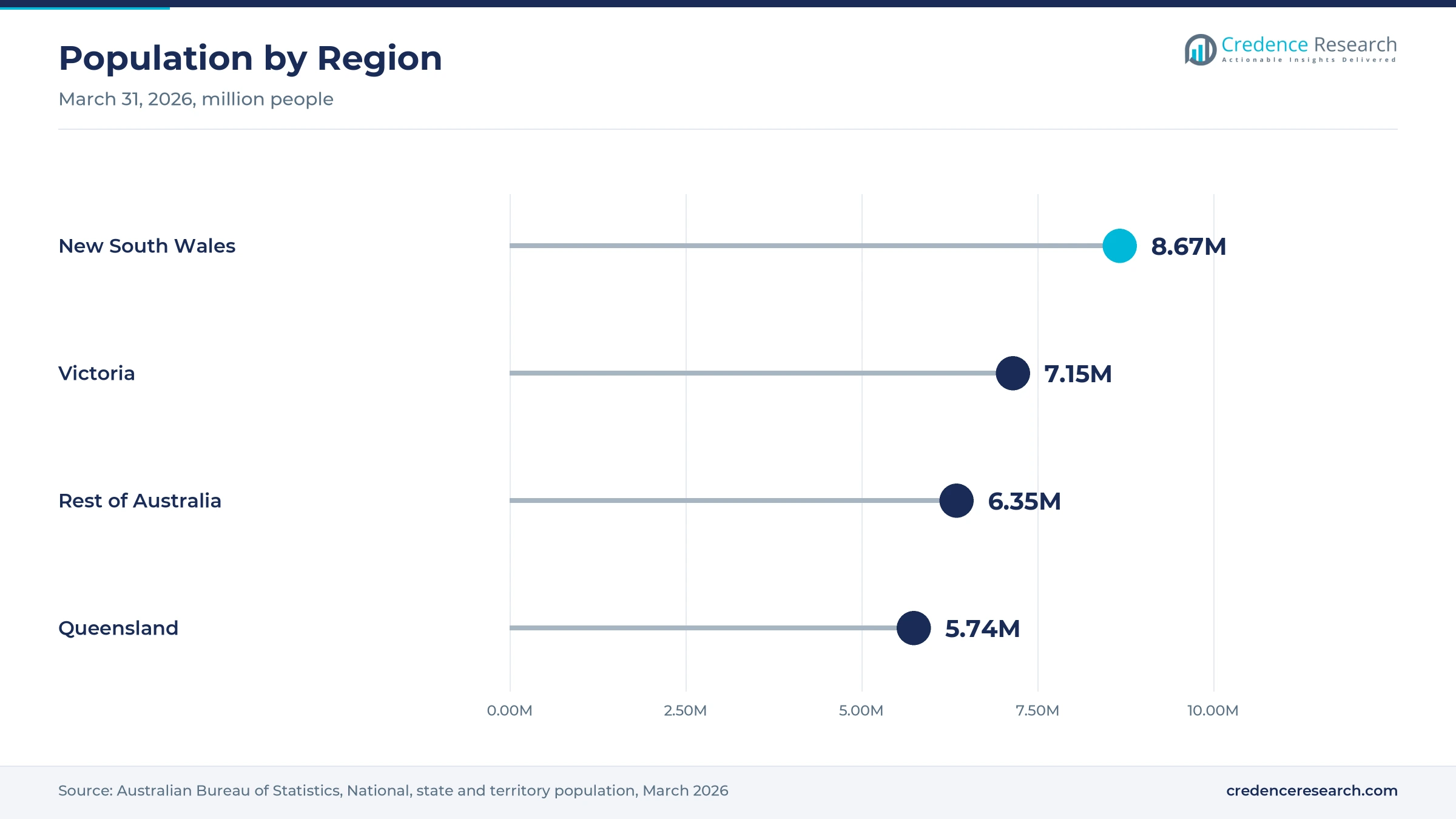
- New South Wales held a 30.9% share of 2025 value, because the state has 8.67 million residents and the largest base of optometry practices and chain stores.
- Daily disposable soft lenses led with a 48.0% share of 2025 value, as daily disposables reached 63% of Australian soft lens fits in 2024.
- Myopia management lenses grow fastest among applications at 9.63% a year during 2026–2035, as CooperVision, Johnson & Johnson Vision and Menicon all sell dedicated pediatric designs in Australia.
- Local laboratories Gelflex and Capricornia Contact Lens compete with global brands through custom rigid, scleral and orthokeratology lenses and through distribution of imported specialty ranges.
Daily disposables lead while myopia management grows fastest
Why do daily disposable soft lenses hold the largest value?
Based on product type, the market is categorized into daily disposable soft lenses, reusable soft lenses and rigid and specialty lenses. Daily Disposable Soft Lenses led with a 48.0% share of 2025 value, because optometrists now fit dailies to most new soft lens wearers and each wearer buys a larger number of lenses a year. Rigid and Specialty Lenses grow fastest at 5.96% a year, as orthokeratology and scleral fitting expand for children and keratoconus patients.
How does routine correction anchor lens spending?
Based on application, the market is categorized into routine refractive correction, myopia management, therapeutic corneal management and cosmetic enhancement. Routine Refractive Correction led with 80.0% of 2025 value, because adults with short sight, astigmatism and presbyopia make up most wearers. Myopia Management grows fastest at 9.63% a year, as practitioners fit soft myopia control and overnight lenses to more children.
Why do adults aged 18 to 39 buy most lenses?
Based on end user, the market is categorized into children and adolescents, adults aged 18-39, and adults aged 40 and above. Adults Aged 18-39 led with 54.0% of 2025 value, because the average Australian wearer is in their mid-30s and wears lenses for work, sport and social use. Children and Adolescents grow fastest at 8.37% a year, as myopia treatment brings younger patients into contact lens care.
How do independent practices keep the channel lead?
Based on distribution channel, the market is categorized into independent optometry practices, optical chain stores, online retailers and pharmacy and specialty retail. Independent Optometry Practices led with 41.0% of 2025 value, because they fit most specialty and pediatric lenses and resupply loyal wearers. Online Retailers grow fastest at 6.59% a year, as wearers reorder familiar daily and monthly brands through websites.
| Segment Group | Leading Sub-segment | Share, 2025 | Fastest-growing Sub-segment | CAGR, 2026–2035 |
|---|---|---|---|---|
| By Product Type | Daily Disposable Soft Lenses | 48.0% | Rigid and Specialty Lenses | 5.96% |
| By Application | Routine Refractive Correction | 80.0% | Myopia Management | 9.63% |
| By End User | Adults Aged 18-39 | 54.0% | Children and Adolescents | 8.37% |
| By Distribution Channel | Independent Optometry Practices | 41.0% | Online Retailers | 6.59% |
Request a Free Sample
Fill in your details and we'll send you a free sample report.
- Sample data tables & charts
- Research methodology
Premium dailies and myopia care drive lens demand growth
Why does daily disposable premiumization lift spending?
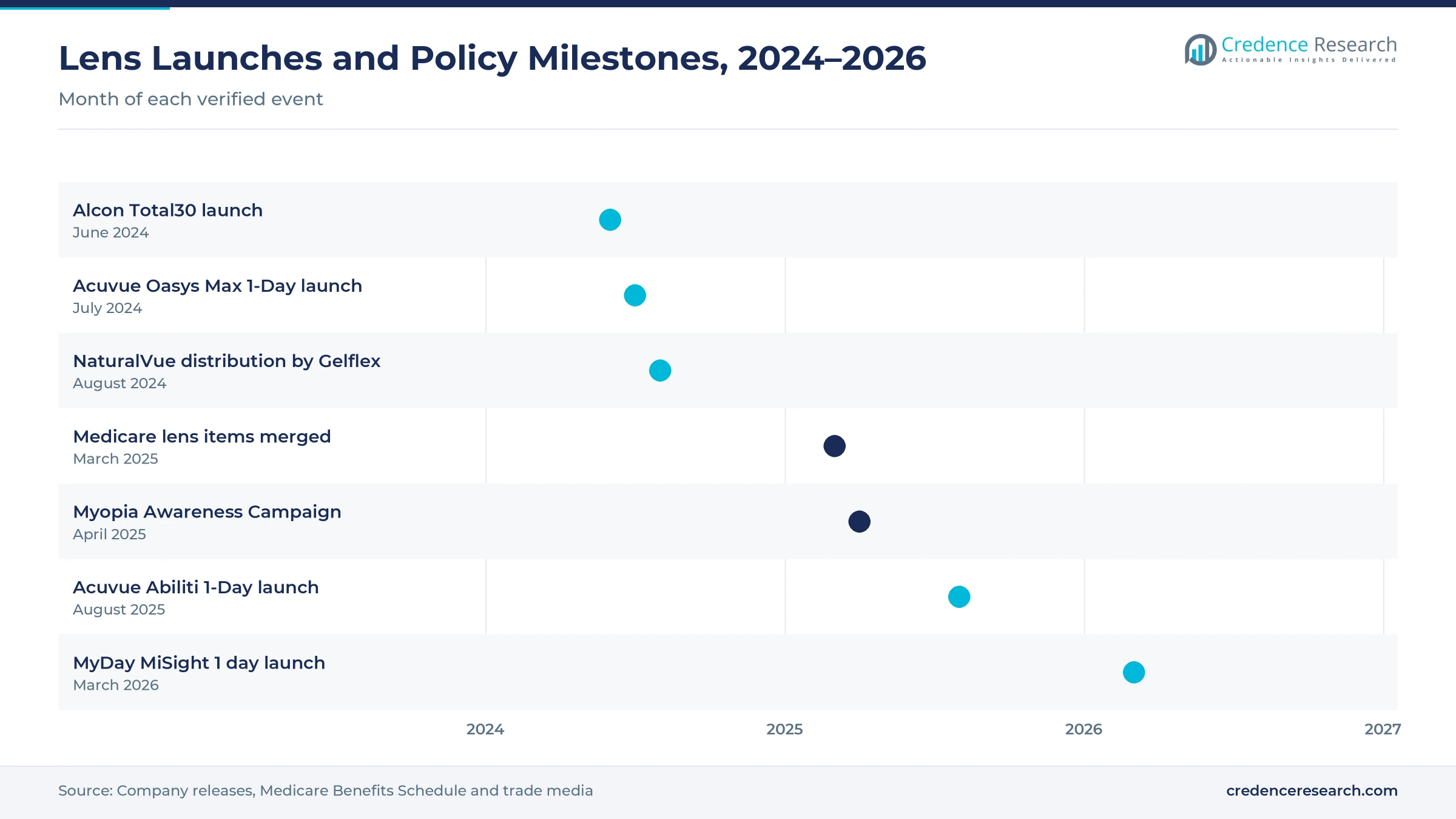
Practitioners keep moving wearers into premium silicone hydrogel dailies, which raises annual spending per wearer because a daily wearer buys hundreds of lenses a year. A 25-year Australian prescribing survey found that daily disposables rose from 7% to 63% of soft lens fits between 2000 and 2024. The same survey of 20,281 fits found that silicone hydrogels reached 96% of soft fits. Johnson & Johnson Vision launched Acuvue Oasys Max 1-Day and its multifocal version in Australia on July 1, 2024, with a blue-violet light filter and a tear-film stabilizing material, Insight reported. As a result, daily disposable soft lenses hold 48.0% of 2025 value and should gain further value as wearers trade up to newer materials.
How does practitioner-led myopia management add new wearers?
Optometrists increasingly treat childhood myopia with dedicated lenses, which brings children into contact lens care years earlier than routine correction would. CooperVision said on March 2, 2026 that MyDay MiSight 1 day was immediately available in Australia and New Zealand, its first Asia Pacific markets. Johnson & Johnson Vision launched Acuvue Abiliti 1-Day at the Optometry Clinical Conference in Melbourne on Aug. 18, 2025, according to mivision. Optometry Australia also ran a national Myopia Awareness Campaign from April 2025 under the slogan Off Screens, Outside, Optometrist. In turn, myopia management grows fastest among applications at 9.63% a year, alongside wider use of overnight orthokeratology for school-age patients.
Why do broader correction portfolios widen the wearer base?
Manufacturers now offer toric, multifocal and custom designs in most lens families, which lets optometrists fit astigmatic and presbyopic patients who once stayed in spectacles. The national prescribing survey found that multifocals rose from 5% to 26% of soft fits and torics from 24% to 30% between 2000 and 2024. Gelflex began distributing Visioneering Technologies' NaturalVue Multifocal 1 Day across Australia on Aug. 19, 2024, Insight reported, adding an extended depth of focus option. SEED appointed Capricornia Contact Lens as its exclusive distributor from July 1, 2022, bringing the 1dayPure EDOF lens to practices. As a result, adults aged 40 and above hold a large share of value, as lenses compete with presbyopia correction options such as reading glasses.
How does Medicare support specialty and therapeutic fitting?
Medicare funds contact lens consultations for patients with high prescriptions or irregular corneas, which lowers the cost of entry into specialty fitting. Medicare Benefits Schedule changes from March 1, 2025 merged four contact lens items into item 10921, which covers myopia or hyperopia of 5.0 diopters or greater and astigmatism of 3.0 diopters or more. A separate item 10924 covers irregular astigmatism, the typical finding in keratoconus, once every 36 months. A 2026 Save Sight Institute study found that the share of rigid gas-permeable lenses sold in Australia rose from 5% to 18% since 2007. In turn, therapeutic corneal management grows faster than routine correction, supported by scleral designs for advanced disease.
Silicone hydrogel, multifocals and specialty fitting rise
Why has silicone hydrogel become the default soft lens material?
Silicone hydrogel has become the default soft lens material, which shifts competition from oxygen supply toward surface wetting, comfort and digital eye strain claims. The national prescribing survey found that silicone hydrogels rose from 22% to 96% of soft lens fits between 2000 and 2024. Bausch + Lomb gained Therapeutic Goods Administration approval for its Ultra One Day silicone hydrogel daily lens in August 2020, joining the main daily silicone hydrogel ranges already sold in Australia. Johnson & Johnson Vision now markets a blue-violet light filter on Acuvue Oasys Max 1-Day, launched in July 2024. As a result, silicone hydrogel dominates new fits, and conventional hydrogel lenses survive mainly in value tiers and some decorative products.
How is the shift to specialty rigid fitting changing practices?
Rigid lens fitting is shifting from routine correction toward orthokeratology and scleral lenses, which need more chair time and custom manufacturing. The prescribing survey found that rigid lenses rose from 13% to 21% of all fits, while overnight wear, mainly orthokeratology, rose from 0.3% to 17% of rigid fits. Corneal grafts for keratoconus fell from 3,170 in 2001-2010 to 2,797 in 2011-2020, as cross-linking and specialty lenses gained use, the Save Sight Institute found. Capricornia makes Epicon scleral designs in Brisbane for irregular corneas and ocular surface disease, Insight reported. In turn, rigid and specialty lenses grow at 5.96% a year as practices add advanced fitting services.
Can reusable lens upgrades open a value opportunity?
Reusable lenses still serve a large share of Australian wearers, which opens room for premium monthly materials to win back value from older hydrogels. Insight reported in June 2024 that 58% of Australian and New Zealand wearers used reusable lenses in the third quarter of 2023, a level that had stayed fairly constant for five years. Alcon launched Total30 water gradient monthly lenses in sphere, toric and multifocal designs at that time, the first new reusable lens innovation since 2017. Reusable wearers also report more discomfort, with 73% affected according to the same report. As a result, reusable soft lenses still hold a sizable share of 2025 value, and premium monthly ranges can slow their decline.
Can wider myopia treatment awareness bring more children into care?
Low public awareness of myopia treatment leaves a large pool of untreated children, which creates an opening for practices that screen and educate families. A UNSW survey of 1,565 Australian adults in September and October 2024 found that 79% had heard of myopia, but only 15% knew that treatments to slow it existed. Optometry Australia said in July 2025 that many state spectacle subsidy schemes do not cover myopia control, and some do not fund contact lenses at all. CooperVision says MiSight technology slowed myopia progression by about 50% in children aged 8 to 17. In turn, children and adolescents grow fastest among end users at 8.37% a year as awareness campaigns convert more families.
Dropout, unverified online supply and subsidy gaps weigh
Why does lens discomfort drive wearer dropout?
Discomfort remains the main reason wearers abandon lenses, which caps the active wearer base even as new patients start each year. Insight reported in June 2024 that 58% of all wearers experience discomfort. As a result, practices must spend chair time on refits and material changes, and some patients return to spectacles. Manufacturers respond with new surface treatments, while optometrists also manage dry eye before refitting affected wearers.
How does unverified online supply raise safety risk?
Some online sellers do not validate prescriptions, which lets wearers switch brands or reorder indefinitely without an eye health check. Optometry Australia warned in 2019 that internet supply is a risk factor for lens-related corneal ulcers, and that supply without a prescription carries an A$30,000 fine in some states. In turn, uneven enforcement across states weakens the role of practices in aftercare. Practitioners respond with direct-delivery subscription plans that keep resupply tied to a valid prescription.
Why do subsidy gaps slow pediatric myopia treatment?
Myopia control lenses cost families far more than single vision spectacles, and public schemes rarely cover them. These subsidy gaps fall hardest on families that already pay higher out-of-pocket costs for specialist lenses. As a result, families with lower incomes delay treatment, which leaves uptake concentrated in higher-income suburbs. Optometry Australia has urged governments to follow the French scheme, which began reimbursing myopia control spectacle lenses for children in July 2025.
How do weak cosmetic lens rules affect the category?
Decorative lenses face little state oversight, which lets low-cost imports compete with practice-supplied colored lenses. Mivision reported in 2021 that cosmetic lens sales are unregulated in every state and territory except New South Wales and South Australia. In turn, buyers often treat colored lenses as costume accessories rather than medical devices, which raises infection risk. Practices respond by stocking approved colored ranges and by warning patients before seasonal events such as Halloween.
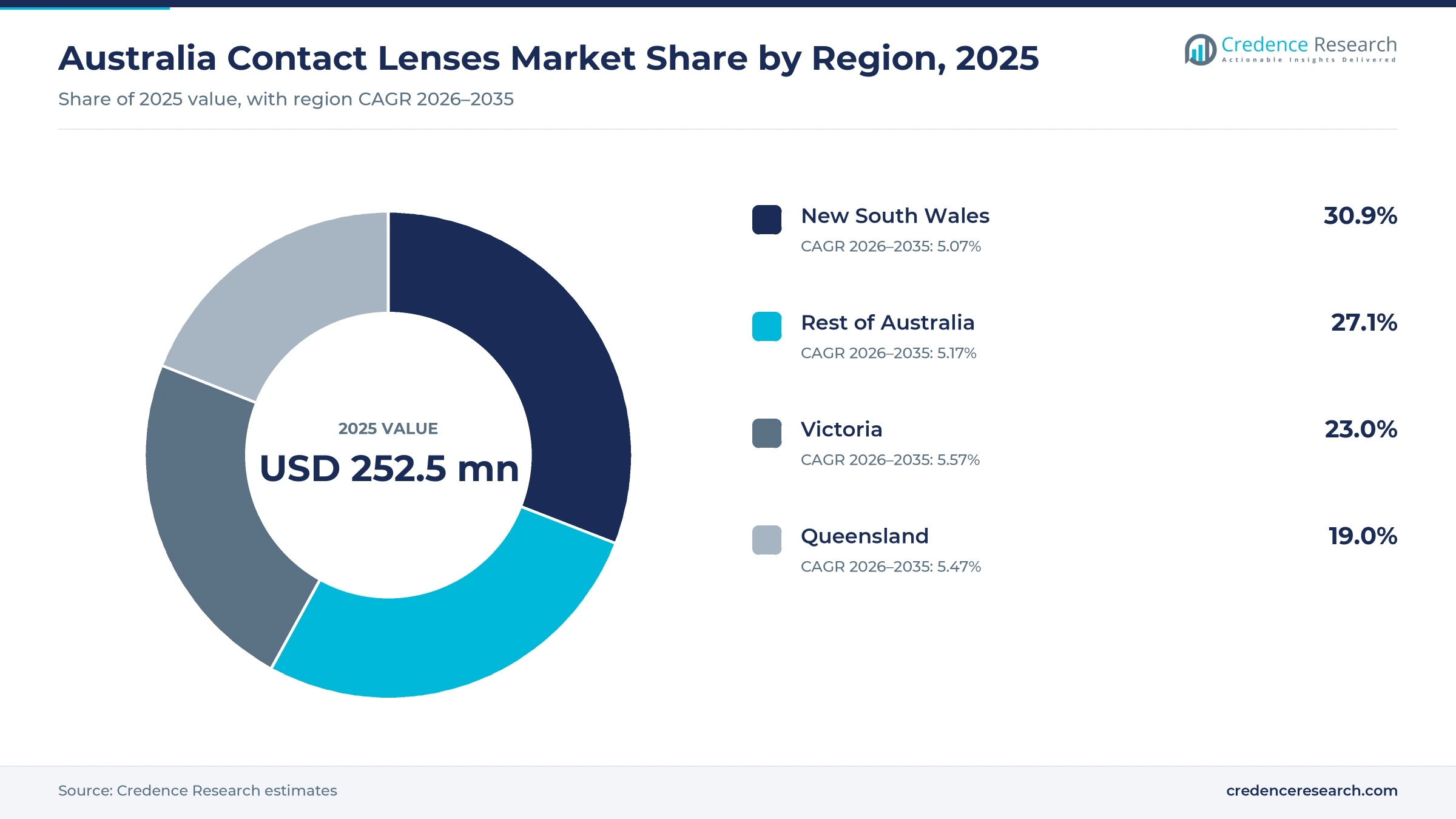
New South Wales leads as Victoria grows fastest to 2035
| Region | Value, 2025 (USD million) | Share, 2025 | CAGR, 2026–2035 |
|---|---|---|---|
| New South Wales | 78.0 | 30.9% | 5.07% |
| Rest of Australia | 68.4 | 27.1% | 5.17% |
| Victoria | 58.1 | 23.0% | 5.57% |
| Queensland | 48.0 | 19.0% | 5.47% |
Sydney population and practice density anchor NSW demand
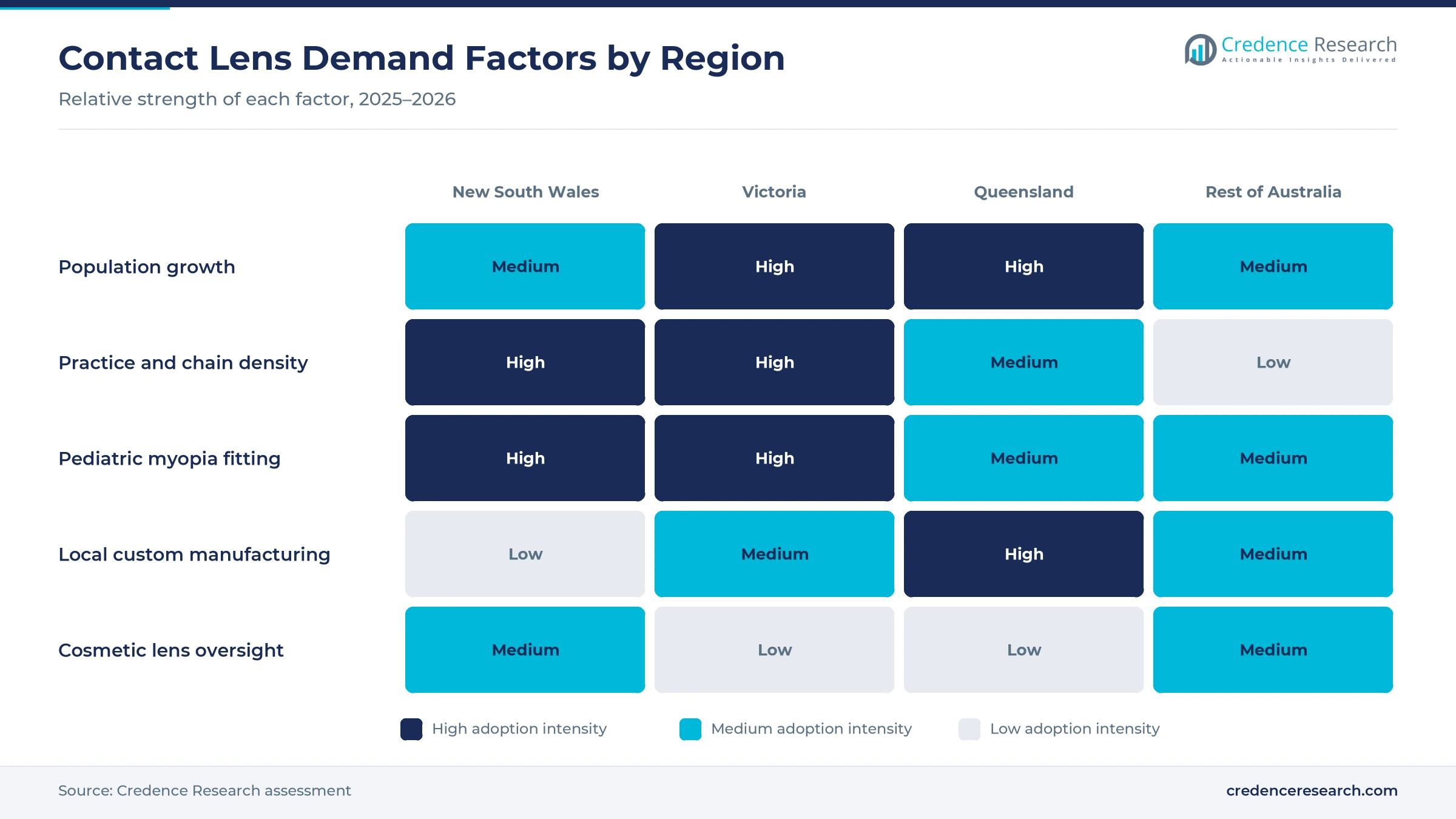
New South Wales held a 30.9% share of 2025 value and grows at 5.07% a year, because Sydney combines the largest population with dense chain and independent practice coverage. The state had 8.67 million residents at March 31, 2026, according to the Australian Bureau of Statistics, after growth of 1.1% over the year. New South Wales is also one of only two states with a prescription rule for cosmetic lenses, although Mivision reported that the rule has no enforcement regime there.
Why is Victoria the fastest-growing region?
Victoria held a 23.0% share of 2025 value and grows fastest at 5.57% a year, because Melbourne adds residents quickly and draws national optometry events. The state had 7.15 million residents at March 31, 2026, after growth of 1.6% over the year. Johnson & Johnson Vision launched Acuvue Abiliti 1-Day at the Optometry Clinical Conference in Melbourne in August 2025. Gelflex also runs a Melbourne team that supports custom and imported specialty lenses across the state.
How does Queensland combine growth and local manufacturing?
Queensland held a 19.0% share of 2025 value and grows at 5.47% a year, because its population growth matches Victoria and it hosts a local specialty manufacturer. The state had 5.74 million residents at March 31, 2026, after growth of 1.6% over the year. Capricornia Contact Lens makes custom rigid, scleral and orthokeratology lenses in Brisbane and distributes SEED daily lenses nationally. As a result, Queensland practices have short lead times for custom specialty orders.
Rest of Australia adds fast-growing Western Australia
The rest of Australia held a 27.1% share of 2025 value and grows at 5.17% a year, combining Western Australia, South Australia, Tasmania and the two territories. Western Australia had the fastest population growth of any state at 2.1% to March 2026, while Tasmania grew only 0.6%. South Australia enforces prescription-only supply of cosmetic lenses, and Gelflex runs a Perth team that makes custom lenses for practices in the western states.
Daily, multifocal and myopia lens launches since 2024
| Development | Status and market relevance |
|---|---|
| In July 2024, Johnson & Johnson Vision launched Acuvue Oasys Max 1-Day and Acuvue Oasys Max 1-Day Multifocal in Australia. | Adds a premium silicone hydrogel daily range with a blue-violet light filter |
| In March 2025, Medicare merged four contact lens consultation items into item 10921 for high refractive errors. | Simplifies claims for high myopia, hyperopia, astigmatism and anisometropia fittings |
| In April 2025, Optometry Australia launched its national Myopia Awareness Campaign for parents and children. | Promotes earlier eye tests and wider uptake of myopia management |
| In August 2025, Johnson & Johnson Vision launched Acuvue Abiliti 1-Day for myopia management in Australia. | Adds a second major soft daily lens designed for children with myopia |
| In March 2026, CooperVision made MyDay MiSight 1 day available in Australia and New Zealand. | First Asia Pacific launch of its silicone hydrogel myopia control lens |
Lens materials and optics that decide fitting choices
- Silicone hydrogel materials carry far more oxygen to the cornea than conventional hydrogels, which is why they now make up almost every new soft fit.
- Myopia control optics add peripheral defocus zones to soft daily lenses, which slows eye growth in children while giving clear central vision.
- Rigid gas-permeable and scleral designs vault or reshape irregular corneas, which makes them the main lens option for keratoconus and post-surgical eyes.
- Extended depth of focus optics spread focus across near and far distances, which lets multifocal dailies serve presbyopic adults and some young myopes.
Need a Custom Version of This Report?
Tailor the scope, geography, or segments to your exact requirements.
- Custom geography or segment scope
- Direct access to our analyst team
Global lens makers and local custom labs share fittings
Competition combines four global soft lens makers with local custom laboratories and niche importers. Johnson & Johnson Vision, Alcon, CooperVision and Bausch + Lomb compete on daily silicone hydrogel ranges, toric and multifocal designs and practice support, and each has launched or registered new lenses in Australia since 2020. CooperVision and Johnson & Johnson Vision now compete directly in soft myopia control, while Menicon sells its Bloom ortho-k and daily system. Gelflex, which supplies nearly two-thirds of eye care professionals, and Capricornia Contact Lens compete through custom rigid and scleral lenses and by distributing imported brands from Visioneering Technologies, SEED and mark'ennovy. In turn, buyers compare suppliers on fitting support, delivery times and the breadth of specialty parameters.
Which lens makers and distributors serve Australian practices?
| Company | Type | Role in the market |
|---|---|---|
| Johnson & Johnson Vision Care Australia | Global manufacturer | Launched Acuvue Oasys Max 1-Day in 2024 and Abiliti 1-Day in 2025 |
| Alcon Laboratories Australia | Global manufacturer | Launched Total30 monthly water gradient lenses in June 2024 |
| CooperVision Australia | Global manufacturer | Made MyDay MiSight 1 day available in March 2026 |
| Bausch + Lomb Australia | Global manufacturer | Gained TGA approval for Ultra One Day lenses in 2020 |
| Menicon Australia | Global manufacturer | Launched Menicon Bloom ortho-k and daily lenses in March 2022 |
| Gelflex | Local manufacturer and distributor | Makes custom lenses and distributes NaturalVue across Australia |
| Capricornia Contact Lens | Local manufacturer and distributor | Makes Epicon scleral lenses in Brisbane and distributes SEED |
| SEED | Japanese manufacturer | Supplies 1dayPure daily lenses through Capricornia from July 2022 |
| mark'ennovy | Custom soft lens maker | Entered Australia in March 2018 with Capricornia as partner |
| Visioneering Technologies | ASX-listed manufacturer | Supplies NaturalVue Multifocal 1 Day through Gelflex |
Credence Research view on Australian lens demand
Credence Research's view is that the Australian lens market will grow on value more than on wearer numbers, because premium dailies and myopia treatment raise spending per patient. Daily disposables stay the largest product type, while myopia management grows fastest as two major soft lenses now compete for pediatric fits. Victoria and Queensland gain from population growth, while New South Wales keeps the largest base. Suppliers that combine premium materials, pediatric programs and custom specialty fitting should win the most practice loyalty by 2035.
Model inputs from surveys, Medicare and population data
The report uses 2025 as the base year on a calendar basis, and market values come from the Credence Research model. That model draws on national prescribing surveys, peer-reviewed studies, Medicare Benefits Schedule documents, official population statistics, professional body releases and company announcements. Segment splits, regional shares and regional growth rates are Credence Research estimates. Sources used are government pages, journal abstracts, trade media and company releases, and no interviews or surveys were conducted.
Myopia care and premium dailies lead growth to 2035
The Australia contact lenses market is expected to reach USD 432.7 million by 2035, a 5.29% CAGR during 2026–2035, as practitioners keep moving wearers into premium dailies and fit more children with myopia control lenses. Growth should be strongest in myopia management, rigid and specialty lenses, online resupply and Victoria, because these areas gain most from new products and population growth. Discomfort, unverified online supply and limited subsidies could slow uptake, while better materials, awareness campaigns and subscription resupply should support steady demand through the forecast period.
Frequently Asked Questions
How big is the Australia contact lenses market?
Which product type leads Australian lens spending?
Which region leads the market?
Why is myopia management the fastest-growing application?
Does Medicare cover contact lens consultations?
How are lens materials changing in Australia?
Who are the leading companies in the market?
What are the main challenges for the market?
Table of Content
Chapter 1 Market Segmentation
- 1.1 Segmentation Framework
- 1.1.1 Product and Service Classification
- 1.1.2 Application and End-Use Classification
- 1.1.3 Technology and Solution Classification
- 1.1.4 Customer and Distribution Channel Classification
- 1.1.5 Geographic Segmentation
- 1.1.6 Market Segment Definitions and Boundaries
- 1.2 By Product Type
- 1.2.1 Daily Disposable Soft Lenses
- 1.2.2 Reusable Soft Lenses
- 1.2.3 Rigid and Specialty Lenses
- 1.3 By Application
- 1.3.1 Routine Refractive Correction
- 1.3.2 Myopia Management
- 1.3.3 Therapeutic Corneal Management
- 1.3.4 Cosmetic Enhancement
- 1.4 By End User
- 1.4.1 Children and Adolescents
- 1.4.2 Adults Aged 18-39
- 1.4.3 Adults Aged 40 and Above
Chapter 2 Introduction
- 2.1 Report Objectives and Scope
- 2.2 Product Definition and Industry Terminology
- 2.3 Market Inclusions and Exclusions
- 2.4 Research Process
- 2.4.1 Primary Research and Expert Interviews
- 2.4.2 Secondary Research and Source Review
- 2.4.3 Top-Down and Bottom-Up Estimation
- 2.4.4 Data Triangulation and Verification
- 2.5 Market Size Measurement Basis
- 2.5.1 2025: USD 252.5 million → 2035: USD 432.7 million
- 2.6 Historical and Forecast Reference Periods
- 2.6.1 Historical Period: 2018-2025
- 2.6.2 Base Year: 2025
- 2.6.3 Forecast Period: 2025-2035
- 2.7 Research Assumptions and Limitations
Chapter 3 Executive Summary
- 3.1 Market Snapshot and Key Findings
- 3.2 Base-Year Market Size, 2025
- 3.3 Forecast Market Size, 2035
- 3.4 Revenue and Volume Growth Outlook
- 3.5 Key Demand and Supply Indicators
- 3.6 Leading Market Segments
- 3.7 Fastest-Growing Market Opportunities
- 3.8 Regional Performance Highlights
- 3.9 Technology and Industry Transformation
- 3.10 Competitive Landscape Summary
- 3.11 Analyst View and Strategic Implications
Chapter 4 Australia Contact Lenses Market Trends and Developments
- 4.1 Historical Industry Development, 2018-2025
- 4.2 Recent Market Trends and Developments
- 4.3 Demand and Customer Behavior Trends
- 4.4 Technology and Product Innovation
- 4.5 Artificial Intelligence, Automation and Digitalization
- 4.6 Local Manufacturing and Supply Chain Realignment
- 4.7 Industry Partnerships, Mergers and Acquisitions
- 4.8 Sustainability and Circular Economy Developments
- 4.9 Government and Private Sector Investment Trends
- 4.10 Emerging Business Models and Commercialization
- 4.11 Industry Developments and Announcements
Chapter 5 Australia Contact Lenses Market Production, Supply and Demand Analysis
- 5.1 Demand Trend and Consumption Analysis, 2018-2025
- 5.2 Demand Forecast, 2025-2035
- 5.3 Production and Output Trend, 2018-2025
- 5.4 Production and Output Forecast, 2025-2035
- 5.5 Installed Capacity and Capacity Utilization
- 5.6 Company-Wise Production Plants and Statistics
- 5.6.1 Installed Production Capacity
- 5.6.2 Actual Production
- 5.6.3 Planned Capacity and Expansion Targets
- 5.7 Supply Chain Structure and Procurement Trends
- 5.8 Supply-Demand Gap and Bottlenecks
- 5.9 Import Dependence and Sourcing Structure
- 5.10 Contract Manufacturing and Outsourcing
- 5.11 Regional Supply and Demand Concentration
Chapter 6 Australia Contact Lenses Market Pricing Analysis
- 6.1 Pricing Structure and Measurement
- 6.2 Historical Pricing Trends, 2018-2025
- 6.3 Pricing Outlook, 2025-2035
- 6.4 Average Selling Price and Unit Economics
- 6.5 Pricing by Product and Market Segment
- 6.6 Geographic Pricing Differences
- 6.7 Key Input, Energy, Labor and Logistics Costs
- 6.8 Contract Pricing and Purchasing Models
- 6.9 Pricing Sensitivity and Competitive Positioning
- 6.10 Price, Margin and Profitability Implications
Chapter 7 Australia Contact Lenses Market Dynamics
- 7.1 Market Growth Drivers
- 7.1.1 Demand-Side Drivers
- 7.1.2 Technology and Innovation Drivers
- 7.1.3 Infrastructure and Investment Drivers
- 7.1.4 Regulatory and Policy Drivers
- 7.2 Market Restraints
- 7.2.1 Cost and Affordability Constraints
- 7.2.2 Technology and Adoption Barriers
- 7.2.3 Supply Chain and Operational Constraints
- 7.3 Market Challenges
- 7.3.1 Competitive Pressure and Margin Erosion
- 7.3.2 Skills, Infrastructure and Implementation Gaps
- 7.4 Emerging Market Opportunities
- 7.5 Market Dynamics Impact and Time-Horizon Assessment
Chapter 8 Australia Contact Lenses Value Chain Analysis
- 8.1 Industry Value Chain Overview
- 8.2 Upstream Suppliers and Critical Inputs
- 8.3 Technology and Component Providers
- 8.4 Manufacturing or Service Delivery
- 8.5 Distribution, Channel Partners and Integrators
- 8.6 Downstream Applications and End Users
- 8.7 Value Addition and Profit Pools
- 8.8 Vertical Integration and Outsourcing
- 8.9 Supplier Concentration and Risk
- 8.10 Supply Chain Localization and Resilience
Chapter 9 Australia Contact Lenses Market Regulations and Policies
- 9.1 Relevant Laws, Standards and Compliance Frameworks
- 9.2 Product, Service, Safety and Quality Requirements
- 9.3 Government Policies, Incentives and Subsidies
- 9.4 Imports, Exports and Trade Barriers
- 9.5 Public Procurement and Local Content Requirements
- 9.6 Environmental and Sustainability Compliance
- 9.7 Upcoming Policy Changes and Market Implications
Chapter 10 Australia Contact Lenses Market Hotspots and Opportunities
- 10.1 Market Opportunity Mapping and Growth Hotspots
- 10.2 High-Growth Applications and Customer Groups
- 10.3 Underserved Markets and White-Space Opportunities
- 10.4 Emerging Technology and Product Opportunities
- 10.5 New Capacity and Investment Hotspots
- 10.6 Market Entry and Expansion Opportunities
- 10.7 Distribution and Partnership Opportunities
- 10.8 Near-Term and Long-Term Commercial Potential
- 10.9 Opportunity Attractiveness and Execution Risks
Chapter 11 Australia Contact Lenses Market Outlook, 2025-2035
- 11.1 Market Size and Analysis
- 11.1.1 Revenue (Market Measurement: 2025: USD 252.5 million → 2035: USD 432.7 million)
- 11.1.2 Market Volume and Quantity Sold
- 11.1.3 Historical Market Size, 2018-2025
- 11.1.4 Base-Year Market Size, 2025
- 11.2 Market Forecast, 2025-2035
- 11.2.1 Revenue Forecast to 2035
- 11.2.2 Volume Forecast to 2035
- 11.2.3 CAGR and Year-on-Year Growth
- 11.2.4 Incremental Revenue Opportunity
- 11.3 Forecast Assumptions and Scenario Analysis
- 11.3.1 Base-Case Forecast
- 11.3.2 Optimistic and Conservative Scenarios
- 11.3.3 Technology, Pricing and Policy Sensitivities
- 11.4 Market Attractiveness and Growth Outlook
Chapter 12 Australia Contact Lenses Market Segmentation and Outlook
- 12.1 Segmentation Summary and Market Shares, 2025
- 12.2 Largest and Fastest-Growing Segments
- 12.3 By Product Type - Market Size and Forecast, 2025-2035
- 12.3.1 Segment Definition and Scope
- 12.3.2 Historical Market Size, 2018-2025
- 12.3.3 Revenue Forecast, 2025-2035
- 12.3.4 Volume Forecast, 2025-2035
- 12.3.5 Base-Year Market Share, 2025
- 12.3.6 Segment CAGR and Growth Drivers
- 12.3.7 Subsegment Market Size and Forecast
- 12.3.7.1 Daily Disposable Soft Lenses
- 12.3.7.2 Reusable Soft Lenses
- 12.3.7.3 Rigid and Specialty Lenses
- 12.3.8 Subsegment Pricing and Adoption Trends
- 12.3.9 Leading Suppliers and Competition
- 12.3.10 Regional Demand and Opportunities
- 12.4 By Application - Market Size and Forecast, 2025-2035
- 12.4.1 Segment Definition and Scope
- 12.4.2 Historical Market Size, 2018-2025
- 12.4.3 Revenue Forecast, 2025-2035
- 12.4.4 Volume Forecast, 2025-2035
- 12.4.5 Base-Year Market Share, 2025
- 12.4.6 Segment CAGR and Growth Drivers
- 12.4.7 Subsegment Market Size and Forecast
- 12.4.7.1 Routine Refractive Correction
- 12.4.7.2 Myopia Management
- 12.4.7.3 Therapeutic Corneal Management
- 12.4.7.4 Cosmetic Enhancement
- 12.4.8 Subsegment Pricing and Adoption Trends
- 12.4.9 Leading Suppliers and Competition
- 12.4.10 Regional Demand and Opportunities
- 12.5 By End User - Market Size and Forecast, 2025-2035
- 12.5.1 Segment Definition and Scope
- 12.5.2 Historical Market Size, 2018-2025
- 12.5.3 Revenue Forecast, 2025-2035
- 12.5.4 Volume Forecast, 2025-2035
- 12.5.5 Base-Year Market Share, 2025
- 12.5.6 Segment CAGR and Growth Drivers
- 12.5.7 Subsegment Market Size and Forecast
- 12.5.7.1 Children and Adolescents
- 12.5.7.2 Adults Aged 18-39
- 12.5.7.3 Adults Aged 40 and Above
- 12.5.8 Subsegment Pricing and Adoption Trends
- 12.5.9 Leading Suppliers and Competition
- 12.5.10 Regional Demand and Opportunities
- 12.6 Segment Growth Comparison
- 12.7 Segment Attractiveness and Priority Matrix
Chapter 13 Australia Contact Lenses End-Use and Application Market Outlook
- 13.1 End-Use Industry and Customer Demand Structure
- 13.2 Leading Applications and Customer Groups
- 13.3 End-Use Market Size, Share and Forecast
- 13.4 Major End-Use Industry Deep Dives
- 13.4.1 Customer Requirements and Use Cases
- 13.4.2 Demand and Replacement Cycles
- 13.4.3 Technical and Regulatory Considerations
- 13.4.4 Purchasing and Procurement Models
- 13.4.5 Leading Vendors and Distribution Channels
- 13.4.6 Forecast and Commercial Opportunities
- 13.5 Emerging Applications and Cross-Segment Demand
- 13.6 End-Use Industry Investment Priorities
Chapter 14 Australia Contact Lenses Geographic Market Outlook, 2025-2035
- 14.1 Domestic Market Distribution and Demand Clusters
- 14.2 State- or Province-Wise Market Size and Forecast, 2025-2035
- 14.3 City and Metropolitan Market Outlook
- 14.4 Industrial, Manufacturing and Commercial Clusters
- 14.5 Geographic Concentration of Key End Users
- 14.6 Local Pricing and Purchasing Differences
- 14.7 Domestic Production Facilities and Capacity Map
- 14.8 Local Infrastructure and Project Pipeline
- 14.9 State-Level Policy and Incentive Differences
- 14.10 Subnational Investment Hotspots and Opportunities
- 14.11 Distribution and Logistics Networks
- 14.12 Domestic Competitive Footprint
Chapter 15 Australia Contact Lenses Technology, Innovation and Sustainability Outlook
- 15.1 Technology Landscape and Maturity
- 15.2 Product, Process and Service Innovation
- 15.3 AI, Automation and Digital Tools in the Industry
- 15.4 Technology Adoption and Performance Benchmarking
- 15.5 Innovation Pipeline and R&D Investment
- 15.6 Patent and Intellectual Property Trends
- 15.7 Energy Efficiency and Resource Management
- 15.8 Sustainability, Recycling and Circularity
- 15.9 Technology Roadmap, 2025-2035
- 15.10 Risks of Obsolescence and Technology Substitution
Chapter 16 Australia Contact Lenses Market Key Strategic Imperatives
- 16.1 Growth and Market Entry Priorities
- 16.2 High-Return Products and Segments
- 16.3 Pricing, Profitability and Cost Optimization
- 16.4 Technology Investment and Product Differentiation
- 16.5 Supply Chain Localization and Resilience
- 16.6 Distribution and Customer Acquisition
- 16.7 Partnership, Acquisition and Capacity Strategy
- 16.8 Regional Expansion Priorities
- 16.9 Short-, Medium- and Long-Term Actions
Chapter 17 Competition Outlook
- 17.1 Industry Competition Characteristics
- 17.2 Market Structure and Concentration
- 17.3 Market Share and Competitive Positioning, 2025
- 17.4 Company-Wise Revenue and Product Benchmarking
- 17.5 Production and Service Capacity Benchmarking
- 17.6 Technology, Pricing and Differentiation
- 17.7 Regional Footprint and Distribution Strength
- 17.8 Mergers, Acquisitions and Strategic Alliances
- 17.9 New Entrants and Competitive Threats
- 17.10 Porter's Five Forces and Industry Attractiveness
- 17.11 Competitive Outlook, 2025-2035
Chapter 18 Company Profiles
- 18.1 Company Coverage and Selection Criteria
- 18.2 Johnson & Johnson Vision Care Australia
- 18.2.1 Business Description
- 18.2.2 Company Ownership and Geographic Presence
- 18.2.3 Product and Service Portfolio
- 18.2.4 Manufacturing and Operating Footprint
- 18.2.5 Production Capacity and Expansion Plans
- 18.2.6 Financial Performance and Investment
- 18.2.7 Market Share and Competitive Position
- 18.2.8 Technology and Innovation Capabilities
- 18.2.9 Strategic Alliances or Partnerships
- 18.2.10 Recent Developments
- 18.2.11 Growth Strategy and Outlook
- 18.3 Alcon Laboratories Australia
- 18.4 CooperVision Australia
- 18.5 Bausch + Lomb Australia
- 18.6 Menicon Australia
- 18.7 Gelflex
- 18.8 Capricornia Contact Lens
- 18.9 SEED
- 18.10 mark'ennovy
- 18.11 Visioneering Technologies
- 18.12 Other Relevant Market Participants
Note: Every listed company is profiled on the structure shown under the first company. The company list is preliminary and may change based on research findings, market developments, data availability and client requirements.
Chapter 19 Disclaimer
- 19.1 Research and Forecast Disclaimer
- 19.2 Data Source and Estimation Limitations
Note: The depth of individual sections depends on data availability for this market. Volume, capacity, trade and other unit-based metrics are included where applicable.

