
Renovation and contract work steady vinyl floor demand
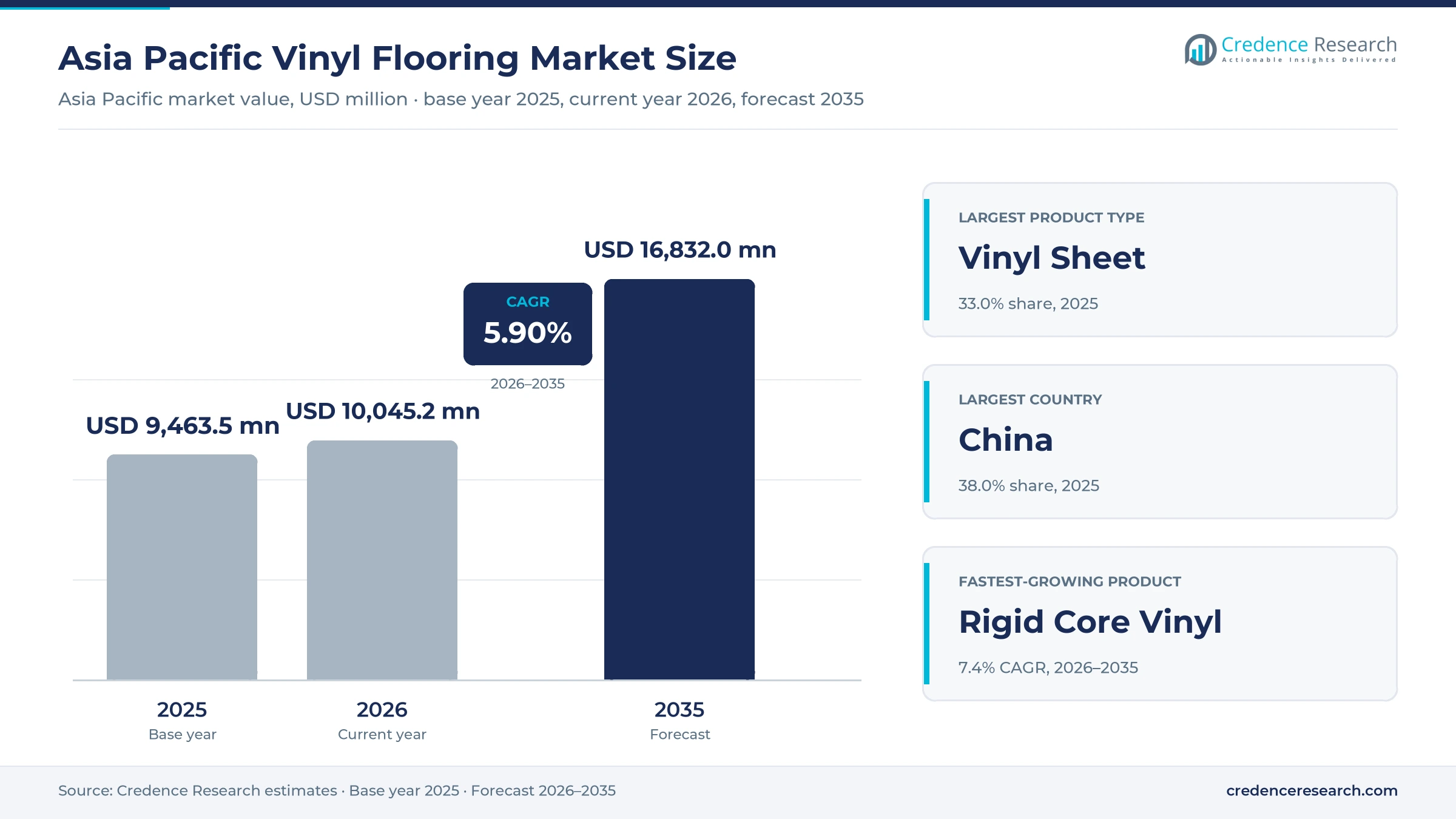
The Asia Pacific vinyl flooring market was valued at USD 9.46 billion in 2025 and is projected to increase from USD 10.05 billion in 2026 to USD 16.83 billion by 2035, registering a CAGR of 5.90% during 2026–2035. Demand comes from new apartments handed over to buyers, from owners who replace worn tile and laminate, and from offices, hospitals, schools and shops that need durable, easy-to-clean floors. China held the largest regional share, 38.0% in 2025, because its housing stock and renovation programs are the biggest in the region. India is the fastest-growing country at 8.1% a year, as public housing schemes and new commercial space add floor area in cities. At the same time, rigid core planks with click joints and adhesive-free loose-lay tiles are widening the range of installers and buyers who can fit vinyl, while low resin prices keep shelf prices within reach of mass-market renovators across the region.
Sheet, tile, rigid core and composition floors make up the count
The estimate measures the value of vinyl flooring, namely vinyl sheet, luxury vinyl tile and plank, rigid core vinyl with stone-plastic or wood-plastic composite cores, and vinyl composition tile sold for installation in Asia Pacific. It covers glue-down, click-lock and loose-lay products bought by households, developers, contractors and facility owners.
The estimate excludes laminate, engineered wood, linoleum, rubber and carpet, as well as adhesives, underlays sold on their own and installation labor. Product made in the region and shipped to North America or Europe is outside the count. The value chain runs from resin and plasticizer suppliers through calendering and extrusion plants to distributors, home-improvement retailers, flooring contractors and project buyers.
Asia Pacific Vinyl Flooring Market Insights
- The Asia Pacific vinyl flooring market grows from USD 9.46 billion in 2025 to USD 16.83 billion by 2035 at a 5.90% CAGR, led by renovation and commercial refits.
- China held 38.0% of regional value in 2025, while India is the fastest-growing country at 8.1% a year on public housing and new commercial floor space.
- Vinyl sheet led product types with 33.0% of 2025 value, supported by apartment flooring in South Korea and welded sheet floors in hospitals and schools.
- China completed 18.1% less building floor space in 2025, so suppliers are leaning on the 27,100 old neighborhoods that started renovation that year.
- FOB China PVC resin fell to a record low of about USD 600 per metric ton in April 2025, keeping material costs low for regional vinyl plants.
Sheet vinyl leads while rigid core and loose-lay gain
Sheet vinyl keeps the lead as rigid core planks grow fastest
Based on product type, the market is categorized into vinyl sheet, luxury vinyl tile, rigid core vinyl and vinyl composition tile. Vinyl Sheet led with 33.0% of 2025 value because Korean apartments and regional hospitals specify it in large volumes. LX Hausys said its double-cushion LX Z:IN sheet ranked first in the household flooring category of Korea's 2025 K-BPI brand survey, reported by Hankyung on March 24, 2025. Rigid Core Vinyl (SPC and WPC) grows fastest at 7.4% a year, as Bunnings in Australia lists waterproof SPC planks with a click joint and an attached 1mm foam underlay for bathrooms and laundries.
Glue-down floors lead as loose-lay tiles spread in offices
Based on installation method, the market is categorized into glue-down, click-lock and loose-lay floors. Glue-Down led with 50.0% of 2025 value because welded sheet and contract tile in clinics, wards and classrooms must be bonded to the subfloor. China alone counted more than 1.1 million healthcare institutions at the end of 2025, according to the National Health Commission. Loose-Lay grows fastest at 6.9% a year, as TOLI added a 250 by 1,000 mm size to its adhesive-free, wax-free Loose Lay 50NW-EX range from July 24, 2025, which already includes tiles up to 1,000 by 1,000 mm, a format that lets offices replace floors over a weekend.
Homes buy most floors while commercial refits grow faster
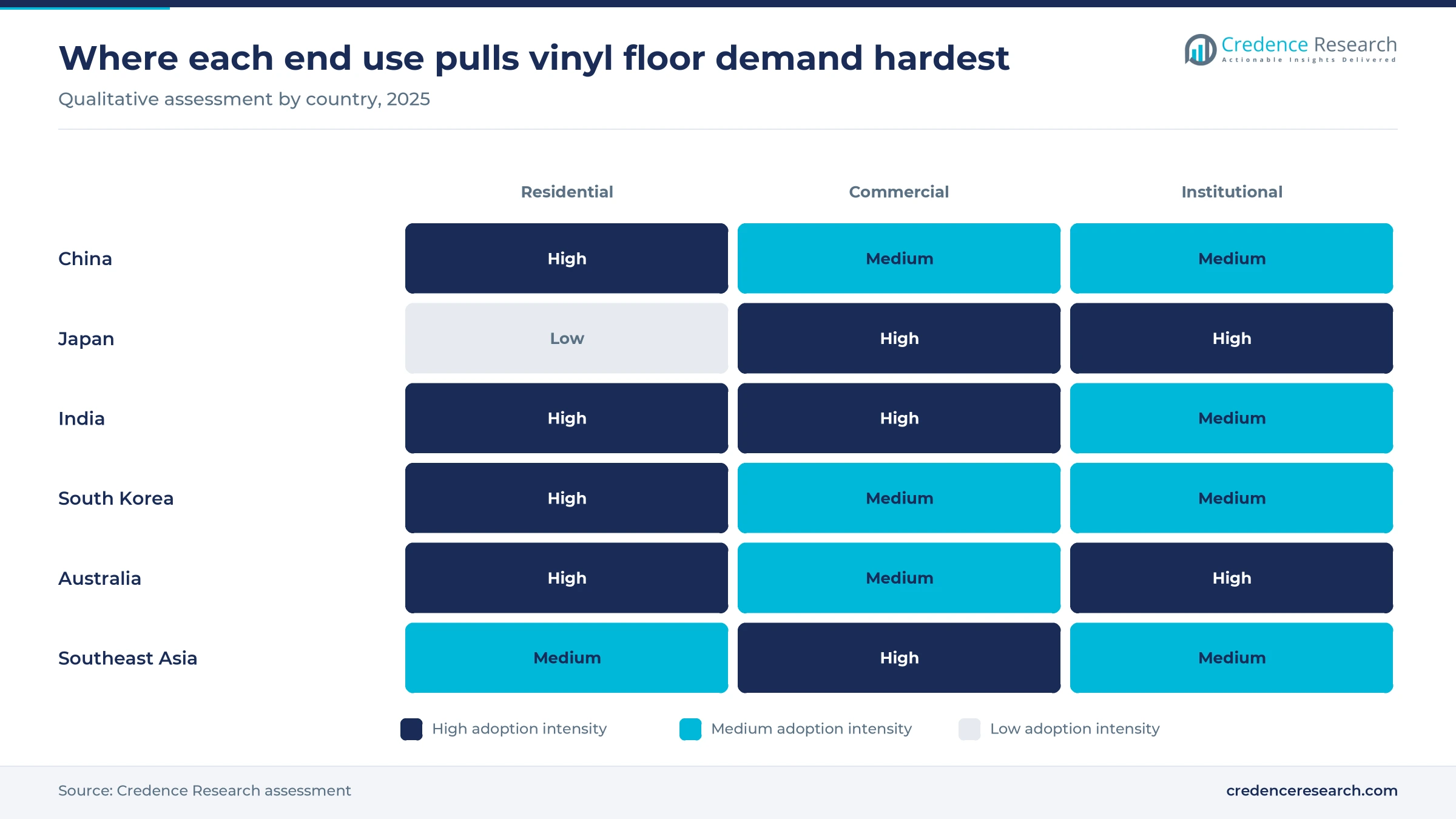
Based on end use, the market is categorized into residential, commercial and institutional buyers. Residential led with 54.0% of 2025 value because apartment handovers and owner renovations set most floor area, and China completed 428.3 million square meters of residential space in 2025, according to the National Bureau of Statistics. Commercial grows fastest at 6.7% a year, as GH Commercial, the Oceania unit of Mohawk Industries, sells vinyl sheet, plank and hybrid floors to workplace, retail, hospitality and multi-residential projects in Australia and New Zealand.
| Segment Group | Leading Sub-segment | Share, 2025 | Fastest-growing Sub-segment | CAGR, 2026–2035 |
|---|---|---|---|---|
| By Product Type | Vinyl Sheet | 33.0% | Rigid Core Vinyl (SPC and WPC) | 7.4% |
| By Installation Method | Glue-Down | 50.0% | Loose-Lay | 6.9% |
| By End Use | Residential | 54.0% | Commercial | 6.7% |
Prices span low-cost hybrid planks to premium contract tile
Vinyl floors are priced per square meter, and the spread between mass retail and contract products is wide. Australian retail SPC planks sell for about AUD 16 per square meter, while TOLI lists Japanese contract loose-lay tile above JPY 9,000. Wear layer thickness, core type, design range, certifications and installation method explain most of that gap. Resin is the largest raw material cost, so the record-low PVC prices of 2025 widened margins for integrated plants. Buyers can therefore save most by choosing the right format for each room rather than by negotiating unit price alone.
| Offer or segment | Typical price or fee | Basis |
|---|---|---|
| Retail SPC hybrid plank, 5mm, Australia | About AUD 16 per square meter (AUD 42.23 per 2.64 sq m pack) | Bunnings listing, November 2026 |
| Contract LVT, Royal Stone and Royal Wood, Japan | JPY 4,800 to JPY 6,900 per square meter, excluding tax | TOLI Corporation price list, June 2025 |
| Loose-lay contract tile, 5mm, Japan | JPY 9,500 to JPY 12,400 per square meter, excluding tax | TOLI Corporation price list, June 2025 |
| PVC resin input, FOB China | USD 600 to USD 620 per metric ton | S&P Global Platts, April 2025 |
Request a Free Sample
Fill in your details and we'll send you a free sample report.
- Sample data tables & charts
- Research methodology
Home handovers, office refits and click formats lift sales
Housing handovers still set most flooring procurement
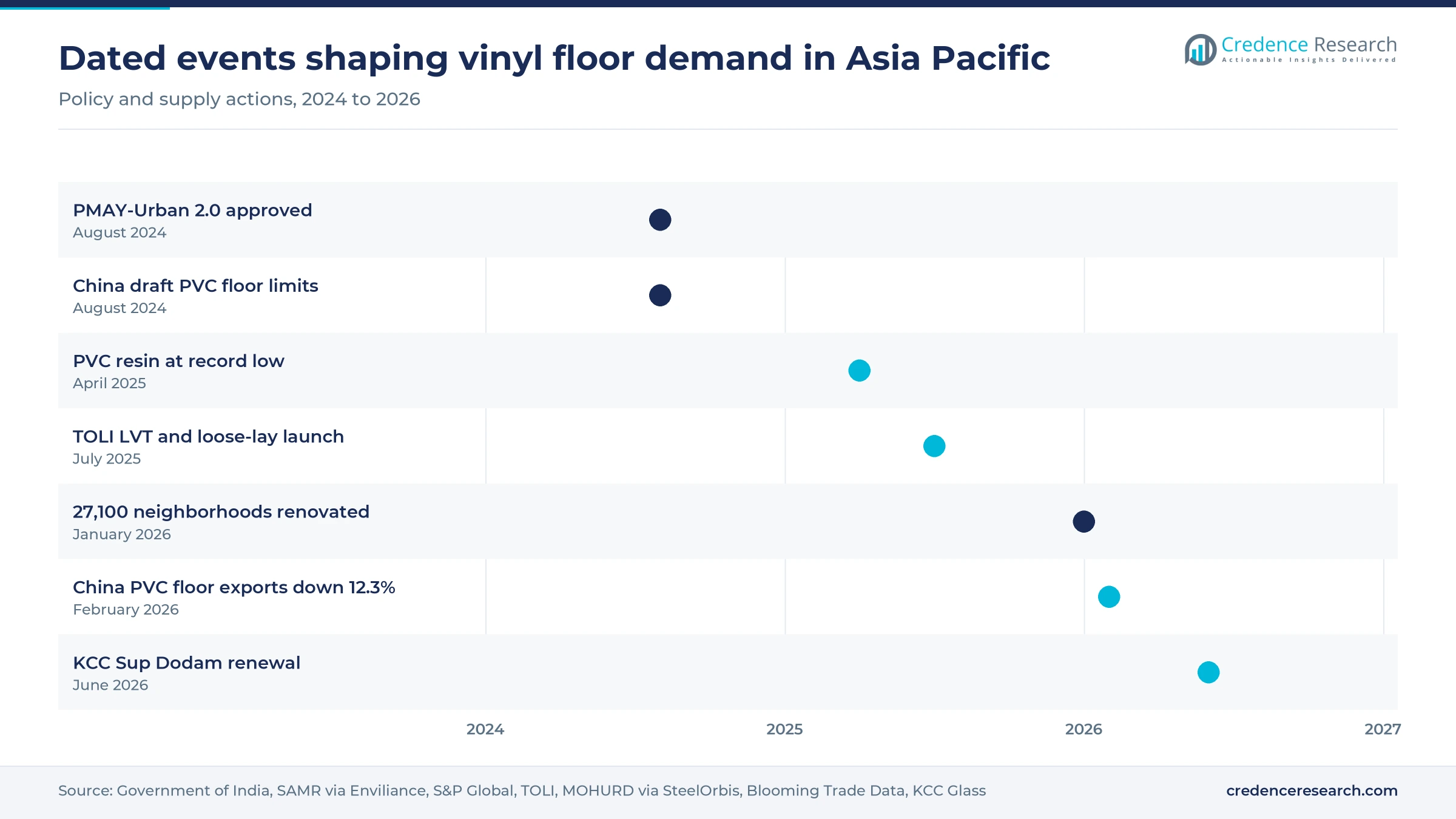
Housing delivery remains the largest single source of vinyl flooring demand, even where new construction is shrinking. China completed 603.5 million square meters of building floor space in 2025, of which 428.3 million square meters was residential, according to the National Bureau of Statistics. Australia completed about 219,000 homes from the June 2024 quarter to the September 2025 quarter, according to the National Housing Supply and Affordability Council, against a target of 1.2 million by June 2029. India approved PMAY-Urban 2.0 on Aug. 9, 2024, to support about 10 million urban homes over five years. Suppliers that win developer and public housing specifications lock in volume for several years.
Commercial buyers move to modular tiles and contract sheet
Offices, shops and hospitals now buy vinyl in modular tile and plank formats that can be replaced in sections, which reduces downtime during refits. TOLI added 22 new patterns to its Royal Stone tile line and launched Eclean Master NW-EX in July 2025, with large formats aimed at commercial facilities, the company said in June 2025. LX Hausys showed sheet vinyl for schools, offices and sports stadiums at TISE in January 2026, reported by The Korea Times. Forbo Flooring Systems sells heterogeneous commercial vinyl through its Australian business. TOLI's Royal Stone and Royal Wood tile lines alone now span 280 items, which shows how wide contract ranges have become. Commercial buyers grow at 6.7% a year on these refits, and contract specifiers reward suppliers with broad design ranges.
Click-lock and loose-lay formats widen the buyer base
Click-lock planks and loose-lay tiles let homeowners, small contractors and facility teams install vinyl without adhesive or specialist floor layers. Bunnings lists HanWood 5mm SPC hybrid planks with a 20-year residential warranty that can be laid in wet areas. Responsive Industries makes LVP, SPC and sheet vinyl at Boisar in Maharashtra, where it reports installed capacity of 10,000 metric tons a month across 15 lines, and offers I4F and Unilin click systems, according to the India Brand Equity Foundation. TOLI markets its loose-lay tiles as needing no adhesive and no wax. Loose-Lay floors grow at 6.9% a year, which favors suppliers that hold click-joint licenses.
Low resin prices and surplus Chinese capacity cut costs
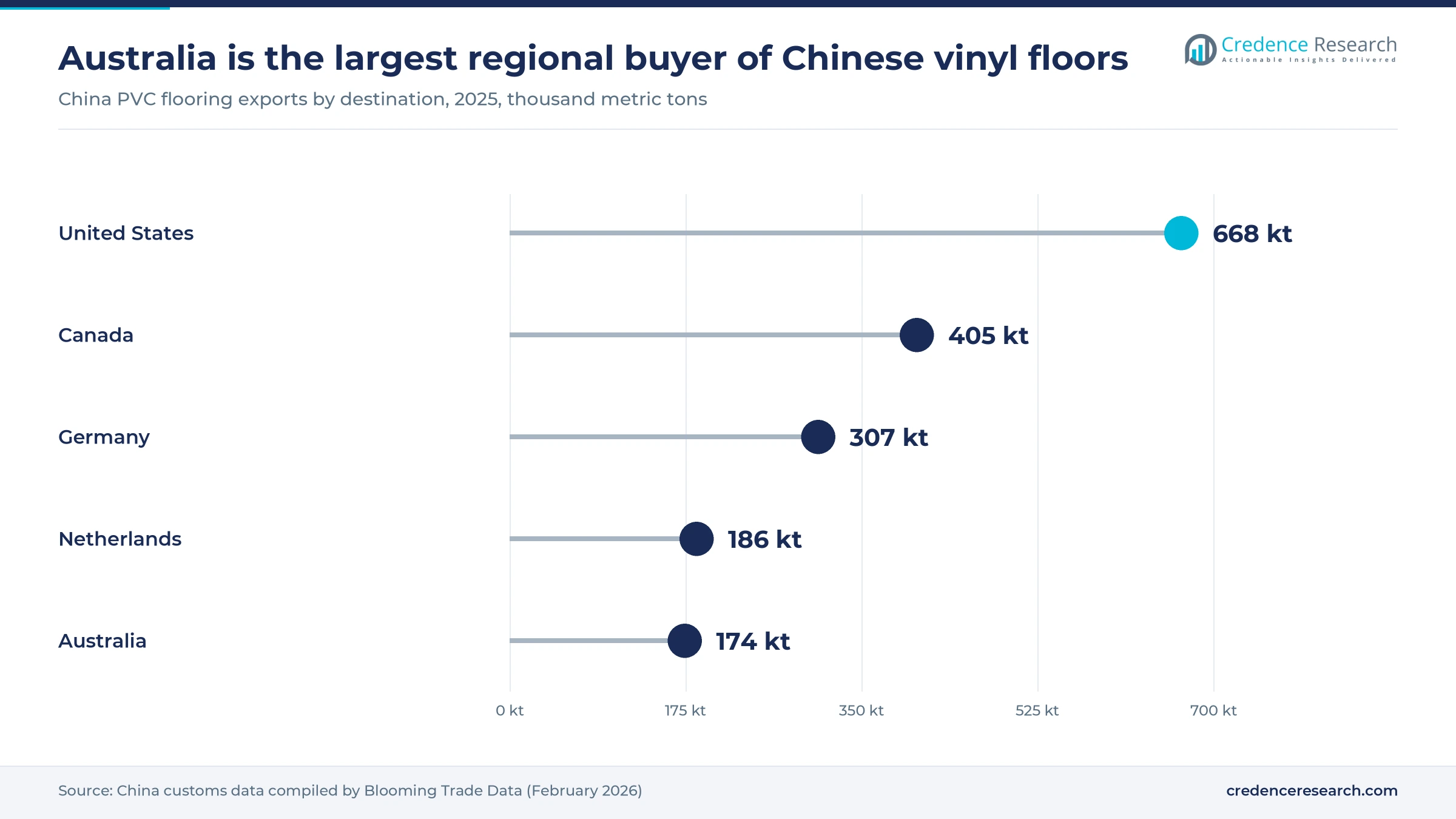
Cheap feedstock and spare plant capacity keep vinyl floor prices low across the region, which helps vinyl win against ceramic and wood in budget projects. Platts assessed carbide-based FOB China PVC at USD 600 per metric ton on April 24, 2025, an all-time low about half the early-2022 peak. China exported 4.156 million metric tons of PVC flooring in 2025, down 12.3%, according to customs data compiled by Blooming Trade Data in February 2026. Australia took 174,000 metric tons of that volume, the most of any regional destination. Plants that buy PVC resin at these levels can protect margins while they redirect surplus output toward buyers in the region.
Health-labeled floors and recycling schemes gain ground
Rise of antiviral, pet-safe and acoustic home floors
Korean makers are shifting home floors toward health and comfort claims that justify higher prices than plain sheet. KCC Glass renewed its Homecc Sup Dodam PVC floor on June 11, 2026, adding a Virus Care surface that Korea Testing and Research Institute tests found killed 99.9% of a coronavirus strain within 24 hours. The product comes in 2.7mm and 3.2mm thicknesses and carries pet product certification. LX Hausys reported that its X-Comfort double-cushion sheet cut household impact noise and gave about 30% better slip resistance for dogs than its wood-style floor. These claims move competition from price per square meter to certified performance, which favors makers with testing budgets.
Shift toward eco-labeled and phthalate-free vinyl
Buyers and regulators in the region are shifting specifications toward vinyl flooring with declared chemistry and third-party labels. Every product in the TOLI LVT series released on July 24, 2025, carries Eco Mark certification, and several loose-lay lines hold SuMPO environmental product declarations, according to the company. Responsive Industries offers recyclable and phthalate-free vinyl variants within a portfolio of more than 30 product categories, according to the India Brand Equity Foundation. KCC Glass's renewed Sup Dodam floor, launched on June 11, 2026, carries a Korea Atopy Association recommended mark, Star News Korea reported. LX Z:IN X-Comfort also carries a Korean Ministry of Environment eco-label for low-emission materials, according to Hankyung. Demand for non-phthalate plasticizers follows this shift, and suppliers without verified content data risk losing public and healthcare tenders.
Opportunity in China's old neighborhood renovation
China's urban renewal program gives vinyl suppliers a large, steady renovation pipeline while new housing shrinks. China began renovating 27,100 old urban neighborhoods in 2025 with investment of RMB 133.2 billion, beating a target of 25,000, according to the Ministry of Housing and Urban-Rural Development figures reported by SteelOrbis in January 2026. Hangzhou gave buyers of new homes vouchers worth up to 100,000 yuan per home for decoration spending, China Daily reported on Feb. 10, 2026. Beijing offers families with older members up to 5,000 yuan for age-friendly home changes, including bathroom remodels that also involve ceramic sanitaryware. Slip-resistant vinyl sheet suits these age-friendly retrofits, so suppliers with certified anti-slip ranges can draw on the subsidy budgets.
Opportunity in recycled vinyl floors for Australian projects
Australia's industry-run recycling scheme creates an opening for suppliers that can take back offcuts and old floors. The Australian Resilient Flooring Association received AUD 1 million from the National Product Stewardship Investment Fund to design ResiLoop, according to Planet Ark. About 22.3 million square meters of resilient flooring are sold in Australia each year, and about 60,000 metric tons are thrown away, nearly all of it to landfill. The scheme targets a 35% recovery rate by its fourth year, funded by a per-square-meter levy. Suppliers that offer recycled content and take-back can win green building points on public and commercial projects.
Housing contraction, trade curbs and new limits weigh
China's property contraction cuts new-build volume
China's housing slump removes floor area that vinyl makers once sold to developers. Real estate development investment fell 17.2% in 2025, and newly started floor space fell 20.4%, according to the National Bureau of Statistics. Fewer starts today mean fewer handovers in 2026 and 2027. Developers also delay fit-out payments, which squeezes the cash flow of distributors. Suppliers are responding by moving sales teams toward renovation and public projects, where orders are smaller but payment is more reliable.
Shrinking housing starts in Japan and South Korea
Mature North Asian markets are losing new-build demand as populations age. Japan recorded 740,667 housing starts in 2025, down 6.5% and a 62-year low, according to the land ministry. South Korea started 133,585 apartments in January to November 2023, down 52%, the Asia Business Daily reported. Domestic makers such as TOLI, Tajima, LX Hausys and KCC Glass must rely on replacement and commercial refits, which lowers volume growth and raises marketing costs.
Trade defense on resin raises costs for Indian plants
Import curbs on Chinese resin raise input costs for vinyl makers in India. India's Directorate General of Trade Remedies proposed provisional anti-dumping duties of USD 82 to USD 167 per metric ton on Chinese PVC suspension resin in October 2024, according to S&P Global. Chinese resin made up 40% of India's 3.22 million metric tons of PVC imports in 2024. Indian producers face higher costs than rivals that buy at Chinese prices, so they push design and service rather than price.
Draft Chinese chemical limits raise compliance costs
A draft Chinese standard will make many plants change formulations and testing. The State Administration for Market Regulation notified the WTO on Aug. 27, 2024, of a draft that merges GB 18586-2001 on PVC flooring with the carpet standard and adds limits for phthalates, total volatile organic compounds and heavy metals, according to Enviliance. Smaller producers that still use low-cost phthalate plasticizers must reformulate, which raises cost per square meter and may push some of them out of the domestic market.
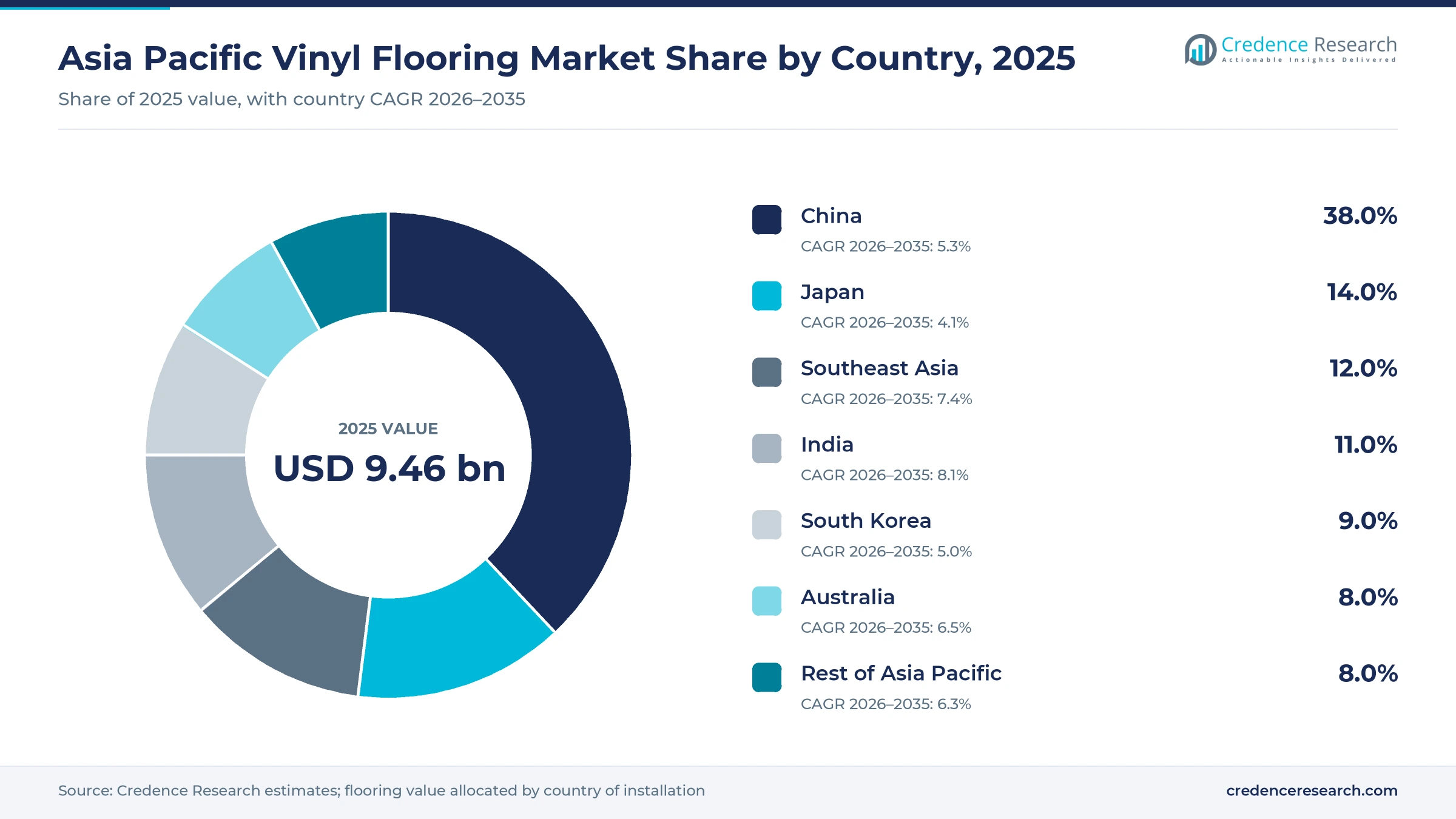
China holds the largest base as India grows fastest
| Country | Value, 2025 (USD billion) | Share, 2025 | CAGR, 2026–2035 |
|---|---|---|---|
| China | 3.60 | 38.0% | 5.3% |
| Japan | 1.32 | 14.0% | 4.1% |
| Southeast Asia | 1.14 | 12.0% | 7.4% |
| India | 1.04 | 11.0% | 8.1% |
| South Korea | 0.85 | 9.0% | 5.0% |
| Australia | 0.76 | 8.0% | 6.5% |
| Rest of Asia Pacific | 0.76 | 8.0% | 6.3% |
China leads on housing scale and renovation programs
China held 38.0% of 2025 value and grows at 5.3% a year. The country has the largest housing stock in the region, and the renovation program described above now offsets part of the drop in new completions. China is also the main export base for SPC and LVT, so domestic buyers can choose from a deep supplier pool at low prices. Growth stays below the regional average because new-build volumes keep falling.
Japan relies on contract tiles and refurbishment
Japan held 14.0% of 2025 value and grows at 4.1% a year, the slowest pace in the region. Housing starts at a 62-year low limit new-build demand, so TOLI and Tajima focus on offices, retail, schools and care facilities. Contract tiles sell at high prices per square meter, which keeps Japan's value share above its share of floor area. Loose-lay tiles that allow fast refits are the main source of new value in the country.
India grows fastest on housing and commercial space
India held 11.0% of 2025 value and is the fastest-growing country at 8.1% a year. PMAY-Urban 2.0 adds urban homes, while offices, hospitals and retail chains specify vinyl sheet and LVT for durability. Responsive Industries supplies the market from Maharashtra through more than 75 distributors, according to the India Brand Equity Foundation. Higher resin costs from trade defense measures limit price cuts, so growth comes from new floor area rather than lower prices.
South Korea favors cushioned sheet in apartments
South Korea held 9.0% of 2025 value and grows at 5.0% a year. Korean apartments use thick, cushioned PVC sheet as standard, so LX Hausys and KCC Glass compete on noise reduction, pet safety and antiviral claims. Weak apartment starts hold back new-build volume, and remodeling has become the main source of orders. Premium sheet lines with certified functions lift value per square meter even when floor area is flat.
Australia buys hybrid planks through big-box retail
Australia held 8.0% of 2025 value and grows at 6.5% a year. Home-improvement chains sell SPC hybrid planks to renovators, while GH Commercial, Forbo, Tarkett and Gerflor supply contract sheet and tile to hospitals, aged care and offices. Housing completions are running behind the national target, which slows new-build demand. The ResiLoop recycling scheme gives local suppliers a way to win green building points on public projects.
Southeast Asia adds plants and growing local demand
Southeast Asia held 12.0% of 2025 value and grows at 7.4% a year. Vietnam hosts SPC and LVT plants that re-export to the United States, and S&P Global linked weak Vietnamese resin demand in April 2025 to tariff pressure on those exports. Local demand comes from condominiums, hotels and shopping malls in Vietnam, Thailand, Indonesia, Malaysia and the Philippines. Spare plant capacity in the region gives local buyers lower prices than in North Asia.
Rest of Asia Pacific follows Australian contract practice
The rest of Asia Pacific held 8.0% of 2025 value and grows at 6.3% a year. New Zealand buys most of its contract vinyl through the same suppliers as Australia, including GH Commercial. Taiwan, Hong Kong and smaller markets add demand from offices, clinics and retail fit-outs. Small project sizes and import-based supply keep prices higher than in China, but total volume stays modest.
Housing, standards and product moves from 2024 to 2026
| Development | Status and market relevance |
|---|---|
| In August 2024, India approved PMAY-Urban 2.0 to support about 10 million urban homes over five years, which adds a long pipeline of flooring demand. | Active, with funding released in stages to states and cities |
| In August 2024, China notified the WTO of a draft standard adding phthalate, TVOC and heavy metal limits for PVC flooring. | Draft, with plants preparing new formulations |
| In July 2025, TOLI Corporation began selling new LVT patterns and larger loose-lay tile sizes for offices and commercial facilities in Japan. | On sale, with Eco Mark certification across the LVT series |
| In January 2026, China reported that 27,100 old urban neighborhoods began renovation in 2025, above the target of 25,000. | Completed for 2025, and the program continues in 2026 |
| In June 2026, KCC Glass renewed its Homecc Sup Dodam PVC floor with an antiviral surface and a wider design range of 19 styles. | On sale in South Korea for households with children and pets |
Rigid cores and adhesive-free backings change installs
- Stone-plastic composite cores combine PVC with limestone powder to make rigid, waterproof planks that can float over uneven subfloors without adhesive.
- Click-lock joint systems licensed from I4F and Unilin let installers lock planks together quickly, which cuts labor time and allows DIY installation.
- Loose-lay backings use heavy, high-friction layers made from PVC compounds so tiles stay flat without glue and can be lifted for access to cables.
- Double-cushion sheet construction adds two foam layers under the wear surface to absorb impact and reduce noise between floors in apartment buildings.
Need a Custom Version of This Report?
Tailor the scope, geography, or segments to your exact requirements.
- Custom geography or segment scope
- Direct access to our analyst team
Korean and Japanese makers face European contract brands
Competition in the region splits into three groups that rarely meet head-on in the same tender. Korean and Japanese makers, led by LX Hausys, KCC Glass, TOLI and Tajima, hold strong domestic positions through brand recognition, dealer networks and products designed for local housing. European contract specialists, including Tarkett, Gerflor and Forbo, compete for hospital, school and office specifications with homogeneous sheet, acoustic floors and documented sustainability data. Mohawk Industries reaches Australia and New Zealand through GH Commercial and its Godfrey Hirst brands. Indian producers such as Responsive Industries compete on local manufacturing and wide distribution. Chinese and Vietnamese export plants supply large volumes of SPC and LVT to retail chains under private labels. Suppliers compete on design range, certifications, installation support and price per square meter.
Calendering scale and contract specifications set the structure
Supply is split between national champions, European contract specialists and a large group of Chinese and Vietnamese export plants. LX Hausys and KCC Glass dominate Korean residential sheet, while TOLI and Tajima lead Japanese contract tile. Tarkett, Gerflor, Forbo and Mohawk's GH Commercial win hospital, aged care and office specifications in Australia and other markets. Entry barriers are low for SPC planks but high for welded sheet and certified contract tile, where test data and installer networks matter. Margins are highest in specified contract products and lowest in export-grade rigid core planks.
Leading vinyl floor suppliers in the region
| Company | Type | Role in the market |
|---|---|---|
| LX Hausys | Full-line supplier | Leads Korean residential sheet with LX Z:IN and sells LVT and contract sheet |
| TOLI Corporation | Specialist | Sells LVT, loose-lay tile and vinyl sheet to Japanese offices and facilities |
| Tarkett | Contract specialist | Supplies iQ homogeneous sheet and LVT to Australian healthcare and education projects |
| Gerflor | Contract specialist | Sells Mipolam and Taralay vinyl sheet for hospitals and aged care in Australasia |
| Mohawk Industries (GH Commercial) | Full-line supplier | Sells vinyl sheet, plank and hybrid floors in Australia and New Zealand |
| Tajima | Specialist | Makes vinyl tile, LVP and hygienic sheet for Japanese commercial and medical buildings |
| Forbo Flooring Systems | Contract specialist | Sells heterogeneous commercial vinyl through its Australian business |
| KCC Glass (Homecc) | Local manufacturer | Sells premium PVC home floors such as Sup Dodam in South Korea |
| Responsive Industries | Local manufacturer | Makes sheet vinyl, LVP and SPC in Maharashtra for Indian and export buyers |
Credence Research view on regional vinyl floor demand
Credence Research's view is that the regional vinyl floor market is moving from new-build volume toward renovation and contract refits. That shift favors suppliers with design depth, certified performance and installer support over low-cost export plants. China remains the largest market, but its growth depends on how much of the renovation budget reaches floors. India and Southeast Asia offer the fastest growth from a smaller base. Buyers should expect stable to falling prices for retail SPC planks and firmer prices for contract sheet and loose-lay tile as chemical rules tighten.
Country and segment values rest on installed demand
The report uses 2025 as the base year and forecasts value to 2035. Market values come from the Credence Research model, which links installed vinyl floor area to housing completions, renovation programs, commercial construction and average prices by product. Country, product, installation and end-use splits are Credence Research estimates. Sources include national statistics offices, housing and trade agencies, customs-based trade data, regulator notices, company releases and price lists, and reputable trade press. No interviews or surveys were used to prepare this edition of the report.
Renovation and contract tiles carry growth to 2035
The regional vinyl floor market will rely less on new apartments and more on renovation, commercial refits and institutional projects through 2035. Chinese renovation programs, Indian public housing and Southeast Asian commercial construction provide the main volume. Rigid core planks and loose-lay tiles will keep gaining share as installers favor quick, adhesive-free formats. Chemical limits in China and recycling schemes in Australia will raise the cost of compliance but reward suppliers with clean formulations and take-back programs. Pricing for specified contract products should stay firm through the decade.
Renovation funding and resin costs set the 2035 range
The range of outcomes depends mainly on how quickly China's renovation and housing support programs offset falling new-build volumes. Stable resin prices would keep vinyl cheaper than ceramic and wood, which supports share gains in India and Southeast Asia. A deeper property slump, higher tariffs on regional exports or strict chemical limits that push out low-cost plants would slow value growth. Faster commercial refits and wider recycling schemes would lift it.
| Scenario | CAGR, 2026–2035 | Value, 2035 | What has to hold |
|---|---|---|---|
| Downside | 4.4% | USD 14.80 billion | China property slump deepens and resin costs rise on trade defense measures |
| Base | 5.90% | USD 16.83 billion | Renovation programs continue and commercial refits grow at recent rates across the region |
| Upside | 7.2% | USD 18.78 billion | Larger renovation subsidies, faster Indian housing and wider loose-lay use in offices |
Frequently Asked Questions
How big is the Asia Pacific vinyl flooring market?
Which country leads the regional vinyl floor market?
Which country grows fastest?
Which product type leads the market?
How much does vinyl flooring cost in the region?
Why are rigid core and loose-lay floors growing?
What holds the market back?
Who are the main companies in this market?
Table of Content
Chapter 1 Market Segmentation
- 1.1 Segmentation Framework
- 1.1.1 Product and Service Classification
- 1.1.2 Application and End-Use Classification
- 1.1.3 Technology and Solution Classification
- 1.1.4 Customer and Distribution Channel Classification
- 1.1.5 Geographic Segmentation
- 1.1.6 Market Segment Definitions and Boundaries
- 1.2 By Product Type
- 1.2.1 Vinyl Sheet
- 1.2.2 Luxury Vinyl Tile
- 1.2.3 Rigid Core Vinyl (SPC and WPC)
- 1.2.4 Vinyl Composition Tile
- 1.3 By Installation Method
- 1.3.1 Glue-Down
- 1.3.2 Click-Lock
- 1.3.3 Loose-Lay
- 1.4 By End Use
- 1.4.1 Residential
- 1.4.2 Commercial
- 1.4.3 Institutional
- 1.5 By Country
- 1.5.1 China
- 1.5.2 Japan
- 1.5.3 India
- 1.5.4 South Korea
- 1.5.5 Australia
- 1.5.6 Southeast Asia
- 1.5.7 Rest of Asia Pacific
Chapter 2 Introduction
- 2.1 Report Objectives and Scope
- 2.2 Product Definition and Industry Terminology
- 2.3 Market Inclusions and Exclusions
- 2.4 Research Process
- 2.4.1 Primary Research and Expert Interviews
- 2.4.2 Secondary Research and Source Review
- 2.4.3 Top-Down and Bottom-Up Estimation
- 2.4.4 Data Triangulation and Verification
- 2.5 Market Size Measurement Basis
- 2.5.1 2025: USD 9.46 billion → 2035: USD 16.83 billion
- 2.6 Historical and Forecast Reference Periods
- 2.6.1 Historical Period: 2018-2025
- 2.6.2 Base Year: 2025
- 2.6.3 Forecast Period: 2025-2035
- 2.7 Research Assumptions and Limitations
Chapter 3 Executive Summary
- 3.1 Market Snapshot and Key Findings
- 3.2 Base-Year Market Size, 2025
- 3.3 Forecast Market Size, 2035
- 3.4 Revenue and Volume Growth Outlook
- 3.5 Key Demand and Supply Indicators
- 3.6 Leading Market Segments
- 3.7 Fastest-Growing Market Opportunities
- 3.8 Regional Performance Highlights
- 3.9 Technology and Industry Transformation
- 3.10 Competitive Landscape Summary
- 3.11 Analyst View and Strategic Implications
Chapter 4 Asia Pacific Vinyl Flooring Market Trends and Developments
- 4.1 Historical Industry Development, 2018-2025
- 4.2 Recent Market Trends and Developments
- 4.3 Demand and Customer Behavior Trends
- 4.4 Technology and Product Innovation
- 4.5 Artificial Intelligence, Automation and Digitalization
- 4.6 Local Manufacturing and Supply Chain Realignment
- 4.7 Industry Partnerships, Mergers and Acquisitions
- 4.8 Sustainability and Circular Economy Developments
- 4.9 Government and Private Sector Investment Trends
- 4.10 Emerging Business Models and Commercialization
- 4.11 Industry Developments and Announcements
Chapter 5 Asia Pacific Vinyl Flooring Market Production, Supply and Demand Analysis
- 5.1 Demand Trend and Consumption Analysis, 2018-2025
- 5.2 Demand Forecast, 2025-2035
- 5.3 Production and Output Trend, 2018-2025
- 5.4 Production and Output Forecast, 2025-2035
- 5.5 Installed Capacity and Capacity Utilization
- 5.6 Company-Wise Production Plants and Statistics
- 5.6.1 Installed Production Capacity
- 5.6.2 Actual Production
- 5.6.3 Planned Capacity and Expansion Targets
- 5.7 Supply Chain Structure and Procurement Trends
- 5.8 Supply-Demand Gap and Bottlenecks
- 5.9 Import Dependence and Sourcing Structure
- 5.10 Contract Manufacturing and Outsourcing
- 5.11 Regional Supply and Demand Concentration
Chapter 6 Asia Pacific Vinyl Flooring Market Pricing Analysis
- 6.1 Pricing Structure and Measurement
- 6.2 Historical Pricing Trends, 2018-2025
- 6.3 Pricing Outlook, 2025-2035
- 6.4 Average Selling Price and Unit Economics
- 6.5 Pricing by Product and Market Segment
- 6.6 Geographic Pricing Differences
- 6.7 Key Input, Energy, Labor and Logistics Costs
- 6.8 Contract Pricing and Purchasing Models
- 6.9 Pricing Sensitivity and Competitive Positioning
- 6.10 Price, Margin and Profitability Implications
Chapter 7 Asia Pacific Vinyl Flooring Market Dynamics
- 7.1 Market Growth Drivers
- 7.1.1 Demand-Side Drivers
- 7.1.2 Technology and Innovation Drivers
- 7.1.3 Infrastructure and Investment Drivers
- 7.1.4 Regulatory and Policy Drivers
- 7.2 Market Restraints
- 7.2.1 Cost and Affordability Constraints
- 7.2.2 Technology and Adoption Barriers
- 7.2.3 Supply Chain and Operational Constraints
- 7.3 Market Challenges
- 7.3.1 Competitive Pressure and Margin Erosion
- 7.3.2 Skills, Infrastructure and Implementation Gaps
- 7.4 Emerging Market Opportunities
- 7.5 Market Dynamics Impact and Time-Horizon Assessment
Chapter 8 Asia Pacific Vinyl Flooring Value Chain Analysis
- 8.1 Industry Value Chain Overview
- 8.2 Upstream Suppliers and Critical Inputs
- 8.3 Technology and Component Providers
- 8.4 Manufacturing or Service Delivery
- 8.5 Distribution, Channel Partners and Integrators
- 8.6 Downstream Applications and End Users
- 8.7 Value Addition and Profit Pools
- 8.8 Vertical Integration and Outsourcing
- 8.9 Supplier Concentration and Risk
- 8.10 Supply Chain Localization and Resilience
Chapter 9 Asia Pacific Vinyl Flooring Market Regulations and Policies
- 9.1 Relevant Laws, Standards and Compliance Frameworks
- 9.2 Product, Service, Safety and Quality Requirements
- 9.3 Government Policies, Incentives and Subsidies
- 9.4 Imports, Exports and Trade Barriers
- 9.5 Public Procurement and Local Content Requirements
- 9.6 Environmental and Sustainability Compliance
- 9.7 Upcoming Policy Changes and Market Implications
Chapter 10 Asia Pacific Vinyl Flooring Market Hotspots and Opportunities
- 10.1 Market Opportunity Mapping and Growth Hotspots
- 10.2 High-Growth Applications and Customer Groups
- 10.3 Underserved Markets and White-Space Opportunities
- 10.4 Emerging Technology and Product Opportunities
- 10.5 New Capacity and Investment Hotspots
- 10.6 Market Entry and Expansion Opportunities
- 10.7 Distribution and Partnership Opportunities
- 10.8 Near-Term and Long-Term Commercial Potential
- 10.9 Opportunity Attractiveness and Execution Risks
Chapter 11 Asia Pacific Vinyl Flooring Market Outlook, 2025-2035
- 11.1 Market Size and Analysis
- 11.1.1 Revenue (Market Measurement: 2025: USD 9.46 billion → 2035: USD 16.83 billion)
- 11.1.2 Market Volume and Quantity Sold
- 11.1.3 Historical Market Size, 2018-2025
- 11.1.4 Base-Year Market Size, 2025
- 11.2 Market Forecast, 2025-2035
- 11.2.1 Revenue Forecast to 2035
- 11.2.2 Volume Forecast to 2035
- 11.2.3 CAGR and Year-on-Year Growth
- 11.2.4 Incremental Revenue Opportunity
- 11.3 Forecast Assumptions and Scenario Analysis
- 11.3.1 Base-Case Forecast
- 11.3.2 Optimistic and Conservative Scenarios
- 11.3.3 Technology, Pricing and Policy Sensitivities
- 11.4 Market Attractiveness and Growth Outlook
Chapter 12 Asia Pacific Vinyl Flooring Market Segmentation and Outlook
- 12.1 Segmentation Summary and Market Shares, 2025
- 12.2 Largest and Fastest-Growing Segments
- 12.3 By Product Type - Market Size and Forecast, 2025-2035
- 12.3.1 Segment Definition and Scope
- 12.3.2 Historical Market Size, 2018-2025
- 12.3.3 Revenue Forecast, 2025-2035
- 12.3.4 Volume Forecast, 2025-2035
- 12.3.5 Base-Year Market Share, 2025
- 12.3.6 Segment CAGR and Growth Drivers
- 12.3.7 Subsegment Market Size and Forecast
- 12.3.7.1 Vinyl Sheet
- 12.3.7.2 Luxury Vinyl Tile
- 12.3.7.3 Rigid Core Vinyl (SPC and WPC)
- 12.3.7.4 Vinyl Composition Tile
- 12.3.8 Subsegment Pricing and Adoption Trends
- 12.3.9 Leading Suppliers and Competition
- 12.3.10 Regional Demand and Opportunities
- 12.4 By Installation Method - Market Size and Forecast, 2025-2035
- 12.4.1 Segment Definition and Scope
- 12.4.2 Historical Market Size, 2018-2025
- 12.4.3 Revenue Forecast, 2025-2035
- 12.4.4 Volume Forecast, 2025-2035
- 12.4.5 Base-Year Market Share, 2025
- 12.4.6 Segment CAGR and Growth Drivers
- 12.4.7 Subsegment Market Size and Forecast
- 12.4.7.1 Glue-Down
- 12.4.7.2 Click-Lock
- 12.4.7.3 Loose-Lay
- 12.4.8 Subsegment Pricing and Adoption Trends
- 12.4.9 Leading Suppliers and Competition
- 12.4.10 Regional Demand and Opportunities
- 12.5 By End Use - Market Size and Forecast, 2025-2035
- 12.5.1 Segment Definition and Scope
- 12.5.2 Historical Market Size, 2018-2025
- 12.5.3 Revenue Forecast, 2025-2035
- 12.5.4 Volume Forecast, 2025-2035
- 12.5.5 Base-Year Market Share, 2025
- 12.5.6 Segment CAGR and Growth Drivers
- 12.5.7 Subsegment Market Size and Forecast
- 12.5.7.1 Residential
- 12.5.7.2 Commercial
- 12.5.7.3 Institutional
- 12.5.8 Subsegment Pricing and Adoption Trends
- 12.5.9 Leading Suppliers and Competition
- 12.5.10 Regional Demand and Opportunities
- 12.6 By Country - Market Size and Forecast, 2025-2035
- 12.6.1 Segment Definition and Scope
- 12.6.2 Historical Market Size, 2018-2025
- 12.6.3 Revenue Forecast, 2025-2035
- 12.6.4 Volume Forecast, 2025-2035
- 12.6.5 Base-Year Market Share, 2025
- 12.6.6 Segment CAGR and Growth Drivers
- 12.6.7 Subsegment Market Size and Forecast
- 12.6.7.1 China
- 12.6.7.2 Japan
- 12.6.7.3 India
- 12.6.7.4 South Korea
- 12.6.7.5 Australia
- 12.6.7.6 Southeast Asia
- 12.6.7.7 Rest of Asia Pacific
- 12.6.8 Subsegment Pricing and Adoption Trends
- 12.6.9 Leading Suppliers and Competition
- 12.6.10 Regional Demand and Opportunities
- 12.7 Segment Growth Comparison
- 12.8 Segment Attractiveness and Priority Matrix
Chapter 13 Asia Pacific Vinyl Flooring End-Use and Application Market Outlook
- 13.1 End-Use Industry and Customer Demand Structure
- 13.2 Leading Applications and Customer Groups
- 13.3 End-Use Market Size, Share and Forecast
- 13.4 Major End-Use Industry Deep Dives
- 13.4.1 Customer Requirements and Use Cases
- 13.4.2 Demand and Replacement Cycles
- 13.4.3 Technical and Regulatory Considerations
- 13.4.4 Purchasing and Procurement Models
- 13.4.5 Leading Vendors and Distribution Channels
- 13.4.6 Forecast and Commercial Opportunities
- 13.5 Emerging Applications and Cross-Segment Demand
- 13.6 End-Use Industry Investment Priorities
Chapter 14 Asia Pacific Vinyl Flooring Geographic Market Outlook, 2025-2035
- 14.1 Regional Market Size and Country-Level Shares, 2025
- 14.2 Country Market Size Comparison, 2025
- 14.3 Country Market Forecasts, 2025-2035
- 14.4 Subregional Industrial and Demand Clusters
- 14.5 Intra-Regional Pricing and Cost Differences
- 14.6 Cross-Border Trade and Supply Networks
- 14.7 Regional Supply and Demand Balances
- 14.8 Country Opportunity Comparison and Prioritization
Note: Every listed country is covered on the structure shown under the first country.
Chapter 15 Asia Pacific Vinyl Flooring Technology, Innovation and Sustainability Outlook
- 15.1 Technology Landscape and Maturity
- 15.2 Product, Process and Service Innovation
- 15.3 AI, Automation and Digital Tools in the Industry
- 15.4 Technology Adoption and Performance Benchmarking
- 15.5 Innovation Pipeline and R&D Investment
- 15.6 Patent and Intellectual Property Trends
- 15.7 Energy Efficiency and Resource Management
- 15.8 Sustainability, Recycling and Circularity
- 15.9 Technology Roadmap, 2025-2035
- 15.10 Risks of Obsolescence and Technology Substitution
Chapter 16 Asia Pacific Vinyl Flooring Market Key Strategic Imperatives
- 16.1 Growth and Market Entry Priorities
- 16.2 High-Return Products and Segments
- 16.3 Pricing, Profitability and Cost Optimization
- 16.4 Technology Investment and Product Differentiation
- 16.5 Supply Chain Localization and Resilience
- 16.6 Distribution and Customer Acquisition
- 16.7 Partnership, Acquisition and Capacity Strategy
- 16.8 Regional Expansion Priorities
- 16.9 Short-, Medium- and Long-Term Actions
Chapter 17 Competition Outlook
- 17.1 Industry Competition Characteristics
- 17.2 Market Structure and Concentration
- 17.3 Market Share and Competitive Positioning, 2025
- 17.4 Company-Wise Revenue and Product Benchmarking
- 17.5 Production and Service Capacity Benchmarking
- 17.6 Technology, Pricing and Differentiation
- 17.7 Regional Footprint and Distribution Strength
- 17.8 Mergers, Acquisitions and Strategic Alliances
- 17.9 New Entrants and Competitive Threats
- 17.10 Porter's Five Forces and Industry Attractiveness
- 17.11 Competitive Outlook, 2025-2035
Chapter 18 Company Profiles
- 18.1 Company Coverage and Selection Criteria
- 18.2 LX Hausys
- 18.2.1 Business Description
- 18.2.2 Company Ownership and Geographic Presence
- 18.2.3 Product and Service Portfolio
- 18.2.4 Manufacturing and Operating Footprint
- 18.2.5 Production Capacity and Expansion Plans
- 18.2.6 Financial Performance and Investment
- 18.2.7 Market Share and Competitive Position
- 18.2.8 Technology and Innovation Capabilities
- 18.2.9 Strategic Alliances or Partnerships
- 18.2.10 Recent Developments
- 18.2.11 Growth Strategy and Outlook
- 18.3 TOLI Corporation
- 18.4 Tarkett
- 18.5 Gerflor
- 18.6 Mohawk Industries (GH Commercial)
- 18.7 Tajima
- 18.8 Forbo Flooring Systems
- 18.9 KCC Glass (Homecc)
- 18.10 Responsive Industries
- 18.11 Other Relevant Market Participants
Note: Every listed company is profiled on the structure shown under the first company. The company list is preliminary and may change based on research findings, market developments, data availability and client requirements.
Chapter 19 Disclaimer
- 19.1 Research and Forecast Disclaimer
- 19.2 Data Source and Estimation Limitations
Note: The depth of individual sections depends on data availability for this market. Volume, capacity, trade and other unit-based metrics are included where applicable.

