
Resurfacing contracts and new highways set Saudi mix demand
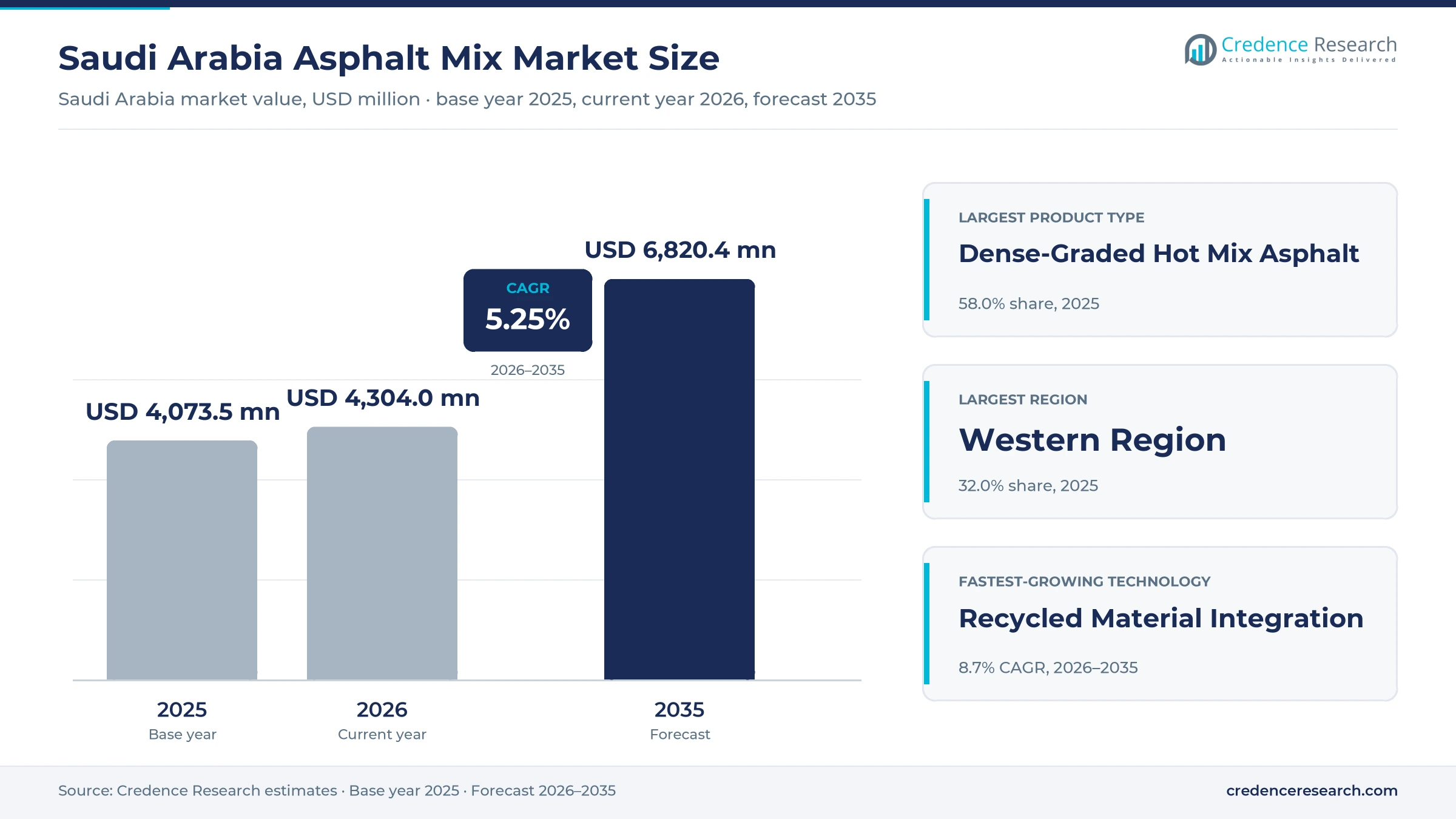
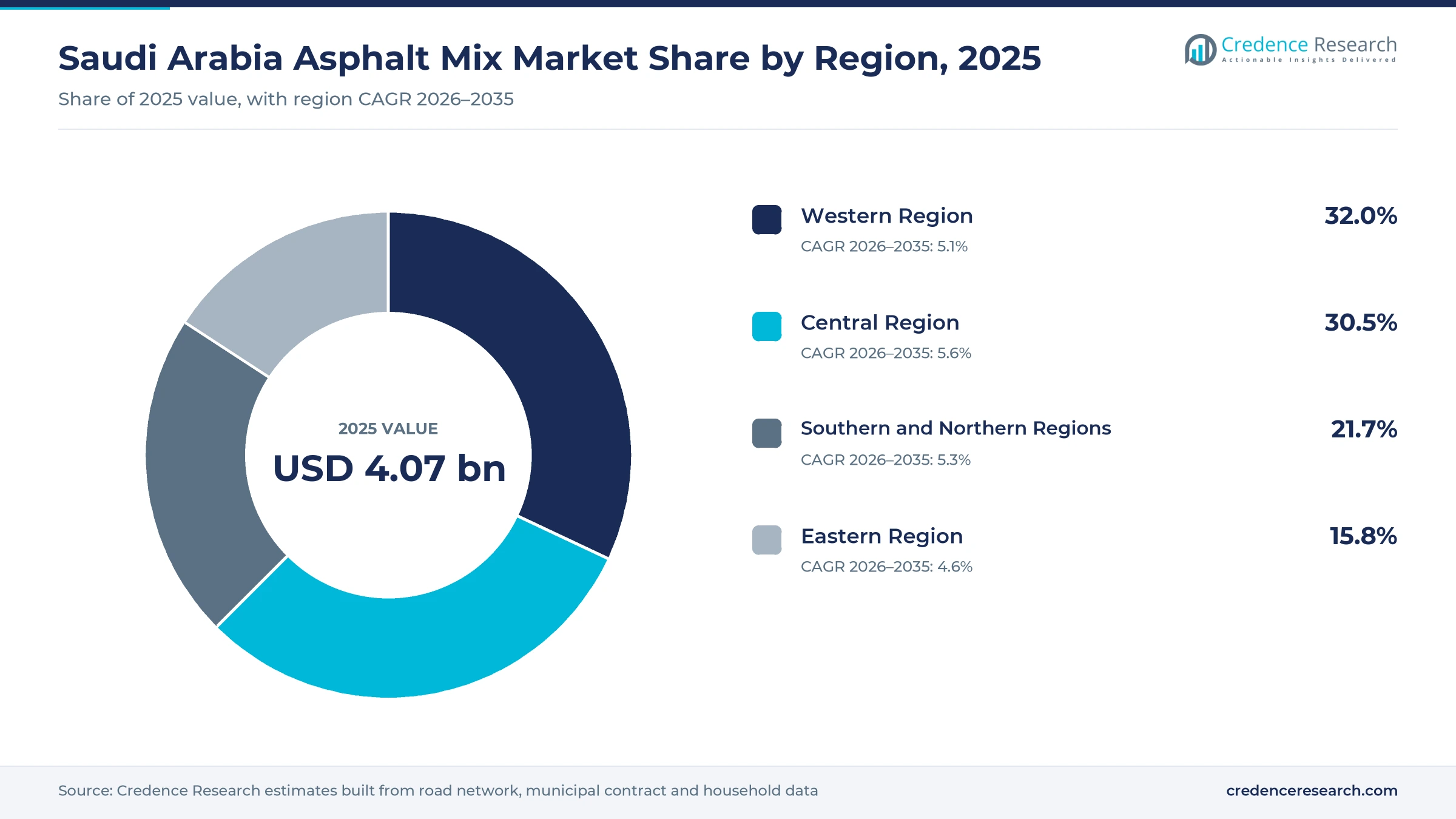
The Saudi Arabia asphalt mix market was valued at USD 4.07 billion in 2025 and is projected to increase from USD 4.30 billion in 2026 to USD 6.82 billion by 2035, registering a CAGR of 5.25% during 2026–2035. Demand comes from municipal resurfacing programs, Ministry of Transport and Logistics maintenance contracts, new urban expressways in Riyadh, and the roads that serve airports, industrial cities and housing districts. The Western Region held the largest regional share, 32.0% in 2025, because Makkah, Jeddah and Madinah carry heavy pilgrim, port and urban traffic. The Central Region is the fastest-growing region at 5.6% a year, as Riyadh runs a multiyear resurfacing program alongside a capital expressway overhaul. The main regulatory change is the Saudi Roads Code, which the Roads General Authority launched on May 27, 2024, as a common technical reference for ministries, municipalities and development authorities.
Which mixes and buyers make up the Saudi asphalt mix estimate?
The estimate measures the delivered value of hot mix asphalt produced in Saudi Arabia for paving, including dense-graded mixes, stone mastic asphalt, polymer-modified mixes and maintenance mixes for patching and overlays. It covers mix sold to road authorities, municipalities, contractors and developers, and mix made in plants that contractors own for their own projects.
The estimate excludes bitumen sold on its own, emulsions and cutbacks used for spraying, concrete pavements, road marking and the paving labor and equipment that contractors bill separately. The value chain runs from refinery binder and quarried aggregate through batch and drum plants to paving crews on highways, city streets, airports and industrial sites.
Saudi Arabia Asphalt Mix Market Insights
- The Saudi Arabia asphalt mix market was valued at USD 4.07 billion in 2025 and is projected to reach USD 6.82 billion by 2035, registering a CAGR of 5.25% during 2026–2035.
- The Western Region held a 32.0% share of 2025 value, because Makkah, Jeddah and Madinah combine pilgrim routes, port traffic and dense urban networks.
- Dense-graded hot mix asphalt led product types with a 58.0% share of 2025 value, because most municipal resurfacing still specifies standard wearing courses.
- Riyadh Municipality signed five road rehabilitation contracts worth SAR 6 billion in September 2024, covering 83 million square meters across north, south, east, west and central zones until 2028.
- Recycled material integration grows fastest by technology at 8.7% a year during 2026–2035, as the Roads General Authority tests demolition waste and in-place recycling.
Dense-graded wearing courses lead as recycled mixes gain
Why do dense-graded mixes still carry most tonnage?
Based on product type, the market is categorized into dense-graded hot mix asphalt, stone mastic asphalt, polymer-modified asphalt mix and maintenance mixes. Dense-Graded Hot Mix Asphalt led with a 58.0% share of 2025 value, because the preventive maintenance under way on 2,500 kilometers of national roads in November 2024 relies mainly on standard overlays. Polymer-Modified Asphalt Mix grows fastest at 6.4% a year, as heavy truck routes and expressways need binders that resist rutting in summer heat. UNIMAC says it already makes polymer-modified, crumb rubber and reclaimed asphalt mixes alongside standard hot mix, which shows the shift has reached large producers.
How do municipal streets outweigh national highways?
Based on end-use industry, the market is categorized into national roads and highways, municipal and urban roads, airports and logistics infrastructure, and industrial and real estate developments. Municipal and Urban Roads led with 38.0% of 2025 value, because municipalities manage more than 115,000 kilometers against over 75,000 kilometers under the transport ministry, according to Asharq Al-Awsat in November 2024. Airports and Logistics Infrastructure grows fastest at 6.3% a year, as King Salman International Airport in Riyadh is planned with six parallel runways on 57 square kilometers, according to the Gulf Daily News in July 2026. Municipal frameworks are the volume base, while airport work rewards producers that can meet runway specifications.
Which supply routes move mix to Saudi job sites?
Based on sales channel, the market is categorized into direct-to-project supply, captive integrated supply, government tender and framework supply, and specialist paving subcontracts. Direct-to-Project Supply led with 34.0% of 2025 value, because quarry-to-plant suppliers sell straight to large sites, and Saleh Abdulaziz Al Rashed & Sons lists supply to the Riyadh Metro, KAFD, Qiddiya and King Salman Park, according to Argaam in September 2025. Government Tender and Framework Supply grows fastest at 5.9% a year, as the Roads General Authority tendered a 10-year operation and maintenance package for the Jeddah-Mecca highway in April 2026. Producers with framework positions gain steadier plant loading than those selling job by job.
Why do batch plants dominate production today?
Based on technology, the market is categorized into conventional batch mixing, continuous drum mixing, recycled material integration and high-performance mix engineering. Conventional Batch Mixing led with 52.0% of 2025 value, because contractors switch gradations often between municipal, highway and airport jobs, and Al Rashed alone runs four asphalt mixing plants beside seven quarry sites. Recycled Material Integration grows fastest at 8.7% a year from a small base, as the Roads General Authority met the National Center for Waste Management on Aug. 6, 2025, to widen the use of demolition waste in asphalt mixes. Batch capacity stays the entry ticket for urban suppliers, while recycling capability becomes the differentiator.
| Segment Group | Leading Sub-segment | Share, 2025 | Fastest-growing Sub-segment | CAGR, 2026–2035 |
|---|---|---|---|---|
| By Product Type | Dense-Graded Hot Mix Asphalt | 58.0% | Polymer-Modified Asphalt Mix | 6.4% |
| By End-Use Industry | Municipal and Urban Roads | 38.0% | Airports and Logistics Infrastructure | 6.3% |
| By Sales Channel | Direct-to-Project Supply | 34.0% | Government Tender and Framework Supply | 5.9% |
| By Technology | Conventional Batch Mixing | 52.0% | Recycled Material Integration | 8.7% |
Binder and haul costs set what Saudi buyers pay for mix
Mix is priced per metric ton at the plant gate or delivered, while municipal and highway owners usually buy finished surface per square meter. Saudi producers do not publish list prices, so the ex-plant ranges below are Credence Research estimates built from binder, aggregate and fuel inputs. Binder makes up only about 5% of a dense-graded mix by weight yet a large share of its cost, so refinery bitumen prices move mix prices quickly. Diesel for drying and hauling adds a further cost that changed in January 2025. Because hot mix cools quickly, suppliers close to a job hold pricing power. Polymer and stone mastic mixes carry clear premiums, which lifts value per ton faster than tonnage.
| Mix or contract basis | Typical price or fee | Basis |
|---|---|---|
| Dense-graded wearing course, ex-plant | SAR 190-260 per metric ton | Credence Research estimate from binder, aggregate and fuel inputs, 2025 |
| Polymer-modified wearing course, ex-plant | SAR 280-380 per metric ton | Credence Research estimate from polymer binder premiums, 2025 |
| Stone mastic asphalt, ex-plant | SAR 300-400 per metric ton | Credence Research estimate from binder and fiber content, 2025 |
| Riyadh municipal rehabilitation contracts | About SAR 72 per square meter on average | Credence Research calculation from SAR 6 billion for 83 million square meters, Argaam, September 2024 |
Request a Free Sample
Fill in your details and we'll send you a free sample report.
- Sample data tables & charts
- Research methodology
Urban rehabilitation and performance contracts lift volume
Multiyear urban road rehabilitation in Riyadh and other cities
City resurfacing programs create the steadiest tonnage, because they run for several years and cover whole districts. Riyadh Municipality signed five contracts worth SAR 6 billion in September 2024 to rehabilitate and asphalt 83 million square meters of streets, according to Argaam. The work is split into north, south, east, west and central zones and runs until 2028, with priorities set by road condition and safety. Splitting the city into zones also lets contractors phase overlays street by street, so each nearby plant sees steady weekly orders. For mix producers, these contracts give a predictable base load for plants near each city zone, and municipal and urban roads hold 38.0% of 2025 value.
Performance-based road quality and maintenance contracts
Maintenance contracts that pay for road condition, not for tons laid, keep resurfacing on a regular cycle. The transport ministry signed 62 performance contracts for road maintenance across all regions on Dec. 16, 2022, judging contractors on quality, safety and user satisfaction, according to Asharq Al-Awsat. The Roads General Authority then had 48 preventive maintenance projects covering 2,500 kilometers worth SAR 1 billion in progress in November 2024, according to the Saudi government news portal. Because contractors carry the risk of early failure, they buy better binders and patch sooner, and that habit favors maintenance mixes and polymer grades.
Riyadh expressway overhaul adds base and binder courses
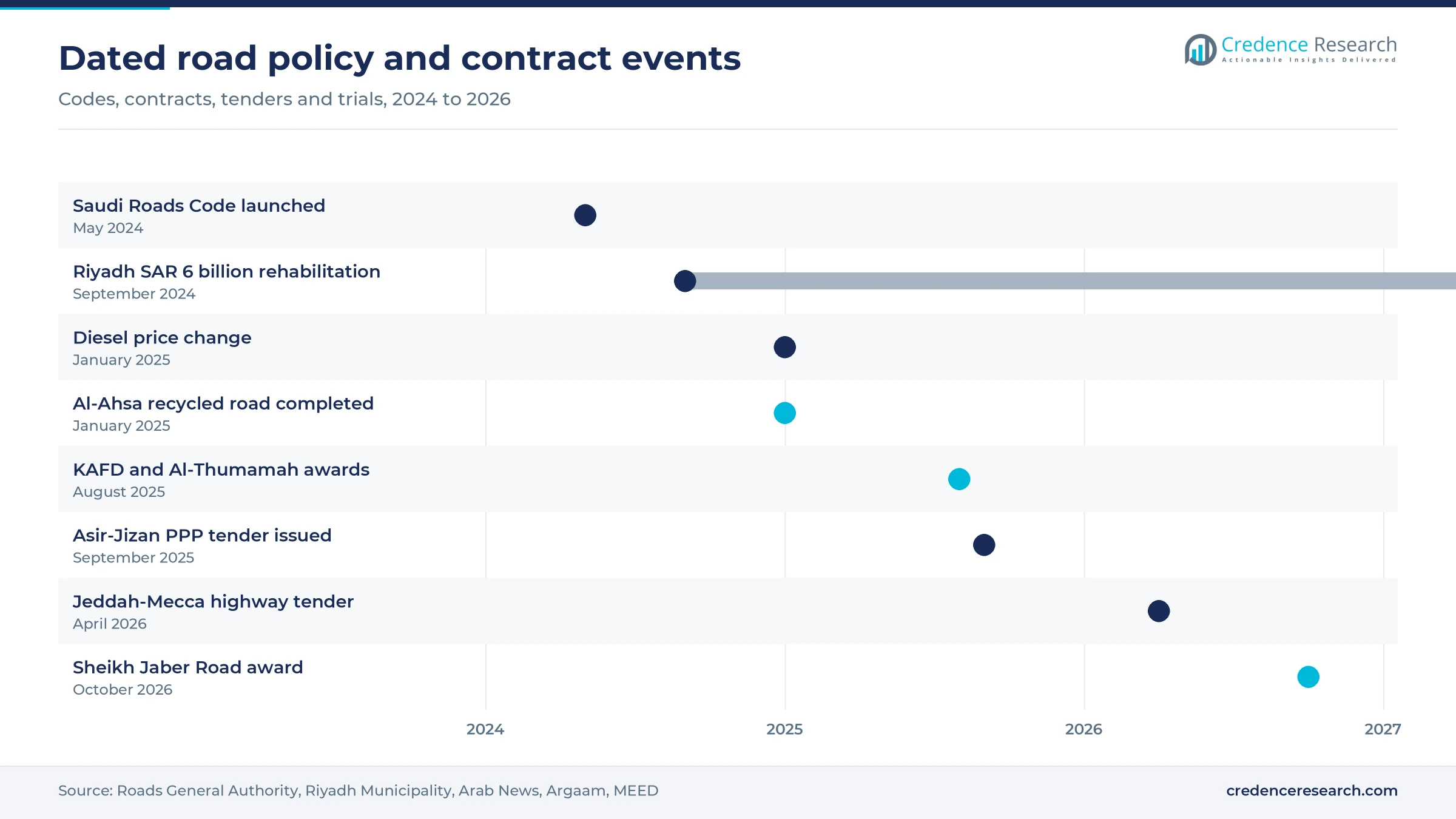
New urban expressways need thick base and binder courses, so capital road programs add tonnage on top of resurfacing. Riyadh's road overhaul totals SAR 29 billion in three packages and extends the network by more than 500 kilometers, according to Gulf Construction Online. The Royal Commission for Riyadh City awarded Almabani two contracts worth over SAR 3.2 billion for KAFD roads and the Al-Thumamah central section on Aug. 11, 2025, according to MEED. It then selected Sapac for an estimated SAR 2 billion of King Salman Road interchanges on Oct. 27, 2026. These packages explain why the Central Region is the fastest-growing region, since each kilometer of expressway uses several layers of mix rather than one overlay.
Intercity highway PPPs bring long-term paving demand
Public-private partnerships are moving intercity highways onto 25-year and 30-year contracts, which ties paving and resurfacing to one operator for decades. The Asir-Jizan highway is a 136-kilometer, three-lane dual carriageway tendered as a 30-year design, build, finance, operate and maintain contract worth an estimated SAR 20 billion, according to MEED in May 2026. Four consortia were preparing bids, including Makyol with Shibh Aljazira Contracting and Tamasuk. The wider economy supports public spending, with real GDP growth projected at 3.8% in 2025 by the World Bank. Concession holders that control paving for decades will favor long supply agreements with nearby plants.
In-place recycling and modified binders change the mix
Shift toward in-place recycling cuts virgin mix per kilometer
The Roads General Authority is replacing part of its mill-and-fill work with in-place recycling, which reuses old pavement instead of trucking in new mix. Its equipment scrapes the top 5 to 10 centimeters, recycles the material on site using water rather than heat and relays it, cutting energy use by 23%, according to Gulf News in May 2024. Recycling of road layers also raised maintenance speed by 40%, according to Asharq Al-Awsat in December 2024. The Roads General Authority and the waste center are now studying demolition waste as aggregate. For plant owners, this means less virgin tonnage per kilometer of maintenance but more demand for recycling equipment and mix-design skills.
Rise of polymer and plastic-modified binders on heavy routes
Modified binders are spreading from trials to working roads, because summer pavement temperatures and heavy axle loads shorten the life of plain mixes. Aramco replaced up to 10% of the bitumen binder with about 160 metric tons of recycled plastic on a 12-kilometer road at its Jafurah gas facility, according to Hydrocarbon Processing in February 2025. Aramco says the plastic extends the periodic maintenance interval from about four years to about seven. It also built a 1-kilometer industrial access road at SPARK in the Eastern Province. A longer maintenance cycle lets road owners justify a higher price per ton, which favors suppliers of polymer-modified bitumen and plants able to blend it.
Airport and motorsport surfaces open a high-margin niche
Runways and race circuits need tightly engineered mixes, which creates a premium niche for producers with laboratory control. UNIMAC lists King Khalid International Airport runway and Prince Sultan Airbase among its airport projects and says it produces 8,000 tons of mix a day from seven plants through its UNIMINE division. Its catalog lists 12 mixes, including two for airfields and two for motorsport circuits. It also lists the Jeddah Corniche Circuit for Saudi Motorsport Company and the Qiddiya Speed Park racetrack. The six-runway King Salman International Airport noted above will need the same engineered runway mixes on a far larger scale. Producers with laboratory-controlled plants near Riyadh are best placed to qualify for that work.
One national road code simplifies mix qualification
A single national code gives suppliers a clearer way to qualify mixes across ministries, municipalities and development authorities. The Roads General Authority launched the Saudi Roads Code on May 27, 2024, with 25 codes prepared over 18 months with local and international experts, according to Arab News. The codes cover planning, design, construction and maintenance of roads, bridges and tunnels, plus traffic engineering and road safety. Producers that certify mixes once against these codes can bid across regions instead of meeting a different municipal specification each time. Because the codes also set road safety rules, contractors can price paving and road marking paints against one specification in a single bid.
Fuel, binder and award swings squeeze producer margins
Higher diesel prices raise drying and haul costs
Diesel prices hit mix producers twice, in the burners that dry aggregate and in the trucks that deliver hot mix. Aramco raised the domestic diesel price to SAR 1.66 per liter on Jan. 1, 2025, from SAR 1.15, an increase of 44.3%, according to Arab News. Producers on fixed-price municipal contracts absorb that cost until the next price review. As a result, plants that switch burners to cheaper fuels or cut haul distances protect margins better than older sites.
Crude price swings make binder costs hard to fix
Bitumen prices follow crude and refinery economics, so long road contracts carry binder price risk. Brent rose from about $65 a barrel before the regional conflict to a $103 average in March 2026, according to MEED in April 2026. MEED also reported that Saudi diesel prices now follow wholesale market references. Contractors bidding multiyear resurfacing work need escalation clauses, or they risk losses when binder and fuel costs rise faster than contract rates.
Lumpy contract awards make plant loading uneven
Plant utilization depends on award timing, and Saudi awards have swung sharply from month to month. Awards totaled SAR 4.86 billion in August 2026, about half of July's SAR 9.75 billion, according to a Saudi Contractors Authority report cited by EnterpriseAM. All 13 August awards were in buildings and construction rather than roads. Mix producers that rely on new projects alone face idle capacity between awards, which favors those with steady municipal maintenance work.
One refining system controls domestic binder supply
Domestic mixes depend on bitumen from Aramco's refining system, and its allocation between local and export buyers can change quickly. Aramco began bitumen exports from Yanbu in September 2023 with a 5,500-ton cargo and aimed for up to 500,000 tons a year, according to Argus. By August 2025, Argus reported that Saudi export cargoes were likely to be unavailable for the rest of the year. Producers without long supply agreements can face tighter grades when refinery output shifts.
The Western Region leads while Riyadh grows fastest
| Region | Value, 2025 (USD billion) | Share, 2025 | CAGR, 2026–2035 |
|---|---|---|---|
| Western Region | 1.30 | 32.0% | 5.1% |
| Central Region | 1.24 | 30.5% | 5.6% |
| Southern and Northern Regions | 0.88 | 21.7% | 5.3% |
| Eastern Region | 0.64 | 15.8% | 4.6% |
Western Region leads on pilgrim routes and coastal cities
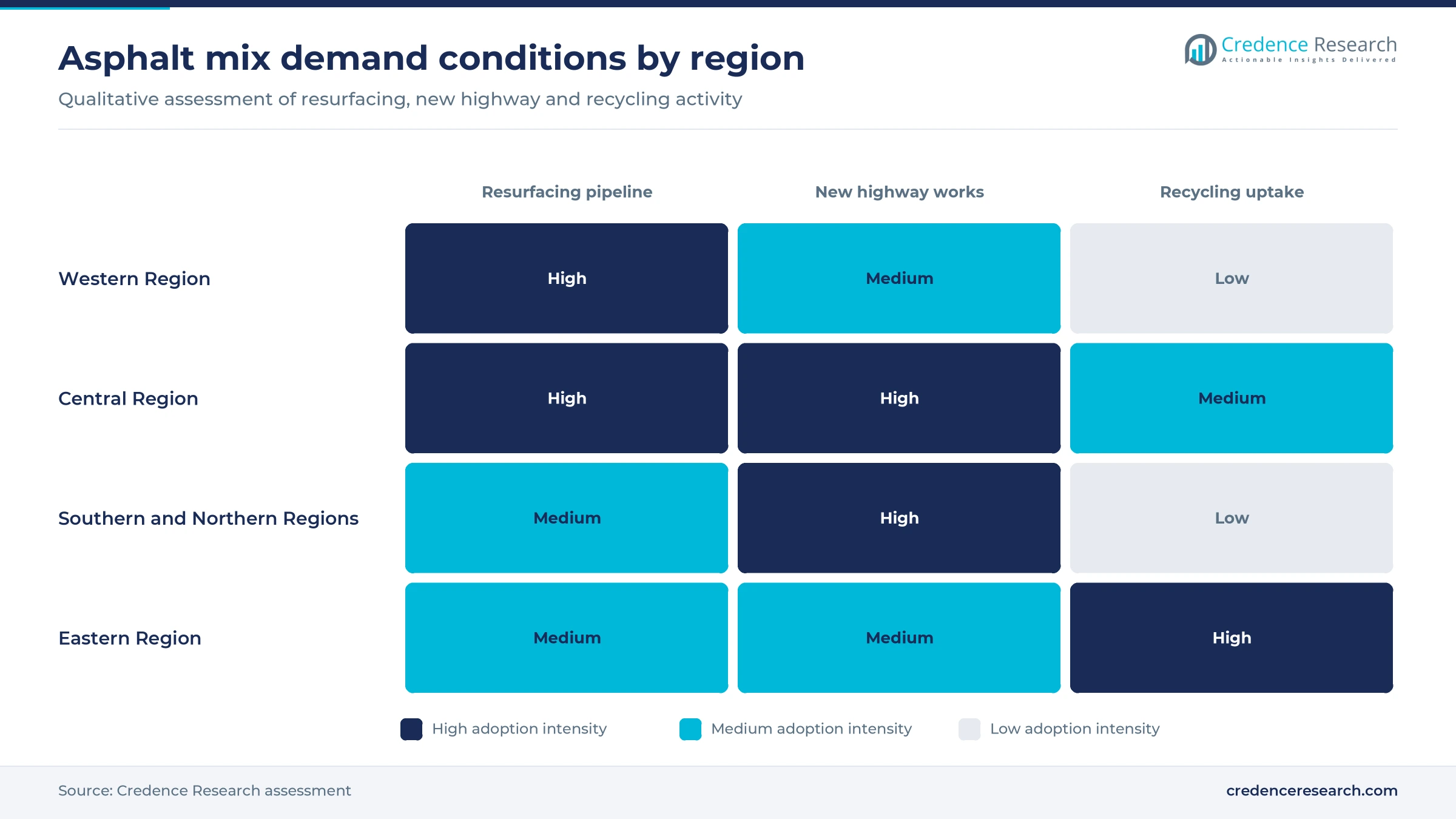
The Western Region held 32.0% of 2025 value and grows at 5.1% a year. Pilgrim routes need frequent upkeep, and the Roads General Authority used 28 performance contracts for roads leading to the Holy Sites in June 2023, according to Saudi Gazette. The 64-kilometer Jeddah-Mecca highway will also move to a 10-year maintenance package, so resurfacing demand should stay high in this region.
Central region grows fastest on Riyadh's two programs
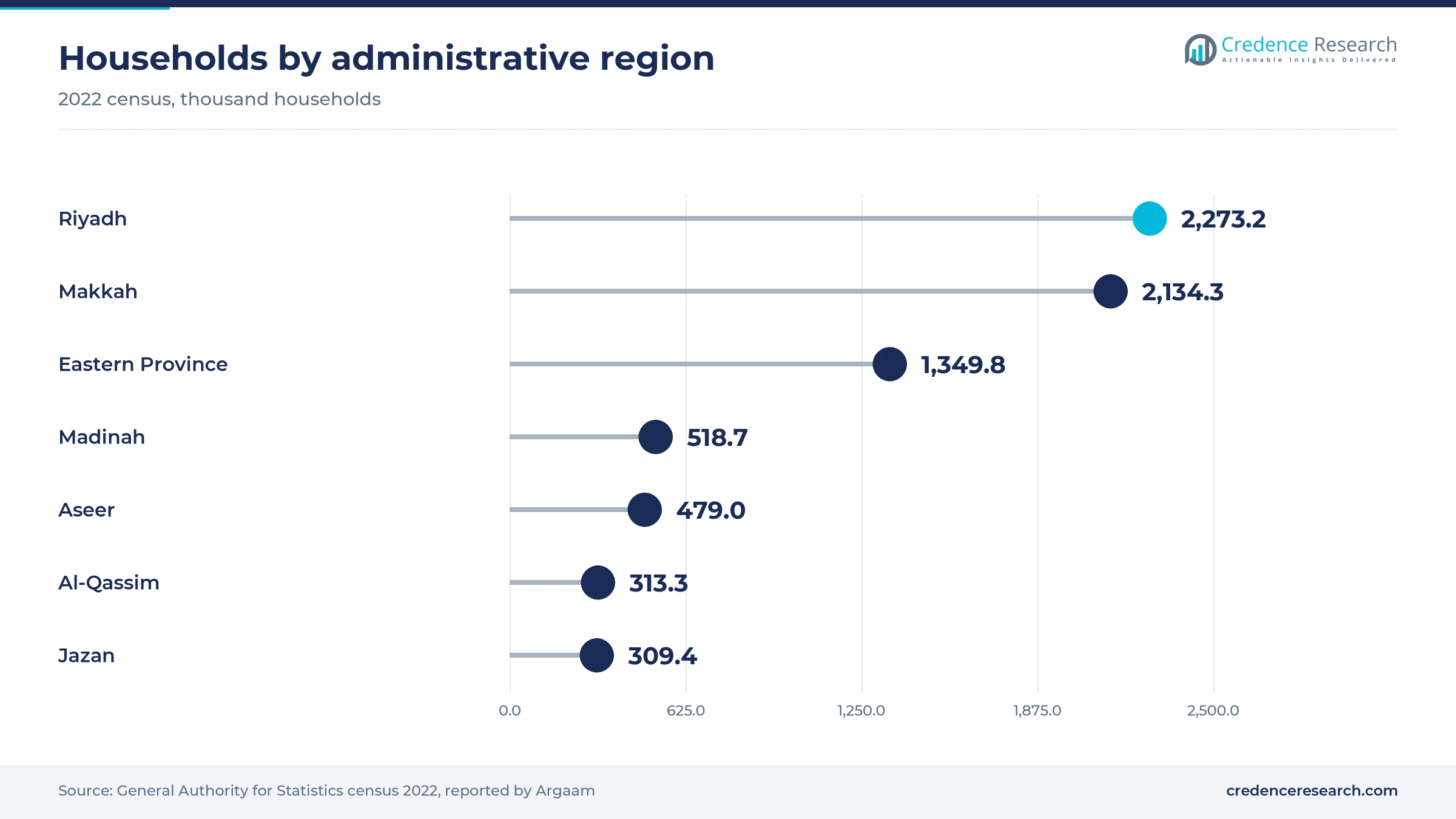
The Central Region held 30.5% of 2025 value and is the fastest-growing region at 5.6% a year. Riyadh Region had about 2.27 million households in the 2022 census, the largest count of any region. The city runs the five-zone rehabilitation program described above beside its expressway packages, so it buys both wearing courses and thick base layers. Local supply is deep, because integrated groups such as Al Rashed run quarries and plants around the capital, which keeps haul distances short and prices competitive.
Southern and Northern regions depend on new highway links
The Southern and Northern Regions held 21.7% of 2025 value and grow at 5.3% a year. Aseer had about 479,000 households and Jazan about 309,000 in the 2022 census, so local street demand is smaller than in the main cities. The Asir-Jizan highway PPP would change that, because a 136-kilometer road with 57 bridges needs large volumes of base and wearing course. Mountain routes also face washouts after heavy rain, and repairs there hold patching demand steady.
Eastern Region pairs industrial roads with recycling trials
The Eastern Region held 15.8% of 2025 value and grows at 4.6% a year. The region had about 1.35 million households in the 2022 census, and industrial roads serve Jubail, Ras Al-Khair and the Jafurah gas field. The Roads General Authority completed the country's first recycled road in Al-Ahsa in January 2025, using demolition waste aggregate from the municipal landfill, according to Arab News. Producers in the east can build a track record in recycled and modified mixes before national specifications require them.
Road contracts, PPP tenders and recycling trials since 2024
| Development | Status and market relevance |
|---|---|
| In August 2025, the Roads General Authority met the National Center for Waste Management to expand demolition waste in asphalt mixes. | Under study, and it points to more recycled aggregate. |
| In January 2025, the Roads General Authority completed the first recycled road in Al-Ahsa using demolition waste aggregate. | Completed, with layer performance under study. |
| In August 2025, the Royal Commission for Riyadh City awarded Almabani over SAR 3.2 billion for KAFD and Al-Thumamah road works. | Under construction in northern Riyadh. |
| In October 2026, the Royal Commission for Riyadh City awarded Alomaier an estimated SAR 1.13 billion Sheikh Jaber Road upgrade that includes asphalt paving. | Awarded, with earthworks and paving ahead. |
| In October 2026, the Royal Commission for Riyadh City selected Sapac for an estimated SAR 2 billion of King Salman Road interchanges. | Selected, adding base and binder course demand. |
Plant type, binder chemistry and recycling define supply
- Batch plants weigh each aggregate fraction separately, which suits contractors that move between municipal, highway and airport gradations in the same week.
- Drum plants mix continuously at high output, which suits long highway jobs where one gradation runs for months with steady binder supply.
- Reclaimed asphalt returns milled pavement to the plant or relays it in place, and the Roads General Authority uses cold in-place methods on national roads.
- Modified binders add polymers, crumb rubber or recycled plastic to the bitumen, which raises resistance to rutting and cracking on hot, heavily loaded roads.
Need a Custom Version of This Report?
Tailor the scope, geography, or segments to your exact requirements.
- Custom geography or segment scope
- Direct access to our analyst team
Plant ownership and haul distance decide who wins work
Competition is local and turns on plant location, aggregate ownership and prequalification with road owners. Integrated groups such as Saleh Abdulaziz Al Rashed & Sons supply aggregate and mix to large projects from Riyadh-based quarries and plants, and partner with SPECO for asphalt plants. General Agencies & Contracting runs its own asphalt plant and crusher and offers milling and paving for road infrastructure. UNIMAC competes on specialized paving through UNIMINE, with mixes for runways, motorways and racetracks. Shibh Al Jazira Contracting works on Ministry of Transport maintenance projects and roads at Qiddiya, while Haif lists roads, airports and maintenance among its contracting services. Large expressway contracts go to general contractors such as Almabani, Sapac and Alomaier, which then buy mix or run site plants. Buyers weigh plant distance, construction aggregates supply and record on performance contracts more than list price.
How is Saudi mix supply organized and where do margins sit?
Supply is fragmented across hundreds of contractor plants, with a handful of integrated groups that own quarries, crushers, mixing plants and truck fleets. Al Rashed, for example, runs seven quarry sites, 13 crushers, four asphalt plants and more than 560 trucks, according to Argaam. Because hot mix cannot travel far, each city behaves as its own market, and the plants closest to large jobs set prices. Margins sit mostly with suppliers that own aggregate and plants, while pure paving subcontractors compete on price. Entry barriers are quarry permits, plant capital and prequalification with road owners.
Producers and paving contractors active in Saudi Arabia
| Company | Type | Role in the market |
|---|---|---|
| Saleh Abdulaziz Al Rashed & Sons Co. | Integrated aggregate and mix supplier | Runs 7 quarry sites, 13 crushers and 4 asphalt plants |
| General Agencies & Contracting (GAC) | Road products maker and contractor | Supplies asphalt mix and milling and paving for road works |
| UNIMAC / UNIMINE | Specialist paving contractor | Produces mixes for runways, motorways and race circuits |
| SAJCO | Road contractor | Ministry of Transport maintenance and Qiddiya road works |
| Haif Company | General contractor | Lists roads, airports and road maintenance among its services |
| Almabani General Contractors | Infrastructure contractor | KAFD roads and Al-Thumamah central section for the Royal Commission for Riyadh City |
| Alomaier Trading & Contracting | Road contractor | Sheikh Jaber Road upgrade including asphalt paving |
Maintenance volumes, not megaprojects, carry this market
Credence Research's view is that recurring maintenance, not megaprojects, carries this market. Saudi Arabia scored 5.7 in the World Economic Forum road quality index and ranked fourth among G20 countries, according to Asharq Al-Awsat in February 2024, and the authority targets sixth place globally by 2030. Holding that position needs steady resurfacing across a very large network. Buyers should treat binder and fuel escalation as a contract issue, because those costs moved sharply in 2025 and 2026. Suppliers with plants near city zones and proven polymer and recycled mixes are best placed.
Road network, contract and plant data anchor the model
The report uses 2025 as the base year and forecasts values to 2035. Market values come from the Credence Research model, checked against a bottom-up estimate of resurfacing and new-road tonnage from published network lengths, contract areas and plant output, multiplied by estimated delivered prices. The 2025 value implies roughly 45 million metric tons at an average delivered value near USD 90 a ton, including polymer and stone mastic premiums and haulage. All regional and segment splits are Credence Research estimates built on these inputs. Sources used are government announcements, Roads General Authority and municipal releases, company statements and websites, World Bank publications and Saudi and regional news reports. No interviews or surveys were conducted for this report at any stage.
Rehabilitation cycles and highway PPPs shape 2035
Value is forecast to rise to USD 6.82 billion by 2035 at a 5.25% CAGR, led by resurfacing cycles in the main cities and by intercity highways moving to long concessions. The Central Region gains share as Riyadh completes its expressway packages, while the Western Region keeps the largest base on pilgrim and coastal routes. Mix design will matter more than tonnage growth, because recycled content and polymer binders raise value per ton. Suppliers that secure binder contracts and plant sites near growth corridors should capture more of this value.
Contract timing and binder costs set the range of outcomes
The forecast range depends mainly on whether municipalities renew multiyear resurfacing programs after 2028 and on the pace of highway PPP awards. Binder and fuel prices matter as well, because they decide whether owners cut overlay thickness or delay work. Recycling lowers tonnage per kilometer but adds value through engineered mixes, so it narrows rather than widens the gap between cases.
| Scenario | CAGR, 2026–2035 | Value, 2035 | What has to hold |
|---|---|---|---|
| Downside | 3.8% | USD 6.02 billion | Municipal programs end without renewal and highway PPP awards slip beyond 2028 |
| Base | 5.25% | USD 6.82 billion | Riyadh and other cities renew resurfacing cycles and two highway PPPs reach construction |
| Upside | 6.5% | USD 7.59 billion | Several highway PPPs and airport runways start together while resurfacing cycles shorten |
Frequently Asked Questions
How big is the Saudi Arabia asphalt mix market?
What growth rate is expected through 2035?
Which product type leads the market?
Which technology grows fastest?
Which region holds the largest share?
Why does plant location matter so much?
How do diesel prices affect mix producers?
Who are the main companies in this market?
Table of Content
Chapter 1 Market Segmentation
- 1.1 Segmentation Framework
- 1.1.1 Product and Service Classification
- 1.1.2 Application and End-Use Classification
- 1.1.3 Technology and Solution Classification
- 1.1.4 Customer and Distribution Channel Classification
- 1.1.5 Geographic Segmentation
- 1.1.6 Market Segment Definitions and Boundaries
- 1.2 By Product Type
- 1.2.1 Dense-Graded Hot Mix Asphalt
- 1.2.2 Stone Mastic Asphalt
- 1.2.3 Polymer-Modified Asphalt Mix
- 1.2.4 Maintenance Mixes
- 1.3 By End-Use Industry
- 1.3.1 National Roads and Highways
- 1.3.2 Municipal and Urban Roads
- 1.3.3 Airports and Logistics Infrastructure
- 1.3.4 Industrial and Real Estate Developments
- 1.4 By Sales Channel
- 1.4.1 Direct-to-Project Supply
- 1.4.2 Captive Integrated Supply
- 1.4.3 Government Tender and Framework Supply
- 1.4.4 Specialist Paving Subcontracts
- 1.5 By Technology
- 1.5.1 Conventional Batch Mixing
- 1.5.2 Continuous Drum Mixing
- 1.5.3 Recycled Material Integration
- 1.5.4 High-Performance Mix Engineering
Chapter 2 Introduction
- 2.1 Report Objectives and Scope
- 2.2 Product Definition and Industry Terminology
- 2.3 Market Inclusions and Exclusions
- 2.4 Research Process
- 2.4.1 Primary Research and Expert Interviews
- 2.4.2 Secondary Research and Source Review
- 2.4.3 Top-Down and Bottom-Up Estimation
- 2.4.4 Data Triangulation and Verification
- 2.5 Market Size Measurement Basis
- 2.5.1 2025: USD 4.07 billion → 2035: USD 6.82 billion
- 2.6 Historical and Forecast Reference Periods
- 2.6.1 Historical Period: 2018-2025
- 2.6.2 Base Year: 2025
- 2.6.3 Forecast Period: 2025-2035
- 2.7 Research Assumptions and Limitations
Chapter 3 Executive Summary
- 3.1 Market Snapshot and Key Findings
- 3.2 Base-Year Market Size, 2025
- 3.3 Forecast Market Size, 2035
- 3.4 Revenue and Volume Growth Outlook
- 3.5 Key Demand and Supply Indicators
- 3.6 Leading Market Segments
- 3.7 Fastest-Growing Market Opportunities
- 3.8 Regional Performance Highlights
- 3.9 Technology and Industry Transformation
- 3.10 Competitive Landscape Summary
- 3.11 Analyst View and Strategic Implications
Chapter 4 Saudi Arabia Asphalt Mix Market Trends and Developments
- 4.1 Historical Industry Development, 2018-2025
- 4.2 Recent Market Trends and Developments
- 4.3 Demand and Customer Behavior Trends
- 4.4 Technology and Product Innovation
- 4.5 Artificial Intelligence, Automation and Digitalization
- 4.6 Local Manufacturing and Supply Chain Realignment
- 4.7 Industry Partnerships, Mergers and Acquisitions
- 4.8 Sustainability and Circular Economy Developments
- 4.9 Government and Private Sector Investment Trends
- 4.10 Emerging Business Models and Commercialization
- 4.11 Industry Developments and Announcements
Chapter 5 Saudi Arabia Asphalt Mix Market Production, Supply and Demand Analysis
- 5.1 Demand Trend and Consumption Analysis, 2018-2025
- 5.2 Demand Forecast, 2025-2035
- 5.3 Production and Output Trend, 2018-2025
- 5.4 Production and Output Forecast, 2025-2035
- 5.5 Installed Capacity and Capacity Utilization
- 5.6 Company-Wise Production Plants and Statistics
- 5.6.1 Installed Production Capacity
- 5.6.2 Actual Production
- 5.6.3 Planned Capacity and Expansion Targets
- 5.7 Supply Chain Structure and Procurement Trends
- 5.8 Supply-Demand Gap and Bottlenecks
- 5.9 Import Dependence and Sourcing Structure
- 5.10 Contract Manufacturing and Outsourcing
- 5.11 Regional Supply and Demand Concentration
Chapter 6 Saudi Arabia Asphalt Mix Market Pricing Analysis
- 6.1 Pricing Structure and Measurement
- 6.2 Historical Pricing Trends, 2018-2025
- 6.3 Pricing Outlook, 2025-2035
- 6.4 Average Selling Price and Unit Economics
- 6.5 Pricing by Product and Market Segment
- 6.6 Geographic Pricing Differences
- 6.7 Key Input, Energy, Labor and Logistics Costs
- 6.8 Contract Pricing and Purchasing Models
- 6.9 Pricing Sensitivity and Competitive Positioning
- 6.10 Price, Margin and Profitability Implications
Chapter 7 Saudi Arabia Asphalt Mix Market Dynamics
- 7.1 Market Growth Drivers
- 7.1.1 Demand-Side Drivers
- 7.1.2 Technology and Innovation Drivers
- 7.1.3 Infrastructure and Investment Drivers
- 7.1.4 Regulatory and Policy Drivers
- 7.2 Market Restraints
- 7.2.1 Cost and Affordability Constraints
- 7.2.2 Technology and Adoption Barriers
- 7.2.3 Supply Chain and Operational Constraints
- 7.3 Market Challenges
- 7.3.1 Competitive Pressure and Margin Erosion
- 7.3.2 Skills, Infrastructure and Implementation Gaps
- 7.4 Emerging Market Opportunities
- 7.5 Market Dynamics Impact and Time-Horizon Assessment
Chapter 8 Saudi Arabia Asphalt Mix Value Chain Analysis
- 8.1 Industry Value Chain Overview
- 8.2 Upstream Suppliers and Critical Inputs
- 8.3 Technology and Component Providers
- 8.4 Manufacturing or Service Delivery
- 8.5 Distribution, Channel Partners and Integrators
- 8.6 Downstream Applications and End Users
- 8.7 Value Addition and Profit Pools
- 8.8 Vertical Integration and Outsourcing
- 8.9 Supplier Concentration and Risk
- 8.10 Supply Chain Localization and Resilience
Chapter 9 Saudi Arabia Asphalt Mix Market Regulations and Policies
- 9.1 Relevant Laws, Standards and Compliance Frameworks
- 9.2 Product, Service, Safety and Quality Requirements
- 9.3 Government Policies, Incentives and Subsidies
- 9.4 Imports, Exports and Trade Barriers
- 9.5 Public Procurement and Local Content Requirements
- 9.6 Environmental and Sustainability Compliance
- 9.7 Upcoming Policy Changes and Market Implications
Chapter 10 Saudi Arabia Asphalt Mix Market Hotspots and Opportunities
- 10.1 Market Opportunity Mapping and Growth Hotspots
- 10.2 High-Growth Applications and Customer Groups
- 10.3 Underserved Markets and White-Space Opportunities
- 10.4 Emerging Technology and Product Opportunities
- 10.5 New Capacity and Investment Hotspots
- 10.6 Market Entry and Expansion Opportunities
- 10.7 Distribution and Partnership Opportunities
- 10.8 Near-Term and Long-Term Commercial Potential
- 10.9 Opportunity Attractiveness and Execution Risks
Chapter 11 Saudi Arabia Asphalt Mix Market Outlook, 2025-2035
- 11.1 Market Size and Analysis
- 11.1.1 Revenue (Market Measurement: 2025: USD 4.07 billion → 2035: USD 6.82 billion)
- 11.1.2 Market Volume and Quantity Sold
- 11.1.3 Historical Market Size, 2018-2025
- 11.1.4 Base-Year Market Size, 2025
- 11.2 Market Forecast, 2025-2035
- 11.2.1 Revenue Forecast to 2035
- 11.2.2 Volume Forecast to 2035
- 11.2.3 CAGR and Year-on-Year Growth
- 11.2.4 Incremental Revenue Opportunity
- 11.3 Forecast Assumptions and Scenario Analysis
- 11.3.1 Base-Case Forecast
- 11.3.2 Optimistic and Conservative Scenarios
- 11.3.3 Technology, Pricing and Policy Sensitivities
- 11.4 Market Attractiveness and Growth Outlook
Chapter 12 Saudi Arabia Asphalt Mix Market Segmentation and Outlook
- 12.1 Segmentation Summary and Market Shares, 2025
- 12.2 Largest and Fastest-Growing Segments
- 12.3 By Product Type - Market Size and Forecast, 2025-2035
- 12.3.1 Segment Definition and Scope
- 12.3.2 Historical Market Size, 2018-2025
- 12.3.3 Revenue Forecast, 2025-2035
- 12.3.4 Volume Forecast, 2025-2035
- 12.3.5 Base-Year Market Share, 2025
- 12.3.6 Segment CAGR and Growth Drivers
- 12.3.7 Subsegment Market Size and Forecast
- 12.3.7.1 Dense-Graded Hot Mix Asphalt
- 12.3.7.2 Stone Mastic Asphalt
- 12.3.7.3 Polymer-Modified Asphalt Mix
- 12.3.7.4 Maintenance Mixes
- 12.3.8 Subsegment Pricing and Adoption Trends
- 12.3.9 Leading Suppliers and Competition
- 12.3.10 Regional Demand and Opportunities
- 12.4 By End-Use Industry - Market Size and Forecast, 2025-2035
- 12.4.1 Segment Definition and Scope
- 12.4.2 Historical Market Size, 2018-2025
- 12.4.3 Revenue Forecast, 2025-2035
- 12.4.4 Volume Forecast, 2025-2035
- 12.4.5 Base-Year Market Share, 2025
- 12.4.6 Segment CAGR and Growth Drivers
- 12.4.7 Subsegment Market Size and Forecast
- 12.4.7.1 National Roads and Highways
- 12.4.7.2 Municipal and Urban Roads
- 12.4.7.3 Airports and Logistics Infrastructure
- 12.4.7.4 Industrial and Real Estate Developments
- 12.4.8 Subsegment Pricing and Adoption Trends
- 12.4.9 Leading Suppliers and Competition
- 12.4.10 Regional Demand and Opportunities
- 12.5 By Sales Channel - Market Size and Forecast, 2025-2035
- 12.5.1 Segment Definition and Scope
- 12.5.2 Historical Market Size, 2018-2025
- 12.5.3 Revenue Forecast, 2025-2035
- 12.5.4 Volume Forecast, 2025-2035
- 12.5.5 Base-Year Market Share, 2025
- 12.5.6 Segment CAGR and Growth Drivers
- 12.5.7 Subsegment Market Size and Forecast
- 12.5.7.1 Direct-to-Project Supply
- 12.5.7.2 Captive Integrated Supply
- 12.5.7.3 Government Tender and Framework Supply
- 12.5.7.4 Specialist Paving Subcontracts
- 12.5.8 Subsegment Pricing and Adoption Trends
- 12.5.9 Leading Suppliers and Competition
- 12.5.10 Regional Demand and Opportunities
- 12.6 By Technology - Market Size and Forecast, 2025-2035
- 12.6.1 Segment Definition and Scope
- 12.6.2 Historical Market Size, 2018-2025
- 12.6.3 Revenue Forecast, 2025-2035
- 12.6.4 Volume Forecast, 2025-2035
- 12.6.5 Base-Year Market Share, 2025
- 12.6.6 Segment CAGR and Growth Drivers
- 12.6.7 Subsegment Market Size and Forecast
- 12.6.7.1 Conventional Batch Mixing
- 12.6.7.2 Continuous Drum Mixing
- 12.6.7.3 Recycled Material Integration
- 12.6.7.4 High-Performance Mix Engineering
- 12.6.8 Subsegment Pricing and Adoption Trends
- 12.6.9 Leading Suppliers and Competition
- 12.6.10 Regional Demand and Opportunities
- 12.7 Segment Growth Comparison
- 12.8 Segment Attractiveness and Priority Matrix
Chapter 13 Saudi Arabia Asphalt Mix End-Use and Application Market Outlook
- 13.1 End-Use Industry and Customer Demand Structure
- 13.2 Leading Applications and Customer Groups
- 13.3 End-Use Market Size, Share and Forecast
- 13.4 Major End-Use Industry Deep Dives
- 13.4.1 Customer Requirements and Use Cases
- 13.4.2 Demand and Replacement Cycles
- 13.4.3 Technical and Regulatory Considerations
- 13.4.4 Purchasing and Procurement Models
- 13.4.5 Leading Vendors and Distribution Channels
- 13.4.6 Forecast and Commercial Opportunities
- 13.5 Emerging Applications and Cross-Segment Demand
- 13.6 End-Use Industry Investment Priorities
Chapter 14 Saudi Arabia Asphalt Mix Geographic Market Outlook, 2025-2035
- 14.1 Domestic Market Distribution and Demand Clusters
- 14.2 State- or Province-Wise Market Size and Forecast, 2025-2035
- 14.3 City and Metropolitan Market Outlook
- 14.4 Industrial, Manufacturing and Commercial Clusters
- 14.5 Geographic Concentration of Key End Users
- 14.6 Local Pricing and Purchasing Differences
- 14.7 Domestic Production Facilities and Capacity Map
- 14.8 Local Infrastructure and Project Pipeline
- 14.9 State-Level Policy and Incentive Differences
- 14.10 Subnational Investment Hotspots and Opportunities
- 14.11 Distribution and Logistics Networks
- 14.12 Domestic Competitive Footprint
Chapter 15 Saudi Arabia Asphalt Mix Technology, Innovation and Sustainability Outlook
- 15.1 Technology Landscape and Maturity
- 15.2 Product, Process and Service Innovation
- 15.3 AI, Automation and Digital Tools in the Industry
- 15.4 Technology Adoption and Performance Benchmarking
- 15.5 Innovation Pipeline and R&D Investment
- 15.6 Patent and Intellectual Property Trends
- 15.7 Energy Efficiency and Resource Management
- 15.8 Sustainability, Recycling and Circularity
- 15.9 Technology Roadmap, 2025-2035
- 15.10 Risks of Obsolescence and Technology Substitution
Chapter 16 Saudi Arabia Asphalt Mix Market Key Strategic Imperatives
- 16.1 Growth and Market Entry Priorities
- 16.2 High-Return Products and Segments
- 16.3 Pricing, Profitability and Cost Optimization
- 16.4 Technology Investment and Product Differentiation
- 16.5 Supply Chain Localization and Resilience
- 16.6 Distribution and Customer Acquisition
- 16.7 Partnership, Acquisition and Capacity Strategy
- 16.8 Regional Expansion Priorities
- 16.9 Short-, Medium- and Long-Term Actions
Chapter 17 Competition Outlook
- 17.1 Industry Competition Characteristics
- 17.2 Market Structure and Concentration
- 17.3 Market Share and Competitive Positioning, 2025
- 17.4 Company-Wise Revenue and Product Benchmarking
- 17.5 Production and Service Capacity Benchmarking
- 17.6 Technology, Pricing and Differentiation
- 17.7 Regional Footprint and Distribution Strength
- 17.8 Mergers, Acquisitions and Strategic Alliances
- 17.9 New Entrants and Competitive Threats
- 17.10 Porter's Five Forces and Industry Attractiveness
- 17.11 Competitive Outlook, 2025-2035
Chapter 18 Company Profiles
- 18.1 Company Coverage and Selection Criteria
- 18.2 Saleh Abdulaziz Al Rashed & Sons Co.
- 18.2.1 Business Description
- 18.2.2 Company Ownership and Geographic Presence
- 18.2.3 Product and Service Portfolio
- 18.2.4 Manufacturing and Operating Footprint
- 18.2.5 Production Capacity and Expansion Plans
- 18.2.6 Financial Performance and Investment
- 18.2.7 Market Share and Competitive Position
- 18.2.8 Technology and Innovation Capabilities
- 18.2.9 Strategic Alliances or Partnerships
- 18.2.10 Recent Developments
- 18.2.11 Growth Strategy and Outlook
- 18.3 Haif Company
- 18.4 Mohammed Hadi Al-Rasheed & Partners Co.
- 18.5 General Agencies & Contracting (GAC)
- 18.6 Azdah Contracting Company
- 18.7 Abdul Ali Al-Ajmi Company
- 18.8 Al Fahd Company
- 18.9 Al-Otaishan Holding / AOSCO
- 18.10 UNIMAC / UNIMINE
- 18.11 SAJCO
- 18.12 Other Relevant Market Participants
Note: Every listed company is profiled on the structure shown under the first company. The company list is preliminary and may change based on research findings, market developments, data availability and client requirements.
Chapter 19 Disclaimer
- 19.1 Research and Forecast Disclaimer
- 19.2 Data Source and Estimation Limitations
Note: The depth of individual sections depends on data availability for this market. Volume, capacity, trade and other unit-based metrics are included where applicable.

