
Event venues and housing now carry Saudi building activity
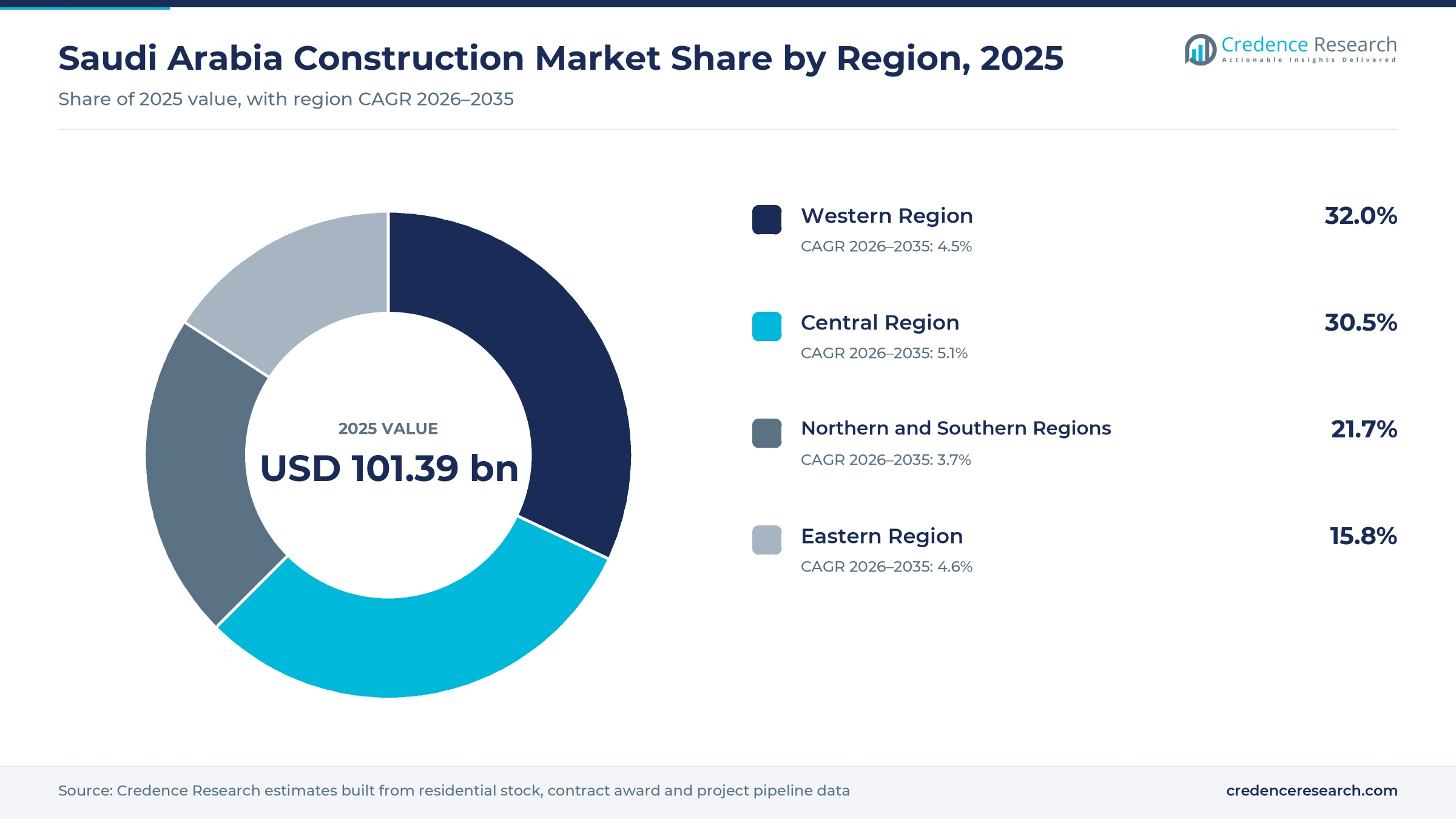
The Saudi Arabia construction market was valued at USD 101.39 billion in 2025 and is projected to increase from USD 106.27 billion in 2026 to USD 158.60 billion by 2035, registering a CAGR of 4.55% during 2026–2035. Demand now rests on fixed-date venues for Expo 2030 and the 2034 FIFA World Cup, on subsidized housing and on transport, water and power networks, rather than on the largest gigaprojects. The Western Region held the largest regional share, 32.0% in 2025, because Makkah, Madinah and Jeddah combine holy site redevelopment, pilgrim housing and port-city growth. The Central Region is the fastest-growing region at 5.1% a year, as Riyadh builds the Expo site, metro extensions and a new airport. The main commercial change is a reset in sovereign spending, with NEOM pausing work on The Line until after 2030 and the Public Investment Fund steering private capital into new projects.
Work put in place, not land or fit-out, sets the value
The estimate measures the value of construction work put in place in Saudi Arabia each year across buildings, infrastructure, renovation and industrial facilities. It counts work for ministries, municipalities, sovereign developers, private developers, households and industrial owners, whether contracted on design-bid-build, design-build, engineering, procurement and construction or construction management terms.
The estimate excludes land, real estate sales margins, finance costs and the equipment that owners install after handover, such as process machinery or furniture. The value chain runs from cement, steel and aggregates through main contractors and specialist subcontractors to owners that range from the Royal Commission for Riyadh City to private families building villas.
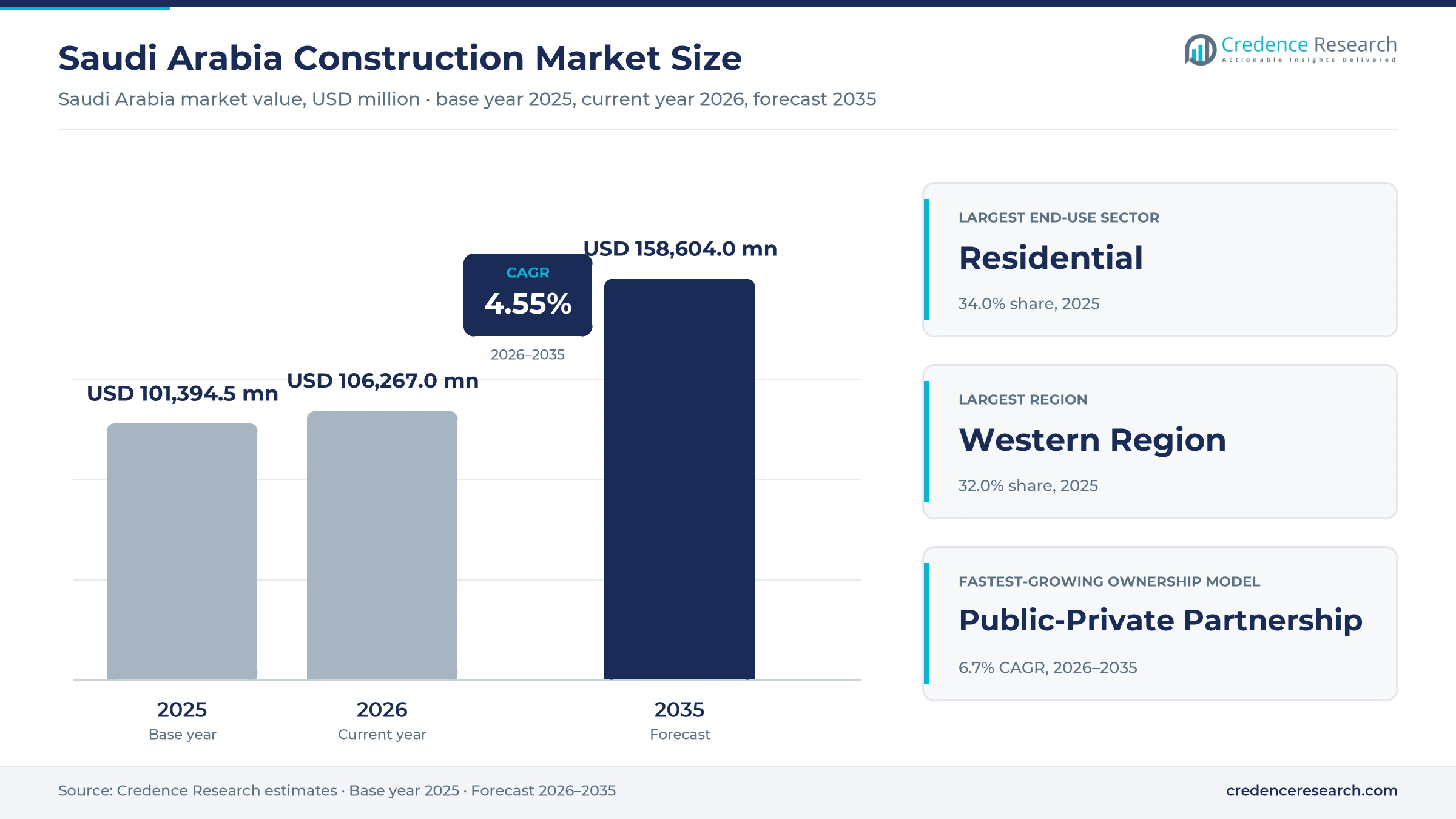
Saudi Arabia Construction Market Insights
- The Saudi Arabia construction market was valued at USD 101.39 billion in 2025 and is projected to reach USD 158.60 billion by 2035, registering a CAGR of 4.55% during 2026–2035.
- The Western Region held a 32.0% share of 2025 value, because Makkah, Madinah and Jeddah combine holy site redevelopment, pilgrim housing and coastal city growth.
- Residential work led end-use sectors with a 34.0% share of 2025 value, as the homeownership rate reached 66.24% at the end of 2025 against a 70% goal.
- Construction contract awards fell 31% to $31 billion in 2025 from $45 billion in 2024, then recovered to $20 billion in the first half of 2026, according to MEED.
- Public-private partnerships grow fastest by ownership model at 6.7% a year during 2026–2035, as the national PPP pipeline holds about 200 projects worth roughly $190 billion.
Buildings lead while infrastructure and PPP work grow faster
Why do buildings still carry most Saudi work?
Based on project type, the market is categorized into building construction, infrastructure construction, renovation and retrofit, and industrial construction. Building Construction led with a 48.0% share of 2025 value, because all 13 contracts recorded by the Saudi Contractors Authority in August 2026 were building projects, including commercial, residential, hospitality and data center work, according to EnterpriseAM. Infrastructure Construction grows fastest at 5.3% a year, as water transmission alone took $5.1 billion of the $8.3 billion of Saudi water contracts awarded by mid-September 2025, according to MEED. Utility and transport networks therefore gain share even when tower work slows down.
How does housing outweigh tourism and transport?
Based on end-use sector, the market is categorized into residential, commercial and tourism, transport and logistics, and energy and utilities. Residential led with 34.0% of 2025 value, because the Real Estate Development Fund and Sakani helped 32,983 families buy their first home in the first quarter of 2026 alone, according to Asharq Al-Awsat. Transport and Logistics grows fastest at 5.2% a year, as the Royal Commission for Riyadh City awarded a Webuild-led consortium an 8.4-kilometer Red Line metro extension on Jan. 13, 2026. Tourism work stays large but is being reprioritized as resort budgets come under review.
Who owns the projects that contractors build?
Based on ownership model, the market is categorized into government-owned, sovereign-backed, private-owned and public-private partnership projects. Government-Owned work led with 35.0% of 2025 value, because ministries, municipalities and royal commissions still award most roads, schools, hospitals and holy site projects, and the 2026 budget plans SR1.313 trillion of spending, according to MEED. Public-Private Partnership contracts grow fastest at 6.7% a year from a small base, as the Saudi Water Partnership Company signed the SR8.5 billion Jubail-Buraydah water pipeline with a private developer team on March 5, 2025.
Why does cast-in-place concrete still dominate?
Based on technology, the market is categorized into conventional construction, modular and prefabricated construction, digital construction and sustainable construction. Conventional Construction led with 78.0% of 2025 value, because Saudi cement producers sold 13.13 million metric tons in the second quarter of 2025, up 21%, as contractors poured concrete for megaprojects, according to Arab News. Modular and Prefabricated Construction grows fastest at 6.9% a year, as China Harbour Engineering Company opened a 200,000-square-meter modular building factory inside ROSHN's Sedra community in Riyadh in February 2025, according to MEED.
| Segment Group | Leading Sub-segment | Share, 2025 | Fastest-growing Sub-segment | CAGR, 2026–2035 |
|---|---|---|---|---|
| By Project Type | Building Construction | 48.0% | Infrastructure Construction | 5.3% |
| By End-Use Sector | Residential | 34.0% | Transport and Logistics | 5.2% |
| By Ownership Model | Government-Owned | 35.0% | Public-Private Partnership | 6.7% |
| By Technology | Conventional Construction | 78.0% | Modular and Prefabricated Construction | 6.9% |
Unit costs show what Saudi owners pay for each asset
Most Saudi public work is bought as lump-sum design-build or engineering, procurement and construction contracts, while housing and private buildings often use remeasured bills of quantities. Input costs have been calm, since the construction cost index from the General Authority for Statistics rose only 1.1% in the year to December 2025. Energy was the exception, up 9.9%, which hits concrete batching, asphalt and site power. With materials stable, price pressure now comes from schedule risk and from the premium owners pay to finish venues before fixed event dates. Contractors that can hold lump-sum prices on fast schedules earn the best margins.
| Asset or contract | Typical price or fee | Basis |
|---|---|---|
| World Cup stadium, Qiddiya | About SR89,000 per seat | Credence Research calculation from SR4 billion for 45,000 seats, Arab News, October 2024 |
| Urban expressway interchanges, Riyadh | About SR333 million per kilometer | Credence Research calculation from SR2 billion for 6 kilometers, MEED, October 2026 |
| Expo site utility networks, Riyadh | About SR20 million per kilometer | Credence Research calculation from SR1 billion for about 50 kilometers, MEED, April 2026 |
| Long-distance water pipeline, PPP | About SR14.5 million per kilometer | Credence Research calculation from SR8.5 billion for 587 kilometers, MEED, March 2025 |
Request a Free Sample
Fill in your details and we'll send you a free sample report.
- Sample data tables & charts
- Research methodology
State capital, homeownership and 2030 deadlines lift output
Sovereign-backed capital formation is being recalibrated
Sovereign developers remain the largest single source of large contracts, but their spending is becoming more selective. The five official gigaprojects awarded $18.2 billion of construction in 2024, against $9.3 billion in the first eight months of 2025, with Diriyah alone taking $4.9 billion, according to MEED in September 2025. The Public Investment Fund approved a 2026-30 strategy in April 2026 that casts it as a catalyst while private capital takes over primary funding, according to a later MEED report. Sovereign-backed work is therefore expected to grow more slowly than the Saudi Arabia construction market as a whole. For contractors, the shift means fewer blank-check awards and more scrutiny of phasing, cost and partner finance.
Housing and urban expansion toward the 70% target
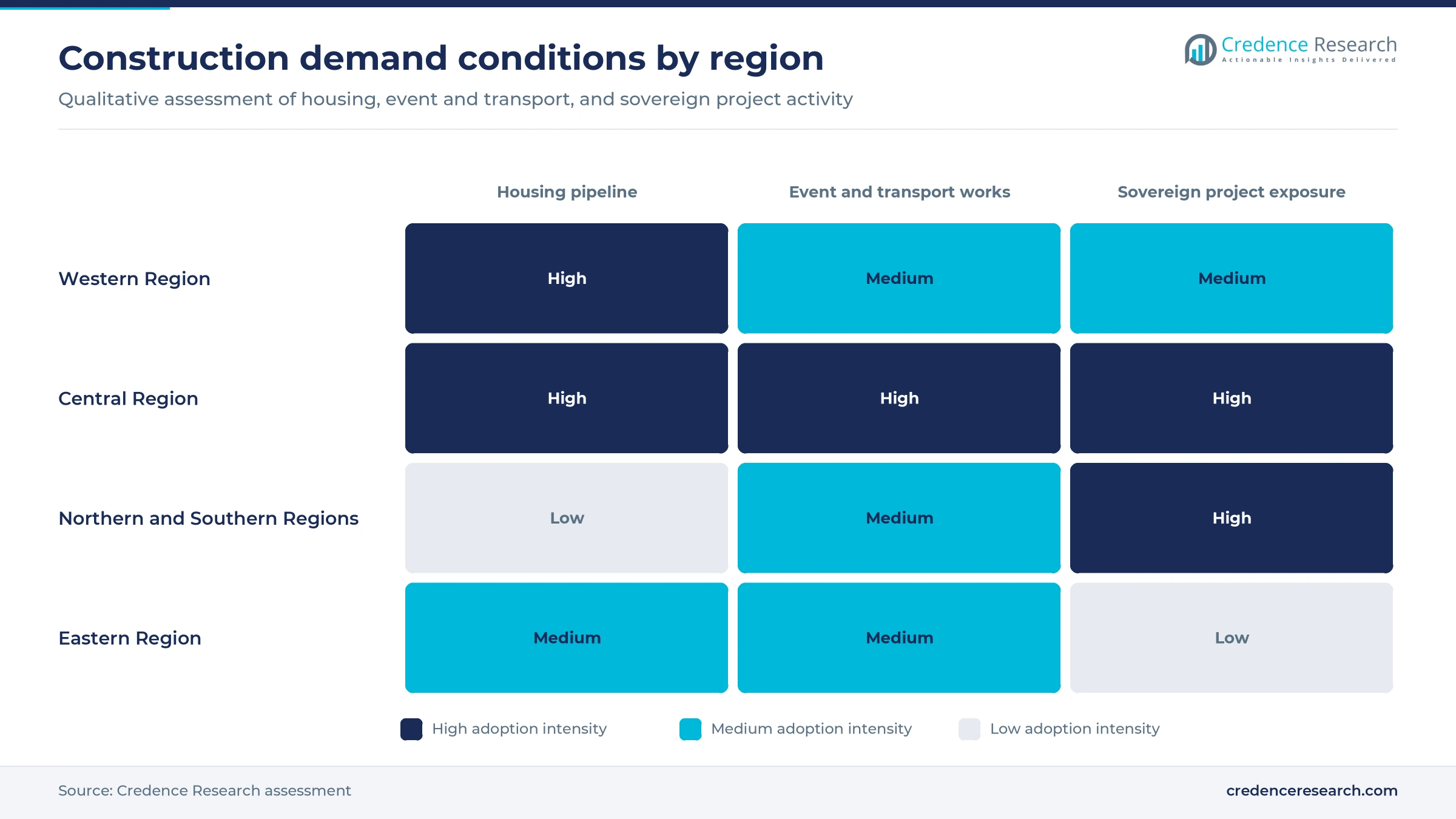
Subsidized home buying keeps residential work at the core of the market, because each new owner household needs a finished villa, townhouse or apartment. The homeownership rate reached 66.24% at the end of 2025, and Sakani and the Real Estate Development Fund passed 1.02 million subsidized contracts by the end of March 2026, according to Asharq Al-Awsat. ROSHN alone plans 400,000 residential units, and about 71% of its 2024 contracts went to domestic firms, according to Argaam in June 2025. Reforms add urgency, since the white land tax on idle urban plots can now reach 10% of value a year after Cabinet approval on April 29, 2025. Landowners now have a strong reason to build rather than wait.
Transport, utilities and event infrastructure with fixed dates
Event and network projects carry deadlines that do not move easily, which makes them the most reliable part of the pipeline. Expo 2030 Riyadh awarded Nesma & Partners the main utilities and infrastructure package for its 6 million square meter site, according to Expo 2030 Riyadh. Qiddiya awarded FCC and Nesma & Partners a SR4 billion contract for the Prince Mohammed bin Salman Stadium in October 2024, one of the venues for the 2034 World Cup. Water is moving as well, with $26.9 billion of water projects out for tender in September 2025, according to MEED. In turn, transport and logistics grows fastest by end use at 5.2% a year, supported by metro, airport and road packages in Riyadh.
Market reforms open the door to private and foreign capital
Property and ownership reforms are widening the pool of buyers and developers that commission buildings. A law allowing non-Saudis to own real estate in designated zones was published on July 25, 2025, and took effect 180 days later in January 2026, according to White & Case. Riyadh also froze residential and commercial rents for five years from Sept. 25, 2025, which shifts developer returns from rent growth toward volume and cost control. The national PPP pipeline adds about 200 projects worth roughly $190 billion across 17 sectors, according to MEED. As these channels mature, private-owned and partnership projects should outgrow work funded directly by the state.
Smaller phased awards and factory-built homes reshape work
Shift from mega-awards to smaller, phased contracts
Owners now split programs into smaller packages released in phases, which changes how contractors plan bids and resources. The Saudi Contractors Authority recorded SR4.86 billion of awards across 13 projects in August 2026, against SR9.75 billion across 11 projects in July and about SR30 billion in each of May and June, according to EnterpriseAM. Riyadh accounted for 54% of the August value, with Riyadh Holding leading by value. A consultant quoted in the same report described the change as phasing and timing rather than weakening. Mid-sized local firms gain from this pattern, since packages of SR300 million to SR1 billion fit their bonding capacity better than single multibillion awards.
Rise of factory-built housing and modular methods
Factory production is moving from pilot to capacity, driven by housing volume targets and limits on site labor. The China Harbour plant at Sedra is one example, and Hong Kong-based AluHouse plans to produce up to 30,000 prefabricated flats a year in Saudi Arabia with a local partner as early as 2027, according to the South China Morning Post. Construction employed 14.7% of all workers in the second quarter of 2026, according to DataSaudi, so offsite methods offer a way to grow output without a matching rise in site crews. Suppliers of modular building systems that localize production stand to win repeat orders from ROSHN and the National Housing Company.
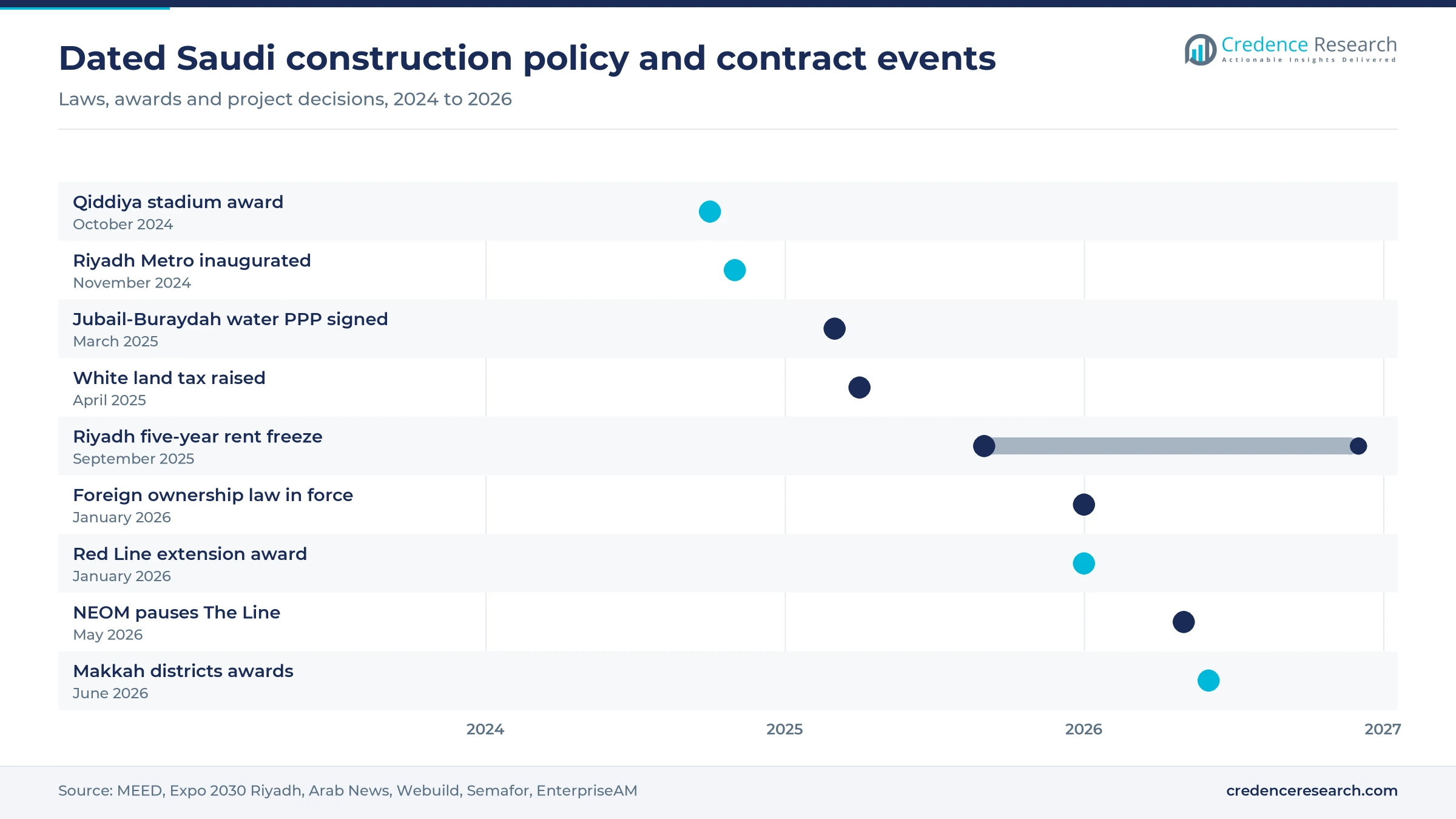
Water and highway PPPs reward contractors that bring equity
Partnership contracts create openings for contractors that can bring equity or join developer teams. The Jubail-Buraydah pipeline covers 587 kilometers and 650,000 cubic meters a day, with Nesma Company among its developers, and Mutlaq Al-Ghowairi Contracting won the engineering, procurement and construction work, according to MEED. A second transmission line from Ras Mohaisen to Baha and Mecca of about 325 kilometers, with four pumping stations, was tendered in September 2025. Highway concessions are next, with Shibh Aljazira Contracting in one of four consortia preparing Asir-Jizan highway bids in 2026. Contractors with project finance partners can lock in decades of operation and maintenance work alongside the initial build.
Green certification and digital delivery become selling points
Sustainability ratings and digital tools are turning into qualifiers on large public and sovereign tenders. The housing ministry's Mostadam program certified six projects in the first half of 2025, up 200%, and registered 38 new projects including four communities covering more than 8 million square meters, according to Arab News. Communities of that size need integrated metering and controls, which lifts demand for building automation systems. In turn, contractors that can document energy and water performance during design gain an edge as sustainable construction grows faster than conventional work. Six certified projects in half a year is still a small base, so early movers can stand out before ratings become routine on public tenders.
Fiscal strain and gigaproject cuts make awards uneven
Gigaproject cuts leave gaps in contractor order books
Some of the largest projects have been slowed or paused, which removes expected work for contractors that staffed up for them. NEOM halted further work on The Line until after 2030 and postponed Trojena investment, while Red Sea coast resorts were also pushed back, according to Semafor in May 2026. Contractors with heavy NEOM exposure face idle crews and equipment. Firms that shift capacity to Riyadh venues and holy site work recover faster than those waiting for restarts.
Fiscal pressure narrows the public spending path
Public owners face tighter budgets, which can delay awards and payments even for approved projects. The IMF projects real GDP growth of just 1.7% in 2026 and a fiscal deficit of 3.7% of GDP, after 5.8% in 2025, according to the IMF. It also urges expenditure rationalization and more selective Public Investment Fund allocations. Contractors need stronger cash positions, and owners increasingly favor projects that bring private finance.
Lumpy awards make workloads hard to plan
Award values swing sharply, so contractors cannot plan crews and equipment on a steady monthly flow. Construction awards fell 31% to $31 billion in 2025 from $45 billion in 2024, then rose to $20 billion in the first half of 2026, according to MEED. Subcontractors and suppliers of white cement, steel and facade systems feel these swings first. Framework agreements with repeat owners reduce the risk for those that can win them.
Balance-sheet strain at large local contractors
Several large local contractors have needed support after years of thin margins and delayed payments. The Ministry of Finance arranged a syndicated loan in October 2024 to settle Saudi Binladin Group's bank debts and provide new financing, according to MEED. Weak balance sheets limit how much work a firm can bond and finance at once. Owners respond by splitting packages and pairing local firms with Chinese or European partners.
The Western Region leads as Riyadh grows fastest
| Region | Value, 2025 (USD billion) | Share, 2025 | CAGR, 2026–2035 |
|---|---|---|---|
| Western Region | 32.45 | 32.0% | 4.5% |
| Central Region | 30.93 | 30.5% | 5.1% |
| Northern and Southern Regions | 22.00 | 21.7% | 3.7% |
| Eastern Region | 16.02 | 15.8% | 4.6% |
Western Region leads on holy site and coastal city work
The Western Region held 32.0% of 2025 value and grows at 4.5% a year. The Royal Commission for Makkah City and Holy Sites awarded SR13.3 billion of projects across six sites and more than 2.7 million square meters under its Developed Districts program, according to EnterpriseAM in June 2026. Saudi Binladin Group was appointed in October 2024 to complete Jeddah Tower and continues the Grand Mosque expansion. Hotel, housing and transport work in Makkah, Madinah and Jeddah keeps this region the largest.
Central Region grows fastest on Riyadh's event pipeline
The Central Region held 30.5% of 2025 value and is the fastest-growing region at 5.1% a year. Riyadh holds the largest residential stock in the country, and the city is adding the Expo site, metro extensions and King Salman International Airport. A joint venture of China Civil Engineering Construction and Mofarreh AlHarbi won enabling and substructure works for the airport's Terminal 6 in July 2026, according to MEED. Contractors with Riyadh resources and supply chains gain most from this concentration.
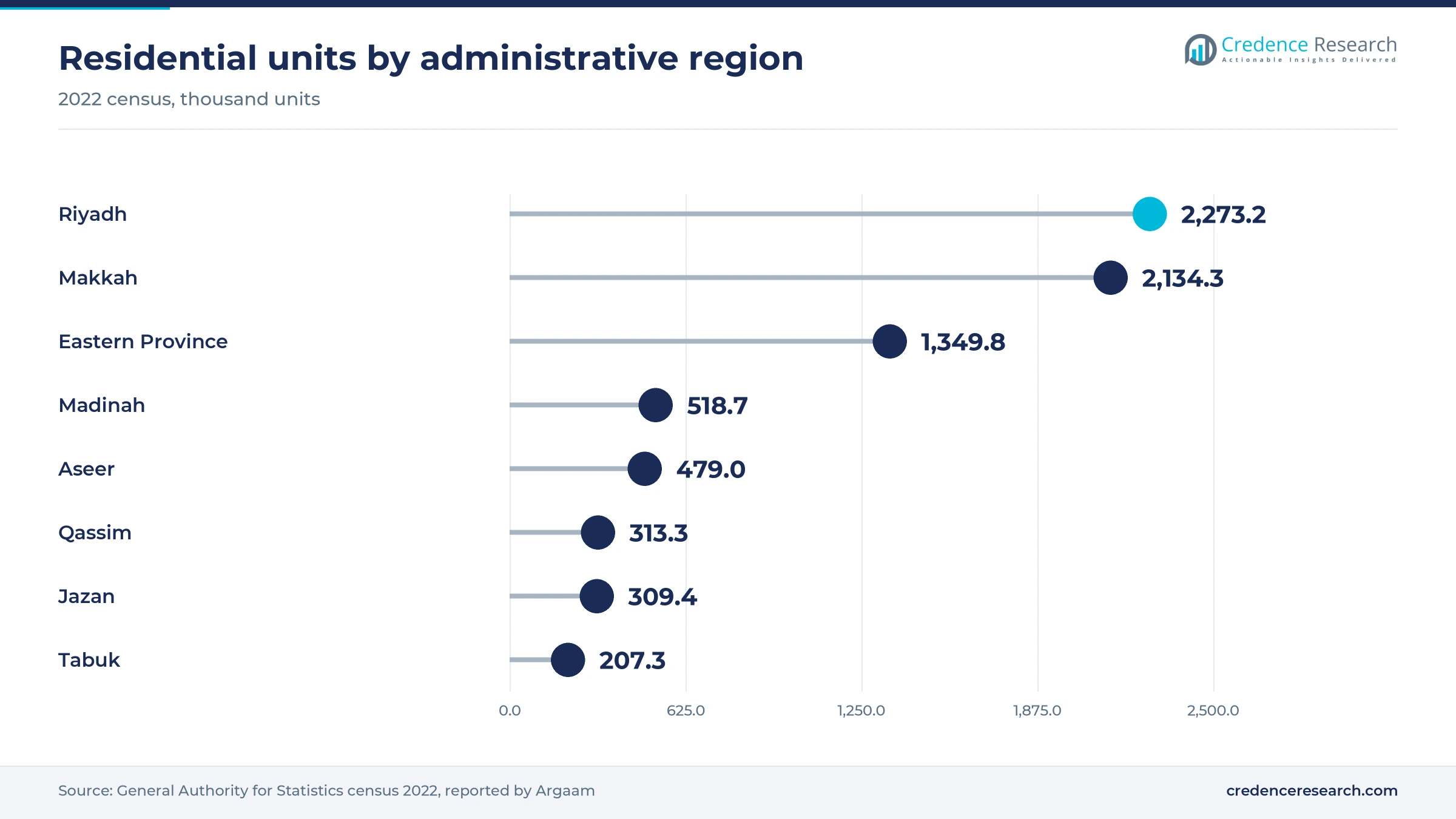
Northern and Southern Regions wait on NEOM and highway links
The Northern and Southern Regions held 21.7% of 2025 value and grow at 3.7% a year, the slowest of the four. Tabuk carries NEOM, where work on The Line is paused, although NEOM plans about $3 billion more for the Oxagon industrial city and port. In the south, the 136-kilometer Asir-Jizan highway PPP would add a large civil works package. Growth here depends on which sovereign projects restart after the review.
Eastern Region pairs industrial and digital campuses
The Eastern Region held 15.8% of 2025 value and grows at 4.6% a year. Six Eastern Province projects worth SR1.46 billion were awarded in August 2026, including a 500 MW AI data center tied to Humain, according to EnterpriseAM. Saudi Downtown Company also awarded road and infrastructure works for downtown Al-Khobar in July 2026. Industrial owners such as Aramco and its suppliers keep demand for plants, pipelines and worker housing steady in Jubail, Dammam and Al-Ahsa.
Stadium, metro, Expo and Makkah awards since 2024
| Development | Status and market relevance |
|---|---|
| In October 2024, Qiddiya awarded FCC and Nesma & Partners a SR4 billion contract for the Prince Mohammed bin Salman Stadium. | Awarded for a 2034 World Cup venue in Qiddiya. |
| In July 2025, Diriyah awarded China Harbour Engineering Company an SR5.7 billion contract for the 20,000-seat Diriyah Arena block. | Awarded within the Diriyah gigaproject in Riyadh. |
| In January 2026, the Royal Commission for Riyadh City awarded a consortium of Webuild, L&T, Nesma and Alstom an 8.4-kilometer Red Line extension. | Awarded, adding five stations. |
| In April 2026, Hassan Allam Construction and Al Bawani won a $490 million contract for the Saudi Arabia Museum of Contemporary Art in Diriyah. | Awarded, in the culture and tourism pipeline. |
| In October 2026, the Royal Commission for Riyadh City selected Saudi Pan Kingdom Company for an estimated SR2 billion of King Salman Road interchanges. | Selected, covering 6 kilometers of new roads. |
Concrete still rules, but modular and digital tools spread
- Cast-in-place concrete remains the default for towers, villas and infrastructure, because cement and aggregates are local and crews are trained for it.
- Volumetric modules are built in factories such as the China Harbour plant at Sedra and shipped as finished rooms, which shortens housing schedules.
- Building information modeling links design, quantities and site progress, and owners increasingly pair it with project management software on large programs.
- Green rating systems such as Mostadam set energy, water and materials targets during design that contractors must document at handover.
Need a Custom Version of This Report?
Tailor the scope, geography, or segments to your exact requirements.
- Custom geography or segment scope
- Direct access to our analyst team
Local champions and Chinese contractors split major work
Competition is led by large Saudi groups that win most sovereign and government work, with Chinese and European contractors joining on the largest and most technical packages. Nesma & Partners holds the largest workload and has won Expo 2030 utilities, the Qiddiya stadium with FCC and a share of the Red Line extension. Almabani built part of the Riyadh Metro Blue Line within the BACS consortium, while El Seif Engineering won a SR1 billion viewing lounge at Qiddiya Speed Park in January 2026. China State Construction and China Harbour compete on housing and venues, and Webuild brings tunneling and metro expertise. Owners weigh classification, financing strength and local content, and many large awards now go to joint ventures that pair a Saudi firm with a foreign partner. After handover, owners increasingly bundle facility management into longer contracts.
How is Saudi contracting organized and where do margins sit?
Supply is split between a small tier of large Saudi groups, a fast-growing set of Chinese state contractors and thousands of small firms. DataSaudi counted 273,874 active construction enterprises in 2024, while MEED ranks Nesma & Partners first by work under execution in Saudi Arabia, with China State Construction second and China Harbour tenth. Barriers to the top tier are Contractors Authority classification, bonding capacity and a record on sovereign projects. Margins are thin on lump-sum building work and better on design-build networks and operation contracts, where execution skill and finance count more than price.
Contractors active in Saudi Arabia
| Company | Type | Role in the market |
|---|---|---|
| Nesma & Partners | Saudi general contractor | Expo 2030 utilities, Qiddiya stadium and metro extension works |
| China State Construction Engineering Corporation | International general contractor | Housing and building projects for national and sovereign developers |
| Almabani General Contractors | Saudi infrastructure contractor | Riyadh Metro Blue Line partner and Riyadh road works |
| Shibh Al Jazira Contracting Company | Saudi civil contractor | Roads, highway PPP bids and infrastructure works |
| El Seif Engineering Contracting | Saudi building contractor | Qiddiya Speed Park viewing lounge and institutional buildings |
| Al Bawani | Saudi building contractor | Saudi Arabia Museum of Contemporary Art in Diriyah with Hassan Allam |
| Saudi Binladin Group | Saudi general contractor | Grand Mosque expansion and Jeddah Tower completion |
| China Harbour Engineering Company (CCCC) | International contractor | Diriyah Arena block and modular factory in Sedra |
| Saudi Pan Kingdom Company | Saudi infrastructure contractor | King Salman Road interchanges for the Royal Commission for Riyadh City |
| AlKifah Contracting | Saudi contractor and precast maker | Industrial and commercial buildings with in-house precast concrete |
| Webuild S.p.A. | International infrastructure contractor | Riyadh Metro Orange Line partner and Red Line extension lead |
Deadline-driven projects matter more than megacities
Credence Research's view is that deadline-driven projects, not megacities, now set the pace of the Saudi Arabia construction market. Venues, metro lines and utility networks for Expo 2030 and the 2034 World Cup cannot slip far, and subsidized housing keeps flowing regardless of oil prices. The gigaproject reset hurts contractors that sized themselves for NEOM, but it rewards those with Riyadh capacity, partnership skills and access to project finance. Buyers should expect more phased packages, firmer cost scrutiny and a growing role for factory-built housing.
Sector GDP, award and pipeline data anchor the model
The report uses 2025 as the base year and forecasts values to 2035. Market values come from the Credence Research model, checked against construction value added from official sector data and against published contract award and pipeline totals. All regional and segment splits are Credence Research estimates built on residential stock, regional awards and named project pipelines. Sources used are government and authority releases, IMF publications, company announcements and Saudi and regional business news. No interviews or surveys were conducted for this report at any stage.
Event deadlines and PPPs shape the path to 2035
Value is forecast to rise to USD 158.60 billion by 2035 at a 4.55% CAGR, with Riyadh's event, metro and airport work carrying the first half of the period and housing, water and highway concessions carrying the second. The Central Region gains share as Expo 2030 and the airport advance, while the Western Region keeps the largest base through Makkah redevelopment. Partnership and private-owned work should grow faster than state-funded work as sovereign spending becomes selective. Contractors that combine local classification, foreign technical partners and finance access are best placed.
Funding and event deadlines set the range of outcomes
The range depends mainly on how far sovereign spending is cut and how quickly private and PPP capital replaces it. Event deadlines for Expo 2030 and the 2034 World Cup protect a core of venue, metro and airport work in all three cases. Oil prices and the fiscal deficit decide whether paused gigaprojects restart after 2030 or stay small. Housing volumes act as a stabilizer because subsidized demand continues through the cycle.
| Scenario | CAGR, 2026–2035 | Value, 2035 | What has to hold |
|---|---|---|---|
| Downside | 3.0% | USD 139.26 billion | Oil revenue stays weak, payments slow and paused gigaprojects stay shelved beyond 2030 |
| Base | 4.55% | USD 158.60 billion | Event venues finish on time, housing programs continue and PPP awards grow steadily |
| Upside | 5.8% | USD 177.26 billion | Private and foreign capital scales quickly and several paused projects restart after Expo 2030 |
Frequently Asked Questions
How big is the Saudi Arabia construction market?
What growth rate is expected through 2035?
Which end-use sector leads the market?
Which ownership model grows fastest?
Which region holds the largest share?
How did contract awards change in 2025 and 2026?
What happened to NEOM construction?
Who are the main companies in this market?
Table of Content
Chapter 1 Market Segmentation
- 1.1 Segmentation Framework
- 1.1.1 Product and Service Classification
- 1.1.2 Application and End-Use Classification
- 1.1.3 Technology and Solution Classification
- 1.1.4 Customer and Distribution Channel Classification
- 1.1.5 Geographic Segmentation
- 1.1.6 Market Segment Definitions and Boundaries
- 1.2 By Project Type
- 1.2.1 Building Construction
- 1.2.2 Infrastructure Construction
- 1.2.3 Renovation and Retrofit
- 1.2.4 Industrial Construction
- 1.3 By End-Use Sector
- 1.3.1 Residential
- 1.3.2 Commercial and Tourism
- 1.3.3 Transport and Logistics
- 1.3.4 Energy and Utilities
- 1.4 By Ownership Model
- 1.4.1 Government-Owned
- 1.4.2 Sovereign-Backed
- 1.4.3 Private-Owned
- 1.4.4 Public-Private Partnership
- 1.5 By Technology
- 1.5.1 Conventional Construction
- 1.5.2 Modular and Prefabricated Construction
- 1.5.3 Digital Construction
- 1.5.4 Sustainable Construction
Chapter 2 Introduction
- 2.1 Report Objectives and Scope
- 2.2 Product Definition and Industry Terminology
- 2.3 Market Inclusions and Exclusions
- 2.4 Research Process
- 2.4.1 Primary Research and Expert Interviews
- 2.4.2 Secondary Research and Source Review
- 2.4.3 Top-Down and Bottom-Up Estimation
- 2.4.4 Data Triangulation and Verification
- 2.5 Market Size Measurement Basis
- 2.5.1 2025: USD 101.39 billion → 2035: USD 158.60 billion
- 2.6 Historical and Forecast Reference Periods
- 2.6.1 Historical Period: 2018-2025
- 2.6.2 Base Year: 2025
- 2.6.3 Forecast Period: 2025-2035
- 2.7 Research Assumptions and Limitations
Chapter 3 Executive Summary
- 3.1 Market Snapshot and Key Findings
- 3.2 Base-Year Market Size, 2025
- 3.3 Forecast Market Size, 2035
- 3.4 Revenue and Volume Growth Outlook
- 3.5 Key Demand and Supply Indicators
- 3.6 Leading Market Segments
- 3.7 Fastest-Growing Market Opportunities
- 3.8 Regional Performance Highlights
- 3.9 Technology and Industry Transformation
- 3.10 Competitive Landscape Summary
- 3.11 Analyst View and Strategic Implications
Chapter 4 Saudi Arabia Construction Market Trends and Developments
- 4.1 Historical Industry Development, 2018-2025
- 4.2 Recent Market Trends and Developments
- 4.3 Demand and Customer Behavior Trends
- 4.4 Technology and Product Innovation
- 4.5 Artificial Intelligence, Automation and Digitalization
- 4.6 Local Manufacturing and Supply Chain Realignment
- 4.7 Industry Partnerships, Mergers and Acquisitions
- 4.8 Sustainability and Circular Economy Developments
- 4.9 Government and Private Sector Investment Trends
- 4.10 Emerging Business Models and Commercialization
- 4.11 Industry Developments and Announcements
Chapter 5 Saudi Arabia Construction Market Production, Supply and Demand Analysis
- 5.1 Demand Trend and Consumption Analysis, 2018-2025
- 5.2 Demand Forecast, 2025-2035
- 5.3 Production and Output Trend, 2018-2025
- 5.4 Production and Output Forecast, 2025-2035
- 5.5 Installed Capacity and Capacity Utilization
- 5.6 Company-Wise Production Plants and Statistics
- 5.6.1 Installed Production Capacity
- 5.6.2 Actual Production
- 5.6.3 Planned Capacity and Expansion Targets
- 5.7 Supply Chain Structure and Procurement Trends
- 5.8 Supply-Demand Gap and Bottlenecks
- 5.9 Import Dependence and Sourcing Structure
- 5.10 Contract Manufacturing and Outsourcing
- 5.11 Regional Supply and Demand Concentration
Chapter 6 Saudi Arabia Construction Market Pricing Analysis
- 6.1 Pricing Structure and Measurement
- 6.2 Historical Pricing Trends, 2018-2025
- 6.3 Pricing Outlook, 2025-2035
- 6.4 Average Selling Price and Unit Economics
- 6.5 Pricing by Product and Market Segment
- 6.6 Geographic Pricing Differences
- 6.7 Key Input, Energy, Labor and Logistics Costs
- 6.8 Contract Pricing and Purchasing Models
- 6.9 Pricing Sensitivity and Competitive Positioning
- 6.10 Price, Margin and Profitability Implications
Chapter 7 Saudi Arabia Construction Market Dynamics
- 7.1 Market Growth Drivers
- 7.1.1 Demand-Side Drivers
- 7.1.2 Technology and Innovation Drivers
- 7.1.3 Infrastructure and Investment Drivers
- 7.1.4 Regulatory and Policy Drivers
- 7.2 Market Restraints
- 7.2.1 Cost and Affordability Constraints
- 7.2.2 Technology and Adoption Barriers
- 7.2.3 Supply Chain and Operational Constraints
- 7.3 Market Challenges
- 7.3.1 Competitive Pressure and Margin Erosion
- 7.3.2 Skills, Infrastructure and Implementation Gaps
- 7.4 Emerging Market Opportunities
- 7.5 Market Dynamics Impact and Time-Horizon Assessment
Chapter 8 Saudi Arabia Construction Value Chain Analysis
- 8.1 Industry Value Chain Overview
- 8.2 Upstream Suppliers and Critical Inputs
- 8.3 Technology and Component Providers
- 8.4 Manufacturing or Service Delivery
- 8.5 Distribution, Channel Partners and Integrators
- 8.6 Downstream Applications and End Users
- 8.7 Value Addition and Profit Pools
- 8.8 Vertical Integration and Outsourcing
- 8.9 Supplier Concentration and Risk
- 8.10 Supply Chain Localization and Resilience
Chapter 9 Saudi Arabia Construction Market Regulations and Policies
- 9.1 Relevant Laws, Standards and Compliance Frameworks
- 9.2 Product, Service, Safety and Quality Requirements
- 9.3 Government Policies, Incentives and Subsidies
- 9.4 Imports, Exports and Trade Barriers
- 9.5 Public Procurement and Local Content Requirements
- 9.6 Environmental and Sustainability Compliance
- 9.7 Upcoming Policy Changes and Market Implications
Chapter 10 Saudi Arabia Construction Market Hotspots and Opportunities
- 10.1 Market Opportunity Mapping and Growth Hotspots
- 10.2 High-Growth Applications and Customer Groups
- 10.3 Underserved Markets and White-Space Opportunities
- 10.4 Emerging Technology and Product Opportunities
- 10.5 New Capacity and Investment Hotspots
- 10.6 Market Entry and Expansion Opportunities
- 10.7 Distribution and Partnership Opportunities
- 10.8 Near-Term and Long-Term Commercial Potential
- 10.9 Opportunity Attractiveness and Execution Risks
Chapter 11 Saudi Arabia Construction Market Outlook, 2025-2035
- 11.1 Market Size and Analysis
- 11.1.1 Revenue (Market Measurement: 2025: USD 101.39 billion → 2035: USD 158.60 billion)
- 11.1.2 Market Volume and Quantity Sold
- 11.1.3 Historical Market Size, 2018-2025
- 11.1.4 Base-Year Market Size, 2025
- 11.2 Market Forecast, 2025-2035
- 11.2.1 Revenue Forecast to 2035
- 11.2.2 Volume Forecast to 2035
- 11.2.3 CAGR and Year-on-Year Growth
- 11.2.4 Incremental Revenue Opportunity
- 11.3 Forecast Assumptions and Scenario Analysis
- 11.3.1 Base-Case Forecast
- 11.3.2 Optimistic and Conservative Scenarios
- 11.3.3 Technology, Pricing and Policy Sensitivities
- 11.4 Market Attractiveness and Growth Outlook
Chapter 12 Saudi Arabia Construction Market Segmentation and Outlook
- 12.1 Segmentation Summary and Market Shares, 2025
- 12.2 Largest and Fastest-Growing Segments
- 12.3 By Project Type - Market Size and Forecast, 2025-2035
- 12.3.1 Segment Definition and Scope
- 12.3.2 Historical Market Size, 2018-2025
- 12.3.3 Revenue Forecast, 2025-2035
- 12.3.4 Volume Forecast, 2025-2035
- 12.3.5 Base-Year Market Share, 2025
- 12.3.6 Segment CAGR and Growth Drivers
- 12.3.7 Subsegment Market Size and Forecast
- 12.3.7.1 Building Construction
- 12.3.7.2 Infrastructure Construction
- 12.3.7.3 Renovation and Retrofit
- 12.3.7.4 Industrial Construction
- 12.3.8 Subsegment Pricing and Adoption Trends
- 12.3.9 Leading Suppliers and Competition
- 12.3.10 Regional Demand and Opportunities
- 12.4 By End-Use Sector - Market Size and Forecast, 2025-2035
- 12.4.1 Segment Definition and Scope
- 12.4.2 Historical Market Size, 2018-2025
- 12.4.3 Revenue Forecast, 2025-2035
- 12.4.4 Volume Forecast, 2025-2035
- 12.4.5 Base-Year Market Share, 2025
- 12.4.6 Segment CAGR and Growth Drivers
- 12.4.7 Subsegment Market Size and Forecast
- 12.4.7.1 Residential
- 12.4.7.2 Commercial and Tourism
- 12.4.7.3 Transport and Logistics
- 12.4.7.4 Energy and Utilities
- 12.4.8 Subsegment Pricing and Adoption Trends
- 12.4.9 Leading Suppliers and Competition
- 12.4.10 Regional Demand and Opportunities
- 12.5 By Ownership Model - Market Size and Forecast, 2025-2035
- 12.5.1 Segment Definition and Scope
- 12.5.2 Historical Market Size, 2018-2025
- 12.5.3 Revenue Forecast, 2025-2035
- 12.5.4 Volume Forecast, 2025-2035
- 12.5.5 Base-Year Market Share, 2025
- 12.5.6 Segment CAGR and Growth Drivers
- 12.5.7 Subsegment Market Size and Forecast
- 12.5.7.1 Government-Owned
- 12.5.7.2 Sovereign-Backed
- 12.5.7.3 Private-Owned
- 12.5.7.4 Public-Private Partnership
- 12.5.8 Subsegment Pricing and Adoption Trends
- 12.5.9 Leading Suppliers and Competition
- 12.5.10 Regional Demand and Opportunities
- 12.6 By Technology - Market Size and Forecast, 2025-2035
- 12.6.1 Segment Definition and Scope
- 12.6.2 Historical Market Size, 2018-2025
- 12.6.3 Revenue Forecast, 2025-2035
- 12.6.4 Volume Forecast, 2025-2035
- 12.6.5 Base-Year Market Share, 2025
- 12.6.6 Segment CAGR and Growth Drivers
- 12.6.7 Subsegment Market Size and Forecast
- 12.6.7.1 Conventional Construction
- 12.6.7.2 Modular and Prefabricated Construction
- 12.6.7.3 Digital Construction
- 12.6.7.4 Sustainable Construction
- 12.6.8 Subsegment Pricing and Adoption Trends
- 12.6.9 Leading Suppliers and Competition
- 12.6.10 Regional Demand and Opportunities
- 12.7 Segment Growth Comparison
- 12.8 Segment Attractiveness and Priority Matrix
Chapter 13 Saudi Arabia Construction End-Use and Application Market Outlook
- 13.1 End-Use Industry and Customer Demand Structure
- 13.2 Leading Applications and Customer Groups
- 13.3 End-Use Market Size, Share and Forecast
- 13.4 Major End-Use Industry Deep Dives
- 13.4.1 Customer Requirements and Use Cases
- 13.4.2 Demand and Replacement Cycles
- 13.4.3 Technical and Regulatory Considerations
- 13.4.4 Purchasing and Procurement Models
- 13.4.5 Leading Vendors and Distribution Channels
- 13.4.6 Forecast and Commercial Opportunities
- 13.5 Emerging Applications and Cross-Segment Demand
- 13.6 End-Use Industry Investment Priorities
Chapter 14 Saudi Arabia Construction Geographic Market Outlook, 2025-2035
- 14.1 Domestic Market Distribution and Demand Clusters
- 14.2 State- or Province-Wise Market Size and Forecast, 2025-2035
- 14.3 City and Metropolitan Market Outlook
- 14.4 Industrial, Manufacturing and Commercial Clusters
- 14.5 Geographic Concentration of Key End Users
- 14.6 Local Pricing and Purchasing Differences
- 14.7 Domestic Production Facilities and Capacity Map
- 14.8 Local Infrastructure and Project Pipeline
- 14.9 State-Level Policy and Incentive Differences
- 14.10 Subnational Investment Hotspots and Opportunities
- 14.11 Distribution and Logistics Networks
- 14.12 Domestic Competitive Footprint
Chapter 15 Saudi Arabia Construction Technology, Innovation and Sustainability Outlook
- 15.1 Technology Landscape and Maturity
- 15.2 Product, Process and Service Innovation
- 15.3 AI, Automation and Digital Tools in the Industry
- 15.4 Technology Adoption and Performance Benchmarking
- 15.5 Innovation Pipeline and R&D Investment
- 15.6 Patent and Intellectual Property Trends
- 15.7 Energy Efficiency and Resource Management
- 15.8 Sustainability, Recycling and Circularity
- 15.9 Technology Roadmap, 2025-2035
- 15.10 Risks of Obsolescence and Technology Substitution
Chapter 16 Saudi Arabia Construction Market Key Strategic Imperatives
- 16.1 Growth and Market Entry Priorities
- 16.2 High-Return Products and Segments
- 16.3 Pricing, Profitability and Cost Optimization
- 16.4 Technology Investment and Product Differentiation
- 16.5 Supply Chain Localization and Resilience
- 16.6 Distribution and Customer Acquisition
- 16.7 Partnership, Acquisition and Capacity Strategy
- 16.8 Regional Expansion Priorities
- 16.9 Short-, Medium- and Long-Term Actions
Chapter 17 Competition Outlook
- 17.1 Industry Competition Characteristics
- 17.2 Market Structure and Concentration
- 17.3 Market Share and Competitive Positioning, 2025
- 17.4 Company-Wise Revenue and Product Benchmarking
- 17.5 Production and Service Capacity Benchmarking
- 17.6 Technology, Pricing and Differentiation
- 17.7 Regional Footprint and Distribution Strength
- 17.8 Mergers, Acquisitions and Strategic Alliances
- 17.9 New Entrants and Competitive Threats
- 17.10 Porter's Five Forces and Industry Attractiveness
- 17.11 Competitive Outlook, 2025-2035
Chapter 18 Company Profiles
- 18.1 Company Coverage and Selection Criteria
- 18.2 Nesma & Partners
- 18.2.1 Business Description
- 18.2.2 Company Ownership and Geographic Presence
- 18.2.3 Product and Service Portfolio
- 18.2.4 Manufacturing and Operating Footprint
- 18.2.5 Production Capacity and Expansion Plans
- 18.2.6 Financial Performance and Investment
- 18.2.7 Market Share and Competitive Position
- 18.2.8 Technology and Innovation Capabilities
- 18.2.9 Strategic Alliances or Partnerships
- 18.2.10 Recent Developments
- 18.2.11 Growth Strategy and Outlook
- 18.3 China State Construction Engineering Corporation
- 18.4 Almabani General Contractors
- 18.5 Shibh Al Jazira Contracting Company
- 18.6 El Seif Engineering Contracting
- 18.7 Al Bawani
- 18.8 Saudi Binladin Group
- 18.9 China Harbour Engineering Company (CCCC)
- 18.10 Saudi Pan Kingdom Company
- 18.11 AlKifah Contracting
- 18.12 Webuild S.p.A.
- 18.13 Other Relevant Market Participants
Note: Every listed company is profiled on the structure shown under the first company. The company list is preliminary and may change based on research findings, market developments, data availability and client requirements.
Chapter 19 Disclaimer
- 19.1 Research and Forecast Disclaimer
- 19.2 Data Source and Estimation Limitations
Note: The depth of individual sections depends on data availability for this market. Volume, capacity, trade and other unit-based metrics are included where applicable.

